
To Elfland
Why do we not get bored with our habits? Why do we do the same thing over and over again and continue to do the same thing over and over again and not go shrieking off into the sunset at our inanity?
The answer—comfortable familiarity; like the ringing of the bell over the door of Augustus’s tobacco shop. I have my pipe in one coat pocket and a book in the other.
Augustus sees me and reaches for the canister of Elfish Gold. “Back already?” he says. “But I am glad you are here; you can help me with a quandary.”
“I am at your service.”
“As you know, I compulsively concoct new blends. Eventually, I need to ‘cull the herd.’ I have two similar mixes, and one of them needs to go. I hear authors talk about ‘killing their darlings.’ I am in that fix, I cannot decide, and need someone else to judge.”
After I make my purchase, we retire to his smoking room, as we always do, and pack our pipes with the first blend, Leprechaun Gold.
“What is your offering for today’s fairy-tale discussion?” he asks.
I produce my book from the coat pocket. “Melissa sold this to me last week.”
“Think you keep her and me in business,” Augustus quips.
“That may be true. It’s entitled, Lovers, Mates, and Strange Bedfellows, by James Foster. I’m not finished with it, but one of the stories has caught me, Thomas Rymer.
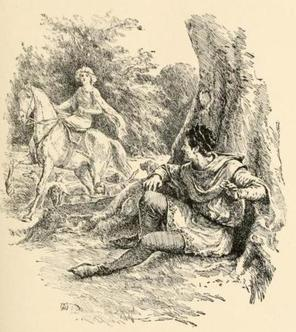
Thomas of Erceldoune reclined on the Huntly Bank near the Eildon Hills, when he spied an extraordinary woman riding toward him. He first thought she must be the Virgin Mary, given her beauty, but then he noticed her less-than-Christian attributes. She dressed as a huntress, bells upon her magnificent horse’s bridle, and three greyhounds on leashes.
They talk and come to terms. Upon a kiss, he fell under her spell, and she now appeared as a hideous hag. Because of the spell, he could not refuse her. For three days, they traveled through the underworld, emerging at last in an enchanted wood. Having not eaten anything for three days, Thomas reached for an apple—low-hanging fruit. His conductress forbade it. These were the same apples that caused the fall of man.
In the enchanted wood, were four paths. His paramour, now returned to her former beauty, explained their meaning. One path led to heaven. The second—well worn—led to hell, and the third to purgatory. They would take the fourth path to Elfland.
She warned him never to speak while in Elfland, lest he say too much. Since they are lovers, and she is the Queen of Elfland, her husband must never know about their liaison.
He shut his mouth, and all went well for seven days. He participated in much merriment. Then the queen told Thomas to prepare to return to his world. Those seven days in Elfland were seven years in his world. But worse, the next day the ‘fiend of hell’ would come for his tribute, and someone as handsome as Thomas would attract his eye.
Placing Thomas again upon the Huntly Bank, she gave him “tender leave.” She also bestowed upon him the gift—or burden—of prophecy and the inability to lie. He pleaded with her to withdraw the gift, fearing it would destroy him, making him unsuitable for the church, market, king’s court, and ladies’ bower.
Instead, it made his reputation.
After my reading, I tap the ashes from my pipe and sample the other blend, Pleiades’ Pleasure.
Fairy Tale of the Month: November 2023 Thomas the Rhymer – Part Two

Settling In
“You’ve hit upon a rather favorite topic of mine. May I see your book for a second?”
I hand it to him, the book opened to the story.
“Odd,” he says, “Thomas Rymer was a seventh century poet, critic, and historian. The Thomas in this story is Thomas The Rhymer, also a poet and a prophet of the thirteenth century, also known as True Thomas.”
“Ah,” I say, “a real person.”
“Yes. In fairy tales, if the hero has a name, then he is probably a real person, even if the adventure he never had is attached to him. If the hero does not have a name—the usual case—then the storyteller was using an archetype for the main character: the prince, the youngest son, etc. This rule does not apply to heroines, sorry to say.”
“Interesting,” I say. “So who was Thomas the Rhymer?”
“Sir Thomas was a Scottish lord, and I will guess charismatic if the folk remember him so well. He may have been the author of Sir Tristem, a version of the Tristam legend. Many a prophetic verse has been attributed to Sir Thomas, usually predicting events soon to be Scottish history but encoded in imagery hard to penetrate. Not unlike Nostradamus.
“It was Sir Walter Scott who became Sir Thomas’s publicist. In his Minstrelsy, he covered Sir Thomas’s visit to Elfland and his later return to the fairy world. How much of this is Scott’s invention is hard to say. He claims his source to be a Mrs. Brown, who heard and learned ballads about Thomas the Rhymer from an aunt.
“In any case, the story that Scott provides goes that, sometime after his first visit to Elfland, Sir Thomas is entertaining friends when someone arrives with the message that a hart and a hind are roaming about, apparently searching. Thomas immediately leaves his friends to follow the hart and hind. Since then, he has not been seen, but the expectation is that he will, one day, return.”
“Wonderful,” I say. “Not unlike Arthur going to Avalon. It also sounds like Oisín’s visit to Tir na nÓg, without the tragic consequences.”
“It,” says Agustus, “sounds more like Ogier La Danois and Morgan la Fay, complete with the hero mistaking the woman for the Virgin Mary.”
I am annoyed. “Are storytellers thieves? Do they take the adventures of one hero and graft them onto the hero they admire? Have they no conscience?”
“Oh,” says Augustus, “don’t be too hard on our illiterate storytellers—most of them were illiterate—the word ‘plagiarism’ was not in their vocabulary. All they wanted was a rollicking good story to tell to their peers.”
“I’m sure you are right,” I concede. “If I don’t hold the tales to high literary standards—and that would not be appropriate—then I should not expect them to play by literary rules. The fairy tales are a free-for-all, aren’t they? It is part of their charm.”
“Well, what do you think of Pleiades’ Pleasure compared to Leprechaun Gold?” Augustus raises an eyebrow.
“I’m not sure. Let me go another round.”
Fairy Tale of the Month: November 2023 Thomas the Rhymer – Part Three
Bad Marriage
I repack my pipe with a little bit of Leprechaun Gold, then light it, trying to savor its effect on my olfactory sense.
“Let me pose another question,” Augustus goes on. “What in your opinion is the fairy/mortal relationship all about? I don’t know of a fairy/mortal marriage tale that ends with the words, ‘And they lived happily ever after.’”
“Oh, good point,” I say, blowing a smoke ring as I contemplate. “I will guess it has to do with us mortals’ wish to hold on to the ephemeral.”
“How so?” Augustus frowns.
“The fairy queen took Thomas to a crossroads. One path led to heaven, another to hell, the third to purgatory, and the fourth to Elfland. That does put Elfland on a par with heaven, as well as the other worlds. The story suggests the path you take depends upon your guide. Mind you, Augustus, I am talking and thinking at the same time.”
“Go on,” he encourages.
“One of the differences between heaven-purgatory-hell and Elfland is that one can return from the latter, which Thomas did, only to disappear again when summoned.”
“And we now wait for Thomas as we wait for King Arthur?” Augustus suggests.
“We also wait for Jesus to return, but we sinners would be less happy about that than the return of Thomas or Arthur, but you are straying from my point, if I have one.”
I blow another smoke ring, then repack my pipe with the other tobacco. “How we think of a marriage between a mortal and an immortal is best represented in Oisín’s visit to Tir na nÓg. He spends three years with Niamh of the Golden Hair, but then desires to visit his family. He is warned not to dismount from his horse, not to touch the earth, or he will never return.
“When back home, he finds three centuries have passed, not three years. When the girth of his saddle breaks, he falls to the ground, turning into an ancient being.”
I blow another smoke ring as the implication of what I am saying occurs to me. “Time in Elfland moves faster than in our world. They are immortals; time has no value to them. Nothing for them should be ephemeral. Not until they touch our world can they experience it.
“For us mortals, time is precious. We hang on to it, not wanting it to slip away too quickly. You know I was married once. That has slipped away from me with her passing. Thalia’s childhood has slipped away as well. Time is the villain of us mortals. Time makes our world ephemeral.
“When Oisín enters Tir na nÓg, he escapes time and, for a while, is timeless. But being mortal by origin, he is drawn back to the physical world to meet his demise. I think it best if Thomas, Arthur, and Jesus stay where they are.”
“I must agree with your assessment of our world as ephemeral,” Agustus reflects. “I always think of tobacco as ephemeral, here today and the next day turned to ash. And what do you conclude between the two blends?”
“Oh,” I say, “I been talking so much I didn’t truly take notice, but I’ll go with Leprechaun Gold. The leprechauns are close to the fairies, so I choose that blend in honor of Thomas the Rhymer.”
Your thoughts?
 Fairy Tale of the Month