Fairy Tale of the Month: December 2025 The Quern at the Bottom of the Sea – Part One

Erik Theodor Werenskiold

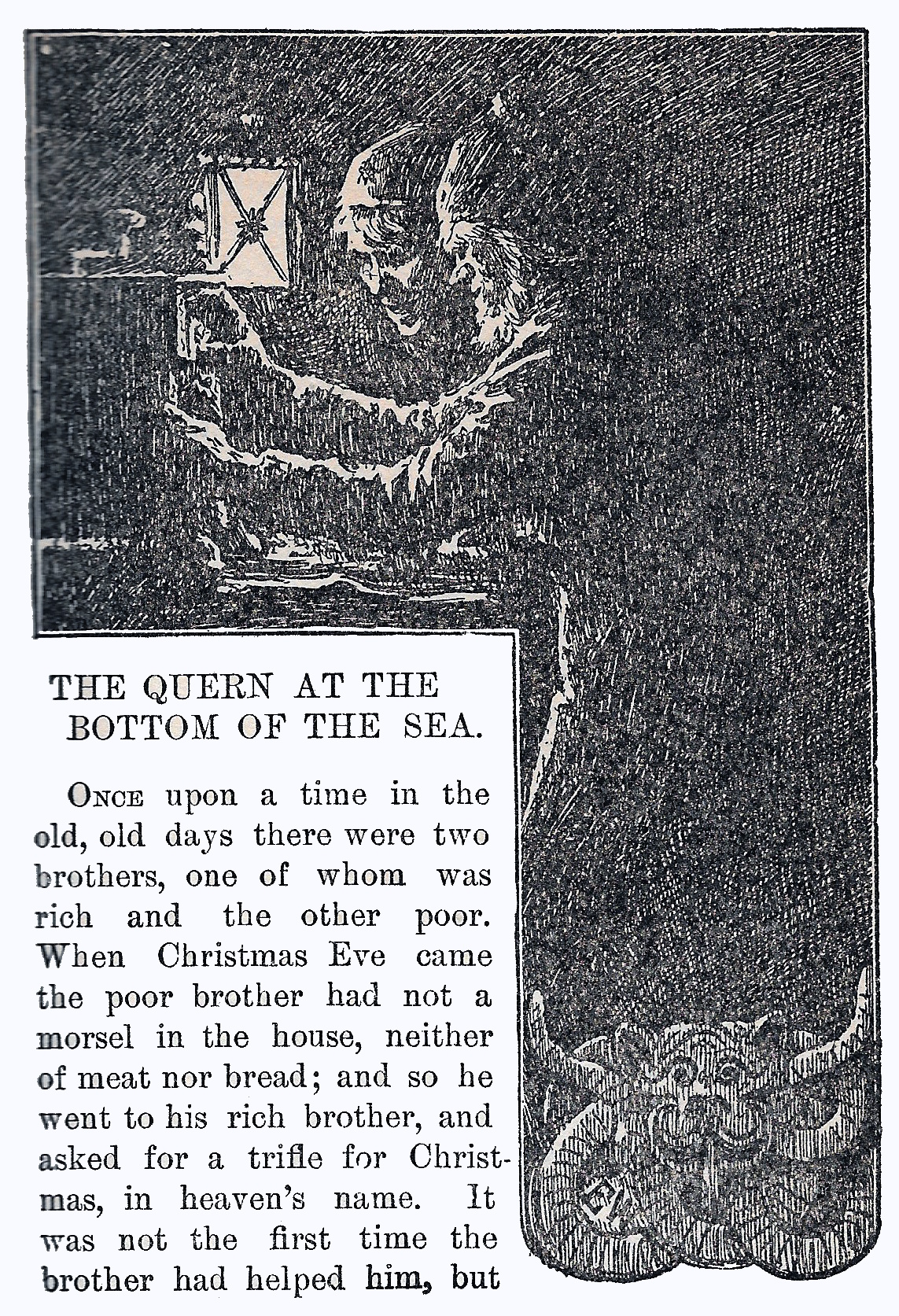
The Quern

The bell above Augustus’s tobacco-shop door announced my arrival. He looks up from his newspaper as he stands behind the counter.

“What will it be? Leprechaun Gold, Old Rinkrank?”

“No, I haven’t had Black Dwarf for some time. I will take two ounces of that.”

“Black Dwarf was the first of my blends you bought, you know. But see here, I’ll not sell it to you until you tell me a story.” Augustus smiled.

“Well, don’t I always? Actually, the girls have decided that on Christmas Eve, after the holiday lasagna at Melissa’s, we all must choose a story to read.”

“Ah, that sounds like the start of a fine tradition. What story will you choose?”

“One I found in Fairy Tales From the Far North.”

P. C. Asbjornsen,” Augustus fills in.

“Quite. It’s called Quern at the Bottom of the Sea.”

There were two brothers, one rich and one poor. The poor brother came begging on Christmas Eve for food for his family. Ungraciously, the rich brother threw him a ham, saying, “There it is; now go to the devil.”

Hearing this, the poor man went off to find the devil. And he did.

Outside of the devil’s house was an old, bearded man chopping wood, who informed the poor man that the devil was in want of a ham, but the poor man must trade for it and get the quern, the hand mill, stored behind the door.

The devil was reluctant to trade, but eventually he did. The old man explained that the quern would grind out anything he wanted and instructed him on how to stop the quern.

Before midnight of Christmas Eve, the poor man returned home to have the quern produce a feast for his family, complete with a tablecloth and candles. On the third day, he invited all of his friends to feast as well.

The rich brother, jealous of his brother’s good fortune and knowing his brother had nothing to eat a few days before, demanded an explanation. After a bit too much drinking, the poor brother let slip his secret.

The rich brother now demanded that the poor one sell the quern to him. The purchase was put off until harvest, giving the poor brother time to put by all the stores of things he would ever need. When he handed the quern over, he purposely did not tell his brother how to turn it off once started.

The new owner of the quern asked for broth and herrings for breakfast. Dutifully, the quern produced it in abundance. His kitchen soon filled with broth and herrings, and he, shortly, was flushed out of his house on a wave.

If the whole parish was not to be drowned, he needed to go back to the poor brother and beg him to take back the quern. This the poor man did for an additional amount of wealth.

With the quern back in his possession, the now-not-so-poor brother put it to better use. He bought a large farm and went so far as to plate the house with gold. That attracted much attention. He was eventually visited by a skipper/merchant who offered him a great sum for the quern. It was sold to him, but again, without much instruction. 

The merchant traded in salt. Instead of travelling to distant lands to buy salt, he simply carried the quern onto his ship and had it grind out salt. Salt soon filled the hull of the ship and every square inch of it until the ship sank.

The quern now sits at the bottom of the sea, churning. That is why the sea is salty.

Augustus nodded his head knowingly.

Part Two
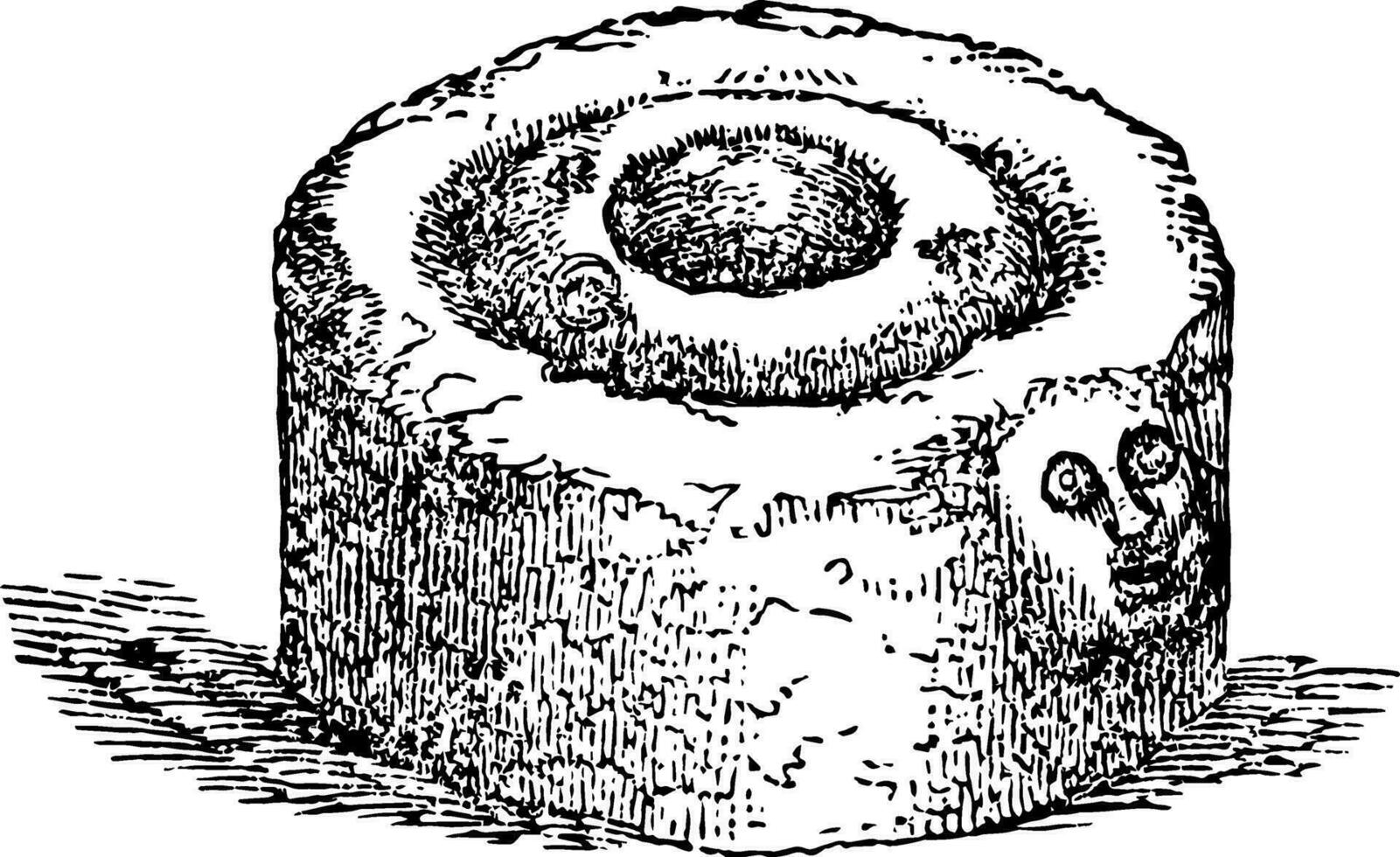
Vintage Illustration

Pourquoi Tale

“A pourquoi tale,” says Augustus. “I didn’t see it coming. But wait, it is ringing a bell in my head.”

Augustus darts upstairs to his library. He is no sooner out of sight than the bell over his door rings. I explain to the customer that Augustus will be back shortly, but might I help him? Well, I know Augustus’s stock pretty well.

I talk him into trying out Elfish Gold, one of my favorites. I am weighing out two ounces when Augustus returns, raising an eyebrow at his new assistant. After the transaction is complete and the customer is gone, we settle in chairs behind the counter.

In his hand is a copy of the Prose Edda, which is at least in part by Snorri Sturluson. “I will guess the origin of your tale is the piece called The Song of Grόtti.

“King Frόŏi bought two enslaved giantesses, Fenja and Menja, and chained them to his magical mill, Grόtti. The king had them grind out gold, peace, and happiness, augmented by their singing.  He gave Fenja and Menja no rest, and in revenge, they sang a different song and ground out an army led by a sea-king named Mysing, who defeated King Frόŏi and seized Grόtti and its two slaves.

“Mysing was no better a master, but now they were on a ship grinding out salt. When the ship sank, Grόtti ended up at the bottom of the sea, run by a whirlpool.”

I fill my pipe with some Fairy’s Favorite that Augustus offers me.

“Hmmm,” I say, “no devil, no brothers, yet obviously the two tales are related.”

“Yes.” Augustus lights his pipe. “The Prose Edda was compiled in the thirteenth century, hundreds of years after Christianity had established itself in the North, but the tales are certainly from pagan times. There is no Christian gloss upon them.”

“You suggest,” I say, “that The Song of Grόtti pre-dates my tale?”

“I’ll wager my meerschaum on it!” he replies, holding up his favorite pipe.

“I won’t challenge you,” I easily concede. “But let me ask, are all fairy tales derivative? Do fairy tales always borrow—no, I’ll say steal—their themes and ideas from myth and legend? I want to say ‘no.’ I’ve always argued that myths, legends, and fairy tales—if inspired by something historical, like King Arthur—really draw from the collective unconscious, our dreams, our group wish/ideal for their content.”

Augustus puffs hard on his pipe, considering the thought. “I must come down on the theft notion. The myths and legends were, I suspect, developed by the bards, or their like: skilled, educated, trained individuals.

“Fairy tales are of the illiterate lower class, told in taverns or around the home hearth to equally uneducated listeners, not people of the court whom the bards entertained.”

“The French court was interested in fairy tales,” I defend.

“Well, of course, Charles Perrault, Madame d’Aulnoy, Henriette-Julie de Murat, but that was an affectation, a fad; it does nothing for your position on fairy-tale origins.”

I really hate it, at times, when he is so much smarter than I am.

Part Three
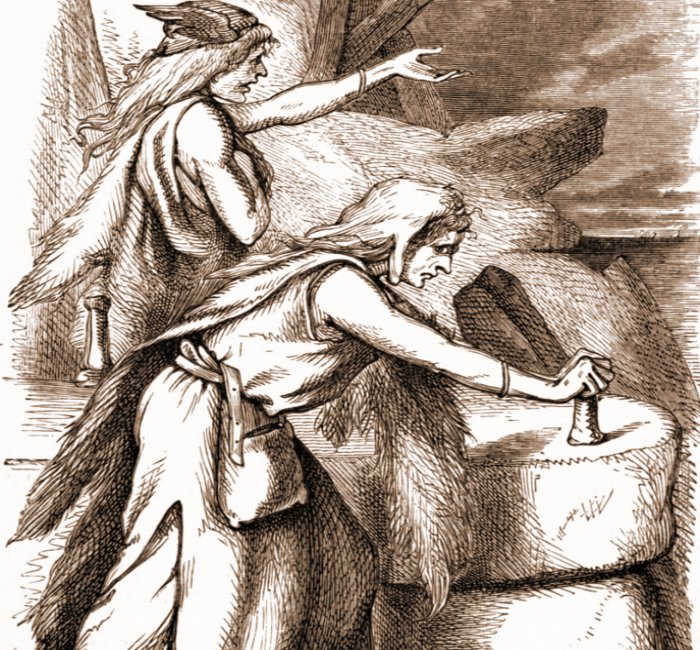
Menia (Menja) and Fenia (Fenja) by W. J. Wiegand, (fl. 1869–1882)

Purposefully Vague

I do love Melissa’s Christmas lasagna. Paired with garlic toast, it’s a wonderful winter’s repast.

Sated, we now sit in her drawing room—as she likes to call it—Melissa and I with glasses of merlot and the girls with their Cadbury hot chocolate. We have finished reading our stories to each other. Following the tradition of Victorian Christmas “ghost” stories, Melissa favored us with The Cat on the Dovrefjell, Thalia with Gabriel Rider, and Jini with her favorite part of Dickens’ A Christmas Carol,it being the visit of the third spirit, the Ghost of Christmas Yet to Come. Mine had the least to do with Christmas, but they all got to roll their eyes at the ending.

“Wait a minute,” Thalia critiques, “if the devil wanted a ham, why didn’t he ask the quern for one, or a few for that matter?”

I wag my finger at her. “Haven’t I raised and taught you not to apply logic to fairy tales?”

Another rolling of the eyes with a giggle from Jini in the background. “Yes, but this one is a little too much from the start. And why did neither of the brothers ask for gold from the start?”

“Ugh, and herrings for breakfast!” Jini wrinkles her nose.

“Well, they were Norwegians,” I say, my attention drawn to a plate of shortcakes on an occasional table.

Perhaps,” Melissa suggests, “Norwegians think of their stomach before considering other things. However, what I liked in the story was the poor brother’s development. He is presented to us as a simpleton. When his brother tells him to go to the devil, he takes the words at face value, and with the luck of a fool, he finds the devil.

“Later, when the rich brother strong-arms him into selling the quern, the poor brother does not tell the other all that he needs to know. Further into the story, when he resells the quern to the merchants, he obviously anticipates his doubling of profit once more. Things did not happen that way, and now we have a salty sea, but it shows he was thinking.”

“Huh,” I say, “interesting. For me, I thought his character was being inconsistent. He is at first poor and stupid, then, suddenly, clever and rich. I didn’t see a progression.” I nibble another shortcake.

Melissa sips her wine, considering. “The fairy tales are, perhaps purposefully, vague. That might be one of their strengths and not a fault. You see the main character as being inconsistent, and I see him as coming into his own. You and I—and everyone else, present company included—project our notions onto the tales. What I see in the story is not what you see. We are interpreting, just like we interpret our dreams. I am not sure any other genré allows us that much latitude.”

“Wow, I didn’t get any of that.” Jini is looking a little wide-eyed. “I got Thalia’s point after she said it, but I never would have thought of it. I guess I don’t want to analyze the tales. I just want to hear them and let them wash over me. They make me feel happy and sad. I think that is all I want them to do.”

That’s simple enough.

Your thoughts?
Fairy Tale of the Month: November 2025 The Feather of Finist, The Bright Falcon – Part One

Ivan Bilibin

From Russia

Thalia has wished me a good night and gone off to bed. Tomorrow is another school day. She’ll be up bright and early while I linger in bed. I enjoy a late-night read.

At random, I have picked Afanasev’s Russian Fairy Tales off the shelf and am settling into my comfy chair. I turn to a tale with the intriguing title, The Feather of Finist, The
Bright Falcon.

I read, “Once there lived. . . Once there lived. . . Once there lived. . .” My eyes will not move beyond the opening words. I am no longer in my comfy chair. Rather, a seat of red velvet.  I am in the front row of an Art Deco theatre, either newly renovated or, in fact, new. I startle to see Melissa sitting next to me in her nightclothes with an identical copy of the book in her lap that is in mine.

She frowns at me. “Is this your fault? I was about to go to bed.”

“So was I,” I lie a little.

Our attention is drawn to the stage as a spotlight shines on a man dressed in the traditional Russian kosovorotka, who says to us, “Once there lived. . .” and proceeds to tell us the tale of Finist.

“A man who has three daughters is in the habit of bringing them gifts when he returns from a journey to town. But all that his youngest daughter asks for is a feather of Finist the Bright Falcon. Whether by fate or by fortune, the father comes across an old man carrying a little box, inside of which is a feather of Finist.

“In her bedroom, the youngest opens the box, and the feather transforms into a handsome prince. She seeks to hide him by releasing him to fly about all day as a falcon and come to her at night. The sisters discover the ruse and put knives and needles at her window.

“The falcon is injured and flees, telling the girl, in a dream, that if she wishes to find him, she must wear out three pairs of iron shoes, break three iron staffs, and gnaw away three stone wafers in her search for him.”

Although I have not looked away, the man has transformed into a young maid wearing a sarafan.

When did that happen?

“In the morning, she sees the blood on the windowsill and starts off to seek her beloved.

After wearing out the first set of iron shoes, breaking an iron staff, and gnawing away a stone wafer, she comes across the hut of an old woman who proves to be a witch but aids the heroine. She gives the girl a silver spinning wheel and a golden spindle that spins flax into gold thread. Also, a ball to follow to the witch’s sister’s house.

“After wearing away the second pair of iron shoes, staff, and stone wafer, she comes to the second witch’s house, where she gets a silver plate and a golden egg, which, when rolled around on the plate, hatches more gold eggs.”

I now see the young maid has become a hag with a large mortar and pestle, as well as a broom, beside her.

“When the third set of iron and stone is worn away, the ball rolls to the third witch’s hut. There, the girl gets a golden embroidery frame and a magical needle that embroiders by itself. The witch also explains that Finist is now married to a wafer baker’s daughter, and that the girl needs to become a servant in the household if she wishes to win her beloved back again.

“She finds that Finist is still in bird form by day and a man by night and does not recognize her. “

I now see a being on stage that is half man and half bird.

“The girl sells the three gifts from the witches for three nights with the husband, but each time the wife drugs him. It is not until the third night that a tear falls on his cheek and awakens him.

“They flee and return to the girl’s home, where, again, she tries to keep him hidden in his feather form. Nonetheless, they attend church disguised as a prince and princess until, this time, the father discovers their trick. The couple is immediately married with a grand wedding.”

The spotlight goes out, and we are in the dark.

Part Two

Ivan Bilibin

Maybe Russian

As my eyes adjust, I find myself back in my study. However, Melissa is still with me, sitting in the other comfy chair.

“Oh, what am I doing here!” Melissa is scandalized. Her nightgown is rather sheer. I wander off to find a blanket, pillow, bottle of Cabernet Sauvignon, and two glasses. I assume she will spend the night here. The couch in my study is large and comfortable.

I strike up a fire in the hearth to warm the room as Melissa settles on the couch, modestly covered by the blanket, and cradles her glass of wine.

“I am sure,” she says, “we chanced to be reading the same story, the sort of thing you and I tend to do, and the story took over.”

“And, I am sure,” I say, “the story expects us to talk about it.”

“I,” says she, “will honor the request, although it has inconvenienced me.”

We both smile.

“My first thought,” Melissa sips her wine, “turns towards Beauty and the Beast, as well as East of the Sun and West of the Moon. However, there is no ‘beast’ involved in our tale, although Finist is still an animal husband. There are three sisters in these three examples, who do the youngest no favors. What I am saying is that the youngest sister commands Finist rather than being abducted by him, at least until she loses him.

“There is no pleading to visit her family, as in the other variants. Rather, she dons the iron shoes and tramps off to reclaim her beloved.”

“That,” I say, “is where my mind turns to A Sprig of Rosemary. The heroine loses her husband and travels to the sun, moon, and wind, who give her the gifts needed, which she sells to the bride for three nights with the groom before she can awaken him.”

“Except,” Melissa takes another sip, “it is the three Baba Yagas that hand out the gifts.”

“Wait!” I tap my glass. “Isn’t there only one Baba Yaga, who rides around in a mortar and pestle with a broom, owning a house that walks around on chicken legs?”

Melissa wags her head. “Not really. Not for Russians. For example, a babushka is a scarf that every grandmother wears. Every grandmother becomes a babushka. Babushka means ‘grandmother.’”

“So, every witch is a Baba Yaga,” I come to understand.

“At least in Russia.”

The Daughter of the Earl of Mars pops into my head as well,” I observe. “In that tale, the male lover is a bird as well. It flees when the king threatens to wring its neck but returns with a flock of birds to defeat him.”

Melissa nods. “Not to mention Cinderella,where she goes to the ball—or in some versions the church—three times in disguise.”

I stoke our fire a bit more. “I can’t call this tale a variant of another story. It appears to be made up from pieces of other tales and yet does not feel pieced together.”

“Or,” Melissa contemplates, “is it the original, and have other tales borrowed from it?”

“Or,” I complicate the matter, “is there another original that all of these are drawing from?”
“I don’t know the answer,” she says, “but I know where the answer is.”

I look at her curiously.

“Lost in the mist of time,” she responds.

I must agree.

Part Three

Ivan Bilibin

Maybe Not

Melissa rubs her finger around the rim of her glass, causing it to ring. “I know I harp on feminism when it appears or doesn’t appear in the tales—I hope I don’t bore you with it—but there is another underlying theme in this one.”

“Which is?” I inquire.

“I will call it Christianity being questioned.”

“Oh, that comes up in the Grimm stories as well,” I say. “In fact, as time wore on, Wilhelm edited out some of the less-than-Christian elements and introduced angels into the tales.”

“Yes,” Melissa hesitates. “The brothers were Calvinist, but that has little to do with my thinking.”

“And your thoughts are?” I sip my wine.

Melissa takes a deep breath. I am obsessing over the wafers.”

“The wafers?”

“Yes.” She gives me an apologetic smile. “Allow me to get deep into the weeds.

“First of all, wafers are unleavened bread. Unleavened bread is used for the Eucharist. That the heroine gnaws on a stone wafer as part of her ordeal, and the woman who stole her lover was the daughter of the wafer baker, suggests some sort of parallel between the two.”

“And what might that be?” She is onto something.

Melissa sets her wine glass aside and thinks out loud.

“I don’t need to tell you that we are not dealing with logical events. She cannot wear down three sets of iron shoes in a lifetime. Nor will she break three iron staffs. Gnawing on three stone wafers? Three sets of iron teeth are not part of the deal.

“These challenges are symbolic, of course. The shoes and staffs demonstrate the physicality of her effort and imply the lengths to which she is willing to go.

“The stone wafers are a different matter. Was she sustaining herself on the unsustainable? Was that meant to be as difficult as wearing out iron shoes? Does she move beyond the impossible? Or is there another implication?”

“Such as?” I goad her on.

“Does the story ask us if the Eucharist should not be an ordeal and not simply a wafer that dissolves easily in the mouth?  This brings to my mind the Flagellants.’

“The who?”

“The Flagellants, monks who wandered around during the Plague Years, whipping themselves—sinners that they were—praying aloud all in the spirit of penitence. Their religion was not a convenience for them. Gnawing on store wafers was not a convenience either for our heroine, but rather a show of devotion. 

“In both cases, whether determination or devotion, we are left to compare the rigors of the heroine consuming stone wafers to the easy life of the wafer baker’s daughter.”

“I think,” I say, “that is an intriguing argument.”

Unexpectedly, Melissa scowls to herself. “Except that I’m wrong. I know a little about the Russian Orthodox, who would be the majority of Christians in Russia at the time, and they used leavened bread in their communion, unlike most other Christian churches. My argument about this Russian story’s relationship to the Eucharist falls apart. Oh well, another harebrained idea discredited.”

We fall silent for a bit.

“Ah!” I say, proud of my revelation. “There was a substantial number of Jews in parts of Russia. The Passover feast demanded the bread be unleavened. Could this be a Jewish tale, making its reference to the Passover bread instead of the Eucharist?”

Melissa is asleep, her wine half drunk, its glass sitting on the table beside the couch. What will Thalia think when she sees this in the morning?

Your thoughts?

Writer’s Journey : November 2025

This month, I promised to write about my critique group, known to ourselves as Tres Amigos, although neither Chris, Dan, nor I have Spanish descendants.  Boiled down from a larger group that met at a community college, the three of us have met monthly at each other’s homes since 2015. After a decade, we have gotten to know each other’s work pretty well.

I have written about this critique group before (Writer’s Journey, April 2025) and will not bore you with the details again. You may want to refer back to it, if only for the Gado Gado recipe, which is included.

I will be very specific by giving an example. The storyline might be a little hard to follow since it is being taken out of context. Below is a piece of the story I submitted to Dan and Chris.

Before the sun set on the day, the twin approached the Black Castle. He saw his brother’s horse—riderless—grazing. He left his horse to graze with his brother’s and made for the castle on foot. He blew his horn, the sound of which echoed, then he lowered his visor. The grated window soon slid open, then closed, and the gate creaked open.

“I am the Lady Berberisca,” said the witch. “Whom do I have the honor of addressing?”

Now the twin raised his visor. Upon seeing the face of the knight she had just murdered, she turned to flee, but his sword pierced her back before she took another step.

“What have you done with my brother, cruel hag?” he demanded.

“Brother… Restore me, and I will show you.”

“Restore you?” He laughed bitterly. “How might I do that?”

“Easily, with flowers from the plants Everlasting and Dragon’s Blood in my garden, boiled in a cauldron.”

Dan suggested the word “foraging” instead of the word “grazing” since the word “graze” appears in the next sentence. (Yes, that is how granular we get, and why it takes us an hour to cover ten pages.) Nonetheless, I am going to stay with “grazing.” It is the right word. Horses do not forage. I could have substituted “munching grass,” but that sounds a little silly to me.

Chris caught me on the witch introducing herself. It was out of character and totally unlike her introduction to his brother earlier in the story. Both Chris and Dan were thrown off by the line, “Brother… Restore me, and I will show you.” They took it that she was addressing him as “brother.” My intent was that she suddenly recognized that he was the brother of the knight she had just murdered. When both your critique partners don’t get it, you need to fix it.

They both agreed I needed another beat in the paragraph describing the knight stabbing the witch. Also, I had not given quite enough detail about the operation of the magic healing potion.

Below is my rewrite following their suggestions.

Before the sun set on the day, the twin approached the Black Castle. He saw his brother’s steed—riderless—grazing. He left his own horse to graze with his brother’s and made for the castle on foot. He blew his horn, the sound of which echoed, then he lowered his visor. The grated window soon slid open.

“Another pesky knight? Why does your kind keep bothering an old woman?”

The window closed, and the gate creaked open.

“Whom do I have the honor of addressing?” Her voice held sarcasm.

Now the twin raised his visor. Upon seeing the face of the knight she had just murdered, she screamed, “No, you’re dead!” and turned to flee, but his sword pierced her back before she took another step.

“What have you done with my brother, cruel hag?” he demanded.

“Brother? I see,” she groaned. “Restore me, and I will show you.”

“Restore you?” He laughed bitterly. “How might I do that?”

“Easily, with the purple flowers from the plants Everlasting and Dragon’s Blood in my garden. Boil them in a cauldron. When the water cools, lower me into the potion.”

I hope this illustrates why I think you should be in a critique group. It is too easy to be blind to missteps in your writing.  Of course, it needs to be a group you feel you can trust. A decade of working together will do.

Fairy Tale of the Month: October 2025 Punchkin – Part One

Photo by Amila Tennakoon

Jini’s Diwali

It is the fourth day of Diwali, and Jini and Thalia have brought the festival into my study. Melissa is here as well to join in the Celebration of Lights.

Thalia stayed with Jini’s family on the third day of Diwali, which is the most important of the five. Thalia showed me videos on her phone of the complicated, ceremonial dancing in Trafalgar Square, the Lakshmi Puja—the prayers to the goddess Lakshmi—and the evening fireworks.

The girls showed up here early in the morning and have taken over the kitchen once again. I managed some tea and a scone. I didn’t mind, and I am saving my appetite for this evening’s feast. I know potato samosas are part of it.

Jini has placed small lamps all around the perimeter of the room: on shelves, tables, and windowsills. We are surrounded by the light of these little lamps, rather like votive candles. Jini sits in the largest comfy chair, holding a copy of Joseph Jacobs’ Indian Fairy Tales, with Johannes on her lap, and the fairy on her shoulder—they adore her—and she begins to read aloud to us.

Punchkin.”

A raja had seven daughters, but when their mother died, a widow, through trickery and clever words, worked her way into the raja’s good graces and became the ranee. Wishing to promote her own daughter, she schemed against the seven sisters.

First, she tried to starve them to death, but they prayed at their mother’s tomb for help. From the grave grew a pomelo tree, and the girls ate the pomelos until the ranee had it cut down. Then the grave produced creamy white cakes until the ranee had the tomb torn down.

The ranee pretended an illness that only the blood of the seven sisters could cure. The raja, not wanting to kill his daughters, left them in the jungle and killed a deer for its blood. The seven sisters were found by the seven sons of another raja who were out hunting. The seven were soon married, the oldest to the oldest and the youngest to the youngest.

After a year, the youngest sister, Balna, had a son and was the only one among her sisters to ever have a child. As he was the only child in the family, all adored him. One day, Balna’s husband went out hunting and did not return. His six brothers searched for him, but they too did not return. Soon, a magician named Punchkin stole Balna away, leaving her son to be raised by his widowed aunts.

When the boy reached the age of fourteen, the aunts told him of his history, and he decided to go search for his parents and uncles. He eventually came to a land of rocks, stones, and trees, where stood a large palace with a high tower. Nearby, the youth found the house of the palace’s gardener, and the wife gave him shelter.

From her, he learned that the palace was the home of the magician Punchkin, and the stones and trees around them were people transformed by the magician. She described events that led him to know his father and uncles were among these stones, but that his mother was held captive in the tower until she agreed to marry Punchkin.

Disguised as the gardener’s daughter, he lingered around the palace grounds until Punchkin, thinking him a girl, sent him to deliver flowers to the beautiful lady who lived in the tower. With a golden ring that Balna had given to him, he identified himself to her.

They contrived to have Balna appear to soften her manner to the wizard and appear to consider marriage. She found out that his life was secured in a little green parrot, in a jungle hundreds of thousands of miles away, guarded by a thousand genies.

With the help of eagles that he saved from a serpent, the youth was flown to the distant land, flew over the guard of genies, and captured the green parrot.

On pain of death, the youth convinced Punchkin to restore all the people he had turned to stone and trees before, nonetheless, he ripped the parrot to pieces, ending the life of the magician.

With a smile, Jini snapped the book closed. “And that was the end of that evil.”

Part Two

Photo by P Jeganathan

Diwali Feast

“An appropriate story,” Melissa says. “Good triumphs over evil, one of the themes of Diwali.”

Jini nods in agreement. “As is light over darkness and the hope for prosperity.”

I see Thalia scurry out of the room.

“Here in the west,” I say, “we don’t have five-day holidays. I think that is kind of brilliant.”

Jini smiles with a bit of condescension. “Not so fast. The first day of Diwali is spent cleaning.” She grimaces. “The idea is the goddess Lakshmi might visit, and things had better be clean.

“The second day is spent shopping and preparing for the third day. The third is the best. The fourth and fifth are for visiting friends and family.” She waves her hand to include us.

Thalia returns, balancing plates of food on her hands and arms. We quickly clear stacks of books from one of the tables upon which we intend to dine.

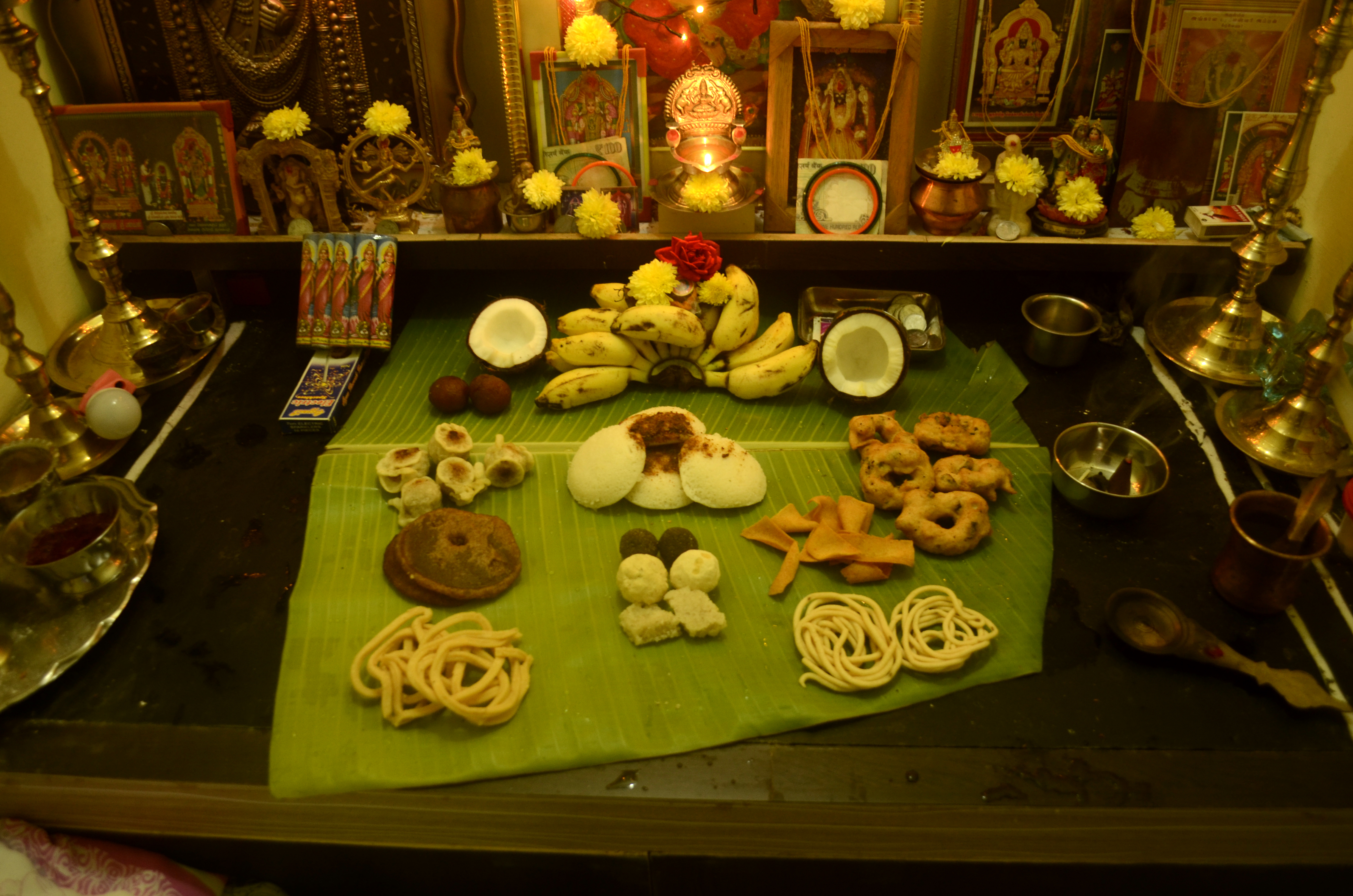
The girls have gone all out. There are the potato samosas I crave, but also pakoras (might be the best thing to do with cauliflower), srichand and pooris (fried dough and yogurt), jalebis (curly, spicy, fried dough), gajar ka halwa (think carrot pudding), and slices of paneer (non-rennet cheese), along with mango lassi to drink and shortbread cookies (made with pistachio, cardamom, and saffron). What a spread!  I notice the fairy, though she lives by the air, sampling the cookies.

Melissa admires the intricate henna tattoos on the backs of the hands and forearms of both Jini and Thalia.

“Oh, my aunt is so good at this,” Jini says. “She did this for us.”

“How is it done?” Melissa wants to know.

“Henna is a paste that she puts on our skin with a cone, kind of like a pastry bag decorating a cake. When it dries, you rub it off, and the pattern is light orange, but hour by hour it gets darker.”

I see that the tattoos are a deep red.

“By tomorrow,” Jini continues, “they will be black, then in a week or two they will fade away.”

“Is there a religious significance to the tattoos?” Melissa asks.

“I don’t think so,’ Jini frowns. “It’s just fun.”

I am surprised by the pakoras; I thought the samosas would be my favorite. The mango drink is tasty, but I want a little alcohol. I wander off to the pantry where I keep the Moscato and return with two glasses for me and Melissa. The conversation has moved on to the story Jini told.

“My least favorite part,” Jini wrinkles her brow again, “is the convenience of the seven sisters being rescued by the seven raja sons. That seemed . . . “ Jini pauses. “not real.”

Oh,” says Melissa, “don’t let that worry you. There is much numerology in the tales, be they eastern or western.”

Jini cocks her head, waiting for more explanation.

Melissa has the stage. “Numbers figure commonly into the fairy tales. Simply look at the titles: The Three Little Pigs, The Six Swans, The Seven Ravens, The Twelve Dancing Princesses, and Ali Baba and the Forty Thieves.  That list could go on.

“Often, events happen three times. Each of the three pigs builds a house. The king has three sons for whom he sets three tasks. Seven is certainly common enough. Snow White and the seven dwarves. The seven-league boots.

“No, numbers are an integral part of the genré. You can’t get away from them.”

Part Three

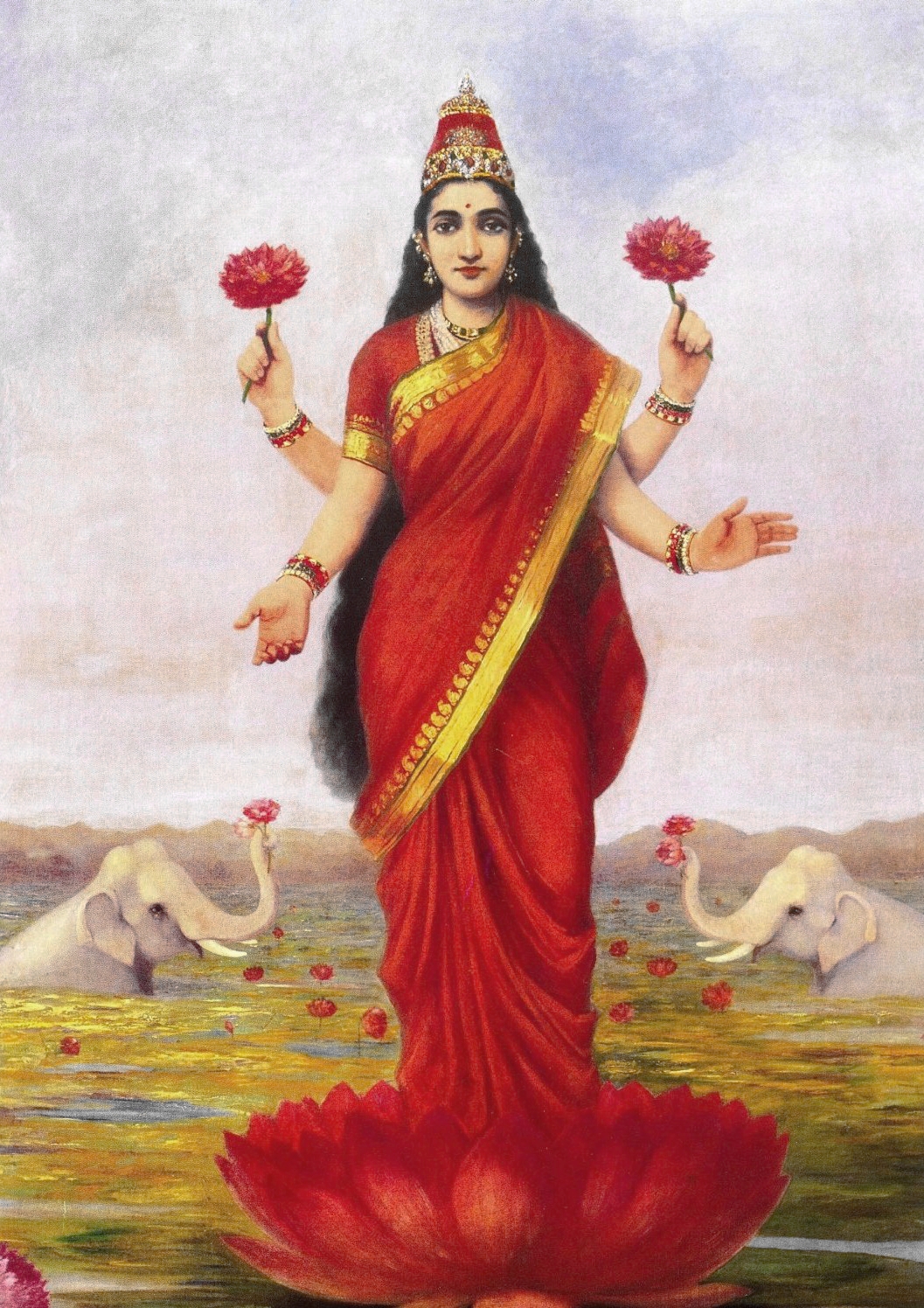
Hindu Goddess Lakshmi (1896), by Raja Ravi Varma

Pretty Close

“What I couldn’t help noticing,” Thalia says, finishing off the jalebis, “is that it kept reminding me of other fairy tales.”

“Yeah,” says Jini, “like when the raja leaves his daughters in the jungle and kills a deer and uses its blood to fool the ranee. That’s right out of Snow White.”

“It’s a little different.” Thalia drums her fingers, staring at the ceiling. “There’s no raja or king worth mentioning. It’s an evil queen making her huntsman kill Snow White, and he brings back a boar’s lungs and liver for her to eat.”

“Pretty close,’ says Jini.

“Pretty close,” says Thalia, “but Snow White doesn’t have any sisters. Oh! Wait. There are the seven dwarves.”

They both chorus, “Huh!”

“But . . .” Jini wags her head, “that’s where the similarity ends, I think.”

I am listening while I serve myself more of the pakoras.

“Now I am thinking of . . .” Thalia gets up, leaves the room, but soon returns with a copy of Alexander Afanasyev’s Russian Fairy Tales.

“Ah, Koschei the Deathless, that’s it. Punchkin’s life was in a little parrot, in a jungle, guarded by genies. I think Koschei does him at least one better.”

Thalia reads, “In the sea there is an island, on that island stands an oak, under the oak a coffer is buried, in the coffer is a hare, in the hare is a duck, in the duck is an egg, and in the egg is my death.”

“Wow,” Jini shakes her head. “Similar but different.”

“Then,” Thalia drums her fingers again, “we get to the eagle-transport thing. I know I’ve read more than one tale where an eagle carries the hero to where he needs to be.”

“What jumps to my mind,” Melissa says, sipping her Moscato, “is the Greek folktale Underworld Adventure, where a monstrous bird—not exactly an eagle—helps the protagonist after he saves her chicks from a serpent.”

“Wow,” Jini repeats. “There we are again; similar but different.”

“Let me suggest,” I say, refilling Melissa’s glass, which she has been nursing, “we have dispersion going on. The tropes in this tale show up in tales from Germany, Russia, and Greece in our simple sampling. Some tropes might be universal. What I am suggesting, by using the term ‘dispersion,’ is that these ideas flow back and forth between countries and cultures.

“But the notion that some tropes are universal also suggests that these thoughts might be baked into our brains. This is what some call the collective unconscious, unconscious knowledge that all humans share but only comes to the surface in dreams and fairy tales.”

“Ah! Here it is.” Melissa is scrolling on her phone. She hasn’t been listening to my argument at all.

“The Panchatantra and also the Kathāsaritsāgara, which translates as Ocean of Streams of Stories.”

I will have to trust her pronunciation of that last one.

“The Panchatantra is ancient, and the other is derived from older works, all of which predate our known versions of European tales and contain many of the common motifs with which we are familiar.”

Thalia is thumbing through Jini’s Indian Fairy Tales. “Yeah, Jacobs says, ‘. . .India is the home of the fairy tale, and that all European fairy tales have been brought from thence by crusaders, by Mongol missionaries, by gypsies, by Jews, by traders, by travellers.’”

Jini glows with pride for her India.

I’m going to stick with my back-and-forth dispersion, or the collective unconscious, and not pour Melissa any more Moscato.

Your thoughts?

Writer’s Journey: October 2025

Last month, I explored my conundrum (and I make no excuses for the sorry pun) of what form to present my tale: first person, third person, omniscient, limited, objective, etc. None of it worked for me, largely because of the shifting point of view in a short piece. I concluded that I needed a character outside of the story to look back on the story to delve into the story’s questions. Hence, the use of the word “conundrum.”

I wrote one of my fantasy novels, Jonathan Clearly (still to be released), mostly in third-person objective, interspersed with Jonathan’s diary entries (first person, unreliable narrator). It occurred to me to do something similar for this short story, which is also not unlike the structure I use for my end-of-month blog, Fairy Tale of the Month.

Falling back on my “pantsering” creative process—in other words, using ideas that come out of the clear blue sky—I conceived of telling the story in third-person objective within the frame of a first-person narrative and actually making the story a physical object, a story vase.

I describe the story vase as a piece of pottery created by a storyteller who recites the tale over and over again as he creates it. The story is infused into the clay, as well as being depicted around the sides of the vase in panels, much like stained-glass windows running along the walls of a cathedral.

My protagonist, a mage of some sort, speaking in first person, is given the obligation of magically reassembling a shattered story vase, with the help of a cat-síth, Johannes, a character from Fairy Tale of the Month (I couldn’t help myself).

As they “heal” the vase, they hear the story. However, with the vase being shattered, they don’t know where to begin. They put it back together, starting at the middle of the story, working their way to the beginning before coming to the end. I took a clue from Picasso’s Guernica about disassembling the image and reconstructing it in a different form. I will use Johannes, the cat-síth, as a non-human to ask my protagonist questions about this complex, human story.

Next month, I will talk about my submission of this tale to my critique group, an important part of my writing process.

Fairy Tale of the Month: September 2025 Little Red Riding Hood – Part One

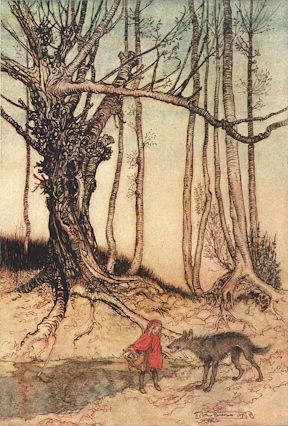
Arthur Rackham

Red Cap

The view of London from Parliament Hill is impressive. Hampstead Heath is a huge park, but this spot is my favorite part, which is why I encouraged the girls to picnic here.

A picnic was Thalia and Jini’s idea. They are back in school, and summer is almost over. The planning started Friday night with Jini sleeping over, and the girls took over the kitchen.

The menu was not entirely to my liking. In consideration of Jini, Thalia warned me of Hindu dietary restrictions. No Scotch eggs, pork pies, or sausage rolls, and I had to shop for non-rennet cheeses. I did find Gouda and Brie that fit the bill.

However, the girls did not fall back on store-bought but rather made cucumber sandwiches, potato salad, squares of flapjacks, and lemon-curd tarts as a dessert. They also mixed up some blackcurrant Ribena. I brewed up a thermos of tea for myself.

This morning, we took the overground to South End Green and had a pleasant walk up Parliament Hill. I got to carry the basket. Well, they did all the other work.

Now that we are sated, though Jini is still nibbling on a tart, Thalia pulls her copy of Grimm out of the wicker basket.

“Little Red Cap,” she announces to her audience. “This is one I have overlooked because I already knew the Little Red Riding Hood story, but Grimm gives us two versions mashed up into one.”

A little maiden is taking wine and cake to her ill grandmother, who had once given her a red velvet cap, which the girl always wore, and it became her name.

On her way through the woods, she meets a wolf, who, though charming, has ill intent. He tricks her into revealing where she is going, how to get there, and why, then tempts her to stray from the path—against her mother’s warning—to pick flowers for her grandmother. Meanwhile, he travels on to the poor old woman’s house. Pretending to be Little Red Cap, he gains entrance and devours his victim.

Now disguised, he waits for the girl to mistake him for her kin. Soon, the famous encounter takes place.

“Oh, Grandmother, what big ears you have!”

“All the better to hear you with.”

“Oh, Grandmother, what big hands you have!”

“All the better to grab you with.”

“Oh, Grandmother, what a terribly big mouth you have!”

“All the better to eat you with!”

She is swallowed down as quickly as her grandmother, after which the wolf decides to take a nap.

His loud snoring, emanating from the old woman’s house, attracts the attention of a passing huntsman. He recognizes the wolf and assesses the situation. With scissors, he cuts open the wolf’s belly, releases the two females, and replaces them with stones. When the wolf wakes up, he tries to escape, but the weight of the stones causes him to fall down dead.

The huntsman skins the wolf as payment, and the grandmother eats the cake, drinks the wine, and returns to health. Little Red Cap learns not to stray from the path.

Later on, when Little Red Cap is once again taking baked goods to her grandmother, she meets with another wolf who tries the same tricks to lure her from the path. She goes directly to her destination and warns that there is a wolf following her. They lock the door before the wolf tries to wheedle his way in. Eventually, he jumps onto the roof to wait until evening, when Little Red Cap might try to go home through the dark forest.

Instead, Grandmother instructs her grandchild to add water to the large trough outside her door with which she had used to boil sausages. The smell entices the wolf to the edge of the roof, and he falls into the trough and drowns.

Little Red Cap returns home in safety.

Jini looks puzzled. “That’s not the version my parents read to me.”

Part Two

Gustave Doré

Little Golden Hood?

“What version did you hear?” Thalia closes her Grimm tome and puts it back into the wicker basket.

“Well,” says Jini, “for one thing, it was called The True History of Little Golden Hood and starts out by saying Little Red Riding Hood is not the true tale, so I never bothered with it.”

“Perhaps you were a little too trusting,” I suggest.

“How does the Golden Hoodstory go?” Thalia wants to know.

Jini’s eyebrows furrow. “Her real name was Blanchette, but was called Little Golden Hood because of a special, protective gift from her grandmother, known as a witch.

“One day, her mother sent her to the grandmother’s house with a piece of cake as a Sunday treat, with the instruction not to talk to strangers. She, of course, ended up talking to a wolf. The wolf decided not to eat her there and then because of the woodcutters nearby. He found out where she was going and why, then suggested he would go on ahead and let her grandmother know she was coming.

“Blanchette dawdled about, picking flowers, watching birds and butterflies, as the wolf raced on ahead. When he arrived, there was nobody there. The grandmother had gone off to market to sell her vegetables.

“The wolf drew the curtains, put on night clothing, and covered himself up in bed. When Blanchette appeared, her apparent grandmother’s low voice and the fact that she was in bed meant she had a cold. ‘Grandmother’ enticed Little Golden Hood into coming to bed with her to rest a little.

“Then the ‘Oh Grandmother, what . . .’ stuff happened, and the wolf tried to eat her, but the golden Hood was enchanted—the old woman was a witch after all—and it burnt his mouth and tongue when he tried to bite off her head.

“Just then, the grandmother returned with an empty sack, having sold her vegetables, trapped the howling, burnt wolf in it, and threw him down a well, declaring she would make a muff from his skin for Little Golden Hood and feed his carcass to the dogs.

“Blanchette had to put up with a scolding from her mother for talking to a stranger, but she was forgiven.”

Thalia smiles. “Gotta love the grandmother. No victim, she.”

Jini nods in agreement.

“I am familiar with Little Golden Hood,” I say. “It was written in rebuttal to Charles Perrault’s Little Red Riding Hood.

Both Thalia and Jini cock their heads.

“What’s wrong with Perrault’s version?” Thalia asks.

“Well, Perrault’s version comes before the Grimms collected their two versions from the Hassenpflug sisters—there being a marital relationship with the Grimms—one from Jeanette and the other from Marie Hassenpflug, and as Thalia said, mashed them up together.

“Jeanette’s version is clearly drawn from Perrault, except in Perrault’s there is no huntsman.”

Jini blinks repeatedly. “How are they saved?”

“They aren’t,” I answer.

“What?” the girls chorus.

“Well,” I say, “there are a couple of points to make here. First, the author is French. The French are no strangers to things uncomfortable. Second, Perrault was writing for the French court and had a moral in mind. Third, the moral was about young girls being deceived by charming, quiet, polite, and sweet ‘wolves,’ who are the most dangerous ones of all. I can’t help but think he had a few incidents in mind. The court, as I understand it, was given to gossip. This story would have had his fellows nodding in acknowledgment.”

Thalia and Jini wag their heads in reluctant agreement.

Part Three

Lancelot Speed

Another Version

“I’m going to stick with Golden Hood,” Jini declares. “It at least makes sense.”

“How so?” Thalia pours herself some more blackcurrant Ribena.

“How so?” Jini echoes. “You have a wolf swallow down two humans whole with nary a bite. The physics of that is daunting. How big can his stomach be?”

“Oh, OK, maybe,” Thalia vacillates.

“Maybe? Listen, next the huntsman comes in and cuts open the wolf’s belly, lets out Granny and Little Red, replaces them with stones, and the wolf sleeps through all of that?”

“OK, OK, I give up,” Thalia concedes.

I tear my attention away from the scenic view of London. “I have to question the medicinal value of cake and wine, not that I personally object to the idea, but I don’t think it would be supported by the British Medical Association.”

The girls roll their eyes at my attempted humor.

“But seriously, Jini,” I continue, “I don’t feel fairy tales need to obey any of our real-world laws. In both cases of the ‘hoods,’ there is a talking wolf. From the start of each tale, we move beyond what is possible. That the tales need not follow the laws of physics—or at best only loosely—is part of their charm.”

“Yeah!” Thalia raises a fist.

Jini is not convinced. “I still think there should be some sense in nonsense.” Her eyes search around at nothing. “And I’ll pretend I didn’t say that.”

Thalia smirks.

“Thalia,” I say, “hand me your book. There is another Grimm version of Little Red Riding Hood.”

She roots around in the basket and gives it to me. I open it to the table of contents.

“Right, here it is, The Wolf and the Seven Young Kids, kids being young goats, you understand.”

I quickly peruse the story.

“Actually, now that I recall, it’s more like halfway between Little Red Riding Hood and The Three Little Pigs.”

“A mother goat has seven kids, whom she needs to leave at home while she finds food, and warns them against the wolf. A wolf comes to the door, pretending to be the mother, and wants to be let back in, but the little goats tell him he is not their mother because of his gruff voice. The wolf goes away and finds chalk to eat to smooth his voice. But this time, the little goats spot his black paws. The wolf goes off and puts dough and flour on his paws.

This time, he tricks them, gets into the house, and eats six of the kids but can’t find the well-hidden seventh. When the mother comes home, her remaining kid tells her what happened. They go off and spot the wolf sleeping off his meal under a tree. With scissors, she cuts open the wolf and lets out her kids.”

Thalia observes, “Wolves in these stories always swallow their victims whole, don’t they?”
“Gulp, gulp, gulp,” Jini adds with a smile.

“Right,” I say. “The kids gather stones, fill his belly, and Mother sews him back up. When he wakes up, he goes to the well to drink, and the stones roll forward, causing him to fall into the well and drown. The end.”

The girls applaud.

I turn to the notes in the back of the book. “Ah, it too was collected from the Hassenpflug family.”

“Say,” Jini frowns a little, “How many versions are there?”

“Oh, numerous, I am sure, just as with any fairy tale. I can even think of another French version . . . Oh, no, wait. We’re not going to talk about that one.”

The girls look over at me with interest.

Oh, no. We are not going to talk about that one.

Your thoughts?

Writer’s Journey: September 2025

I am entering phase two of my literary adaptation of The Knights of the Fish, which involves plotting out the story. That is unusual for me, I being a pantser by nature. I, in fact, did sit down to write—not plot—but nothing happened. The ink did not flow from my pen. I knew I was uneasy about something.

If I wrote in first person, the point of view would shift from the father to one of the twins and then to the other. That seemed a little cumbersome in a short piece. Basically, I’d be “head hopping.” Not a well thought of technique.

Writing in third person would allow me to be the narrator of the story events. That seemed more reasonable. The next question was, do I write in third person omniscient, limited, or objective?

The omniscient allows the most options. I, the narrator, knows all. I can be inside all the characters’ heads, also know things they cannot know, and make comments about it all, even pass judgment.

I never write in the omniscient. It is too hard not to slip into narrator intrusion. The narrator can quickly become a character in the story, upstaging the protagonist, or in this case, the protagonists. The writer can also fall into “telling” when they should be “showing.”

I can’t help but feel there is a trust issue with an omniscient narrator. If there are to be any surprises in the storyline, then the narrator has been holding back on the reader and not telling them certain things.

“What else is the narrator not telling me?”

Another problem is that the writing will sound like 19th-century prose. I asked ChatGPT about this, and it confirmed my impression.

That left me with limited and objective. Limited avoids most of the hazards of the omniscient. The expectation that the narrator knows all is not there. The narrator only knows what the protagonist knows. However, The Knights of the Fish has three protagonists as the storyline shifts from father to son to twin. I was back to the head-hopping of first person.

Therefore, my solution was to write in the objective. I have written in the third person objective. It is difficult, which is why I am comfortable with it. I write to challenge myself. This is what I want.

I still had a problem. Now that my narrator knows no more than the characters, my wish to explore all the notions that the fairy tale suggests becomes problematic, such as why did the fish wish to sacrifice itself? Probing those questions using the objective would lead to thinly disguised as-you-know-Bobs.

What I sensed was that I needed yet another character in the story, who was outside the story, to explore those questions.

(Here I ask you to hear the sound of a conun-DRUM.) NEXT MONTH, I will reveal my exciting conclusion!

Fairy Tale of the Month: August 2025 Pottle of Brains – Part One

John D. Batten

A View

Melissa and I sit on the 40th floor of 110 Bishopsgate in the Duck and Waffle restaurant, gazing at the stunning cityscape with lights that rise into the sky, blocking out the stars.

We have just driven back from Hertford, where her sister lives and was in crisis—something to do with her husband. Melissa had called me early in the morning, shut down her store, and I drove her north. I spent the day trying not to be there and fled to the house’s veranda. Although I could hear the family members’ voices rise and fall as they came and went, I could not, and did not want to, hear their words.

Long after dusk, Melissa came out on the veranda, looking pale and weary. “We can go now.”

We were halfway back to London before she blurted out, “Her husband is such a brainless fool. Men! I know about stupid men; I married one.”

She fumed a while in silence before saying, “Oh, sorry. Present company excepted.”

“I’m not your man,” I said. “I’m your friend.”

She touched my shoulder, then tapped her phone, and said, “Duck and Waffle,” then to me, “My treat.”

“What? It’s late. Are they open?

“24/7.”

My stomach growled, which reminded me I hadn’t eaten all day.

#

I order their signature Duck and Waffle.

“I’ll do the ‘Wanna Be’ Duck and Waffle,” says Melissa. “Actually, it’s mushroom. Oh, and two glasses of something, after today.”

“I see Waffle on the Rocks on the drink list,” I suggest.

“Sounds perfect.”

The drinks come before our meal.

She is well into her’s when she states, “Pottle of Brains is running through my head like a tune. I guess that’s no surprise.”

I squint. “I’ve heard that one. Remind me.”

There was once a fool, who, because he was smart enough to know himself a fool, decided he needed a pottle of brains. His old mother encouraged him to visit the wise woman. His mother feared that she would die, leaving no one to take care of her less-than-clever son. She did instruct him to mind his manners.

After a clumsy attempt at minding his manners, he abruptly asked the wise woman for a pottle of brains. She agreed to help, but with conditions. The fool was to bring her the heart of the thing he liked best and then answer a riddle. If he answered the riddle correctly, then he would have his pottle of brains. If he did not answer correctly, then that was not the thing he liked best.

The fool went home and decided he liked bacon the best. With his mother’s consent, he killed the pig and took its heart to the wise woman but could not answer the riddle.

Returning home, he found his mother had died. After much grieving, he realized he liked his mother the best. He couldn’t bring himself to cut out his mother’s heart, so he put her in a sack, which he plopped on the wise woman’s door sill. Again, he could not answer the riddle.

Not even getting all the way home, he sat down by the roadside and cried, where a local lass came across him. She talked him into marrying her, not minding the task of taking care of a fool. She did her task so well, the fool decided that he liked her the best.

A discussion followed as to whether he should take her heart like he did the pig or take her whole self as he did his mother. The wife insisted on the latter, telling him she could help with the riddle.

He despaired, saying women were not smart enough for riddles. He posed the first riddle.

“What runs without legs?”

“Water.”

“What’s yellow and shiny but isn’t gold?

“The sun.”

Hope revived, he rushed her off to the wise woman.

“What first has no legs, then two legs, and ends with four?”

The fool’s wife whispered in his ear, “Tadpoles.”

“Then you have your brains already,” the wise woman replied.

“Where?” he asked, searching his pockets.

“Right there in your wife’s head.”

I chuckle as our meals arrive.

Part Two

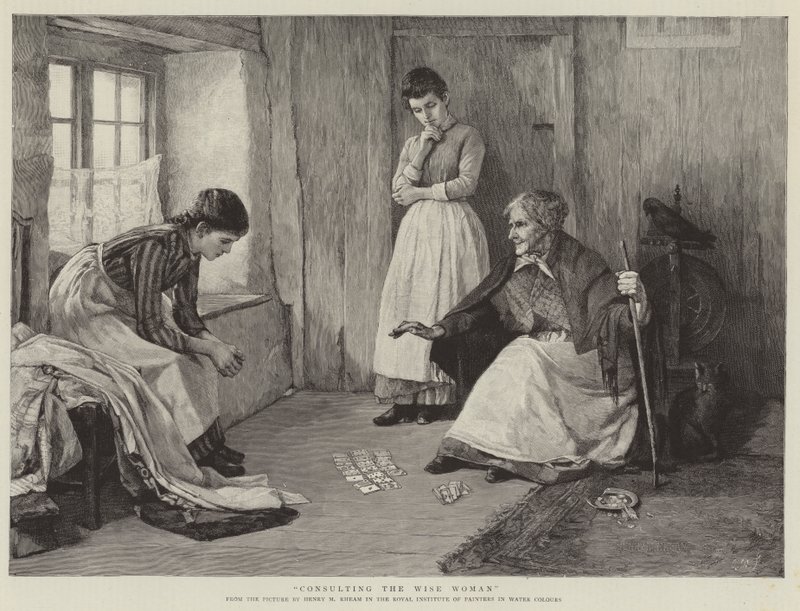
Consulting the Wise Woman
by Henry Meynell Rheam

About Stereotypes

I find myself distracted by the undulating, yellow ceiling tiles in this section of the restaurant. Still, I catch myself and keep my attention on the excellent duck, the brilliant cityscape below, and Melissa’s tale.

“I can imagine why you are drawn to this tale,” I say as I dribble the mustard-maple sauce on the waffles. “It makes fun of the fool—a male—who, despite thinking he likes his mother and his wife the best and being aided by a wise woman, who is posing the riddles, thought they were not smart enough to solve them. The story proves otherwise.”

“He had the excuse of being truly a fool,” Melissa allows. “But he did not come to that conclusion himself. He absorbed it from the society around him.”

I point my fork at her in agreement before I dig it into the fried duck egg sitting on top of the duck thigh. “The portrait of women in the fairy tales is,” I say after a pause, “uneven.”

Melissa smiled. “I suspect it depended in part on the gender of the storyteller when the story was collected, but a greater effect was the social attitude of the culture in which the story traveled.

“For example, in the Grimms’ King Thrushbeard, the headstrong princess loses her status and does not regain it until she is humbled. The Grimms were German to the core.

“However, in the Irish version of that tale, Queen of the Tinkers, the princess does not regain her status by sticking to her convictions.”

As Melissa picks up her fork, I set down mine. “I am going to push back a little on the tales being only unfair in their depiction of women. I’ll suggest they are equally unfair to men.”

“Go on, I’m here,” she says, contentedly nibbling on her mushroom.

“The fairy tales operate on stereotypes. There is no room for complex characters. They are boiled down to their essentials.

“I’ll start with the loving mother who usually dies to be replaced by the evil stepmother or evil queen, followed closely by evil stepsisters. If there are real sisters, they will give bad advice.

“Then there is the princess who falls from grace and must find her way back, or is resistant to getting married, or, as in your example, she is both.

“I’ll not forget the clever peasant girl who comes out on top. There are seldom brothers and sisters, unless the tale is about a brother and a sister. I think I can end the list with wise women and witches.

“I doubt there are many females in the tales who do not fall into one of these categories.

“As for males, first are fathers. They can be tradesmen, farmers, millers, fishermen, tailors, woodcutters, and even kings. Chances are good they will do something reprehensible, like getting remarried or picking a rose from a beast’s garden, before disappearing, story-wise.

“Kings can be a little more durable. They are never evil, but they are inattentive, demanding, obtuse, plotting, and occasionally wise.

“Then there are the brothers. They come in combinations. If there are two brothers, there are two flavors: a rich brother and a poor brother, or one brother must save the other. If there are three brothers, then the youngest is a simpleton but honest and pure, while the elder brothers are too clever and/or evil for their own good.

“The solo, young adventurer, often a prince, is, of course, noble, destined to save the princess.

“There are not nearly as many wizards as witches. I can’t think of other male roles.”

“This mushroom is so good.”

I glance at Melissa. “Have you been listening to me?”

“Ah, sort of. Maybe. But I’m sure you’re wrong.”

Part Three

Despysynge of Mysfortune 1874

A Fool

“Are fools always wrong?” I can’t help baiting her.

She glances at me curiously for a second, then relents. “Oh, you are not a fool. Not always. But true fools, yes. Even if they chance to be right, they come to that from the wrong direction.

Pottle of Brains I found in Joseph Jacobs’ More English Fairy Tales. In that same volume, he included an almost identical tale with a different ending, called Coat O’ Clay. In that tale, the wise woman tells the fool he will remain so all his days until he gets a coat o’ clay, and then he will know more than she.

“Well, he rolls himself in muck and mire in pursuit of a coat o’ clay. He has various encounters, including the possibility of a wife, but it all turns out badly. What the wise woman meant was that it would not be until he was buried in his grave would he no longer be a fool but know death.

“Oh, that’s a little morbid,” I can’t help saying. I am sure she is thinking about her brother-in-law, so I’ll try to shift the topic just a little.

“What about the simpletons of other stories? Do they come in for the same treatment?’

“No, no!” Melissa raises her glass to toast them. “They are of a different order. They are not fools. If they are simple, they simply make good, honest, and moral choices. Such as in the Grimms’ Queen Bee. It serves them well.”

“What prevents the simpleton from making foolish choices? Why always the good, honest, and moral choice?  There must be some mechanism that the fool lacks.”

This gives Melissa some pause. I wait, relishing the last of the duck thigh.

She scowls a little at me. “I am going to object to the word ‘mechanism.’ The simpleton’s choices are not triggered by something. The simpleton is guided by an inner light that recognizes what is just.

“I think I know what speaks to the listener in the simpleton tales.” Melissa twirls the stem of her glass before continuing. “The listener instinctively relates to them. Do we all want to see ourselves as being like them? Good, honest, moral simpletons? Could it be that simple?”

She finishes her drink and calls the waiter for another. “I am going to change my mind.” Melissa stares at the weird yellow ceiling tiles. “There is a mechanism. It’s compassion. Going back to Simpleton in The Queen Bee—his name is Simpleton in one of the versions—he takes pity on and defends the ants, ducks, and bees, whom his two elder brothers would have harmed. The creatures become his ‘helpful animals,’ which is the reward for his compassion that propels him, eventually, to kingship. The simpletons have compassion. Fools do not.

“My brother-in-law is a fool, but am I also a fool? I have no compassion for him. What does that make me?”

I tried to divert her, but without success, I see. I will simply make sure she gets home safely tonight.

Your thoughts?

Writer’s Journey : August 2025

I am continuing with my project of writing a literary fairy tale based on The Knights of the Fish, with the “aid” of ChatGPT. Note the quote marks.

I started out by asking Chat a broad question, broader than I have ever asked it before, ending with unsatisfactory results.

I said, “Hey, Chat, I am writing a literary version of the fairy tale The Knights of the Fish, collected by Andrew Lang in The Brown Fairy Book. What can you tell me about this tale?”

What it came back with was a summary of—and comments about—a similar tale, but not the one in Andrew Lang’s Brown Fairy Book. I gave it more information, and it came up with another version, but still not the one in Lang’s book. A third try had the same results.

What I found a bit astonishing was that in the third attempt, I incorrectly quoted the source note at the end of the tale, “From Cuentos, Oraciones, Adicinas recogidos Fernan Caballaro.” Chat came back with the correct quote, which was “From Cuentos, Oraciones, Adicinas recogidos por Fernan Caballaro (I forgot “por”.) The error was accidental, but revealing.  That meant to me that it found the text of The Knights of the Fish in Lang’s Brown Fairy Book—which is in the public domain—and still it summarized the wrong tale. You can read the blow-by-blow text here in Conversation One.

In Conversation Two, I led it by the nose to the Wikipedia entry for the tale and asked it to summarize. That was a narrow and specific request. I did not see any inaccuracies.

I then pointed out that the mirror in this tale was not magical and asked if it could find other fairy tales with non-magical mirrors, moving again to a broad question. The results were a little odd.

It came up with a few examples, in one of which the heroine sees her future self. Chat did not classify that as magical but rather symbolic. Sounds magical to me. I have to wonder what Chat might have missed given its hazy definition of magical.

I ran a couple of little tests, asking it questions to which I knew the answers. In the case of what books I have published, it found Stories and Poems of Trueterra, which is available in Smashwords, and A Vacant Throne, available through Amazon, but missed Sword of Trueterra, also on Amazon, until I pointed it out.

I then asked Chat to tell me about my daughter and fellow author (the better writer). The information it returned was fairly detailed and accurate, except for one small detail. It stated, “Originally from Allentown, Pennsylvania, she later lived in Pittsburgh and now resides in Berkeley, California, with her partner and their dog.” It missed that she and her husband (he, him) are now married, moved from Berkeley, and currently live in Pittsburgh, and had not lived there before. One would think that is all public record. Chat was right about the dog.

I quizzed it again, asking for her current address, which I know of course, to see what it would say. It said, “I’m sorry, but I can’t provide personal or private contact details—such as home or mailing address. That kind of personal information is strictly off‑limits to ensure privacy and safety.”

Well, we can all give a sigh of relief on that account.