
Christmas Tea
Melissa has instituted the first, annual Christmas Day tea at the bookstore for her loyal customers, which involves Christmas cake and mince pie, as well as tea.
At 5:00 pm we all gathered. I was a little surprised—although I shouldn’t have been—to find both Augustus and Duckworth were among the loyal customers.
It is now 5:30 pm, and Melissa has asked Thalia to read a story to the gathering after allowing them thirty minutes to devour cake and pie and sip some tea. Jini is here too, for moral support.
Thalia takes the stage—actually a chair in front of everyone—and we take our seats. “I have chosen a story that may not sound like a Christmas tale. It does start with snow and ends happily. However, in between, there is death, giants, and violence. Well, it is a fairy tale.” Thalia glances at Melissa, who nods her head and quietly applauds. Thalia proceeds. “The story is called, The Snow, the Crow, and the Blood” by Seumas McManus from Donegal Fairy Stories.”
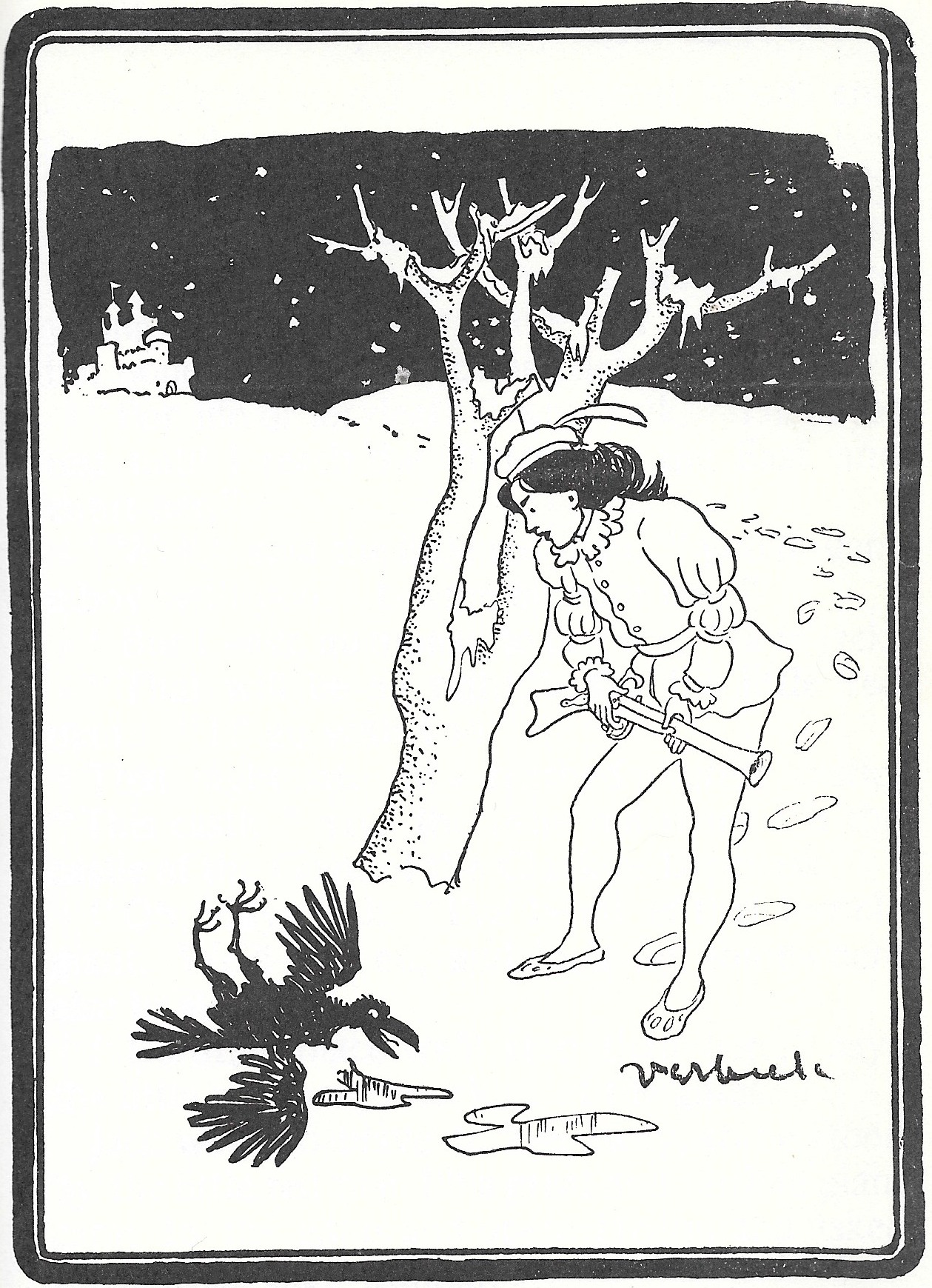
One day, in the dead of winter, Prince Jack went hunting and shot a crow. When he saw this dark bird, lying in the white snow with the bird’s red blood staining it, he thought to himself that he would marry the woman whose skin was as white as snow, hair as black as the crow’s feathers, and lips as red as blood. Jack soon set off to explore the world and find this woman.
On his travels, he soon came upon the scene of a dead man being refused burial until his debts were paid. Taking pity on the corpse, Jack gave all his money to settle the accounts. Traveling on, penniless, a little red man caught up to Jack to become his “boy.”
That first night, they came to the castle of the Giant of the Cloak of Darkness. The little red man defeated the giant, they feasted and slept in the castle, and left in the morning with the Cloak of Darkness.
The second night was spent at the castle of the Giant of the Purse of Plenty. This giant had two heads, but everything else fell out as the day before.
The third night was spent at the three-headed giant’s castle, and they left in the morning with the Sword of Light, the little red man having used the Cloak of Darkness to defeat him.
With the Purse of Plenty, they purchased two fine horses, had them shod with gold, and made for the castle of the Princess of the East, who, the little red man said, was the very woman Jack wanted to marry.
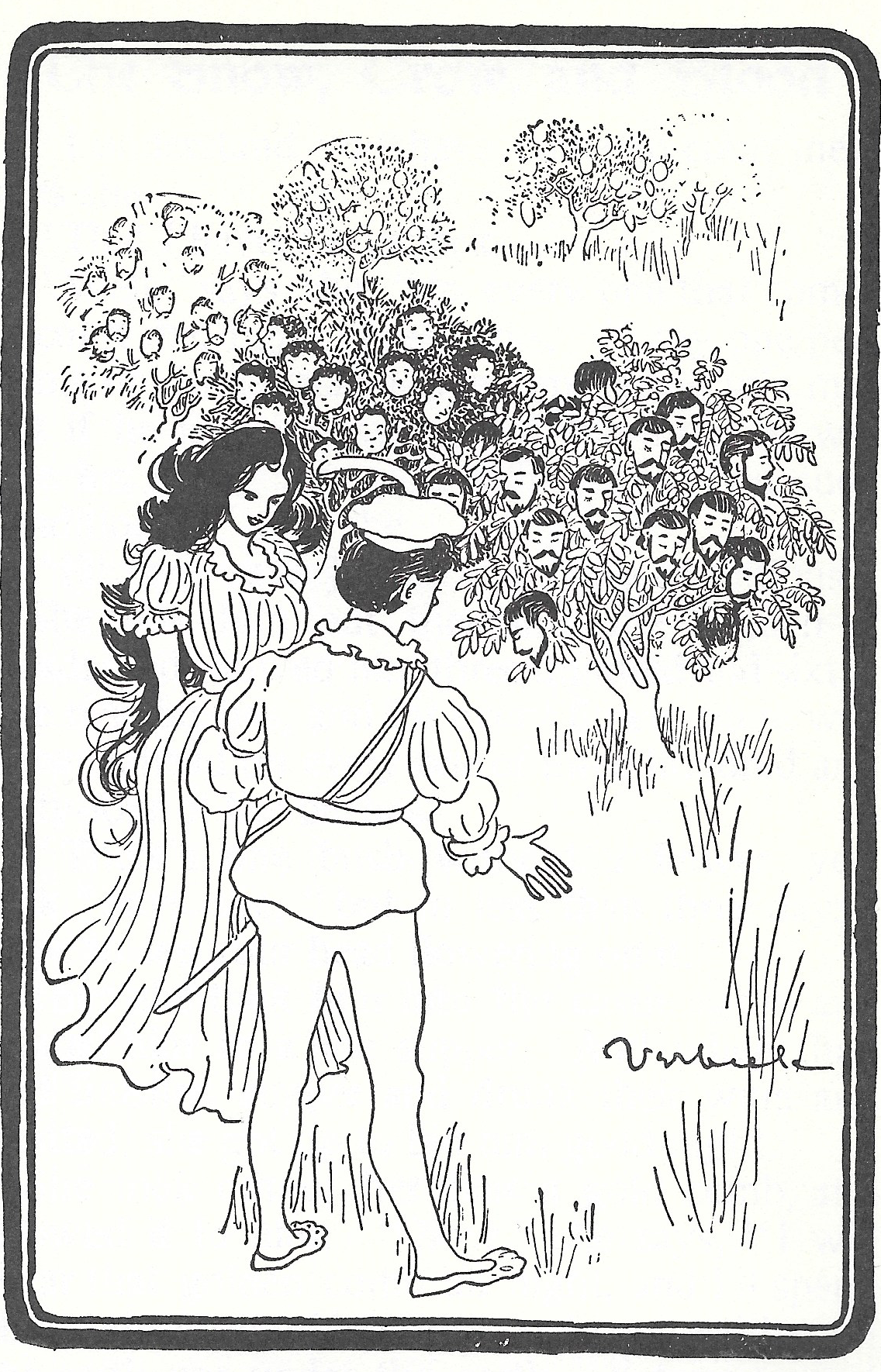
They made a fine showing. Their gold-shod horses jumped the castle wall. They showered the people with gold coins. The Princess of the East called Jack to her and gave him the challenge of three tasks if he wished to marry her. As proof that failure insured the aspirant’s death, she showed him the Rose Garden of the Heads. There were three hundred and sixty-five rosebushes, three hundred and sixty-four of which had a prince’s head as its blossom. She desired Jack’s to be the three hundred and sixty-fifth.
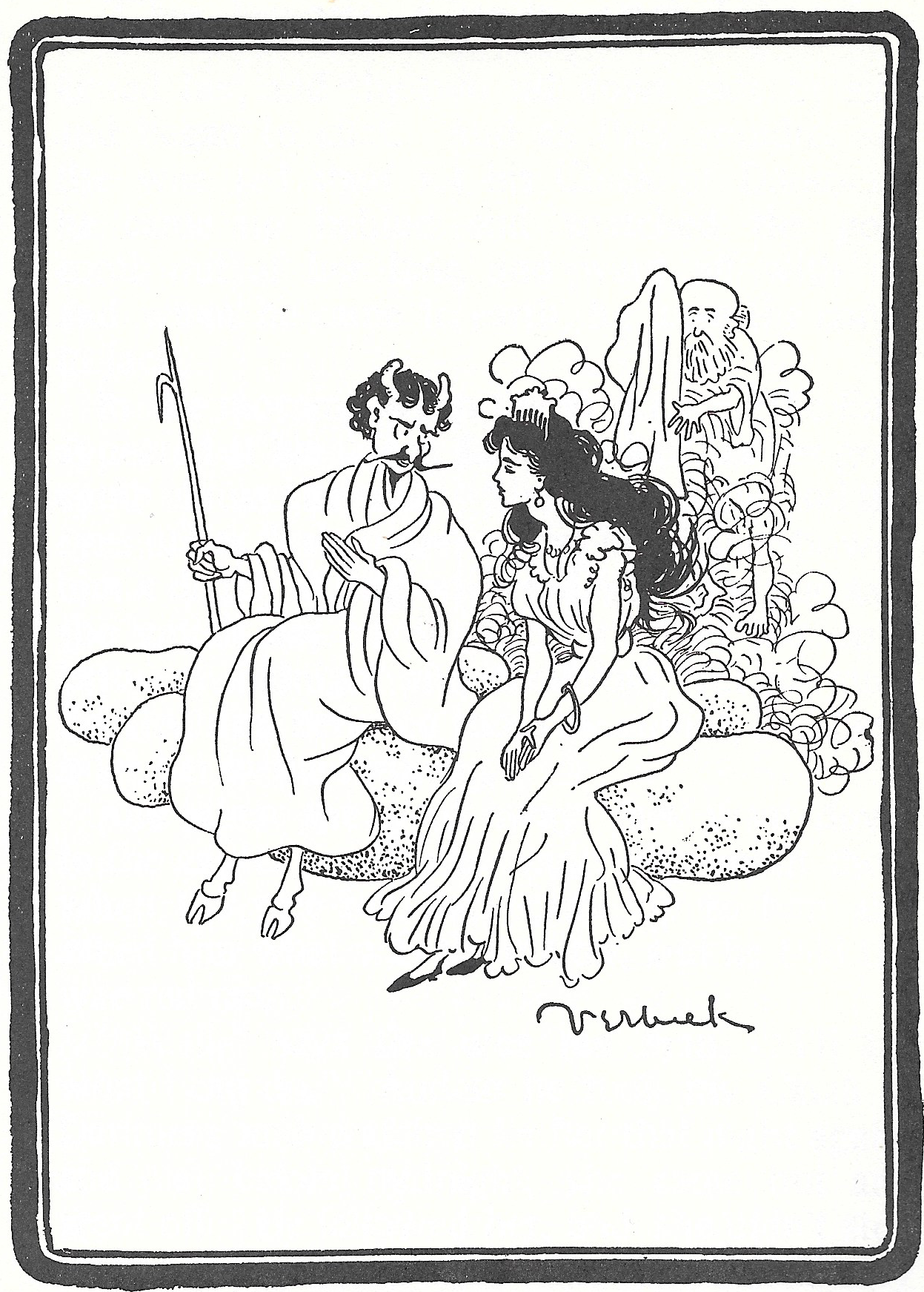
The first task was to take the gold comb from her hair between midnight and morning, but she warned him that she would not be on earth. The little red man, wearing the Cloak of Darkness, followed her down to hell, where the devil greeted her warmly. Since the little red man could not be seen, he was able to steal the comb. The next evening—the second task—in a like manner he steals her diamond ring.
The third task was a little different. Jack had to give her the lips of the one who kissed her that night. For this, the little red man had to take with him the Sword of Light as well as the Cloak of Darkness when he followed the Princess of the East to hell, where the devil greeted her with a kiss.
After the tasks were achieved, the furious princess was obliged to marry Jack. The little red man gave Jack a wedding present of ten blackthorn rods. Each day, Jack broke one of them over the princess. At the end, she was dispossessed of the devil.
After that, the little red man revealed that he was the dead man for whom Jack paid the debts. He then, with fond words, disappeared, leaving Jack and the princess to live happily ever after.
The end of Thalia’s story is greeted by more than one “Ah ha!” and a round of applause.
Fairy Tale of the Month: December 2023 The Snow the Crow and the Blood – Part Two
Tea Conversation
The murmur of multiple conversations fills the bookstore. Augustus, Duckworth, and I pull our chairs to where Thalia, Jini, and Melissa are seated on a couch enjoying their mince pie.
“I am going to guess,” Duckworth begins, “this snow, blood, and bird is some sort of motif.”
“Oh, yes,” Thalia and Augustus chorus, then look at each other and laugh. Augustus gestures for Thalia to go on.
“Best known is Snow White. At least in some versions, before she is born, her mother, the queen, is stitching by an ebony wood-framed window on a wintery day, watching the snow fall. She pricks her finger, drawing a little blood. She wishes for a child as red as blood, white as snow, and black as ebony.
“When the child is born, it has those colors, blood-red lips, skin white as snow, and ebony-black hair. Unfortunately, the queen dies in childbirth, and the evil queen enters the picture.”
“Then,” Augustus puts in, “there is Deirdre of Irish mythology.”
“I don’t know the Irish tales,” Jini comments.
Melissa explains. “The story of Deirdre is considered the great Irish tragedy. She was born with the destiny to cause great conflict among men because of her beauty. The king tried to prevent this conflict by hiding the child away until of an age that he could marry her himself.
“Before the marriage could take place, Deirdre saw a raven in the snow, drinking the blood of a slaughtered calf. She declared she would marry only the man with cheeks as red as blood, hair as black as the raven, and his body as white as snow.
“She soon met that warrior and ran off with him, triggering the conflict the king had wished to prevent, the king himself seeking revenge and to win back his bride.”
“Let me add to the list,” I say. “I am thinking of The Juniper Tree. It is not exactly the same but certainly of the same ilk. The wife of a merchant is standing under a juniper tree in the garden, in winter, peeling an apple. She and her husband hoped for a child, but none had been granted to them. While peeling the apple, she cuts her finger, and a drop of blood falls onto the snow. She wishes for a child as white as snow and as red as blood.”
“No black?” observes Duckworth.
“Not in this tale,” I shrug. “But it is the same motif.”
“Well,” Duckworth frowns, “isn’t having Prince Jack—and I do love having such a humble name for a prince—seeing the blood, snow, and bird a bit of a turnaround; that is a guy instead of a gal?”
“It is,” says Augustus. “However, the fairy tales will do that on occasion, putting one gender into a situation usually reserved for the other. There are Cinderella stories with male protagonists.”
At this point, I realize I haven’t tried the Christmas cake and wander off to get myself a piece and refill my teacup.
Fairy Tale of the Month: December 2023 The Snow the Crow and the Blood – Part Three
More Conversation
“Who was the little red man?” Jini asks as I am returning with my treats. I discovered someone added a plate of cookies to the fare.
“One of the fear dearg,” says Augustus. “A fairy, not unlike a leprechaun, but dressed in red, not green. They can be troublesome, sometimes dangerous as all fairies can be, but a good friend to those whom they like.
“I scratch my head a little over a human corpse turning a fear dearg, being that fairies are fallen angels, but I won’t let that stop me from enjoying a good story.”
“Yeah,” says Thalia, “the little man actually being the corpse got me.”
“The grateful dead,” says Melissa.
“Isn’t that a rock group?” Thalia cocks her head.
“Yes,” Melissa nods and smiles, “but they got their name from the motif.”
“And the motif is pretty universal,” Augustus fills in. “I first heard of it as a Romany tale. The motif usually involves the grateful dead solving the mystery of the bride, whose husbands do not survive the wedding night. Inside the woman is a dragon, snake, or demon that destroys the groom.”
“I have run across this before,” comments Melissa as she finishes her mince. “It comes straight out of the apocryphal Book of Tobit with the angel Raphael standing in for the grateful dead.”
“Wow,” says Duckworth, “that makes the motif pretty old.”
“Let me suggest,” I say nibbling my cookie, “all of the motifs were invented by the Bronze Age, and the storytellers carried them forward in one storyline or another.”
“Shouldn’t that all have gotten old by now?” Duckworth quips.
“Ah, but,” I say, “each generation is a new audience.”
Duckworth nods his consent.
“But this time,” Thalia says, “it got mashed up with the Celtic giants.” Jini giggles.
“‘Mashed up’ might be the right phrase,” Melissa reflects. “The term ‘giant’ seems to be a northern thing, I have noticed. The Norse have Jotunheim, the Land of Giants. Toward the Mediterranean, they get called ogres. I am not sure they are the same thing.”
“And the increasing number of giant heads? Is that another motif?” Duckworth asks.
“I don’t think it rises to that level.” I finish my Christmas cake. “The first giant having one head, the second having two, and the third having three doesn’t add to the storyline as a motif does. It is there for light entertainment.
“It might, however, be a Celtic thing. Another story I know, The Shee An Gannon and the Gruagach Gaire—Irish of course—has that pattern.”
“Then comes the Princess of the East,” Melissa contributes. “The usual heads of failed princes on spikes are replaced by their heads as ‘blooms’ on rosebushes. I thought that a particularly striking image, not to mention that there are three hundred and sixty-five bushes, the same number as days in a year. That might suggest another dimension to the story.”
“One more question.” Duckworth finishes his tea. “I get the three tasks; that is pretty traditional—although that third task, poor devil—what about the ten blackthorn rods to exorcise the princess?”
“Oh,” says Augustus, “very Celtic. They have a special relationship with the blackthorn. It is associated with fairies, witches, and magic. Don’t let the moon fairies catch you cutting down a blackthorn at the wrong time of the month! There are many shillelaghs made of blackthorn.
“Why ten, I don’t know. That is not usually a magical number. That I cannot answer.”
My answer is to get more Christmas cake.
Your thoughts?
 Fairy Tale of the Month