
Usual Crowd
The usual weekday crowd has gathered: Thalia and myself in our comfy chairs, Johannes on the window-seat pillow, the fairy on Thalia’s shoulder, and the brownies lurking in the dark corners for the post-supperial entertainment. (Don’t try looking that up. You won’t find it. It means post-supper with an inference of being superior.)
In our study/sanctuary, Thalia fingers my copy of Modern Greek Folktales, by R. M. Dawkins.
“Tonight’s reading is The Mountain of Jewels and the Dove Maiden.”
A young woodcutter, who worked morning till night to support himself and his widowed mother, fell in with a merchant with a scheme to acquire great wealth. Taking to sea with his fleet, the merchant brought them to an island dominated by a lofty mountain, its peak in the clouds.
The merchant gave the youth a sword, sewed him into an animal skin, and told him an eagle would carry him to the mountain’s top. The merchant instructed the lad to cut himself out of the animal-skin bag and throw down to him whatever he found.
All this happened, and the young man found the mountain top cluttered with diamonds, gold, pearls, and sapphires. These he threw over the mountain’s cliff to the merchant below. When the merchant’s ships were filled, he sailed away, abandoning the youth on the mountaintop.
Desperate, the lad searched for escape and found a subterranean staircase into a palace. There dwelt a blind ogre. Although at first frightened, the youth befriended the ogre, who doted upon him, giving him the forty keys to the palace rooms, but with the instruction not to enter the fortieth room.
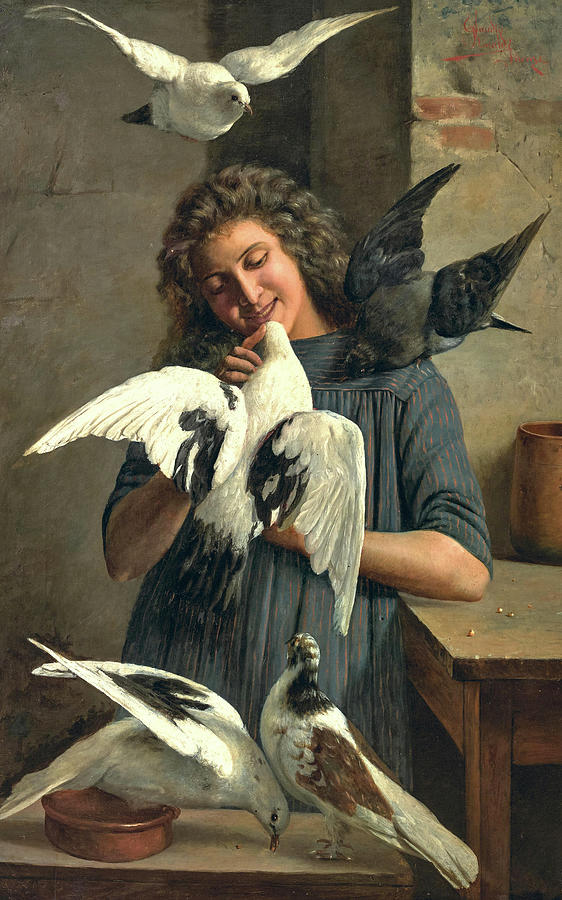
Needless to say, the fortieth room was entered, where the youth found a magnificent garden, in which he saw a marble-lined cistern, into which descended three doves that removed their plumage, transforming into beautiful girls. The three splashed about in the water as he fell in love with the youngest. As quickly as they had come, they put back on their feathers and flew away.
Brokenhearted, the youth returned to the ogre and confessed what he had done. The ogre, rather than being angry, sympathized and told him to steal the plumage of the youngest, and she would become his wife.
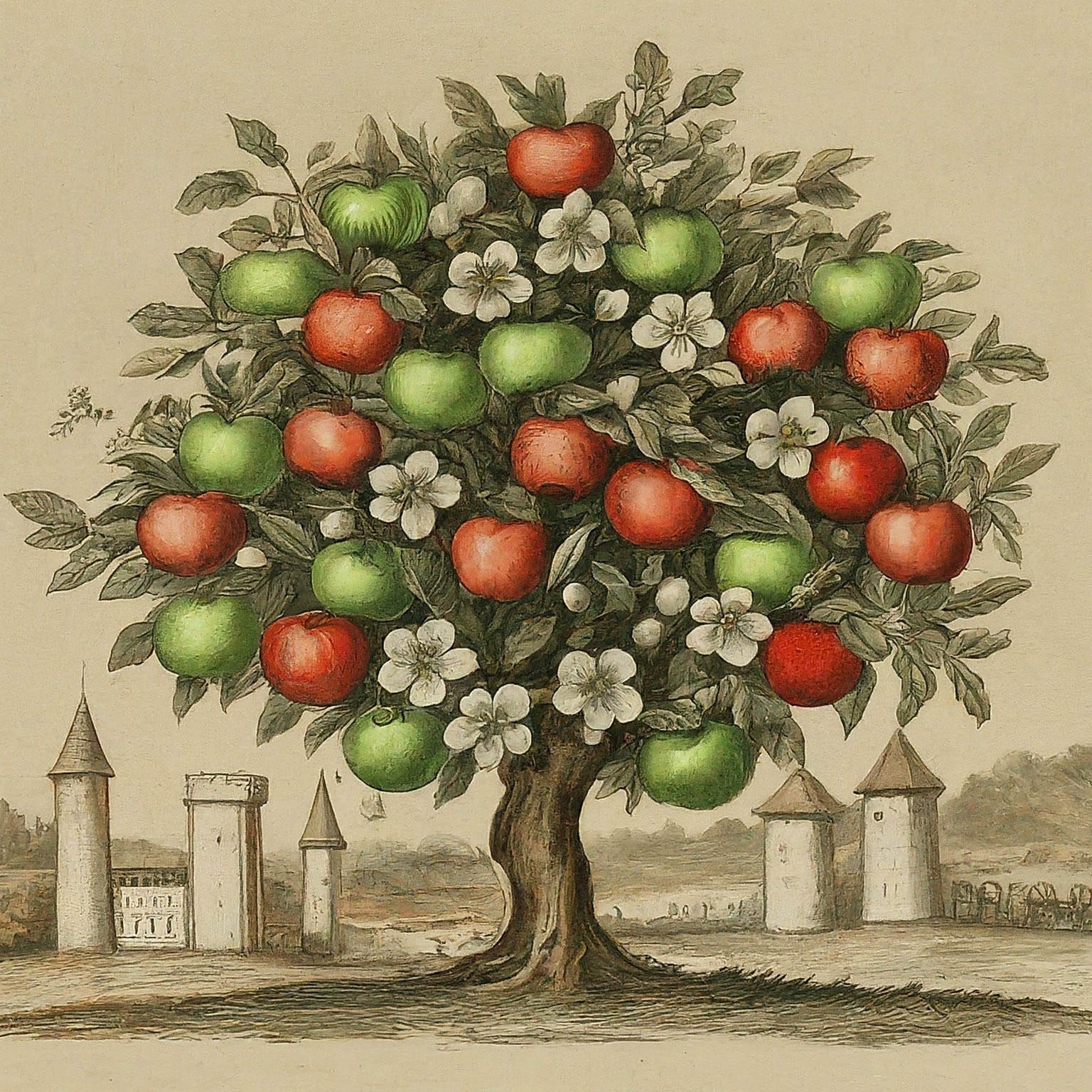
This the youth did. After some time, and two children, the ogre allowed the family to return to the lad’s widowed mother. All went well until the dove maiden rediscovered her plumage. Before flying off, she told the widow how the husband could find her in the place that is all green, all red, with five white towers.
The youth returned to the ogre for help in his search, and the ogre assisted him by giving him iron shoes and an iron staff. During his wanderings, he came across two men arguing over the possession of three magical devices: a hat of invisibility, a flying carpet, and an invincible sword. These items soon belonged to the lad, if by deceit. He wished himself to the place that is all green, all red, with five white towers.
He found his wife demoted, living in the stable of her father, the king. In order for him to reclaim her, they needed her father’s permission. The father would rather destroy the youth, but because of the hat of invisibility, he could not find him. Instead, he set the condition that the lad needed to turn a mountain into a garden overnight.
The dove maiden gave her husband a tile to be thrown down a particular well, from which would emerge thousands of men to do his bidding. By morning, the mountain had become a garden.
The father then demanded that the garden become the sea. With another tile, the youth accomplished the task.
The father then demanded to see the husband of his daughter. When he revealed himself, both the king and the queen rushed forward to devour him, but with the invincible sword, he slew them.
Reunited, the husband and wife returned to the ogre’s palace, where, in gratitude, the dove maiden restored the ogre’s sight, for it was she and her sisters who had stolen his eyes and hid them in a cave.
Thereafter, all lived in good health.
Huh. This is one for Augustus to interpret.
Fairy Tale of the Month: August 2024 The Jewel Mountain and the Dove Maiden – Part Two

Augustus Interprets
“Not Elfish Gold?” Augustus exclaims with mock shock.
“I suppose my tastes have taken a turn toward the dark side. Black Dwarf and Fairies’ Delight will fill the bill this time.”
Augustus considers. “Toward the dark side, eh? Then let me tempt you with a bowl of Raven Black.”
“Raven Black; I think I had that once.”
“You did, but I have changed the blend a bit, I think for the better.”
We are already stepping into his testing room, he carrying a small canister. When our pipes are packed, we settle in.
“You have, I assume,” says Augustus, “a story to share.”
“Have you heard of The Jewel Mountain and the Dove Maiden?”
“I have not.”
“Greek,” I say and tell him the story.
When I finish, he contemplates for a while.
“I have not heard this story before,” he says, “and yet I have.”
I nod in agreement. “It is made up of well-known tropes.”
“And yet, there is something fresh about it. Well, let’s pick it apart.”
He blows a couple of smoke rings before continuing.
“The theme of the woodcutter and his widowed mother is as old as it gets. The lad being waylaid by a merchant rings of Aladdin and the Lamp, which does not surprise me. There is only the Aegean Sea between Greece and the Middle East.
“The subterranean palace I know from A Sprig of Rosemary if nowhere else.”
“The Twelve Dancing Princesses has a subterranean palace as well,” I comment.
“Ah!” Augustus gestures with his pipe. “A blind ogre, that is new, and a sympathetic, friendly ogre as well. The Greek tales are filled with ogres, but not too many are friendly.”
“Now,” I say, “we come to the forbidden-room motif. A hero, yet more often a heroine, is given the keys to the castle and told not to use a certain one.”
Augustus frowns. “I think you are conflating two rather distinct motifs. In our story, it is the hero—and not a heroine—who gets the keys to the forty rooms of the palace and told not to enter the fortieth room. It shares similarities with another Greek tale, The Quest for the Fair One of the World—notice how long some of these Greek titles are—not to mention that part of the world’s obsession with the number forty.”
I skip over the number-forty obsession and focus on the gender question just raised.
“In the European tales,” I reflect as I speak, “when the heroine opens the forbidden door, there is something awful behind it. In the Greek tradition, when the hero opens the forbidden door, there is a marvel, dangerous, but a marvel.”
“Have you . . .” Augustus hesitates for a second. “Have you ever had a dream about being in a house, a house you know very well, but you should not be there?”
I am a little stunned. “There is a third floor to my house,” I confess, “that appears to me a little uncanny.”
“In my dream,” Augustus goes on, “I am in my great-grandmother’s dining room, hiding under her table. All about me is the high-Victorian décor and its mysteries. I fear being overwhelmed.”
Are dreams and fairy tales our way of dealing with our invented realities?” I wonder.
Fairy Tale of the Month: August 2024 The Jewel Mountian and the Dove Maiden – Part Three
Wonder Tales
I pick up the thread of our conversation. “Next up is stealing the dove maiden’s plumage to oblige her to be his wife.”
“Again,” says Agustus, relighting his pipe, “another well-known trope. With mermaids it is their fishtails, with swan maidens their feathered robes. Invariably, they get their accoutrements back again. They cannot resist them when back in their hands, even to the point of abandoning their children by their forced marriages.
“However, I cannot help noticing that the dove maiden says, before flying away, ‘Look for me in the place where . . .’ instead of the usual, ‘You will never find me until . . .’ She appears to be encouraging her husband to find her.”
“And he does find her,” I say between puffs, “with the help of the ogre and three magical devices.”
“Yes, yes, the magical devices. Notice that one of them is a flying carpet instead of the seven-league boots, a nod to its Middle East influences.
“I find it a bit interesting in this fairy-tale motif that our heroes are not above trickery to acquire the devices, yet we don’t think any less of them for it, but rather how clever they are.”
I tap out my pipe and refill it with more Raven Black. “Add an ounce of this to my order, please.”
Augustus smiles. “The dove maiden’s predicament, I did not expect. Her father, the king, consigned her to the stable in punishment for . . . “ Augustus trails off.
“In punishment for marrying a human?” I suggest.
“Possible, even though that was not her fault; she was being humiliated.”
“It is also apparent,” I put in, “her husband cannot simply put her on the magic carpet and make an escape. There are three ordeals to face.”
“Which he does,” Augustus climes in, “with the help of magic, including his wife’s magic. This scene in the story has the freshness I mentioned before. Not only the dove maiden dilemma, but I am not sure I have run across the impossible tasks of turning a mountain into a garden and then the garden into the sea. And she aids her husband with a tile to be thrown into a well to produce an army for men to do the tasks. Where does that come from?”
“A sort of wishing well, with tiles instead of coins?” I speculate.
“Maybe.”
“The third task,” I continue, “is a bit different than the first two. The youth has been hiding beneath the hat of invisibility, and the king demands to see him.”
“Right, and as soon as he does, the king and queen attack to eat him. This event comes at the end of the story, but it is the first clue we have that they, too, are ogres.”
“And dispatched with the invincible sword,” I add. “Making good use of the magic available to him.”
“I think,” Augustus taps out his pipe, “the craziest thing about this story is the surprise ending where the dove maiden restores the eyes of the blind ogre that she and her sisters had stolen.
“This hints of an entirely other tale. I imagine the ogre seeing the bathing dove maidens, just like the lad did, but was found out and punished by them by having his sight taken away.”
“Hmmm,” I say, “you could be right. The ogre had access to that world through the fortieth door and warned the youth against opening it. But where was that world; all green, all red, with five white towers?”
“That, I am convinced, is a riddle, my answer to which is an apple.”
“An apple.” I echo.
“The unripe fruit is all green, the ripe fruit all red, and the towers are the five white petals of the apple blooms.”
“I like it,” I say. “All we need do is imagine a world inside an apple.”
“And that, my friend,” concludes Augustus, “is why ‘fairy tales’ should be called ‘wonder tales.’”
Your thoughts?
 Fairy Tale of the Month