
At Melissa’s
I have never been in Melissa’s rooms above her store before. They are what I should have expected if I thought about it. A little spartan, no clutter (unlike my place) but full of Victorian touches. There is not a piece of furniture I would call modern. I am amused to see no bookshelves.
In her small dining room, she promises to lay out a Christmas Eve supper for me, Thalia, and Jini. Oddly, it is lasagna. “My family tradition,” she explains.
While the lasagna is baking in the oven, filling her apartment with an encouraging aroma, we settle in her parlor with drinks—appropriate to our ages—and cookies.
“Tonight, it is I who has a story to read to you,” Melissa says. “It is Celtic and has to do with the giving of gifts.” I see her pick up a copy of More Celtic Fairy Tales, and she continues. “The story is called How Cormac Mac Art Went to Faery.”
Cormac Mac Art, son of Art, son of Conn of the Hundred Battles, King of Ireland, who resided in Tara, purchased a fairy branch with nine apples hanging from its limbs from a youth for whatever the asking price. The price turned out to be his wife, son, and daughter. All protests Cormac quelled by shaking the fairy branch, which uttered music so dear that it tempered everyone’s fears, casting an aura of peace upon all.
After a year, Cormac decided to see if he could not reclaim his wife and children, and he followed the path the youth had taken. In his travels, he came upon three curious sights. The first was a house being thatched with feathers by warriors. After they had feathered on one side, they rode off to find more feathers. When they returned, the feathers they had thatched were gone.
The second sight was a young man consigning a tree to fire. But before he could find another tree, the first would be consumed completely. Again, the labor appeared endless.
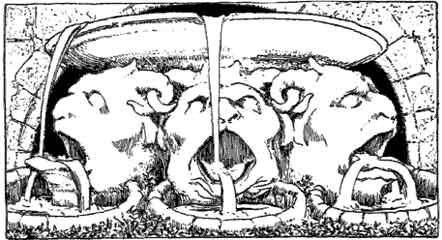
The third was of three wells. From the first flowed three streams, from the second two streams, and from the third one stream.
Traveling over the plain he had entered, he came upon a dwelling where a couple dressed in multicolored robes greeted him and offered him shelter for the night.
When it came to the evening meal, Cormac was given a boar and a log and told to cook a meal for himself. He told his host that he did not see how that could be done. The host explained that Cormac must quarter the boar, quarter the log, then place the meat over the log, and then tell a true story. The log would burst into flames and cook the meat.
Cormac then asked his host to demonstrate. The host told the story of the boar they were about to eat. He had seven boars with which he could feed the world. When one of the boars was slaughtered, they need only throw the bones back into its stall, and in the morning the boar would be whole again. As the host finished the story, his quarter of the boar was cooked.
Cormac asked the mistress for her story. She said she had seven white cows that gave enough milk to feed the world if they were present. Soon the second serving of meat was cooked. Cormac told the story of the fairy branch and the disappearance of his wife and children.
Although the meat was cooked, Cormac hesitated to feast with so few friends in the room. The host brought Cormac’s wife and children into the room and took on his true form, that of the god Manannan Mac Lir.
We hear the beeping from the kitchen. The lasagna is ready.
Fairy Tale of the Month: December 2024 How Cormac Mac Art Went to Faery
True Story
I am into my second serving of lasagna when Melissa, more easily sated than I and the girls, picks up her story again.
“Cormac,” said Manannan, “I was the youth that lured you into buying the fairy branch at the expense of your family, knowing you would follow me to faery and be here tonight. Now you and I can feast.”
“Feast I will,” said Cormac, “when I have heard the meaning of the three things I saw today.”
“That I will tell you,” Manannan said.
The god told Cormac that the warriors thatching the house with feathers were the like of those that go forth into the world seeking riches and fortune, but when they return home, they find it bare and must venture out again.
The young man dragging up the trees to make a fire is the likeness of those who labor for others and never get to warm themselves by the fire they made.
The wells represent the three types of men. There are those who give as freely as they get. Then there are others who get little but still give freely. And lastly, despite what they get, give little.
Now Cormac agreed to feast. Manannan spread before his company a tablecloth, declaring it a special thing. All they need do was to think of a food or drink, and it would manifest before them for their pleasure.
Then Manannan set down a goblet, saying that the goblet would shatter when a false story was told and mend when it heard a true one. These objects, along with the fairy branch, he gave to Cormac Mac Art.
At the courtesy of the tablecloth, they all feasted. When the feast ended, they took to their beds. In the morning Cormac, his wife, and children found themselves waking up in
Tara, still in possession of the tablecloth, goblet, and fairy branch.
We all drop our forks and applaud.
“Did they have lasagna?” I say.
“Only if they knew to ask for it,” Melissa smiles.
“Wait,” says Jini, “I’m doing the math. What happened to the fourth quarter of the boar?”
“I’ve thought of that.” Melissa blinks. “It could be the Celts didn’t bother to count, but I think the fourth quarter belongs to the listeners of this tale. But we would have to tell a true tale.”
Thalia and Jini exchange furtive glances. I am sure they have their own little secrets. Secrets old men should not hear.
“I can tell a true story,” I say.
They look at me expectantly.
“I ate too much.” I pat my belly.
“That is not a story,” Melissa laughs. “Although it is true. But I am thinking I have some truth to explore. Yet, it, too, is not a story.
“This tale dwells on true stories. The meat will not be cooked without a true story. The goblet will break at the sound of a false story and mend only by a true one. What is the truth of fairy tales?
‘We, here in this room, live in the presence of magic because of you.” Melissa looks directly at me. “Fairy tales flitter about our everyday lives. They move between the mundane and our dreams, and we cannot tell which is which.
“Again, I ask, what is the truth of fairy tales?”
Fairy Tale of the Month: December 2024 How Cormac Mac Art Went to Faery
Truer Tale
“Oh good,” I say with a touch of sarcasm. “First you lead me into an Italian food-induced coma, with a bit of wine, and then ask me to think clearly.”
Melissa wags a finger at me. “I didn’t force you to overindulge.” The girls giggle.
“Well,” I continue, “your question brings to my mind a storyteller’s adage I once heard. ‘Every story I tell is true, whether it happened or not.’”
I see calculations going on behind Thalia’s eyes. “Hmmm,” she says. “It seems to me stories make more sense than real life, no matter how fanciful they are.”
“I agree.” Melissa gestures with a hand. “Stories have a beginning, a middle, and an end. In real life, the beginning is our birth, the ending is our death, and the middle is hopefully long, but in any case, confusing. A listener or reader may get bored and lost by the incoherent middle of that long tale.”
“Does that mean,” Jini asks, a little wide-eyed, “stories break down our lives into smaller pieces so that we can understand it?”
“That is probably a good way of describing it,” Melissa answers with a bit of hesitation in her voice. I pick up on her hesitation.
“I think we are now talking about story in its broadest sense, that is, from nursery rhymes to the great works of literature. They are all story, from the Itsy-Bitsy Spider to The Iliad. But Melissa’s question regards the truth of fairy tales. I will suggest its stock in trade is with the passing on of morals and with wish fulfillment if we allow ourselves to call these truths.”
Melissa taps her fingertips together. “Give us an example.”
I take a deep breath and consider.
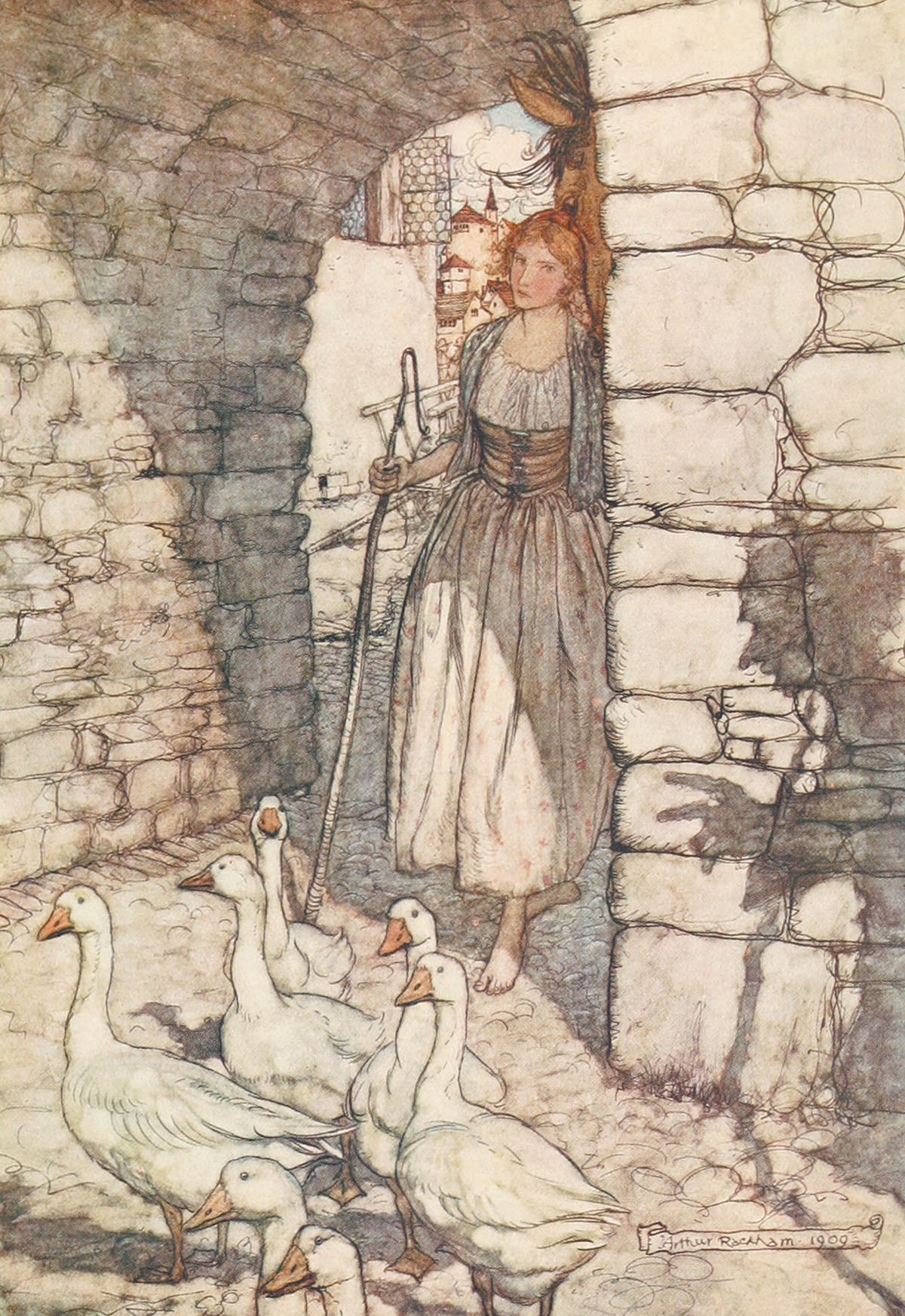
“The Goose Girl,” I say.
“I know it,” says Melissa. Thalia nods. Jini looks perplexed.
“To keep it in context,” I explain, looking at Jini, “the goose girl is really a princess whose role—let’s call it identity theft—has been taken over by a maid-in-waiting. The real princess is demoted to being a goose girl. The maid-in-waiting has forced the real princess to swear in the name of God not to reveal the exchange of status.
“Because this is a fairy tale, there is a royal marriage involved. The false princess is to marry a king’s son. However, the goose girl uses magic, which royalty in fairy tales are entitled to, in her everyday dealings. A peasant boy observes her doings so, which eventually leads to the king learning of her true nature and that she was meant to marry his son.”
“The moral?” asks Melissa.
“That the true princess should keep her vow to God, even though given under duress with the threat of death, and trust that the truth will out.”
“And the wish fulfillment?”
“That even a goose girl can rise to be a queen when her true nature is recognized.”
“Rise to be a queen!” exclaims Thalia. “That’s us.” She points between herself and Jini, who buries her face in her hands.
“Your point is taken and demonstrated,” says Melissa with a hint of mirth.
Your thoughts?
 Fairy Tale of the Month