
Alone Again
Loneliness is a sorry thing. One does not realize how comforting ambient noise can be until it is absent. No bustling about of another person. No distant voice talking on their cell. No clattering coming from the kitchen. No Thalia.
It’s February, the month that Thalia traditionally goes with her mother to visit her ex-husband’s relatives. I cannot explain that, but it is of some comfort to me that Thalia has taken Jini along with her for company.
That does leave me alone in the middle of winter for a week. However, I discover that I am not the only lonely one.
“Read me a story.” Johannes, who I thought was asleep on the window seat, is now erect, his tail twitching in agitation.
“A story,” I say thoughtfully as it occurs to me that Thalia and Jini always lavished attention on Johannes, and he misses them as much as I do.
I reach for my copy of The Complete Fairy Tales of the Brothers Grimm translated and edited by Jack Zipes, turn to the table of contents, spiral my finger in the air, and let it come down on the page, the method by which I select the tale to be told (a
Thalia tradition).
My finger lands on The Three Little Birds. The story starts with the phrase, “More than a thousand years ago . . .”
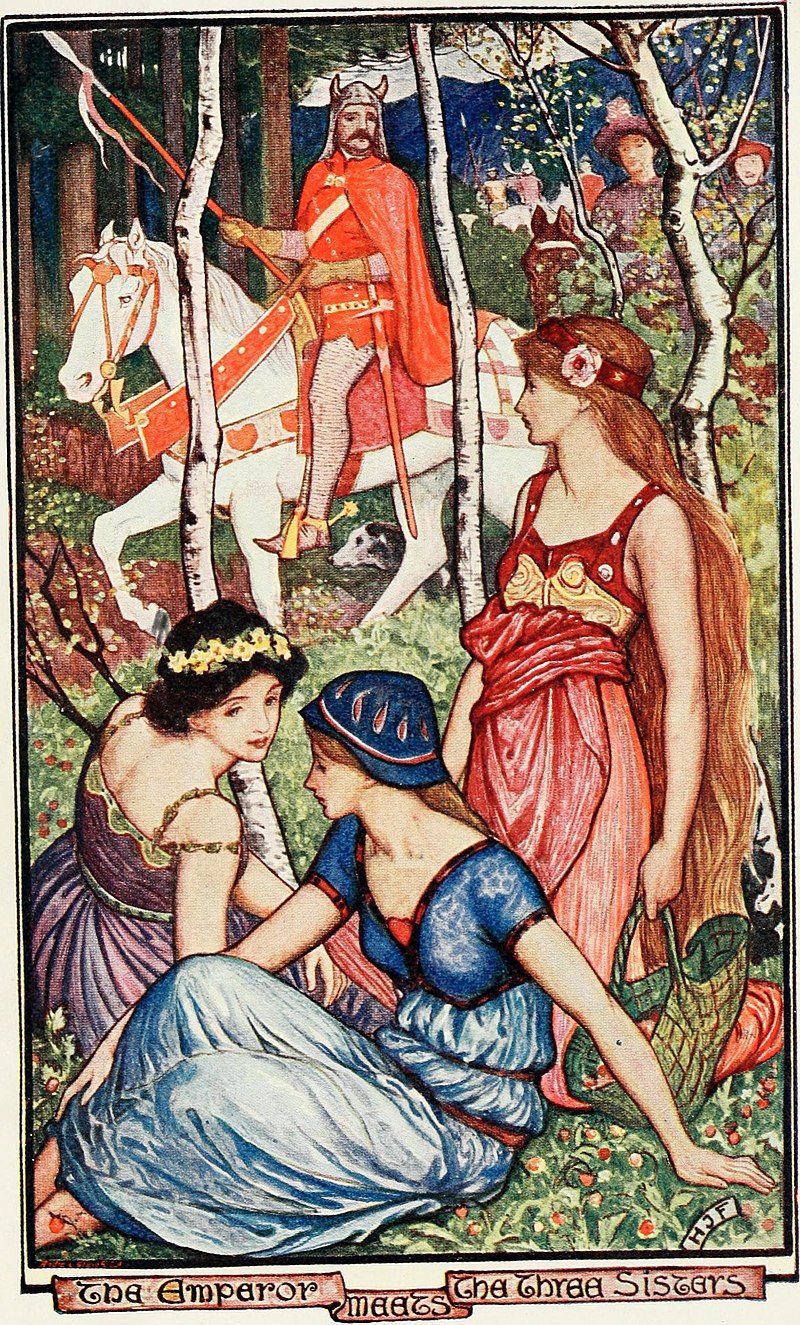
A king, out hunting with two of his ministers, hears three maiden sisters calling to each other as they tend to their cows. Each declares they would like to marry one of the three men, the eldest sister choosing the king. Soon, it is arranged.
When the king has to take a trip, he asks the other two sisters to stay with his wife as she is about to have a child, a boy as it turns out, who is born with a bright red star as a birthmark. The two sisters, not having children, are jealous and throw the child into the river.
Up flies a little bird singing,
“Get ready for your death.
I’ll see what I can do.
Get ready for the wreath.
Brave boy, can that be you?”
When the king returns, the sisters tell him his wife gave birth to a dog.
The exact same thing happens a second time, and on the third, the only difference is that the child is a girl, and the sisters claim the queen gave birth to a cat. The king then imprisons his wife.
However, each time the sisters cast the babies into the river to drown, they are rescued by a fisherman. He and his wife raise them as if they were their own.
Eventually, the eldest discovers they are all foundlings and sets off to find their father. A year later, the second brother sets off to find the first brother and, finally, the sister goes off to find them both.
She comes to a river where there is an old woman—as had her brothers. The woman carries her across the river—as she did the brothers—but because the sister is kind to her—although the brothers were not rude—she gives the sister more instruction.
The old woman gives the girl a stick and tells her to travel on and ignore the black dog along the way. At a castle, she must drop the stick on the threshold. On the other side of the castle, there will be a well and a tree. In the tree, there will be a bird in a cage. She must return with the caged bird, a glass of water from the well, and retrieve the stick on her way out. Meeting the black dog again, she shall strike it in the face with the stick and then return to the old woman.
This she does, meeting with her brothers along the way, and when she strikes the black dog in the face, he turns into a handsome prince. The old woman carries all of them back across the river and, therefore, is freed from a spell and disappears. The foursome returns to the fisherman’s hut, and there is much in the way of glad greetings.
The second brother, a bit restless, goes out hunting and then settles down to play his flute. The music attracts the king, also out hunting, and all end up in the fisherman’s hut, where the bird in the cage sings a song, which is the whole story about what has happened.
The truth now known, all return to the king’s castle, the queen is freed from prison and given the water from the well to restore her health, the two sisters are burnt, and the daughter marries the prince.
“Nice. Nice,” muses Johannes.
Fairy Tale of the Month: February 2025 The Three Little Birds – Part Two
Much Alike
“You know,” I say, “I’ve not read this story before, but I am sure I’ve read a variant.”
“You have read it a thousand times!” Johannes’s ears flatten a little. “It must be in the top ten most popular fairy-tale motifs.”
“Let me think on that a second,” I say.
Johannes does my thinking for me. “Straparola’s Ancilotto, King of Provino; One Thousand and One Nights’ The Sisters Envious of Their Cadette; Schönwerth’s The Talking Bird, the Singing Tree, and the Sparkling Stream; Wolf’s The Three Royal Children. Even stories like the Six Swans have that motif.”
“Wait,” I defend. “Six Swans? The heroine is not accused of birthing puppies and cats. She is accused of eating her children. And the culprit is her mother-in-law, not her sisters.”
“I speak of ‘The Calumniated Wife,’ or, in simpler terms, ‘The Slandered Wife.’ It comes in many forms.”
He’s got a point.
“And,” Johannes goes on, “I couldn’t help noticing Wilhelm started The Three Little Birds with the phrase, ‘More than a thousand years ago. . .’ He apparently felt this story to be very old.”
“A thousand years might be going back a little too far,” I consider. “You mentioned Straparola and, indirectly, Galland. Straparola is fifteenth century, and Galland’s translation of One Thousand and One Nights is seventeenth century. Although those stories were not Galland’s inventions and they go back far into time, I will guess they fall short of a thousand years.
“Johannes, refresh my memory. How similar are Straparola’s and Galland’s versions?”
“In both versions, the king hears or is informed of three maidens expressing their marriage wishes. The king grants their wishes, even though the girls are of no particular status, and he marries the youngest.
“In Galland’s version, the cruel sisters substitute puppies for the three children as they are born and cast them into the river in a cradle or basket where they are saved by the superintendent of the gardens, a high official.”
“A basket in the river?” I interrupt. “That sounds biblical. I may have to reconsider the ‘more-than-a-thousand years thing.’”
Johannes pushes on. “In Straparola the three children are born all at once, with golden chains on their necks and golden stars on their foreheads. The conspiracy against the queen is conducted by the mother-in-law, the two sisters, and a midwife. All three children are sealed in a box, cast into the river, and replaced by three whelps. Their rescuer is a common miller.
“In both cases, the queen suffers some sort of imprisonment, yet the three siblings end up living in a castle not far from the king, who is unknown to them as their father. Because of their special natures, the king takes notice of them, and the conspirators are alarmed.
“An old woman appears to the heroine; in Straparola’s case it is the midwife, who talks her into sending out her two brothers on the dangerous mission of finding three magical items. In Straparola it is the Dancing Water, the Singing Apple, and the Beautiful Green Bird. In Galland’s version, the tasks are to obtain the Golden Water, the Singing Tree, and the Talking Bird.
“In both cases the brothers fail, and the sister rescues them. When they show these prizes to the king, the bird reveals the whole story. The king and his children are reunited, the mother released from prison, and the evil women punished.”
Johannes must be feeling really lonely. He is talking my head off, and I don’t think he is done.
Fairy Tale of the Month: February 2025 The Three Little Birds – Part Three

My Thinking
“My thinking,” I say, “is that the Arabic version is the original even though Straparola’s version was published before Galland’s.
“Stories travel, you know, and this story traveled to Straparola’s ear, then he might have changed it to his liking for a literary audience, accounting for the changes between the two versions.
“I don’t think The Three Little Birds was drawn from Straparola. The three children being born at once is missing. The plot between the mother-in-law, the sisters, and the midwife is gone. The Three Little Birds is closer in detail to Galland’s translation.”
“Ah,” Johannes raises a paw. “But the three little spirit birds are missing from these other two versions, as well as the black dog. What have you to say about that?”
Johannes is trying to trap me.
“Indigenous additions from the local German culture,” I state.
“I believe,” Johannes asserts, “it is more complicated than that.”
“Go on,” I encourage. We have all the time in the world to argue.
“What this Grimm story has in common with the other versions is: One, there are three sisters. Two, one of the three marries the king while the other two marry men of lesser status. Three, the two sisters connive against their sibling. Four, there are two sons and a daughter born and abandoned. Five, the three children are rescued. Six, there are magical devices involved, which vary a little except for the talking bird. Seven, it is the talking bird that reveals all. Eight, the king is reunited with his children, and the culprits are put to death.”
“That is a lot in common,” I suggest, “indicating a common origin.”
“It is, but, as I have said, The Three Little Birds has its unique points. There are the spirit birds, after which the Grimms named the story. The stick and the black dog, not to mention the old woman who carries them over the river, appear nowhere else. These are all particular to the Grimms’ German version.”
“You are about to make a point, I am sure,” I say.
“Quite. Here is my suspicion. This tale traveled—as you suggest tales do—to Germany as it traveled to Italy and into Straparola’s awareness. Then, some storyteller heard it, perhaps as a youth, forgot about it, then ‘revisited’ it in a dream. The illiterate storytellers’ structure for their stories was dream construction. The spirit birds flying up as the children drown, the old woman carrying the cast of characters across the river, the stick lying across the threshold, and the black dog transforming when struck by the stick, are all dream-like forms.
“You humans are hardwired for story. It takes little for tellers separated by great distances to come up with the same story.”
“Hardwired for story,” I repeat. “I think you refer to the collective unconscious, but wait, how do you know about such things?”
“I have been around a long while. I considered Dortchen Wild my mistress when she married Wilhelm Grimm. I kept my ears open when the brothers talked. Later, I let Marie-Louise von Franz take care of me and made a few suggestions to her.”
“Really,’ I say. “Then I am flattered that you are a part of my household.”
“Don’t flatter yourself. I am here to watch over Thalia.”
Well, I should have known, but I am uncomfortable being put in my place by a cat.
Your thoughts?
 Fairy Tale of the Month