
Intuitive Editing
Recently, I had the pleasure of being in the company of Tiffany Yates Martin, a developmental editor of note and buddies with Jane Friedman. I, being a member of the committee for the three-day Write Stuff Writers Conference, helped arrange for her to be a presenter and our keynote speaker. She was quite a delight.
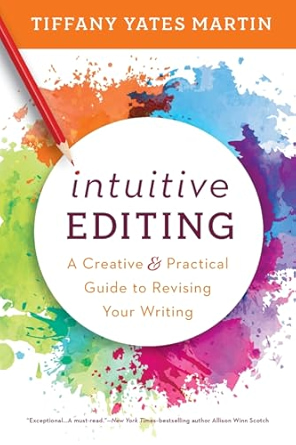
Because of an earlier career as an actor, Tiffany has honed the skill of presenting to sleep-deprived conference attendees, keeping us awake as she made salient points, points worthy of which one should take note. Inspired by her presentations, I purchased her book Intuitive Editing: A Creative & Practical Guide to Revising Your Writing at the conference book fair. (Got it signed, of course.) It is my current favorite book on writing.
Beyond the introduction and before the final word, she divides the work into four sections and thirteen chapters. I think it illustrative to simply list the sections and chapter headings. I like the way she has broken things down.
Part I: Macroedits
Character
Stakes
Plot
Part II: Microedits
Suspense And Tension
Point of View
Showing and Telling
Structure
Momentum and Pace
Voice
Part III: Line edits
Line Editing
Part IV: Getting Feedback
How to Train Your Editor Brain
The Frugal Author’s Guide to Getting Editorial Feedback
Hiring a Pro
Within the chapters, as she addresses problems, she has the recurring subheadings labeled How to find it and How to fix it. She uses many examples to illustrate problems but is also quick to bullet point for simple, concise clarity. I appreciate the mixture.
I will also point to chapter eleven, where she spends eight pages on critique groups and provides the most exhaustive coverage of the topic and its pros and cons that I have encountered in books about writing.
I did scan the reviews of the book on Amazon. Mostly positive. I found the objection that there is nothing ‘intuitive” about the work to be valid. It is all very practical advice. I found the one-star review that dealt with the reviewer’s objection to the way she referred to Dan Brown’s works to say more about the reviewer than about the author. (You’ll have that.)
My next read might well be her The Intuitive Author: How to Grow & Sustain a Happier Writing Career.
There are other worthwhile books on writing:
On Writing, Stephen King
The Writing Life, Annie Dillard
Bird by Bird, Anne Lamott
The Elements of Style, William Strunk & E.B. White
Story, Robert McKee
Steering the Craft, Ursula K. Le Guin
To name a few, some are still on my books-to-read list.
What are your favorite books on writing?
 Fairy Tale of the Month