
Sinister Castle
At the girls’ insistence, Duckworth and I are rowing Thalia and Jini up and down the Isis, which is to end in a picnic at Christ Church Meadow. We’ve done this before. It may become a summer tradition.
I know much attention was given to the picnic basket this morning in my kitchen, a space the girls took over to the extent that I could only grab a cup of tea and a cold scone for my breakfast.
I also know the seriousness with which they are taking this outing. They want to commune with nature so much that they have left their smartphones behind.
I can’t help but also notice they both wear the leaf pendant around their necks that the nixie gave to them.
We’ve only been rowing for a few minutes when Thalia reaches into the picnic basket and retrieves Lang’s The Brown Fairy Book.
“The Fish Knights,” Thalia announces and reads aloud to us.
A cobbler, despite working from dawn to dusk, cannot bring in enough money to feed himself and his wife and turns to fishing to find food. The first fish he catches is marvelous and speaks to him, telling the cobbler to cook him and divide him into four pieces, two for his wife and two to be buried in the garden. Before long, his wife gives birth to two identical boys. Two plants grow in the garden, budding two knight’s shields.
When the lads grow to be young men—tired of the quiet life and being mistaken by everyone to be their identical other—they set off on their life’s journey in opposite directions, although with fond farewells.
Thalia pauses here in her reading to take in a deep breath of fresh air and see the willow trees along the bank before continuing.
One of them travels to a city that appears to be in mourning. Inquiring into this despair, he hears that every year the city must sacrifice a maid to a dragon. This year it is the king’s daughter, a girl loved by all. Borrowing a horse, lance, and mirror, the youth rushes off to save her.
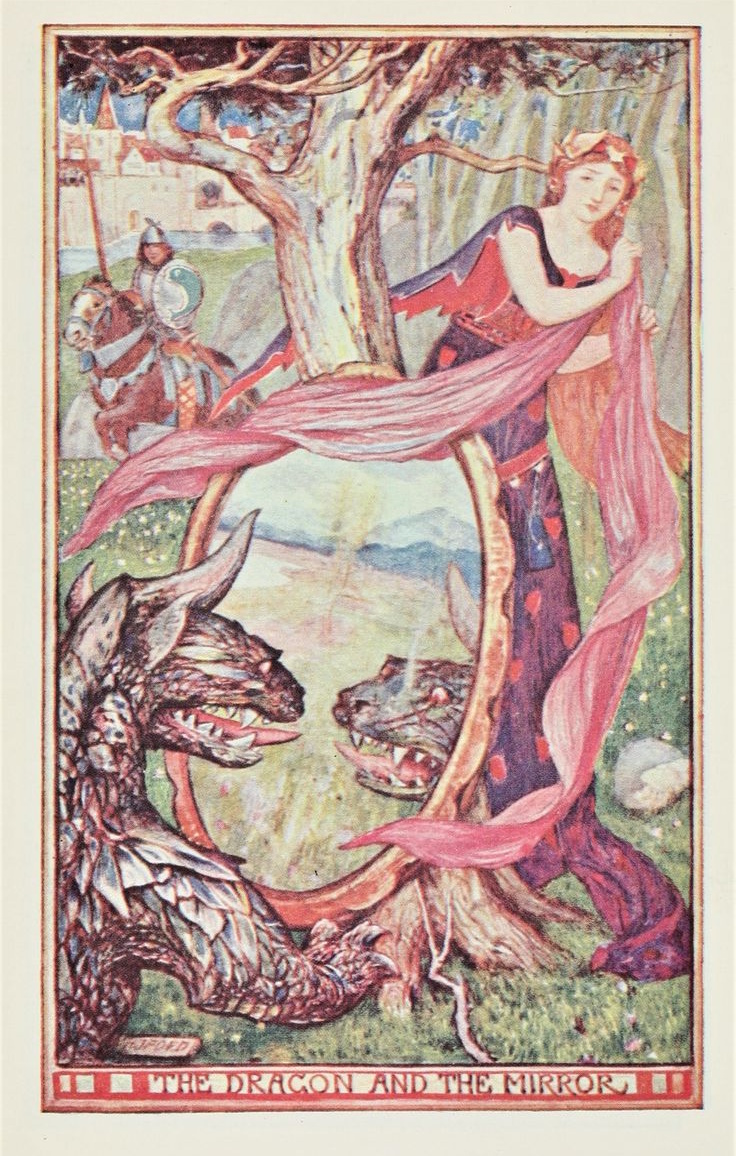
He places the mirror against a tree and instructs the princess to put her veil over the mirror and stand in front. When the dragon charges for her, she is to pull away the veil and slip behind the tree.
What the dragon perceives is the princess disappearing and another dragon facing him. He attacks the mirror, which shatters. Confused by the multiple images of himself scattered on the ground, he is distracted long enough for the lad to charge up on his horse and thrust the lance down its throat.
The lad and the princess are soon married, and all is well for a short time until he notices a sinister, black marble castle in the distance. Although warned by his wife that no one returns from visiting it, he is compelled to investigate.
Again, Thalia pauses to take in the river’s ambiance with a contented sigh as Duckworth and I happily labor at the oars.
The lad knocks on the door of the black marble castle, asking for a night’s shelter as if he were a wandering knight. The witch of the castle allows him in, but she soon insists he marry her. He refuses. Through her trickery, he meets his death.
Meanwhile (fairy tales are full of meanwhiles), after a time, his identical brother shows up in the city, and everyone is jubilant at his “return.” Realizing he has once again been confused for his brother and fearing his brother is in peril, he continues the ruse. When asked what happened to him at the sinister castle, he says his mission is not over and he must return.
After the witch allows his entry, she recognizes him as her last victim’s ghost. She tries to flee, but he wounds her with his sword. She begs him to restore her to life and gives him the potion formula to do so. This he does, but also applies it to his brother and all the former victims, including the girls sacrificed to the dragon.
The witch, seeing her evil undone, dies of rage. As she takes her last breath, her black marble castle crumbles.
Thalia snaps the book shut as Duckworth and I beach the boat at our picnic grounds.
Part Two

The Picnic
We find a large oak under which to spread our blanket. The girls unpack the basket in a deliberate—and I suspect—prearranged manner. They are so fastidious, you would think Melissa was here.
“OK,” says Duckworth, settling himself and eyeing the delectables coming out of the basket, “so, talking fish is one of those motifs you talk about?”
“Oh, yes,” I say. “Common as cockroaches. I doubt there is a culture, country, or ethnic group that doesn’t have a talking-fish fairy tale.”
“Oh!” Jini pipes up, “Like the tale of Matsya.”
“I don’t know that one,” I inquire.
“Well,” Jini concentrates, “more myth than fairy tale. King Manu saves a little, talking fish, which grows into the huge fish, Matsya, who is actually an avatar of Vishnu, and warns Manu of the coming world flood. Our Manu is your Noah.”
Duckworth raises his eyebrows, but it is at the Wiltshire Ham she just loaded out. That was thoughtful of the girls to remember his weakness for this delicacy.
“I have a personal theory about talking fish.” I seize the moment to pontificate. “Fish are subterranean; that is, they live under the surface. I believe the fairy tales, sprung from our imaginations, equate that with the subconscious. I say the talking fish are messengers from our collective unconscious. But what the talking fish say and do is in the language of dreams and no easier to understand than the dreams themselves.”
I end my little lecture and observe they have not forgotten the potato salad.
“I thought the fish getting cut into four pieces was pretty cool,” Thalia comments.
“It sacrificed itself,” Jini observes.
“I’m guessing it knew the future,” Thalia adds as she sets out the Scotch eggs.
“Did it? I think we can’t know.” Jini’s expressive face holds worry.
“It must have,” Thalia returns. “It knew the cobbler’s wife would have two sons and the garden would grow two shields; don’t you think?”
“OK,” says Jini, “but beyond that, were the guys predestined? Were the fish’s two knights meant to go out in the world to do good, or were they specifically there to destroy the witch?”
Thalia nodded at the dilemma.
“We have here,” I say, returning to lecture mode, “a linear tale, as opposed to a circular tale.”
Both Thalia and Jini cock their heads toward me. Good. I have their attention.
“A circular tale example is the Grimms’ The Fisherman and His Wife, where Isabelle and the fisherman start out living in a miserable hovel, but through her demands upon the enchanted flounder—another talking fish—who was spared from death by the fisherman, she attains great wealth and position until she asks for too much and ends up back in their miserable hovel.
“Tolkien’s The Hobbit: Or There and Back Again is another example of a circular tale.
“Our story is a linear tale. It starts with a cobbler deciding to go fishing and ends with a black marble castle crumbling into dust. Each step of the story goes forward, and there is no turning back. We move from a hungry cobbler to the death of a witch. We do not end where we started.”
“Yeah,” says Thalia thoughtfully. “Well, time to eat.”
Part Three

The Spread
The spread is admirable. Besides the Wiltshire ham, Scotch eggs, and potato salad, there are quiche, egg and cress sandwiches, charcuterie, crisps, cut fruit, and Victoria sponge cupcakes, as well as iced tea to drink. I thought to bring a flask of Pimm’s Cup, minus the sprigs and slices, for Duckworth and me to pass back and forth.
“How about the twin thing?” Duckworth is already munching on the Wiltshire. “Is that unique to this tale?”
“No,” I say, between bites of potato salad. “I can think of two more, at least: the Grimms’ The Two Brothers and a Lang tale, The Twin Brothers. Both are long stories, and, as I recall, the Lang tale has a fish, not a talking fish, but a goldfish that gets cut up into six pieces: one for the fisherman and one for his wife, who will birth two identical boys; one for their dog, who will bear two identical puppies; one for the mare, who will bring forth two identical foals; and two pieces that are buried in the ground on either side of their front door, from which grow cypress trees. How’s that for the start of a story?”
“Oh, I want to read that,” Thalia chimes in.
“The more I remember about The Two Brothers and The Twin Brothers, the greater their resemblance, and all three end with one brother saving the other.”
“Another motif,” Duckworth sighs as he samples some Stilton from the charcuterie as the girls titter.
“I’m still thinking about the fish.” Jini takes a bite of an egg and cress sandwich. “The fish is hacked up into pieces, but he is not really killed.”
Jini stops to think for a second. “Transformed.”
“Yes,” I say, “the fairy tales are all about transformation.”
“And about magic,” Jini continues. “Yet some of this is a stretch for me. The fish’s body is transformed into two identical boys and two shields that show the boys are to be knights. All well and good.
“But to the rest of the world, they are the sons of a cobbler. They had no formal training to be knights. No one has knighted them, and yet no one in the story questions their humble birth. Isn’t that asking too much of magic to have poor boys become knights, and one marry a princess?”
Thalia eyes her friend through lowered lids. “No. They are heroes. The first one comes to a city and sees injustice being done. On his own, with little support—they lend him stuff—he saves the princess and destroys the dragon. That is noble! The second one heroically saves the first hero.
“Why get picky about how they were born? Jeez, even the Beatles were knighted. I don’t think any of them even rode a horse.”
“Ah…,” Duckworth raises a finger, “only Paul and Ringo were knighted, and Paul’s wife, Linda, was big into horses.”
Thalia rolls her eyes, and I raise my eyebrows.
I didn’t know Duckworth was a Beatles nerd.
“I think with the fairy tales,” I conclude, “we need practice Samuel Taylor Coleridge’s ‘willing suspension of disbelief.’”
“OK, I’ll buy that for now.” Still, Jinni looks skeptical as she reaches for a Victoria sponge cupcake.
Yes, the Victoria sponge cupcakes!
Your thoughts?
 Fairy Tale of the Month