
A Walk
Duckworth rings me up. “Listen, this is the time of year we hunker down and become inactive. We need to make a special effort to keep going.”
I agree with him.
“Let me suggest,’ he says, “we participate in the Serpentine Swimming Club.”
“What’s that?”
“It’s an inclusive, community organization that’s given permission to swim in the Serpentine between the hours of 5:30 am and 9:00 am all during the winter.”
“Duckworth, I am not a polar bear, if a bit rotund. Let me suggest a group in Devon who run around carrying flaming barrels over their heads. At least they have a source of warmth.”
We settle on a walk in Hyde Park, where we can view the Serpentine Lake, but we need not enter it.
We now stride by the Italian Gardens on our way to the Peter Pan statue.
“Well,” says Duckworth, “what story has Thalia read to all of you of late?”
I think for a second. “Ah, yes, The Battle of the Birds. A Scottish tale, a concoction of motifs, but like a good cocktail, it’s the ingredients that count, and this story is a pleasant mixture.”
“Tell on.” We have hit on a leisurely pace.
There was a battle between the creatures of the earth and the creatures of the sky to see who should be king. The prince of Tethertown came to witness the battle.”
“Tethertown? Where’s that?” Duckworth frowns.
“The story does not say.”
“Of course, this is a fairy tale. Sorry I interrupted.”
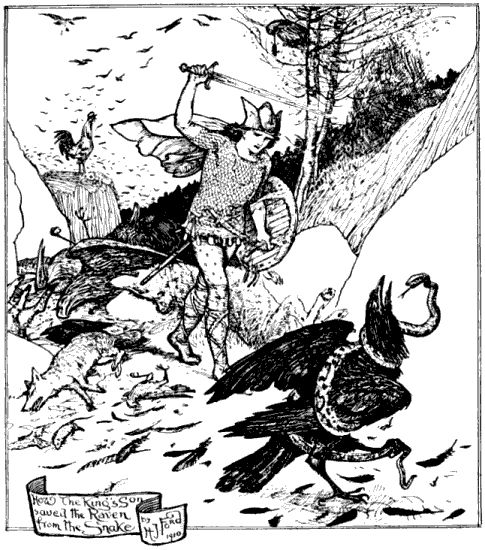
The prince nearly missed the entire battle and arrived when the last combatants—a snake and a raven—were having at each other. The snake had the upper hand. (The wordplay is mine and intended.)
After Duckworth rolls his eyes, I continue.
The prince interceded and cut off the snake’s head. In gratitude, the raven flies the prince off to his sister’s home to be feasted. When the feasting was over, the raven had turned into a young man who gave the prince a bundle.
“A bundle of what?”
“You’ll see.”
The young man instructs the prince not to open the bundle until he is in the place where he wants to live. Of course, curiosity got the better of him.
“Of course,” Duckworth sighs.
The lad untied the bundle, and out popped a castle surrounded by an orchard. Immediately, a giant appeared and offered to put the castle and orchard back in the bundle in exchange for the prince’s firstborn son when the lad reaches seven years of age. The prince agreed.
Duckworth raises an index finger in the air. “Ah, the firstborn motif I recognize.”
“Quite right.”
When the castle was properly situated, the prince found it came with a beautiful woman, whom he married.
“Now there’s a real-estate deal.” Duckworth’s eyebrow arches.
Seven years later, the giant showed up for his payment.
“Oops.”
We approach the Peter Pan statue and spend a good bit of time admiring its delights before moving on.
The prince and his wife tried to substitute other children, but each time the giant asked the child about his father, which revealed who the real father was. The giant raised the boy as his own son but kept the existence of his three daughters a secret from the lad until it was time for marriage.
Before that happened, the lad, drawn in by her harp playing, discovered the giant’s youngest daughter. She explained that she was betrothed to the son of the king of the Green City, whom she did not want to marry.
“Whoa, wait, son of the king of the Green City. Where . . . no, never mind.”
“Right.”
They conspired that when the giant offered the lad one of the elder sisters for marriage, he was to insist on the youngest.
Duckworth turns his head towards me. “Is this a long story?”
“Oh, most certainly.”
Part Two
A Stroll
We soon come to the Diana Memorial Fountain. However, a fountain it is not. It is more of a Diana Memorial Flume. I am not objecting to the structure. Really, it is a lot of fun, and running water is a thing pleasurable to the eye. But let us not call it a fountain.
Putting my umbrage aside, I continue my tale for Duckworth’s benefit.
As the youngest daughter predicted, her father was not happy with the lad’s demand and put forth three challenges, the first being to clean the giant’s cattle barn—which had not been done for a hundred years—until a golden apple could be rolled from one end to the other. Otherwise, the lad would pay with his blood.
“Stop,” says Duckworth. “My college English classes now stand me in good stead. That’s one of the tasks of Hercules, who diverted a river to wash out the barn. And golden apples were rolling around in there somewhere, too.”
“Quite so; only here, the lad fails in his labors, and the youngest daughter tells him to go to sleep while she, magically, completes the task.”
The next task was to roof the barn with the feathers of every different type of bird. The lad went off hunting but only killed two blackbirds. Again, the youngest daughter bid him sleep while she did the work.
“Wait again.” Duckworth stops walking. “The lad’s father saved the raven from the snake, yet the lad condones the killing of birds to roof a barn?”
“A valid point, but shut up until we get to the end, and we’ll talk about it.”
“OK. Sorry.”
On we go toward the Serenity.
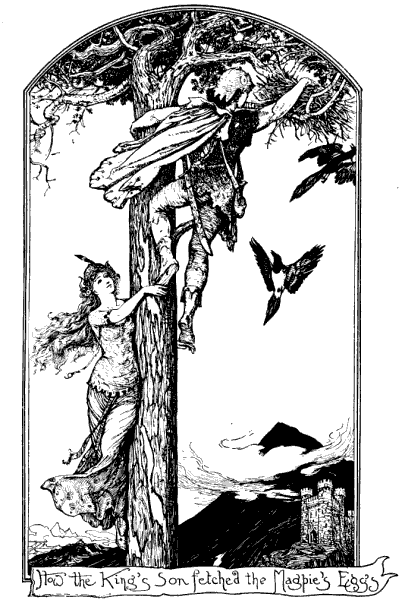
For the third task, the giant wanted five eggs for his breakfast from a magpie’s nest in a particular fir tree, five hundred feet tall with no branches until the very top. Failing to shinny up the tree, the youngest came to the lad’s aid, putting a finger against the trunk and then another above it. She floated upwards, giving the lad’s feet purchase for each step. The lad achieved the eggs, but on their rapid descent, the youngest’s little finger got caught in a branch, and she was, as the story says, obliged to leave it behind.
Having accomplished the three tasks, the giant had to allow the marriage. Yet, there was a fourth task that the youngest anticipated. The giant had the three sisters dressed identically, with veils inferred, and the lad needed to pick out which was his bride. The youngest told him to look for the one missing her little finger.
This test passed, the marriage proceeded.
“Might that be the end of the story? And they lived happily ever after?” His wicked smile clues me into his intent.
“You know better than that,” I respond as we pass by the admirable Serenity statue.
The youngest more than suspected her father would murder them on their wedding night. She took an apple and divided it into nine pieces. Two she put at the head of their bed, two she put at the foot of their bed, two by the kitchen door, two at the main door, and one outside.
During the night, the giant called out, “Are you asleep?” The apples, in turn, answered that they were not. Meanwhile, the couple fled on a blue-grey mare.
“This is a long tale.”
“I told you so.”
Part Three
An Amble
As we make our way around the Serpentine, we come to the area roped off for swimmers.
“Excuse me a second.” Duckworth goes to the edge of the shore, takes off a glove, and sticks his bare hand in the water. I am sure it is my active imagination, but I see his hand, as well as the tip of his nose, turn a light shade of blue. He dries his hand the best he can and puts his glove back on.
With a shiver, he says, “There’s a kiosk up ahead that sells hot coffee.”
We amble on, purchase coffee, and I continue my tale.
Discovering the ruse, the giant took off after the couple. When the youngest sensed her father getting near, she told the lad to reach into the mare’s ear and throw whatever he found behind them.
Duckworth recoils. “Ick! That sounds—well—unsanitary.”
“It’s another motif,” I say.
Duckworth scowls. “Is ‘motif’ a code word for saying crazy stuff?”
“No, it’s a code word for copying crazy stuff said by other tellers.”
“Ah.”
We pass by Henry Moore’s statue called The Arch without taking much notice, as I return to the tale.
The lad found a sloe twig, tossed it behind him, and twenty miles of thornwood sprang up. The giant had to return home for his axe and wood knife in order to get through, but he was soon in pursuit again.
The next time, the lad found a grey splinter of stone that turned into twenty miles of impassable rocks. The giant returned home for his lever and crowbar.
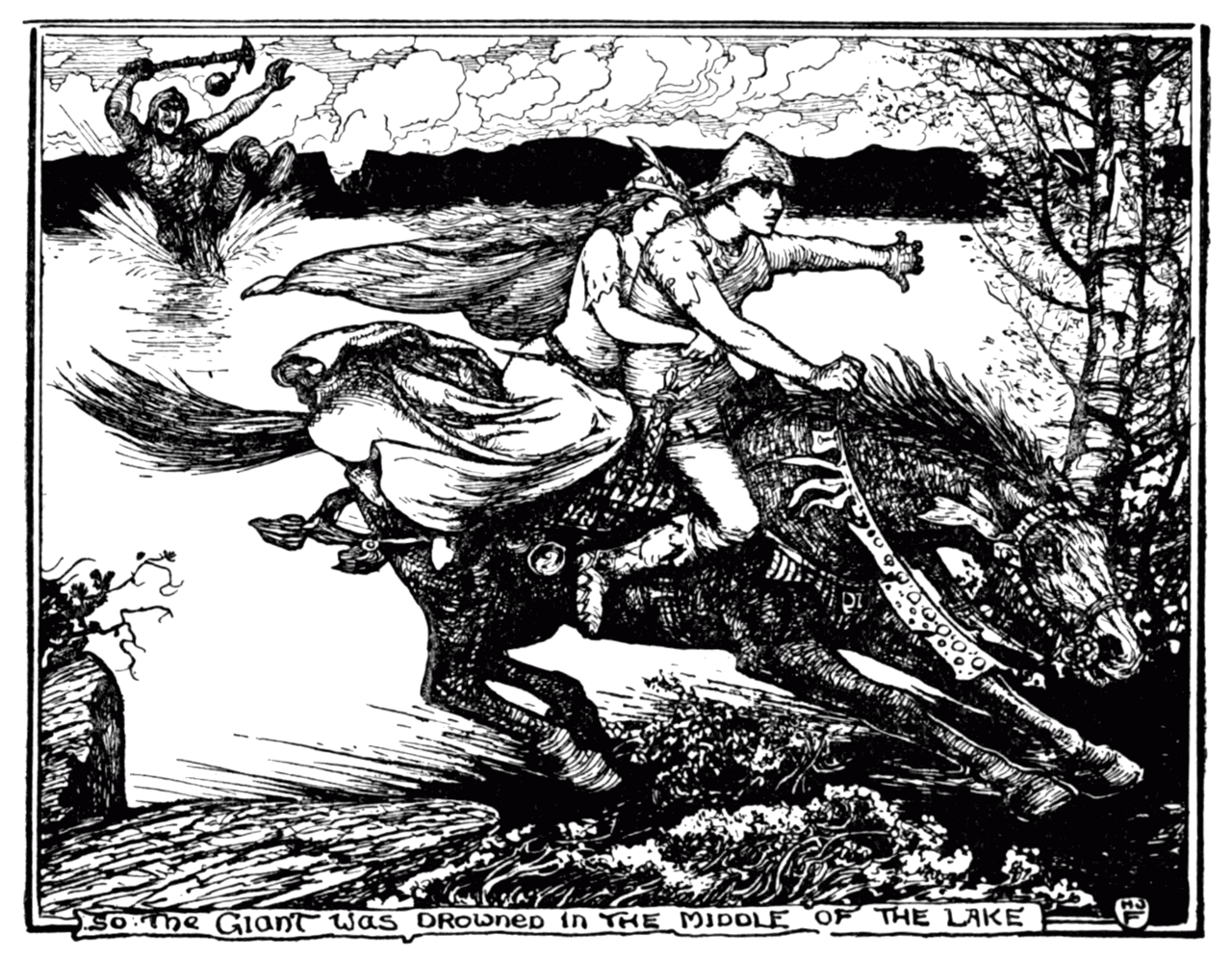
When the giant caught up for the third time, the lad tossed a bladder of water that turned into a loch in which the giant drowned.
I see Duckworth considering. “I’ll bet the story is not over, is it?”
“Nope.”
When they came to the gate of the lad’s father’s castle, the youngest told her husband to enter and warn them that he was returning with a bride. However, he must let no one kiss him, or he would forget all about her. Unfortunately, upon entering the castle, his old greyhound recognized him and leapt up, licking him on the lips.
The youngest waited by a well. When night fell, and he had not returned for her, she climbed into the oak tree that shaded the well. The next morning, a shoemaker’s wife came to the well and saw the youngest’s reflection in the water. Thinking it was her own, she dropped her water pot in surprise, smashing it. The identical thing happened to the daughter, after which the shoemaker discovered the youngest in the oak tree. He invited her to stay with his family and work for him.
When it was announced that the king’s son—the lad—was to be married, the young men of the court came to the shoemaker for new shoes to wear to the wedding. Three of them took a fancy to the youngest, but, one by one, she tricked them when they came courting. The first got stuck to the well, the second stuck to a door latch, and the third got his foot stuck to the floor. None could move until she released them, and they went off embarrassed.
Duckworth and I return to the other side of the Italian Gardens, settle down in Queen Anne’s Alcove, and finish sipping our coffee and the story.
On the day of the wedding, she and the shoemaker went to the castle to deliver the shoes. She ended up in the banquet hall. When she raised her wine glass, flames shot out. Up rose two pigeons, one gold and the other silver. Three grains of barley fell to the floor. The silver pigeon swooped down and swallowed them, as the gold pigeon reminded the lad of how “I” cleaned the cattle barn. This happened twice more with the reminders of how “I” feathered the roof and how “I” aided with the magpie eggs as the silver pigeon ate the grain.
With that, the lad remembered his wife. Since a wedding had been prepared, they got married a second time.
“Listen,” says Duckworth, there is a meeting I need to get to. Still, I’d like to talk more about this story. That last bit with the pigeons is really odd.”
“We’ll get together again, I’m sure,” I say. “Hmmm, and maybe with some friends.”
An idea pops into my head.
(To be continued.)
Your thoughts?
 Fairy Tale of the Month