
Irish Story
“In honor of Saint Patrick’s Day,” Thalia announces, “I will read an Irish story.”
We are all settled in the study for the evening reading. By we, I mean Thalia, Jini, Johannes in Jini’s lap, the fairy on her shoulder, probably the brownies in the dark corners, and myself. A fire in the hearth keeps the March dampness at bay.
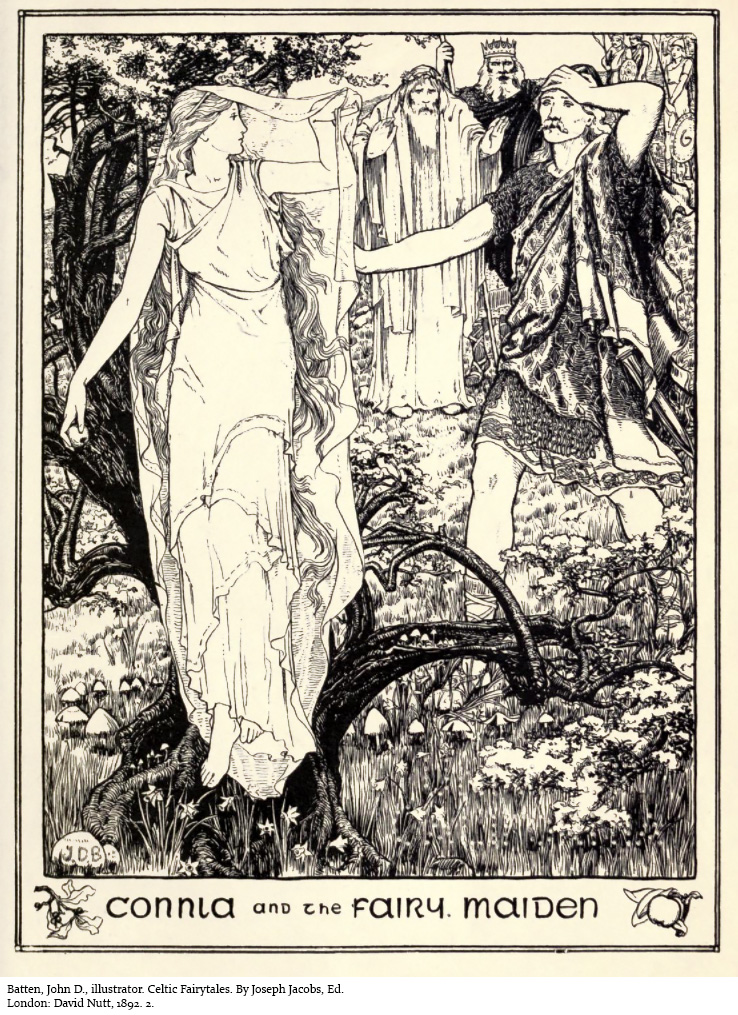
“Connla and the Fairy Maiden from Celtic Fairy Tales.”
Connla of the Fiery Hair, son of Conn of the Hundred Battles, stood on the heights of Usna with his father when they were approached by a fairy maiden that only Connla could see and hear, although Conn could also hear her.
They gathered that she had come to take Connla to the fairy world, the Plain of Pleasure, to be her consort and live with her forever until the Judgement Day. Fearful, the king called for his Druid, who drove her off with a spell, but not before she threw an apple to Connla.
For the next month, Connla would not eat or drink save for consuming the apple, which grew back its flesh. As Connla ate the apple, he became more enamored of the fairy maiden.
At the end of the month, she reappeared. Connla, the king, and their men were on the Plain of Arcomin. As before, Connla could hear and see the fairy maiden, and Conn again called for his Druid. The fairy maiden pleaded her case, pointing out the evilness of the Druids.
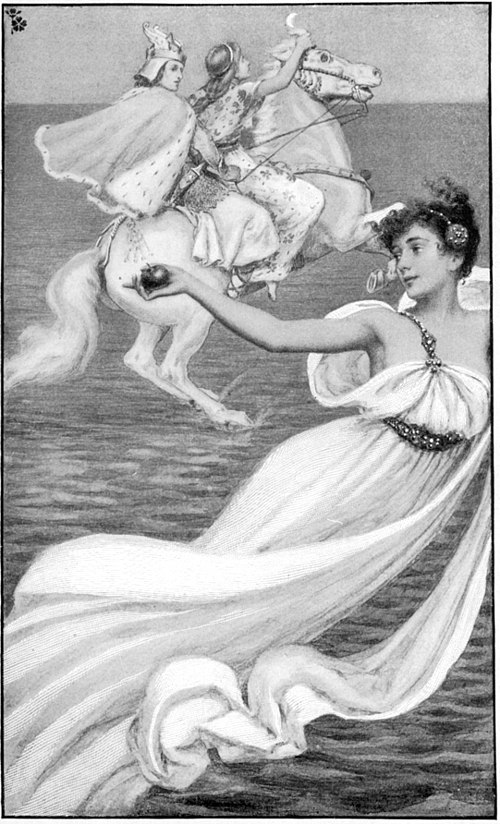
The king deferred to Connla and let him make the decision. Connla was torn between his kin and the fairies. In an impulsive gesture, he left with the fairy in her crystal boat, never more to be seen.
“Oh,” Jini sighs, “that’s so lovely and tragic. Connla is torn between those he loves and the one he loves. He can’t have both. Kind of Romeo and Juliet, sort of.”
“Ah!” I say. “Star-crossed lovers.”
“Oh,” Jini smiles. “I like that too.”
Johannes stirs restlessly in her lap. “It’s really Oisin and Niamh.”
I hadn’t thought Johannes was listening, only taking advantage of Jini’s lap while she stroked him during the reading.
“In that version, Oisin returned from fairyland, Tir na nÓg, after a year, except in our time it had been three centuries. Niamh warned him to stay on his horse and not touch earth, but accidents happen. He was condemned to be an ancient man, not able to return to the Land of Youth. Curiously, it is said he met and talked to Saint Patrick. All in all, the tale falls well within the Irish tradition of tragedy.”
“I know that version too,” says Thalia, “but I prefer this one. It ends much more romantically. Connla disappears in a crystal boat with a beautiful woman. I say, let’s leave it there.”
Jini scratches Johannes gently behind his ears. “The fairy tales are filled with love stories. Couples are getting married: Cinderella, Snow White, Sleeping Beauty, all of them.”
“Yeah, but,” Thalia puts in, “I’m thinking of the lovers who cross over into fairyland, like Connla and Oisin, and don’t get to come back without it becoming a disaster.”
“Ah,” Jini nods, “bittersweet.”
Part Two
More Irish
“I remember,” I say, “another Irish tale about Brân Mac Febail, who was, one day, out walking when he heard beautiful music that put him to sleep. When he awoke, there was a silver branch with white blooms in front of him.
“That evening, in his court, appeared an otherworldly woman, who took the branch, explained it came from the Land of Women, sang a song describing that land as a paradise, and encouraged Brân to sail there. She then disappears with the branch.
I have Thalia and Jini’s undivided attention, and I go on.
“He and a number of companions sailed off, met the sea god Manannán riding a chariot across the waves, the Isle of Joy where the inhabitants couldn’t stop laughing, and then the Land of Women. Brán and his men were paired off with mates.
“After a year of feasting, they wished to return to Ireland but were warned by the woman not to touch land. Nonetheless, they sail. Remaining on the ship, they call out to people on the shore. They only knew the name Brân Mac Febail as a legend. When one of his men went ashore, he instantly turned to dust.
“Brân related his story to those gathered on the shore, then sailed off never to be seen again.”
“Yeah, similar,” Thalia nods, “but the women don’t call themselves fairies?”
“No, they don’t. It does sound a touch like some of the islands in The Odyssey.”
“I’m thinking,” Jini squints a little, “of Tam Lin, sort of.”
“Sort of?” Thalia squints back at her friend.
“Well, it’s the opposite. Connla is kind of abducted by the fairy maiden to fairyland. Tam Lin is abducted from the fairies by a mortal woman.”
“Oh, oh, okay.” I see Thalia analyzing. “Tam Lin was a mortal man, taken by the fairies, and about to be sacrificed when stolen back. The Tam Lin thing is a bit more complicated than Connla’s, but still there’s shuffling back and forth between the worlds, and it’s romantic. I’ll count it.”
“Let me make another suggestion to be included in your club,” I try again. “There is a Welsh tale of King Pwyll and Arawn, lord of the otherworld. To settle an argument between them, they agree to take on each other’s likeness for a year, and Pwyll, mighty warrior, would defeat Arawn’s enemy. Honorably, Pwyll does not take advantage of Arawn’s wife and does defeat his enemy.”
“No romance,” Thalia frowns. “Doesn’t count.”
“No, wait,” I argue. “There is still exchange between the two worlds.”
“Doesn’t count,” Thalia insists.
I sense a prejudice toward romance. “I believe I have one more to be considered for the club, Thomas the Rhymer.
“He was lounging under a tree when the queen of Elfland lured him away. On their trip to Elfland, they come to three forks in the road. The queen explained that one road led to heaven, one to hell, and the other to Elfland.
“After seven days in Elfland, the elf queen sent him home again because, in fact, seven years had passed. Like Tam Lin, she feared he would become the ‘tithe to hell.’ He returned with the gift of prophecy and the inability to lie. During the next seven years, he became famous for his prophecies, but then a hart and a hind came out of the forest and summoned Thomas back to Elfland, and he was not seen again.”
Thalia raises her finger. “Thomas can join the club.”
Part Three
A Meal
“I am torn between the sweetcorn ribs with a lime pickle or the shalgam sabzi. With the shalgam, I get a poached egg and pickled daikon. I’ll go with that.” Melissa lays down her menu. I have already decided on the mutton chops with red cabbage and green chutney with a side of masala fries.
We are sitting in The Raglan on Shernhall Street. The building is a large, red-brick structure. The restaurant is an Irish/Indian culinary mashup. We have seated ourselves at the back in the bright, greenhouse-like extension.
“And what are the girls up to?” Melissa queries. I don’t get to answer her until our server has taken our order.
“I think they might be starting the Fairy-Tale Romance Club, very informal though. It did occur to me, during our silly conversation, that the word ‘romance’ is not usually applied to the term ‘fairy tale’unless they are modern retellings.”
Melissa cocks her head. “I did my master’s dissertation on that word.”
“Really?” I declare. “Please pontificate.”
She takes a sip of water before starting. “During medieval times Romantic literature referred to works not written in Latin, that is to say, the vernacular.”
“Oh,” I say, “the Romance languages, French, Spanish, etc.”
“Exactly, serious writing—philosophy, medicine, religion—tended to be in Latin, the language of scholars. Fictional writing happened more often in the common tongue.”
I nod. “I am thinking of The Canterbury Tales andLe Morte d’Arthur as examples.”
“Right again. Those non-Latin works were adventures, trials, wonders, and things out of the ordinary.”
“Under that definition,” I confirm, “fairy tales are romantic.”
“Yes. Even when the hero and heroine in the tales get married, as they so often do, it is still not so much about loving each other; it is more about the restoration of order, regaining identity, or achieving a goal. The fairy tales are not about ‘boy meets girl, boy loses girl, boy gets girl back again.’”
Our conversation lapses when our food arrives, but only for a few minutes until Melissa continues.
“I can cloud the issue by talking about the German Romantic Movement.”
“Please do.” I return to my mutton.
“It was a reaction to the Enlightenment thinking. The Romantics felt too much imagination, mystery, and tradition had been overlooked by rationalists. Fairy tales fell well within the Romantic mindset in that they represented the folk voice, their simplicity spoke of authenticity, and they reflected something primordial. The tales were unpolished (although the Grimms put a literary gloss on them) and collective in that there were many versions, but all had a sense of timelessness.”
“Now,” I suggest, “the word means a specific genre.”
Melissa takes a few more bites of her meal, then says, “Devoid of context, people will think you are talking about modern romantic novels. Nonetheless, there are subgenres like romantasy and cozy fantasy that bring the ‘romance’ and the term ‘fairy tale’ back together, but on different terms. Now they are talking about interpersonal love.”
“I find this an interesting topic, Melissa. I was thinking upon your words and have hardly tasted my mutton.”
She smiles, and we finish our meal in silence.
Your thoughts?
 Fairy Tale of the Month