cjkiernanhttps://chaztales.wordpress.comStoryteller Charles Kiernan, now retired from gainful employment, performs at theatres, listening clubs, schools, libraries, and arts festivals. He is also coordinator for the Lehigh Valley Storytelling Guild, Pennsylvania State Representative for the National Youth Storytelling Showcase, Pennsylvania State Liaison for the National Storytelling Network and recipient of the 2008 Individual Artist Award from the Bethlehem Fine Arts Commission.
He has, of late, been fobbing himself off as Mark Twain with some success. Twain is wont to ramble on about his boyhood memories, the newspaper publishing business, life on the Mississippi and frogs. Mostly, though, he likes to talk about the river.
Charles also performs Americana stories, collectively labeled the "Lost Dollar" stories. This is a collection of Appalachian tales whose wisdom and humor is woven into the life of a little village stuck way back in the hills. The village is named “Lost Dollar” after the original settler’s mishap that caused him to stay there. The main industries seem to be the growing of apples and the catching of catfish. Just ask about Uncle Willard's Catfish!
Departing from this continent, he also specializes in Brothers Grimm and other fairy tales. Be warned, however, he does tell them in their original spirit, under the belief that the "grimness" of Grimm serves a purpose, and should not be removed.
In addition, Charles is a writer, best known for his blog “Fairy Tale of the Month” (https://chaztales.wordpress.com). His middle grade novel, Ailuros, resides with his agent, looking for a publishing home. Two other middle grade novels are in progress.
Last month, I explored my conundrum (and I make no excuses for the sorry pun) of what form to present my tale: first person, third person, omniscient, limited, objective, etc. None of it worked for me, largely because of the shifting point of view in a short piece. I concluded that I needed a character outside of the story to look back on the story to delve into the story’s questions. Hence, the use of the word “conundrum.”
I wrote one of my fantasy novels, Jonathan Clearly (still to be released), mostly in third-person objective, interspersed with Jonathan’s diary entries (first person, unreliable narrator). It occurred to me to do something similar for this short story, which is also not unlike the structure I use for my end-of-month blog, Fairy Tale of the Month.
Falling back on my “pantsering” creative process—in other words, using ideas that come out of the clear blue sky—I conceived of telling the story in third-person objective within the frame of a first-person narrative and actually making the story a physical object, a story vase.
I describe the story vase as a piece of pottery created by a storyteller who recites the tale over and over again as he creates it. The story is infused into the clay, as well as being depicted around the sides of the vase in panels, much like stained-glass windows running along the walls of a cathedral.
My protagonist, a mage of some sort, speaking in first person, is given the obligation of magically reassembling a shattered story vase, with the help of a cat-síth, Johannes, a character from Fairy Tale of the Month (I couldn’t help myself).
As they “heal” the vase, they hear the story. However, with the vase being shattered, they don’t know where to begin. They put it back together, starting at the middle of the story, working their way to the beginning before coming to the end. I took a clue from Picasso’s Guernica about disassembling the image and reconstructing it in a different form. I will use Johannes, the cat-síth, as a non-human to ask my protagonist questions about this complex, human story.
Next month, I will talk about my submission of this tale to my critique group, an important part of my writing process.
The view of London from Parliament Hill is impressive. Hampstead Heath is a huge park, but this spot is my favorite part, which is why I encouraged the girls to picnic here.
A picnic was Thalia and Jini’s idea. They are back in school, and summer is almost over. The planning started Friday night with Jini sleeping over, and the girls took over the kitchen.
The menu was not entirely to my liking. In consideration of Jini, Thalia warned me of Hindu dietary restrictions. No Scotch eggs, pork pies, or sausage rolls, and I had to shop for non-rennet cheeses. I did find Gouda and Brie that fit the bill.
This morning, we took the overground to South End Green and had a pleasant walk up Parliament Hill. I got to carry the basket. Well, they did all the other work.
Now that we are sated, though Jini is still nibbling on a tart, Thalia pulls her copy of Grimm out of the wicker basket.
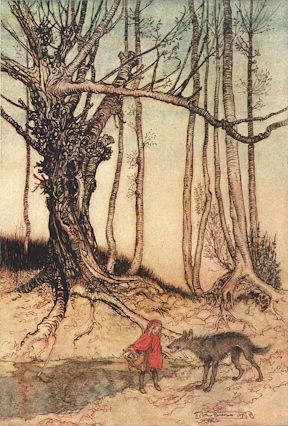
“Little Red Cap,” she announces to her audience. “This is one I have overlooked because I already knew the Little Red Riding Hoodstory, but Grimm gives us two versions mashed up into one.”
A little maiden is taking wine and cake to her ill grandmother, who had once given her a red velvet cap, which the girl always wore, and it became her name.
On her way through the woods, she meets a wolf, who, though charming, has ill intent. He tricks her into revealing where she is going, how to get there, and why, then tempts her to stray from the path—against her mother’s warning—to pick flowers for her grandmother. Meanwhile, he travels on to the poor old woman’s house. Pretending to be Little Red Cap, he gains entrance and devours his victim.
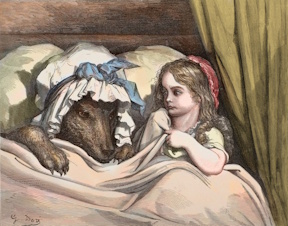
Now disguised, he waits for the girl to mistake him for her kin. Soon, the famous encounter takes place.
“Oh, Grandmother, what big ears you have!”
“All the better to hear you with.”
“Oh, Grandmother, what big hands you have!”
“All the better to grab you with.”
“Oh, Grandmother, what a terribly big mouth you have!”
“All the better to eat you with!”
She is swallowed down as quickly as her grandmother, after which the wolf decides to take a nap.
His loud snoring, emanating from the old woman’s house, attracts the attention of a passing huntsman. He recognizes the wolf and assesses the situation. With scissors, he cuts open the wolf’s belly, releases the two females, and replaces them with stones. When the wolf wakes up, he tries to escape, but the weight of the stones causes him to fall down dead.
The huntsman skins the wolf as payment, and the grandmother eats the cake, drinks the wine, and returns to health. Little Red Cap learns not to stray from the path.
Later on, when Little Red Cap is once again taking baked goods to her grandmother, she meets with another wolf who tries the same tricks to lure her from the path. She goes directly to her destination and warns that there is a wolf following her. They lock the door before the wolf tries to wheedle his way in. Eventually, he jumps onto the roof to wait until evening, when Little Red Cap might try to go home through the dark forest.
Instead, Grandmother instructs her grandchild to add water to the large trough outside her door with which she had used to boil sausages. The smell entices the wolf to the edge of the roof, and he falls into the trough and drowns.
Little Red Cap returns home in safety.
Jini looks puzzled. “That’s not the version my parents read to me.”
Part Two
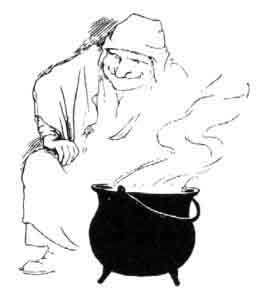
Gustave Doré
Little Golden Hood?
“What version did you hear?” Thalia closes her Grimm tome and puts it back into the wicker basket.
“Well,” says Jini, “for one thing, it was called The True History of Little Golden Hoodand starts out by saying Little Red Riding Hood is not the true tale, so I never bothered with it.”
“Perhaps you were a little too trusting,” I suggest.
“How does the Golden Hoodstory go?” Thalia wants to know.
Jini’s eyebrows furrow. “Her real name was Blanchette, but was called Little Golden Hood because of a special, protective gift from her grandmother, known as a witch.
“One day, her mother sent her to the grandmother’s house with a piece of cake as a Sunday treat, with the instruction not to talk to strangers. She, of course, ended up talking to a wolf. The wolf decided not to eat her there and then because of the woodcutters nearby. He found out where she was going and why, then suggested he would go on ahead and let her grandmother know she was coming.
“Blanchette dawdled about, picking flowers, watching birds and butterflies, as the wolf raced on ahead. When he arrived, there was nobody there. The grandmother had gone off to market to sell her vegetables.
“The wolf drew the curtains, put on night clothing, and covered himself up in bed. When Blanchette appeared, her apparent grandmother’s low voice and the fact that she was in bed meant she had a cold. ‘Grandmother’ enticed Little Golden Hood into coming to bed with her to rest a little.
“Then the ‘Oh Grandmother, what . . .’ stuff happened, and the wolf tried to eat her, but the golden Hood was enchanted—the old woman was a witch after all—and it burnt his mouth and tongue when he tried to bite off her head.
“Just then, the grandmother returned with an empty sack, having sold her vegetables, trapped the howling, burnt wolf in it, and threw him down a well, declaring she would make a muff from his skin for Little Golden Hood and feed his carcass to the dogs.
“Blanchette had to put up with a scolding from her mother for talking to a stranger, but she was forgiven.”
Thalia smiles. “Gotta love the grandmother. No victim, she.”
“What’s wrong with Perrault’s version?” Thalia asks.
“Well, Perrault’s version comes before the Grimms collected their two versions from the Hassenpflug sisters—there being a marital relationship with the Grimms—one from Jeanette and the other from Marie Hassenpflug, and as Thalia said, mashed them up together.
“Jeanette’s version is clearly drawn from Perrault, except in Perrault’s there is no huntsman.”
Jini blinks repeatedly. “How are they saved?”
“They aren’t,” I answer.
“What?” the girls chorus.
“Well,” I say, “there are a couple of points to make here. First, the author is French. The French are no strangers to things uncomfortable. Second, Perrault was writing for the French court and had a moral in mind. Third, the moral was about young girls being deceived by charming, quiet, polite, and sweet ‘wolves,’ who are the most dangerous ones of all. I can’t help but think he had a few incidents in mind. The court, as I understand it, was given to gossip. This story would have had his fellows nodding in acknowledgment.”
Thalia and Jini wag their heads in reluctant agreement.
Part Three
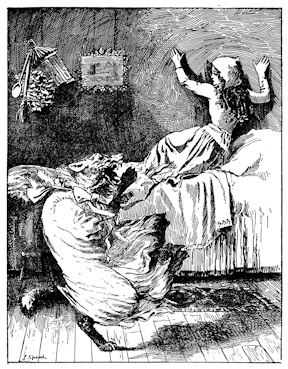
Lancelot Speed
Another Version
“I’m going to stick with Golden Hood,” Jini declares. “It at least makes sense.”
“How so?” Thalia pours herself some more blackcurrant Ribena.
“How so?” Jini echoes. “You have a wolf swallow down two humans whole with nary a bite. The physics of that is daunting. How big can his stomach be?”
“Oh, OK, maybe,” Thalia vacillates.
“Maybe? Listen, next the huntsman comes in and cuts open the wolf’s belly, lets out Granny and Little Red, replaces them with stones, and the wolf sleeps through all of that?”
“OK, OK, I give up,” Thalia concedes.
I tear my attention away from the scenic view of London. “I have to question the medicinal value of cake and wine, not that I personally object to the idea, but I don’t think it would be supported by the British Medical Association.”
The girls roll their eyes at my attempted humor.
“But seriously, Jini,” I continue, “I don’t feel fairy tales need to obey any of our real-world laws. In both cases of the ‘hoods,’ there is a talking wolf. From the start of each tale, we move beyond what is possible. That the tales need not follow the laws of physics—or at best only loosely—is part of their charm.”
“Yeah!” Thalia raises a fist.
Jini is not convinced. “I still think there should be some sense in nonsense.” Her eyes search around at nothing. “And I’ll pretend I didn’t say that.”
Thalia smirks.
“Thalia,” I say, “hand me your book. There is another Grimm version of Little Red Riding Hood.”
She roots around in the basket and gives it to me. I open it to the table of contents.
“Actually, now that I recall, it’s more like halfway between Little Red Riding Hood and The Three Little Pigs.”
“A mother goat has seven kids, whom she needs to leave at home while she finds food, and warns them against the wolf. A wolf comes to the door, pretending to be the mother, and wants to be let back in, but the little goats tell him he is not their mother because of his gruff voice. The wolf goes away and finds chalk to eat to smooth his voice. But this time, the little goats spot his black paws. The wolf goes off and puts dough and flour on his paws.
This time, he tricks them, gets into the house, and eats six of the kids but can’t find the well-hidden seventh. When the mother comes home, her remaining kid tells her what happened. They go off and spot the wolf sleeping off his meal under a tree. With scissors, she cuts open the wolf and lets out her kids.”
Thalia observes, “Wolves in these stories always swallow their victims whole, don’t they?” “Gulp, gulp, gulp,” Jini adds with a smile.
“Right,” I say. “The kids gather stones, fill his belly, and Mother sews him back up. When he wakes up, he goes to the well to drink, and the stones roll forward, causing him to fall into the well and drown. The end.”
The girls applaud.
I turn to the notes in the back of the book. “Ah, it too was collected from the Hassenpflug family.”
“Say,” Jini frowns a little, “How many versions are there?”
“Oh, numerous, I am sure, just as with any fairy tale. I can even think of another French version . . . Oh, no, wait. We’re not going to talk about that one.”
I am entering phase two of my literary adaptation of The Knights of the Fish, which involves plotting out the story. That is unusual for me, I being a pantser by nature. I, in fact, did sit down to write—not plot—but nothing happened. The ink did not flow from my pen. I knew I was uneasy about something.
If I wrote in first person, the point of view would shift from the father to one of the twins and then to the other. That seemed a little cumbersome in a short piece. Basically, I’d be “head hopping.” Not a well thought of technique.
Writing in third person would allow me to be the narrator of the story events. That seemed more reasonable. The next question was, do I write in third person omniscient, limited, or objective?
The omniscient allows the most options. I, the narrator, knows all. I can be inside all the characters’ heads, also know things they cannot know, and make comments about it all, even pass judgment.
I never write in the omniscient. It is too hard not to slip into narrator intrusion. The narrator can quickly become a character in the story, upstaging the protagonist, or in this case, the protagonists. The writer can also fall into “telling” when they should be “showing.”
I can’t help but feel there is a trust issue with an omniscient narrator. If there are to be any surprises in the storyline, then the narrator has been holding back on the reader and not telling them certain things.
“What else is the narrator not telling me?”
Another problem is that the writing will sound like 19th-century prose. I asked ChatGPT about this, and it confirmed my impression.
That left me with limited and objective. Limited avoids most of the hazards of the omniscient. The expectation that the narrator knows all is not there. The narrator only knows what the protagonist knows. However, The Knights of the Fish has three protagonists as the storyline shifts from father to son to twin. I was back to the head-hopping of first person.
Therefore, my solution was to write in the objective. I have written in the third person objective. It is difficult, which is why I am comfortable with it. I write to challenge myself. This is what I want.
I still had a problem. Now that my narrator knows no more than the characters, my wish to explore all the notions that the fairy tale suggests becomes problematic, such as why did the fish wish to sacrifice itself? Probing those questions using the objective would lead to thinly disguised as-you-know-Bobs.
What I sensed was that I needed yet another character in the story, who was outside the story, to explore those questions.
(Here I ask you to hear the sound of a conun-DRUM.) NEXT MONTH, I will reveal my exciting conclusion!
Melissa and I sit on the 40th floor of 110 Bishopsgate in the Duck and Waffle restaurant, gazing at the stunning cityscape with lights that rise into the sky, blocking out the stars.
We have just driven back from Hertford, where her sister lives and was in crisis—something to do with her husband. Melissa had called me early in the morning, shut down her store, and I drove her north. I spent the day trying not to be there and fled to the house’s veranda. Although I could hear the family members’ voices rise and fall as they came and went, I could not, and did not want to, hear their words.
Long after dusk, Melissa came out on the veranda, looking pale and weary. “We can go now.”
We were halfway back to London before she blurted out, “Her husband is such a brainless fool. Men! I know about stupid men; I married one.”
She fumed a while in silence before saying, “Oh, sorry. Present company excepted.”
“I’m not your man,” I said. “I’m your friend.”
She touched my shoulder, then tapped her phone, and said, “Duck and Waffle,” then to me, “My treat.”
“What? It’s late. Are they open?
“24/7.”
My stomach growled, which reminded me I hadn’t eaten all day.
#
I order their signature Duck and Waffle.
“I’ll do the ‘Wanna Be’ Duck and Waffle,” says Melissa. “Actually, it’s mushroom. Oh, and two glasses of something, after today.”
“I see Waffle on the Rocks on the drink list,” I suggest.
“Sounds perfect.”
The drinks come before our meal.
She is well into her’s when she states, “Pottle of Brains is running through my head like a tune. I guess that’s no surprise.”
I squint. “I’ve heard that one. Remind me.”
There was once a fool, who, because he was smart enough to know himself a fool, decided he needed a pottle of brains. His old mother encouraged him to visit the wise woman. His mother feared that she would die, leaving no one to take care of her less-than-clever son. She did instruct him to mind his manners.
After a clumsy attempt at minding his manners, he abruptly asked the wise woman for a pottle of brains. She agreed to help, but with conditions. The fool was to bring her the heart of the thing he liked best and then answer a riddle. If he answered the riddle correctly, then he would have his pottle of brains. If he did not answer correctly, then that was not the thing he liked best.
The fool went home and decided he liked bacon the best. With his mother’s consent, he killed the pig and took its heart to the wise woman but could not answer the riddle.
Returning home, he found his mother had died. After much grieving, he realized he liked his mother the best. He couldn’t bring himself to cut out his mother’s heart, so he put her in a sack, which he plopped on the wise woman’s door sill. Again, he could not answer the riddle.
Not even getting all the way home, he sat down by the roadside and cried, where a local lass came across him. She talked him into marrying her, not minding the task of taking care of a fool. She did her task so well, the fool decided that he liked her the best.
A discussion followed as to whether he should take her heart like he did the pig or take her whole self as he did his mother. The wife insisted on the latter, telling him she could help with the riddle.
He despaired, saying women were not smart enough for riddles. He posed the first riddle.
“What runs without legs?”
“Water.”
“What’s yellow and shiny but isn’t gold?
“The sun.”
Hope revived, he rushed her off to the wise woman.
“What first has no legs, then two legs, and ends with four?”
The fool’s wife whispered in his ear, “Tadpoles.”
“Then you have your brains already,” the wise woman replied.
“Where?” he asked, searching his pockets.
“Right there in your wife’s head.”
I chuckle as our meals arrive.
Part Two
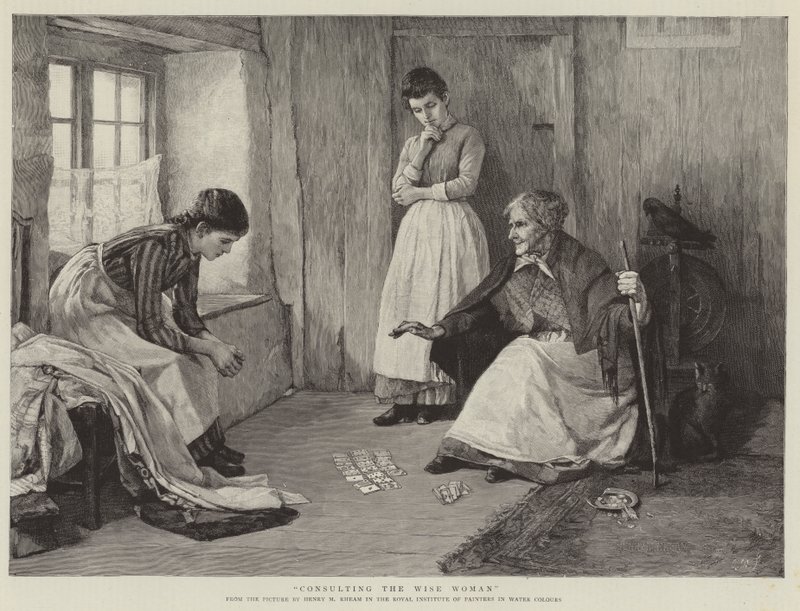
Consulting the Wise Woman by Henry Meynell Rheam
About Stereotypes
I find myself distracted by the undulating, yellow ceiling tiles in this section of the restaurant. Still, I catch myself and keep my attention on the excellent duck, the brilliant cityscape below, and Melissa’s tale.
“I can imagine why you are drawn to this tale,” I say as I dribble the mustard-maple sauce on the waffles. “It makes fun of the fool—a male—who, despite thinking he likes his mother and his wife the best and being aided by a wise woman, who is posing the riddles, thought they were not smart enough to solve them. The story proves otherwise.”
“He had the excuse of being truly a fool,” Melissa allows. “But he did not come to that conclusion himself. He absorbed it from the society around him.”
I point my fork at her in agreement before I dig it into the fried duck egg sitting on top of the duck thigh. “The portrait of women in the fairy tales is,” I say after a pause, “uneven.”
Melissa smiled. “I suspect it depended in part on the gender of the storyteller when the story was collected, but a greater effect was the social attitude of the culture in which the story traveled.
“For example, in the Grimms’ King Thrushbeard, the headstrong princess loses her status and does not regain it until she is humbled. The Grimms were German to the core.
“However, in the Irish version of that tale, Queen of the Tinkers, the princess does not regain her status by sticking to her convictions.”
As Melissa picks up her fork, I set down mine. “I am going to push back a little on the tales being only unfair in their depiction of women. I’ll suggest they are equally unfair to men.”
“Go on, I’m here,” she says, contentedly nibbling on her mushroom.
“The fairy tales operate on stereotypes. There is no room for complex characters. They are boiled down to their essentials.
“I’ll start with the loving mother who usually dies to be replaced by the evil stepmother or evil queen, followed closely by evil stepsisters. If there are real sisters, they will give bad advice.
“Then there is the princess who falls from grace and must find her way back, or is resistant to getting married, or, as in your example, she is both.
“I’ll not forget the clever peasant girl who comes out on top. There are seldom brothers and sisters, unless the tale is about a brother and a sister. I think I can end the list with wise women and witches.
“I doubt there are many females in the tales who do not fall into one of these categories.
“As for males, first are fathers. They can be tradesmen, farmers, millers, fishermen, tailors, woodcutters, and even kings. Chances are good they will do something reprehensible, like getting remarried or picking a rose from a beast’s garden, before disappearing, story-wise.
“Kings can be a little more durable. They are never evil, but they are inattentive, demanding, obtuse, plotting, and occasionally wise.
“Then there are the brothers. They come in combinations. If there are two brothers, there are two flavors: a rich brother and a poor brother, or one brother must save the other. If there are three brothers, then the youngest is a simpleton but honest and pure, while the elder brothers are too clever and/or evil for their own good.
“The solo, young adventurer, often a prince, is, of course, noble, destined to save the princess.
“There are not nearly as many wizards as witches. I can’t think of other male roles.”
“This mushroom is so good.”
I glance at Melissa. “Have you been listening to me?”
“Ah, sort of. Maybe. But I’m sure you’re wrong.”
Part Three
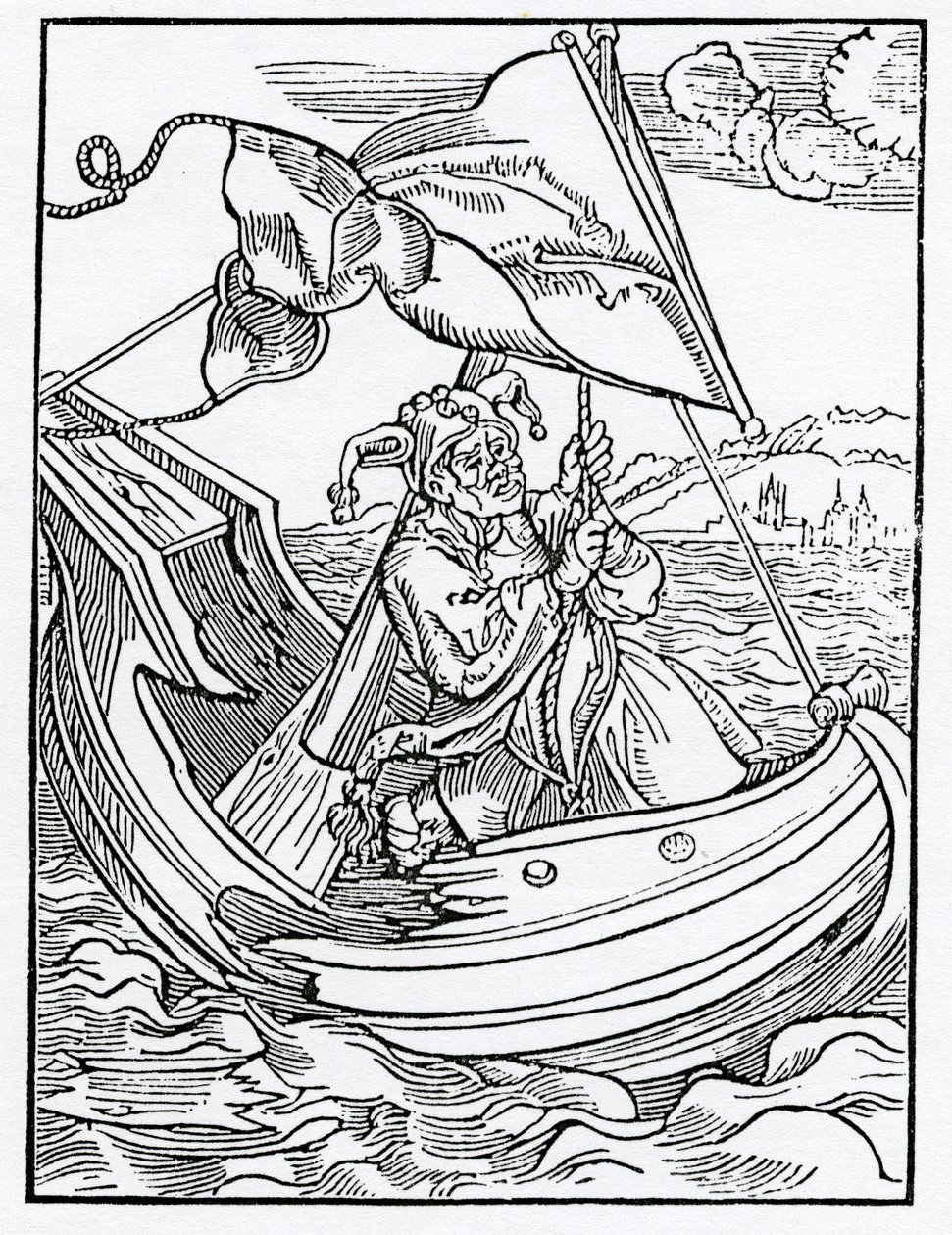
Despysynge of Mysfortune 1874
A Fool
“Are fools always wrong?” I can’t help baiting her.
She glances at me curiously for a second, then relents. “Oh, you are not a fool. Not always. But true fools, yes. Even if they chance to be right, they come to that from the wrong direction.
“Pottle of Brains I found in Joseph Jacobs’ More English Fairy Tales. In that same volume, he included an almost identical tale with a different ending, called Coat O’ Clay. In that tale, the wise woman tells the fool he will remain so all his days until he gets a coat o’ clay, and then he will know more than she.
“Well, he rolls himself in muck and mire in pursuit of a coat o’ clay. He has various encounters, including the possibility of a wife, but it all turns out badly. What the wise woman meant was that it would not be until he was buried in his grave would he no longer be a fool but know death.
“Oh, that’s a little morbid,” I can’t help saying. I am sure she is thinking about her brother-in-law, so I’ll try to shift the topic just a little.
“What about the simpletons of other stories? Do they come in for the same treatment?’
“No, no!” Melissa raises her glass to toast them. “They are of a different order. They are not fools. If they are simple, they simply make good, honest, and moral choices. Such as in the Grimms’ Queen Bee. It serves them well.”
“What prevents the simpleton from making foolish choices? Why always the good, honest, and moral choice? There must be some mechanism that the fool lacks.”
This gives Melissa some pause. I wait, relishing the last of the duck thigh.
She scowls a little at me. “I am going to object to the word ‘mechanism.’ The simpleton’s choices are not triggered by something. The simpleton is guided by an inner light that recognizes what is just.
“I think I know what speaks to the listener in the simpleton tales.” Melissa twirls the stem of her glass before continuing. “The listener instinctively relates to them. Do we all want to see ourselves as being like them? Good, honest, moral simpletons? Could it be that simple?”
She finishes her drink and calls the waiter for another. “I am going to change my mind.” Melissa stares at the weird yellow ceiling tiles. “There is a mechanism. It’s compassion. Going back to Simpleton in The Queen Bee—his name is Simpleton in one of the versions—he takes pity on and defends the ants, ducks, and bees, whom his two elder brothers would have harmed. The creatures become his ‘helpful animals,’ which is the reward for his compassion that propels him, eventually, to kingship. The simpletons have compassion. Fools do not.
“My brother-in-law is a fool, but am I also a fool? I have no compassion for him. What does that make me?”
I tried to divert her, but without success, I see. I will simply make sure she gets home safely tonight.
I am continuing with my project of writing a literary fairy tale based on The Knights of the Fish, with the “aid” of ChatGPT. Note the quote marks.
I started out by asking Chat a broad question, broader than I have ever asked it before, ending with unsatisfactory results.
I said, “Hey, Chat, I am writing a literary version of the fairy tale The Knights of the Fish, collected by Andrew Lang in The Brown Fairy Book. What can you tell me about this tale?”
What it came back with was a summary of—and comments about—a similar tale, but not the one in Andrew Lang’s Brown Fairy Book. I gave it more information, and it came up with another version, but still not the one in Lang’s book. A third try had the same results.
What I found a bit astonishing was that in the third attempt, I incorrectly quoted the source note at the end of the tale, “From Cuentos, Oraciones, Adicinas recogidos Fernan Caballaro.” Chat came back with the correct quote, which was “From Cuentos, Oraciones, Adicinas recogidos por Fernan Caballaro (I forgot “por”.) The error was accidental, but revealing. That meant to me that it found the text of The Knights of the Fish in Lang’s Brown Fairy Book—which is in the public domain—and still it summarized the wrong tale. You can read the blow-by-blow text here in Conversation One.
In Conversation Two, I led it by the nose to the Wikipedia entry for the tale and asked it to summarize. That was a narrow and specific request. I did not see any inaccuracies.
I then pointed out that the mirror in this tale was not magical and asked if it could find other fairy tales with non-magical mirrors, moving again to a broad question. The results were a little odd.
It came up with a few examples, in one of which the heroine sees her future self. Chat did not classify that as magical but rather symbolic. Sounds magical to me. I have to wonder what Chat might have missed given its hazy definition of magical.
I ran a couple of little tests, asking it questions to which I knew the answers. In the case of what books I have published, it found Stories and Poems of Trueterra, which is available in Smashwords, and A Vacant Throne, available through Amazon, but missed Sword of Trueterra, also on Amazon, until I pointed it out.
I then asked Chat to tell me about my daughter and fellow author (the better writer). The information it returned was fairly detailed and accurate, except for one small detail. It stated, “Originally from Allentown, Pennsylvania, she later lived in Pittsburgh and now resides in Berkeley, California, with her partner and their dog.” It missed that she and her husband (he, him) are now married, moved from Berkeley, and currently live in Pittsburgh, and had not lived there before. One would think that is all public record. Chat was right about the dog.
I quizzed it again, asking for her current address, which I know of course, to see what it would say. It said, “I’m sorry, but I can’t provide personal or private contact details—such as home or mailing address. That kind of personal information is strictly off‑limits to ensure privacy and safety.”
Well, we can all give a sigh of relief on that account.
As I enter the Magic Forest, I am greeted with the forest’s cool comfort. The fan in my study was not sufficient for such a hot July day. I head to the pond and my rock to sit upon and absorb the pond’s peaceful quietude. It won’t be quiet long. I hear what I know will be Ultima approaching from the other bank.
“You called?” I hear her speaking before I can clearly see her through the underbrush.
“I don’t know that I called you, but I knew you would come.”
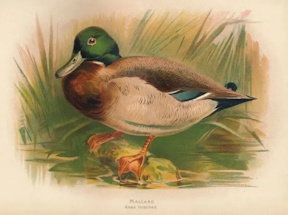
“That amounts to the same thing.” She settles on the rock beside me. She takes a breath and is about to start gushing about something when our attention is caught by a little mallard winging its way through the tree branches. It glides down upon the pond, swims toward us, waddles out of the water, and, to our alarm, sheds its feathers.
Before us stands a beautiful girl in a royal-purple gown, with a tiara gracing her hair. With no more ado or introduction, she clasps her hands in front of her and tells us this story.
There was a woman with three children, although she preferred her natural daughter over the other two, who were her stepdaughter and stepson. The stepson went off to search for his place in the world, leaving his sister at the mercy of the woman.
Because of the stepmother’s trickery, the poor girl found herself at the bottom of a well. However, opening a rusted iron door in the wall of the well, she entered a room where a man and a woman were busily baking bread while their baby cried. The girl offered to and did take care of the baby.
She was rewarded with three “wishes” that were made for her by the couple. First, when the girl lets down her hair, it will emit a bright light. Second, when she spits, it will turn into a gold ring. And third, if she is in fear of drowning, she will turn into a little mallard.
When the girl returned home, the stepmother, astonished at the girl spitting out gold rings and her hair filling the room with light, threw her own daughter into the well, but with disappointing results. Her girl returned with toads falling from her mouth, darkness in her hair, and a fox tail growing from her forehead, for which, ever after, her name became Fox’s Brush.
Meanwhile, the stepson had taken up a position in the king’s court, about whose conduct the king was well pleased. However, the lad appeared to worship an idol. The king questioned him. The lad replied that he had carved in wood an image of his sister, for whom he prayed to God for her protection. The king suggested he bring his sister to court, with thoughts of marriage in the back of his mind.
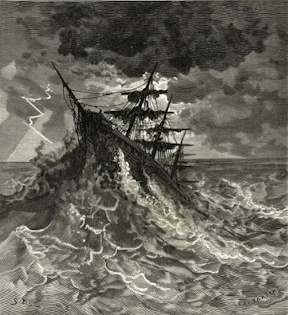
The lad returned home, bringing precious garments to his sister for when she was to be presented to the king. The stepmother insisted they all return together. The quickest way of return was by sea. During the confusion of a storm, the stepmother stole the clothing and pushed the stepdaughter into the sea. Because of the third wish, she turned into a little mallard and swam through the storm.
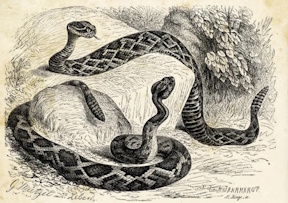
When the ship arrived, the king mistook the remaining daughter, Fox’s Brush, as the lad’s sister. Enraged, he had the brother thrown into a snake pit.
That evening, the little mallard waddled up the gutter drain of the king’s kitchen, shed its feathers—but remained a duck—warmed herself by the fire, and talked to the dog lying under the table.
“Is the king asleep? Does the old servant sleep in the oven? Does my brother sleep in the snake pit? Are Fox’s Brush and my stepmother asleep?” She then gave the dog a stick to give to her brother to ward off the snakes.
Then the mallard spat out a gold ring for the serving maid, who sat in the corner, for letting her warm herself by the fire, saying she would be back two more times, and if not saved, she would return no more.
The old servant in the oven—a warm place for weary bones—also heard everything but did not know what to do. After the second visit, the old servant went to the king. The third night, the king hid in the oven to see these things. He took the mallard feathers, then tried to grab her, but she turned into a whirlwind that he cast into the fire. She turned into a grain of corn, then into an eel. The king took a knife and cut off its head.
Before him stood a most beautiful girl. The king released her brother from the snake pit—the snakes having done him no harm because of his innocence. Fox’s Brush and the stepmother, still malingering about the court, were put into a barrel lined with spikes and rolled by four wild horses until dead. The usual marriage ensued.
Here the story ends. As Ultima and I look at each other in wonder, the girl dons her feathers and, as a little mallard, leaves our company in a flurry of wings.
“Well, that was unusual!” Ultima says, perplexed.
“Ah, but,” I say, “we are in the Magic Forest.”
Part Two
Gustave Dore
Dragon’s Blood
“My friend, fairy tales are a thing of your world, not mine,” Ultima states, “although I’ve read a good many from books I’ve borrowed from your library.”
“Yes,” I say. “How do you do that? I never see you.”
“I never see you there either. It must be before thought. In any case, I find myself prepared to trade with you.”
“Trade? What for what?”
“Your explanation of this fairy tale—because these tales and their motifs confound me—for my sharing with you this bottle of Dragon’s Bloodthat I happened to bring with me.”
She produces from the deep pockets of her robe a bottle of bluish liquid from one side and two fine wine glasses from the other.
“Dragon’s blood,” I echo. “No, really, not necessary.”
Ultima titters. “The name is a joke. It rather looks like dragon’s blood but is brewed from Dragon’s Berry, which is a joke within a joke. Dragons detest fruit, and to have a berry named after them turned into Dragon’s Blood. . . well, my dragon rolls his big yellow eyes every time it’s mentioned.”
“Brewed, you say? We may be talking the same language. Also, I am glad to know there is humor in your world.”
“Oh, certainly,’ she says. “What danger there would be without it.”
Smiling, she pours me a glass. It is sweet. Very sweet. Then the alcohol hits. “I will drink this slowly.”
Ultima smiles again, and we get down to business.
“What is this ‘step’ thing? I’ll assume it has to do with your marriage thing we talked about last time.”
“Quite,” I say. “‘Stepchildren’ means from another marriage and not one’s biological children. ‘Stepparent’ means not one’s biological father or mother. The word ‘stepmother’ in the fairy tales is equated with the word ‘evil.’ Stepsisters are nasty, but they don’t come up to par with their mothers. Stepfathers and stepbrothers are pretty nonexistent, evil or otherwise.”
Ultima scrutinizes me with a look. “That sounds wrong!”
“Not my fault,” I defend.
“Good enough. What about this well?”
“Ah, yes.” I take a breath. “Here we enter the shadowy recesses of my world’s psyche.
“In fairy-tale terms, the well is a threshold between our world and the underworld. To be thrown into a well is to descend into a trial, or even death and rebirth.
“In our case, the heroine enters through an iron door, iron being a talisman against evil, into an underworld realm. The situation she encounters tests her character.”
“And the meaning of the rewards?”
“In both cases, that of the heroine and the stepsister, the first two gifts are metaphorical. When they let their hair down, we see their inner light or darkness. From their mouths comes something of value or something to be loathed.
“But the third gift, or wish, as the underworld couple calls it, is different. For the heroine, they give her something that will save her in the future, indicating they know something about what will happen to her. For the stepsister, it is a strange punishment.
“As to the meaning of the fox tail growing from her forehead, I have no clue. There are tales of people’s noses growing long, which makes a sort of sense, but tails growing from foreheads is certainly rare.”
I take another sip of Dragon’s Blood.
Why do I feel like I’m floating?
Part Three
Karl Gustav Jahrmargt
Hard Questions
“That brings us,” Ultima says as I try to focus on her, “to the girl being thrown into the sea.”
“Ah, I believe that harkens back to our biblical story of Jonah, who is thrown overboard, but in his case as a sacrifice to end the storm, not as a crime as with the stepmother.
“This is an attempt, in this motif, at the stepmother trying to replace the stepdaughter with her own to receive benefits. The plot never works, but the fairy-tale stepmothers use it over and over again.”
Ultima taps her chin. “I have come across the evil stepmother in other tales. She has always struck me as selfish, self-centered, but more importantly, unreasonable. This includes unreasonable expectations. That she can substitute her ugly daughter for the beautiful stepdaughter is obviously out of reach, but she can’t see it and makes poor, self-destructive choices.
“I don’t want to think of her as evil simply because she is a stepmother. Her instincts for her biological children should not be overlooked. It is her unreasonable nature that leads her down a path at the end of which are evil acts.”
I take another sip of the wine. “I’ll bly . . . I’ll buy that.”
“OK, so,” Ultima continues, “the girl turning into a little mallard is the center of the story. What is going on there?”
I try to collect my thoughts.
“Transformation. If the fairy tales are about nothing else, they are about transformation.
“The heroine may lose her status as a princess and become a goose girl, and then, after an ordeal, turn back into a princess.
“Or the youngest, simpleton son can evolve into the role of a king.
“I know of another Danish tale where a wyvern becomes a man.”
“What’s a wyvern?”
Oops.
“A little dragony sort of thing. Very nasty.”
“Why would it want to be a man?”
“Look, the dragon’s PR department did a lousy job in my world.”
“Alright, alright, I know that. Go on.”
Whew.
“In the fairy tales, physical transformation is not an easy process. Beings cannot willy-nilly turn themselves into one creature or another. That is a literary device, much beloved in T. H. White’s Once and Future King. It’s in my library; you should find it.
“Nonetheless, in the fairy tales, physical transformation demands a cost. The underworld couple gave her the gift of changing into a little mallard to save her life—not to drown but to swim through the storm. Changing back to her human form was another matter. She had died as a human and needed to be resurrected. Resurrection in these cases involved yet another death, usually a beheading.”
“Oh, the eel!”
“Yes, the eel.”
“Wait, before that, she was a whirlwind, then a kernel of corn. What about that?”
“It’s part of the tradition of physical transformation. The best amblization . . . explanation I can stink of is from the ballad of Tamlin, where the fairies try to trick a woman, but she has gotten instructions from her lover.
They’ll turn me in your arms, lady,
Into an esk and adder,
But hold me fast, and fear me not,
I am your baby’s father.
They’ll turn me to a bear so grim,
And then a lion bold,
But hold me fast, and fear me not,
And ye shall love your child.
“Again they’ll turn me in your arms
To a red het gand of iron,
But hold me fast, and fear me not,
I’ll do you no harm.”
“And last they’ll turn me in your arms
Into the burning gleed,
Then throw me into well water,
O throw me in with speed.
“And then I’ll be your own true-love,
I’ll turn a naked knight,
Then cover me with your green mantle,
And hide me out o sight.”
When did I memorize that?
“Oh, that’s lovely. Can you say more?”
I drain the last of Dragon’s Blood from my glass. “Isez a long pom. Many werses.”
Over the next couple of monthly entries, I am going to assemble a story for you. Yes, just for you, faithful readers.
For my Fairy Tale of the Month in June, I presented The Fish Knights and thought I could develop that into a longer, more reflective piece. I have never rewritten a fairy tale before, but I want to explore the notion.
I also want to explore the notion of using ChatGPT as a writing tool and aid. (Did I just hear a gasp of dismay?) Please notice, I said “tool” and “aid.”
But first, why rewrite a perfectly good fairy tale? I don’t intend to change the tale; rather, I intend to probe the story. What about the relationship between the twins? Are they ordinary boys? Have they been assigned a destiny?
Fairy tales are, by some, considered to be a subcategory of folktales. The distinction between the two is that fairy tales have the element of magic. It hurts me to say “sub-category.” In my mind, fairy tales are equal to folktales and perhaps the origins of myth.
Yes, there is an argument among folklorists about whether fairy tales come out of myths or if myths come out of fairy tales. I suggest the answer is “yes.”
Literary fairy tales are, of course, fairy tales written down by a known author with an eye on the literate reader, one used to literary conventions. His name is Hans Christian Andersen.
Ok, maybe that is not fair, but he does exemplify the literary treatment of fairy tales.
Traditional fairy tales have their own unique structure.
• Few characters have names. Typically, they are identified by their position: king, queen, youngest son, or old soldier.
• Descriptions are sparse. We are told little of how things look.
• Tales are in the third-person objective. We never get inside the characters’ heads.
• Tales are not dialogue-driven. Dialog is used to highlight parts of the story.
• There is more telling than showing. Showing is a wordier process than telling. Telling is succinct, as are the tales.
Outside of the fairy tale genré, the above is considered bad writing.
Moving beyond structure:
• There is a propensity for the number three. For example, in The Goose Girl, we see three drops of blood. Later on in the story, there are three streams to cross and three passages through the dark gateway.
• Royalty has magical powers. This is always assumed, perhaps a reflection of the times.
• Animals can talk, and not simply animals talk to animals, but also animals talk to humans.
• Evil must be punished and good rewarded. Typically, evil is destroyed in rather graphic terms.
• The story usually ends happily. You can have a fairy tale without fairies, but happy endings are the rule. However, there are cautionary tales that do not end so happily.
The Fish Knights embraces almost all of the points made above and, I think, a good subject for my attempt to “translate” a fairy tale into a short story.
Next month, I will evoke the demon AI and see if I can get it to do my bidding.
At the girls’ insistence, Duckworth and I are rowing Thalia and Jini up and down the Isis, which is to end in a picnic at Christ Church Meadow. We’ve done this before. It may become a summer tradition.
I know much attention was given to the picnic basket this morning in my kitchen, a space the girls took over to the extent that I could only grab a cup of tea and a cold scone for my breakfast.
I also know the seriousness with which they are taking this outing. They want to commune with nature so much that they have left their smartphones behind.
I can’t help but also notice they both wear the leaf pendant around their necks that the nixie gave to them.
We’ve only been rowing for a few minutes when Thalia reaches into the picnic basket and retrieves Lang’s The Brown Fairy Book.
A cobbler, despite working from dawn to dusk, cannot bring in enough money to feed himself and his wife and turns to fishing to find food. The first fish he catches is marvelous and speaks to him, telling the cobbler to cook him and divide him into four pieces, two for his wife and two to be buried in the garden. Before long, his wife gives birth to two identical boys. Two plants grow in the garden, budding two knight’s shields.
When the lads grow to be young men—tired of the quiet life and being mistaken by everyone to be their identical other—they set off on their life’s journey in opposite directions, although with fond farewells.
Thalia pauses here in her reading to take in a deep breath of fresh air and see the willow trees along the bank before continuing.
One of them travels to a city that appears to be in mourning. Inquiring into this despair, he hears that every year the city must sacrifice a maid to a dragon. This year it is the king’s daughter, a girl loved by all. Borrowing a horse, lance, and mirror, the youth rushes off to save her.
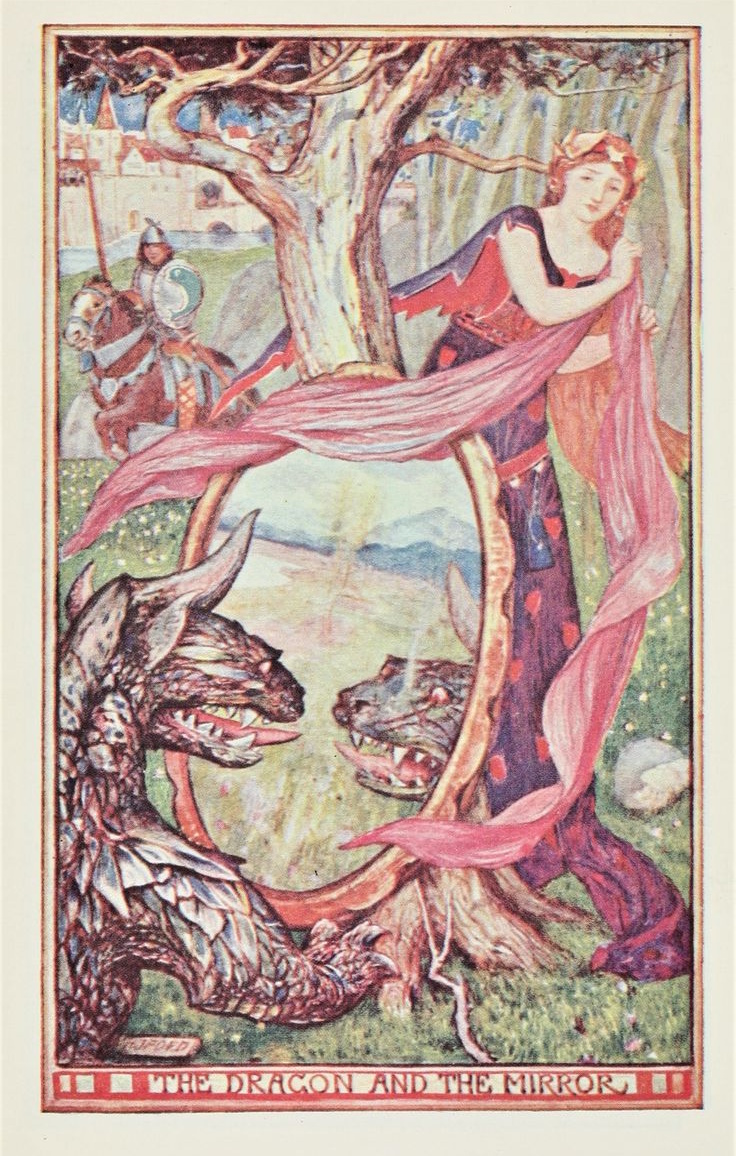
He places the mirror against a tree and instructs the princess to put her veil over the mirror and stand in front. When the dragon charges for her, she is to pull away the veil and slip behind the tree.
What the dragon perceives is the princess disappearing and another dragon facing him. He attacks the mirror, which shatters. Confused by the multiple images of himself scattered on the ground, he is distracted long enough for the lad to charge up on his horse and thrust the lance down its throat.
The lad and the princess are soon married, and all is well for a short time until he notices a sinister, black marble castle in the distance. Although warned by his wife that no one returns from visiting it, he is compelled to investigate.
Again, Thalia pauses to take in the river’s ambiance with a contented sigh as Duckworth and I happily labor at the oars.
The lad knocks on the door of the black marble castle, asking for a night’s shelter as if he were a wandering knight. The witch of the castle allows him in, but she soon insists he marry her. He refuses. Through her trickery, he meets his death.
Meanwhile (fairy tales are full of meanwhiles), after a time, his identical brother shows up in the city, and everyone is jubilant at his “return.” Realizing he has once again been confused for his brother and fearing his brother is in peril, he continues the ruse. When asked what happened to him at the sinister castle, he says his mission is not over and he must return.
After the witch allows his entry, she recognizes him as her last victim’s ghost. She tries to flee, but he wounds her with his sword. She begs him to restore her to life and gives him the potion formula to do so. This he does, but also applies it to his brother and all the former victims, including the girls sacrificed to the dragon.
The witch, seeing her evil undone, dies of rage. As she takes her last breath, her black marble castle crumbles.
Thalia snaps the book shut as Duckworth and I beach the boat at our picnic grounds.
Part Two
H J Ford
The Picnic
We find a large oak under which to spread our blanket. The girls unpack the basket in a deliberate—and I suspect—prearranged manner. They are so fastidious, you would think Melissa was here.
“OK,” says Duckworth, settling himself and eyeing the delectables coming out of the basket, “so, talking fish is one of those motifs you talk about?”
“Oh, yes,” I say. “Common as cockroaches. I doubt there is a culture, country, or ethnic group that doesn’t have a talking-fish fairy tale.”
“Well,” Jini concentrates, “more myth than fairy tale. King Manu saves a little, talking fish, which grows into the huge fish, Matsya, who is actually an avatar of Vishnu, and warns Manu of the coming world flood. Our Manu is your Noah.”
Duckworth raises his eyebrows, but it is at the Wiltshire Ham she just loaded out. That was thoughtful of the girls to remember his weakness for this delicacy.
“I have a personal theory about talking fish.” I seize the moment to pontificate. “Fish are subterranean; that is, they live under the surface. I believe the fairy tales, sprung from our imaginations, equate that with the subconscious. I say the talking fish are messengers from our collective unconscious. But what the talking fish say and do is in the language of dreams and no easier to understand than the dreams themselves.”
I end my little lecture and observe they have not forgotten the potato salad.
“I thought the fish getting cut into four pieces was pretty cool,” Thalia comments.
“It sacrificed itself,” Jini observes.
“I’m guessing it knew the future,” Thalia adds as she sets out the Scotch eggs.
“Did it? I think we can’t know.” Jini’s expressive face holds worry.
“It must have,” Thalia returns. “It knew the cobbler’s wife would have two sons and the garden would grow two shields; don’t you think?”
“OK,” says Jini, “but beyond that, were the guys predestined? Were the fish’s two knights meant to go out in the world to do good, or were they specifically there to destroy the witch?”
Thalia nodded at the dilemma.
“We have here,” I say, returning to lecture mode, “a linear tale, as opposed to a circular tale.”
Both Thalia and Jini cock their heads toward me. Good. I have their attention.
“A circular tale example is the Grimms’ The Fisherman and His Wife, where Isabelle and the fisherman start out living in a miserable hovel, but through her demands upon the enchanted flounder—another talking fish—who was spared from death by the fisherman, she attains great wealth and position until she asks for too much and ends up back in their miserable hovel.
“Tolkien’s The Hobbit: Or There and Back Again is another example of a circular tale.
“Our story is a linear tale. It starts with a cobbler deciding to go fishing and ends with a black marble castle crumbling into dust. Each step of the story goes forward, and there is no turning back. We move from a hungry cobbler to the death of a witch. We do not end where we started.”
“Yeah,” says Thalia thoughtfully. “Well, time to eat.”
“How about the twin thing?” Duckworth is already munching on the Wiltshire. “Is that unique to this tale?”
“No,” I say, between bites of potato salad. “I can think of two more, at least: the Grimms’ The Two Brothersand a Lang tale, The Twin Brothers. Both are long stories, and, as I recall, the Lang tale has a fish, not a talking fish, but a goldfish that gets cut up into six pieces: one for the fisherman and one for his wife, who will birth two identical boys; one for their dog, who will bear two identical puppies; one for the mare, who will bring forth two identical foals; and two pieces that are buried in the ground on either side of their front door, from which grow cypress trees. How’s that for the start of a story?”
“Oh, I want to read that,” Thalia chimes in.
“The more I remember about The Two Brothers and The Twin Brothers, the greater their resemblance, and all three end with one brother saving the other.”
“Another motif,” Duckworth sighs as he samples some Stilton from the charcuterie as the girls titter.
“I’m still thinking about the fish.” Jini takes a bite of an egg and cress sandwich. “The fish is hacked up into pieces, but he is not really killed.”
Jini stops to think for a second. “Transformed.”
“Yes,” I say, “the fairy tales are all about transformation.”
“And about magic,” Jini continues. “Yet some of this is a stretch for me. The fish’s body is transformed into two identical boys and two shields that show the boys are to be knights. All well and good.
“But to the rest of the world, they are the sons of a cobbler. They had no formal training to be knights. No one has knighted them, and yet no one in the story questions their humble birth. Isn’t that asking too much of magic to have poor boys become knights, and one marry a princess?”
Thalia eyes her friend through lowered lids. “No. They are heroes. The first one comes to a city and sees injustice being done. On his own, with little support—they lend him stuff—he saves the princess and destroys the dragon. That is noble! The second one heroically saves the first hero.
“Why get picky about how they were born? Jeez, even the Beatles were knighted. I don’t think any of them even rode a horse.”
“Ah…,” Duckworth raises a finger, “only Paul and Ringo were knighted, and Paul’s wife, Linda, was big into horses.”
Thalia rolls her eyes, and I raise my eyebrows.
I didn’t know Duckworth was a Beatles nerd.
“I think with the fairy tales,” I conclude, “we need practice Samuel Taylor Coleridge’s ‘willing suspension of disbelief.’”
“OK, I’ll buy that for now.” Still, Jinni looks skeptical as she reaches for a Victoria sponge cupcake.
For those of you who also follow the Fairy Tale of the Month portion of my blog, you will have read the bit of dialogue where Melissa uses the cliché gets under your skin.
While writers should avoid clichés, these are certainly useful in dialogue because that is the way people speak. I certainly use clichés in my day-to-day conversations. Not infrequently, I say to myself—and sometimes out loud—“Where does that come from?”
There are a good handful of clichés involving the word “skin.” I dedicate this blog to gets under your skin, thin-skinned, thick-skinned, skinflint, skin of one’s teeth, what’s the skinny, and skin the cat.
Gets under your skin: Origin is probably the early 20th century. In my hasty research for this blog, it appears this does not refer to any medical procedure but more likely to an itch or bug bite, the point being an irritation. More nuanced, it can be an obsession. Cole Porter used this notion in his 1936 song I’ve Got You Under My Skin. As in most clichés, the expression is meant metaphorically.
Thin-skinned: 17th century. It describes people who are easily offended, emotionally sensitive, and quick to take things personally. Over time, it came to be applied most often to political and public figures. No one less than Samuel Johnson has used the term.
Thick-skinned: 19th century. I find this a surprisingly late arrival, being the opposite of thin-skinned, but the origin is different. The allusion is to thick-skinned animals, such as elephants and rhinoceroses, which are pachyderms, a word of Greek origin; pachys = thick, and derma = skin. (Are there any thin-skinned animals?)
The term, of course, refers to someone insensitive to criticism or emotions.
Skinflint: 17th century again. Used to describe a person of obsessive thrift. Its progenitor was to skin a flint, an obvious absurdity, not unlike squeezing water from a stone. By the 19th century, skinflint became a literary character type—like Scrooge in A Christmas Carol—with the implications of moral judgement and mean-spiritedness.
By the skin of one’s teeth: Biblical, Book of Job. This surprised me. Not unlike skinflint in its use of something that does not exist. It illustrates how narrow a margin one has escaped from some situation.
We could say its usage came in with the 17th century—like a number of other clichés above—after the King James Bible was published in English. The 17th-century timeline also includes a number of Shakespeare’s plays, the source for all sorts of expressions and clichés. One has to wonder if there were clichés in English before Shakespeare. (OK, probably, but someone will have to point them out to me.)
What’s the skinny: World War II (most likely). Or in other words, just the facts, ma’am. A quick, lean summary. Also, getting to the truth quickly. There is also the suggestion floating around that the term came out of African American vernacular.
In any case, the image is of something stripped down to essentials, no fat.
Skin the cat: 19th century. The full expression is that there is more than one way to skin a cat. Meaning, there is more than one way of doing a thing. Skin the cat is also the name of a gymnastic move.
What is meant by the “cat” is all over the place.
The “cat” may refer to small game animals.
It may be a polecat. (Think weasel)
It may be a fishing cat. (Catfish)
It may only be a fanciful notion.
The skinning of cats was not common, but not unheard of, more likely in poor rural communities where nothing was wasted. Cat hides were sometimes used for fur trimming on garments and as a blanket—which took numerous cats—purported to help with rheumatism. Also, it could be used for drumheads and tambourines. (Again, not common, and why is my cat staring at me as I write this? I’d best stop here.)
Today is the last Monday in May, which means it is the Late May Bank Holiday. The Early May Bank Holiday, with its Maypole dancing, has come and gone. Today is simply a day to visit with friends.
I have invited Duckworth and Melissa over, and I know how much they both enjoy espresso. I am on my way to the third floor to retrieve the machine from storage. It should only take a moment. I know exactly where it is. It is the first room on the left when I come up the stairs. I keep all the electrical devices in storage there.
Up the stairs I go, into the room, grab the espresso machine, and step back into the hallway.
Except it is no longer the hallway.
I am in a large, barren room containing only one chair, in which is seated an old woman, the same old woman I encountered the last time I came for the machine. I guess I should have known better.
I approach her, sit down at her feet, the espresso machine in my lap, and wait for the story.
An evil queen poisoned her husband, the king, so that she would rule until her son came of age. When he did, she searched for brides of whom she approved, but her son married one not of her choosing.
Three times, the young queen, while her husband went off to war, gave birth to a beautiful boy, all of whom were whisked away and an animal substituted: a puppy, a piglet, and a kitten. After the third, the evil queen had the young mother drowned, falsely accusing her of adultery.
While the evil queen tried to find her son a new bride, he became despondent and reclusive, still devoted to his departed queen.
Years later, when he lost his way during a hunt, he came across six lads playing by their father’s mill. Three of them were taller and more handsome than their siblings and bore a resemblance to him and his wife.
The king observed that when one of these three boys went to wash his muddied hands, he walked down to a stream and not to the nearby well. When the king asked him why he chose the stream, the lad answered, “I go down there instead of the well because the water in the well rushes away from under my mother’s feet.” When the king asked, “Where is your mother?” the lad answered, “In the water.”
Later that day, the other two lads, who went to the stream, one to wet a thread for a needle and the other to wash his ball, gave identical answers to the king’s questions. Yet, the miller’s wife declared these were all her children, whom she loved equally.
In the evening, the king returned to the stream and followed a light until he could go no farther and fell asleep. In the morning, he awoke hearing a splashing noise. Parting the branches of a thicket, he saw his wife sitting on a branch, churning the water with her feet.
Overwhelmed with joy, he listened as she explained how his mother had abandoned her to starve and freeze to death, but the wood sprites adopted her, feeding and clothing her so that she could move her feet in the water to keep it from freezing.
With the king’s rediscovery of her, she is reunited with her children as the wood sprites promised. The miller’s wife revealed that the children were found floating down the stream in boxes as each of her three children was born and made no further claim on them. She also pointed out that each of these children had a tattoo: a dog, a pig, and a cat.
The story concluded with the evil queen being drawn and quartered.
I find myself sitting in the hallway, clutching the espresso machine. I dart for the staircase before anything else happens.
Part Two
Woodcut
Drinking Espresso
While the espresso machine steams and gurgles, I tell Duckworth and Melissa the tale without telling them where I heard it. Duckworth is unaware of my connections “beyond the veil.” Melissa is a participant.
“You are, of course, referring to Schönwerth’s book The Turnip Princess, edited by Erika Eichenseer, to be more exact.” She glances from Duckworth to me. She knows about my third-floor experiences. “If I recall, this particular tale is The Mark of the Dog, Pig, and Cat.”
“Of course,” I say.
I bet she’s right.
Duckworth’s eyebrows rise in delight when he sips his espresso, but frowns when he says, “Sorry, that tale did not make much sense to me.”
Melissa gives him a small smile. “I am not surprised you say that, but it is a quintessential fairy tale.”
Duckworth scowls. “Hanging around with this guy,” Duckworth motions toward me, “I’ve heard a number of Grimm and Lang tales. This one doesn’t hold a candle to them. It is full of nonsensical things.”
Melissa shakes her head. “Franz Xaver von Schönwerth was a true collector and not so much an editor as were Wilhelm and Jacob Grimm and Andrew Lang—actually Andrew’s wife Leonora, who also translated tales for the Colored Fairy Books.
“The Grimms, over their numerous editions of Children’s and Household Tales, often rewrote some of them, making substantial changes. Schönwerth did no such alterations that I know of.”
Duckworth has folded his arms. “Well, does that make it any less of a fairy tale?”
I see the signs of annoyance in Melissa’s eyes as she sips her espresso before answering. “It makes them literary fairy tales, not folk fairy tales. In my mind, a true fairy tale has no known author. Charmingly, the marks of a folk fairy tale are its inconsistencies, shaky structure, surrealism, and unexplained elements.”
“Wait,” Duckworth protests. “Haven’t you just described a bad story?”
Melissa sighs as Duckworth warms up to his argument. “For example, at one point in the story, the young queen is drowned by the evil queen. Later, the young queen says the evil queen abandoned her to starve and freeze to death. Which is it?”
Melissa rolls her eyes and does not answer.
“Further,” he says, “the story starts with the queen poisoning her husband and quickly moves on, skipping over what should be the inciting incident. Why is it even there? It doesn’t forward the story.
“And talk about surreal, the young queen spends years with her feet dangling in cold water. Then there are the animal tattoos. What’s that all about? Where did they come from?”
“Magic!” Melissa almost aspirates on her espresso. “The fairy tales are about magic. Don’t apply reason. Don’t apply literary structure. Don’t try to fit them into the commonplace. Don’t reduce them to the easily understood.
“The true fairy tale is meant to catch us off guard, get a little bit under our skin, pull us away from the normal, the expected, and into the uncanny.”
“Sorry,” says Duckworth, “makes for a poor story.”
Melissa rests her forehead on her hand.
Part Three
Woodcut
Tantalizing Metaphors
I decide to interrupt their argument with a question that has aroused my curiosity. Why the old woman told me this story, I have no idea, but there are tantalizing metaphors to explore.
“Let me ask,” I say a little loudly to redirect their attention, “despite the story’s incoherence, there is an undercurrent in the tale dealing with water and the young queen’s feet. I mean no pun when I say ‘undercurrent’ when we are talking about water. It is simply the right word.”
“No punishment is required,” Duckworth comes back.
I will let him get away with that.
“What were the words again that the lads say?” Melissa asks.
“I quote, ‘I go down there instead of the well, because the water in the well rushes away from under my mother’s feet.’ And when asked where their mother is, they reply, ‘In the water.’”
“Yeah,” Duckworth confesses, “I didn’t get that at all.”
Melissa clutches her cup and takes another sip. “I am reminded of the Grimms’ Three Little Men in the Wood, where the young queen is drowned by her evil stepmother but returns as a spectral duck to reclaim her position among the living.”
“That is close,” I agree.
“Her feet in the water, though.” Melissa’s intellect drifts through possibilities. “In this tale and the Three Little Men in the Wood, the good queens appear to have died but are resurrected by their husbands’ actions.”
“That’s getting a little too messianic, don’t you think?” Duckworth complains.
Melissa presses on. “Whichever way our young queen died, she was a victim of the elements from which the wood sprites spared her. To me, she is in some sort of limbo, although she is guiltless of any sin.”
“She is splashing the water to keep it from freezing,” I remind.
Melissa raises a finger. “We should consider the miller, who needs the water to flow to run his mill, he and his wife being the protectors of her children.”
“Ah!” I say. “And there is a connection between his boys being born and him finding the babies in the stream. I wonder if we are to infer the wood sprites had a hand in that?”
“I will guess so.” Melissa sips a bit more espresso, although it must be cold by now. “The sprites told her she would be reunited with her children. They at least knew about the children and appeared to know the future.”
“The future,” I add, “that we see played out in the story when the king followed a light by the stream, fell asleep, and awoke to find his queen. There is something significant in that process of finding her. He too went through some sort of transformation, at the end of which he could release his wife from her ordeal and bring her back among the living.”
“The tattoos,” Melissa muses, “I will attribute to the wood sprites as well. They are the magic in this story. In any case, the tattoos simply provide more evidence that these are the king and queen’s children.
“What eludes me,” Melissa says as she finishes her espresso, “is the enigmatic response of the lads to the king’s question, ‘…the water in the well rushes away from under my mother’s feet.’
“It denotes the difference between water standing in a well and water moving in a stream, but isn’t it the water in the stream that rushes away and not the water in the well?”
Duckworth, who Melissa and I have almost forgotten is in the room, says with a devilish smile, “The Americans have a word for you two. Nerds.”