
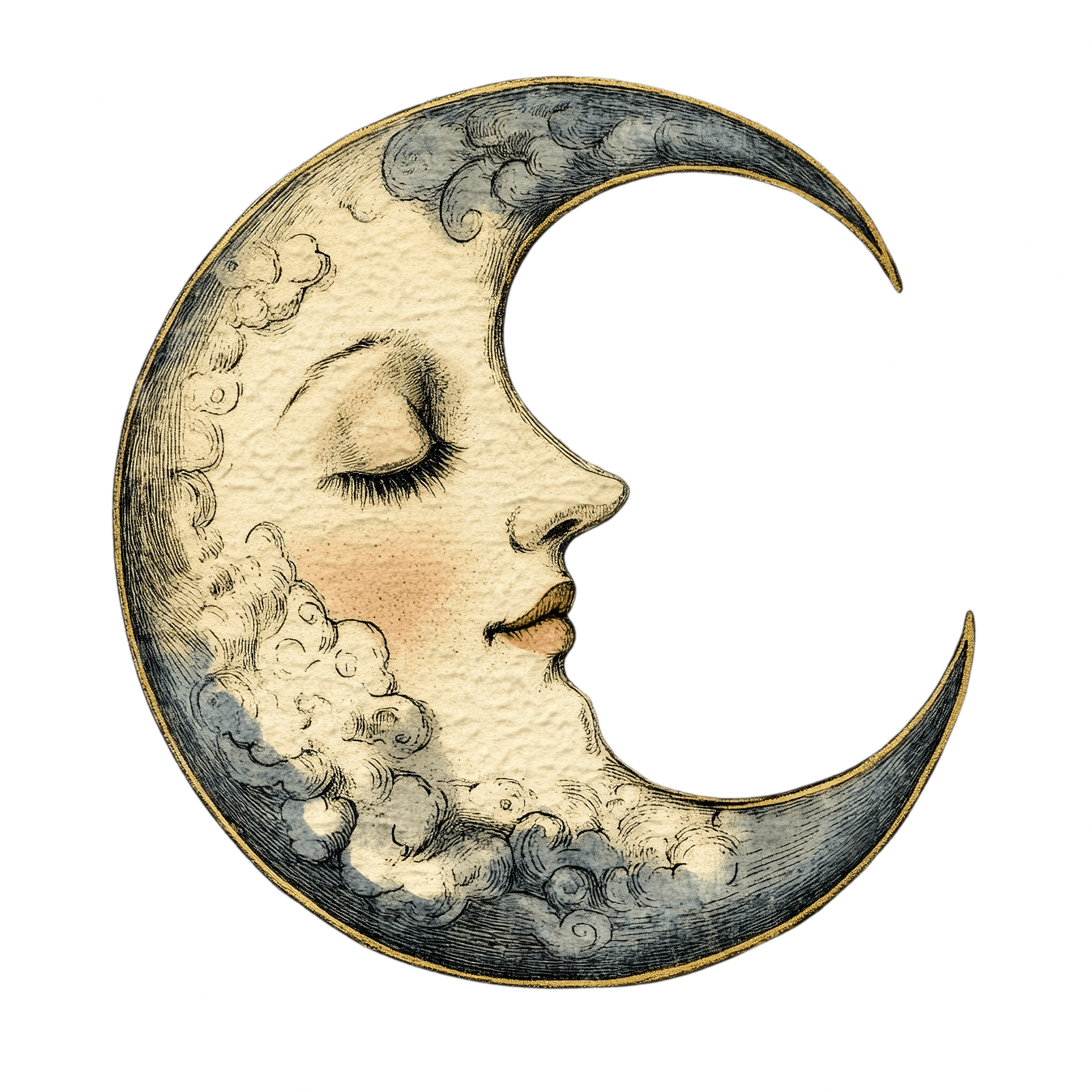
Laszor’s Wedding Night
Laszor the poet lay by his new bride as the moon’s light shone into the bridal chamber. He lay awake in the four-in-the-morning sacred space of time.
Thoughts of the wedding paraded before his mind’s eye. The flowers encircling her head. The scent of ground rosemary rubbed into her fur. They, standing before their peers, declaring their commitment to each other. The wedding feast. The smell of roasted fish permeating the hall. The overly long and lauding speeches by relatives. The wedding couple’s dance. And, again, the scent of rosemary that still lingered over the wedding bed.
The moon, lowering in the west, sent light creeping across the bedroom floor. With it came a seductive voice calling his name. Laszor rose, padded his way silently to the window.
The moon appeared to him as bright as day. Almost beneath hearing, he heard his name called again. Again, he crossed the chamber floor, careful not to let his nails click on the stone floor, moving toward the chamber door.
Laszor soon stood in the surprisingly warm, gentle night air. The call came again, more like a thought than a sound, drawing him toward a cliff overlooking the sea. Near the edge, on her haunches, sat a calico dame who absorbed the moon’s light and radiated it out again. He knew at once she must be of the fae.
He approached—her amber eyes fixed upon him—and sat on his haunches in mirror reflection of her to the point of wrapping his tail across his paws as she did.
“You called.”
“You answered.”
The sea wind blew, rustling the long grass.
“Should not a call be answered?”
“No,” she said, grinning at him. “Some callings are not worthy of an honest tom. You allowed me to lead you away from your wedding bed. Shame on you.” But her continuing, alluring grin spoke otherwise.
“I am a poet. I must answer what calls to me. What would you have me do?”
“Conjoin,” came the reply.
Laszor felt temptation and its opposite, decency, rise up in him to battle for his heart, which pounded in his breast. He restrained his paws from touching hers, keeping his tail undisturbed as it lay across them.
“Which of us is whoring?” he asked.
“I say it is you. It is you who has come to me, offering yourself.”
“Well then, there must be a price.” Laszor nodded toward the sea. “Make me a vest of sea foam that I can wear, and others will marvel. A thing I can be proud of for losing myself to you.”
“That I might do,” her amber eyes narrowed, “if you will make me a shawl from aster petals, the color of which must change and shimmer as the sun’s light hits them.”
“In exchange,” Laszor returned, “build for me a castle that I may appear to be a king. Make it strong with thick stone walls and towers roofed with gold—a house for us and to be the envy of all.”
“That I will,” she said smoothly, yet her tail flicked with a bit of anger, “but you need raise an army to defend it. The strong will want what you and I have, including me to be their queen.”
“Ah!” frowned Laszor, “the stakes are too high for a poor poet like myself. I think our love cannot be.”
“Then you shall not have me.” Her grin turned a little wicked. “But, if you are a poet, tell to me this metaphor.” She pointed to the sky over the sea.
There, instead of the one familiar moon, hung two moons, one white and the other red, slowly revolving around each other. For a time, the red moon moved over the face of the white moon until it eclipsed it except for a white corona. Just as slowly, the white then eclipsed the red until it was only a red corona.
“I see a struggle between lust and purity.
Lustiness, oh so keen, it dulls my piety.
But can there be good if not a bad companion
To circle as it should and to its orbit add
Passion versus reason; roaming versus staying?
Yet, good has its season when no longer waning.
Repairs my sad, false heart. Restores me to the light.
Delicate is the art of setting all things right.
But by these moons’ orbit, I’ll face again my lust.
Waxes and wanes my fault of turning love to dust.”
Laszor turned her attention back to his companion. Her grin now held gentleness. “Look again,” she said.
Now the usual moon settled deep into the horizon, fading away. Glancing back, he saw her fading as well. He could look through her to the landscape behind.
Sadness edged his voice. “Will I see you again?”
“Maybe, maybe not. Maybe in a different form. If nothing else, I am, like the moon, ephemeral.”
Then she was gone.
The night turned dark without the moon’s light, and the air freezing cold. Laszor now knew the warmth of the evening had been part of the enchantment. His body felt numb from the long exposure.
As Laszor slipped back into his bed, his paw brushed against his wife, startling her awake.
“What?” She uncurled. “Are you dead? Why are you so cold?”
“Oh,” lamented Laszor,” I did not mean to wake you. It was the moon; it called to me.”
“The moon? Called you? Ahh, is this what I will have to abide by, having married a poet?”
She pulled him into her arms to warm him.
“Ahh, my poor dear,” he purred in her embrace. “I am afraid so.”
 Fairy Tale of the Month