Fairy Tale of the Month: April 2011 The Snow Maiden – Part One

Only a Myth

The Snow Maiden, daughter of Grandfather Frost and Spring Beauty, is clearly one of the progeny of myth. Although know best as a literary tale, the Snow Maiden shows mythological origins. In Russia she accompanies Grandfather Frost on his rounds during Christmas to deliver gift to good children.

What is myth? I won’t attempt to answer that.

What scares me off from the attempt are questions like: Where does myth leave off and legend begin? Are myths only other culture’s creation stories? Is Superman truly a myth? I am not smart enough or foolish enough to proffer an answer. There are plenty of smart and silly definitions already out there. Go google them.

However, I am incautious enough to expose my thoughts on the role of myth.

The role of myth was best explained to me by storyteller Dan Keding. I am going to tell you what I recall him telling me; it was years ago, but the essence has stuck with me. I hope my memory has not mangled too badly what he said.

Imagine story as a series of concentric circles. The inner circle is labeled family stories: all those wonderful family-centric (not important to anyone else) stories told around the table at Thanksgiving. These are delicate, true stories, too quickly lost as generations pass away.

In the next circle are the community stories: anecdotes, jokes, gossip, and urban legends. We may hear these stories over beer at the bar. They pop up in our emails. They possess an annoying durability.

The next circle encompasses the fairy tales and folk tales: the traditional province of the storyteller, a circle dear to my heart. These are the tales most people relate to when the word “story” comes up. These may be stories of our culture or the culture of others. From this point on our circle of stories come from the past.

Beyond that is the circle of legend: historical tales that have been aided and improved by the imagination. Here lay the romances of King Arthur, the Irish tales of the Fianna, and the German hero Siegfried.

Far on the outer edge is the circle of myth: the creation tales, stories of the gods and their misdeeds, and trickster tales. Pantheons of gods, grist for the mills of poets and composers. From this circle the Snow Maiden was kidnapped and turned into an opera.

Now imagine a bowl filled with the liquid of myth. On its surface floats the thin oil slick of concentric circles I described with myth peeping up around the edges.

This final image that Dan created for me is the point. Myth under lays all story. Without myth we would not know how to construct a story. Even family stories create a sort of mythology. Storytellers like to say our brains are hard-wired for story. The mythic structure is the hard-wire.

Did the events in these myths really happen? Yes, over and over again. Are they happening? Yes. Will they happen in the future? For our sakes, I certainly hope so.


Fairy Tale of the Month: April 2011 The Snow Maiden – Part Two

 Edmund Dulac

Cold Hearted

The power of the Snow Maiden story lies in Snegurochka’s destructive love. The Snow Maiden is the daughter of Grandfather Frost and Spring Beauty, manifested in this world when an old couple forms her out of snow.

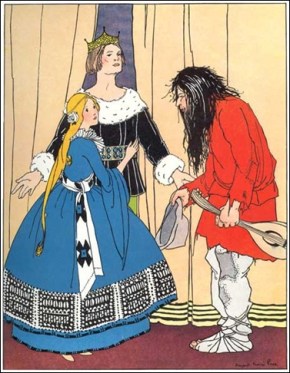
The Snow Maiden’s desire is for human contact. She is at first satisfied by being a daughter to the old couple who wished her into this world. The Snow Maiden, whom the old couple calls Snegurochka, is soon propelled out into the great world. Snegurochka is embraced in friendship by Kupava, a friendship that leads to Kupava’s self-destruction when her lover, Mizgir, falls for the cold hearted Snegurochka. Snegurochka’s destruction comes when the shepherd boy Lel’s music softens her heart and she vanishes into mist.

Encounters like this, liaisons between lovers from either side of the veil, never end well. My thoughts leap to the story of the love between Oisin, son of Fionn mac Cumhaill and Niamh of the Golden Hair. Oisin follows Niamh to Tir na Nog, the fairy world. Oisin lives there in bliss for three years until seized by a desire to visit his homeland. Niamh warns him not to dismount from his stead and touch the ground. Oisin does not realize that three hundred years have passed in our worlds. When he accidentally falls from his horse he turns to dust, as he should, being three hundred years old.

Well, what could we expect, he was a poet.

There are many tales, legends, and myths about romances between our world and the other worlds. Visit the Greek and Roman mythology—Zeus and his many mortal liaisons. Why do we and the ‘other’ fair so badly if we chance to fall in love?

I’ve toyed with the notion that the Snow Maiden, and similar tales, tell us to ‘stick to our own kind’, but that sounds too prosaic and cautionary. I prefer to think the Snow Maiden reflects the difference between our world and the others. The others are fragile. We are brutal.

Snegurochka, declared guiltless by Tsar Berendei, survives only as long as her heart does not warm to affection in this world. Oisin returns to this world, carrying affection from beyond the veil, and turns to dust because of his love for both.

Places like Tir na Nog are our fantasy lands. Youths like the Snow Maiden are our imaginary people. These other worlds and other beings are made from the fragile fabric of our illusions, formed from our wishful thinking. Ever so delicate, they are crumbled by the harsh light of reality. Keep them in the half light of dream land. Don’t let them slip off seeking love in the real world. Like the Snow Maiden, they may turn to mist.


Fairy Tale of the Month: April 2011 The Snow Maiden – Part Three

 Kay Nielsen

All in a name

Russia culture provides us a fine example of a literary tale in the Snow Maiden. Although it has traditional, even mythological, origins, when I google this title the opera by Rimsky-Korsakov is at the top of my screen (thank you Wikipedia).  After a few more clicks I came up with a story version attributed to Aleksandr Ostrovsky, who wrote the play that Rimsky-Korsakov based his opera upon. A “folk” version is no where to be found.

The Snow Maiden has the two common markers of a literary tale, markers not shared with fairy tales:

  1. Everyone has a name.
  2. It ends in tragedy.

Seldom are there more than two given names in the fairy tales. Hansel and Gretel have a father, identified as a woodcutter, and a step-mother, identified as evil. They meet a witch, who bears the moniker “the witch”.

In Ostrosky’s version the weight of names tilt to the other side of the scale, Snegurochka, Kupava, Mizgir, Lel, and Tsar Berendei, all of whom I struggle to vocalize. Only the old woodsman and his wife do not have names. (Old woodsmen and their wives never have names, right up there with the old women gathering sticks.)

To the same degree that fairy tales lack names, they lack the element of tragedy. Grimm’s “The Companionship of the Cat and the Mouse” ends sadly, and predictable. The “Death of the Hen”, which ends with all members of the funeral party drowning, does not rise to the level tragedy. (Could none of them swim?) Neither of these inspires heart-felt sympathy nor evokes romantic longing. Fairy Tales’ usual fare is “happily ever after”.

But what, at the emotional level, is the difference between the fairy tale and the literary tale?

When the fairy tale uses position as the identifier (the king, the witch, and the woodcutter) the characters becomes emblematic of their station in the world. They are there in the story to instruct us.  We become students, observers, and view the characters from a distance to see what practical and moral lessons the story intends to pass on to us. That mice should not take up abode with cats can have broader implications. Concerning the death of a chicken, although the tale is darkly humorous, it is instructive to us to see a moment of greed leading to unintended consequences. (Also, we should all learn to swim.)

However, when we know the character’s names, as we do in the literary tale, we get pulled in to their conflicts and stand with them.  We are no longer objective. Names are subjective. Names are powerful.  In some cultures to know someone’s true name is to have power over them. We will never know the true name of God, nor should we; God is there to instruct us.

Knowing their names, even one as unpronounceable as Snegurochka, demands that we feel with them,  that we absorb  their tale, and that we become alive in their story,  in their tragedy.

Your thoughts?

Fairy Tale of the Month: March 2011 The Flounder & The Fisherman – Part One

 Walter Crane

Around and around we go…


A notable feature in many a fairy tale is the repetitive structure of the plot. A common motif is the three brothers, the eldest two striking out to achieve a task and failing, followed by the third and youngest brother who succeeds.


Or our hero has three tasks to perform, and is aided by three sets of creatures encountered earlier in the story. Three is a popular round of repetition.


In “The Flounder and the Fisherman” the repetition goes further. Isabelle first wants a cottage to live in, then a castle, If there is a castle there ought to be a king. Why not an emperor?  Why not be pope?  Why not be like God? Her poor fisherman-husband goes back to the sea six times. Lots of repetition. Why aren’t we bored to tears by the same thing (almost) happening over and over and over?


I’ll make some observations. I recall our daughter, when very young, had a favorite cartoon video that she listened to daily, if my memory serves, until she could recite the dialog along with the characters. The parental experience of favorite items being rerun, rehashed, redone ad nauseam may be too familiar. Is repetition a kid thing? Does the repetition and predictability give them comfort?


What of music and its use of recurrence. Classical music often takes a theme to which it returns, develops, moves on, and returns again. Popular music has its refrain that we wait for and are satisfied to listen to again. “Happy Birthday” for crying out loud. How many times can we sing that? Insist on singing it, even badly. Does the repetition and predictability give adults comfort?


Which bring me to rituals, those events we crave to repeat over and over. Family holiday rituals are legion and legend. How many firework displays can you watch? How much cranberry relish can you eat? How many times will we listen to the inaccuracies of a prognosticating groundhog?


Returning to “The Flounder and the Fisherman”, let me suggest the success of its repetition comes from incremental variation. Every time the fisherman returns to the sea, Isabelle’s demands are larger, the sea more severe, the flounder more angry. The tension increases with each visitation. The repetition allows us to see the familiar in a new light, showing an evolving aspect.


Nothing stays the same. Even a song’s refrain, repeated exactly, comes along further into the song. The story and images have changed since the last time we hear the chorus only seconds before.  As we read that bedtime story to our child, again, we know the day will come when she will no longer have interest in the tale.


I think of repetition as an old friend I meet every day on a park bench, who gets older and older, and friendlier and friendlier. He looks like a constant in an otherwise fleeting world.


Fairy Tale of the Month: Mar 2011 Flounder & Fisherman – Part Two

  Kay Nielsen

Long Streak of Blood

In the beginning of Grimm’s “Flounder and the Fisherman” the fisherman has caught a huge flounder with his fishing pole and hook. The flounder pleads for its life, which the soft-hearted fisherman readily grants. When the flounder is released he sinks to the bottom of the sea, leaving behind a long streak of blood.

What a wonderful, enduring image. It contains, I believe, a very subtle allusion to the blood that Jesus shed during the crucifixion. There is in this image true romance. Not the torrid lusting of Harlequin romances, but the noble spirit of the early 19th century writers. Whenever I tell this tale, I edit out that streak of blood. Why?

That streak of blood is the Grimms intruding on the story. I can’t verify my statement with academic research, but I “hear” the Grimms adding this image for their own satisfaction.

Don’t think for a moment I am about to pick on the Grimms. All the folk tale collectors have put their mark on the material they’ve collected. How could they not? They were, although with pen in hand, storytellers.

There are storytelling traditions in the world where the story is related word-for-word as it was heard. This is not the European tradition, where every teller has their artistry, and a need to decorate. I am guessing this process accounts in part for the—sometimes wildly—different versions of the same story.

The reader of these collected tales can sometimes tell when the collector has altered the story for the sake of readability. Orally transmitted stories have a cadence and structure that do not translate well to the page. Without the animated presence of the teller, the words lay lifeless on the paper.

Should these “additions” be edited out when we can spot them? What of “additions” we can’t spot, those that were added to the oral tradition during their oral transmission? Should we at least make the attempt to return to the original form of the story? How can we tell when we have reached its original form? Can you tell I am leading you down an endless path with no destination?

The stories are what they are when we encounter them. They bear the marks of their history. We may put our marks upon them wittingly or unwittingly.

My argument does not support striking out the Grimm’s “addition” of the streak of blood. Why do I drop what I identify as a Grimm intrusion?

Why? Because I didn’t think of it first.


Fairy Tale of the Month: Mar 2011 Flounder & Fisherman – Part Three

 Kay Nielsen

The Enchanted

Princesses sleep, princes are enchanted. We rarely have sleeping queens and enchanted kings. These states are usually reserved for the young. This makes a certain amount of sense, psychologically. The young are in transition, moving from one state to another, moving from childhood (being asleep, being enchanted) to a state of adulthood (becoming their true selves). There is travail involved. Someone has to get to the princess to give her the awakening kiss or token. The prince labors to nullify the curse laid upon him.

Examples abound of this common motif of young royalty under a curse: Beauty and the Beast, Snow White, Sleeping Beauty, the Princess and the Frog, The Flounder and the Fisherman – no wait. What about that flounder?

In the beginning of “The Flounder and the Fisherman” the fisherman catches a huge flounder, who speaks to him telling the fisherman that he is an enchanted prince. By the end of the story the flounder is still an enchanted prince. The spell is not broken.

In my mental magical pond a frog has broken to the surface and croaks, “Why?”

My intuition tells me the flounder represents the unconscious. The fisherman exists at the conscious level. He lives in the world of air. The flounder lives at the unconscious level, in the world of water, beneath the surface.

But do we stand upon our rock and call out, asking favors of our unconscious? Is the unconscious at our beck and call?

The frog in my mental pond makes a big splash, disturbing my thoughts. It pokes it head out again and croaks, “Bruno, Bruno.”

Now I remember. Bruno Bettelheim. In his book, “The Uses of Enchantment” he discusses this fairy tale. Bettelheim’s observations are filtered through a Freudian lens. They both go on about the Oedipal myth as it can be used, metaphorically, to understand child/parent relationships. Why didn’t Freud use “The Flounder and the Fisherman” (as Bettelheim did) to explain the id—ego—super-ego concept?

Isabelle, the fisherman’s wife, is the id, the primal satisfaction of desire.  The flounder, our enchanted prince, is the super-ego, the holder of higher thoughts and ideals. The fisherman is the ego, the poor sap, who shuffles between the id and the super-ego, trying to communicate between the two. It is not the flounder who is the unconscious, but rather the entire tale rises up from beneath the surface.

Had Freud used this tale by way of explanation, we would never have, erroneously, come up with the term “egotistical” when we really meant “idtistical”. The relationships would have been clear.

My magical pond frog is staring at me with its big yellow eyes, but not croaking anything at me. I think I got this one right.

Your thoughts?

Fairy Tale of the Month: Feb. 2011 The White Snake – Part One

 Walter Crane

The Unacceptable.


Many of the Grimm fairy tales are not told in the form in which they were collected. Many Grimm fairy tales are not told at all because of their content. I am talking about their violence. Harsh punishment for evil doers is integral to these tales, reflecting the strict moral mindset of the time when the Grimms wrote these stories down.

Matters become worse as innocent characters meet their demise. In The White Snake, when the hero sees the three baby ravens pushed from their nest before they can fend for themselves, he kills his horse and feeds the carcass to the ravens.


Modern American audiences find this totally inappropriate. We do not kill, or harm, companion animals. Only beings of the lowest caliber (typically little boys) would consider such a crime.


When I tell this tale, I interject the horse turning to the hero and saying, “Kill me and feed me to the ravens. Neither you nor I will regret this.” My listeners find this, if mysterious, acceptable. Listeners two hundred years ago needed no such tampering. Perhaps they understood something we have forgotten. What might that be?


I have diverted attention away from, what appears to the modern listener as, an inexplicable act. In the hero’s other two encounters, he wades into the mire to save three fish. He gets his feet wet.  He spares the ants by directing his horse around their colony; a most minor inconvenience. For the ravens he sacrifices his horse. From here on he walks. 


I consciously used the word ‘sacrifice’ in the sentence above. The ravens are sacred. This is what we, the modern listener, do not know. Ravens are the familiars of the shaman, who, in the form of birds, transported into other levels of existence to bring back cures for the aliments of their patients. Only the ravens can transcend our world, traveling to the garden of the tree of life, and bring back its fruit.


That one part of the White Snake speaks to the incredible age of this tale, or at least the motif therein. I have violated the story when I have the horse speak, giving the hero permission to act. In the Grimm version the hero knows who the ravens are and that he needs to make a sacrifice. In my version the hero, like us, has forgotten how to honor the ancient beliefs. I mask the shaman who have done so much for us in the past, deleting our racial memory of them.


I could defend my version, arguing as I did in my blog on Rapunzel (Dec. 2010 below) that the cultures that receive these fairy tales change them to fit their particular mores. I can not tell this worthy story unless I change it. As I change it a voice rises up to object.


Herein lays the schizophrenia of this fairy tale teller. Picture if you will, the practical-me, holding my new version close to my breast as the purist-me wags its finger saying “Shame on you.” 

Fairy Tale of the Month: Feb 2011 The White Snake – Part Two

 Walter Crane

Three.

The white snake embodies the traditional storytelling’s ‘three’.  Three appears in not merely the nursery tales—The Three Little Pig, Three Billy Goats Gruff, Goldilocks and the Three Bears—but prominently in the more complex tales.

In our tale the hero aides three fishes and three ravens. He also aids the ants, making three sets of creatures, who in turn help him with three tasks. During his last task he passes through three kingdoms before the three ravens end his search.

Other common numbers in fairy tales are six, seven, nine and twelve, seven being the only number not a multiple of three. What’s with the ‘three’?

The trinity jumps to mind, and so too the three White Goddess; Maiden, Mother, Crone; and the three witches in Macbeth. The religions before the monotheistic ones took over usually had three main deities and groupings of three (three Fates, three Graces, three Gorgons and the three Furies). In our culture the number three has deep mystical and religious overtones.

The fairy tales ignore this. The Three Little Pigs does not have hidden Masonic implications.

If we think in dimensional terms, existence starts with the third. The first dimension is a line; the second a plane. Without depth—the third dimension—they exist theoretically for the purposes of geometry (a form of secondary educational torture akin to algebra).

The fairy tales could care less.

Could it be that three is the number that represents to us all of existence? Three exists not just in religion and dimensions. It is pervasive. Our brains can remember three unrelated item; beyond that we need a written list. An appetizer, main course and dessert comprise a meal. Three notes make up a musical chord. Does three appear in the fairy tales because we equate three with our very existence?

Nah.

Then why does the number three keep coming up?

It is because three is useful, familiar and enough. Plays typically have three acts; stories a beginning, middle and end. A very useful pattern. Being useful, the pattern gets used over and over again. We come to expect thing to come in threes. If in my opening sentence to this paragraph I had come up with four or five reasons for the number three that would have been too much. Three is enough.

Your thoughts?

  1. Looking through that dinosaur called the Thesaurus, I couldn’t help noticing that an overwhelming number of the words related to ‘three’ start with the letter ‘T’. Curious. The wonderful exception was “runcible”, a nonsense word coined by Edward Lear, now referring to a spork-like silver spoon, although Lear also wrote about a runcible hat and runcible cat.


Fairy Tale of the Month: Feb 2011 The White Snake – Part Three

 Walter Crane

When animals could talk…

As a young servant samples the king’s secret delicacy, a white snake, he acquires the intriguing ability to understand the language of animals. Talking animals have charmed listeners and readers from time out of mind, as far back as Eve bantering with the serpent in the garden. What do we want to hear from them? In the folk and fairy tale genre, I identify three types of talking animal stories.

Type One: Animals talking to animals; the most common of talking animal stories.

Type Two: Animals talking to humans. This gets a little more complicated. As likely as not, we encounter an enchanted prince turned bestial, giving the creature the inherited ability to speak. The remaining talking animals appear clearly magical. I find that interesting in light of cultures that do not have stories of animals talking to humans. That would raise the animals to the human level, a notion offensive to their way of thinking. In our culture we grant these creatures exemptions due to special circumstance.

Type Three: As in the White Snake, a human is given to understanding animal speech, but does not talk to the animals. (Doctor Dolittle not withstanding, not being a folk or fairy tale.) Overhearing the animals lends a voyeuristic quality to this talent.

Given these three types we can expect three modes of animal talk. With Type One, what we hear from the animals propels and serves the storyline. In these stories we project upon the animals what we feel their personalities ought to be. Foxes are clever, bears are dense, and birds are chipper if a bit flighty.

The Type Two talking animals come to us from the “other”. Not being

common animals, they do not speak of common animal concerns. They focus on magical missions: to regain their human form, grant wishes to the hero, act as guides.

Only with Type Three do we have a chance to listen to the animals speak for themselves. What do we find?  If the White Snake is typical they are asking us for favors.

What do we want to hear from them? The answers to the universe. What is love. What is our future. Animals are God’s creatures that have not fallen from grace. Certainly they have wisdom outside of our own.

Alas, talking animal stories are the creations of storytellers, who have no more insight than the human mind will allow. They can make these animals open their mouth and have words come out, but the words will be about us. We are, after all, only human.

Your thoughts?

  1. White snake is hard to come by. I haven’t found it in Wegmans. If you are interested in overhearing the chatter of birds, this recipe from Iceland might be helpful.

“Take the tongue of a hawk and put it in honey for two days and three nights; place it then under your own tongue and you will understand the language of birds. It must not however be carried elsewhere than under the tongue for the hawk is a poisonous bird.” I cannot, however, recommend the above, not having personally tried it.


Fairy Tale of the Month: Jan 2011 The Goose Girl – Part One

 Arthur Rackham

Growing Up

Good triumphs over evil. The fairy tales without this message are few. Many heroes and heroines achieve a new status because of their pure and simple, even excruciating, goodness. The Goose Girl falls into that category. What stands out in our tale is her fall from status because of her flaws, and those who try to aid her to become a whole person.

The Goose Girl, as a young princess, receives from her mother, the elderly queen, all the material aid that can be offered for the princess’ journey: a dowry (wealth), a serving maid (assistance), a horse (transportation), and most precious of all, a handkerchief with the three drops of blood – protection.

OK, the maid wasn’t of much assistance. Getting decent help remains a perennial problem. In our story she embodies evil.

The princess, in her state of immaturity, does not know how to deal with the usurping maid, who refuses to serve, then denies the princess the golden drinking cup. The princess, lowered to the state of an animal, drinks from the stream on all fours. When the princess, through carelessness, loses the handkerchief—her protection—she loses all of her possessions in a moment, including her clothing—her identity.  Given the apparent age of this tale we may be witnessing the original identity theft.

The elderly queen could give her daughter things, but not inner strength. This, the Goose Girl needed to develop herself, which she does under distress. With the last of her world wealth, a coin, she pays the hacker to hang the horse’s head in the dark gateway of the city. With this odd gesture the Goose Girl, for the first time in the tale, has acted, rather than been acted upon.

She is bullied by another usurper, Conrad the goose boy, who wants to steal her golden locks.  She draws upon her innate magical powers to raise a wind to carry off Conrad hat. This starts a series of events that restores the Goose Girl to her rightful status. It is the old king who recognizes her true nature after she has matured, and begun to assert herself.

Although the Goose Girl has to learn to grow up on her own, she has the aid, or at least the attempted aid, of her elders. Note the odd construction of this story. The elderly queen’s husband has died many years ago. That is an unnecessary detail, having nothing to do with the situation in progress. In the second half of the story we meet the old king. His son is not referred to as the prince, but rather as the young king. Two kings? Note also, there is no mention of a queen.

At one end of the story we have a widowed queen holding forth material possessions to her daughter, and an old king (no queen) providing spiritual recognition of who the Goose Girl has become at the other, with the heroine traveling between the two. The moon and the sun? Ying verse Yang? Might Siddhartha have traveled the same road?

Fairy Tale of the Month: Jan. 2011 The Goose Girl – Part Two

Severed Heads

The casual reader of fairy tales may be struck by their imaginative nature: enchanted sleeping women, a child playing with a golden ball (think about that for a moment, it’s not going to bounce), someone wearing glass slippers, and, of course, talking beasts. In theGoose Girl, her horse, Falada is no generic talking animal, rather he is a severed head who talks to her.

From where comes such a grotesque thought? Is the head there for shock value? Had some storyteller, in the forgotten past, gone a little too far with the imagination thing when it came to Falada?

Have you heard of the Mari Lywd? That horse’s skull annually paraded around on a stick in Wales? This old (as in pagan) New Year’s tradition involved a group of men and boys meandering from house to house in mummer’s fashion, one of their number being the Mari Lywd.  Covered in a white shroud, he held the stick with the skull attached above his head, usually with the jaw bone spring operated to bite people. A “sergeant” accompanied the Mari Lywd, along with other Punch and Judy like characters, and at each house they would sing a song, then address the occupants of the home in rhyme, not unlike Falada when he spoke to the Goose Girl.

Incidentally, the Mari Lywd and company, though begging for food and drink, were quick to insult those inside if the occupants did not bring forth the expected treats. In this scenario the occupants felt obliged to return the insults, also in rhyme. It was considered bad form for the Mari Lywd to break down the door, however…

Have you come across, “The Three Heads of the Well”? This is a tale I know from Joseph Jacobs’, “English Fairy Tales”. In this, a young princess is pushed out into the wide world by an evil step-mother queen, then through acts of kindness, she is given a wand and instructions to approach a magical well. Up from the well’s depths floats three golden heads, whom she takes from the water and grooms. The salient point for me is that the heads talk to the princess in rhyme.

Did you know that the ancient Celts had a propensity for heads? During battle they hung the heads of their enemies around their horse’s neck. Important heads would be preserved, sometimes decorated with gold.

Forgive me as I get carried away with these tenuous links that I have been boldly making, and point your attention to the similarity between “The Three Heads of the Well” and “The Princess and the Frog”. One has a golden ball falling into a well, and the other has three golden heads bobbing to the surface. Not the same thing… but… sort of… similar?

Returning to my severed heads theme, I will let you look into “Sir Gawain and the Green Knight” and the legend of St. Denis yourself. Suffice it to say—more heads.

Had some storyteller, in the forgotten past, gone a little too far with the imagination thing when it came to Falada? I say no. The talking heads were ready and waiting to speak to us. Why make this stuff up?


Fairy Tale of the Month: Jan. 2011 The Goose Girl – Part Three

 Arthur Rackham

Royalty and Magic

Implicit in The Goose Girl is the idea that royalty have magical powers. We usually think of magic as the province of witches and warlocks, but that royalty posses it as well gives fairy tale listeners no pause. Let me argue it should. In what other literature are kings, queens, princes and princesses given supernatural powers? None come to my mind.

The Goose Girl provides us with three drops of on a handkerchief that cry out, “If your mother only knew it would break her heart in two.” There is a talking horse, whom we don’t hear until its severed head hangs in the dark gateway of the city. It also recites, “If your mother only knew it would break her heart in two.” The princess/goose girl harries her companion, Conrad, by raising a wind to blow his hat away. Toward the end of the tale she uses the talismanic power of iron to protect her when she crawls into a stove to confess her woes. (Oddly similar to a catholic confessional, with the King listening at the stove pipe.) And all this without a witch in sight.

Why did fairy tale tellers and listeners of these tales grace royalty with these powers? It has to do with assumptions.

Consider the time of the Goose Girl’s origins. A variant can be traced back to the Carolingian myth (9th century) of Bertha, the betrothed wife of Pepin, who is supplanted by her waiting-maid. The assumption at that time, among the peasantry, who gave these fairy tales life, was that royalty were born superior. Not lucky to be born that way, but ordained, by God, to be that way. The distinction between god, religion, and magic among the illiterate peasantry could have used some refinement. Remember the services were conducted in Latin, and meant to awe, not instruct.

There is a vein of wishful thinking expressed in some fairy tales with the motif of the commoner who gets to marry a princess and become a king. Two examples: “The Queen Bee”, and “The White Snake”. In both tales the hero does not set out to achieve that goal, and does not succeed on his own merit. He becomes a king through the aid of magical (note magical) helpers who reward him for excruciating goodness.

That royalty are not super-human is (historically) a new thought for us. It is not until the “Age of Reason” that chinks appear in the royal amour. The French Revolution can be seen as the water shed between absolute monarchy and constitutional rule. Still, it would take most of the 19th century for the assumption to be that we are who we are because of our socio-economic condition, and not the condition of our birth. Previously, royalty were born to be above commoners, their rule ordained by God. Why shouldn’t they be able to raise a meager wind to blow away a commoner’s hat?

Your thoughts? 


Fairy Tale of the Month: Dec. 2010 Rapunzel – Part One

 Kay Nielsen

Beneath the surface.

In many versions of Rapunzel our heroine is taken by the witch and locked up in a tower, a description that circumvents an important element. In the Grimm version Dame Gothel promises to care for the unborn Rapunzel as if she were her own. Rapunzel grows up to be the loveliest child on earth. At the age of twelve, let me repeat this, at the age of twelve, Dame Gothel locks her in a tower. In psychological terms, our story is about the often repeated struggle between an emerging youth and their protective guardian.

We can re-cast this story from Dame Gothel’s point of view, though, in story terms, it is not a satisfying tale. Dame Gothel discovers someone has stolen produce from her garden. The next night the brazen thief returns to do more damage. Upon capture he reveals he has a wife driven by cravings. Conjecturing that this man of questionable moral value, and his addiction driven wife may not make ideal parents, Dame Gothel shows a kind of mercy by proposing trade of produce in exchange for a child. The man agrees and it is not recorded that his wife protested. All goes apparent well for the first eleven years as Rapunzel grows to be a beautiful child.

Historically, the onset of puberty has affected parental blood pressure. Dame Gothel attempts to shelter Rapunzel from the world and all its ills, resulting in Rapunzel betraying the witch. Dame Gothel flies into a regrettable rage at her daughter’s guilt ridden Freudian slip. Rapunzel thoughtlessly compared Dame Gothel’s weight with the Prince’s.  As in many family conflicts it does not end well. Dame Gothel sends Rapunzel away and washes her hands of the affair.

Let me support my three-little-pigs-from-the-wolf’s-point-of-view approach with internal evidence. These Grimm stories were clear on one of their moral messages. Evil must be punished. In Hansel and Gretal the witch must be shoved into the oven and burnt alive for the story to work. Dame Gothel receives no such punishment, because she has done no evil. Her punishments are harsh, but harsh is no problem for the Grimms. They were German.

If this story ended here it would be a cautionary tale. What follows is a period of growth and maturity as both the prince and Rapunzel learn to take care of themselves through travail, she raising infants in poverty and he wandering in blindness. Not until then can they come together and have a successful relationship do we come to a satisfying ending. This ending carries a life lesson with it; stage directions for the acts pre-adolescents will soon play out.

What of Dame Gothel. I have called her a witch. The Grimms referred to her as an ‘enchantress’. The name Dame Gothel is generic in German for ‘godmother’. Rapunzel, the character and the story, come to a happy end. Not so Dame Gothel. For fourteen years she shepherd her daughter, to be overthrown by a youth. Might this not be a story of loss?


Fairy Tale of the Month: Dec 2010 Rapunzel – Part Two

 Walter Crane

Rapunzel the plant

Rampion, a salad green craved by Rapunzel’s mother that led to the inciting incident of our tale, is little known to modern audiences. It is a bitter green with edible roots popular at the time of the Grimms, but now fallen out of favor in an age dominated by high fructose corn syrup.

The Rampion is key toward understanding this tale. An alternate name for Rampion is Rapunzel. The 19th century listener would have gotten the pun. The Rampion plant puts out a stalk (tower), which, because the Rampion is self-fertilizing, may split, causing tendrils (hair) to curl down toward its base.

I am not going to take up space here to substantiate this next claim, but will leave it to your imagination how many times modern re-tellers of this tale have edited out the unfamiliar Rampion, and replaced it with a common head of lettuce, which begs the question, “How many times has this sort of thing happen?”, which I am also not going to delve into, largely because I really don’t want to speculate on what has been lost, and, besides, this sentence has gone on far too long.

Another, somewhat unsettling, comparison can be made between Rapunzel and the Virgin Mary. The Virgin Mary appears as a character in a number of the Grimm tales such as “the Virgin Mary’s Child” and “The Blessed Virgin’s Little Glass”. In the Rapunzel tale, given the Rampion connection, she appears again, indirectly.

The Virgin Mary is engaged to Joseph, but before the marriage can be concluded she is with child through the agency of the Holy Spirit. In our tale, the prince vowed to marry Rapunzel, but before they are wed she bares two children, a boy and a girl, through, by implication, self-fertilization—without sin. Both women bore their children in poor and dire circumstances. What this parallel achieves is harder to define, other than to put Rapunzel in favorable company.

What is easier to see is that this story is about procreation/propagation and seasonal repetition. Rapunzel’s mother is looking from a high small window into a walled garden. Rapunzel’s father has to climb up the high garden wall to get the Rampion (Rapunzel). Rapunzel finds herself standing at a small window looking out. The Prince has to climb a high wall to get his Rapunzel. Near the start of the story is the birth of Rapunzel. Near the end of the story is the birth of Rapunzel’s children. When I tell this tale I stress the passing cycles of the year.

The Grimm Brothers ultimately missed these points, or were willing to abandon them for modesty’s sake. The Grimms issued numerous editions of their fairy tale collection, and with each one they dropped questionable elements. After the first edition they changed Rapunzel complaining that her clothing were getting tight with remarking how Dame Gothel was harder to pull up than the prince. By the last edition the birth of Rapunzel’s children is gone. Rampion would have been next.

Fairy Tale of the Month: Dec 2010 Rapunzel – Part Three

 Arthur Rackham

A tangled Story.

Rapunzel is on our minds this month, given Disney’s release of “Tangled”. Let me push beyond the mandatory cry of “They changed it!” and answer, “Of course they did.”

Here is one of the surprising features of fairy tales; they change. They always have. As they move through time and space they fit themselves into the surroundings they occupy.

Example: In the Grimm version of “Queen of the Tinkers” the princess, who refuses to marry the suitors her father suggests, is obliged to marry the King of the Tinkers, and does not get to be married to a real king until she relents in her haughty ways. To bend to social norms was the proper role for early 19th century women in the Austrian Empire.

In the contemporary Irish version, the princess doesn’t get to be married to a real king until she refuses to give up her Tinker King. In both cases the Tinker King is a real king, the reveal not coming until the end after the princess’s rightful nature is established. The story fits itself into its surroundings by adapting to that culture’s norms.

Let’s review Rapunzel as she travels through time and space from the 19th century Austrian Empire to the 21st century United States. In Grimm’s version, Rapunzel acts at the behest of Dame Gothel, and then of the prince. For her deceit, secretly preferring the prince over Dame Gothel and planning an escape, she is banished to a desert land where she conceives two children, and raises them in hardship and poverty.  She is not released until the blinded prince discovers her. His blindness cured by her tears, he then brings her out of her travail. This Rapunzel can not act directly for her own benefit.

Disney’s Rapunzel is trapped, but seizes an opportunity when it presents itself, and exercises much more control than her historic counterpart. Try to imagine Grimm’s Rapunzel clunking her uninvited guest on the head with a frying pan (the ‘frying pan’ motif also a modern add-on to the story). In short, she is a plucky female.  Our Disney’s Rapunzel is a more acceptable role model for current audiences than Grimm’s, despite her bent toward violence.

“Hold on.” You should say. “Disney is a big strong corporation, but does that give them the right to screw up a story?” The simple answer is “Yep.” In Grimm’s time it was the Roman Catholic Church that got to put a Christian gloss on this story (the earlier French version was much bawdier). In our time it’s a corporation that gets to tweak it.

Here’s my theory. The entity that gets to call the shots is the entity than can come to a consensus within itself.

In Grimm’s time that was the Roman Catholic Church. They had the coherent message. In our time there are many churches, with many messages, and despite the National Council of Churches (have you heard of them?) they do not have one voice. Our national government—well, the word coherent does not apply.  However, a corporation, or more correctly the corporate mind set, has the capacity to come to a consensus, assemble a message, and the wherewithal to get it out. I believe they call it branding. 

My personal turmoil with the above theory is that my right brain wants to rip out my tongue for having said it.

Your thought?