
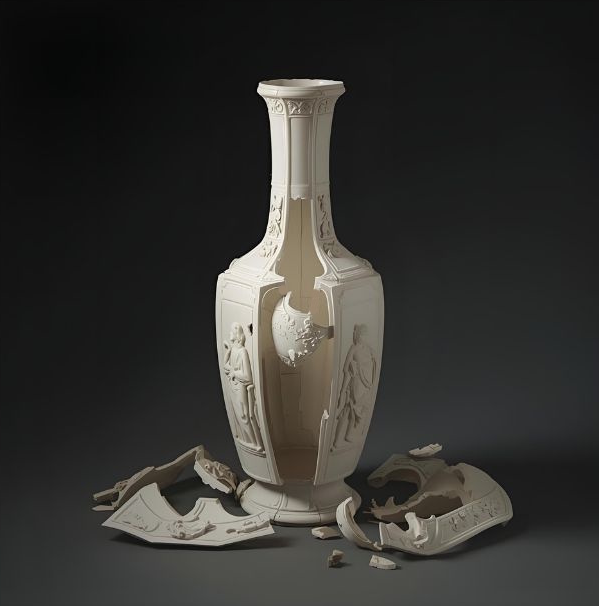
Vase of the Fish Knights
I must find Johannes, my familiar. He is probably curled up somewhere inside the castle. Having already strolled along the parapets, thinking he would be sunning himself there, I walk through the armory, a stone room with its instruments of war hung along the walls. Ah!—there he is, settled atop a pile of folded cloth banners on a heavy oaken table.
Johannes pretends to be asleep, but I see the end of his tail thumping in annoyance. I scratch him behind an ear, and he leans into it. Gradually, my familiar rises to his paws, stretching his front legs forward and raising his hind end, then sits on haunches, glares at me.
“What is it?” he says after a hefty sigh.
“I need your assistive feline powers of healing and mending.”
“Of course you do. To what end?”
From a bag, I gently dump the pottery shards of a vase onto the table. The base and collar are still intact, but the center, around which a story had been illustrated, panel by panel, is in many pieces.
“It is a story vase, a present from our king to his queen. She knocked it over, quite by accident, and wishes that we mend it whole again before His Majesty finds out.”
Johannes sighs. “She is addressed as ‘your grace’ but not known for her grace, is she? What is a story vase?”
“It’s specially made by a storyteller/potter, who tells the tale aloud, over and over again, while turning, glazing, and firing the earthenware. The vase is not merely decorated with the story; the story is absorbed into its clay.”
“I see.” Johannes paws at one of the pieces. “And if we fail in this task? What then?”
“Our queen did not say, but the intensity in her eyes told me she’ll have my head.”
“For your and the queen’s sakes, I suppose we should get started while the king is out hunting, as I imagine he is. The beginning of the tale might be the place from which to commence.”
“Unfortunately, among this jumble, I don’t know where the story starts.”
I pick up a piece and then another until I find two shards whose jagged edges match. Eventually, I find four shards that match, which is all I can hold in my hands at one time. I raise them up to Johannes, and he puts his paw on the opposite side. We concentrate on mending and experience the story.
As things came about, as one of the youthful knights entered a grand city, he found all of its inhabitants standing in their doorways, wringing their hands. The youth asked and was told about the dragon. Every year, on that day, the city must give a maiden to the dragon, or it will destroy them all. This year, the lot fell upon their dear, beloved princess.
The youth asked where it was that the princess waited for the dragon, then asked for and received a large mirror, which he took to rescue the princess.
“Flee,” said the princess. “You cannot save me.”
“Of that, we will see.” The knight set the mirror against the trunk of the ancient tree under which she waited.
“Princess, cover the mirror with your veil. When the dragon is close by, remove the veil and stand behind the tree. I and my steed will hide nearby. Do not fear.”
The words were no more than said when they could hear the flapping of the beast’s wings. It settled to the ground and lumbered toward its victim. The princess unveiled the mirror and stepped behind the tree.
The dragon, seeing another dragon as big as himself replacing the princess, roared. The other roared back. Enraged, the dragon attacked the mirror, shattering it. A hundred small reflections stared back.
The dragon’s head moved from side to side, looking at the fragments on the ground. Growling, the dragon did not hear the young knight charging up to him. Too late, the dragon raised its head, only to have a lance rammed down its throat, piercing its heart.
I hold in my hand what were the four shards, now a single large piece of the vase puzzle, mended with no signs of cracks.
“This is not the start of the story,” Johannes complains.
“No, it is not, but it is our start.” I look for more matching shards.
“I find it humorous,” my familiar says, preening his tail, “a shattered vase is telling us a story about a shattered mirror. But what of this mirror? It is not a magic looking glass as it should be in a fairy tale.”
I consider his question. “Whether a mirror is magical or not, it still reflects. I will go even a little further and say all mirrors are a little magical when they show us back to ourselves, though be it in reverse.
“What our hero understood was that evil would be confused by its own reflection. It may not like what it sees. In our story, the dragon saw itself getting its own way to achieve the princess. When the dragon shattered the mirror, it only multiplied its problem; a hundred of himselves that he disliked staring back at him.”
“Is that how you humans defeat evil?” Johannes twitches an ear.
“It is one strategy. However, evil is not good at recognizing itself and changing its ways.”
Johannes blinks. I take that as an acknowledgment of my point.
I find two more pieces that match. These are all to the left of our first effort. We move another step toward the start of the story. Johannes raises his paw once more and touches the pieces, which start to meld together.
Time passed. The twins grew up to be the two young knights of the fish. Armed with their shields, swords, and lances, astride their two mounts, they stood at a juncture in the road.
All their lives, they had been mistaken for the other, so identical were they. A good or bad deed of one was attributed to the other. Now they were to be their own selves. With fond farewells and vows that they would meet again, they embraced and then departed. One rode east and the other west.
Johannes’s eyes narrow. “Twins. That is a human motif. For us cats, it is a litter, nothing so paltry as only two. But why do your storytellers always make them male twins? I have yet to hear a tale of twin sisters.”
“Certainly, there are some,” I say, “but, yes, I’ve not heard of one either.”
“I will ask again. Why?” Johannes stares as only a cat can.
“I have no answer. I’ve never thought about it.”
“Ah, well, of course. You beings tend to obsess over some thoughts—usually about yourselves—and give other worthy ideas no consideration.”
“Now there’s a thought,” I say.
Johannes doesn’t even blink.
Three more pieces—larger ones than before—find their way into my hands to be touched by Johannes’s paw.
There was a shoemaker who, as hard as he worked from dawn to dusk, could not sustain himself and his wife. They lied to each other, saying they needed no more than they had, but he saw himself and his wife grow thinner and paler day by day.
One day, he threw down his tools and borrowed a fishing pole from a neighbor. He wanted to put food on their table. As diligent as he was at shoemaking, he was patient with fishing. Still, it did him no good.
After a few days, he said to his wife, “I will fish one more day. If, again, I catch nothing, we will kill ourselves. Why wait for starvation to take us?”
The next day, he cast his line and brought in a shining, iridescent fish, as beautiful as any eyes had ever seen. Even more marvelous, it spoke to him in a pipy voice.
“Take me and cook me. Sprinkle much salt and pepper. Cut me into six pieces. Give two to your wife—sparing yourself—two to your nag, and bury two in your garden. Then, fisherman, return to your vocation of shoemaking, and you will not want again.”
The shoemaker, realizing he was—and always had been—in the incomprehensible hands of fate, did as the fish asked.
In time, his wife birthed two sons, the nag two foals, and in the garden grew two trees that bore, not fruit or nuts, but each a shield, a lance, and a sword.
“Now, here is the beginning.” Johannes thumped his tail. “But now I wonder, what questions should I be asking, or maybe, more to the point, what questions does this story want us to ask?”
I contemplate Johannes’s words. “Are we talking about the motivations of both the shoemaker and the fish?”
Johannes blinks this time. “I will take my argument from that perspective. The shoemaker turned fisherman; his motivation is to put food on his and his wife’s table. He is a man in despair. His motive is basic.”
Johannes scratches behind an ear. “I have another thought about the shoemaker flittering on the periphery of my thinking like a butterfly. Did he need to be looking over the cliff of suicide before he could be granted the role of attending marvels? And was that the fish’s doing?
“Speaking of the fish,” Johannes continues, “what was his motive?”
“His or hers?”
“Point taken. Its motive?”
I contemplate. “We are now speaking of a magical fish, not a fisherman/shoemaker. I think the rules are different.”
“I think not,” Johannes returns. “They are both sentient beings with a past, present, and future. The fish gives up its future. It sacrifices itself. Why?”
We both fall silent.
I take the piece that now constitutes the first half of the story that we have been working on and hold it to the intact base and collar, which have no illustrations of the story, and we do not expect to hear any. With Johannes’s healing touch, we now have something that looks like a vase. With a bit more searching, I find three more story shards that fit. This time, when Johannes puts his paw on the pieces, nothing happens. They do not meld.
I tamp down the rising panic in my chest. “What now? This was going so well!”
Johannes stares into the void that surrounds our existence as only a cat can do. “We need to understand the fish’s sacrifice before we can heal the vase.”
“Why is that important?” I ask.
Johannes remains silent for a long time, staring at nothing, before saying, “Healing will not happen without understanding. The vase, after all, is only clay. We must think for it in order to heal.”
“Perhaps,” I am talking and thinking at the same time, “the shoemaker tenders the idea of suicide, which, as you suggest, allows him to attend the marvel of the fish, who comes to him and instructs him as to how to divide his body. Is the fish substituting its own death for the life of the shoemaker as an act of mercy and for some greater good?”
Johannes ignores my suggestion, and I wait for his.
“The fish’s sacrifice was predestined,” Johannes declares. “He, she, it did not choose to sacrifice itself; it knew it had come into existence to fulfill that role. In a way, it was a prophet. Did it know the future? Maybe yes and maybe no. Does that matter? I say no. I say an inspired beginning can sense the channels of destiny stretching out before it. The fish knew this sacrifice would be worth the outcome.”
That isn’t all that far from what I suggested. I hold the shards in place. Lightly, he touches the pad of his paw upon them. Nothing happens.
“Well, that wasn’t it,” I say. I now know what a crestfallen cat looks like.
“I don’t understand,” I continue. “Oh!” I snap my fingers. “Maybe that’s it. Are we meant to understand? Is this simply a glimmering of a thing beyond us, beyond our comprehension?”
Johannes peers at me dubiously, yet when I hold up the pieces, he puts his paw on them. They meld.
Great joy spread through the kingdom when the fish knight and the princess returned to the city. The king rewarded the youth with his daughter’s hand in marriage.
A few days after their marriage, the knight and his lady stood on the castle’s parapets, and he asked, “What castle is that yonder? It looks to be made of black marble.”
“Some call it the Black Castle, others the Castle of Death. None who enters it ever comes back.”
Those words served as a challenge to him, though he made no indication to his wife.
The next morning found him mounted on his horse in full armor, sword and shield in hand, plodding toward the black gate that appeared to swallow the morning light, creating a sinister, silent air. For a moment, he lifted his visor to blow his horn, its sound echoing repeatedly. The castle remained still.
“Is this challenge a bit uncalled for?” Johannes complains.
“Not in heroic terms,” I state. “A knight’s ethos is to meet challenges.”
“I suppose,” Johannes sighs. “But this one is looking for trouble. Could he not be content with a lucky marriage and sit on his laurels?”
“Of course not!” I say, holding up three more shards to be melded.
“Is there not anyone inside to give hospitality to a knight?” His last word echoed with diminishing return, “Knight, knight, knight.”
A small window covered by an iron grating slid open, revealing a most ugly face. The long hair and lack of beard denoted a woman.
“What is your business?” she growled.
“Will you allow me entry or no?” he demanded, again lifting the visor of his helmet.
Replied the echo, “no, no, no.”
“Why, yes,” her eyes glinted. “A handsome youth as you will do me no harm.”
“Harm, harm, harm.”
“Ah! Now this story has me by the tail. Where are the next pieces?” Johannes’s ears flicker.
There are fewer shards now, and my job is becoming easier.
The black gate creaked open only enough to let the youth step inside. The witch—for that is what she was—shoved the gate shut again.
“Well, my lad, now that you are inside, you shall be my consort.”
“Consort! Not I. How many hundreds of years old are you?”
“Tsk,” she replied, “do not judge me until you see what I can offer. Let me show you my castle.”
The youth followed her through richly furnished rooms, some containing strange and exotic objects unknown to him, until they came to a dark, unlit, spiraling staircase.
“In this tower are my greatest treasures. Follow the sound of my footsteps.”
Up the youth climbed, higher and higher, until his foot found no purchase. He could not have known the witch’s trick. He tumbled into the void to join the other knights, her “consorts,” and to become one of the echoing voices.
“And was it you, my young fool, that slew my dragon? I think so. A life for a life.”
Johannes glances at me worriedly before his eyes stray to the remaining shards.
“There had better be more to this story. That would be a most dissatisfying end.”
I sift through the bits of pottery and match three more to hold in place.
Because fate’s hand moves the chess pieces of life around the world’s board, the fish knight twin rode into the same city as his brother had. To his astonishment, the guard stood at attention and saluted him. Drummers played a royal march. Soon, castle servants came, dressed in livery, saying his lady had made herself ill with weeping. He then knew he had once again been mistaken for his brother but determined to play the role until he solved this mystery.
“Take me to her.”
The servants brought him to the parapets, where the princess stood, transfixed on the distant castle. Seeing him, she threw herself into his arms. Then, wide-eyed, she asked, “Have you gone there and returned when no one else ever has?”
His eyes followed her hand’s gesture toward the black marble castle.
“I have, and yet, I must return.”
“No,” she pleaded. “Not yet. Feast this evening and spend the night. Gather your strength and be with me.”
The twin faltered for only a second. “No, I cannot. I vow not to eat, drink, or rest until this business is done. Seeing you gives me this resolve.”
“Ha, the twin,” Johannes declares. “I should have seen it coming. The story allowed me to forget about him.”
“There are not many pieces left,” I say, holding up a few more. “We are obviously near the story’s end.”
Before the sun set on the day, the twin approached the Black Castle. He saw his brother’s steed—riderless—grazing. He left his own horse to graze with his brother’s and made for the castle on foot. He blew his horn, the sound of which echoed, then he lowered his visor. The grated window soon slid open.
“Another pesky knight? Why does your kind keep bothering an old woman?”
The window closed, and the gate creaked open.
“Whom do I have the honor of addressing?” Her voice held sarcasm.
Now the twin raised his visor. Upon seeing the face of the knight she had just murdered, she screamed, “No, you’re dead!” and turned to flee, but his sword pierced her back before she took another step.
“What have you done with my brother, cruel hag?” he demanded.
“Brother? I see,” she groaned. “Restore me, and I will show you.”
“Restore you?” He laughed bitterly. “How might I do that?”
“Easily, with the purple flowers from the plants Everlasting and Dragon’s Blood in my garden. Boil them in a cauldron. When the water cools, lower me into the potion.”
“Come, come! More pieces.”
“Don’t rush me,” I say.
This he did, but by the time he finished the task and the potion had cooled, the witch was dead. Nevertheless, he bound her hand and foot and put a gag in her mouth so she could not articulate a spell before immersing her in the potion. With wonder, he watched the body restore itself. Now, he knew what to do.
Not trusting her as guide, he explored the castle, starting with the dungeon, and was rewarded for his good guess. There he found a pile of decaying bodies, his brother’s among them. Carrying the shattered body out of the dungeon, he eased it into the cauldron, and life returned.
Reunited, they wasted little time in bringing up the bodies of the other “consorts” and restoring them to life.
“What of the maidens?” one of the restored asked.
“Those given yearly to the dragon? Can they be found?” asked another. The first beckoned for them to follow.
In the dragon’s lair were the remains of many damsels. They, too, were carried to the cauldron.
All the while, the witch struggled against her bonds, howling behind her gag as, one by one her victims came back to life. As the last of the knights and damsels was restored, the witch’s heart burst.
And when that happened, a quake ran through the castle. The twins and the company of the restored quickly left through the black gate and, in safety, watched the Castle of Death crumble into a pile of rubble.
Johannes’s tail trembled with pleasure. “I see there is one last piece of the vase puzzle.”
I rotate it in my hand until it falls into place. We are moments away from my head being saved.
“Now then!” I hear pontification rising in Johannes’s voice. “This is where we find out the truth of the fish’s sacrifice.”
“What? I thought we were not meant to understand.”
“Rubbish,” he says. “This story is about the consequences of a sacrifice. The fish was at the beginning of the story. It is fitting that this entity should reappear at the end and reveal the meaning of the sacrifice. Oh, the fish might be transformed into a disembodied voice or be a shroud of mist, but the fish must return. Mark my words.”
With a confident flourish, he places his paw on the back of my finger that holds the shard in place. It melds. The vase is healed.
The end.
Johannes’s ears flatten. I snatch up the vase before he can do it harm.
“My many thanks to you,” I say. “I will recommend you to the queen.” And I scurry out the door.
 Fairy Tale of the Month