
Magic Picnic
Thalia and I wander into the Magic Forest, she carrying a wicker picnic basket hastily provided with egg-and-cress sandwiches, two apples, some parlies, and two bottles of Karma Cola. It was a last-minute decision. Looking out the window at a glorious summer day, I suggested a picnic, and Thalia chose the Magic Forest as the location. That surprised me, but why not?
We go no farther into the forest than the pond and find a grassy sward on which to spread our blanket. We are just getting settled, when down another path comes Ultima.
“Hello again,” she smiles. “I have come to contribute this!” She holds up a small, colorful box. “To add to your picnic for a story in exchange.”
“Well, Ultima,” I say, “First things first. This is my granddaughter, Thalia.” They simply wave energetically at each other. “Now, what is in the box?”
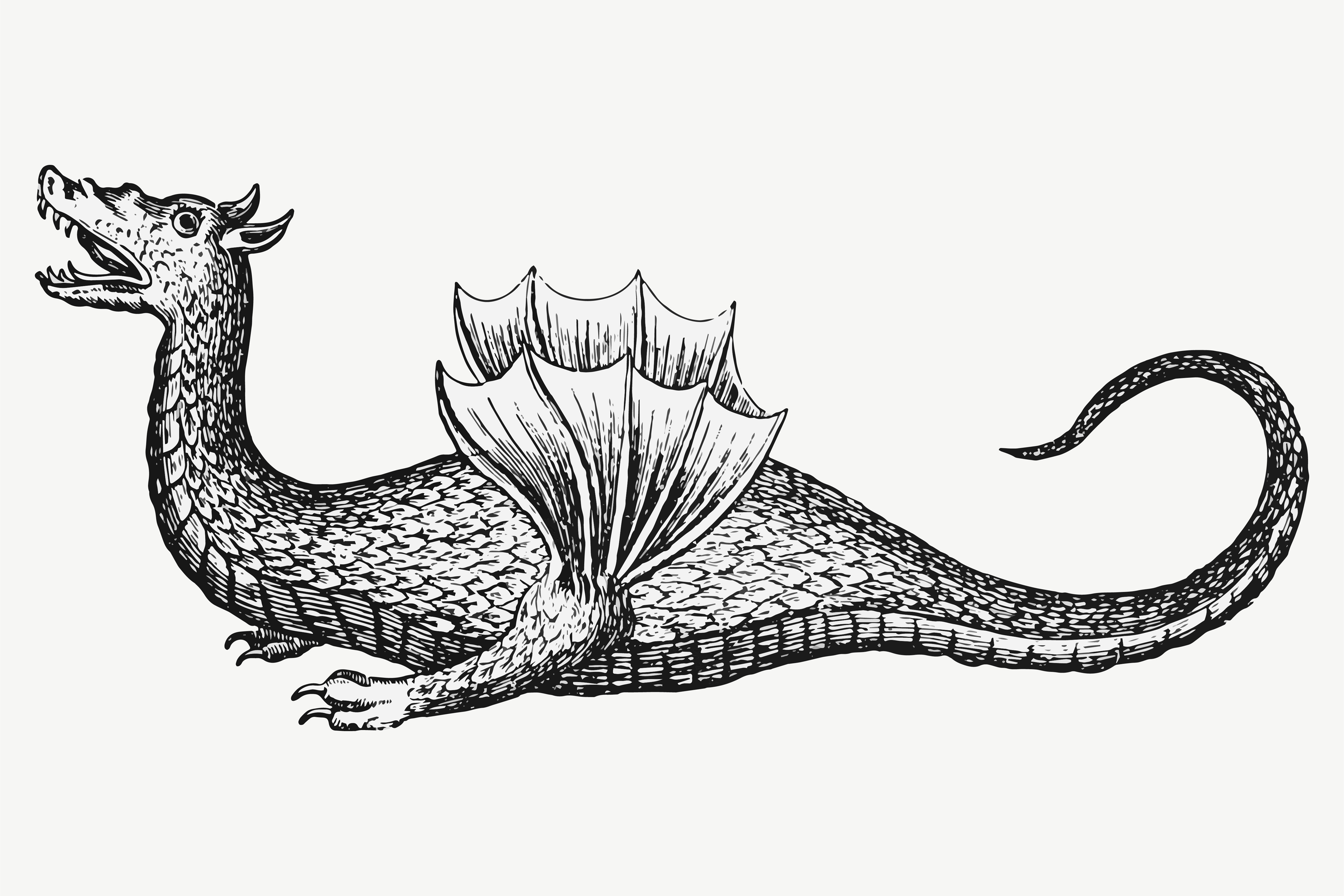
“Caramel Dragon Nuts.”
“Hmmm, dragon,” says Thalia. She reaches into our basket and pulls out Folk and Fairy Tales from Denmark, Volume Two, a collection l know she has been exploring. “In exchange,” Thalia offers, “here is Kidnapped by a Mermaid and a Dragon.”
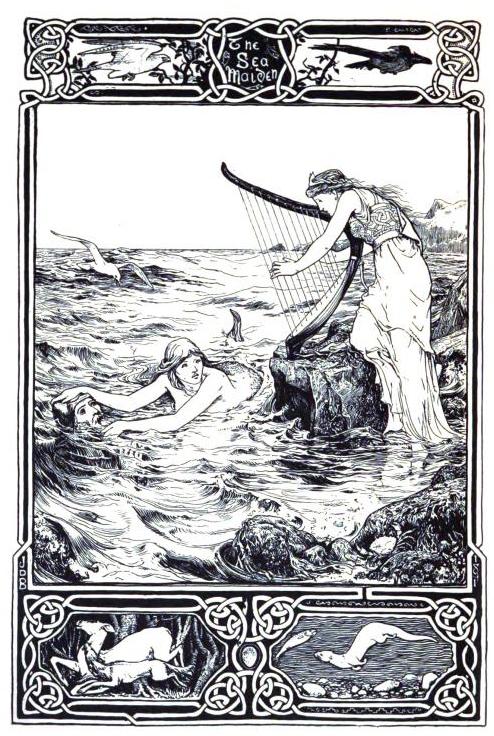
A poor fisherman, unable to provide for his family, is approached by a mermaid, who promises his wealth in fish if he will give her the son his wife is carrying in her womb. The fisherman, knowing he cannot feed another mouth, agrees to give up his son soon after the child’s twelfth birthday. The child, when he turns twelve, finds out what his father has done and flees from the sea to avoid the mermaid.
On his travels, he comes across a lion, a dog, a falcon, and a beetle arguing over a dead animal and who should consume it. The lion enlists the lad to solve their problem. Wisely, the lad divides the corpse among them, each to their own contentment. As reward, they give the lad the power to assume their shapes, only with twice the power, twice the speed, and twice the wisdom.
In the form of the falcon, he allows himself to be lured by a trail of breadcrumbs into the hands of a princess, who puts him in a decorative cage. That night, he turns into a beetle, crawls out of the cage, and approaches the princess’s bed as a man. She screams, and he retreats into the cage. The household thinks it is a bad dream, and this happens three nights in a row.
However, on the third night, before she can scream, he says, “Hush now. I am your falcon.” It was not long before they are plotting how to get married. The king, unfortunately, had declared no one could marry her until they could pick her out from her two other, identical sisters. Failing to do so carries the usual punishment.
There grew a hair on her neck that was unlike her sisters and with that clue, he picks her out three times in a row no matter how they dress.
But, as fate will have it, the newly married couple, on a walk, strolls too close to the sea, and the new prince is snatched away by the mermaid. The princess demands of her father a gold spinning wheel, a gold spinning reel, and a gold thread-winder—which with great reluctance he provides—for her to make a shirt for her husband. She does the spinning, reeling, and winding by the sea. The mermaid demands the devices, saying that she, the mermaid, should make the shirt for the husband. The princess agrees to surrender the gold instruments as long as she can once again see her husband. This the mermaid allows. The princess says, “If only my falcon were here.” The husband transforms into a falcon and escapes the mermaid.
Fate, once more, interferes. On their return, a dragon appears and steals away the princess. The king offers up one of his other daughters to the prince—they all look alike—but the prince will have none of that and sets out to find his wife.
In falcon form, he searches the world. One day, while resting on a mountaintop, he senses a strange odor. In dog form, he follows the scent to a mouse hole. In beetle form, he crawls into the mountain to find his wife and six other princesses crying into a vat. He stays long enough to discover how to destroy the dragon.
Every day, the dragon demands fifty pigs from the king of that land. The prince arranges to be the swineherd, then transforms into a lion and battles the dragon. This encounter happens three times. Each time, when they lay exhausted, no longer able to fight, the dragon says, “If I had the princesses’ tears to drink, you’d be dead by now.” To which the lion responds, “And if I had a sip of wine from the king’s table, your guts would be on the ground.”
On the third day, the prince brings a companion whose sole duty is to give him the wine. With that, the lion rips apart the dragon. As the prince knew would happen from his spying inside the mountain, a hare springs from the dragon’s body. In the form of the dog, the prince chases and kills it. From the hare, flies a dove. As a falcon, the prince kills the dove and dashes the egg inside it onto the mountain. The dragon’s mountain collapses, and everyone in it is freed. The prince and princess return home in honor.
Ultima applauds. “I am not sure about the evil dragon part. My dragon would not appreciate that a bit, but I like the story.”
Fairy Tale of the Month: July 2023 Kidnapped by a Mermaid and a Dragon – Part Two
Other Food
“Now,” says Ultima, “if this is a proper picnic, I am sure you brought a bottle of wine.” She peers into our picnic basket.
“Ah, well, you see, this was sort of a last-minute . . .”
“Oh, a bottle of claret, how nice.”
What?
“And here are three glasses. There now, you did know I was coming. You did bring a corkscrew, I hope.”
I see Thalia’s eyes light up at the prospect.
“Only half a glass for her,” I declare.
“I do have a question,” Ultima asks as she pours out two and a half glasses. “It seems to me, there is more than one motif being borrowed by this story.”
“Oh my, yes,” I say. “Let’s enumerate them.”
We all pause to take a sip. Thalia’s eyebrows flicker.
“First,” I describe, “is a fisherman bargaining with an entity from the sea. They invariably want a child. The sea is equivalent to the fairy world—another place where abducted children end up—except that the fairy world is in another dimension. The sea is in front of us. Obviously a different realm, but one we can at least wade into, but if embraced, would drown us.”
“That’s a setup,” says Thalia, “for what happens later on when he gets kidnapped, but what about the four animals arguing over who gets the dead one?”
“That is another trope,” I say, “that appears in lots of stories. The unusual feature in this one is the four contenders for the feast, as opposed to the typical three. For me, the lion stands for strength, the dog for speed, the falcon for cunning, and the beetle for wisdom.”
“Is there a Carl Jung in your world?” Ultima asks out of the blue.
“Yes,” I answer.
“Right. He talks about the four personality types. For me, the lion is the Sensor, the one who has rules for himself and others; the dog is the Feeler, the one who is concerned about others’ comfort; the falcon is the Intuitor, the one with flights of fancy and insight; and the beetle is the Thinker, the one who reasons things out.”
“Sooo,” Thalia is thinking out loud, “in either case, the hero’s meeting the four creatures is more than something that happens to him and he gets gifts, they become part of who he is. He absorbs them—at least their gifts. They become a part of his personality.”
I wonder if a little wine clarifies her thoughts.
“I like that idea,” Ultima smiles. “Magic can become part of you, more than something you just have. Well, if there is wine, there must be cheese.”
“At this point, I am not sure,” I say.
Ultima peers back into the wicker. “Oh my, a whole wheel of Jarlsberg. You are extravagant. Where’s the knife.”
How did that fit in there?
We are soon nibbling on wedges of cheese.
“What was the next stolen motif in our story?” Ultima breaks the silence.
“Next,” says Thalia, “the falcon is captured by the princess, and his,” Thalia clears her throat, “somewhat inappropriate behavior. Is that a motif?”
I hesitate. “I’ll say ‘no.’ I have run across something similar in The Earl of Mar’s Daughter, but I will call that a borrowing, not a motif.”
“What’s the difference?” Ultima frowns.
“A motif,” I suggest, “doesn’t just travel down the road of story from one teller to another, although it might, but originates in the human psyche, the collective unconscious. It is not any teller’s invention.”
“Next is the identical-sisters contest,” Ultima chimes in. “Is that a motif?”
“Most certainly, although it is usually not sisters but a larger troop of women of identical appearance, sometimes magically produced.”
“And what part of the human psyche does that tap into?” she asks.
“I’ll have to think about that,” I say.
“Easy,” Thalia responds. “It’s about making the right choice when there are lots of choices, like finding who is your best friend among all the people you know.”
Does wine spur her thinking, or is it simply making her loquacious?
Fairy Tale of the Month: July 2023 Kidnapped by a Mermaid and a Dragon – Part Three
More Food
Ultima lays out a platter of sizzling Angels on Horseback—bacon-wrapped oysters—and beside it, steaming Yorkshire pudding.
Hot appetizers?
“I believe that brings us up to the kidnappings.” Ultima samples a haggis sausage roll.
“Which brings us back to where the story started,” Thalia observes. “And why is it called ‘kid’ napping? Why not ‘princenapping’ and ‘princessnapping’?”
“Well,” I say, “in the plural, ‘princessesnapping’ would be hard to pronounce.”
Thalia giggles, and I continue. “As I said before, fairies and merfolk were given to bargaining for or stealing children. Losing one’s children is, I believe, rated as a primal fear among parents. But then, fairy tales have a way of reflecting all of our fears.
“In these abduction tales and similar stories, the silver lining is that the mother manages to get her baby back, or the husband or wife regains their stolen spouse. Herein is a theme of loss and triumph.”
“Not in The Pied Piper of Hamelin,” Thalia states.
“True, but that only reinforces my idea of our fear of losing our children. The Pied Piper, a magical being, isn’t stealing a child for his benefit, but the children of an entire town as punishment for breaking their contract. No silver lining there. It is the other side of the coin, as it were.”
“I see the theme of fate being played out when the mermaid kidnaps the prince,” Ultima says.
“There is plenty of fate to be found in fairy tales,” I say. “However, we think of fate—at least in the English language—as the inevitable fall, or even demise, of its victim. Seldom, if ever, is the hero or heroine fated to good fortune. Good fortune comes of the defiance of fate. To use another simile, when the cards are stacked against the hero or heroine, they have an ace in the hole.”
“Oh!” says Thalia with wine-enhanced emphasis, “is that the role of magical devices? To help defy fate?”
“There’s another good thought,” says Ultima.
“Hmmm,” I analyze. “That is a good thought. The princess talked her reluctant father into providing her with golden thread-making tools. These were not magical, but being made of gold is just short of being magical.”
“Or,” says Ultima, “is gold magical?”
“We do treat it that way, don’t we.” I say. “In either case, the princess used these devices to trick the mermaid.”
“And so,” Ultima raises a finger, “the story comes full circle, fate is defied, and the story should end. But it doesn’t.”
“Yeah,” Thalia squints, “the dragon comes in as a random act of nastiness.”
“Right,” Ultima goes on. “What happened to the prince was a matter of fate. What happened to the princess—as you say, Thalia—was a random event. In either case, one mate had to save the other. That was kind of a given. It’s the origins of the dilemmas that I find interesting.
“I don’t think the teller was simply trying to make the story longer. I think the teller wanted to give equal time to the animus and anima within the listener.”
“The what?” Thalia’s eyes blink rapidly.
“My apologies for projecting Jungian thought into the story again,” Ultima says. “Simply put, the animus is the man in every woman, and the anima is the woman in every man. Just as everyone has elements of the four personality types, and one of the types will dominate, we all have elements of the animus and the anima, the dominance of which will depend on our sex.
“As I interpret the story, it tells us that the animus—the male part—may defy his fate through some device, be it physical or otherwise. Then the tale tells us that the anima—the female part—may solve an unlooked-for crisis through acquired knowledge and by getting to the origin of the matter.”
“Oh!” Thalia brightens. “The egg that held the dragon’s soul.”
“Egg-actly.”
I groan as I get around to tasting her caramel dragon nuts. “I don’t know if that would hold up as a scholarly paper, but I rather like your notion that the story speaks to all the different parts that make up our psyche.”
Ultima peers into the basket again, then looks at us warily. “Are we ready for the main course?”
Your thoughts?
 Fairy Tale of the Month
Love the breakdown of the story. I have a long-standing interest in Jungian thought and fairy tales, but have not formally studied or practiced any of it. Your stories brought me joy!
On the Freud side, “Fisherman and HIs Wife” plays well into the Id (wife), Ego (fisherman), and Superego (flounder) idea. It is fun to look at the tales from different angles.