

Jini’s Diwali
It is the fourth day of Diwali, and Jini and Thalia have brought the festival into my study. Melissa is here as well to join in the Celebration of Lights.
Thalia stayed with Jini’s family on the third day of Diwali, which is the most important of the five. Thalia showed me videos on her phone of the complicated, ceremonial dancing in Trafalgar Square, the Lakshmi Puja—the prayers to the goddess Lakshmi—and the evening fireworks.
The girls showed up here early in the morning and have taken over the kitchen once again. I managed some tea and a scone. I didn’t mind, and I am saving my appetite for this evening’s feast. I know potato samosas are part of it.
Jini has placed small lamps all around the perimeter of the room: on shelves, tables, and windowsills. We are surrounded by the light of these little lamps, rather like votive candles. Jini sits in the largest comfy chair, holding a copy of Joseph Jacobs’ Indian Fairy Tales, with Johannes on her lap, and the fairy on her shoulder—they adore her—and she begins to read aloud to us.
“Punchkin.”
A raja had seven daughters, but when their mother died, a widow, through trickery and clever words, worked her way into the raja’s good graces and became the ranee. Wishing to promote her own daughter, she schemed against the seven sisters.
First, she tried to starve them to death, but they prayed at their mother’s tomb for help. From the grave grew a pomelo tree, and the girls ate the pomelos until the ranee had it cut down. Then the grave produced creamy white cakes until the ranee had the tomb torn down.
The ranee pretended an illness that only the blood of the seven sisters could cure. The raja, not wanting to kill his daughters, left them in the jungle and killed a deer for its blood. The seven sisters were found by the seven sons of another raja who were out hunting. The seven were soon married, the oldest to the oldest and the youngest to the youngest.
After a year, the youngest sister, Balna, had a son and was the only one among her sisters to ever have a child. As he was the only child in the family, all adored him. One day, Balna’s husband went out hunting and did not return. His six brothers searched for him, but they too did not return. Soon, a magician named Punchkin stole Balna away, leaving her son to be raised by his widowed aunts.
When the boy reached the age of fourteen, the aunts told him of his history, and he decided to go search for his parents and uncles. He eventually came to a land of rocks, stones, and trees, where stood a large palace with a high tower. Nearby, the youth found the house of the palace’s gardener, and the wife gave him shelter.
From her, he learned that the palace was the home of the magician Punchkin, and the stones and trees around them were people transformed by the magician. She described events that led him to know his father and uncles were among these stones, but that his mother was held captive in the tower until she agreed to marry Punchkin.
Disguised as the gardener’s daughter, he lingered around the palace grounds until Punchkin, thinking him a girl, sent him to deliver flowers to the beautiful lady who lived in the tower. With a golden ring that Balna had given to him, he identified himself to her.
They contrived to have Balna appear to soften her manner to the wizard and appear to consider marriage. She found out that his life was secured in a little green parrot, in a jungle hundreds of thousands of miles away, guarded by a thousand genies.
With the help of eagles that he saved from a serpent, the youth was flown to the distant land, flew over the guard of genies, and captured the green parrot.
On pain of death, the youth convinced Punchkin to restore all the people he had turned to stone and trees before, nonetheless, he ripped the parrot to pieces, ending the life of the magician.
With a smile, Jini snapped the book closed. “And that was the end of that evil.”
Part Two
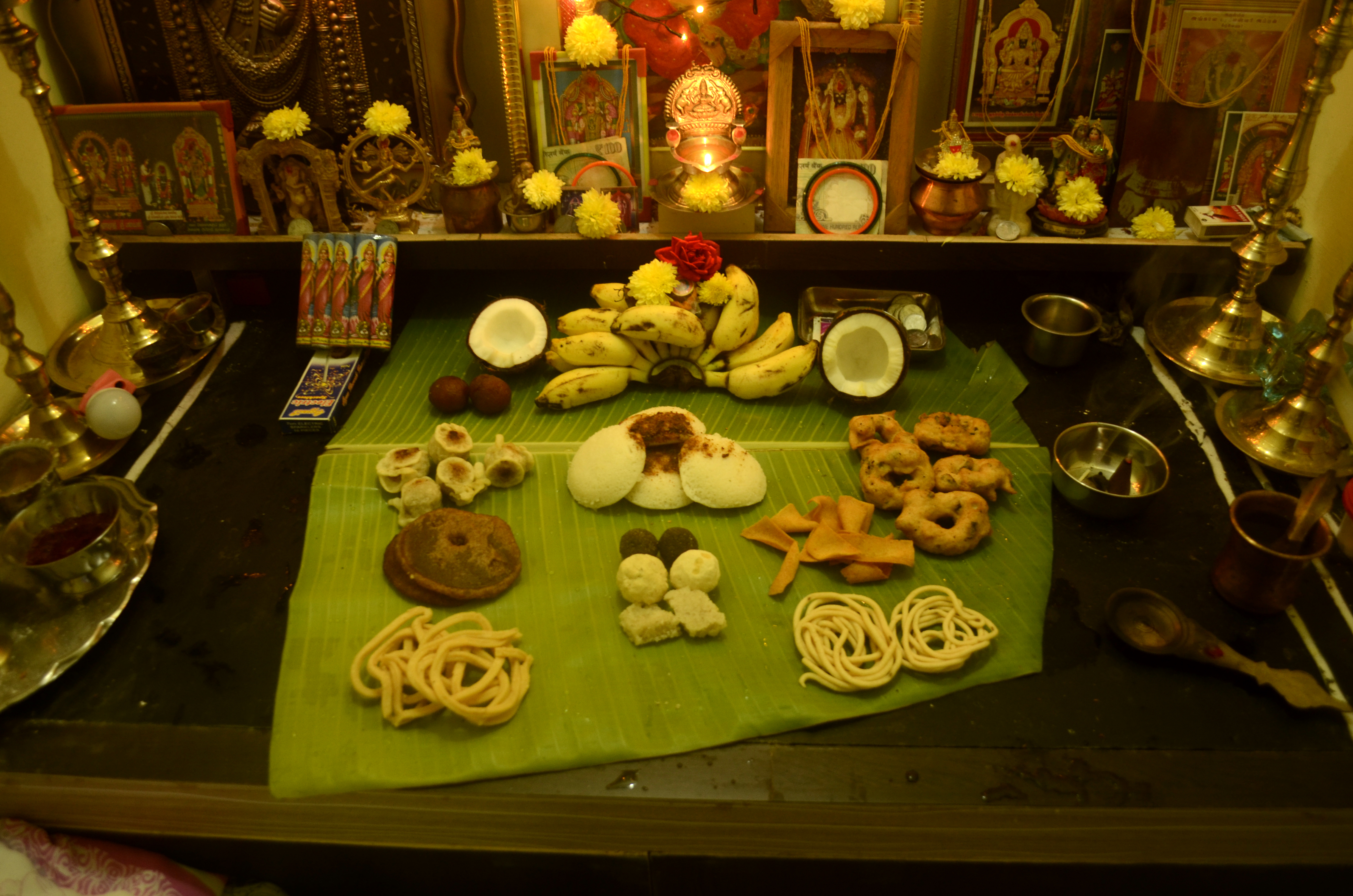
Diwali Feast
“An appropriate story,” Melissa says. “Good triumphs over evil, one of the themes of Diwali.”
Jini nods in agreement. “As is light over darkness and the hope for prosperity.”
I see Thalia scurry out of the room.
“Here in the west,” I say, “we don’t have five-day holidays. I think that is kind of brilliant.”
Jini smiles with a bit of condescension. “Not so fast. The first day of Diwali is spent cleaning.” She grimaces. “The idea is the goddess Lakshmi might visit, and things had better be clean.
“The second day is spent shopping and preparing for the third day. The third is the best. The fourth and fifth are for visiting friends and family.” She waves her hand to include us.
Thalia returns, balancing plates of food on her hands and arms. We quickly clear stacks of books from one of the tables upon which we intend to dine.
The girls have gone all out. There are the potato samosas I crave, but also pakoras (might be the best thing to do with cauliflower), srichand and pooris (fried dough and yogurt), jalebis (curly, spicy, fried dough), gajar ka halwa (think carrot pudding), and slices of paneer (non-rennet cheese), along with mango lassi to drink and shortbread cookies (made with pistachio, cardamom, and saffron). What a spread! I notice the fairy, though she lives by the air, sampling the cookies.
Melissa admires the intricate henna tattoos on the backs of the hands and forearms of both Jini and Thalia.
“Oh, my aunt is so good at this,” Jini says. “She did this for us.”
“How is it done?” Melissa wants to know.
“Henna is a paste that she puts on our skin with a cone, kind of like a pastry bag decorating a cake. When it dries, you rub it off, and the pattern is light orange, but hour by hour it gets darker.”
I see that the tattoos are a deep red.
“By tomorrow,” Jini continues, “they will be black, then in a week or two they will fade away.”
“Is there a religious significance to the tattoos?” Melissa asks.
“I don’t think so,’ Jini frowns. “It’s just fun.”
I am surprised by the pakoras; I thought the samosas would be my favorite. The mango drink is tasty, but I want a little alcohol. I wander off to the pantry where I keep the Moscato and return with two glasses for me and Melissa. The conversation has moved on to the story Jini told.
“My least favorite part,” Jini wrinkles her brow again, “is the convenience of the seven sisters being rescued by the seven raja sons. That seemed . . . “ Jini pauses. “not real.”
Oh,” says Melissa, “don’t let that worry you. There is much numerology in the tales, be they eastern or western.”
Jini cocks her head, waiting for more explanation.
Melissa has the stage. “Numbers figure commonly into the fairy tales. Simply look at the titles: The Three Little Pigs, The Six Swans, The Seven Ravens, The Twelve Dancing Princesses, and Ali Baba and the Forty Thieves. That list could go on.
“Often, events happen three times. Each of the three pigs builds a house. The king has three sons for whom he sets three tasks. Seven is certainly common enough. Snow White and the seven dwarves. The seven-league boots.
“No, numbers are an integral part of the genré. You can’t get away from them.”
Part Three
Pretty Close
“What I couldn’t help noticing,” Thalia says, finishing off the jalebis, “is that it kept reminding me of other fairy tales.”
“Yeah,” says Jini, “like when the raja leaves his daughters in the jungle and kills a deer and uses its blood to fool the ranee. That’s right out of Snow White.”
“It’s a little different.” Thalia drums her fingers, staring at the ceiling. “There’s no raja or king worth mentioning. It’s an evil queen making her huntsman kill Snow White, and he brings back a boar’s lungs and liver for her to eat.”
“Pretty close,’ says Jini.
“Pretty close,” says Thalia, “but Snow White doesn’t have any sisters. Oh! Wait. There are the seven dwarves.”
They both chorus, “Huh!”
“But . . .” Jini wags her head, “that’s where the similarity ends, I think.”
I am listening while I serve myself more of the pakoras.
“Now I am thinking of . . .” Thalia gets up, leaves the room, but soon returns with a copy of Alexander Afanasyev’s Russian Fairy Tales.
“Ah, Koschei the Deathless, that’s it. Punchkin’s life was in a little parrot, in a jungle, guarded by genies. I think Koschei does him at least one better.”
Thalia reads, “In the sea there is an island, on that island stands an oak, under the oak a coffer is buried, in the coffer is a hare, in the hare is a duck, in the duck is an egg, and in the egg is my death.”
“Wow,” Jini shakes her head. “Similar but different.”
“Then,” Thalia drums her fingers again, “we get to the eagle-transport thing. I know I’ve read more than one tale where an eagle carries the hero to where he needs to be.”
“What jumps to my mind,” Melissa says, sipping her Moscato, “is the Greek folktale Underworld Adventure, where a monstrous bird—not exactly an eagle—helps the protagonist after he saves her chicks from a serpent.”
“Wow,” Jini repeats. “There we are again; similar but different.”
“Let me suggest,” I say, refilling Melissa’s glass, which she has been nursing, “we have dispersion going on. The tropes in this tale show up in tales from Germany, Russia, and Greece in our simple sampling. Some tropes might be universal. What I am suggesting, by using the term ‘dispersion,’ is that these ideas flow back and forth between countries and cultures.
“But the notion that some tropes are universal also suggests that these thoughts might be baked into our brains. This is what some call the collective unconscious, unconscious knowledge that all humans share but only comes to the surface in dreams and fairy tales.”
“Ah! Here it is.” Melissa is scrolling on her phone. She hasn’t been listening to my argument at all.
“The Panchatantra and also the Kathāsaritsāgara, which translates as Ocean of Streams of Stories.”
I will have to trust her pronunciation of that last one.
“The Panchatantra is ancient, and the other is derived from older works, all of which predate our known versions of European tales and contain many of the common motifs with which we are familiar.”
Thalia is thumbing through Jini’s Indian Fairy Tales. “Yeah, Jacobs says, ‘. . .India is the home of the fairy tale, and that all European fairy tales have been brought from thence by crusaders, by Mongol missionaries, by gypsies, by Jews, by traders, by travellers.’”
Jini glows with pride for her India.
I’m going to stick with my back-and-forth dispersion, or the collective unconscious, and not pour Melissa any more Moscato.
Your thoughts?
 Fairy Tale of the Month
We lived in Singapore for years and familiar with Diwali, called Deepavali there, “Festival of Lights”. The kids were young enough to be enthralled with the colorful festival. Since our time there, we’ve been addicted to Indian food. Your story brought me back to those time.