
A Snake
I open the familiar gate to Miss Cox’s garden. I always enjoy being here. The grounds are pleasant and well-kept. Miss Cox always provides a pot of tea tucked into its cozy and enough cups for her visitors. I never see her, but then she is always rather reclusive.
It is in her garden, a place between time and space, that I have been able to meet with Joseph Jacobs, Andrew Lang, Hans Christian Anderson, and others. But today . . .
Why am I here?
I spot Melissa sitting on the bench with the teapot on the wrought iron table in front of her.
“You called me?” I say.
Melissa smiles. “You are so obedient.”
I settle onto the bench, and she pours me a cup.
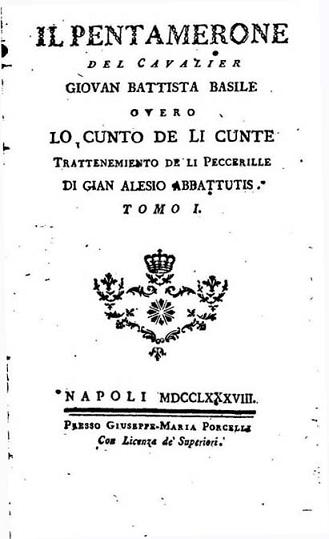
“I am in fairy-tale distress,” she says. “I read a tale, many years ago, in Giambattista Basile’s Pentamerone, that offended me, and I excluded it from my memory. I ran across it again today in Andrew Lang’s Green Fairy Book, there called The Enchanted Snake. It still offends me, but now I want to know why. Interestingly, in the preface of the Green Fairy Book, Andrew says this is the last of the color-book trilogy. It went on for eight more volumes. Apparently, he did not talk to Lenore about that.”
“Well,” I say, “tell me the tale.”
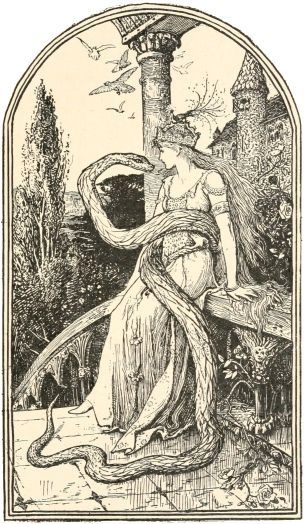
A woodcutter, Cola-Mattheo, and his wife, Sabatella, to their sadness, have no children. They show sympathy to a little snake they find in a bunch of faggots that the woodcutter brings home. The snake speaks to Sabatella and asks her to be like a mother to him. This she does.
When the snake has grown, he wants to marry the king’s daughter and asks his “father” to make the arrangements. The woodcutter, something of a simpleton, does as his “son” asks. The king, thinking this a bizarre joke, agrees if the snake will turn his palace into ivory, inlaid with gold and silver.
With the help of Mattheo, this the snake easily performs. The next two challenges the king demands are also easily done. Trapped by honor, the king calls for his daughter, Grannonia, and tells her that he has chosen a husband for her. Calling the king her lord and father, she acquiesces. He does not tell her he has promised her to a snake.
When the reptile arrives in a golden carriage drawn by six white elephants, all flee at the appearance of the would-be bridegroom. Only Grannonia holds her ground. The snake, after kissing her, leads her into a room where he sheds his serpent skin to become a handsome man. The king and queen, spying on them, rush in, seize the snakeskin, and burn it. The bridegroom turns into a dove and escapes by breaking through a glass window, injuring itself.
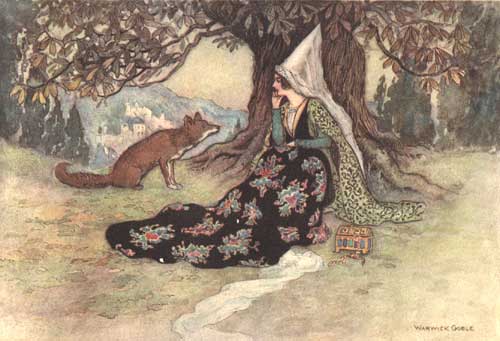
That evening, nearly heartbroken, Grannonia slips from the castle disguised as a peasant to search for her would-be husband. She is befriended by a fox, who translates the story that the birds around them are singing, which is her story, and that the dove, actually a prince, is gravely wounded.
The fox further explains that, at her pleading, she could effect a cure for the prince with the blood of the birds telling the tale. The princess talks the fox into catching the birds for her. He does so, but then further explains that his blood is also necessary, which he is not willing to give up.
She convinces him to try and still help her, even promising he can sell her as a slave to the king of her beloved. On the way to that kingdom, she murders the fox. With the blood of the birds and the fox, she is able to cure the prince with the agreement that he will marry her, although she is still disguised as a peasant.
The prince, when healed, refuses to marry the peasant woman since his heart belongs to someone else. Grannonia reveals herself to the prince’s great joy. Her parents are invited to the prince’s kingdom, and the grand marriage takes place.
“So,” I say, “are we here to meet with Basile, Andrew, or Lenore?”
“I would like to meet with Lenore someday,” Melissa nods, “but today I have invited the fox for an interview.”
Part Two
A Princess
A movement catches my eye. I turn to see a fox jumping over Miss Cox’s garden gate. He trots, purposefully, toward us, but then stops a good twenty feet away and sits on his haunches.
“I see there is a gentleman with you,” the fox states. “That gives me some encouragement that I have not been called to be beguiled by a woman again. Men are honest if poor at following my instructions. Women have yet to prove themselves worthy of my assistance. If you want something from me, you will need to bargain for it, and a cup of tea will not suffice.”
“I anticipated your reluctance,” Melissa says, “and have brought kibbles.” She advances halfway between the fox and us with a stainless-steel bowl. The fox backs up as she moves forward, then approaches the bowl as Melissa moves back. He sniffs suspiciously, glances up with a question in his frown, then takes a bite.
“Oh, it is good. Well then, I sense you have a question.” He nibbles and listens.
“Yes,” says Melissa. “I wish to speak of, and perhaps defend, the princess Grannonia.”
The fox coughs but continues to eat, and Melissa goes on.
“The king, her father, falls into the snake’s trap of giving up his daughter to him. Grannonia, being a dutiful daughter, never thinks of objecting. However, the king does not tell her he has betrothed her to a snake.
“This is the beast-as-a-husband motif, of course. In this case, she is left to face her snake bridegroom as everyone else flees. True to the motif, the snake turns into a handsome prince. What could have been a happy ending turns tragic when her parents interfere.
“Now, deceived by her father and denied true joy in a rapid turn of events, she, in disguise, leaves the castle, leaves the life familiar to her, and steps into the unknown to reclaim the true love she so briefly knew.
“Here is my question. Was her distress why you befriended her, or was it a chance encounter?”
The fox finishes his kibbles. “A valid, feminine-perspective question that I will try to answer, although it gives me pain. You must understand I am a fairy-tale fox, a helper. My befriending Grannonia was no coincidence, no accident. I appear to supply what my client lacks.
“In the case of heroes, men, it is their lack of any kind of strategy to get from point A to point B. They invariably screw things up, and we move on to get them from point C to point D and onward.
“The case of women is different. It is not all about a strategy but more about comprehending their dilemma and plotting a path forward. What they lack is control. To my demise, Grannonia seduced me into trying to help, even promising me I could sell her. Blindsided, I let her murder me. She took my life, she took my blood, but more importantly, she took my cunning, if only metaphorically. She became cunning and took control. I was no longer needed.”
With that, he turns, vaults over the garden gate, and is gone.
Part Three
The Mindset
“He is a bit misogynistically inclined,” I defend.
“I won’t blame him,” Melissa replies. “Grannonia is certainly one of the few women with a fox helper in European fairy-tale tradition. She did not act saintly toward him.
“I am thinking he is right that Grannonia murdered him in part to acquire, or maybe usurp, his abilities.”
I sip my tea as our conversation comes to a halt while Melissa processes the fox’s words.
“A bit off topic,” I eventually say, “but I could not help noticing the naming convention. Only the woodcutter, his wife, and the princess had proper names.”
“Yes, how about that?” Melissa also sips her tea. “At the end of the tale, we find out that Grannonia’s parents are the king and queen of Starza-0longa, and the prince’s kingdom is Vallone Grossa, yet we still do not know their names.
“Usually, the fairy tales begrudgingly give up a few names, those of lesser characters, not often the names of royalty. They are the King, the Queen, the Prince, and the Princess. That the woodcutter and his wife have names is no surprise, but that the princess does in our case is unusual.”
“I also noticed,” I say, “that while the woodcutter and his wife had names, and the snake is indebted to them, they disappear from the story and do not reappear, not even at the wedding.”
“A good point,” Melissa agrees. “Were peasants not allowed at royal weddings? When this story was told in the seventeenth century, would that protocol not be questioned?”
“The fairy tales come out of a different mindset than our own,” I agree. “Characters set off on their life’s adventure with nothing more than a loaf of bread to sustain them. Lovers do not recognize each other when they meet after a separation. Heroes will not reveal their true identity for no profitable or apparent reason. Fathers, who initiate a crisis, disappear from the story. The weddings! They go on for days. Much of this is nonsense, but I for one will buy it every time.”
“Maybe,” Melissa frowns. “The weddings, at least, in the fairy tales are a reflection of actual medieval customs. Interestingly, medieval weddings took place on the church steps, not over the threshold, not in the sanctuary. Marriage was considered to be a contract, not something sacramental. A mass might follow the contractual agreement.
“However, the marriage feast, among royals, was political theatre. The more elaborate, the better. Peasant marriages did their best to reflect that as well. Marriages have always been a big deal.”
It is my turn to frown. “You suggest the fairy tales reflect the era in which they were created? What I consider nonsense has some basis in medieval culture?”
Melissa smiles at me. “I am not sure I would put money on it, but it is a workable idea. But what I am thinking about is the universal, timeless thoughts that the fairy tales embody. Particularly, this tale of The Enchanted Snake.”
Now my eyebrows rise. “The fox said something that touched you.”
Melissa sighs. “Maybe not something he said, but the realization that crossed my mind as we spoke. Grannonia’s story is my story.”
She turns away but then looks directly at me. “I married under pressure from my parents. I soon found myself trying to reclaim the marriage as it fell apart, and we became separated. I did things and thought things I now criticize others for doing. My hypocrisy is what made me reject the story when I first read it. Now, I must reconsider and purge myself.”
“Well,” I say, “I hope you don’t murder me in the process.”
Melissa snorts a laugh.
Never underestimate the content and effect of a good tale.
Your thoughts?

