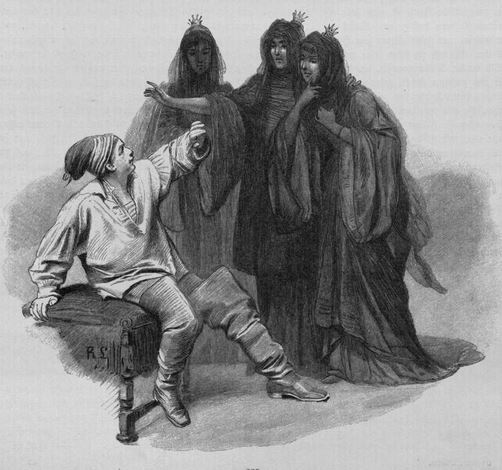
Fairy Tale of the Month: December 2024 How Cormac Mac Art Went to Faery – Part One

John D. Batten

At Melissa’s

I have never been in Melissa’s rooms above her store before. They are what I should have expected if I thought about it. A little spartan, no clutter (unlike my place) but full of Victorian touches. There is not a piece of furniture I would call modern. I am amused to see no bookshelves.

In her small dining room, she promises to lay out a Christmas Eve supper for me, Thalia, and Jini. Oddly, it is lasagna. “My family tradition,” she explains.

While the lasagna is baking in the oven, filling her apartment with an encouraging aroma, we settle in her parlor with drinks—appropriate to our ages—and cookies.

“Tonight, it is I who has a story to read to you,” Melissa says. “It is Celtic and has to do with the giving of gifts.” I see her pick up a copy of More Celtic Fairy Tales, and she continues. “The story is called How Cormac Mac Art Went to Faery.”

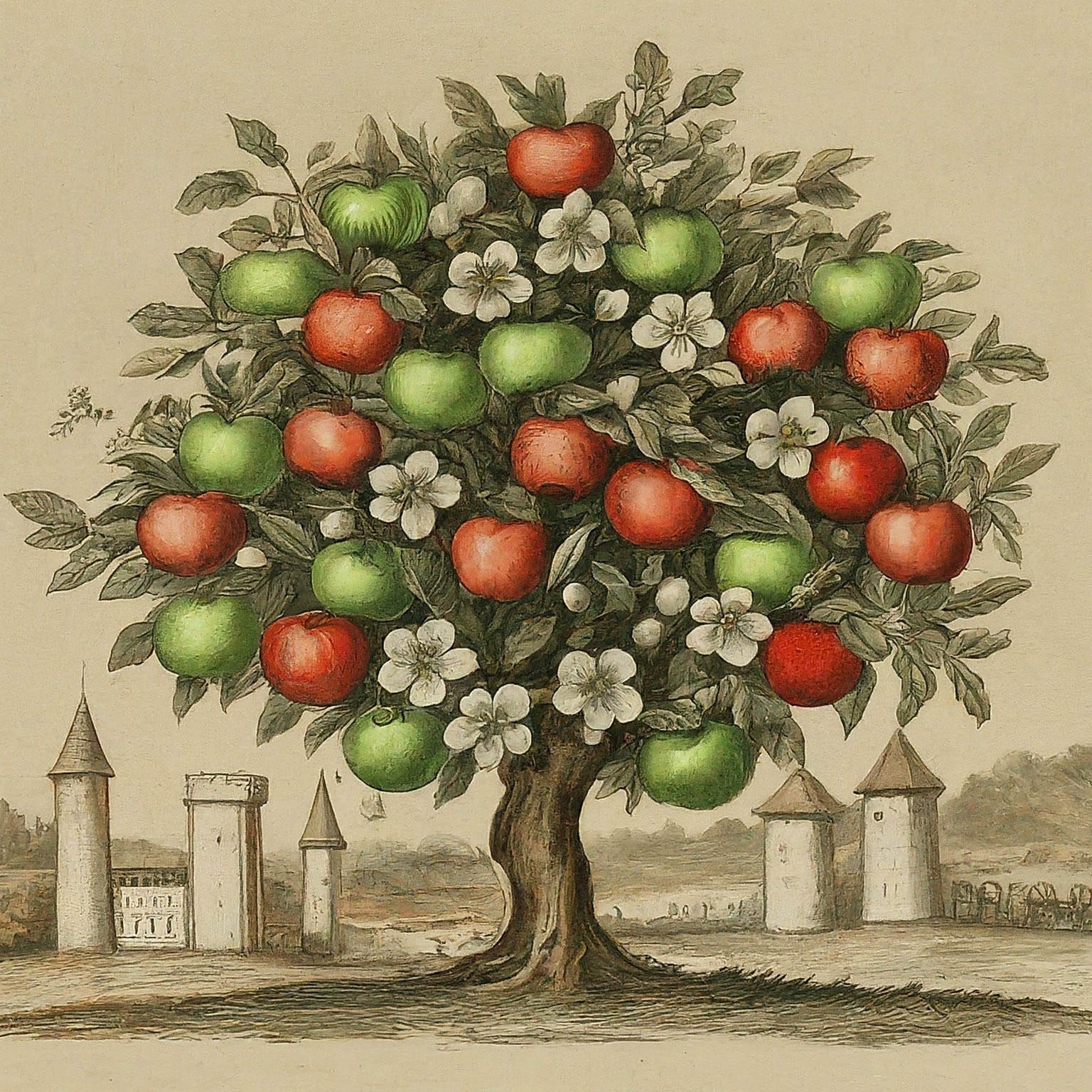
Cormac Mac Art, son of Art, son of Conn of the Hundred Battles, King of Ireland, who resided in Tara, purchased a fairy branch with nine apples hanging from its limbs from a youth for whatever the asking price. The price turned out to be his wife, son, and daughter. All protests Cormac quelled by shaking the fairy branch, which uttered music so dear that it tempered everyone’s fears, casting an aura of peace upon all.

After a year, Cormac decided to see if he could not reclaim his wife and children, and he followed the path the youth had taken. In his travels, he came upon three curious sights. The first was a house being thatched with feathers by warriors. After they had feathered on one side, they rode off to find more feathers. When they returned, the feathers they had thatched were gone.

The second sight was a young man consigning a tree to fire. But before he could find another tree, the first would be consumed completely. Again, the labor appeared endless.

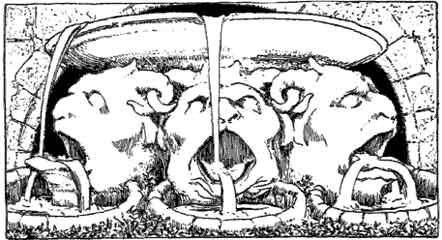
The third was of three wells. From the first flowed three streams, from the second two streams, and from the third one stream.

Traveling over the plain he had entered, he came upon a dwelling where a couple dressed in multicolored robes greeted him and offered him shelter for the night.

When it came to the evening meal, Cormac was given a boar and a log and told to cook a meal for himself. He told his host that he did not see how that could be done. The host explained that Cormac must quarter the boar, quarter the log, then place the meat over the log, and then tell a true story. The log would burst into flames and cook the meat.  

Cormac then asked his host to demonstrate. The host told the story of the boar they were about to eat. He had seven boars with which he could feed the world. When one of the boars was slaughtered, they need only throw the bones back into its stall, and in the morning the boar would be whole again. As the host finished the story, his quarter of the boar was cooked.

Cormac asked the mistress for her story. She said she had seven white cows that gave enough milk to feed the world if they were present. Soon the second serving of meat was cooked. Cormac told the story of the fairy branch and the disappearance of his wife and children.

Although the meat was cooked, Cormac hesitated to feast with so few friends in the room. The host brought Cormac’s wife and children into the room and took on his true form, that of the god Manannan Mac Lir.

We hear the beeping from the kitchen. The lasagna is ready.

Fairy Tale of the Month: December 2024 How Cormac Mac Art Went to Faery
John D. Batten

True Story

I am into my second serving of lasagna when Melissa, more easily sated than I and the girls, picks up her story again.

“Cormac,” said Manannan, “I was the youth that lured you into buying the fairy branch at the expense of your family, knowing you would follow me to faery and be here tonight. Now you and I can feast.”

“Feast I will,” said Cormac, “when I have heard the meaning of the three things I saw today.”

“That I will tell you,” Manannan said.

The god told Cormac that the warriors thatching the house with feathers were the like of those that go forth into the world seeking riches and fortune, but when they return home, they find it bare and must venture out again.

The young man dragging up the trees to make a fire is the likeness of those who labor for others and never get to warm themselves by the fire they made.

The wells represent the three types of men. There are those who give as freely as they get. Then there are others who get little but still give freely. And lastly, despite what they get, give little.

Now Cormac agreed to feast. Manannan spread before his company a tablecloth, declaring it a special thing. All they need do was to think of a food or drink, and it would manifest before them for their pleasure.

Then Manannan set down a goblet, saying that the goblet would shatter when a false story was told and mend when it heard a true one. These objects, along with the fairy branch, he gave to Cormac Mac Art.

At the courtesy of the tablecloth, they all feasted. When the feast ended, they took to their beds. In the morning Cormac, his wife, and children found themselves waking up in
Tara, still in possession of the tablecloth, goblet, and fairy branch.

We all drop our forks and applaud.

“Did they have lasagna?” I say.

“Only if they knew to ask for it,” Melissa smiles.

“Wait,” says Jini, “I’m doing the math. What happened to the fourth quarter of the boar?”

“I’ve thought of that.” Melissa blinks. “It could be the Celts didn’t bother to count, but I think the fourth quarter belongs to the listeners of this tale. But we would have to tell a true tale.”

 Thalia and Jini exchange furtive glances. I am sure they have their own little secrets. Secrets old men should not hear.

“I can tell a true story,” I say.

They look at me expectantly.

“I ate too much.” I pat my belly.

“That is not a story,” Melissa laughs. “Although it is true. But I am thinking I have some truth to explore. Yet, it, too, is not a story.

“This tale dwells on true stories. The meat will not be cooked without a true story. The goblet will break at the sound of a false story and mend only by a true one. What is the truth of fairy tales?

‘We, here in this room, live in the presence of magic because of you.” Melissa looks directly at me. “Fairy tales flitter about our everyday lives. They move between the mundane and our dreams, and we cannot tell which is which.

“Again, I ask, what is the truth of fairy tales?”

Fairy Tale of the Month: December 2024 How Cormac Mac Art Went to Faery
Arthur Rackham

Truer Tale

“Oh good,” I say with a touch of sarcasm. “First you lead me into an Italian food-induced coma, with a bit of wine, and then ask me to think clearly.”

Melissa wags a finger at me. “I didn’t force you to overindulge.” The girls giggle.

“Well,” I continue, “your question brings to my mind a storyteller’s adage I once heard. ‘Every story I tell is true, whether it happened or not.’”

I see calculations going on behind Thalia’s eyes. “Hmmm,” she says. “It seems to me stories make more sense than real life, no matter how fanciful they are.”

“I agree.” Melissa gestures with a hand. “Stories have a beginning, a middle, and an end. In real life, the beginning is our birth, the ending is our death, and the middle is hopefully long, but in any case, confusing. A listener or reader may get bored and lost by the incoherent middle of that long tale.”

“Does that mean,” Jini asks, a little wide-eyed, “stories break down our lives into smaller pieces so that we can understand it?”

“That is probably a good way of describing it,” Melissa answers with a bit of hesitation in her voice. I pick up on her hesitation.

“I think we are now talking about story in its broadest sense, that is, from nursery rhymes to the great works of literature. They are all story, from the Itsy-Bitsy Spider to The Iliad. But Melissa’s question regards the truth of fairy tales. I will suggest its stock in trade is with the passing on of morals and with wish fulfillment if we allow ourselves to call these truths.”

Melissa taps her fingertips together. “Give us an example.”

I take a deep breath and consider.

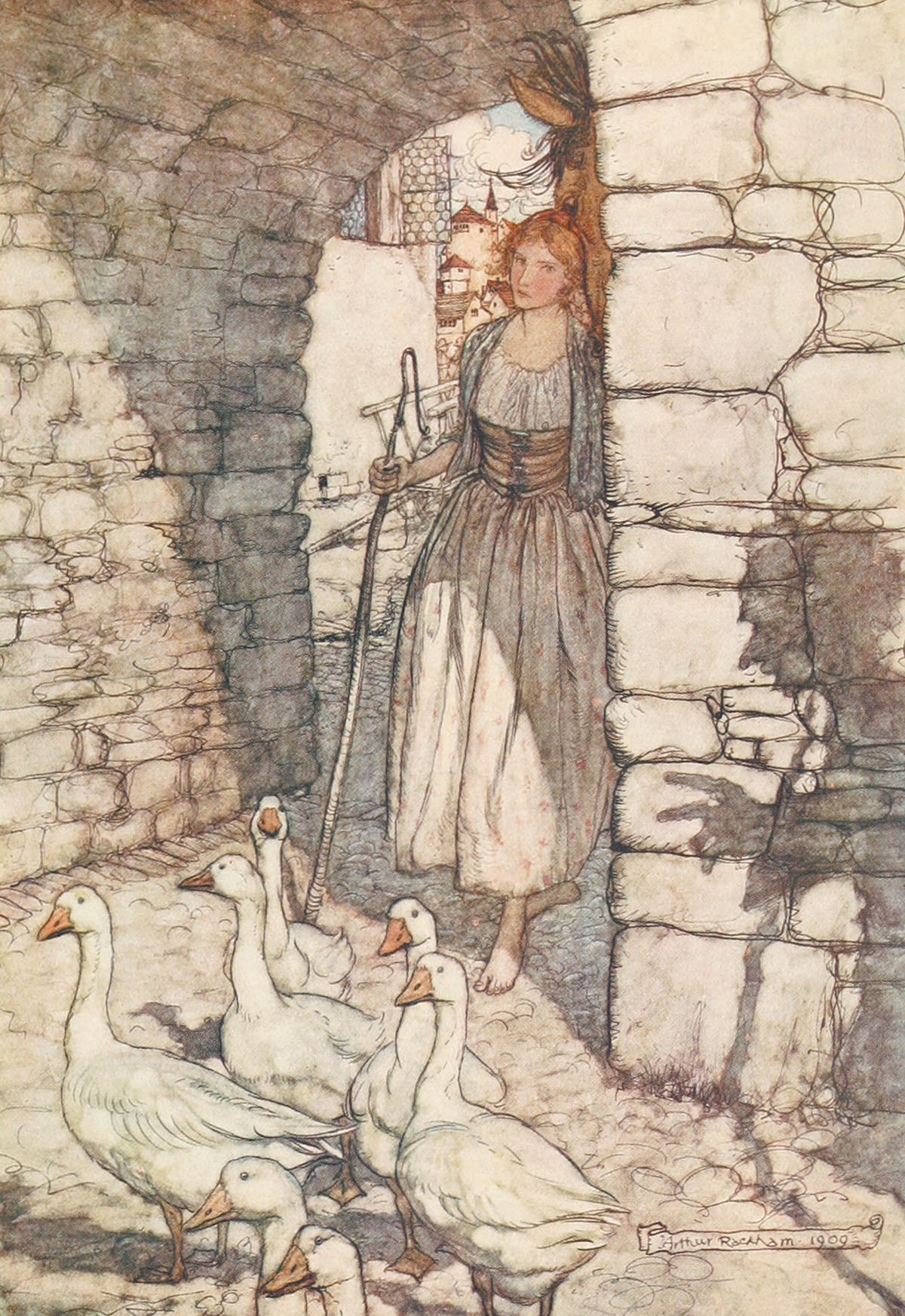
The Goose Girl,” I say.

“I know it,” says Melissa. Thalia nods. Jini looks perplexed.

“To keep it in context,” I explain, looking at Jini, “the goose girl is really a princess whose role—let’s call it identity theft—has been taken over by a maid-in-waiting. The real princess is demoted to being a goose girl. The maid-in-waiting has forced the real princess to swear in the name of God not to reveal the exchange of status.

“Because this is a fairy tale, there is a royal marriage involved. The false princess is to marry a king’s son. However, the goose girl uses magic, which royalty in fairy tales are entitled to, in her everyday dealings. A peasant boy observes her doings so, which eventually leads to the king learning of her true nature and that she was meant to marry his son.”

“The moral?” asks Melissa.

“That the true princess should keep her vow to God, even though given under duress with the threat of death, and trust that the truth will out.”

“And the wish fulfillment?”

“That even a goose girl can rise to be a queen when her true nature is recognized.”

“Rise to be a queen!” exclaims Thalia. “That’s us.” She points between herself and Jini, who buries her face in her hands.

“Your point is taken and demonstrated,” says Melissa with a hint of mirth.

Your thoughts?
Fairy Tale of the Month: Mid-month Writer’s Journey – December 2024

My book promotion for Sword of Trueterra has come and gone. Here are my results.

On the whole, pretty lackluster. I sold a hundred and five books in all of November. I had been averaging about ten books a month. With the promotional costs, I still lost money, but making money was not my goal.

Ninety of the sales were ebooks and fifteen were paperback. To break it down further, Sixty eight were Sword of Trueterra ebooks and six were paperbacks. Twenty-two sales were A Vacant Throne ebooks and nine were paperbacks.

I started out by running two BookBub campaigns, one for the week of the 10th through the 16th, and then the 17th through the 22nd . The idea was to keep an undercurrent of sales with stacked promotions on the weekends. Each had a budget of $60 with an 80₵ bid. The first campaign spent the budget and bumped along selling about four books a day. The second campaign spent only half the budget. The first campaign had clicks in the teens. The second campaign started out strong and then faded. I don’t know why. It left me with one day of no sales in the middle of my promotion.

My first promotion was Best Book Monkey on the 9th at the cost of $11.50 (a special half price deal). Actually, it was the kickoff, and not truly stacked like the others. I sold three books that day.

My second promotion was Bargain Booksy on the 17th ($45). On that day I sold twenty-one books and twelve more on the next day. Some of those sales could have been from BookBub which was still clicking along at that point.

On the 23rd, was Fussy Librarian ($25.80). I sold three books, which were probably from that promotion, because by then the Bookbub had ended.

I goofed up a little on the 24th when I scheduled both ENT ($45) and Reader IQ ($30) on the same day. That made it impossible to see which one was working the best. I should have put them two days apart. That day I sold twenty-six books and six more in the following two days.

The day after that? Crickets. The goal had been for Amazon to notice the uptick in sales and start promoting the book themselves without advertising costs to me. Didn’t happen.

Time to put the promotion price of .99₵ back to $2.99.

Before running off for another month, here is an item I have been toying with, which has to do with keywords. When you publish a book in Amazon, during the setup, you can enter seven keyword phrases. These are the words that you suspect that readers will enter when searching for the next book to read. It is also a way that Amazon will categorize your book, even though they don’t call it that.

I tested out my keywords to see that if I were the customer and used those words, would books like mine come up.

Step one in this process is to go into Incognito. This is an option that will appear when you click on the three vertical dots in the upper right-hand corner of the screen when you are in Chrome. (I am not sure about other browsers.)  You don’t want Amazon to be considering your preferences. Then go to Amazon books and enter your keyword phrase and see what comes up.

For example, I used “coming of age” as one of my keyword phrases; a minor theme in my books. That brought up largely non-fiction works on the subject. “Coming of age for children” did give me mostly books for children, but with the work “Coming” in the title. “Coming of age fantasy” was not any closer. There were a lot of steamy-looking covers in that lot. I gave up on the phrase and tried “Fantasy books for girls” with far more success.

You can spend a lot of time doing this to come up with seven keyword phrases, but it should be worth the effort.

Fairy Tale of the Month: November 2024 Peter Bull – Part One

Microsoft Image Generator

Staying Afloat

There is something about the plunge of an oar into the water and the glide of the boat propelled by men’s muscles that is soothing to the soul. Duckworth and I have taken to the Isis, our upper part of the Thames, to do a bit of rowing before the weather becomes too brisk.

Duckworth always humors me by asking about what fairy tale I am delving into. I doubt he concerns himself with the tales outside of my presence. I am his sole source on the topic, and he humors me now.

“So . . .” He hardly needs to ask.

“A tale called Peter Bull,” I respond as we continue to pull on the oars.

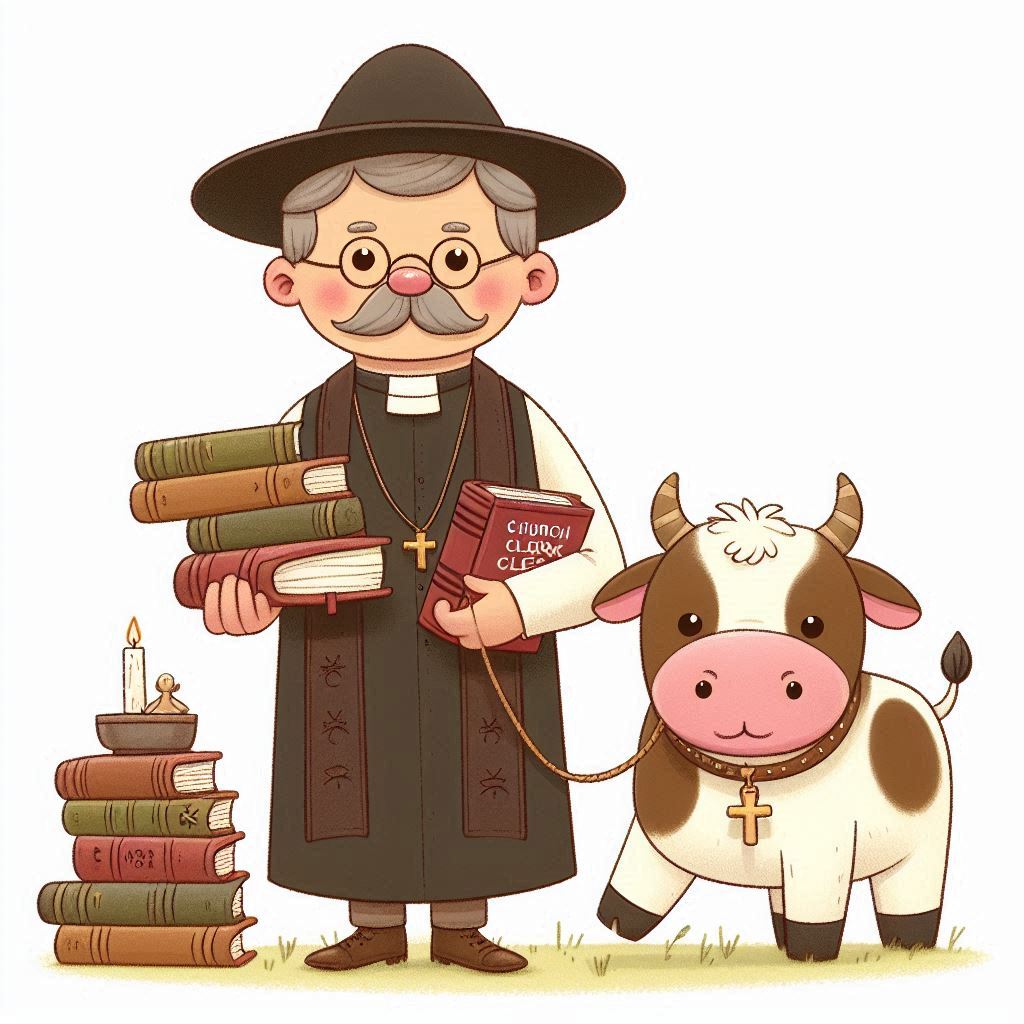
A well-to-do Danish farmer and his wife lived happily but for one thing. They had no children. Because of that, they became attached to one of their bull calves, which they named Peter. The husband speculated that perhaps the church clerk, known as an educated and clever man, might be able to teach Peter how to speak, and his wife agreed.

The clerk, seeing an opportunity, consented to educating Peter under certain conditions. First, the education must be done in secrecy, especially hidden from the priest, since it was forbidden. Second, there would be a cost because the books required to educate the calf were expensive.

Gleefully, the farmer turned Peter over to the clerk and gave him a hundred dalers. After a week, the farmer visited the clerk to see how things were going. The clerk reported that Peter was making progress, but the farmer could not see him. Peter loved the farmer and his wife so much, he would want to go back home and interrupt his learning. The farmer understood this and left another hundred dalers for the necessary books at the clerk’s request.

This sort of thing went on for some time. The visits from the farmer became less frequent in that they cost him a hundred dalers each time. Eventually, when the calf was fat enough, the clerk slaughtered it for a number of excellent veal meals.

“No, wait,” Duckworth exclaims. “Are you kidding?”

“Stay with me,” I say. “The tomfoolery gets worse.”

Soon after the clerk slaughtered the calf, he went to visit the farmer, declaring Peter’s education was complete and that Peter wished to return home. In fact, they had started out together, but the clerk returned home for his walking stick. Setting off again, he realized Peter had not waited for him, and the clerk asked the farmer if the calf hadn’t gotten there before him? They inquired around the neighborhood for the lost Peter, but it bore no results.

Sometime later, the clerk came across an article in a newspaper that referred to a Mr. Peter Bull, a young, struggling merchant. The clerk cut out the article and presented it to the farmer, suggesting that this might be their son. The farmer took off immediately for a few days’ journey, arriving at his destination early in the morning, invading poor Mr. Bull’s bedroom. Peter Bull was a bullish-looking fellow, and the farmer felt he recognized his Peter in him. Peter Bull dealt with the lunatic cautiously until he understood that the farmer intended to make him heir, at which point Peter warmed up to him and agreed to call him “father.”

In the end, the farmer sold his possessions, gave the clerk another two hundred dalers for his good services, and he and his wife moved in with the merchant, making him wealthy, and in return the merchant took good care of them for the rest of their happy lives.

Duckworth gives me a dubious glance, but he can’t suppress his grin.

Fairy Tale of the Month: November 2024 Peter Bull – Part Two

Microsoft Image Generator

Correct Me

“Correct me if I’m wrong, but aren’t fairy tales supposed to have a moral?”

“I am happy to correct you, Duckworth. You are wrong.”

“Explain.”

“I will speculate that the notion that fairy tales should have a moral comes from two sources. First is Aesop, that admirable Greek slave, whose formula for storytelling did have a moral at the end. Second are the Grimm Brothers, who were appealing to a Protestant, bourgeois audience and therefore implied a moral at the end of many of their tales.

“But they were not as consistent as Aesop in moralizing. For example, one of my favorite Grimm tales is The Three Spinners. It is similar to their Rumpelstiltskin, with some significant differences.

“In the story, a mother, rather than admit that her daughter—although pretty—was a wastrel, declared the girl could spin flax into gold. The queen took the girl up to the castle, relieving the mother of a useless daughter. On pain of death, the girl was to spin rooms of flax into gold.

“Three ugly fairy women appear, and for two nights, accomplish the task for mere trinkets. On the third night of this endeavor, the poor girl runs out of trinkets. Then the fairies request she invite them to her wedding to the queen’s son, which they know will happen.

“This small request the girl remembered to make when the wedding plans were made. She described them as cousins. When the wedding feast began, the three ugly fairies entered the hall to the notice of everyone.

“The prince, the girl’s new husband, approached the fairy women, rather rudely, and asked about their deformities. One had a huge foot from running the treadle, the second a gargantuan thumb from rubbing the thread, and the third a large drooping lip from wetting the thread. The prince looked at the three women, then his beautiful bride, and declared she would never again spin flax.”

Duckworth drops his oars and applauds.

“And,” I continue, “I can think of another lacking-a-moral Grimm tale called The Master Thief, a Robinhood sort of figure who, on a dare, for example, steals the bedsheet of a lord during the night.”

“Clever,” remarks Duckworth.

“Yes, clever,” I say. “There is also The Clever Farmer’s Daughter, who wins a king because of her cleverness, loses him because of her cleverness, then wins him back again through cleverness.

“Ah, but then there is Clever Else, who is not so clever and fools herself into thinking she is not herself. Clever Hans doesn’t do any better, and neither do the characters in The Clever People. “

“I think I see a pattern emerging.” Duckworth grins at me. “You are suggested there are many stories in the Grimm collection with the themes of cleverness or its opposite, beside those with a moral.”

“I still have to mention The Clever Little Tailor, The Clever Servant, and Clever Gretel.

“Well, now you have,” he returned.

“But then there’s Doctor Know-It-All.”

“Enough!” Duckworth shook his head at me.

I guess I made my point.

Fairy Tale of the Month: November 2024 Peter Bull – Part Three

Microsoft Image Generator

But Seriously


“But seriously, now,” Duckworth speaks after a short while, “you have pointed out to me that there are different kinds of fairy tales, but what makes a fairy tale a fairy tale?”

“Oh, you want me to pontificate, don’t you?”

“I want to see if you will run out of breath before we finish rowing,” Duckworth jests.

 “Well,” I begin, “it comes out of the oral tradition along with its companions, myths and legends. That is another way of saying the oral tradition is not literary. Myths, legends, and fairy tales have been written down, but they do not have an author.”

“Wait,” Duckworth interrupts, “didn’t Hans Christian Andersen write fairy tales?”

“No, he did not. He wrote literary fairy tales; he made them up. He was the author. He borrowed from fairy-tale structure, which made them sound like fairy tales.

“But this is the point where distinctions get cloudy. The Brothers Grimm collected their fairy tales, often from secondary sources, and put them closer to literary standards than the material they collected. However, they did manage not to overstep the genré rules for these tales.”

“And those rules are, may I ask?”

I think Duckworth is actually interested.

“I will start with the observation that few characters have names. Typically, they are identified by their position—king, queen, youngest son, old soldier. Often, it is the minor characters that have names.

“Followed by the convention that descriptions are sparse. We are told little about how things look.

“Next, the tales are in the third-person objective. We never get inside the characters’ heads.

“Also, the tales are not dialog driven. Dialog is used to highlight parts of the story. There is more telling than showing. Showing is a wordier process than telling. Telling is succinct, as are the tales.

“There is a propensity for the number ‘three.’ For example, in The Goose Girl, we see three drops of blood. Later on in the story, there are three streams to cross and three passages through the dark gateway.

“Royalty has magical powers. This is always assumed, perhaps a reflection of the times.

“Animals can talk, and not simply animals talking to animals, but also animals talking to humans.

“Evil, of the magical sort, must be punished and good rewarded. Naughtiness and deception, as in the clever tales, not necessary so.  Typically, evil is destroyed in rather graphic terms.

“The story usually ends happily. You can have a fairy tale without fairies, but happy endings are the rule. However, there are cautionary tales that do not end so happily.”

“That is a pretty extensive list,” Duckworth argues. “Can you make it more concise?”

“Yes. Fairy tales make bad literature. Really, they violate most of the rules of good literature. They stick to one POV, third-person objective. They ‘tell’ don’t ‘show.’ There are no beautiful, florid, or even accurate descriptions. And what is with the number ‘three’ all the time? It is more overused than ‘clever.’”

I get a chuckle from Duckworth.

“But seriously,” I say, “for me, the fairy tales are the stuff of dreams. Not those things we strive for, but those things that come to us, unbidden, in the night. There is a good reason for the tales to end happily. Theirs is the resolution that protects us from witches, demons, and the devil himself we encounter in the tales. All those things that make us uneasy while we sleep.”

Your thoughts?

Fairy Tale of the Month: Mid-month Writer’s Journey – November 2024

Here is my update on the promotional effort so far for Sword of Trueterra. To date, I have no reviews from my ARC readers, maybe. There was a glitch.

It took me a while to realize that on my Amazon book detail page—the one customer most often sees—my ebook and paperback each had their own page. The customer could not toggle between the two formats. On one detail page, it looked like I only had a kindle format for the book, and on the other I only had a paperback. The two were not linked.

I “chatted” with KDP Support, and it turned out I had published one book under the author name of Charles B. Kiernan and the other as Charles Kiernan. Amazon treated them as two entirely different books! I was assured that when I made the correction, the two would automatically link.

I corrected the error, and they did not automatically link.

I chatted again with Support, and they manually linked them for me.

However—isn’t there always a “however”—an acquaintance of mine, who reviewed my first book, also reviewed my second, but that review has not appeared. This led to a third chat, with me asking if the reviews had to also be linked. I was advised to contact Community Support.  That was done via email. I wait for a reply.

Therefore, I will ask, if you have written a review, please give me a heads up at cjkiernan01@gmail.com, so that I will know how many reviews to expect. Thanks.

I mentioned Reedsy last month. I applied for and got a review by Shubaboti Bose; pretty stellar. She reviewed my first book with the same quality and thoughtfulness. I have added it to my detail page as an editorial review, which is different from a customer review.

Editorial reviews are entered in the Author Central. You will need to google “How do you enter an editorial review in KDP?” The page is buried, and there are a number of steps to get to it. Once there, the page is pretty much self-explanatory. The editorial review will show up near the top of the detail page, labeled as such.

By the way, please go HERE and upvote my book on Reedsy. If I get enough votes, I could be featured in their newsletter.

As of this writing, I am only part way through my promotion. I have decided, rather than “stack” my promotions, I will spread them out. With the stacking approach, the idea is that Amazon will see a spike in sales and take notice. The other strategy is that Amazon will see a consistent rise in sales and take notice. Getting noticed means Amazon will start promoting your book themselves. They do want to sell books and will back a good prospect.

My first promotion was with Best Book Monkey on November 9th. I took advantage of a 50% discount, so it was cheap. From it, it appears I got three or four sales. On the Amazon side, I have to guess where sales came from, since, to my knowledge, Amazon does not share that information.

My second promotion is with BookBub and is ongoing. BookBub ads are set up similar to Amazon ads. You decide on a budget, bid, and duration. You upload a predesigned ad or use their ad generator—not bad, I used it—and answer a few other parameters. I set mine up for a week that started on November 10th. So far, it has sold around ten books.

However—there is that “however” again—the sales were not all the $.99 promotion.  Only half were. The other sales were A Vacant Throne, divided between paperbacks and ebooks. On the whole, I have been selling more paperbacks than ebooks. I think I am also seeing readers wanting to start at the beginning of a series. My numbers are small and could be anomalous, but those are my observations.

Coming up, I have settled on using ENT, BarginBooksy, Fussy Librarian, and EReaderIQ, scattered through the rest of the month. More updates in December.

Fairy Tale of the Month: October 2024 The Devil – Part One

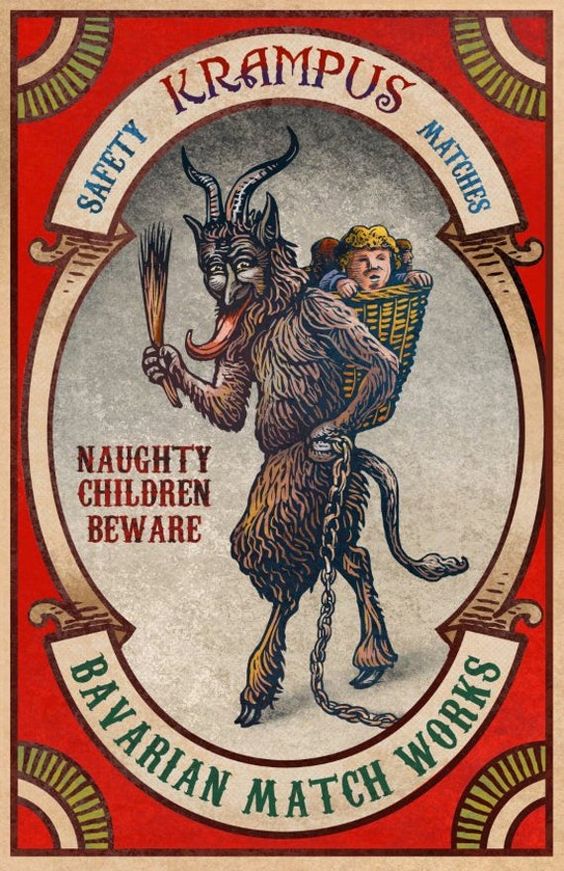
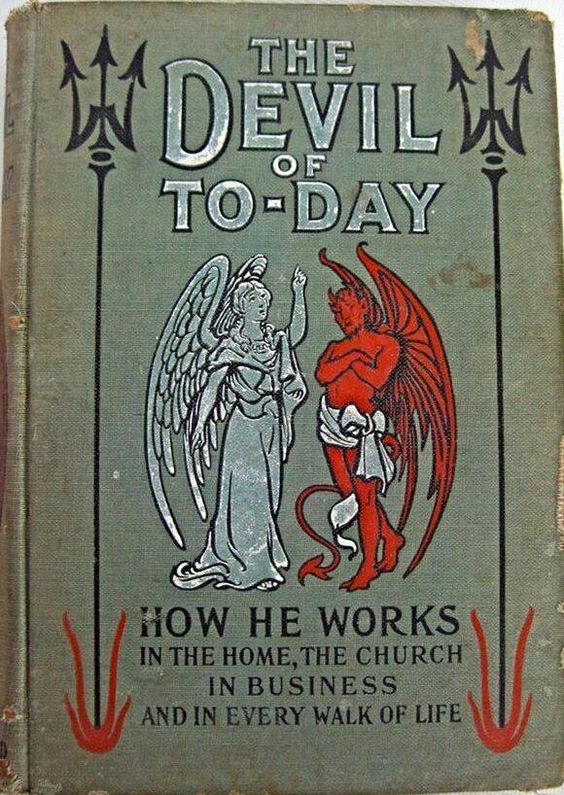
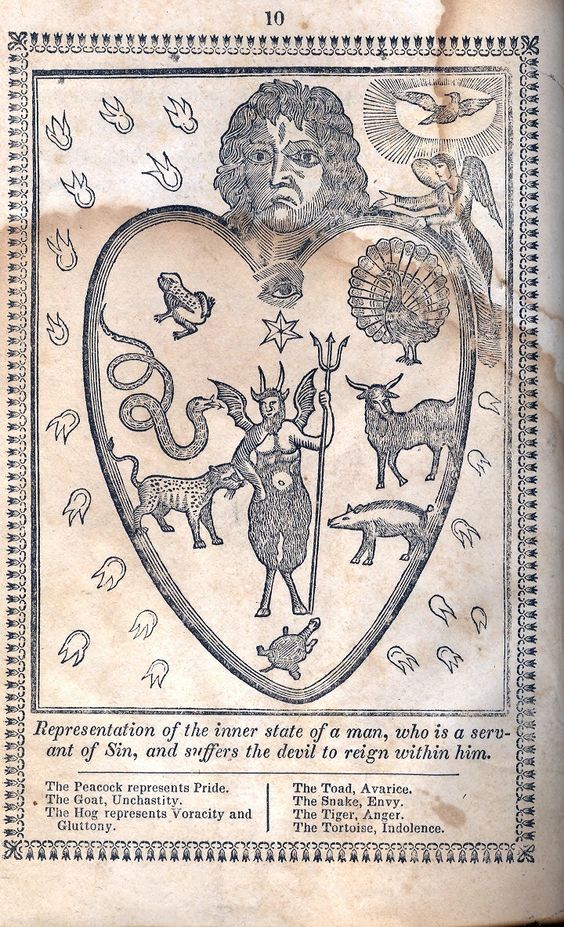
The Devil

I am torn. Do I want the beef Wellington with truffled mushrooms, confit potatoes, caramelized shallot with beetroot purée, and thyme jus on the side, or the Grenadier beefburger with fig relish, brie, streaky bacon on top, and paprika fries?

“Don’t forget the starters,” Melissa says, staring at her menu.

“That’s easy, the grilled king scallops. Nothing like scallops with garlic and parsley butter. The samphire adds some green.”

We are sitting in The Grenadier Pub off of Belgrave Square, almost in sight of Buckingham Palace. Melissa tells me this is the most haunted pub in London, which is why she chose it for my Halloween treat.

“For a starter,” she says, “I am thinking of the burrata, and for the main course, the wild mushroom tagliatelle. I’ve not had chestnut gremolata before.”

“To go with our meal,” I say, “may we get a bottle of Croft ten-year-old tawny port?”

“Of course we can.”

After we place our orders, I ask, “And how have you been busying yourself lately?”

“Well, I have been trying to find an agent for my book.”

Finding the Sacred Wells of England, I assume.” I know she has been writing it for years.

“Yes, without success. I have decided I need to get some articles published to give me a track record.”

“Articles such as . . . ?”

“Well, I have started one on the Devil in fairy tales.”

“The Devil you say!” I quip.

Melissa rolls her eyes and goes on. “There really are many of them. At present, my favorite is Stephen Badman’s translation of The Boy and the Devil.”

There was a lad who decided it had come time for him to make his way in the world. Although resourceful, he had a fault, one which he recognized. He was lazy.

The lad decided, rather than getting work, he would beg for his living. He quickly concluded begging could be as hard as working and would never do.

As he wandered down the road, he pondered upon selling his soul to the Devil and how he might trick the Devil afterwards. Obligingly, the Devil appeared, and a bargain resulted.

The Devil told the lad to continue down the road. He would meet with three old women in turn, and each would grant him a wish. Then the lad would have a few years to enjoy himself until the Devil came to collect him.

From the first old woman, he wished for bags of gold. These he found too heavy to lug around and simply threw it all away for others to find.

From the second old woman, he wished for a sack into which he could wish anything he wanted, and it would not come out until he wished it to.

From the third, he wished for a violin that would force the listeners to dance. Armed with these magical devices, he traveled to a kingdom whose king, too, had made a bargain with the Devil. In exchange for wealth, the king promised the Devil the thing that would first greet him on his return to the castle. The king assumed it would be his dog but turned out to be his only daughter. Rewards and marriage were offered to anyone who could save the princess.

The lad presented himself and had the throne-room floor covered with spiky flax combs. When the Devil appeared to collect the princess, the lad played his violin, forcing the Devil to dance on the flax combs. Then the lad wished the Devil into his sack. Soldiers beat the bag with iron rods. When the lad released the Devil, he slinked off with his tail between his legs.

Years later, the lad, now the prince, was away from the castle and saw the Devil coming down the road to collect him. His magical devices were back at the castle. Instead, he quickly took off his coat, buttoned the buttons, and held it out in front of himself as if it were a sack, calling out, “Come on then. Time for you to get back in the sack.”

The prince never saw the Devil again.

I applaud the story as the server brings our starters.

Fairy Tale of the Month: October 2024 The Devil – Part Two

To Task

We fall silent for a while as we enjoy our delectables.

“It seems to me,” I contemplate as I sample the samphire, “the fairy tales enjoy taking the Devil to task.”

 Melissa thinks about that a second. “Not uniformly. There are four stories in Badman’s collection of Jens Kamp’s tales that have the word ‘Devil’ in the title.  These really span the gamut. For example, the tale What Will the Devil Think of Next.”

The Devil had a split hoof and went to a smithy to get himself shod. While waiting for the smith to make his shoe, the Devil noticed the smith was incredibly neat and clean, despite his occupation. The Devil challenged the smith to not wash, shave, or change clothing for ten years, during which time—and after—the smith would have as much gold as he wanted unless he tried to clean himself up; then his soul would belong to the Devil.

After some hesitation, the smith agreed. It was not long before he found himself shunned by most human company. Eight years passed when, one day, an innkeeper allowed the smith—by now a filthy creature—to sleep in an outbuilding and sit in the stove corner of the inn.

That evening, a small group of businessmen were drinking and playing at cards. The more they drank, the higher the stakes rose. One of them was on a lucky streak and cleaned out his fellows.

As the winner bragged about his ability at cards, the creature by the stove spoke up and offered to play a hand or two. The winner declared he would play with the Devil himself if he had money.  By morning, the businessman was saying he had lost everything he had except his name and his three daughters. The creature suggested he would return all the businessman’s possessions if he could marry one of the daughters.

The two eldest daughters refused to marry the creature, but the youngest—also a stepdaughter—agreed. It was arranged that the creature would return in two years to claim the daughter.

Two years later, a handsome, rich young man appeared in town, throwing grand parties. At one of these gatherings, the young man proposed to the youngest daughter, who turned him down, explaining she was already betrothed. The smith revealed his identity, and they were married.

The next day, as they traveled to the castle he had purchased to be their home, they met the Devil on the road. The Devil was not displeased, explaining that while he had lost the smith’s soul, he had gained two others. It came out that the two vexed older sisters, out of jealousy, had hung themselves.

Melissa’s wild mushroom tagliatelle and my beef Wellington arrive along with the tawny port. After I pour our glasses, silence reigns again until I ask after the third of the four stories.

A wealthy lawyer was on his way to collect or foreclose on a farmer’s debt to him. He fell in with a walking companion, who he soon realized was the Devil. They passed a man trying to drive a reluctant pig before him. He swore that the Devil should come and take the pig.

The lawyer asked the Devil why he did not take up the invitation. The Devil told him that “the old man upstairs” had instructed him to take up only the third invitation that day. A second invitation was passed by when they heard a mother scolding her child.

They got to the farmer, whose land the lawyer had come to foreclose on. The lawyer insisted he would wait no longer, and in anger the farmer shouted, “May the Devil take you.”

That was the third invitation that the Devil had been waiting for.

Fairy Tale of the Month: October 2024 The Devil – Part Three

The Banknotes

Something has been bothering me all evening, but nothing that has anything to do with Melissa’s Devil stories. Yet I must ask her.

“Melissa, what are those banknotes glued to the ceiling all about?”

She chuckles. “That brings us to the haunting here at The Grenadier. Their ghost they have named ‘Cedric.’ The story goes that back in the early eighteen hundreds, the second floor of this pub was a mess hall for the local garrison, and the soldiers used the basement for drinking and gambling.

“One of the grenadiers was caught cheating at cards. As he was unable to pay off his gambling debt, his companions beat him up, and he soon died from the injuries.

“His ghost now haunts the pub. Visitors feel rapid temperature drops, chairs and dishes rattle unaccountably, and there are even reflections in glass of a grenadier’s face.”

“Remarkable,” I say. “But what does that have to do with banknotes glued to the ceiling? I don’t think there’s a spot in any of the rooms that isn’t double layered in them.”

“Well, the notion is that the patrons are leaving money to help pay off Cedric’s gambling debt. Apparently, that has not worked. Cedric still haunts.”

I dig back into my beef Wellington for a bit before asking, “And the fourth tale?”

“Yes, this one is a little more of what I expect to see in a tale that involves the Devil. This one is titled, How the Devil Almost Lost His Pelt.”

There were two brothers, one rich and one poor. The rich brother lived for pleasure, never went to church, and never gave a thought to his poor brother.

The poor brother was of the opposite nature. He lived wisely, always went to church, and would not hear an ill word about his brother.

At last, the rich brother’s high living led to an early death. The poor brother was on the path to his rich brother’s house to be by his side when he passed, when he met the Devil coming to take the rich man’s soul.

The poor man argued with the Devil for his brother’s soul. The Devil did not agree, but as they talked, the poor man scratched a circle of crosses in the dirt around the Devil with his crook.

Although trapped, the Devil would not give up the rich man’s soul, but finally agreed not to take his soul until the night after he died, and if not then, he would give up his claim.

After the rich brother died, the remaining brother sat on his grave after the parson drew a circle around the site, telling the brother not to step outside the circle until the parson returns in the morning and says he can leave the circle “in the name of God.”

At midnight, the Devil appeared and saw how he had been tricked. Try as he did, he could not get into the circle and left in disgust.

Later, the poor brother saw the ghost of the rich brother come to him, saying all was well and he could leave the circle. The poor man made the sign of the cross with his crook, and the Devil fled, dropping a bundle he was carrying that held his pelt, which he’d had to remove in order to take on the guise of the brother.

The Devil bargained with a bag of gold to get his pelt back and apparently surrendered.

Just before dawn, the parson arrived, telling the brother it was now safe to step out of the circle. The brother nearly did but then realized the parson did not say “in the name God,” and he sat back down.

After sunrise, the real parson appeared, and in this way the poor brother saved the rich brother’s soul.

“Excellent,” I say to both the story and the arrival of our dessert; chocolate mousse for me and apple with mixed berries crumble for Melissa. A pleasant way to end our conversation.

Your thoughts?

Fairy Tale of the Month: Mid-month Writer’s Journey – October 2024

My book launch is in midstream. To recap, I published the ebook version of Sword of Trueterra on Amazon at 99₵, then, in mid-September, I did a five-day giveaway for my arc readers (advanced reader copy) to download it and get it for free. My hope is they will give me an honest review before November 1.

Also, mid-September I took part in four group author promotions through StoryOrigin. I have also utilized StoryOrigin for further book reviews. For those of you who missed the five-day giveaway, here is your second chance. Go to StoryOrigin. You will need to setup an account, but it is free. There is a reader side to the site and an author side. Find the reader side and look for “Free eBooks.” To find me, use the filter and choose the “fantasy” tag and my name in the author box.

What will happen is that I then need to approve you as an arc reader, and StoryOrigin will then make the ebook available to you.

For those of you interested in getting your book reviewed, the application is a little onerous. You need to have three sample copies (EPUB, MOBI, and PDF) for prospective reviewers to look over, then three full versions in those three formats.

I know I have talked about Calibre before. They say of themselves, “Calibre is a powerful and easy to use ebook manager. Users say it’s outstanding and a must-have. It’ll allow you to do nearly everything, and it takes things a step beyond normal ebook software. It’s also completely free and open source and great for both casual users and computer experts.”

Okay, there is a learning curve, but there is a manual and a number of Youtube videos. I used it to turn my DOCX files into the different formats mentioned above. If you are going to self-publish, you will need to understand Calibre.

Another avenue for getting reviews is Reedsy. (Check them out. A wealth of resources. Similar to StoryOrigin in some ways.) I got a review from them with A Vacant Throne. It was a bit of a struggle. They pretty much promise you a review for $50. My problem was that the person who signed up to review the book didn’t. I had to contact support, and it took two additional months, but they were good to their promise.

Again, I had to upload the EPUB and PDF versions of my book and jump through some other hoops. It took me an evening to do it all, but the paid review I got the last time was professional.

That’s all for now. Next month I’ll talk more about my “stacked” promotion.

Fairy Tale of the Month: September 2024 The Three Black Princesses – Part One

Source not found (Russian?)

Crystal Pyramid

I am returning from an evening stroll in the Magic Forest. I went to the pond and lingered there awhile watching the reflections in the water before going back to my study. It is pleasant to know that every visit to the forest need not end in some sort of drama.

However, as I enter my study through the French doors, there sits on my table by my comfy chair a crystal pyramid about three inches tall. I sit down to inspect it more closely.

Thalia and Jini are away tonight doing who knows what. Melissa, whom I had invited over for dinner, is off to some meeting instead. Duckworth is out of town on some business. Who would have dropped off an odd bauble and left without a word?

Beyond me and the bauble is a table lamp. The light it casts through the pyramid appears as a shifting, shadowy pattern on my side of the tabletop.

Why does the pattern move?

I pick up the pyramid, placing it in the palm of my hand, and peer into its facets, trying to discover the cause.

I now stand in a somewhat exotic, town setting, its architecture not familiar to me. There is panic in the air; soldiers and civilians appear to be scurrying about, but the scenario is frozen.

Without being told, I know what is happening. They prepare to battle; unless they can come up with six hundred thalers for ransom, their enemy would attack. Despite the promise of being made the mayor of the town to anyone who would pay the ransom, no one has come forward. What I am seeing dissolves before my eyes.

Now I am standing by a lake. The tableau in front of me is of soldiers restraining a raggedly dressed youth, as one soldier places coins in the hat of another man who is looking sadly at the youth.

Again, I know what is happening. The enemy has seized a young fisherman, but at his father’s pleading to let his son go, the captain compensates the father with six hundred thalers.

Another scene change, and I am at the back of a crowd gathered around a raised platform on which stand the town dignitaries and the elder fisherman. The scene informs me that the fisherman contributed the six hundred thalers to satisfy the ransom and is being declared the mayor. Further, it is declared that the fisherman will henceforth be addressed as “Lord Mayor” and no other title on pain of being hung from the gallows.

In the next image, I stand behind the young fisherman who is staring at the side of a mountain, which has opened up, revealing an ominous castle. At this point, he has escaped his capturers and has wandered to this spot to witness the miracle before him.

After this scene fades, he and I are inside the castle, in a room where all the furniture is draped in black cloth. Before us stand three princesses, dressed in black and of dark complexion except for a white spot on each of their faces.

I understand they mean him no harm and wish for him to release them from enchantment. He asks how and is informed he must not address them or look at them for a year. If he needs anything, he only needs to ask aloud, and if they are permitted, they will provide. After a time, he wishes to visit his family. He is transported back to his home in East India.

East India?

I now see the young man surround by guards holding spears toward him, along with a group of elderly men pointing their fingers at him.

Upon returning to his hometown, he asks after the fisherman and is told not to use that title for the Lord Mayor, but he persists. The lords of the city are about to take him to the gallows for this offense when he is allowed to visit his childhood home where he dons his old clothing and is recognized by the lords for who he is.

I then see him with his family—dressed in his poor clothing, his father, the Lord Mayor, in rich robes—the father and son embracing one another.

He then relates his story to all. However, his mother warns him against the black princesses and tells him to drip hot wax on them from a consecrated candle.

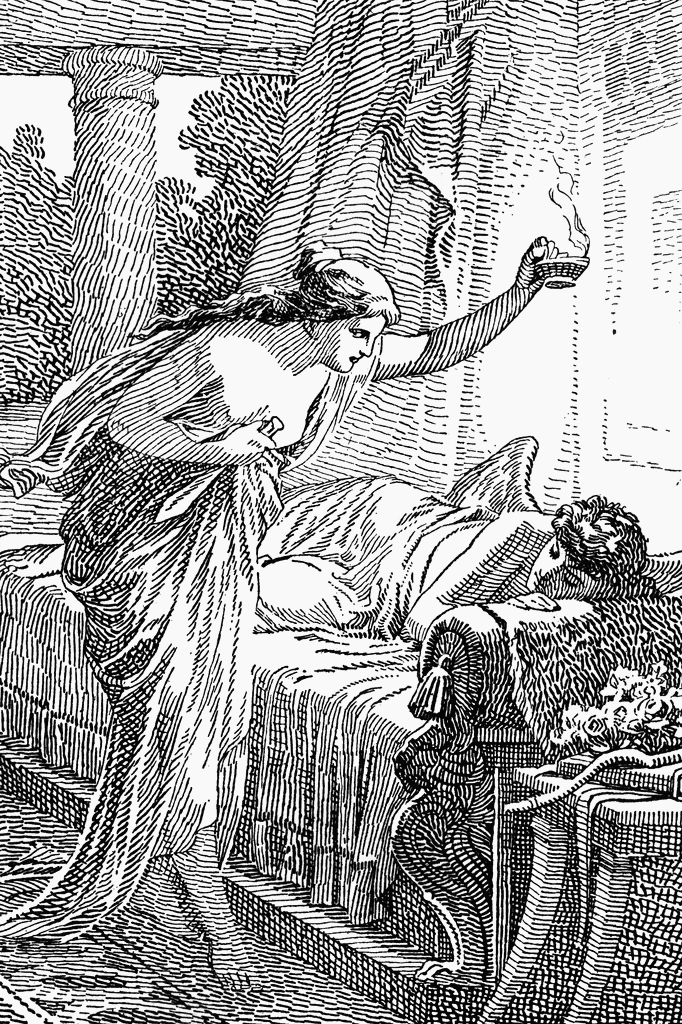
In the next image, he holds a candle above the sleeping black princesses. I know he is nervous and accidentally lets hot wax drip on the princesses. What I see next is more intense. The images flip rapidly, illustrating the actions of the princesses as they turn half white and rise up exclaiming—and I can’t tell you if I heard the words or read them—“You accursed dog, our blood shall cry for vengeance on you! Now there is no man born in the world, nor will any ever be born who can set us free! We have still three brothers who are bound by seven chains, and they shall tear you to pieces.”

In the last scene, the youth has escaped through a window, breaking his leg as the castle crashes into the ground and the mountain closes. There the images stop, my “understanding” ends, and I sit once again in my study staring at the pyramid.

Fairy Tales of the Month: September 2024 The Three Black Princesses – Part Two

AI Art

On Reflection

My shock increases when I look up and see myself seated across from me in a mirror-image comfy chair.

“What are you doing there?”

“I was about to ask you the same.”

“Well, this is most unusual. I don’t know what to think. I am—permit me to say—beside myself.”

“I knew you were going to say that.”

We regard ourselves for a while until I say, “Well, this is the pyramid’s doing. I’ll suppose it is its way of getting me to think about the story to myself.”

“Agreed,” myself returns. “What do we think about the story?”

“First,” I say, “we know it is the Grimms’ The Three Black Princesses.”

Myself nods. “Certainly one of the lesser tales, but it was in the first edition and not booted out like some of the others.”

“True,” I say. “Perhaps the pyramid wants us to reconsider the tale. I believe we dismissed it when we first read it.”

“True again,” says myself. “Let us tear it apart. We start with a town under siege, the deliverance from which is six hundred thalers.”

“A tidy sum,” I agree, “but if they had passed around the hat, I would think a town full of people, under attack, could easily ante up that amount of money, but that is not the case.”

“Instead,” myself picks up my thread, “the mayoral position is offered up as a bribe, but still to no effect until the fisherman arrives on the scene.”

“And he,” I continue, “acquired the money from the same enemy that had taken his son prisoner but felt somehow obliged to compensate the father with the same amount of money needed to lift the siege.”

“You are thinking what I am thinking,” myself says to me.

“Yes, the economics of this story stink.”

“But let us not be too harsh on this lack of logic. We both know that the fairy tales are not based on logical thinking. In fact, they wallow in defying it.”

“True, again,” I say to myself. “The fisherman becomes the Lord Mayor and is to be addressed by no other title. I can’t help but notice the passive tense of the declaration. The story does not tell us who—the active character—made the pronouncement. It is just there. Subsequently, it is implied that the word is enforced by the ‘lords’ of the town.”

“Good point,” myself nods, “which is a setup for later on in the story.”

“Correct, of course.” On impulse, I reach for my pipe and tobacco and see in my peripheral vision myself doing the same. The study is soon filled with the scent of Angel’s Glory, a blend I keep in reserve for special occasions.

“We now turn our attention,” I say, “to the young fisherman, who has escaped his capturers—they, therefore, gaining nothing for their efforts—and for no apparent reason, is admitted into an enchanted castle.”

“Let’s stop there and linger,” myself declares. “Why does the mountain open up for him?”

“Oh,” I say, “because he is us, or—as we experienced in the pyramid—we stand right behind him. We want the mountain to allow us into the enchanted castle. The fairy tales are always about us, a source of wish fulfillment.”

“I knew that,” says myself, “but I will never tire of hearing it.”

Fairy Tale of the Month: September 2024 The Three Black Princesses – Part Three

Psyche at the Couch of Cupid — Gayley, 1893

By Myself

“Next,” I say, “is actually the interesting part of the story: the three black princesses. I love all the furniture draped in black and the princesses themselves dressed in black. That suggests to us that there is some state of mourning going on, but we see no corpse.”

I puff on my pipe before speaking again. “The white spot on their faces, what can that stigmata signify?”

Myself ponders. “Black is the color of evil, but I don’t think white represents only good in our story’s images. I believe white is what widows wear in India among the Hindus and not black as in the West, and does this story have its actual origins in India, as the story itself suggests? What of the wax of the consecrated candle dripping on them and turning them half white?”

“We are getting ahead of our story,” I say. “At this point, he agrees to help them break a spell by not speaking to them or looking at them for a year. That is a pretty namby-pamby challenge. No herculean, impossible task, no suffering on his part. And yet, he can’t achieve it.”

“Again, we get ahead of our story,” myself reprimands.

I smile to myself. “Ok, back on track. The youth wishes to visit his family. Here we enter into the Beauty-and-the-Beast/Psyche-and-Cupid motif with a bit of gender reversal.”

“You know,” myself relights his pipe, “the clothing thing is inserted at this point, which reminds me of a Nassardim story.”

“Yes,” I say in delight, and we tell each other the tale in tandem.

“Nassardim, invited to a feast, shows up poorly dressed.”

“He is not allowed entrance and returns home to put on better clothing.”

“Now, with respect, he is accepted into the company.”

“To his host’s distress, Nassardim stuffs food up his sleeves, saying, ‘Eat, eat.’”

“’Nassardim,’ says the host, ‘what are you doing?’”

“’Well,’ says Nassardim, ‘when I appeared poorly dressed, I was sent away. When I reappeared well dressed, I was escorted in. Therefore, this feast is not for me but for my clothing.’”

We laugh at our own joke.

“Seriously though,” I say, “this story’s treatment of the motif in question is unusual.”

“There is,” myself contemplates, “the clumsy handling of the candle wax. First, a consecrated candle occurs in no other story that we know of. This is one of those Christian insertions for which the Grimms were open to, given their bourgeois audience.”

“What bothers us,” I say, “is that his mother instructs him to drop the candle wax on the princesses but with no indication as to why or for what purpose. When he does drip the wax, it is described in the story as an accident. Not to mention he is looking at the princesses in violation of his promise to save them.”

“Clumsy, as we agreed,” concludes myself.

“Let me press our point about how unusual this is,” I say. “Psyche drips the wax on the sleeping Cupid, then has to pursue her flown lover through the rest of the story. In our version of the motif, the dripping of the wax causes the sudden, closing apocalypse.”

“Yes,” says myself, “while he suffers a broken leg, what happened to the princesses’ blood calling out for revenge and their three chained brothers tearing him apart?”

“Not much,” I frown. “If I recall, we searched for a story about three chained brothers at the time we first read this but came up with nothing.”

“Now,” myself says, tapping out our pipe, “that we are at the end of the story, where the wax has turned the princesses half white; does that bring up the notion of yin and yang, especially with the previous white spot on their faces?”

“We both know that is a stretch,” I say. “The symbol of yin and yang does not appear in the Hindu representations.  It is more of a Taoist thing, but not unknown to Buddhists, but there are not that many Buddhists in India despite the religion’s origins. However, the notion tempts us.”

“A given,” myself agrees. “Therefore, overall, what do we think of this tale?”

“Despite the pyramid’s efforts,” I say, picking the crystal up again and looking into its facets, “and regardless of some enticing images, I’ll guess the story’s significance will continue to ellude us.”

I set the pyramid back down on the table. I see that I am alone in my study.

Your thoughts?

Fairy Tale of the Month: Mid-month Writer’s Journey -September

My book launch begins. There are a number of moving parts.

As I mentioned last month, I am using the promotional site Story Origin to give away my free, ever-evolving book, Stories and Poems of Trueterra. I am cross-promoting with four groups of authors. Below are links to these groups. Please check them out. These books are free. Be aware the authors will add your email to their list. As I said before, you can always unsubscribe.

https://storyoriginapp.com/to/MYUpSeq

https://storyoriginapp.com/to/Ame07RW

https://storyoriginapp.com/to/kBjz5xX

https://storyoriginapp.com/to/PIxeCHv

From the first list, I suggest Tales from Derian by Wendelyn Vega. It is very similar to my own in concept and a fun read.

From the fourth list is Clash of Goddesses by R.A. Goli. It is a bit of a reimaging of Norse mythology concerning Frigga and Baldur. It is 26 pages long and, I believe, a partial of a longer work. A lot of these free offerings are there to tempt you to follow that author.

When you click on a selection, you will get a box in which you need to click “yes” to acknowledge that you are sharing your email address. Then press the blue bar below to get the download options.

For the rest of my launch, I have mapped out things in a somewhat non-traditional way. That tradition is based on the old days of physical books only. What most authors do is get copies of their book to people to review it. That might only be a DOCX. Then on launch day, when the author pushes the publish button in KDP, they round up their reviewers to go into Amazon and submit their reviews ASAP. That is really quite an ask.

My pace is different. I published my book, Sword of Trueterra, last month at the introductory price of $0.99 for the ebook and the paperback at $8.95. I don’t consider that my launch because I didn’t tell anyone. I thought the book was as safely out of sight as if I had buried it in the sands of Egypt. Not so. The Sword of Trueterra paperback is selling  as well as The Vacant Throne paperback since they are now a series and appear together.

However, as of now, starting September 15th until September 20th, I am offering the Sword of Trueterra ebook for free on Amazon, a promotion that they allow, but only for five days every ninety days.

In other words, you can get the book for free. I am doing this in hopes you will give it a review (an honest review, please) on Amazon. You can put your review up anytime you wish, since the book is published. I want to have a good number of reviews before I “launch” during the week following November 1st. That is the date I will “stack” the promotion sites (and I will have the ASIN number for them).

I will also use Story Origin for getting reviews. Say, if you want more free books, go to Story Origin and agree to be a book reviewer.

January 1st is the date I will raise the prices from $0.99 and $2.99—end of book launch.

Fairy Tales of the Month: August 2024 The Jewel Mountain and the Dove Maiden- Part One

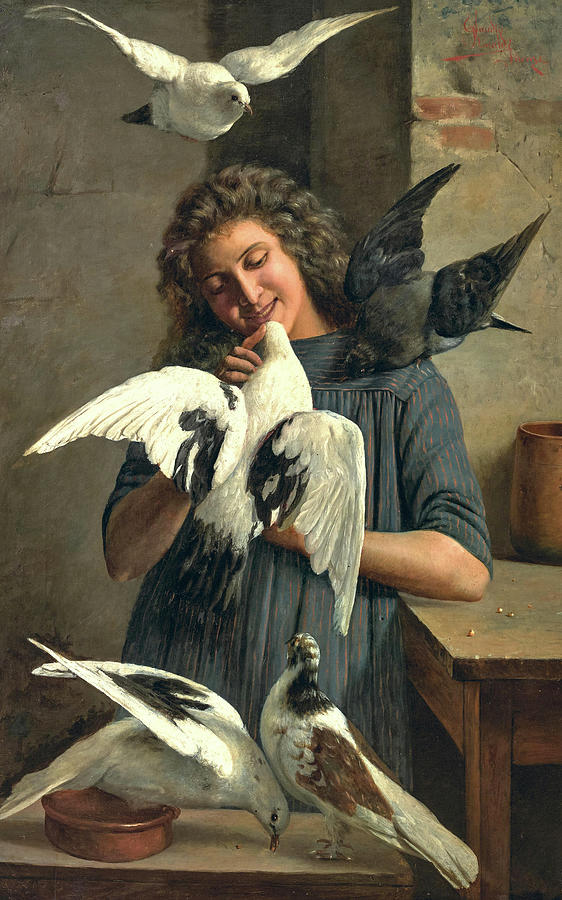
Dove Maiden Feeding the Doves – Claudio Rinaldi

Usual Crowd

The usual weekday crowd has gathered: Thalia and myself in our comfy chairs, Johannes on the window-seat pillow, the fairy on Thalia’s shoulder, and the brownies lurking in the dark corners for the post-supperial entertainment. (Don’t try looking that up.  You won’t find it. It means post-supper with an inference of being superior.)

In our study/sanctuary, Thalia fingers my copy of Modern Greek Folktales, by R. M. Dawkins.

“Tonight’s reading is The Mountain of Jewels and the Dove Maiden.”

A young woodcutter, who worked morning till night to support himself and his widowed mother, fell in with a merchant with a scheme to acquire great wealth. Taking to sea with his fleet, the merchant brought them to an island dominated by a lofty mountain, its peak in the clouds.

The merchant gave the youth a sword, sewed him into an animal skin, and told him an eagle would carry him to the mountain’s top. The merchant instructed the lad to cut himself out of the animal-skin bag and throw down to him whatever he found.

All this happened, and the young man found the mountain top cluttered with diamonds, gold, pearls, and sapphires. These he threw over the mountain’s cliff to the merchant below. When the merchant’s ships were filled, he sailed away, abandoning the youth on the mountaintop.

Desperate, the lad searched for escape and found a subterranean staircase into a palace. There dwelt a blind ogre. Although at first frightened, the youth befriended the ogre, who doted upon him, giving him the forty keys to the palace rooms, but with the instruction not to enter the fortieth room.

Needless to say, the fortieth room was entered, where the youth found a magnificent garden, in which he saw a marble-lined cistern, into which descended three doves that removed their plumage, transforming into beautiful girls. The three splashed about in the water as he fell in love with the youngest. As quickly as they had come, they put back on their feathers and flew away.

Brokenhearted, the youth returned to the ogre and confessed what he had done. The ogre, rather than being angry, sympathized and told him to steal the plumage of the youngest, and she would become his wife.

This the youth did. After some time, and two children, the ogre allowed the family to return to the lad’s widowed mother. All went well until the dove maiden rediscovered her plumage. Before flying off, she told the widow how the husband could find her in the place that is all green, all red, with five white towers.

The youth returned to the ogre for help in his search, and the ogre assisted him by giving him iron shoes and an iron staff. During his wanderings, he came across two men arguing over the possession of three magical devices: a hat of invisibility, a flying carpet, and an invincible sword. These items soon belonged to the lad, if by deceit. He wished himself to the place that is all green, all red, with five white towers.

He found his wife demoted, living in the stable of her father, the king. In order for him to reclaim her, they needed her father’s permission. The father would rather destroy the youth, but because of the hat of invisibility, he could not find him. Instead, he set the condition that the lad needed to turn a mountain into a garden overnight.

The dove maiden gave her husband a tile to be thrown down a particular well, from which would emerge thousands of men to do his bidding. By morning, the mountain had become a garden.

The father then demanded that the garden become the sea. With another tile, the youth accomplished the task.

The father then demanded to see the husband of his daughter. When he revealed himself, both the king and the queen rushed forward to devour him, but with the invincible sword, he slew them.

Reunited, the husband and wife returned to the ogre’s palace, where, in gratitude, the dove maiden restored the ogre’s sight, for it was she and her sisters who had stolen his eyes and hid them in a cave.

Thereafter, all lived in good health.

Huh. This is one for Augustus to interpret.

Fairy Tale of the Month: August 2024 The Jewel Mountain and the Dove Maiden – Part Two

John D. Batten

Augustus Interprets

“Not Elfish Gold?” Augustus exclaims with mock shock.

“I suppose my tastes have taken a turn toward the dark side. Black Dwarf and Fairies’ Delight will fill the bill this time.”

Augustus considers. “Toward the dark side, eh? Then let me tempt you with a bowl of Raven Black.”

“Raven Black; I think I had that once.”

“You did, but I have changed the blend a bit, I think for the better.”

We are already stepping into his testing room, he carrying a small canister. When our pipes are packed, we settle in.

“You have, I assume,” says Augustus, “a story to share.”

“Have you heard of The Jewel Mountain and the Dove Maiden?”

“I have not.”

“Greek,” I say and tell him the story.

When I finish, he contemplates for a while.

“I have not heard this story before,” he says, “and yet I have.”

I nod in agreement. “It is made up of well-known tropes.”

“And yet,  there is something fresh about it. Well, let’s pick it apart.”

He blows a couple of smoke rings before continuing.

“The theme of the woodcutter and his widowed mother is as old as it gets. The lad being waylaid by a merchant rings of Aladdin and the Lamp, which does not surprise me. There is only the Aegean Sea between Greece and the Middle East.

“The subterranean palace I know from A Sprig of Rosemary if nowhere else.”

The Twelve Dancing Princesses has a subterranean palace as well,” I comment.

“Ah!” Augustus gestures with his pipe. “A blind ogre, that is new, and a sympathetic, friendly ogre as well. The Greek tales are filled with ogres, but not too many are friendly.”

“Now,” I say, “we come to the forbidden-room motif. A hero, yet more often a heroine, is given the keys to the castle and told not to use a certain one.”

Augustus frowns. “I think you are conflating two rather distinct motifs. In our story, it is the hero—and not a heroine—who gets the keys to the forty rooms of the palace and told not to enter the fortieth room. It shares similarities with another Greek tale, The Quest for the Fair One of the World—notice how long some of these Greek titles are—not to mention that part of the world’s obsession with the number forty.”

I skip over the number-forty obsession and focus on the gender question just raised.

“In the European tales,” I reflect as I speak, “when the heroine opens the forbidden door, there is something awful behind it. In the Greek tradition, when the hero opens the forbidden door, there  is a marvel, dangerous, but a marvel.”

“Have you . . .” Augustus hesitates for a second. “Have you ever had a dream about being in a house, a house you know very well, but you should not be there?”

I am a little stunned. “There is a third floor to my house,” I confess, “that appears to me a little uncanny.”

“In my dream,” Augustus goes on, “I am in my great-grandmother’s dining room, hiding under her table. All about me is the high-Victorian décor and its mysteries. I fear being overwhelmed.”

Are dreams and fairy tales our way of dealing with our invented realities?” I wonder.

Fairy Tale of the Month: August 2024 The Jewel Mountian and the Dove Maiden – Part Three

AI – Google Gemini

Wonder Tales

I pick up the thread of our conversation. “Next up is stealing the dove maiden’s plumage to oblige her to be his wife.”

“Again,” says Agustus, relighting his pipe, “another well-known trope. With mermaids it is their fishtails, with swan maidens their feathered robes. Invariably, they get their accoutrements back again. They cannot resist them when back in their hands, even to the point of abandoning their children by their forced marriages.

“However, I cannot help noticing that the dove maiden says, before flying away, ‘Look for me in the place where . . .’ instead of the usual, ‘You will never find me until . . .’ She appears to be encouraging her husband to find her.”

“And he does find her,” I say between puffs, “with the help of the ogre and three magical devices.”

“Yes, yes, the magical devices. Notice that one of them is a flying carpet instead of the seven-league boots, a nod to its Middle East influences.

“I find it a bit interesting in this fairy-tale motif that our heroes are not above trickery to acquire the devices, yet we don’t think any less of them for it, but rather how clever they are.”

I tap out my pipe and refill it with more Raven Black. “Add an ounce of this to my order, please.”

Augustus smiles. “The dove maiden’s predicament, I did not expect. Her father, the king, consigned her to the stable in punishment for . . . “ Augustus trails off.

“In punishment for marrying a human?” I suggest.

“Possible, even though that was not her fault; she was being humiliated.”

“It is also apparent,” I put in, “her husband cannot simply put her on the magic carpet and make an escape. There are three ordeals to face.”

“Which he does,” Augustus climes in, “with the help of magic, including his wife’s magic. This scene in the story has the freshness I mentioned before. Not only the dove maiden dilemma, but I am not sure I have run across the impossible tasks of turning a mountain into a garden and then the garden into the sea. And she aids her husband with a tile to be thrown into a well to produce an army for men to do the tasks. Where does that come from?”

“A sort of wishing well, with tiles instead of coins?” I speculate.

“Maybe.”

“The third task,” I continue, “is a bit different than the first two. The youth has been hiding beneath the hat of invisibility, and the king demands to see him.”

“Right, and as soon as he does, the king and queen attack to eat him. This event comes at the end of the story, but it is the first clue we have that they, too, are ogres.”

“And dispatched with the invincible sword,” I add. “Making good use of the magic available to him.”

“I think,” Augustus taps out his pipe, “the craziest thing about this story is the surprise ending where the dove maiden restores the eyes of the blind ogre that she and her sisters had stolen.

“This hints of an entirely other tale. I imagine the ogre seeing the bathing dove maidens, just like the lad did, but was found out and punished by them by having his sight taken away.”

“Hmmm,” I say, “you could be right. The ogre had access to that world through the fortieth door and warned the youth against opening it. But where was that world; all green, all red, with five white towers?”

“That, I am convinced, is a riddle, my answer to which is an apple.”

“An apple.” I echo.

“The unripe fruit is all green, the ripe fruit all red, and the towers are the five white petals of the apple blooms.”

“I like it,” I say. “All we need do is imagine a world inside an apple.”

“And that, my friend,” concludes Augustus, “is why ‘fairy tales’ should be called ‘wonder tales.’”

Your thoughts?

Fairy Tale of the Month: August 2024 Mid-Month Writer’s Journey

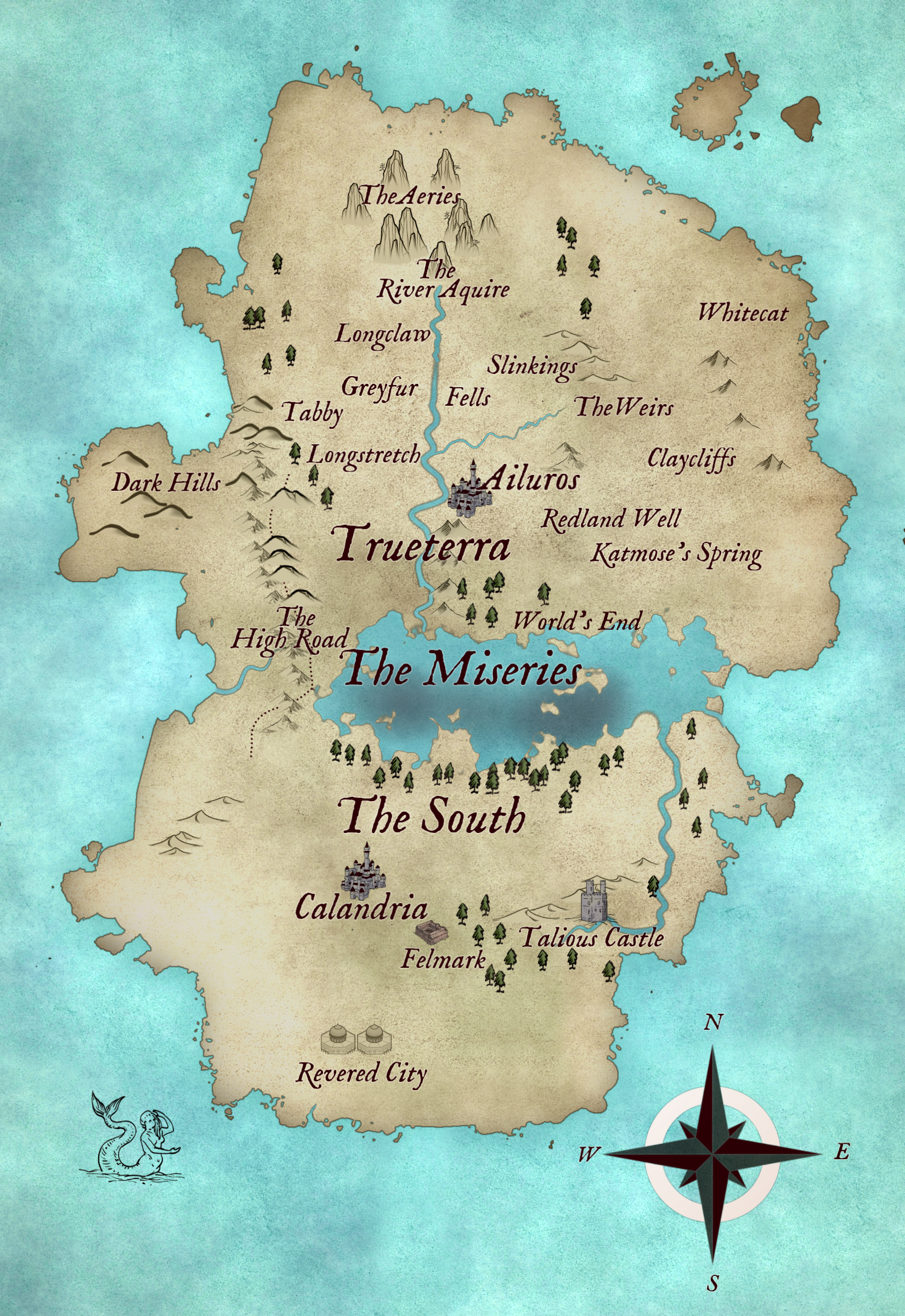
It’s map time! For all you world builders out there, a fun, fantasy map is a must, I think. Given the state of applications today, un-artistic idiots, like me, can make a pretty decent map at little expense.

If you google “fantasy map generators,” you will see many options. Let me direct you to  the article 16 Best Fantasy Map Generator Tools: A New Tool by Shannon Clark. This piece is less than a year old but may be a little dated. Some of the generators she lists are free or have a free version. Many of these were developed with gamers in mind but can be used for illustrations as well.

I settled on Wonderdraft, largely for its intuitive nature and the modest price of $30. The program is downloaded and installed on your computer, as opposed to being in the Cloud. It comes with a large array of images (mountains, trees, buildings), but more can be purchased.

The program starts off by having you select a background (the sea) along with some other parameters, and then you plop in a land mass. There are a limited number of choices for the background and the texture of the land mass, but you can change the colors, intensity, and shapes. There is a manual plus tutorials. Here is a tutorial I found useful for getting started.

My other approach to learning Wonderdraft was to play with all the options and delete the out-of-control results. Rather much fun.

Returning to my mention last month about my failure to promote my freebie, Stories and Poems of Trueterra, on promotional sites, I now slap myself for forgetting about Story Origin. It is a very different model from the usual promotional sites. Rather than you paying them to put you in their email newsletter and list you on their website, Story Origin is a community of authors cross-promoting each other. It is $10 a month, and you have access to join small groups of authors in a particular genré and/or sub-genré who are cross-promoting the authors in their group in their newsletter (in my case, my blog) during a campaign period (usually a month).

There are various categories of campaigns, such as Sale, Reviews, and Kindle Unlimited.The category I entered was in four Giveaway campaigns, and they never asked for an ASIN number, which my giveaway does not have but other promotional sites insisted upon.

I will encourage you to visit these four campaign sites in September’s blog. Hey, free books in exchange for your email! You can always unsubscribe.

Also in September, I will be offering you a free ebook copy of my sequel to A Vacant Throne, which is Sword of Trueterra, in the hope you will review it on Amazon before my official launch date.

I will explain in September, in more detail, how I have set this all up for myself.