There are two rather technical subjects I want to cover this month. First is formatting poetry in epubs, and second is my latest failure.
Poetry in epubs is tricky. I will refer you to Derek Haines’s article on the subject. My experience shadowed his advice. I was not trying to create poetry with KDP, which Derek covers, but with Draft2Digital, which he also talks about.
The central problem is that, appropriately, epubs expect the text of a paragraph to “flow.” Depending on what font size and style a reader is using, it will vary the length of a line on the device (laptop, table, or phone). The words in the paragraph need to flow to adjust to the physical space available to it.
Poetry is a fixed format, not a paragraph. It has lines and stanzas. In a Word document, if you turn on the hidden formatting symbols (in Home, hit the ¶ symbol), you will see that each line of the poem you have written ends with the end of paragraph symbol (¶). Draft2Digital disregards half of Word’s formatting and does what it wants. Each line of your poem is a paragraph? D2D puts spacing between each paragraph. It will stretch your poem out down the page and ignore the stanza breaks. Try it. It looks awful.
However, you don’t have to upload a Word document to D2D; you can upload your own epub created with Calibre, a free ebook converter. (Learning curve warming!) Calibre respects the Word formatting and is not all that hard to figure out. There is an extensive manual, which you can get to by hitting the Help icon. The point being you end up with an epub that looks like your Word document.
To some extent, the flow problem still exists. If the poem line is longer than the device and font size allow, it will still flow to a second line. If you have indented your poem, then the second line goes to the margin as a paragraph line would. You may want to consider not indenting the poem to alleviate the line’s appearance of staggering.
On to the next item. Last month, I mentioned the idea of using my free reader magnet, Stories and Poems of Trueterra, on promotional sites to get email addresses from interested readers. I immediately ran into a catch-22. All of the promotional sites assume you are promoting a book by lowering the list price temporarily. They also assume you have an ASIN number assigned by Amazon. Most require an ASIN number for you to list the book with them. Is Amazon now the only game in town?
KDP does not usually publish perma-free books, which is how I got involved with D2D, which will publish them. However, that means my book does not have an ASIN number. So that little project went belly-up.
By-the-by, Stories and Poems of Trueterra does not have an ISBN number either. Ebooks are not required to have one; print books are if they are to be sold. In my case, since the content of each edition of the work has changed—I have added a poem or story—I would need a new ISBN number every time, an expense I do not wish to incur.
Next month, I will talk about my latest endeavor, creating a fantasy map for Sword of Trueterra.
We don’t have as many evening reads as we did when Thalia was little. In fact, the pattern has settled into readings on Sunday nights. A good way to start a week. Thalia, some time ago, took over the duties of being the reader. I enjoy being read to, and Thalia has such a soothing, yet articulate voice.
We have all gathered as usual, Thalia and I in our comfy chairs, Johannes curled up on the window seat, the fairy on Thalia’s shoulder, and the brownies lurking in a dark corner.
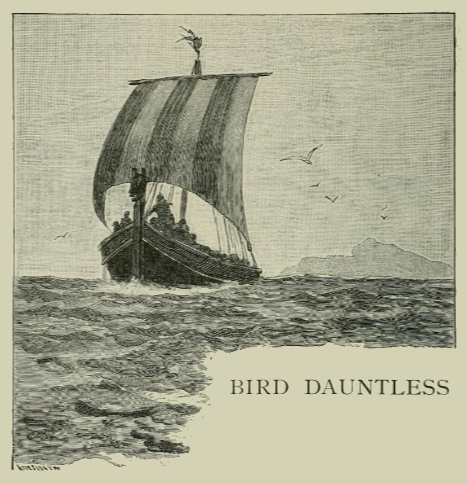
Thalia holds a new acquisition in her hand from Melissa’s bookshop. “Fairy Tales From the Far North, by P. C. Asbjornsen,” she announces. “From which I will read Bird Dauntless.”
There is a king with twelve daughters, of whom he thinks the world, but one day they disappear. Word of this strange event comes to a realm whose king has twelve sons. The brothers determine to find and marry the twelve princesses. Their father gives them a ship with Knight Redbeard to command and steer.
They search for seven years until they encounter a storm that lasts for three days. At the end of it, all are so exhausted that they fall asleep, except for the youngest prince. He sees a dog on an island and lowers a boat to rescue it. The dog leads him to a castle, and turns into a beautiful maid, with her father, a fearsome troll, sitting beside her.
From the troll, the prince learns that the twelve princesses were stolen away by the troll’s master/king to scratch his twelve heads. The troll gives the prince a sword with which to slay his master/king, allowing the troll friend to be the new king. The troll says there is still another seven-year journey before them in order to get to their destination. The troll also warns that Knight Redbeard hates the prince and will kill him if given the chance.
After seven years, the pattern of the three days of storm repeats, and the youngest prince slips away from the ship as the others sleep, enters the castle of the twelve-headed troll, and finds him asleep as his friend, the troll, had predicted. He waves the princesses to stand back and quickly slays the king troll.
Having already started their return voyage, the princesses realize they have forgotten their crowns. The youngest prince offers to return for them while the rest remain at sea. The Knight Redbeard takes the opportunity to abandon the prince with threats of death for anyone who defies him. The prince is left stranded on the old troll king’s island.
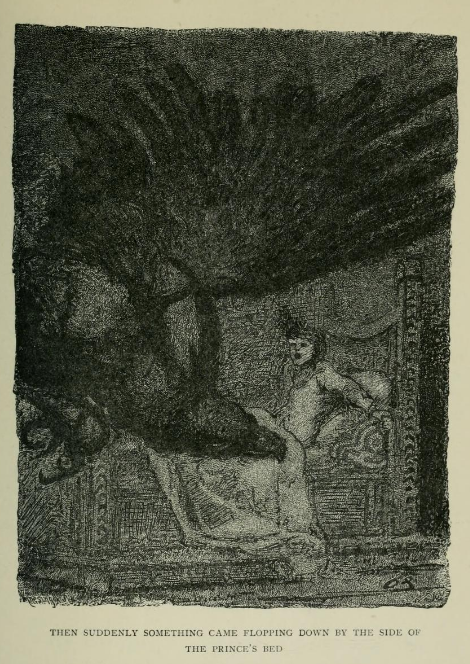
To the prince’s aid comes the Bird Dauntless, an apparent resident of the old troll king’s palace. It flies him back to the new troll king’s palace—the prince’s friend—with magical speed.
Seven years later, after a three-day storm, the sleeping crew comes to the new troll king’s island. The youngest prince boards the ship, reclaims the sword of the new troll king for him, and sees that the youngest princess sleeps with a naked sword by her side and that the Knight Redbeard sleeps at her feet.
Another seven years pass as the crew travels back to the kingdom of the twelve princesses’ father. Toward the end of the seven years, the new troll king gives the prince an iron boat that will take him back and return by itself. When the prince comes in sight of his brothers’ ship, he raises an iron club to evoke a storm that allows him to pass by them unnoticed.
Pretending to be a storm-tossed sailor, the prince creates the rumor (however true) that the princesses are returning. When they do return, there is much joy except for the youngest princess, who is now obliged to marry the Knight Redbeard.
The prince, now pretending to be a beggar, offers up the crowns. Seeing this, the youngest princess reveals the deceit of the Knight Redbeard. The king has Knight Redbeard executed before he can do any more harm.
“And all, as you may suspect,” says Thalia, “live happily ever after.”
Fairy Tale of the Month: June 2024 Bird Dauntless – Part Two
Twenty-eight Years
“Twenty-eight years!” Melissa marvels. “Seven to the troll’s island, seven more to the king troll’s island, and fourteen more returning. What a patient people they must have been.”
I smile at her quip. “This is the stuff of fairy tales.”
We are sitting, again, on Melissa’s reading-space couch. She has generously provided a full teapot and cups.
“Obviously, you know the story,” I say.
“I read the book before I sold it to Thalia. That is one of the perks of being a bookseller. I read them before I sell them to my profit.”
“Very good,” I say. “But what are your thoughts on this tale?”
“Well, first is the twenty-eight-year saga.” Melissa holds her teacup to her mouth but does not drink, frozen in thought. “There is a cultural context to this tale that came out of the Middle Ages. The peasantry was tied to the land. They existed pretty much from hand to mouth. It was a mark of privilege to have the ability to travel. Besides religious pilgrimages, there were the Crusades. That men of royalty would go off for extended periods of time seemed to have been expected. Twenty-eight years is still excessive, but for the listeners of the time, not unimaginable.”
She finishes taking a sip of tea and continues.
“Then there is the strong suggestion that none of the characters age.”
“No, wait!” I exclaim. “The story does not say that.”
“You are right; it does not, but it is implied. Note that the heroes and heroines get married and live happily ever after. ‘Ever after,’ not ‘for the rest of their lives.’
“Death in the fairy tales is reserved for three categories of characters: witches, trolls, giants, and all other evildoers; kings that are old when the story starts so that the hero can inherit the kingdom; and mothers so that their progeny can have an evil stepmother. There is the caveat that if the king gives half his kingdom to the hero, he can avoid mention of his demise. Even taking an axe and cutting off the head of a fox may produce the enchanted brother of the heroine. Death is a bit elusive in the tales.”
“I am going to suggest you are exaggerating.” I sip my tea.
“Let’s take our tale,” Melissa persists, pouring herself another cup. “Our heroes and heroines return on the cramped quarters of a ship for fourteen years, at the end of which there is no mention of children being born during that time.”
Oh, she may have a point here.
Melissa takes another sip of tea. “They don’t get grumpy, there is no mention of graying hair, there are no medical issues. Why? Because they are suspended in time.”
“Now there is a notion I have not entertained before.” I set down my teacup. “Time often moves differently in the Celtic fairy world than it does in our world. Why shouldn’t it not move strangely in other tales as well? I will buy into your analysis.”
Melissa smiles. She has her little victory.
Fairy Tale of the month: June 2024 Bird Dauntless – Part Three
Peter Christen Asbjornsen
So Many
“There is also quite a cast of characters.” Melissa absently rotates her teacup with her fingers. “This tale starts with twelve princesses, twelve princes, and their two fathers.”
“That’s twenty-six,” I say.
“Then there is the Knight Redbeard, two trolls, one troll daughter, and the Bird Dauntless.”
“Making an uneven thirty-one,” I calculate. “Unless we count the king troll’s twelve individual heads.”
“No, don’t.” Melissa smiles and takes another sip of tea. “Eleven of the princesses and eleven of the princes are a sort of corps de ballet, dancing around in the background, not coming front and center. Only the youngest prince and princess do we actually see.”
“Hmmm, a form of crowd control?” I say.
Melissa ignores my quip. “Out of the thirty-one characters, only two have names: the Knight Redbeard and the Bird Dauntless.”
I raise a finger. “Knight Redbeard I recognize. In the Danish folk tales with which I am familiar, he is the Red Knight, the stock villain. He is in the story to cause trouble, sometimes only for the sake of causing trouble.”
“I recognized him too. He is the one to be punished by death at the end of the tale and is brought back again in another tale to be killed once again. I must wonder if this was not a running joke among the tellers to recycle the bad guy.
“What I found most curious was the Bird Dauntless, starting with that curious name. Asbjornsen thought it important enough to name the story after it. The bird is a necessary component of the tale. The young prince would otherwise remain abandoned. Nonetheless, the bird only has a brief appearance and then disappears from the tale.”
“I have,” I say, “run across large birds rescuing heroes before. What jumps to my mind, for example, is The Underworld Adventure. In that story, the hero is abandoned by his two brothers when they are looking for missing ladies in an underworld. It is a huge bird that flies back to the upperworld, similar in feel to our tale. There, too, the bird serves its purpose and then is gone.”
Melissa considers this while drumming her fingers. “I suppose it is not unusual for characters to disappear from these tales. Besides the Bird Dauntless coming and going, the princes’ father gives them a ship, and then the story is done with him. We don’t even hear him being invited to the wedding. I also think the troll’s daughter got left behind—a beautiful maiden and shape-shifter—the story could have done more with her for my liking.”
“For myself,” I say, “I found the use of the three-day storm an interesting device. Every time the ship comes to one of the troll islands, their arrival is preceded by a storm, after which the crew falls asleep except for the youngest prince, who forwards the story.
“On the return trip, he raises an iron club, given to him by his troll friend, to create a storm so that he could slip by them unnoticed. I don’t recall ever seeing a troll/storm relationship before.”
“Let me return to the character of the bird,” says Melissa. “What of the name ‘Bird Dauntless?’”
“I did Google search that,” I say. “I came up with nothing.”
I mentioned my “reader magnet” in a previous blog. It is called Stories and Poems of Trueterra, which refers to my novel A Vacant Throne. There are stories and poems alluded to in this novel but usually does not present them in their full context. Stories and Poems has these in full, along with additional material written in the spirit of the originals and that I continue to write. When I add new stories or poems, I send off the new version to my email subscribers to remind them that I still exist and hopefully keep them engaged until I have another book to promote.
This is a standard practice in the self-publishing world. Typically, authors send out a newsletter to keep in contact with their subscribers. I prefer to write additional stories.
Another standard practice among self-publishers, particularly on Amazon (Kindle Direct Publishing), is to have a new release available for free for a few days to get things rolling. You can only do this for a few days on Amazon, then the price must return to normal. You cannot publish a free book on Amazon. My reader magnet is published on Draft2Digital and available through Smashwords.
Part two of this scheme of offering the new title for free is to “stack” the offers of promotional sites to help give away your book. Here I will refer to David Gaughran’s excellent blog on promotional sites for explanation.
I spent less than two hundred dollars to have multiple promotional sites to help me give away e-copies of A Vacant Throne. To my delight, during this campaign, there were 1300 + downloads of my book. To my distress, I appeared to have garnered one bad review for my effort and nothing more. I vowed never to do that again.
However, I recently had a “duh” moment. What if I use the promotional sites to give away my free book? On the promotion site, I will present a pitch for Stories and Poems of Trueterra with a line somewhere informing the reader that they will be directed to my opt-in page on Mailerlite. I think that is only fair. I only want people who have some interest in what I am writing. I might get hundreds of subscribers.
Is this a long shot? Yup. But if 9% of them respond in the future, this could be well worth it. I’ll let you know how it turns out in a future blog post.
Also, I will soon be sending out a new version of Stories and Poems to all of you on my email list. My present concern is how the poems’ formatting appears on the various e-readers. Please let me know in the comment box if there are no breaks between stanzas, strange indenting, etc. If you are not receiving Stories and Poems of Trueterra, here is your chance! And don’t worry, you have my promise that our email address is safe with me.
Next month, I might be blogging on the formatting of poems for epubs, depending on what feedback I get. There are problems.
I am alone this evening—sort of. Thalia and Jini are in the kitchen, along with the fairy, making themselves a late-night snack. I am making myself scarce per Thalia’s instructions. Well, there is nothing I could add to the young girls’ sleepover prattle.
Along with a bit of whiskey, I entertain myself with the trick of running my finger across the spines of books on my shelves, picking one out on impulse, closing my eyes, and opening to a page.
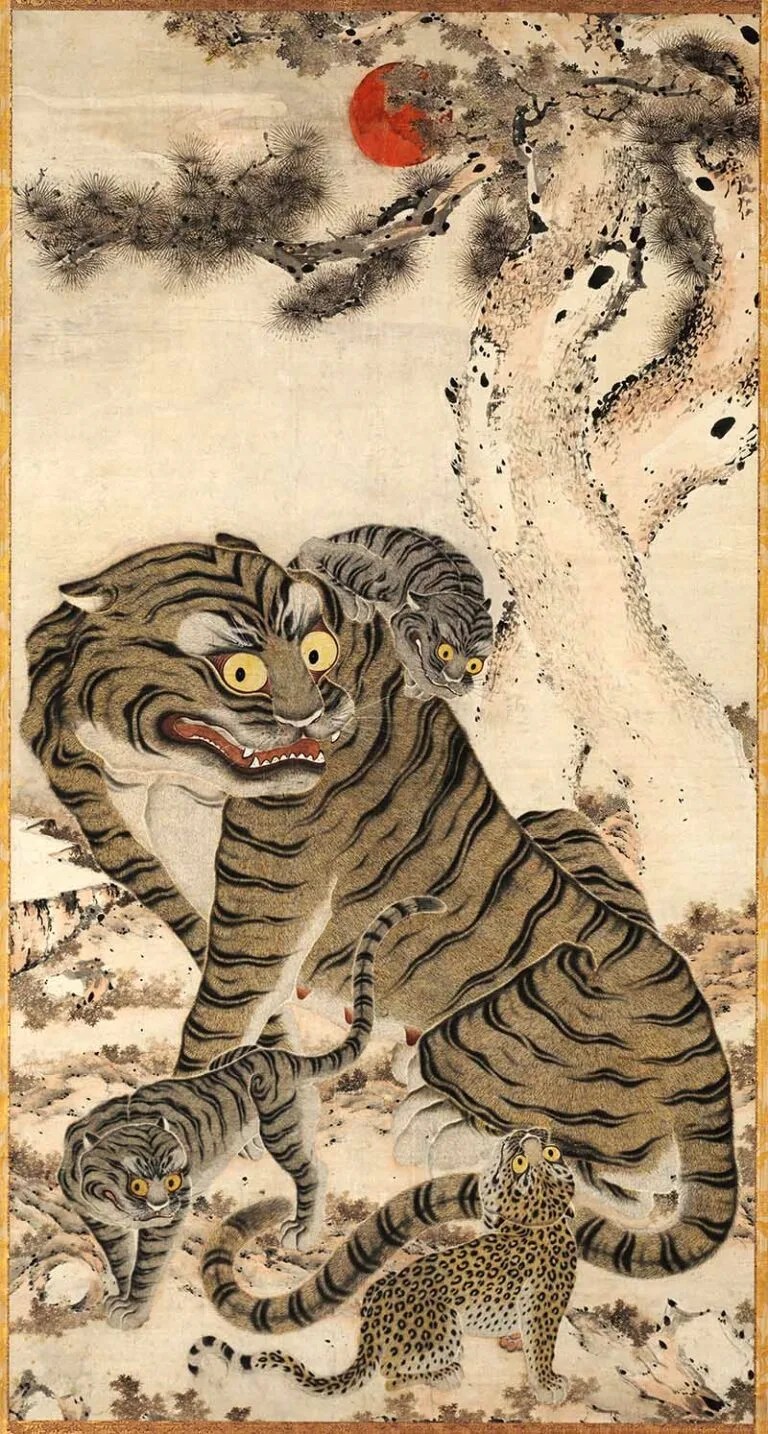
The book I choose is Folk and Fairy Tales from Denmark: Stories Collected by Evald Tang Kristensen, Vol. 1, edited by Stephen Badman. In bold letters is the title, The Prince and the Tiger Child. I settle into my comfy chair and take a sip of whiskey.
There is a husband and wife who have no children and blame each other. The wife goes to the wise woman, who gives her the odd advice to go home, pretend to be ill, and send her husband to her for the cure.
This is done, and the husband is given a small, covered pot, with the instructions not to look inside. He, of course, does and sees three small, cooked fish that he knows as smelts. A bit peckish, he eats one of the smelts. Nine months later, his wife gives birth to a child, and so does he.
When his wife goes into labor, he hides in the woods and gives birth to a daughter, whom he abandons, mortified at what has happened to him. She is discovered by a wyvern that takes the child into its mouth, but before it can consume the babe it is attacked by a tigress. The tigress, having recently lost her cubs to hunters, takes the child as her own and nurses it.
Years later, the “tiger girl” is discovered by a young king out hunting when his horse paws at the entrance to the girl’s hiding place. The young king marries the girl, much to his mother’s distress. The old queen insists the girl is little more than a wild animal.
When the young king is obliged to go off to war just before his child is born, his mother takes advantage. She steals the child, gives it to her maidservant to be drowned, smears the girl’s mouth with blood, and declares the mother has eaten her own child.
Upon returning from war, the young king refuses to believe what he hears. Two more times his wife bears a child; each time the baby is spirited away, given over to be drowned, and the old queen insists the girl has eaten her children.
However, the maidservant, whose duty it was to drown the infants, did not have the heart to do so. Rather, she put each child in a watertight box and floated the poor being down the river toward its fate. Each time, a different miller and his wife find the floating box and adopt the child as their own.
Meanwhile, the old queen keeps up her campaign, declaring the girl should be burnt. The young king cannot bring himself to that justice. Instead, he sends his queen from the court to tour the kingdom, never to return. She leaves, well provided for, in a carriage drawn by six horses.
As soon as they pass through the gate of the capital city, the young queen finds her voice. Immediately, she instructs her driver to go to the mill where her eldest son now lives. She is well received, and after dinner, as is customary, they play a riddle game. However, the queen demands high stakes if they cannot guess her riddle. She wants another carriage with six horses, a coachman, and their child—her child—as a servant.
The riddle is, “My father is a fish, my mother is a man, a wyvern bore me in its mouth, and I was brought up by a tigress; a horse gave me a husband. I bore my husband three healthy children, all of them died, but all three are still alive.” The miller and his wife, of course, are clueless.
The queen repeats this quest two more times until she has all of her children. When she eventually returns to her husband’s capital city, she enters the castle courtyard with four sets of carriages, one for herself and three for her sons. She is, also, unrecognized by the king or the old queen.
After dinner, the riddle game commences. This time, the young king knows enough about the clues to guess that this is his wife, and all is revealed. The evil old queen is consigned to the punishment she wished upon her daughter-in-law.
“Oh, nice,” I say aloud. “I can confound poor, logical Duckworth with this one when we take our walk tomorrow.”
I empty my whiskey glass.
Fairy Tale of the month: May 2024 The Prince and the Tiger Girl – Part Two
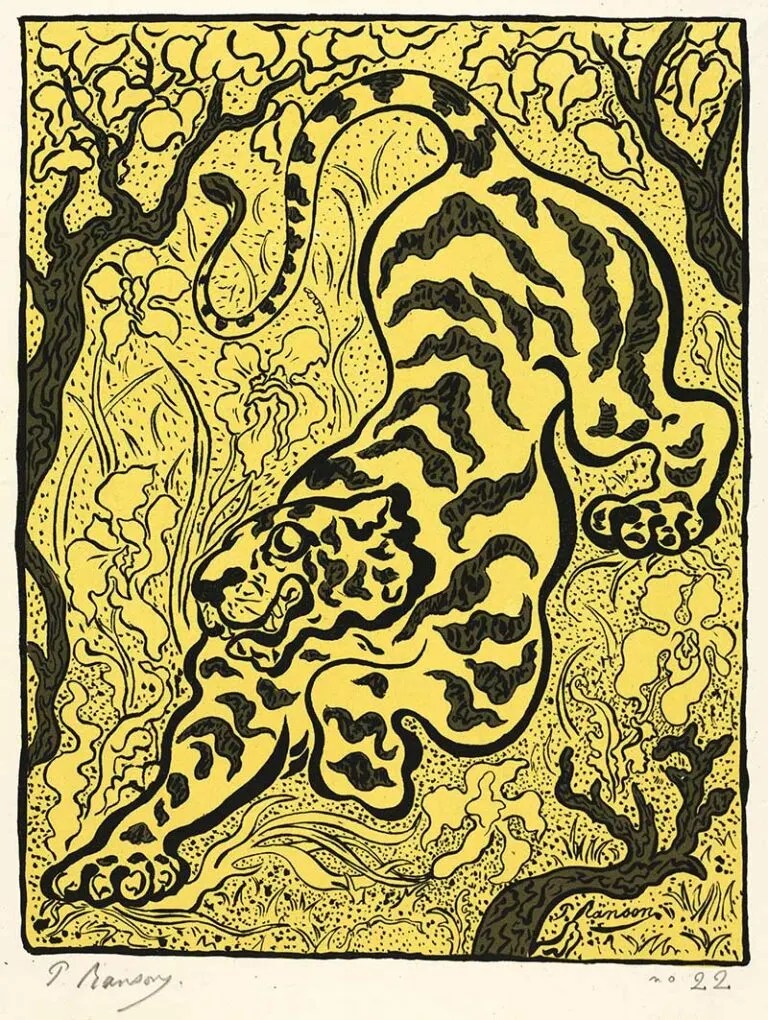
Tiger in the Jungle 1893 Paul Elie Ranson
Hill Garden
Duckworth and I wander about Hill Garden and its winding, multilevel pergola at Hampstead Heath, often described as a “secret garden.” Built by Lord Leverhulme as a place to entertain guests in good weather, it had fallen into near ruins but then restored by the City of London Corporation. It makes for a marvelous ramble up and down stairs and through the gardens on a spring day. Especially with the wisteria hanging from the pergola rafters.
I have just finished relating The Prince and the Tiger Girl to Duckworth, and I try not to smile at his bemused expression.
“Let me get this straight,” he gestures with a finger in the air. “A tiger in Denmark?”
“It was there to attack the wyvern,” I say. “Or in other words, they both were exotic beasts to this story’s listeners, on a par with dragons and unicorns.”
“Okay,” says Duckworth. “I’ll let you get away with that one and move on to a more serious story offense.”
“And what might that be?”
“Things like a prince out hunting finding a beautiful woman hiding in some wood; having an evil queen abducting children and rubbing blood on the heroine’s mouth—as improbable as these things are—I understand that these are familiar tropes in the fairy-tale canon.
“However, having the heroine pass through the gate of the city and suddenly be able to talk and know where her children are—knowledge she can’t possibly possess—goes too far beyond logic.”
“Duckworth! I’m ashamed of you,” I declare, suppressing my mirth and pretending to be annoyed. “How often have I told you that one cannot apply logic to fairy tales?”
“Well,” he grumbles, “if not logic, what reason can you apply to explain her sudden insights?”
We come to a bench under one of the pergola and breathe in the scent of the wisteria.
Presently I say, “That she was passing through a gateway is significant. She was leaving her old world into another. Her purpose in the new world was to find her way back to her old world with all the injustices foisted upon her corrected. That is to say, to reclaim her children.”
“Good,” says Duckworth, “as far as it goes, but what about her unaccountable knowledge? Where does she get that from?”
I put my hands to my chest dramatically. “Why, from us, the listener/reader. In the theatre, I think it is called the fourth wall. This is the breaking of the fourth wall, if only for a moment, and the heroine now knows what we know.”
“Oh, poppycock!”
“No, listen. How do we know, you and I, sitting here, on this bench, smelling the wisteria, are not, in fact, the imagination of some writer scribbling us down? What thoughts could that writer put into our brains?”
“Double poppycock!”
I see I will not convince him and take my argument no further. With no signal between us, we rise and continue our amble.
“Here is another thing that bothers me,” Duckworth picks up the conversation. “Not just in this tale but in others as well, the characters inexplicably do not recognize each other, even if, as in this case, they are husband and wife. I recognize long-ago friends from public school, for heaven’s sakes.”
“Ah, here I can give you a possible, logical—which you so adore—explanation. She wore a veil.”
Duckworth cocks his head to indicate I should continue.
“In medieval times and beyond, women of worth wore veils in public to indicate their modesty and high station. Our young queen would certainly have worn a veil and had reason to hide her identity until she had proven herself.”
Duckworth knits his brow. “I thought that was an Islamic thing.”
“No, no. Muslims are newcomers to the religious world. They took the veil from Jewish and Christian traditions of the time. Young girls, serving maids, and prostitutes did not wear the veil. Prostitutes, in particular, could be severely punished for the effrontery of wearing it.”
“Well,” says Duckworth, “you won two out of three arguments, but really, we being figments of someone’s imagination takes the cake.”
Fairy Tale of the Month: May 2024 The Prince and the Tiger Girl – Part Three
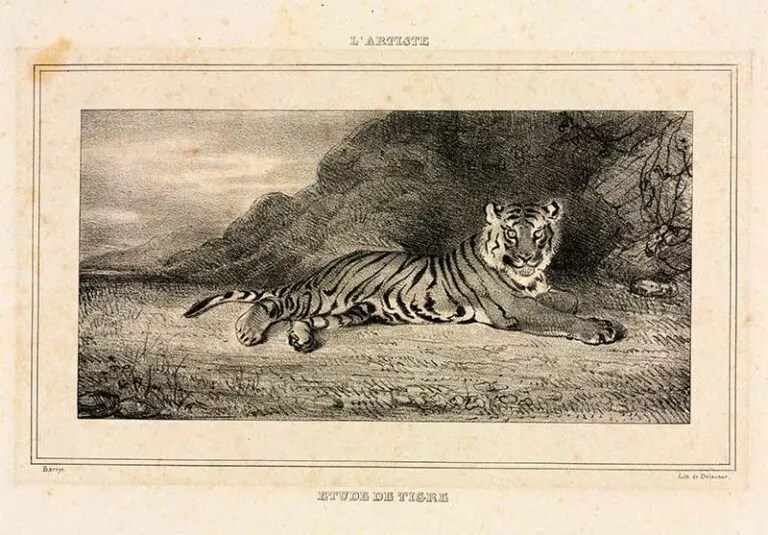
1832 Antoine-Louis Barye
A Metaphor
“It is clearly metaphorical,” Melissa says with her usual certainty, taking a sip of tea.
“Metaphorical of . . .” I ask.
“Of women’s journey.”
We sit in the reading area of Melissa’s bookstore, each with a cup in our hands and the teapot in its cozy on the table in front of us, along with a copy of Folk and Fairy Tales of Denmark from which I have just finished reading aloud. Two customers wander through the store. From where we sit, Melissa can keep an eye on the register.
“Really?” I say. “I wasn’t seeing that and am not sure that I do, at least not in terms of metaphor. Her birth, for example, I thought of as something of a joke that worked into her riddle later on. How is that metaphorical?”
“At the time this story was collected—and in some cases still today—a male child was more valued than a female child. The male child was the one to carry on the family name. The male child would receive a higher education or be apprenticed out to learn a trade. For a man to ‘have’ a daughter could be a disappointment.”
“And her abandonment?” I ask. “Little girls aren’t usually left in the woods.”
“Well,” Melissa says, becoming a little unfocused. “In a way, they can be. Again, a girl’s brother may be given the greater share of a family’s resources and attention, and she rather left behind. The tigers and wyverns? These are the good and bad influences that come in and out of a girl’s unstructured career pretty much at random, as opposed to the careful grooming of a brother’s path to success.”
I sense this story is hitting close to home—not my intention—and I alter the trajectory.
“Then enters the prince to change everything?” I suggest.
“He is simply another male figure,” she continues. “However, there is a change. Instead of abandoning the girl, he takes control of her through marriage.”
I know Melissa is divorced. I am going to pour myself a cup of tea and pretend I don’t notice the parallel.
Melissa takes another sip of her tea, then says, “In the context of this story, the prince tries to take control, with all benevolent intentions, but is unable or skillful enough to do so. Another actor, with their own agenda, thwarts his efforts. His own mother.
“I will sympathize. Had it been an advisor, stranger, or friend, he should have been—and rightly so—skeptical of their opinions. But his own mother? That is a special bond hard to break. Yet, he resists.
“In the end, after a campaign of lies and deceit and the claim that the young queen should be burnt, he sends her away from court. The ‘he’ abandons her all over again.”
Ouch.
I will try to divert. “What of the passing through the gateway? What of her suddenly knowing the unknown?” I take Duckworth’s position at this point.
“Yes, that is the transformation. We have often talked about transformations in fairy tales. Endlessly, actually, and here is another.
“When she passes through the gateway, she is liberated from her past. She comes into her own. When that happened to me, I understood things I had not been told. I simply knew as she did.
“Our heroine goes forth and reclaims her life. She takes back, through riddles, her children, all males. I wish there had been a daughter, but that’s just me.
“Myself? I made other choices. I had no children. I abandon the men in my life as they have abandoned me. You, my friend, are a bit of an exception.”
One of her customers comes to the counter, and Melissa rises to attend, ending our conversation.
If I am going to be giving advice to fellow struggling authors, then I imagine I am obliged to talk about email lists. On this topic, I am in the Hubert Humprey camp; an old-time Minnesotan politician—that I remember him dates me—of whom it was said he could talk about any subject, any time, any where, whether he knew anything about it or not. Witness that I have thirty-three fans on my email list, that should disqualify me from opening my mouth on this topic, but here goes.
In the self-publishing world, if you have a large email list (10,000 for example), to which you can market, then you are ahead of the game. How do you get such a list? It is with a “reader magnet.” You offer something for free in exchange for their email address. Then the trick is, you, the author, need to keep them engaged with more content, such as a newsletter, so that they don’t forget who you are when it is time for you to say, “Hey all, I’ve got a new book!”
I have a reader magnet. It’s called Stories and Poems of Trueterra(click if you dare), an on-going ebook of short stories and poems related to my fantasy world. Periodically, I add another story or poem, then send it off to my email list, all thirty-three of them, as a way of saying, “Hey, I’m still here.”
My failure is that the new material is very periodical, maybe four times a year, not weekly or daily like most email lists that I am on. Yet, I can’t see myself filling up other people’s email folders with prattle, attempting to remind them of my existence.
I am sure you have the same experience as I when we surrender our email address to a virtual stranger, then see our screens populated with items of marginal interest. We can unsubscribe or ignore. I tend to open, glance, and if nothing catches my interest, move on. I do try to keep a finger on the pulse of the market.
Rather than focusing on an email list, I prefer blogging to get attention. Readers come to my blog when they want to read it, not because I am foisting it upon them. I am much more comfortable with that approach. Between this mid-month blog and my end-of-month fairy-tale blog, in April I got six hundred and thirty visitors and eight hundred and three views. Is this a good approach to marketing my book? Probably not, but I have settled into it.
Speaking about being on others’ email lists, there are two that I have found useful. One is Bryan Cohen’s free 5-Day Amazon Ad Profit Challenge. This is a course he runs a couple of times a year, the next one in July. Yes, he is trying to sell you a larger course, and you will have to put up with his unending, positivity-generating, enthusiasm, but he will give you actionable information. In fact, he will handhold you through creating the three basic types of Amazon ads, step by tiny step. If you are interested in Amazon ads, there is no better free course that I am aware of.
On broader topics in self-publishing, there is David Gaughran’s extensive and free Starting From Zero course. He generously shares an immense amount of information in a readable and viewable manner. I highly recommend, and I think I will revisit it again soon. He also has a useful newsletter that comes out most Fridays.
PS. My email list resides on MailerLite, which I talked about before in December’s mid-month blog. I am using MailerLite at David Gaughran’s suggestion.
“I ran across a story last night,” I explain, “that I think all three of you will enjoy.”
“Three?” Jini asks with a frown.
“He is talking about Ultima,” Thalia fills in.
“Who?” Jini’s perplexed look I find entertaining.
Jini has not been to the Enchanted Forest, our destination for an April picnic that we are planning. The weather is always fine there.
“Ultima,” Thalia explains, “always knows when we are coming, and she will be there.”
“I wonder if she will bring her dragon this time?” I offer.
Jini’s eyes widen.
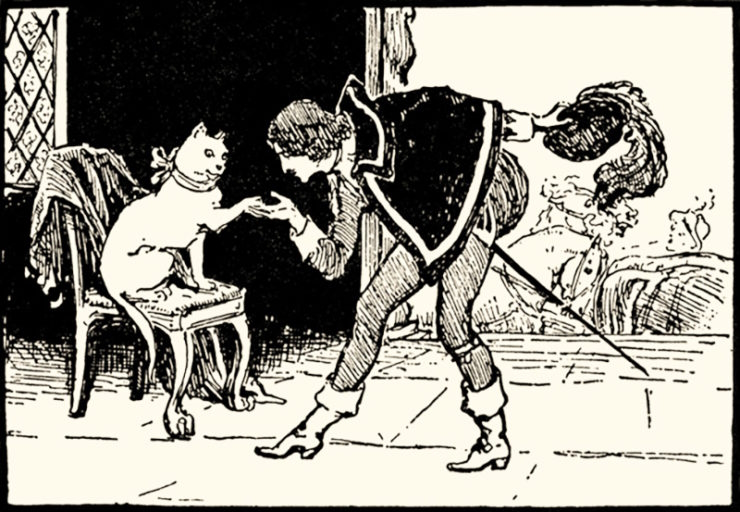
The story I plan to read is The White Cat,by Contessa d’Aulnoy, or, in other words, a French tale.
There was a king who feared his three clever sons might take away his kingdom for themselves before he intended to let it go. To divert them, he asked that they find him a petite dog to entertain him in his retirement, for which he had no plans.
With goodwill, the three brothers agreed to meet at a certain place in a year’s time and from there return to their father.
Following the adventures of the youngest son, we find him, drenched to the bone, at the door of a mysterious castle, knocking with a deer’s hoof that hung on a diamond-studded chain. Disembodied hands conducted him into the castle and royally dressed him. He was entertained by musicians, all of whom were cats, until the queen of the cats, a white cat, arrived to greet him.
In like manner, the white cat pleased him with all sorts of diversions for a year, at the end of which, she reminded him of his quest. Alarmed at his forgetfulness (He was under a spell.), he pleaded for help, freely given in the form of an acorn in which was the most petite of all dogs.
The young prince was clearly the winner over his brothers. However, the king, unwilling to relinquish the throne, proposed another challenge. He wished for muslin that was so fine that it could pass through the eye of a needle. Off went the brothers on their new quest.
The young prince returned to his white cat and was joyfully received for another year’s stay, at the end of which he was given a walnut, which he assumed held fine muslin. But when he opened it in the presence of his brothers and the king, inside was a hazelnut. Inside the hazelnut was a cherry stone. Inside the cherry stone is its own kernel. Inside the kernel is a wheat grain, and inside the wheat grain is a millet seed.
The young prince began to wonder if the white cat had played a trick on him, but inside the millet seed was a piece of muslin four hundred ells long, woven with wonderful colors and patterns. It did, of course, pass through the eye of a needle.
Once more, the king staved off the inevitable, declaring the sons must go off once again and find brides before one of them could take the throne.
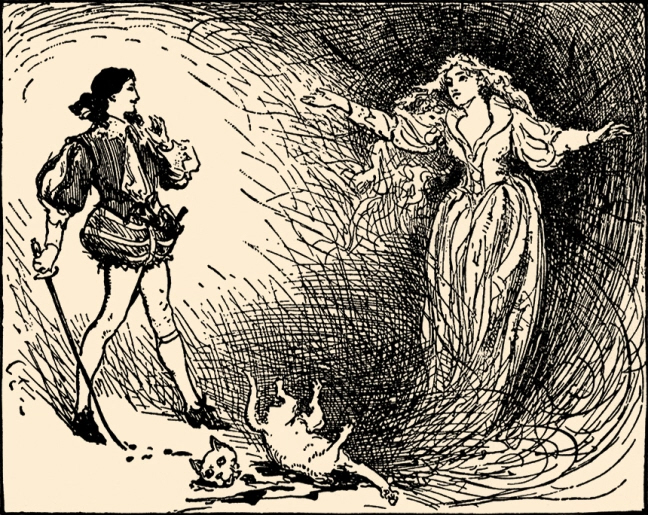
Returning to his white cat, the young prince was appalled when, at the end of a year’s time, she instructed him to cut off her head. With extreme reluctance, he does so, and she transformed into a beautiful princess, the other cats turned into her court, and the disembodied hands into servants.
She then explained the history of her curse. As a child, she had been abducted from her royal parents by the fairies, and they arranged she should marry the king of the dwarves. However, one day, from her tower-prison window, she spied a young prince out hunting. They became friends, then lovers, and at the point of escape, the prince was eaten by the fairies’ dragon.
Furious at her deceit, the fairies returned her to her father’s court, turning them all into cats and hands. The only way to break the spell was to have another prince, identical to her lover, also fall in love with her. And that was what happened.
The young prince returned to his father’s court with his bride. Not only was she clearly the loveliest, but she also told them she had six kingdoms and would give the king one of them, and one for each of the brothers, still retaining three for herself and her new husband.
And so, all ended happily.
Fairy Tale of the Month: April 2024 The White Cat – Part Two
G P Jacomb Hood
So French
“French!” declares Thalia as I finish the story. We sit along the bank of the Enchanted Forest’s pond. Ultima’s brows knit. “You mean the Franks?” She sits with her back resting against the curled-up bulk of her napping dragon.
“Well,” I say, “in our world, the Franks are the ancestors of the French, the people of France.”
“Are we talking about a province of the Holy Roman Empire?” Ultima quizzes.
“Oh,” says Thalia, “we got rid of them a long time ago.”
“Got rid of?” Ultima’s eyes goggle. “Who would do such a thing?”
“Nationalists,” I reply.
“Well, whatever religion they may be, our dragons would never allow such chaos. I think that’s the trouble with your world; no dragons to keep the order.”
I will not argue the point.
“This tale,” I say, diverting us from anything political, “is really a literary fairy tale by Madame d’Aulnoy, a contemporary of Charles Perrault, a woman not known for fidelity.”
I observe my listeners. Ultima has a raised eyebrow. Thalia is smirking. Jini is staring at the dragon, not hearing a word of my exposition.
I continue.
“Her infidelity was not entirely her fault, I will argue. Her father married her off at fifteen to the Baron d’Aulnoy, thirty years her elder.”
Thalia’s expression dissolves into empathetic distress.
I forge on.
“The baron was accused of treason by two men, both of whom were Madame d’Aulnoy’s lovers. The baron spent three years in the Bastille.”
Thalia’s smirk returns. Ultima’s eyebrow remains raised. Jini continues to be oblivious to everything except the dragon.
“The baron eventually convinced the court that he was innocent and turned the tables on his accusers, who were executed in his stead. Madame d’Aulnoy avoided her arrest warrant by slipping out of a window and hiding in a church. She and her mother, who was also complicit in the scheme, fled the country.
“Her history gets a little murky at this point. She traveled to Spain, Holland, and England, a hiatus of fifteen years, then was allowed to return to Paris, possibly as repayment for being a spy.
“On returning to Paris, she became a hostess for the salon scene, the gathering of intellectuals and social elites of the day. That was until a close friend was beheaded for trying to murder her abusive husband, she also a victim of an arranged marriage, not unlike Madame d’Aulnoy’s. Accused of being involved, Madame d’Aulnoy escaped being prosecuted, but for the next twenty years, withdrew herself from the Parisian social scene.
“During all this hectic life, she managed to have six children, arguably none of whom were the baron’s, and wrote twelve books of history, fiction (these two categories not clearly distinct in her mind), and fairy tales.
“Her best-remembered works are Contes de fées (1697), which translates into Fairy Talesand Les Contes nouveaux ou les fées à la mode (1698) which translates into New Tales, or the Fancy of the Fairies, similar in style to that of Charles Perrault but laced with her own sardonic touches.”
Ultima’s dragon stirs and looks around sleepily.
Fairy Tale of the Month: April 2024 The White Cat – Part Three
Can I . . .
“Can I touch him?” I hear a hint of fear in Jini’s voice.
“Oh, of course, dearie,” Ultima smiles. “Scratch him behind one of his horns; he likes that.”
As Jini does so, the dragon leans into it, nearly knocking her over.
“What’s his name?” Thalia asks.
“Cedric,” Ultima replies. “But tell me, your white cat does not sound feral.”
“Cats in our world,” I say, “are domesticated. A feral cat is simply homeless.”
Ultima raises a finger in the air. “So I have come to suppose from the evidence in this tale. I think of cats as nasty creatures, but d’Aulnoy’s white cat is all about grace and manners. That was a hard thing for me to swallow.”
“Fairy tales,” I say, “involve the Coleridge adage about ‘the willing suspension of disbelief.’ If you think an element of a story can’t be true, then you miss the truth of the story.”
I see that Jini, totally focused on Cedric, has willingly suspended her disbelief as she strokes his massive snout, now resting on her lap. I am a little nervous for her physical safety—he is so big—but all appears under control.
“The disembodied hands grabbed me. Pun intended,” Ultima winks. “That is a surreal image that sticks in the imagination. A tad frightening, really.”
“I agree.” Anything unnaturally disembodied makes me uneasy.
Ultima’s blank stare indicates contemplation. “I found unusual d’Aulnoy’s treatment of the three brothers. They were always civil with each other. They didn’t fall into murderous sibling rivalry, the expected trope for fairy-tale brothers.”
“Yes,” I say. “None of the biblical Joseph and the many-colored cloak business.”
“A little bit of a shame,” she returns. “It would have added some much-needed tension to the story.”
“Tension?” I query.
“All stories,” Ultima insists, “spoken or written, ought to have some tension in there to keep things interesting.”
I feel my brows automatically frown. “Shouldn’t intellectual content and insight be of enough interest?”
“Nope, sorry, give me tension.”
I sigh. I hear Thalia giggle at my distress.
“The only tension,” Ultima continues, “is the beheading; yet, what is that all about? Gratuitous violence to close out the story? OK, I know it is another trope, but then there is nothing in this story that is not a trope, except the disembodied hand and the kindly brothers.”
“Isn’t that enough to make it unique?”
“Nope.”
I sigh again. Thalia giggles.
“So what about the beheading?” Ultima cocks her head.
This is hard to explain.
“Beheading is an ancient practice to end an antagonist’s existence without honor, held in public. In the fairy tale, the beheading is between two protagonists, in private, for the purpose of transitioning one of them from a spell-state back to their original form, their true being. I think it may be the fairy-tale version of the Christian death and resurrection. The fairy tale, if nothing else, is about transition.”
I see Cedric has gone back to snoozing, his snout still in Jini’s lap, tears of joy streaking down her cheeks.
ARC’s (Advanced Reader Copies) appear to be the poor stepchild of the book promotion family when it comes to self-publishing. I assume traditional publishers have worked out relationships for themselves when it comes to ARCs, but for us self-promoting authors, we have no kith or kin. That is to say, we are on our own.
What would work nicely is if Amazon would have a holding space for pre-launch reviews (of any product) that would appear at the release. They have no such service. A book cannot be reviewed until it is published. Why Amazon is oblivious to such a common practice as ARCs, I cannot guess.
The workaround is to send ACR copies to your “street team,” as your supporters are called. On the day you publish your book, you have your street team review the book on Amazon. In order to review, they must have bought the book (called by Amazon a Verified Purchase) or have spent fifty dollars on Amazon in the past year. The reviews need to be honest and not from family and friends. Therefore, the reviewer should not sound too familiar/friendly with the author. “Over coffee and tea, I argued this point with Charles,” is the death knell for an Amazon review.
Anyone want to be on my street team? Seriously, let me know. (cjkiernan01@gmail.com)
Beyond the street team, there are ARC services. I found a recommended list of sites at MW Editing. They range from free to expensive, and each is set up differently. If you are interested, you will need to explore them for yourself. I will not prejudice you, but I will tell you which ones I intend to use for my purposes.
BookSiren looks good to me. For ten dollars, I can get started, plus there is a ninety-day free trial. Reviews are not guaranteed, but they claim 75% of their readers who download a book post a review. You get charged two dollars for every download, but you can cap your budget. The reviews will be where the reviewers post them. The same Amazon problem still applies, as with all the other sites below.
The Indie View grabs my attention. It’s free and not so much a service as a monitored listing of over ninety independent book review sites. You would need to apply to each one separately. I intend to explore that list.
Similarly, there is a community inside of Goodreads called Making Connections where you can request reviews from other members. It is free; I am already a Goodreads member, so I plan to try this.
Not listed by MW Editing is Reedsy. I will focus on the Discovery program. It costs fifty dollars to submit an ARC. Again, reviews are not guaranteed. My experience with them has been good. I have blogged about that process before in January. Their reviewers are vetted, so the quality of the reviews is high. I used the one I got for A Vacant Throne as an editorial review on Amazon as opposed to the reader reviews. I will try them again.
They also have a list of book review bloggers. This is a list of over two hundred bloggers, which can be filtered by category, like children’s or horror. Another list for me to explore.
These are my suggestions for approaching ARCs. Now I must put my nose to the grindstone and do what I said I’d do above.
For more detailed information about ARCs, here is an article from Ingram/Spark. Also, consider using Calibre to create your own ARC. (Free)
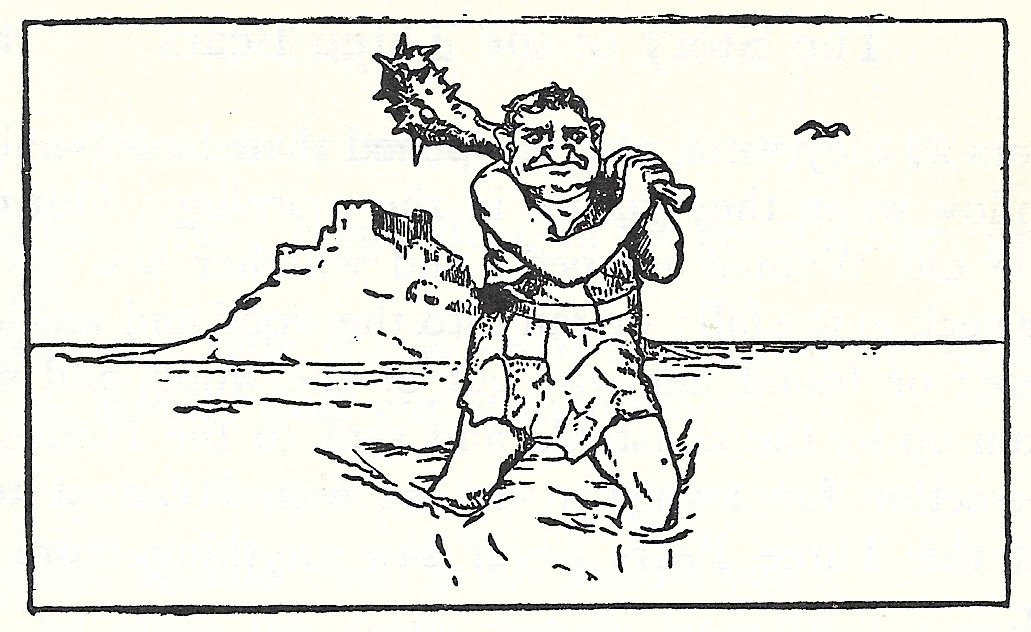
“Fee, fi, fo, fum, I smell the blood of an . . . Englishwoman?”
I lumber forward, confident in my ignorance. I have strength. I need not listen to intellect. I am . . .
“What am I? I’m not me. I’m a giant! What is going on?”
I crest the rise of a hill. Below me is a fair damsel, gowned in purple velvet, seated on a dais. As she rises, raising her arms into the air, I recognize her.
“Giant, I put upon you a geis. I demand you tell me . . . “
“Melissa,” I say, my voice booming, “it’s me.”
“Oh, no.” She collapses back down onto her throne. “I’m so sorry. I didn’t mean to transform you again.”
“Last time it was an owl. This time a giant. What are you doing?” I rumble.
I sit down on the ground, causing a tremor that nearly jolts Melissa from her throne.
“Well, taking my cue from Maria Louise von Franz when she said, ‘Fairy tales are the purest and simplest expression of the collective unconscious . . .’ or, in other words, our dreams, I decided to dream of fairy tales, consciously, to better understand them. The results have been variable.”
Melissa straightens herself on her throne and proceeds.
A queen gives birth to a son while the king is far away. She declares she will not name and christen the boy until his father returns. In the meantime, they will call him Nix Nought Nothing. Unfortunately, the king does not return for a number of years.
During his travels, when the king does return, a giant does him a favor, seemingly for no payment, saying he would take nix, naught, nothing. Upon arriving home, the king finds that is his son’s name.
The king and queen try to substitute the henwife’s son and then the gardener’s son, but in each case the giant discovers the ruse, kills the unfortunate lads in his rage, and returns for Nix Naught Nothing.
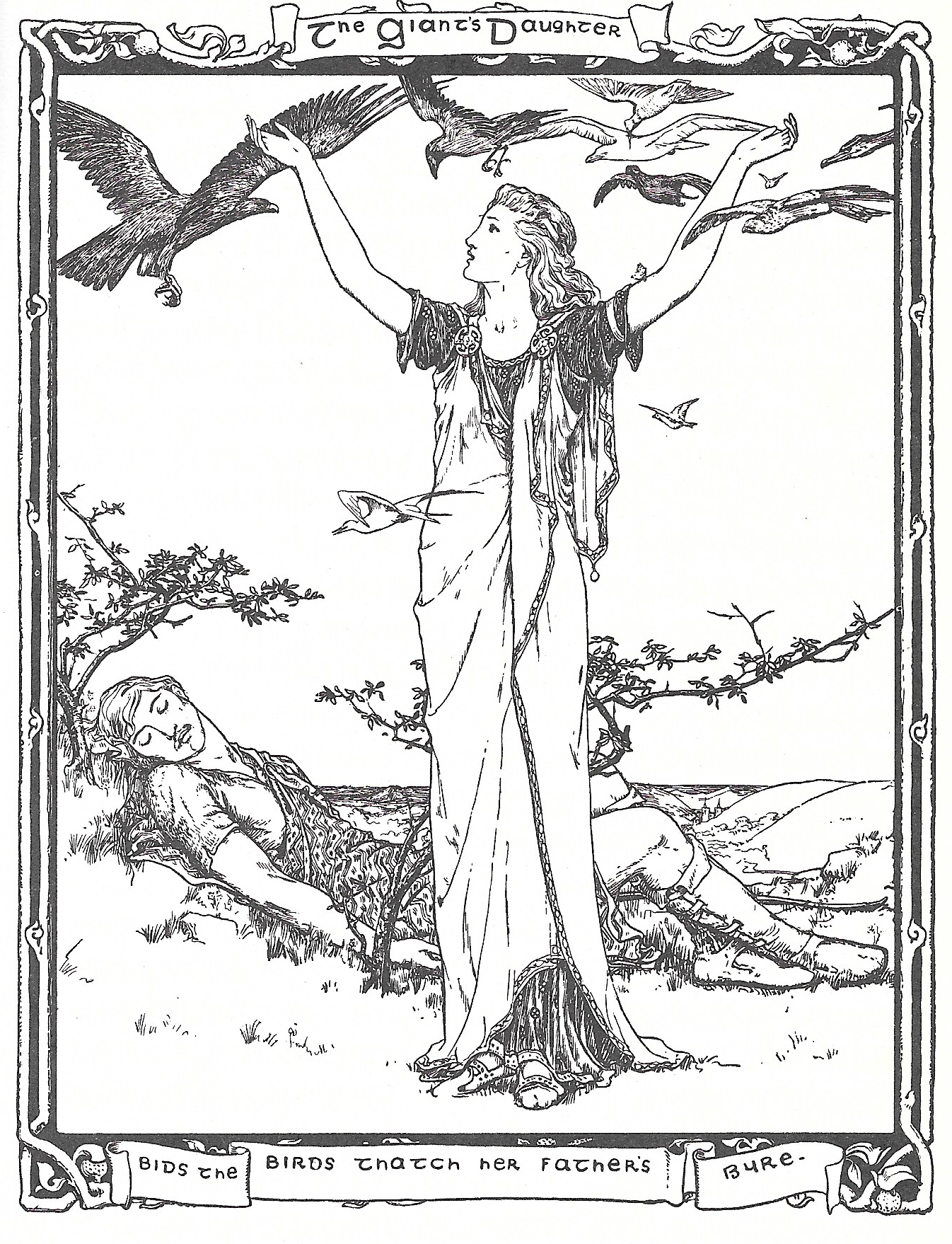
The giant raises the boy until he is a man. Then the giant gives Nix Naught Nothing the task of cleaning out the stable that is seven miles long, seven miles wide, and has not been cleaned in seven years. He is allowed only one day to accomplish the feat or become the giant’s supper that night. Our hero is helped by the giant’s daughter, who calls upon all the animals and birds to aid him.
The next task is to drain a lake that is seven miles wide, seven miles across, and seven miles deep. The daughter calls upon all the fish in the sea to drink up the water.
The third trial is to climb a tree seven miles tall with no branches until the top, where there is a nest with seven eggs. The daughter cuts off her fingers and toes to use the bones as pegs for him to climb the tree.
However, one of the eggs breaks, and they must flee with the giant in hot pursuit. They throw down her comb and hair dagger, which turn into briars and hedges to slow down the giant. They then throw down her flask, which turns into a wave that drowns the giant.
They arrive, unbeknownst to them, at Nix Naught Nothing’s father’s kingdom. He leaves his love, who is too tired to go on, to find shelter. He comes across the henwife, whose son was killed for his sake, and she puts him under a sleeping spell. She then contrives with the gardener’s daughter that only this girl can wake the sleeping stranger and will do so if she can marry him.
Through good fortune, the giant’s daughter shows up in time to reveal that the sleeping stranger is Nix Naught Nothing. The gardener’s daughter is forced to break the spell, the henwife is put to death, and the remainder live happily ever after.
“Rarely totally kind, these fairy-tale endings,” I muse, my comment echoing off of the hills.
Fairy Tale of the Month: March 2024 Nix Naught Nothing – Part Two
Jack the Giant Killer – John D. Batten
Big Thoughts
“If I recall,” I say, straining the capacity of giant thinking, “this version was concocted by Joseph Jacobs, borrowed from Andrew Lang, who collected it somewhere in Scotland, but it is pretty clear that much of the story leans on Greek mythology.”
“I agree,” Melissa nods. “What are your insights?”
“The name ‘Nix Naught Nothing’ reminds me of Odysseus and the Cyclops in that the name becomes a trick. Odysseus told Polyphemus his name was ‘Nobody.’ When Odysseus and his men put out Polyphemus’s lone eye, the screams of agony brought the cyclops’s neighbors. From beyond the stone that blocked Polyphemus’s cave entrance, they asked what the matter was. He answered that nobody had harmed him, so they went back to their homes.”
Melissa smiles and I continue. “But I think this tale mostly reflects Jason and the Argonauts. In that legend, Jason had tasks to perform in order to get the Golden Fleece from King Aeȅtes. He had to yoke the fire-breathing oxen and plow a field, sowing it with dragon’s teeth that sprang up as warriors and might have turned against him. With her sorcery, Medea, the king’s daughter, aided Jason just as the giant’s daughter aided Nix Naught Nothing.”
Melissa knits her brow. “But the tasks are different. The thing with the stable that was seven miles long and seven miles wide and had not been cleaned in seven years is similar to one of the Herculean tasks. Although all of them are imbued with the number seven, I am not sure where the other two tasks came from.”
I am thinking I do know. Something is tickling my memory, and I scratch my massive head with a thick finger. Melissa goes on. “And you’re right about the similarity to Jason and Medea, right to the end of the story. In both cases, there was a pursuit of the lovers by the father, at whom they threw obstacles in his path to slow him down. In Medea’s case, pieces of her brother, whom she had killed, which the king stopped to retrieve for proper burial.
“But, ah!” I see realization in her eyes. “The marriages at the conclusions are very different; in fact, opposites.”
My sluggish giant brain is almost remembering something, but not quite as Melissa continues. “In Nix Naught Nothing, he ‘forgets’ his bride for a time, until she is restored to him, and then they live happily ever after. With Jason and Medea, they were married, but after ten years he left her for another woman. Medea had her revenge, ending the legend in tragedy. That may be the difference between legends and fairy tales. Fairy tales end well for the main characters, and legends do not.”
“Talking about endings, in Nix’s story, the giant was drowned. I think I heard that before.” There is that tickling again. “But isn’t the usual death we giants get is having our heads cut off and our tongues taken as a receipt?”
Melissa smiles benignly. “You giants don’t get to be the heroes, do you?”
I am starting to feel sorry for myself.
Fairy Tale of the Month: March 2024 Nix Naught Nothing – Part Three
Battle of the Birds – John D. Batten
Big Deal
“Battle of the Birds!” I hear myself bellow. Melissa startles. “That’s what’s been tickling my brain. It’s the Celtic version of Nix Naught Nothing.
“Oh, the story starts out very differently. The beasts and birds have a battle, over a trivial matter between a wren and a mouse. The prince of Tethertown aids a raven during its fight with a snake. The raven rewards the prince, after a long journey, with a mysterious bundle that the prince is not to open until he is at the place he wishes to dwell.
“Of course, he peeps into the bag far too soon, and a castle, surrounded by gardens and an orchard, pops out. A giant offers to stuff them all back in if the prince gives him his firstborn son. The prince, not having a son, agrees.
“Returning home, the prince unpacks the castle, which comes with a maiden, whom he marries. Seven years later, the giant appears to collect his due. The prince and his wife substitute the cook’s son and then the butler’s son, with the same disastrous results as in Nix. The giant raises the lad until manhood, then offers him his choice of one of his two eldest daughters. The youngest daughter is pledged to the son of the king of the Green City, but the prince and the youngest daughter, Auburn Mary, have already fallen in love.”
“Wait,” says Melissa. “Auburn Mary? She has a name?”
“Yes. Nobody else does. The prince of Tethertown is invariably called ‘king’s son,’ even by Auburn Mary.
“King’s son’s choice of Auburn Mary angers the giant. He puts upon him the tasks of cleaning the stable, thatching its roof with down feathers, and climbing a tree for magpie eggs. Auburn Mary aids him. Extreme is having the king’s son kill her, strip her flesh, and use her bones as pegs to climb the tree for the eggs. He then reassembles her by her instructions but loses her little-finger bone. That becomes useful when the giant again tries to deceive him by having him choose between the three identically clothed sisters. His bride is the one with nine fingers.
“Auburn Mary realizes her father plans to kill them, and they flee, aided by a hoodie. The talismans that become barriers come out of the ear of the blue-grey filly they ride. The last is a water bladder that turns into a lough in which the giant drowns.
“Returning to his father’s kingdom, Auburn Mary sends king’s son on ahead to reunite with his parents and let them know about her. She warns him to let no one kiss him, or he will forget all about her. His old greyhound greets him with a lick on the face, and forgetfulness falls upon him.
“A shoemaker finds her and gives her shelter until the day he is to deliver the shoes for the royal wedding about to take place. Auburn Mary follows him, ending up at the wedding feast, where she is given a glass of wine.
“Flames spring up from the wine, out of which flutter a golden pigeon and a silver pigeon. Three times, three grains of barley fall to the floor. Each time the silver pigeon devours them, the golden pigeon admonishes him for not sharing and reminds him of when she cleaned the stable, thatched the roof, and sacrificed her little finger for him. The king’s son remembers his true bride, and they are married.”
Melissa blinks. “There are certainly a lot of birds in this version: a wren, raven, hoodie, and pigeons, not to mention down feathers and magpie eggs.”
I am about to comment when a mounted, armored knight with drawn sword comes to sally forth.
“Oh dear,” Melissa regrets. “It’s my Prince Charming come to rescue me.”
“Aren’t I supposed to be drowned in this story?”
“He’s following the wrong script. I’d better dismiss you from my dream.” She raises a hand in the air and mutters what must be a spell.
“Well, hurry,” I say.
Prince Charming’s horse has leapt into my lap and starts up my belly as if it were a steep hill. I see the sun glinting off the edge of the blade as it reaches its zenith and descends toward my throat.
I sit straight up in bed, clutching my neck.
Nope. Still there. Melissa cut that awfully close.
I have started to delve into my Book Launch Strategy Checklist from Kindlepreneur. It is a one-page summary that I settled on, to keep me on track. IngramSpark has a good article on their site, Book Launch Checklist: A Cheat Sheet for Your New Release, which I found useful. It is thorough, about eight pages long, but not really a checklist with boxes to check off. If you google (yes, google has become a verb) the term “Book Launch Checklist,” you will get pages of offerings from which to choose.
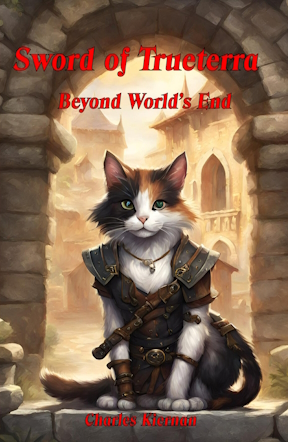
One of the items on my checklist is the front cover reveal. Well, here is my proposed cover for this next book (a sequel to A Vacant Throne). I played around with Binge AI’s image generator and also Canva’s generator. I glanced at Leonardo’s AI, which looks pretty good too. There are dozens of image generating options to play with for free; doesn’t cost you anything to get your paws wet.
How does it work? Type in a description, say, “This is a fantasy book cover about a medieval world of cats. The main character is a female calico cat. She wears a leather vest and holds a sword. The background is a stone arch.”
Most of the generators will give you four images to look at. You can repeat the instructions with a click and get four more images, or refine your instructions and try again. You can do this again and again and again and . . .
Warning: the more you do this, the wackier it gets. It will put a cat’s head on an otherwise human body, or a human’s face on a cat’s body, or it might forget that the cat is supposed to be a calico or that there is supposed to be a sword (as in the case above. I liked it anyway.)
Cheapskate that I am, I used the free versions, but they gave me an introduction to this whole realm. I am sure the paid versions have much more facility.
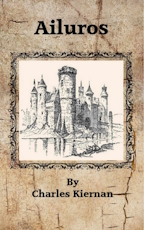
I will embarrass myself and give you the history of A Vacant Throne’s cover design. First, I will confess that I am an incurable DIYer and make no pretense of recovering. Below is my first cover.
You should note the title. A really terrible title. Why? It says nothing about the book. I thought myself clever. The name is derived from the Greek word for “cat.” But, my story has nothing to do with the Greeks! The word conveys no meaning to the reader. Only the castle starts to give a hint of the story’s setting. The cover also lacks a sub-title.
I still like the look of this cover, but it does not meet genré expectations. Let me underline this. It Does not meet genré expectations. Take a look at a romance cover, and then look at self-help cover. The difference will be clear. If a genré reader does not see what they expect to see, they will look elsewhere.
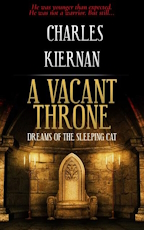
Next, I stowed my DIY inclinations in a dark corner and searched for a professionally designed cover. This one I found on BookZone. On sites like this (again, there are many) there can be found unused book covers often for under $150. Cover designers typically make multiple versions for a client from which to choose. The rejects end up on sites like BookZone at bargain prices. BookZone includes the software onsite to put your title and other descriptions on the cover and back cover, make small alterations, and create the properly sized spine. Quite a nice service.
I loved the cover at first. “Throne” was in the new title, and a throne was on the cover. That remained the cover for some time. Gradually, I recognized the cover was rather dark and brooding. More dark and brooding than my story. Perhaps more importantly, no “live” character graced the image. The cover was cold.
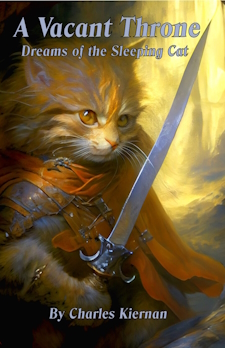
Entered my son with his access to Midjourney one holiday gathering and produced this image of my main character. My DIY leapt from its corner, taking me over once more. I slapped a title at the top, my name at the bottom, and replaced the cover. Now, a cat holding a sword, dressed for battle, jumped out at the viewer from a book in which cats are the main characters.
Not for long. That it does not meet genré expectations reared its ugly head. The black bar at the top and bottom would not do.
Climbing up the learning curve in Publisher, I produced and settled on this version. Note that the image of the cat is much larger, which, when seen on Amazon as a thumbnail, is more striking. I also have a thin outline around the fonts to make them stand out and not blend into the colors behind them. Your cover must look good as a thumbnail. That is what your prospective reader will be clicking on to get to your product page. Worry about the small stuff.
Next month, I plan to agonize over ARC’s (Advance Reader Copies).
I had decided that I would not sulk around the house this year when my daughter, as is traditional, would whisk my Thalia away from me in February (school be damned) to visit her late husband’s relatives in Glasgow. Well, it has been three years, given the circumstances, since this visit was made. I did have a reprieve.
But now, Thalia is gone, and I rang up Duckworth to see if he was available for lunch. He, too, has been abandoned by his wife and children for a visit to her relatives, whom he cannot stand. He and I are compatriots.
We are sitting in Rock and Sole Plaice waiting for our meal. True, every pub in London has fish and chips on its menu. But here, there are nearly a dozen variations. Duckworth, adventurous soul that he is, ordered the calamari and chips. I stuck to the plaice, although tempted by the Proper King Prawns.
“Tell me,” says Duckworth as we wait. “What bizarre fairy tale have you stumbled across recently?”
“Well you should ask,” I say. “With Thalia gone, I contented myself last night by plunging into Grimm. I chanced upon a tale I had read before but taken little notice of. This time, it caught my curiosity.”
“I’m all ears,” Duckworth grins.
“Perhaps you should be,” I say. “Its about a donkey. In fact, it is called The Donkey.
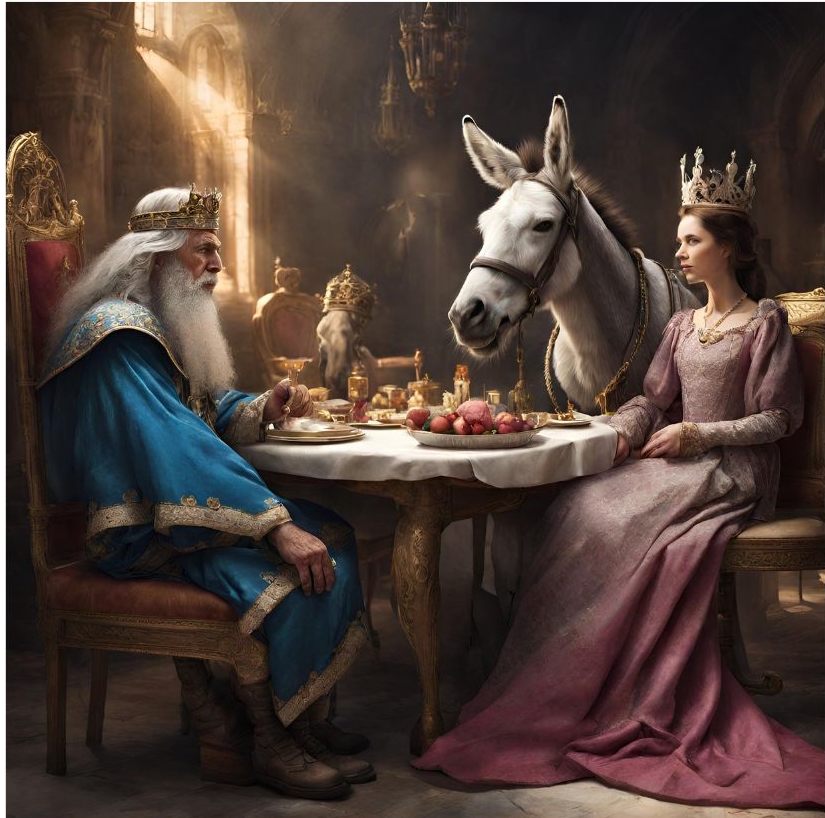
A king and queen at long last have a child, but it is a donkey. The queen wants to drown it, but the king says if this is God’s will, it will inherit the throne.
The donkey grows up with all the benefits of a prince. Being attracted to music, he learns to play the lute as well as his teacher, despite his hooves.
At length, he ventures into the world after seeing his reflection in still water and truly realizes he is, by all appearances, a donkey.
He travels to a distant kingdom, and there he asks for entrance into the castle as a guest. Being a donkey, his request is denied by the guard. The donkey sits down by the gate and plays his lute. The guard, amazed, reports this to the king. The king, entertained by the idea of a lute-playing donkey, invites the donkey into the castle.
The donkey refuses to eat with the servants or even the knights. Being of royal birth, he insists upon eating at the king’s table. The king, amused, agrees. The donkey’s manners are impeccable, and he is seated by the king’s lovely daughter.
As time goes on, the king becomes exceptionally fond of his “little donkey.” However, the donkey realizes the futility of his presence at this king’s court and asks leave to return to his home.
The king offers him gold and half his kingdom if he will stay, but this is not what the donkey wants. The king then offers his daughter in marriage. At that, the donkey agrees to stay.
That night, the wedding is held, but the king immediately has second thoughts and arranges that a servant hide himself in the bedchamber to assure that the donkey conducts himself properly.
When the donkey believes all is secure, he throws off his donkey skin and reveals his true, handsome self to his bride, who is delighted. In the morning, he returns to his donkey skin.
The servant reports to the king, who is amazed and wishes to see all this for himself. The servant advises that the king take the donkey skin and burn it, which the king does.
In the morning, the handsome prince cannot find his skin and tries to flee. The king waylays him and offers, again, half his kingdom if the prince stays. The prince relents.
Eventually, he inherits all of the kingdom, plus his own father’s kingdom, and lives out his life in splendor.
“Oh, really?” says Duckworth, shaking his head. “Way too easy.”
Fairy Tale of the Month: February 2024 The Donkey – Part Two
Author + AI
Donkey’s Skin
The meals arrive, and conversation halts as we sample our choices.
“‘Way too easy’ you say?” I comment after I decide I made the right menu choice.
“Well.” Duckworth sets down his fork. “As I understand story structure, be it literary or oral, there must be a crisis, a high point of tension, at the climax of the story.
“In our case, the prince cannot find his familiar donkey skin, tries to flee, and is stopped by the king, who offers him half the kingdom if he stays. The prince says, ‘What the hell. Why not?’
“This is not a crisis. There is nothing to lose but the curse of a donkey skin in return for half a kingdom! The stakes are not high.”
“I do agree,” I confess. “The end of the story falls flat. I feel the same way as you, but the earlier part of the story holds promise.”
“Such as?” Duckworth picks up his fork again to attack his meal.
“Well,” I contemplate, setting my fork down, “I am encouraged by the donkey’s father refusing to drown the poor thing, but rather giving him all the benefits of royal birth. The donkey takes to music and learns to play the lute, which should be impossible. This shows the reader or listener that there is more to this creature than being just a donkey.
“Perhaps my favorite part is when he sees his reflection in still water and sees himself as the rest of the world sees him. This is the point—in Hero’s Journey terms—when he crosses the threshold and ventures into the greater world to try, I suppose, to find himself. What he knows is inside him, and what he sees in the still water are two different things he needs to reconcile.”
“I’ll buy that,” says Duckworth, dipping a chip into the sauce. “Go on.”
“He passes two tests: getting into the castle by a show of his musical talent, and then getting to the king’s table by insisting on his rank. The king appears more amused by the donkey’s claim than convinced, but nonetheless, seats the donkey beside his daughter.
“However, in time, the donkey, despite his achievements, could see no way forward, especially concerning the princess. When he asks leave to return home, the king, to the donkey’s delight, offers him his daughter in marriage to tempt the donkey to stay.”
Duckworth raises his fork. “Isn’t that, ah . . .”
“Sexist?” I supply. “Well yes, but women were property back then, and back then was not so long ago, and don’t get me started on that or I will lose my point.”
Duckworth lowers his fork and applies it to his calamari.
“Where was I?” I continue. “Oh yes. In the bridal chamber he finally reveals his true identity to the princess and, I will suggest, to himself. But then, in the morning, he retreats back into his lesser, familiar form. It is only when the king destroys the donkey skin is he forced to accept himself in his true nature.”
“That does put the story in a new light for me.” Duckworth salutes me with his last chip before popping it into his mouth.
“What fascinates me,” I continue, “is the fairy-tale trope of the hero feeling he has to disguise himself for no apparent purpose. That bit I have never figured out.”
“Wait.” Duckworth’s eyes narrow. “This is not your typical line of argument. Who have you been talking to?”
He’s caught me.
“I had this same conversation last night with Melissa.”
“I thought so. She has much influence over you, you know.”
Picking up my fork, I say, “For the better, I hope.”
Fairy Tale of the Month: February 2024 – Part Three
Author + AI
A Stroll
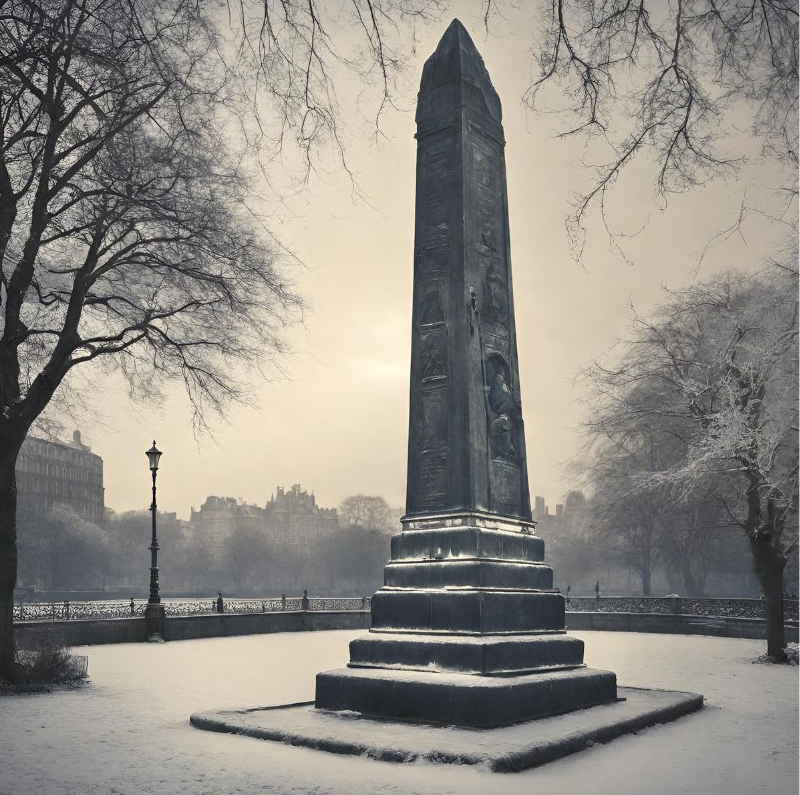
Leaving the Rock & Sole Plaice by hopping into Duckworth’s Morris Minor, we make our way down to Victoria Embankment Gardens to walk off some of the calories we absorbed and to visit Cleopatra’s Needle, simply to have a destination.
As we walk down a gravel path, Duckworth asks, “So, why do you think the Grimms wrote this story?”
“That’s a hard question to answer, given that they did not write them and yet they did.”
“Sounds like an answer off to a wrong start,” Duckworth quips.
“Well, it’s simply that the Grimm brothers collected the stories from various sources, including variants, then wrote them up in a coherent fashion, trying not to stray too far from the originals, at least in the first edition, which they considered to be a scholarly work.
“Their purpose was to establish a ‘German Folk Voice’ in the context of the rising German nationalism. Remember, this was in 1812, when the Holy Roman Empire still held sway. There were only empires, no nations.”
We pass the erotic statue that graces the Arthur Sullivan Memorial. Arthur being of the famous operatic duo Gilbert and Sullivan.
Is that the definition of bad taste?
Duckworth glances sidelong at me. “I hear you leading to something amiss when you say, ‘at least in the first edition.’”
“Quite so. The Grimms quickly realized their larger audience was the children of bourgeois families. After the first edition, Wilhelm took over Kinder- und Hausmärchen, leaving Jacob to lead in their more scholarly works (a dictionary and a collection of Germanic mythology). There were six more editions of Kinder- und Hausmärchen; Wilhelm could not leave it alone.
“Wilhelm, in consideration of his Christian audience, eliminated most of the pagan references in the original stories and supplanted them with more Christian elements. Angels appeared in some of the rewritten versions, who had not haunted the tales before then.”
We now stroll beside the Thames. Duckworth returns to my earlier point. “They were seeking the ‘German Folk Voice’ you say?”
“Yes, which involved a bit of irony. A number of the better-known tales, like Little Red Riding Hood, Snow White, and Sleeping Beauty, the Grimms collected from a friend and neighbor, Marie Hassenpflug of a French Huguenot family. The daughters of another neighbor, the Wild family, also of Huguenot origin, supplied quite a few other tales. One of these girls, Wilhelm ended up marrying.”
“Oh my,” says Duckworth, “collecting tales was quite a different business in those days, was it not?”
Cleopatra’s Needle comes into view.
“The Grimms were not the ‘field’ folklore collectors that were to follow,” I continue, “but depended upon friends and acquaintances to gather their material. For example, Philipp Otto Runge. He was a German Romantic painter and color theorist—and an exquisite mind that passed away too young. He sent the Grimms two stories, The Fisherman and his Wife, and The Juniper Tree. When Wilhelm read these tales, he was much impressed by Runge’s ‘voice.’ Wilhelm patterned the collection’s style on Runge’s.”
“Well, now that we are here,” says Duckworth, “we can turn around and go back. I think we can spend a little time at Sullivan’s memorial.”




 Fairy Tale of the Month