Fairy Tale of the Month: January 2015 The Nixie in the Pond – Part One

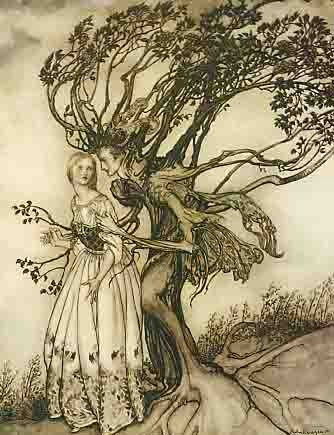
nixieofthemillpondH. J. Ford

The Water’s Edge

“I didn’t know you liked fairy tales.” I address Thalia’s cat, Johannes, who sits on the study table, my copy of Jack Zipes’s translation of Grimm lying open in front of him.

“I never said I didn’t,” he answers coldly, inserting a deft claw between the pages, turning a leaf, and pinning the opposite page with his other claw. This explains why my books are not always where I leave them. They often end up on the floor.

Looking over his head, I see he is reading The Nixie in the Pond. In this tale a miller is approached by a nixie—a mermaid-like creature. He bargains for wealth in exchange for what is being born at that moment in the mill. He thinks it to be a dog or a cat, unaware that his wife is birthing a boy in the mill as they speak.

The miller cheats the nixie by keeping the lad away from the pond. The youth grows up, becomes a huntsman, and marries. One day, while hunting, he washes blood from his hands at the mill pond and is seized by the nixie.

His wife, discovering his plight, circles the mill pond, calling his name until she collapses and is taken by a dream. In the dream she climbs a mountain until she reaches a hut at the door of which an old woman beckons to her.

Upon waking, the young woman indeed climbs the mountain and meets the old woman who beckoned to her in the dream. The old woman gives the younger a golden comb with the instructions to comb her hair, in the moonlight, by the mill pond, then set the comb down by the water’s edge. When she does these things, the water rises up and takes the comb in exchange for a glimpse of her husband’s face.

Again, the woman dreams of climbing the mountain and, again, she actually does. The old woman gives her a golden flute to play by the mill pond. In exchange, the wife sees more of her husband.

Again the dream and the visit; this time the young woman returns with a golden spinning wheel. For it, the husband is fully revealed and escapes from the nixie. Together they flee, with the water rising quickly behind them. Fearful of drowning, the younger woman cries out to the older. She is transformed into a toad, and he into a frog. In these forms they survive the flood, but are separated. Returning to their human shape, each finds themself in a foreign land.

Lost and no longer together, they each become shepherds in order to make a living. For many years they drive their flocks from pasture to pasture, gradually moving closer together. When they again meet they do not recognize each other, but take comfort in each other’s company.

One evening the man plays a tune on his flute, the same that she played at the edge of the mill pond. She cries and tells her story. The veil falls from their eyes and they are reunited. And, ah yes, they live happily ever after.

“What do you think?” I ask Johannes.

“My fur bristled when she dunked him into the mill pond.”

“As well it might,” I say.

“And given the chance, I’d have scratched her eyes out.”

“You’re not a forgiving cat, Johannes.”

“Cats never forgive.”

“I’ll remember that.”

Johannes curls up and goes to sleep.

Fairy Tale of the Month: January 2015 The Nixie in the Pond – Part Two
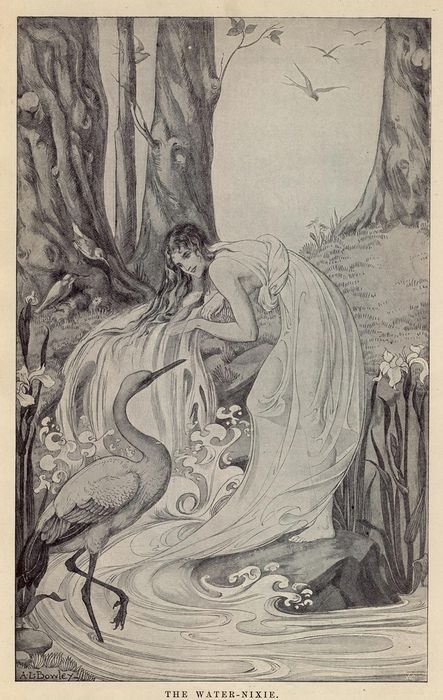
Nixie  A. L. BowleyA. L. Bowley

The Pond

While contemplating The Nixie in the Pond, I decide to go to the authority on the topic. I do this despite the cold weather and the lateness of the day. In addition, it always feels a bit warmer in winter and cooler in summer in the magic forest than elsewhere. I grab a paper bag of unshelled peanuts and head out.

My destination is fairly deep into the forest, but I know it is safe, even under the moonlight, as long as I stay on the path. At the path’s end is the pond. It’s never frozen over. I am sure that has something to do with her. I sit on my rock at the top of the bank to wait.

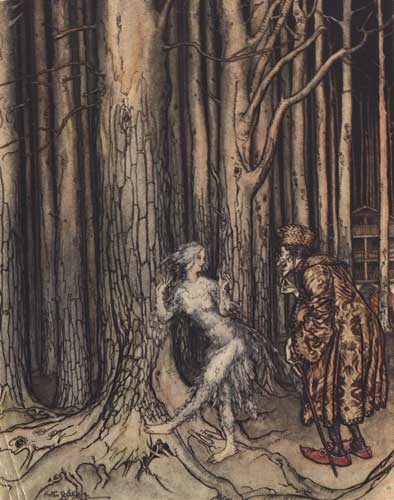
Immediately she appears, posing on her rock at the pond’s edge, water flowing from her hair and arms as though she were a trickling fountain.

“Hello, my human.”

“Hello, my nixie.” We have never exchanged names. I doubt it is safe to do so. I shell a peanut and toss it to her. She catches it in her thin, pale-green hand and pops it into her mouth, rolling her eyes in ecstasy.

“I want to ask you about the miller’s son you abducted.”

“Which miller’s son? There are many.”

“The one who eluded you long enough to become a huntsman and to marry.”

“Oh, the one that got away. She did it with help you know.”

“Yes, I know. Why did you show her the huntsman, her husband?”

“I carved the golden comb, flute, and spinning wheel. We nixies make exchanges for the things we want. I knew what she wanted. Yet, I gave her only the sight of him. I did not intend to exchange all of him for the spinning wheel. He belongs to me. My fault was being too patient in collecting my due. He tasted being his own man. Willfully he abandoned me and prompted my anger.”

I can see that anger in her eyes and I throw more peanuts to placate her.

“They were husband and wife,” I reason.

“That is of no concern to me.” She is looking at a peanut kernel between her fingers.

“You nearly destroyed them, and set them each on a long, lonely journey. Was that not a bit harsh?”

The nixie looks at me with deviltry in her eye. “My human, I am immortal. You are mortal. Mortals live with their past in their thoughts. Our past is immense; we cannot keep it in mind. We live only in the present. Therefore, we love, we hate, we anger completely, untampered by what came before.”

As I shell more peanuts, I am thinking there is a bigger question, but I cannot wrap my mind around it.

“I see,” she says, “questions floating about in that human brain of yours. I will give you all the answers to your unasked questions.”

I am stunned by the offering. She sees into my soul. I am as transparent as glass. The enormity of this opportunity seizes me.

“I am interested. You are right, I am full of questions. Your offering of answers trembles my heart. You will do this for me in exchange for …? No, I am not going to ask!” Images of Thalia flicker in my mind. “Here.” I toss my nixie the bag of peanuts and make an escape.

Your thoughts?


Fairy Tale of the Month: January 2015 The Nixie in the Pond – Part Three

nixie ‘LITTLE SEAMAID’  Louis RheadLouis Rhead

By the Hearth

Back in my study, after checking in on Thalia sleeping peacefully, I light a fire in the hearth to soothe my shivering. Or am I trembling after my encounter with the nixie? I should know better than to underestimate anything fay, be it a tale or the real thing.

I settle into my comfy chair and let my thoughts wander back to The Nixie in the Pond. If Augustus were here, I think he’d agree that one of the striking features of this tale is the wife’s dreams.

There is something shamanistic about the wife dreaming three times and actualizing the dreams by climbing the mountain to see the old woman who beckoned to her. At this point in the story there are three realms: the nixie’s world under the water, the wife’s world on land, and the old woman’s world atop a mountain accessed by dreams.

When the husband escapes from the nixie, he and his wife are reunited briefly, but their world shifts; they are transformed into separate creatures—a frog and a toad—and swept away, each taken to a different land unknown to them. Now there are two realms, both alien.

Unaccountably, they become (transform into) shepherds, and slowly, unconsciously, drift back toward each other until they once again occupy the same realm. Yet, they do not recognize one another. It is not until they know each other’s story that their reunion takes place both physically and spiritually.

It is tempting to put this tale into Freudian terms. The three realms could be the Id (nixie), ego (wife), and superego (old woman). The two realms could stand for the disintegration of the personality (bi-polar, schizophrenia), and the one realm to represent the reintegration, the healing, of the personality. Many fairy tales fit neatly into the Freudian mold as Bruno Bettelheim famously noted.

With the fire tongs I work the unburnt ends of logs in toward the glowing embers.

I could view the tale in Campbellian terms (I looked that word up; it really does exist.), which is the “hero’s journey.” When the miller bargains with the nixie, I see that as the “call to adventure.” When the huntsman washes the blood from his hands and is snatched by the nixie, he enters the “belly of the whale.” The old woman whom the wife encounters is the “supernatural aid.”  Escaping from the nixie only bring them more hardship, casting them upon the “road of trial.” At the end of the tale the husband and wife are reunited, which is of course the “ultimate boon.

I could invent another scenario about how the story reflects on the trials of a mundane world’s marriage, but I need to stop somewhere.

The tension that pervades this tale is that of the tentativeness of our existence, an element which underlies most good fairy tales. I sympathize with both the husband’s and the wife’s travail. It’s the story’s pattern that leaves me with a sense of satisfaction. Events come full circle. And of course, there is a happy ending.

I notice my shivering has stopped and I drift off to sleep lounging before the fireplace.

Your thoughts?
 

Fairy Tale of the Month: December 2014 The Winter Rose – Part One


Winter Rose ford_beauty H J Ford

A Ceremony

Christmas Eve in my study has a form that must be followed. Thalia, although of tender years, insists on decorum. Traditions survive because of children.

We start with my reading The Night Before Christmas to her and Teddy, all of us squeezed between the arms of the comfy chair by the hearth. Over the hearth fire is a three-legged cast-iron pot containing mulled cider warming up to be ladled out into cups; the convenience of a microwave is not to be considered.

I recently found out there is a controversy surrounding C. C. Moore’s rendition of the poem, but that sort of thing cannot be mentioned now. The poem—tonight—is sacred.

Following that, it is my choice what to read. Grimm has nothing about Christmas in their canon. A winter-themed story that I have not already read to her and Teddy proves hard to come by, but I manage. I peruse my copy of Jack Zipe’s translation of Grimm, finding what I want in the third story from the last. The Winter Rose.

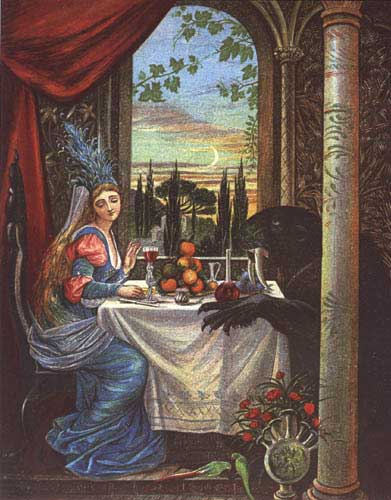
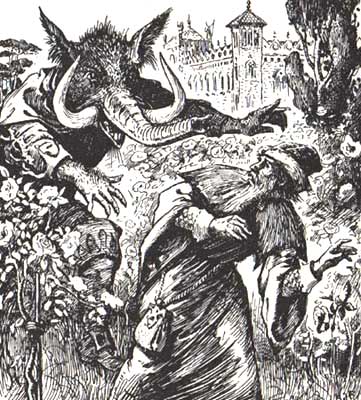
It is a Beauty and the Beast variant, complete with a traveling merchant, three daughters, and three requests, the youngest asking for a rose. As it is winter, the merchant cannot find a rose. On his return trip home, he comes across a garden, half in winter, half in summer.  The summer half has roses in bloom. The merchant picks a rose and returns to the road. A black beast chases after him, demanding with a threat that his rose be returned.

The merchant ends up keeping the rose, thinking he has outwitted the beast, but the beast forcefully seizes his youngest daughter and take her to his castle.

There the violence ends. The beast dotes on the girl until she becomes fond of him. After a time, she wishes news of her family. The beast shows her a mirror in which she can see what is happening at home. Her father lies on his deathbed.

At this point in the story, we stop to serve ourselves some cider. Thalia provides a doll’s teacup for Teddy’s cider, but I am sure he is going to spill it.

The daughter pleads with the beast to let her visit home and he relents, allowing her a week but no more. During her visit the father dies. In her grief, she overstays her time. Upon return to the beast’s castle, she finds he has disappeared. Winter dominates the garden. There she finds a heap of rotting cabbages, under which she uncovers the beast, who appears to be dead.

She pours a bucket of water over the beast to revive him. Up rises a handsome prince, the garden returns to summer, and they marry.

“I like the garden,” says Thalia, finishing her cider.

I like the garden too.

She toddles off to bed, dragging Teddy behind her. I clean up the cups and the spill.

Has anyone explored the role of gardens and cabbages in fairy tales? That does sound like a pedantic inquiry, even to me. But I am conscious that while popular fiction dwells on the unusual, exotic, and exciting, my genre pulls from the mundane. Popular fiction plucks low-hanging fruit, fairy tales look at the root.

Fairy Tale of the Month: December 2014 The Winter Rose – Part Two

Winter Rose boyle_beauty Eleanor Vere Boyle

Boxing Day

It’s Boxing Day and I visit Augustus, bearing the gift of a quality fountain pen, knowing his abhorrence for other ink devices. The shop isn’t open, but Augustus lives above his store, and his friends know the shop door is unlocked on this day after Christmas. As I enter, I am delighted to see Duckworth already there, the two of them surrounded by a haze of pipe smoke.

As I enter into this fraternal matrix, Duckworth asks me, “What have you been spouting at your granddaughter these days?”

“Spouting, spouting,” I object. “This is Christmas; I am sharing.”

Duckworth’s waves his hand in a gesture of acquiescence.

The Winter Rose,” I supply.

Winter Rose,” Augustus echoes. “Ah, yes, The Summer and Winter Garden.”

“Pardon?”

Behind Augustus’ eyes I know his encyclopedic mind is sorting through the data. “The story appeared in the 1812 edition as The Summer and Winter Garden, but was soon replaced by The Singing Springing Lark, the first version appearing in the notes, until it reappeared, as I recall, in the last edition as The Winter Rose.”

Duckworth looks mildly amused. “How many editions were there?”

“Seven,” I say, taking out my pipe.

“For a children’s book, really?”

Augustus smiles. “They initially produced the work for an intellectual, nationalistic Germanic audience. As it gathered a popular following, they kept re-editing it to suit bourgeois tastes.”

I settle into one of the comfy chairs and tamp my pipe. “It seems to me—with The Winter Rose being an example—there are at least as many gardens in fairy tales as spinning wheels.”

Augustus nods. “Part of that is the extensive number of these Beauty and the Beast variants littering the fairy-tale field, the better number of them having a rose plucked from a garden. However, beyond these variants and still staying within Grimms’ collection there is Rapunzel, The Lettuce Donkey, and The Hare’s Bride, in which the garden plays a large role, and the garden is mentioned in passing in such stories as The Fisherman and his Wife and The Pink Flower.”

Duckworth clicked the stem of his pipe on his teeth. “Spinning wheels and gardens are ordinary things. Why are they of any interest?”

“Exactly because they are ordinary.” Augustus relights his pipe. “Fairy tales move from the everyday to the extraordinary, suggesting to us that the common can be imbued with meaning we did not notice before.”

“I am taken by the image of a garden half in summer and half in winter.” I look to Augustus for his thoughts. “I didn’t realize the first incarnation used that image in its title.”

“The tale is not that well known.” Augustus’ eyes are not focused. This is good. He is formulating, not recounting. “But anyone who has read it is struck by the garden in two seasons. What is it? Ying and yang? Folk recognition of duality? The cycle of life and death?”

“All of the above, I’d guess.” Duckworth puffs contentedly. He’s smoking “Elfish Gold” I realize.

“I’ll concur,” I say. “Pre-Freudian listeners were not schooled to analyze the hidden meanings of images. They felt the images, emotionally, as I am sure modern listeners still do—initially—before their brains take over.”

“I like that,” says Duckworth. “You suggest moderns try to think their way out of a fairy tale.”

Augustus looks dubious.

Fairy Tale of the Month: December 2014 The Winter Rose – Part Three

Winter Rose goble beauty Warwick Goble

A Rose

The smell of burning logs on the hearth sets me at ease. The glow from the fireplace illuminates my corner of the study. A Chromebook glows over my fingers, a Christmas present from my daughter. I like that they call it a “book.” That gives me permission to have it in my lap.

My favorite computer game is treasure hunting across the web, searching for tidbits on a topic. My topic tonight is “roses.”

I tip-tap in “roses in fairy tales.” Below the offers to buy roses in fairy tales from various proprietors, Grimm stories with the word “rose” appear, Snow White and Rose Red, Briar Rose, and The Rose. I follow the link to The Rose. It’s an odd little, grim Grimm tale about a youngest son encountering a child in the wood, who gives him a rosebud, saying he will visit again when the rose blooms. The next day the rose blooms, and the mother finds her youngest son dead.

The Winter Rose does not appear in the listings.

Typing in “roses symbolism” brings a wealth of information. Starting with the Wikipedia entry, and linking through the other offerings, a consensus emerges. The rose, as a symbol, pervades Western culture.

The entries like to start with the Egyptians, Greeks, and Romans, and their goddesses’ connection with the rose. I ran across two references to the Roman practice of hanging a rose on the door or from the ceiling of a room where matters of secret are to be discussed. Hence the term “sub rosa,” that is to say, “under the rose.”

The name Rosicrucian has something of the same origin, in that the rose lies at the heart of their symbol, the Rose Cross.

Another fun item: the rose holds the honored position of being the national flower of England. That came about with Henry VII, who introduced the heraldic Tudor Rose, which is composed of the red rose of the House of Lancaster and the white rose of the House of York. Henry ended the fifteenth-century civil war—later branded the War of the Roses—between the two houses by defeating Richard III in battle (A horse! A horse! My kingdom for a horse!) and marrying into the House of York.

Continuing my search, I find a lot about the rose representing the Virgin Mary and other sainted women, the rose garden symbolizing Paradise, and the rosary connection to our flower. When I consider the rose appeared in the Old Testament largely metaphorically and not symbolically, and does not appear in the New Testament (according to my source), I jump to the assumption that the rose in Christianity is a medieval invention.

My “Ah ha!” moment comes when the internet provides a link to Tam Lin. Tam Lin, of course, that quintessential Scottish ballad.

She had not pulled a double rose,

A rose but only two,

Till up then started young Tam Lin,

Saying “Lady, pull thou no more.”


“Why pullest thou the rose, Janet,

And why breakest thou the wand?

Or why comest thou to Carterhaugh

Withoutten my command?”


I had not seen Tam Lin in the usual list of Beauty and the Beast variants, probably because it is a ballad. The ballad dates to at least as early as 1549. Given its age, I wonder if it might not be the inspiration for that plucking-of-the-rose motif.

I look up at the hearth. For a moment I see a rose in the flames, its solid red petals and verdant green leaves in contrast to the orange and yellow flames. It quickly turns to ash.

Your thoughts?


Fairy Tale of the Month: November 2014 Earl of Mar’s Daughter – Part One

Earl mars rackhamArthur Rackham

Birds of a Feather

Duckworth and I have taken advantage of a mild fall day to go rowing on the Isis. There are others on the river, teams of scullers, who slide past us with coordinated strokes, not ceding a look as two fellows sitting side by side in a rowboat, each flounder with an oar.

“What Grimm story are you obsessing over currently?” Duckworth has made an assumption.

“I am not obsessing over Grimm, at present. Thalia rarely lets me read her anything other, but I need to expand my horizons.”

“Therefore . . .” inquires Duckworth.

“I am reading Joseph Jacobs, and obsessing over “Earl of Mar’s Daughter.”

The daughter of the Earl of Mar could often be seen playing in the castle garden, and was given to sitting and listening to the birds. One day she entices a dove to settle on her shoulder. It stays with her and that evening turns into the handsome young prince Florentine. After they marry in secret, he remains her pet dove by day and her husband at night.

As their seven sons are born, the dove whisks them away, taking them to his mother, the queen, who had put the curse of transformation upon him when he would not do as she wished. The Earl of Mar, unconscious of his daughter’s true status, intends to marry her to a nobleman. The daughter declares she wishes not to marry and will be content with the company of her dove. The Earl declares he will wring the bird’s neck.

Escaping, Florentine flies over the sea to return to his mother, leaving his wife to be remarried the next day. His mother, with instructions from her mentor, the Spae Wife of Ostree, aids her son. At his request, she turns him into a goshawk, his seven sons into swans, and her dancers and pipers, who have come to celebrate the prince’s return, into herons.

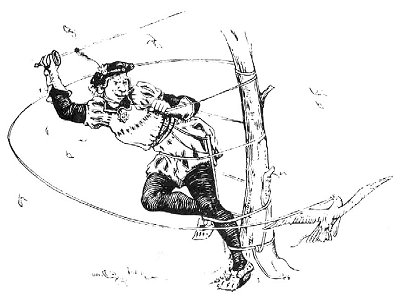
This entourage returns to the Earl of Mar’s estate in time to settle on a tree along the path from the castle to the church before the wedding party arrives. At the approach of the Earl, the bridegroom, their guests, and—at the end—the melancholy bride, the birds attack. The herons scatter the guests; the goshawk, with a cord in its beak, binds the bridegroom to a tree, while the swans carry off their mother.

Upon the dove/goshawk/prince’s return to his mother’s castle with his wife, the queen removes the spell she put upon her son, and all live “ever after” as you might guess.

Another scull of athletic young men pace by us without any recognition that our rowboat is a fellow craft upon the shared waters.

Duckworth’s brow creases from mild curiosity.

“What’s with the queen cursing her son?”

“Yes, an odd element. I felt there must be a backstory of which the tale told me nothing except by inference. That didn’t turn out to be the case. I checked Jacobs’ source, which was Allingham, whose source was Buchan, and I even checked out Child.”

“Who are they?”

“Oh, sorry, nineteenth-century collectors and editors of English and Scottish ballads.”

“Ballads? I thought we were talking about fairy tales.”

“Yes, well, it turns out Jacobs was fond of taking ballads and turning them into fairy tales, and then taking some liberties with them. The ballad of Earl Mar’s Daughter says nothing of the queen cursing her son, but rather she turned him into a bird so that he could more easily seduce young women. I have no idea where Jacobs got the Spae Wife of Ostree; that’s not there either. I think he made it up to fool me.”

“I am sure he had you in mind,” says Duckworth.

Fairy Tale of the Month: November 2014 Earl of Mar’s Daughter – Part Two

Earl mars battenJohn batten

A Marriageable Age

I wonder at my split personality concerning books. I delight in exploring the web, searching for out-of-print titles of folk and fairy tales that I can download to my Kindle for free. Then I go looking for hardbound copies of the same to weigh down my shelves, first editions if I can find them.

Now that I have befriended Melissa, she may facilitate my bad habits. She claims she can find anything with a cover.

“Good morning,” she says, looking up from her laptop. Swiveling in her chair, she runs her finger up and down a stack of books on her desk, pulling one out. “English Fairy Tales, by Joseph Jacobs, first edition. This one’s a little battered, which only means I got it for an excellent price.”

“Wonderful.” I hand her my card. “Still, don’t tell me how much, I don’t want to become self-conscious.”

As she rings up the sale, I peruse my purchase.

“In this work, Melissa, is a tale called Earl Mar’s Daughter that starts with the heroine playing in the garden, but when her dove turns into a young prince, BAM! she’s married. It’s the same pattern as the Frog Prince. There the heroine is playing with a golden ball, then the frog turns into a prince, and BAM! she’s married.

“When I stop to think on it, how is it acceptable that little girls are suddenly wives?”

Melissa smiles at me. “I’ve noticed that too. I propose there is an historical reason and a psychological reason.”

I settle onto a reading stool near the counter to listen.

“Historically, the average life span in earlier centuries was substantial shorter than ours. Everyone knows that, but when you look at it closely, things get a little weird. For example, during the early 1600s in England, life expectancy was about thirty-five. But that was an average, skewed largely because two-thirds of the children died before the age of four. If you got to your early twenties, chances were you would live to be seventy.

“Marriageable age started at puberty from the time of the Romans till the start of the nineteenth century. For girls that is about twelve years, only halfway to the magic age of twenty-something. After a girl’s early twenties she was an old maid. The pressure was for them to marry in their teens.”

I begin to visualize Melissa as a walking encyclopedia. She might be worse than Augustus.

“And psychologically?” I ask.

Melissa’s smile broadens. “Little girls love to fantasize about marriage. They are quick to play ‘house’ at an early age. It’s their way of being like grown-ups, similar to little boys pretending at being soldiers.  I personally object to both role models, but there it is.

“I think the old storytellers were happy to appeal to the little girls in their audience by allowing the heroines of those listeners’ same age to become wives of princes. Always princes, mind you, never tailors or soldiers. That would never do.

“I will put my money on my latter notion as the dominant influence.”

I think she is right, but then I tend to think women are always right. That’s been my experience. And it’s kept me out of a lot of arguments.

Fairy Tale of the Month: November 2014 Earl of Mar’s Daughter – Part Three

Earl mars batten2John Batten

Another Visit

The cold, cloudy November weather returned this morning, but in Miss Cox’s garden the temperature is milder than outside the garden gate. The sun peeks out from behind the clouds, which it did not on my walk over here. Nonetheless, the cozy on the teapot waiting for us on the wrought-iron table is a necessity against the chill. Fortunately, Mr. Jacobsarrives promptly and the tea I pour for us sends steam rising into the air.

Because he compiled English Fairy Tales and More English Fairy Tales I think of him as a quintessential Englishman. In truth, though he spent his adulthood in England, his birth took place in Australia and his death in America. His broad popularity came from his folklorist achievements, but those in learned circles saw him as the Jewish scholar and author.

“Well, my friend,” Joseph starts our conversation, “to what inquiry do I owe this pleasant visit?”

“An inquiry and a request.  My inquiry is about Earl of Mar’s Daughter and the motif of the bird/husband. In my readings I’ve not run into a bird/lover before. The seven sons being turned into seven swans brings to mind Grimm’s The Seven Swans. Stories of husbands who are animals by day and men by night abound. But the bird/husband is new to me.”

“Oh, it is not unique,” Jacobs returns. “Forgetting Leda and the Swan from the ancient Greek and The Destruction of da Derga’s Fort of Celtic legendwhich aren’t fairy tales—we still have from France a twelfth-century story/poem by Marie de France called Yonec and a seventeenth-century tale called The Blue Bird by Madame d’Aulnoy, both with humans turned bird/husbands.

The Danes’ Green Knight”  fits our motif. Evald Kristensen collected that one. I believe ’you’ve met Evald.”

“Yes, he’s visited this garden.” I still remember the Akvavit we drank.

“The Italians can boast The Canary Prince collected in the nineteenth century. I suspect some Italian version of this story had an influence on our tale, given that the prince’s name is Florentine and he flies home to his mother over the sea. All the way to Italy perhaps?”

“I am pleased to meet a man who feels free to conjecture as wildly as I do,” I respond.

“What may be unique,” there is doubt in Joseph’s voice, “is the element of the swans abducting their mother, the bride. It’s got a Scottish ring to it. That bit of the story I haven’t found anywhere else, but maybe I haven’t looked hard enough.

“And now, what is your request?” Joseph takes another sip of tea.

“Being a fan of yours, I ask you to sign my copy of your book.” I proffer the volume Melissa found for me.

“With pleasure.” He signs the title page with a flourish, then inspects my book’s condition.

“A bit worn isn’t it?”

“I like to think of a worn book as well used and well loved.” I take it from his hands. “You ought to see my granddaughter’s copy of Grimm.”

We clink our tea cups—the contents quickly going cold—in a salute to battered books everywhere.

Your thoughts?
Fairy Tale of the Month: October 2014 Fitcher’s Bird – Part One

fitchers bird RackhamArthur Rackham

It’s Halloween

Thalia’s mother had taken her trick or treating, allowed her to snack on some of the loot, given her a bath, and now Thalia, with Teddy dragging behind, is in my study, a demonic gleam in her eye.

“Tell me a scary one.”

For a moment I consider Blue Beard, but judging her tender years, I settle on another.

“How about The Fitcher’s Bird?”

“A bird? That’s not scary.”

“It’s got a sorcerer, a skull, other body parts, and . . . ”  Now I sell it. “And blood.”

“Tell me.” Thalia and Teddy settle into my lap.

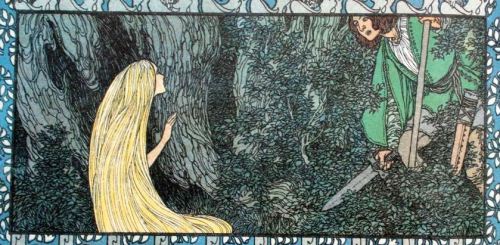
A sorcerer kidnaps young women with the intent of marrying them if they can pass his test. He declares he must journey for a few days and leaves the girl with an egg, which she must carry with her, and the keys to the manor, which she may explore with the exception of one room. He even points out the key it is she must not use on pain of death.

The sorcerer has captured the eldest of three sisters and puts her to the test. Inevitably, after her explorations of the manor, she finds herself in the forbidden room facing a basin filled with the hacked-up bodies and the blood of the women who entered the room before her.

Trembling at the sight, she drops the egg she carries and it falls into the bloody basin. No amount of cleaning will removed the stain on the shell, giving her away upon the sorcerer’s return.

“You went into that chamber against my will,” he says, “and now against your will you shall go into it once again. Your life is finished.”

Thalia’s thumb is in her mouth. She hasn’t done that for some time. I am hoping I haven’t crossed the line with this choice.

The sorcerer returns to the abode of the sisters and steals the second eldest and the scenario repeats itself. The third and youngest sister, in true fairly-tale fashion, is a different matter. She stashes the egg safely away before heading directly to the forbidden room.

There, with unexplained wisdom, she pieces the body parts of her sisters back together, restoring them to life, then hides them in another room.

“Whew!” Thalia is relieved and her thumb released from duty.

Appearing to have passed the test, the bride now demands the sorcerer carry a basket of gold to her parents before the wedding. In the basket she conceals her sisters, instructs the sorcerer/bridegroom not to rest or tarry, and says that she will be watching him from a window. She puts a decorated skull in the attic window as her decoy, but it is her sisters’ voices from inside the basket that goad the carrier on, allowing him no rest.

Meanwhile, the bride dips herself in honey, rolls in white feathers, and goes outside to greet the wedding guests, the sorcerer’s nefarious companions. The sorcerer himself does not recognize her, thinking she is the bejeweled skull in the attic window looking down on him.

Help, sent by the sisters, quickly arrives, shuts up the house with the sorcerer and wedding guests inside, and burns it down.

Content with just the right amount of fright for a Halloween night, Thalia and Teddy toddle and drag themselves off to bed.

Fairy Tale of the Month: October 2014 Fitcher’s Bird – Part Two

fitchers bird John B GruelleJohn B. Gruelle

Temptation

I stand before a forbidden door, my own personal forbidden door. It is a physical door, quite ordinary, dull really, unlike the forbidden doors I imagine in fairy tales.

These doors stand apart from all the other doors, at the end of long, dimly-lit hallways, panel doors of heavy, dark wood, not ornate in any way, except for doorknobs made of glass.  Their keys are plain, unassuming, on rings with other keys. There are no skulls and cross-bones emblazoned upon them to alarm those that hold them, yet they have been warned not to use them.

What is behind the forbidden doors? In The Fitcher’s Bird, as well as in Blue Beard, andMister Fox, it is the dismembered bodies of the victims who have gone before.

Is it always that gruesome? By no means. In Virgin Mary’s Child it is nothing less than the Holy Trinity. In another tale, The Quest for the Fair One of the World, found in Modern Greek Folktales, by R. M. Dawkins, behind the door is the painting of a beautiful woman.

In the case of The Fitcher’s Bird behind the door is a horror, the manifestation of a twisted, evil mind. The heroine, using the sorcerer’s own magic against him, overcomes the villain with cunning.

In Virgin Mary’s Child, behind the door is knowledge beyond the ken of man that the heroine is bold to touch. Denying her actions, she suffers at the hands of the Virgin Mary until confessing her sin.

Quest for the Fair One of the World has three brothers, each smitten in turn by a portrait’s image, and each setting out on impulse to find her. Two of them lose their heads, while the third and youngest succeeds.

These tales present three different conundrums behind each door. What do they hold in common?

In each case, when the door is opened, the life of the hero or heroine profoundly changes. Behind the door waits a path for the bearer of the key, taking them to their fate. Turning the key unlocks a future, for good or for ill. The door can be closed again, but what was inside cannot be shut away.

The forbidden door is not the only device of no return in the fairy-tale lexicon. The box to which the heroine has the key (Pandora’s not being the least of them) fulfills the same purpose. In the White Snake the device is simply the lid of a covered dish, there being no key involved.

Another fairy-tale device of no return is the crossing of the threshold, that well-known step in the hero’s journey. But the forbidden door is different. In crossing the threshold, the protagonist has made a decision to heed the call to adventure. Opening the forbidden door is done out of the weakness of spirit, not anticipating the consequences.

What I find compelling about the forbidden door is that I am more familiar with being weak-willed than being heroic. I, too, have the impulse to open the forbidden door, and I take solace in the fairy-tale message that this action too can lead to growth, bringing us to the next level of awareness as much as the hero crossing the threshold.

I am still facing my forbidden door. It’s a cupboard door, actually. I open it and take out the crackers and Nutella. I am only going to have three. Maybe four.

Fairy Tale of the Month: October 2014 Fitcher’s Bird – Part Three

fitchers bird skull

Dilemma Bird

I return to my study with a plateful of Nutella crackers. I won’t tell you how many.

The Fitcher’s Bird contented Thalia as a Halloween story, but the more I think on it, the more I am bothered by the rhyme at the end.

When reading a fairy tale, it is not uncommon for me to feel there is more to the tale than appears on the surface. When I contemplate the tale its layers emerge as I consider what the story elements mean to me. Like other works of art, I am prompted to insights not made before that bit of creation revealed them to me.

I am seeking creature comforts as I build a fire in the hearth before settling into the crackers. The Fitcher’s Bird brings up my fairy-tale anxieties. As usual, I sense there is more beneath the surface, but there my understanding stops. I haven’t the means to penetrate further.

Here on the surface is what I can see. Bird references imbue the tale, starting with the title. The sorcerer gives the sisters an egg to carry with them as they explore the manor. This egg betrays the first two victims. The youngest sister manages the egg better, not letting it reveal the truth.

She disguises herself as a bird by coating her body with honey and rolling in feathers from a mattress she tears open. (Her wedding bed?) In this manner she greets the wedding guests and her would-be bridegroom, participating in the following rhyme.

The guests and bridegroom say, “Where are you coming from, oh, Fitcher’s bird?” To which she responds, “From Fitze Fitcher’s house, haven’t you heard?” They reply, “And what may the young bride be doing there?” And she answers, “She’s swept the whole house from top to bottom. Just now she’s looking out the attic window.”

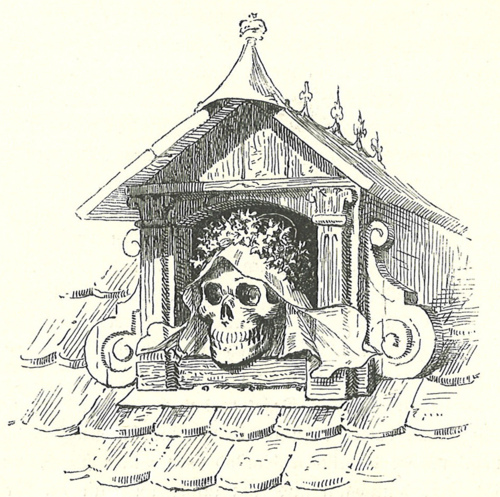
A skull looks out the attic window, one that she has decorated with jewels and flowers as a decoy.

What are we to make of this rhyme?

The word “Fitcher” in German suggests “wing” or “feather.” The rhyme suggests the sorcerer’s name is Fitze Fitcher. He has the sisters carrying around eggs. I can’t help but note the story leaves the youngest sister in her bird-like state. She doesn’t get to go home, clean up and marry someone else. All of these avian references point to . . .

I am nagged by the thought a riddle may be involved, but I am not getting subtle cultural references, notions in place when a teller first spoke this rhyme.

If I were to update Fitcher’s Bird I would consider Thalia’s cultural relationship with birds. Her knowledge of chickens is filtered through supermarkets and fast food. Being a city girl I dare say she has never held a live chicken.

I would have the youngest sister dipped in honey and rolled in breadcrumbs to pass herself off as a nugget. Thalia would immediately get the joke, while someone from a nonbreaded-chicken-cuisine subculture would not.

I believe that is my dilemma. That, and the empty plate with a little smudge of Nutella left behind.

Your thoughts?

Fairy Tale of the Month: September 2014 Mother Holle -Part One

mother-holle-1 Walter Crane

Rowing

Duckworth and I are bent upon rowing up the Isis. It’s been a while since we’ve had our fair-weather outing, he being up to Liverpool on business. To break the tedium of our effort, he asks a question.

“What’s your latest fairy-tale inquiry?”

“I’ve not thought of my interest as an ‘inquiry,’ but it’s Mother Holle.”

“Yes, and?”

He knows me. I give him the synopsis.

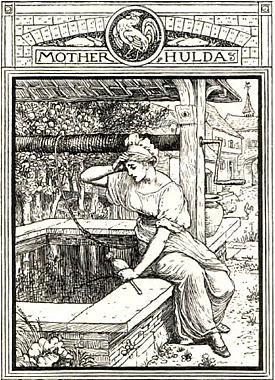
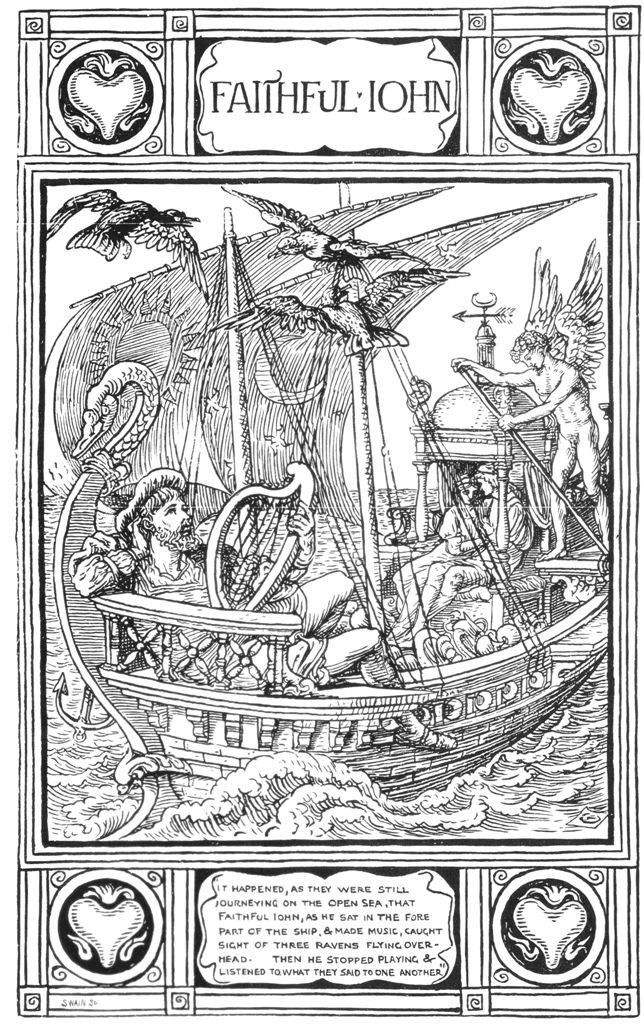
The less-favored daughter of an old wife jumps into a well after a reel of linen thread she has dropped, knowing the punishment if she does not retrieve it. The maid wakes up in a flowered meadow. In this underworld she wanders until she comes to a bake oven from which loaves of bread call out to her, “Oh, take us out! Take us out! Or we shall burn.” This she does and travels on.

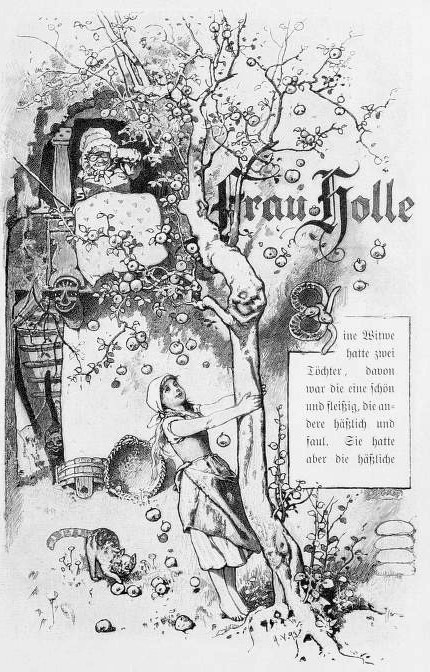
She comes across an apple tree that cries, “Shake me. Shake me. My apples are all ripe!” The girl shakes the tree and piles the apples neatly.

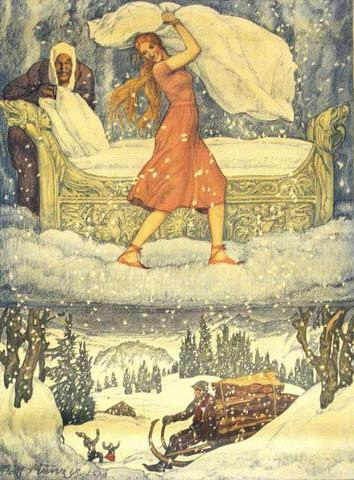
Next she comes to a cottage where there stands an old woman with large teeth. This scares her, but the woman speaks kindly and the maid accepts the offer of being housekeeper. The old woman has a special request that the mattress be shaken until the feathers fly, “Then it will snow on earth, for I am Mother Holle.”

The maid performs her duties faithfully. Although well treated, well fed, and a thousand times better off than before, after a time she becomes homesick.

“I’m pleased that you want to return home,” says Mother Holle, opening a door. As the girl passes through she is showered with gold coins that stick to her and is given back the reel of thread. When the door closes, she finds herself back home.

The old wife sends her other daughter to throw her reel of thread down the well and follow it. In the underworld, she does not help the bread or the tree when they speak to her. She works well for Mother Holle for only a day, then slacks off.  Mother Holle dismisses the lazy girl, who returns covered in pitch after passing through the magic door. She wears the pitch for the rest of her life.

“Well,” says Duckworth, “I see why you like it.”

“Your reasoning?” I inquire.

“First, there is Mother Holle. I remember my great-grandmother saying, ‘Mother Holle is making her bed,’ every time it started to snow. I thought her addled, and she was, but now I realize that remark must have come from somewhere.

“Then there is the good sister/bad sister. I think I’ve heard before.”

“Certainly you have,” I say.

“And of course the world at the bottom of the well. That is right up your alley.”

I nod in agreement. “Overall, there is nothing really remarkable about the tale. The good sister/bad sister is a well-worn motif. The well is more common to these stories than the spinning wheel. Mother Holle is, I suspect, a watered-down deity. It’s all three crammed into one short story that entertains me.”

“Watered-down deity,” Duckworth chortles. “In this context that’s almost a pun,” and looks at me suspiciously.

“Oh dear, no. I didn’t mean it that way.”

We row on in silence.

Fairy Tale of the Month: September 2014 Mother Holle – Part Two

Mother Holle 5Hermann Vogel

The Bookshop

Thalia turns the doorknob of Serious Books. Melissa left a message on the answering machine telling me that my copy of Hunt’s translation of Grimm had come in.

“Melissa, this is my granddaughter, Thalia.”

I see them regard each other as they lightly touch hands. It strikes me they are of the same ilk, if decades apart.

“Pleased,” says Melissa.

“Thalia, find yourself a book.” I gesture toward the shelves. She wanders off with a mission.

Melissa hands me Hunt’s book. Before I can turn to the story that the Grimms numbered 24, she asks “What is you latest inquiry?”

Am I that transparent? I think, but say, “Mother Holle.”

“I don’t recall that one, although my father read all of Grimm to me.”

“It has to do with a beautiful sister and an ugly sister, and falling into a well.”

“The two-sisters thing I recognize and I love worlds at the bottom of wells.”

“What is your take on such matters?” I ask, looking around to see what has become of Thalia.

“I…,” she considers her words, “personalize the stories, more than any other literature; I put myself into a fairy tale. For me, the two sisters are two aspects of myself, my better half and my selfish half.”

“Is that the angel on one shoulder and the devil on the other, whispering in your ears?”

“Not exactly. The angel and devil speak of good and evil, giving it a religious cast. My thoughts don’t go there, though I see why others might. My struggles belong to me. I’m self-contained. I fight with myself on my terms, with no interference of another’s theology.

“For me, these sisters are cautionary voices, reminding me that my selfish side will ultimately bring me to harm.”

I glance around once again, trying to spot Thalia.

Melissa smiles. “She’s in the third aisle, sitting on the floor.”

“You can see her?”

“No, but I sense she is there.”

I walk by the aisles to check. The woman is psychic. Thalia sits cross-legged perusing a hardbound.

Returning to the counter, I find Melissa’s pretty brows knit in contemplation.

“Wells,” she says. “Every well in every story is the same well for me. It’s not a wishing well, but the well that I remember from an uncle’s farm.  It had a stone rim with the water near to the surface, and a pivot boom that lowered a bucket into it. I doubt it had much depth, but my mother would not let me go near it, sure that I would drown. This meant, to me, it was bottomless. The allure of danger and mystery beckoned to me then and in my memory still does.”

“Mine is a treacle well,” I muse.

Melissa’s green eyes glow. “How much of our attraction to fairy tales is about our childhood fears and fascinations? Unresolved moments we experienced without the vocabulary to express ourselves? Fairy tales have a language that pulls at me rather than explains to me, evoking lost thoughts from a time past.”

Thalia comes to the counter, gently but firmly placing her purchase on the glass casing.

Alice in Wonderland,” Melissa intones. “I knew you’d find that book.”

Your thoughts?
 Fairy Tale of the Month: September 2014 Mother Holle – Part Three

Mother Holle Adolf Münzer Adolf Münzer

Slipping Away

An unanticipated boon in owning a copy of Margaret Hunt’s translation of Children’s and Household Tales is that it has attracted our resident fairy. I thought the little creature had bonded with Thalia’s edition of Grimm, but apparently as long as the book is old the fairy will read it.

I’d left the tome open to Mother Holle on the table and when I looked up from my terminal there she hovered over the book, her gossamer wings and floating black hair in a static-charged display. I know better than to try to talk to her. I turn my attention back to my terminal.

The internet tells me Mother Holle or Hulda appears in Norse mythology as Hel, queen of the underworld and is likely of pre-Indo-European Neolithic origins. In early Germanic folklore Holle, a Sky Goddess, ruled the weather: sunshine, snow, and rain. The most tantalizing association is with Perchta, who dwells at the bottom of a well and taught man the craft of making linen from flax. She is also known as the Dark Grandmother, to whom go children who die in infancy.

No one less than Jacob Grimm, in his more scholastic works, wrote about Perchta/Hulda in her two forms, Schönperchten (the beautiful) and Schiachperchten (the ugly). I must suspect the forms are reflected in the beautiful sister and the ugly sister of the Mother Hollestory.

Just as interesting, I’ve run across a reference to Perchta wandering the countryside between Christmas and Epiphany, entering into homes, knowing which children had been good and which had not. The good received the gift of a sliver coin and the others had their bellies slit open, their stomachs and guts removed, to be replaced with straw and pebbles. Oh, for a simple lump of coal!

When trying to grasp the stories of the gods and goddesses of any mythology as they have come down to us, we cannot think of them as consistent, thought-out works of literature. In my youth, I pored over the mythologies of the Greeks, Romans, Norse, and Celts trying to understand their message. The more I read, the less sense they made to me. I wanted their storylines to conform to a story arc, a familiar device, on a par with modern novels. The myths resisted.

Now that I am old, baffled, and confused, the myths are more amenable to me. My model is to see myths (legends and fairy tales as well) as shards of glass from a broken mirror reflecting their images upon each other in a confusion of light and wisdom, over which history has cast the pall of Christianity, dimming their brilliance, giving us shadowy figures such as Mother Holle, once a sky goddess, now thrown to the bottom of a well.

I look up from my terminal. The fairy is gone. I can almost doubt my senses that she was ever there, like details of a dream slipping away upon waking. My fairy, the gods, and goddesses are so ephemeral.

Your thoughts?
Fairy Tale of the Month: August 2014 The Two Brothers – Part One

Two Brothers Kay Neilsen Kay Nielsen

A Tale of Tails

“Here is a story you might enjoy,” I address Johannes. He sits at “his” spot on the window seat, decidedly not looking at me.  I encourage a response. “It has lots of talking animals.”

“So?”

Silence follows. His tail twitches. “Any cats?”

“Ahhh—a lion.”

“A close relative, evolutionary-wise. I’ll listen.”

I read to him Grimms’ TheTwo Brothers.

There are two brothers, one rich and one poor. The poor brother captures a golden bird, which the rich brother buys from him, knowing its magical property of granting gold coins. However, it is the poor brother’s twin sons who accidently acquire the gift. Jealous, the rich brother advises the poor brother that his sons are in league with the devil and must be driven out.

Abandoned, the youths are taken in by a huntsman, who apprentices them in his trade. Eventually, as huntsmen, they venture into the world.

When they are about to shoot a hare, the creature pleads for it life promising them two of its offspring. The two bunnies are so cute, the huntsmen do not have the heart to kill them. The same thing happens with a fox, a wolf, a bear, and a lion.

Johannes purrs with satisfaction at the mention of the lion.

The brothers part ways, leaving a knife, given to them by the master huntsman, stuck into a tree, knowing that if one side or the other rusts, then that brother is in danger.

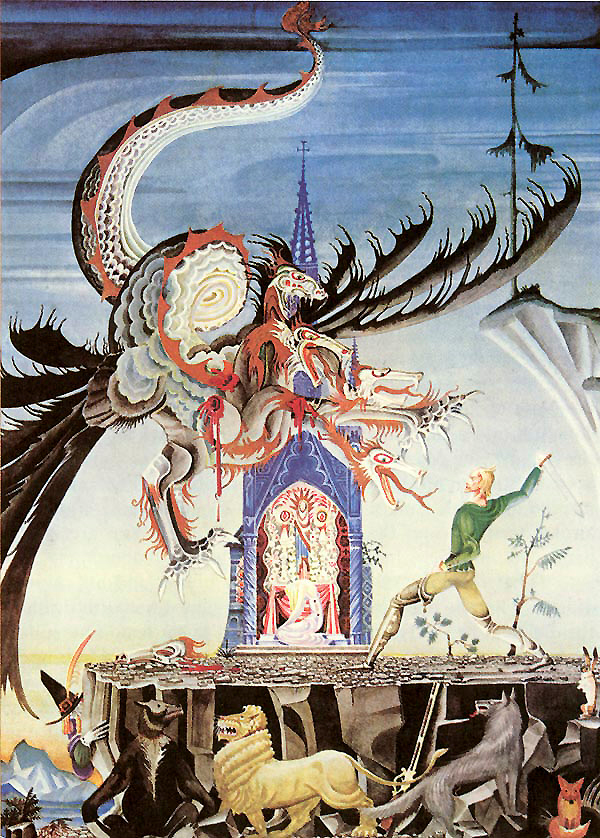
The story follows one of them and his half of the animal entourage. They come to a kingdom ravaged by a dragon that yearly demands a virgin as sacrifice. The last virgin left is the king’s own daughter.

Johannes grins. “I bet they marry young in that town.”

I ignore him.

On the hill where the princess is to be given over to the dragon, stands a church. In the church the huntsman finds three goblets of wine, and written instructions on where to find and use the sword to defeat the dragon. When the princess arrives, he secures her in the church. He and his animal companions face and defeat the seven-headed dragon. The huntsman cuts out the tongues and wraps them in the kerchief of the princess. Exhausted by battle, they all fall asleep.

A marshal, left behind to observe the proceedings, sneaks up, cuts off the huntsman’s head, terrorizes and carries off the princess, then declares to the king that he defeated the dragon.

The resourceful animals restore their master with a magic plant. Knowing nothing of the marshal, the huntsman assumes the princess betrayed him, and it is some time before he learns of the marshal’s treachery.

On the day of the wedding between the princess and the marshal, the huntsman returns to make his claim. The marshal has the seven dragon heads, but the huntsman has their tongues and the princess’s kerchief.

After the marriage, he is out hunting, when he is waylaid by a witch and turned into stone. His twin brother chances to check the knife and finds one side is rusted. He follows his brother’s path and is mistaken for him when he gets to the kingdom. He keeps the secret, hoping it will help in his search. That evening, retiring to bed with his brother’s wife, he lays his sword between them.

The next day he goes hunting and comes across the witch, but is not fooled by her. He forces her to restore his brother. However, the revived brother, upon hearing the other brother spent a night with his wife, without a thought, cuts off his head. Regretting his action, he allows the animals to heal the wounds with the same magical plant used on him.

Upon his returning to the castle that evening, his wife asks him why he laid a sword between them the night before. The husband now truly understands the faithfulness of his brother.

“Well, what do you think of that?” I ask.

Johannes has nodded off. Well, it is a long tale.

Fairy Tale of the Month: August 2014 The Two Brothers – Part Two

Gemini

Why Two?

I lounge in the comfort of Augustus’ testing room, a space replete with properly-made comfy chairs. Augustus’ newest blend is made of two different types of Cavendish, a mixture he calls Gemini.

“You read The Two Brothers you say.” Augustus tamps his pipe and relights. “What did Thalia think of it?”

“Actually, I read it to her cat.”

Augustus smiles at my silliness. “And what did her cat think of it?”

“He fell asleep.”

“His loss. That story is a personal favorite.” Augustus settles into his overstuffed chair. “There is an oddity about it that I can’t quite put my finger on.”

“Something about the two brothers theme?” I suggest.

“Exactly. There are multiple sets of brothers: the rich brother and the poor brother, the twin brothers, then the animal sibling pairs of rabbits, foxes, wolves, bears and lions. That’s seven sets of brothers, if you’ll accept my assumption that the animals are all males. The story does not tell us that, but terms like lioness or vixen are not used.

“Which,” he contemplates, “makes the only females in the story a princess and a witch. Women are not fairly represented in this tale, but it is interesting that one is symbolic of good and the other of evil.”

Both our pipes have gone out, and the conversation ceases as we re-tamp. Augustus picks up his thread of thought as we settle in again.

“This is a story for and about men. ‘Brothers’—especially in its broader sense—is a term that resonates with us. Somehow, the incompatible notions of ‘camaraderie’ and ‘independence’ merge. The two brothers are devoted to each other, and yet part ways to pursue independent lives, leaving the knife stuck in the tree trunk to remain as their unbroken connection.

“The sibling animals are something of a masculine comic relief. After the battle with the seven-headed dragon, the huntsman needs to rest, and instructs the lion to stand guard. The lion, having done his part in the battle, also takes a nap, telling the bear to wake him up if something happens. The onus is passed from predator to predator to fall upon the rabbit, who is at the bottom of the food chain.

“When the marshal cuts off the huntsman’s head, the blame passes, in the same manner, onto the trembling shoulders of the rabbit. If that is not male thinking, then I don’t know my own sex.”

I chuckle, but look at my pipe, which has gone out again.

“Then,” pontificates Augustus, “there is the twin thing. Mark Twain identified our twin fascination, and used it in The Prince and the Pauper, as well as in Pudd’nhead Wilson.

“As a plot device, it is necessary in this fairy tale that the brothers are identical, but their identicalness is taken a step farther by their having the same set of animal companions. I am not sure what to make of that.”

“Did you look at the Grimms’ notes on TheTwo Brothers?” I ask.

“Yes, they are fairly extensive. What caught my attention is the number of variants they cite in which the twins have unusual births, sometime immaculate.  Hmmm. My pipe’s gone out too. I must have used too much rum extract as casing.”

That’s what I like about this blend! I think to myself.

“I suspect,” says Augustus, cleaning out his pipe, “the Grimms were fond of this tale too. They were, after all, brothers.”

Your thoughts?
Fairy Tale of the Month: August 2014 The Two Brothers – Part Three

Sigmunds Schwert (1889) by Johannes GehrtsSigmunds Schwert by Johannes Gehrts

Something Borrowed

The mantel clock in my study strikes twelve as I light my second bowl of Gemini. Beside me is a large box of wooden matches, and in my lap is Johannes, a surprising turn of fortune. I must allow myself to feel honored.

My mind wanders to the sky as I look out the bay windows, searching for the Gemini constellation, its two primary stars being Castor and Pollux, the twin huntsmen of Greek mythology.

Zeus put them into the constellation when Castor died and Pollux wished to share his own immortality with his mortal twin. Relationships in Greek mythology can get confusing. The ancient sources are not consistent about the births of these twins. Some have them both as mortal born, others as both divine. In the most popular version Castor is the son of Tyndareus, king of Sparta, and Leda, who is seduced by Zeus in the form of a swan, giving birth to Pollux at the same time as her mortal son.  I ran across a reference to a runaway version in which the twins are born from eggs along with their twin sisters, Helen of Troy and Clytemnestra. Put that in your pipe and smoke it.

Many of the fairy-tale storylines come out of Greek mythology. Cupid and Psyche have been reworked and reformulated any number of times, Beauty and the Beast, and A Sprig of Rosemary, being two examples that jump to my mind.

But storytellers have been democratic in their theft. Any mythology is fair game.  In theVölsunga saga, the hero Sigurðr falls in love with the shieldmaiden Brynhildr, but ends up marrying Gudrun, daughter of the sorceress Grimhild. Grimhild’s son, Gunnar, wishes to marry Brynhild, but cannot penetrate the ring of fire that surrounds her castle. It is Sigurðr, in the form of Gunnar, who accomplishes the task to claim Brynhildr for Gunnar. Sigurðr spends three nights in the castle with Brynhildr, but lays his sword between them. Sigurðr soon returns to his true form, and Brynhildr marries Gunnar.

It doesn’t turn out well when Brynhildr finds out the truth. In a love/hate rage, she tells Gunnar that Sigurðr did sleep with her. Gunnar causes Sigurðr’s death and Brynhildr throws herself on the hero’s funeral pyre.

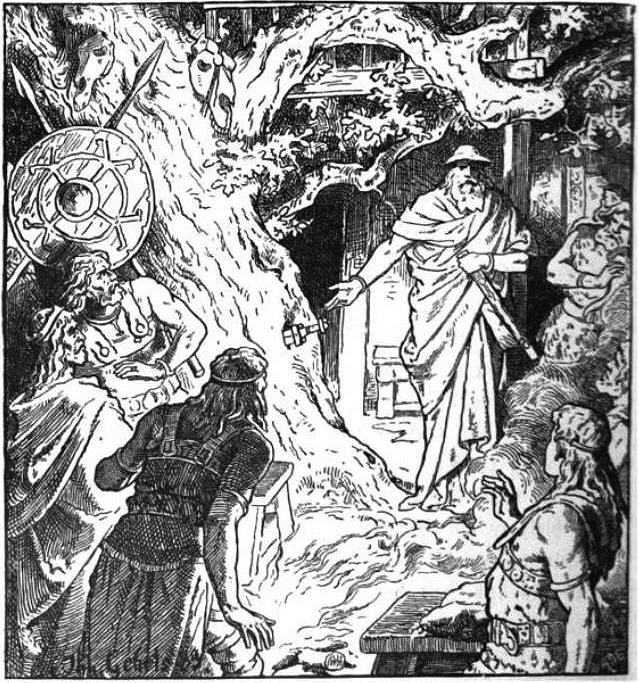
Theft is not the only way to cobble together a story. Another method is intrusion, of which Christian thought is expert. The Grimms were Calvinists, and Wilhelm, in his revisions, would quickly replace pagan practices with Christian-themed devices. Angels appeared in later editions of the Grimm stories where mystical wisemen and wisewomen previously had a place.

However, in The Two Brothers, I sense the Christian intrusion comes from a more Catholic source. When the huntsman goes to the dragon’s mountain to save the princess, what should be there but a church. I know in my soul, some religious storyteller put that church on the dragon’s mountain.

There are three goblets on the altar, presumably filled with wine, and a note that says whoever drinks from the goblets will be the strongest man on earth, able to wield the sword buried under the threshold of the church.

Wilhelm, romantic that he was, intruded with divine beings. Here are the accouterments of ceremony. The goblets on the altar suggest the Communion wine, but three of them in connection with a sword? I suspect Catholic trappings are covering a pagan ritual.

Frankly, if I were to quaff three goblets of wine, I’d be feeling pretty invincible myself. I am thinking about some wine, but I have this cat in my lap. I would need to disturb Johannes to get a glass. Instead, I will content myself with tamping and relighting my pipe.

Your thoughts?


Fairy Tale of the Month: July 2014 The Three Snake Leaves – Part One

Three Snake Leaves FordH. J. Ford

Unfaithful

“What? Is that it?” Thalia is incredulous and indignant.

“Yes, I am afraid so.”

“I don’t like that story.” Thalia stalks off to bed with Teddy dragging behind.

I do like the story, but I shouldn’t expect a tale of infidelity to be a kid’s thing. What disturbs her is The Three Snake Leaves.

A poor, young soldier, through dint of senseless bravery, becomes the king’s favorite. More emotional than cautious, he falls in love with the king’s daughter.

The field for his pursuit is clear, given the princess’s declaration that she will marry no man who won’t agree to follow her to the grave, no matter when her death may occur, and she vows to do the same for her beloved.

He, she, and the king agree to the bargain, and the marriage soon follows. Her untimely death is not far behind.

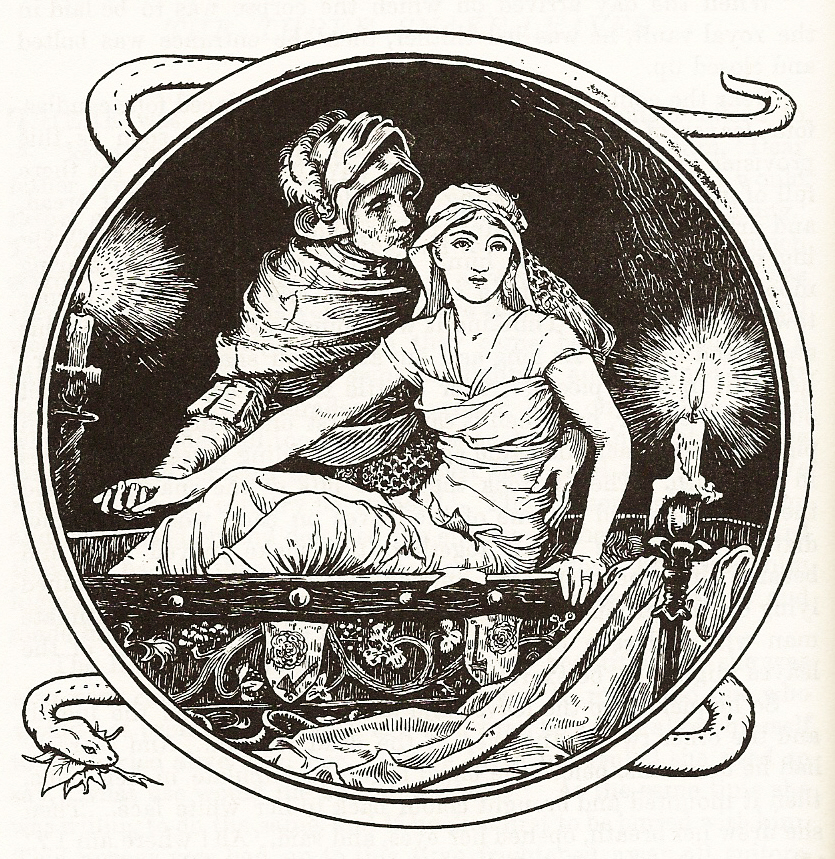
Sitting in the crypt with his wife’s corpse, he stares at the four loaves of bread, four bottles of wine, and four candles provided to him. These he rations, but death slowly approaches.

As he sits, waiting for his demise, a snake slithers into the tomb, moving toward the body of his love. He leaps up, sword in hand, cutting the snake into pieces. Presently, another snake appears, departs, and returns with leaves in its mouth. These it places on the body of its companion, which wiggles out from under the leaves, and they slither away together.

The youth takes the leaves and puts them on the eyes and mouth of his wife, and she begins to breathe.

Returned to life, his wife unaccountably loses her love for her husband. On a sea voyage, she develops a passion for the ship’s captain. Together, they throw her husband overboard to his death.

His faithful servant lowers a small boat, retrieves his master’s body, and restores him to life with the snake leaves. Together they row for home, returning before the faithless wife.

The king gives his daughter enough time to incriminate herself, then sends her off with her captain-lover, in a boat bored with holes, to sink beneath the waves.

No surprise that Thalia is not enamored of this story, but not all stories collected by the Grimms were told for a youthful audience. The tales were as often told among women for women. This one, I will guess, was told as a cautionary tale.

Not for the first time, I sense a feminine mind behind a story, challenging my masculine outlook. The hero of this tale is not in charge of his fate. First, he throws himself at the feet of valor. Soon, through passion, he places himself at the behest of his wife’s will. He triumphs, through luck, only to be murdered at the hand of the one he saved, then saved himself by a servant. In the end, the king, not our hero, decides everyone’s fate.

Had the story reversed the role of the sexes, had a heroine agreed to her husband’s demand to follow him to the grave, had she saved him only to have him be ungrateful and pursue another woman, we would nod our heads, identifying a familiar theme.

With The Three Snake Leaves I am a little stunned at the princess’s boldness, and ultimately, the passive nature of the hero.

Plus, where have I heard this tale before? I think a conversation with Augustus is in order.

Fairy Tale of the Month: July 2014 The Three Snake Leaves – Part Two

William-Adolphe_Bouguereau_(1825-1905)_-_Arion_on_a_Sea_Horse_(1855)William Adolphe Bouguereau

Arion

I stand at the door of Augustus’ shop, my hand on the latch, but my eyes on the sign that reads, “Closed. On Vacation.” My fingers, disbelieving, try the lock anyway. He goes on vacation this time every year and every year at this time I forget.

Deflated, I linger on the sidewalk. Across the street, in bold lettering on a plate-glass window I see, “Serious Books, New and Used, Melissa Serious, Proprietor.”

I have purpose again. As i enter the shop, a young red-haired woman, sitting behind the counter, gives me a pleasant nod and returns to her reading. I browse, noting the rather strange arrangement. The new books are not up front and the old in back, but are intermixed by subject. Simple handwritten signs list the subject headings: Literature (by far the largest section), Philosophy, Science, Religion, etcetera, but no signs for Romance, Mystery, or Self-help.

“No Self-help?” I query aloud from the back of the store.

“I don’t cater to the helpless,” she calls back, not looking up.

I come to the counter, “And no Romance. I’ll take it you’re not romantic.”

“Oh, I can be very romantic, as long as the subject is nineteenth-century Romantics.

“Excellent,” I say. “Have you Margaret Hunt’s translation of Grimm with the notes?”

“Oh, hard to come by. I can do a search. I am tenacious and can locate most titles within a month.”

“Good. Please do so.”

“That work is also available through Internet Archive,” she suggests.

“My dear, you’re not going to sell books by referring customers to the web.”

She fixes me with her green eyes. “You are the sort who wants a book in hand.”

She has me pegged.

As she takes my information for the book search, I notice she is reading a Penguin edition of Herodotus’ The Histories. The page is propped open with a glass paperweight to the section on the musician Arion. That’s where I heard the story before.

Melissa notices my wonderment.

“I am standing here,” I explain, pointing to her book, “realizing the story of Arion is the last half of The Three Snake Leaves.”

“Oh?” She picks up her book and reads aloud. Her contralto voice transports me. In this tale, Arion, a  musician at the court of King Periander, the ancient Greek tyrant ruler of Corinth, is robbed by the sailors on the ship that is carrying him home. He is given the choice of burial at sea or burial on land. Stalling, he offers them a song. The music attracts a dolphin, which, when Arion casts himself into the sea, carries him off. The sailors believe Arion has drowned. Arion returns to Corinth before the sailors appear, and King Periander lets the sailors falsely declare they buried Arion, revealing their deceit.

Melissa then goes to her Literature section and returns with Jack Zipes’ translation of Grimm.

“You don’t have a Children’s section, either,” I comment.

“I have plenty of children’s books, they are all under Literature.” She reads aloud The Three Snake Leaves much to my enjoyment.

“Yes,” she contemplates when she finishes reading. “The difference is the role of a woman—and not a woman to serve as a role model I must add—which put a different light on the moral. Instead of dealing with dishonesty, we witness unfaithfulness.

“Nonetheless, I feel sympathy for her. The woman she is at the start of the story is not the woman she is by the end. The princess suffers a loss of morals in her resurrection, assuring her return to death’s grip.”

I remain quiet as Melissa thinks, her hand to her chin.

“The hero,” she continues, “also is brought back to life by the snake leaves, but we hear nothing of a change in him. Nor do we hear a word from, nor do we really see, the captain.

“No, this story is not about the protagonist, the young man, it is about her.”

“Then, it is a woman’s story,” I conclude.

Melissa’s green eyes flicker. “Yes, yes it is.”


Fairy Tale of the Month: July 2014 The Three Snake Leaves – Part Three

Rod_of_Asclepius2Rod of Asclepius

Authorship

I can see the light of the moon washing over the enchanted forest through the bay windows of my study, prompting me to engage in an evening of late night-researching.

The two snakes in The Three Snake Leaves bring to mind the caduceus, the staff entwined with two snakes, carried by Hermes. Commentators state that the wand could wake the sleeping and put the awakened to sleep. Placed round the dying, death would be gentle; around the dead, the wand would return them to life. But the same commentators warn that the caduceus is confused with the Rod of Asclepius, which is one snake curled around a staff, the emblem of the Greek god Asclepius, the deity associated with healing and medicine. These two items make a suggestive muddle.

I follow Melissa’s suggestion and go online to find Margaret Hunt’s translation of the Grimms’ notes, although I look forward to having the Hunt translation on my shelf.

The notes mention two German sources from which the Grimms drew the tale, but speak more about its possible Greek origin, the story of Polyeidos and Glaucus. The seer Polyeidos (from Cornith just like Arion interestingly enough) is commanded by King Minos of Crete to return the youthful prince Glaucus to life. The young Glaucus has been found dead by Polyeidos, under extremely strange circumstances, in a barrel of honey down in the King’s wine cellar.

Minos imprisons the seer with the body of his son in the wine cellar until the seer can conduct a miracle. A snake crawls into the cellar and Polyeidos kills it. The companion snake appears, disappears, and returns with an herb to restore the deceased snake. Polyeidos uses the herb to restore the child.

The notes go on to cite the Norse saga of Asmund and Aswit, in which two friends swear to be as brothers and to follow each other to the grave. Aswit takes ill, dies, and Asmund holds to his promise, but takes provisions with him into the tomb.

What the Grimms don’t mention is that Asmund ends up wrestling with Aswit’s vampire-like ghost every night until Swedish grave robbers inadvertently release him. I find this not unlike the princess’s turn of nature after her passing through death, to become something of a monster.

I light my pipe and turn my comfy chair to look out the bay window at the forest, ghostly illuminated in moonbeams. What is this process of cobbling together pieces of other myths and legends, to come up with a story recreated by its teller?

Or, am I trying to give authorship to fairy tales? Likely there is no one author. Maybe these stories are not assembled by one teller, but rather are an accretion, added to by many tellers. That makes them the creation of a group mind. What do these tales then say about us? Have we created them in our own image?

This story, The Three Snake Leaves, draws from the stories of Arion, Polyeidos and Glaucus, Asmund and Aswit, or perhaps the variants they generated—sources in which the feminine aspect is missing. But in this tale, the princess’s will pushes the story forward. I can hear the mind of a single soul, lost somewhere in time, imbuing the plot with angst, a personal fear, projecting it forward, into my present. There is a She speaking to me.

Your thoughts?

Fairy Tale of the Month: June 2014 Old Woman in the Wood – Part One

Keyhole

Spying

I creep on tiptoe down the hall, returning from the linen closet with a fresh towel for my evening bath. Passing Thalia’s room I hear her piping voice. From its cadence I know she is reading aloud, obviously to Teddy.

If I am not mistaken, she reads The Old Woman in the Wood. I haven’t thought of that tale for a long time, and listen with my ear to the door to recall how it goes.

A poor serving girl travels with her masters into the depths of a large forest, where they are set upon by robbers. Jumping from the carriage, she saves herself while all the others are murdered. Friendless and helpless, she sits under a tree and awaits her fate.

A white dove appears with a golden key in its beak, telling her to open the lock on a certain tree. More keys and other trees provide the girl with all her needs.

The girl lives a contented and quiet life, until the bird makes a request. The girl is to go into the hut of the Woman of the Wood. The old woman will address her, but the girl is not to answer, but rather go into the next room where there is a table piled with ornate rings. She is to find a plain band and return with it.

She does as the bird instructs, and the old woman is powerless to stop her, but  the girl cannot find a plain band among all the elaborate rings on the table. Catching the old woman creeping from the room carrying a bird cage, the girl gives chase, snatching away the cage. In it is a bird with a plain band in its beak.

With the band, she returns to her forest bower where one of the trees wraps it limbs around her and transforms into a handsome prince. Other trees turn into the prince’s entourage. The prince explains the witch turned him and his men into trees, but that he could also be a dove. They all go off to his kingdom where the girl and the prince will be married.

“I like the golden keys that open the tree trunks,” I hear Thalia say. “What about you?”

A little voice answers, “I like the table of rings.”

That can’t be Teddy, can it?

On my knees, I peek through the keyhole. Framed by the aperture, there is Thalia and, in front of her, the fairy.

“Oh,” Thalia claps her hands. “When the tree hugs her, I like that too.”

The fairy turns her head, her black hair floating about, and peers directly at me, her eyebrow raised. Seeing myself through her eyes, I am embarrassed. Peeking through a keyhole upon two innocents—whatever am I doing?

In the bath, I put aside my shame, and let the story images return to me.

What of the golden keys to the locks in the trees?

Why does not speaking to the old woman deny her power over the girl?

What of the table covered with rings?

What is the significance of the birds?

I may need to visit Augustus.

Fairy Tale of the Month: June 2014 Old Woman in the Wood – Part Two

Old Woman in the WoodArthur Rackham

Trees and Keys

Ah yes, Old Woman in the Wood,” says Augustus of my inquiry. “A personal favorite and one that has not gotten the recognition it deserves.”

The whitish smoke and rich vanilla odor of “Fairy’s Favorite” fills the air of his testing room, replete with comfy chairs, where he induces customers to try new blends. I can tell by the sparkle in his eyes I need only sit back and let him carry on.

“It is,” he says, “one of the most charming tales in the Grimm collection.”

“Charm?” I am taken back. “Her companions are all murdered in the opening scene.”

“Technically, yes. Symbolically, no.”

I rotate my hand to indicate he needs to explain this one.

“You, of course, recall Hansel and Gretel, in which the evil stepmother casts out the children who fall under the control of the evil witch. When they destroy the evil witch, they return home to find the evil stepmother has died too.

“The same symbolic connection is here in this story between the entourage that is murdered by the robbers at the start and the entourage the serving girl restores at the end.”

I am left nodding approval. “What about the trees and the golden keys?”

“Aren’t they a lovely combination?” Augustus re-tamps his pipe and lights it again.

“A striking image,” I agree.

“Trees have a mysterious appeal. Norse mythology has Yggdrasil, the world tree. Magical baobab trees turn up in African tales. Tolkien took advantage of our fascination with tree mythos when he put the Ents into his trilogy,

The Old Woman in the Wood takes place deep in a forest, a place outside of the norm. Here resides enchantment. In this story the prince can transform into a dove for a short time each day. The trees magically provide the girl all of her needs. Enchanted beings have powers of  enchantment they did not have as humans, not unlike the flounder in The Fisherman and his Wife, who was also an enchanted prince. He had the power to grant wishes.”

“I hadn’t truly noticed that,” I confess. “And the golden keys?”

“Although trees and keys are associated in this story, they are of two different orders. Trees are living entities. Keys are inanimate and instrumental. A key never transforms into a prince. It remains a key.

“The keys given to the girl unlock the trees to provide her with food, clothes, and shelter. The image of tree trunks equipped with keylocks waiting to be opened, I find appealing. More often, keys unlock a forbidden room or box, and dire events follow.”

Augustus considers for a moment. “On the other hand there is The Golden Key.”

“I haven’t heard that one.”

“It’s deep in the book, tale number 200. It’s about a boy who finds a golden key on the forest floor. He reasons that where there is a key there might be a lock. He soon discovers a little iron chest. He puts the key into the lock, and the story ends with:

…he began turning it, and now we must wait until he unlocks the casket completely and lifts the cover. That’s when we’ll learn what wonderful things he found.”

Other customers enter the shop and Augustus rises to serve them. I must bide my time to ask the other questions.


Fairy Tale of the Month: June 2014 Old Woman in the Wood – Part Three


Bird with Ring

Rules

The veil of “Fairy’s Favorite” rises up around Augustus and me once again as we relight our pipes.

I speak first, “The dove asks the girl to bring him a ring from the hut of the woman in the wood. Quite clearly he instructs her not to speak to the witch. I sense there is something to that, which is not explained until we see the witch cannot stop her.”

“Rules of the game.”

“Rules of the game?” He is confusing me again.

“Fairy tales will often telegraph the action of their story by having a ‘helper’ explain the ‘rules of the game,’ as I like to call it, to the main character. For example, in The Twelve Dancing Princesses the old woman of the wood (of that story not ours) explains to the kind old soldier how to use the magic cloak to spy on the princesses and also warns him not to drink the wine offered by the eldest princess. The listener follows the old soldier and, with satisfaction, watches him act out the advice and succeed.

“In The Golden Bird the fox tells the young prince what he will see and what he must do at each of the castles they encounter. Unfortunately, the young prince is not good at playing by the rules and the listener sees the consequences, which are his continuing sorrows.

“It may be redundant to have the action that will happen predicted, but the interest for the listener comes in when the protagonist goes beyond what was instructed, such as the old soldier having to use his wits after following the princesses underground, or what follows when the protagonist neglects the rules, as happens between the fox and the prince.”

Another customer comes into the store, but Augustus is too intent on pursuing his point to acknowledge him.

“In our story, the girl, like the old soldier, does as she is told, but cannot find the ring. The dove’s instructions have failed her. However, she is clever enough to recognize that the witch is trying to sneak off with the prize.”

“What do you make of the bird in the cage with the ring in its beak?” I know I only have moments before the mercantile side of Augustus’s brain takes over.

“Birds are always fair game in these wonder tales. Look at some of the titles: The Raven, The Seven Ravens, The Six Swans, The Golden Bird, The Golden Goose.

“The image of the bird in the cage with the plain band in its beak is haunting, asking us to read significance into it. Is this bird the soul of the prince the witch captured and by returning the ring is the girl returning the soul to the prince?

“That explanation is tempting, but why then did the dove expect the ring to be on the table, hidden among other rings?

“Reading into these stories a clear set of symbols—logically organized, which by understanding we lift the shroud to see the secret code underlying the tale—is in itself a fairy tale.

“Trust me, these images are meant to convey only a sense, however surreal, of connections between elements in the story. To convey a sense, not to make sense of … What can I do for you, sir!”

I am sure there is more intended symbolism in not speaking to the witch, the table of rings, and the bird in the cage than Augustus is allowing. I’ll keep looking, even if it is through keyholes.

Your thoughts?

Fairy Tale of the Month: May 2014 Virgin Mary’s Child – Part One

Marys-child2 Heinrich Lefler and Joseph Urban

Good Heavens

This evening Wilhelm appeared in my study again. He does from time to time. Tonight he is content to ignore me, which is not unusual. His biography leads me to understand both he and his brother Jacob were diligent scholars, not easily distracted.

Wilhelm busies himself at my table, writing and occasionally staring off into the interior of the room. Thalia’s cat, Faithful Johannes, curls up at the end of the table.

Feigning to need a book from the shelves behind Wilhelm, I steal a glance over his shoulder. At the top of the manuscript he works on, I see the title Marienkind. Beside that lies the 1857 edition of Kinder- und Hausmärchen, open to the same story. Hasn’t he worked that one to death?

The English translation of the title is The Virgin Mary’s Child. The ever-misfortunate woodcutter is approached by the Virgin Mary, who offers to lift from him the burden of his young daughter. The girl is given over to her without a question. The child grows up in heaven with little angels as her playmates. When the child reaches the age of fourteen, Mary entrusts her with the keys to the thirteen doors of heaven. Allowed to enter twelve of the rooms, in each of which she finds an apostle, the thirteenth room she is forbidden to enter. As with all forbidden rooms in fairy tales it must be opened. She barely puts the key in the lock, when it flings open, terrifying the girl with the sight of the Holy Trinity.

Noting her fear, the Virgin Mary asks if she has entered the forbidden room. The girl denies this three times. Mary takes away her power of speech, and casts her from heaven, to be imprisoned in a forest wilderness. The girl lives in a hollow tree, surviving on roots, nuts, and berries. Piece by piece, clothing falls away, leaving her cloaked in her own hair.

After some years, a king finds this remarkable maiden, takes her from the forest prison, and marries her. On the birth of their child, the Virgin Mary reappears to the girl, now a queen, asking that she repent of her sin. When the queen refuses, Mary departs with the child. The pattern repeats itself for two more births, the queen refusing to confess. The people believe the queen has eaten her own children. Since she cannot speak in her own defense, she is condemned to be burned at the stake.

Only as the flames rise around her, does she repent. Mary appears in a blaze of glory, returns the children, loosens the queen’s tongue, and declares, “Whoever repents a sin and confesses it will be forgiven.”

As I watch Wilhelm scribbling away, I can’t help but suspect he has tampered with this tale rather than simply recordingjjn it. When there is a Christian gloss on the Grimms’ tales it can often be traced back to Wilhelm—to whom Jacob gave primary responsibility for the collection after the first edition—and is not a product of the teller of the source tale.

A self-evident example appears in the Grimms’ two versions of The Girl Without Hands. In the 1812 edition the hands are restored when the heroine wraps her arms around a certain tree. By 1857, the heroine is being attended to by an angel, during which time her hands grow back.

I need to keep in mind that the Grimms were, in their scholarship as well as in their worldview, romantics of the German Romantic Movement. The science of folklore study had only begun to develop. In addition, the Grimms were appealing to a larger audience than fellow scholars. They needed to make the stories acceptable to children, according to the standards of the time. Heavy-handed Christianity was acceptable.

I see Faithful Johannes curled up on the table, but Wilhelm has disappeared. I wonder where he goes when he isn’t here. I’ll suppose the deceased can be reclusive, and certainly they are free to make their own schedule.

Fairy Tale of the Month: May 2014 Virgin Mary’s Child – Part Two

marys-child Heinrich Lefler and Joseph Urban

In the Eye of the Cat

“Johannes,” I say, “Come here. I want to read you something.”

Faithful Johannes opens one eye, then closes it again. I reconsider my wording.

“Might it please you to hear a story? I value your opinion.”

Johannes slowly rises from his spot on the table, stretches, licks a paw, rubs an ear. Defining the word “gradually,” he makes his way over, and sits down beside me on the couch. I read to him The Virgin Mary’s Child.”

“I liked her until the end,” he says.

“Well, she had to save herself, didn’t she?”

“She showed weakness of character; gave in to confessing.”

“She would have died otherwise.”

“Don’t martyrs allow themselves to be killed?”

“She wasn’t a martyr.”

“Wasn’t she?” Johannes curls up again.

I am inclined to tell him that is nonsense, but I know better than to be glib with a cat. Besides, he has picked up on a sense of martyrdom coming from Mary’s child.

When the girl denies she opened the forbidden door, she is fearful, immature, and naïve.  After being cast from heaven, she suffers grievously in the wilderness for years. A king delivers her from her wretched life and together they have a child.

When the Virgin Mary reappears, the girl is now a queen and a mother. She has no secret to keep from the Virgin Mary, and knows Mary will take her child if she persists in her sin. Though she has nothing to gain, she does not repent.

Mary refers to her stubbornness and the narrator to her pride. Nowhere else in the tale does she show these traits. The story tells us the king marries her because she is so sweet and beautiful. The queen does not repent her state of sin at great cost, almost losing her life.

In the end, when she does confess to the obvious, I feel no satisfaction. Mary states, “Whoever repents a sin and confesses it will be forgiven,” which is both gracious and dogmatic.

I return my attention to Johannes. “OK, let’s go with our heroine as a martyr. What is her cause? She has sinned, after all, by lying.”

“Liar, liar, pants on fire; yes, she has. How dear to you humans is one foolish act? No harm comes to others from her deed, yet it alters the course of her life.

“Her cause,” Johannes continues, “is undue retribution. She witnesses the core of Christianity’s philosophy behind the thirteenth door. Should that be punishable?”

“And what would you have done had the Virgin Mary given you the keys?”

“I would have returned the twelve keys, taken the thirteenth, and told her to wait for me, I’d be right back.”

“That sounds rather brash!”

“No cat would have allowed themselves to be so duped. The forbidden door is no different than the forbidden fruit in the Garden of Eden, which led to the fall of man. In a cat’s eye that was the original setup. That curiosity can kill is better applied to you humans than to us felines.”

I pondered this a moment.

“You are ungracious, you know,” I scowl.

Fairy Tale of the Month: May 2014 Virgin Mary’s Child – Part Three

Marys-child5  Heinrich Lefler and Joseph Urban

Up In Smoke

My eyes rest on a canister of “Angel’s Glory,” while Augustus goes through the familiar routine of weighing out four ounces of “Elfish Gold” with a stainless steel scoop. Not taking his eyes from the scale he asks, “And what story have you been contemplating lately?”

The Virgin Mary’s Child.”

“Oh? No one bothers with that story; quite unpopular.”

“I agree, but I wonder why. While its moralizing makes me a little uncomfortable, I would think for others it is a safe story. It carries a clear message about the hazards of lying, and could be the basis for a Sunday school lesson, but I have never heard of it being used that way.”

“I share your misgivings.” Augustus empties the weighing bowl of “Elfish Gold” into a plastic baggie. “It feels contrived to me, which is an odd thing to say about a fairy tale, but this one goes beyond the norm.”

“In what ways, do you think?” I look for my wallet.

“Most striking to me is the way the forbidden-door motif is used. Within the Grimms’ collection, the motif comes up in Blue Beard and The Fitcher’s Bird. In both cases it is a despotic, evil character who sets the conditions and deals out mortal punishment when the inevitable happens. To put the Virgin Mary in that role, traditionally held by villains, strikes me as odd.”

I see Augustus lean against the counter behind him and fold his arms, as he slips into lecture mode.

“In the Grimms’ own notes they point to a variant in which the antagonist is a woman dressed in black, traveling in a black coach, and living in a black castle. Nor is this woman averse to a little violence. When the heroine peeks into the forbidden room, the woman in black slaps her on the face so hard the blood flows and the voice is lost.”

Augustus contemplates for a moment. “However, in fairness, I must say the Grimms also cited a Nordic version in which the antagonist, a wealthy woman, reveals her true identity at the end of the story as the Virgin Mary.”

“Ah!” I say raising my forefinger, “I’ll bet that is where Wilhelm drew inspiration for his version.”

“No,” says Augustus cautiously, “The notes say their version is from Hesse, but they explain nothing more.” Augustus knits his brow, “You think Wilhelm wrote this story?”

“I am sure of it.” My stance is firm.

“I am going to disagree. The tale adheres to Roman Catholic thinking. The Virgin Mary looms large in the popular Catholic consciousness to the extent of being a cult figure. Take note, there are more sightings of her than there are of Jesus. The confessional, where believers confess their sins, is as regular a part of their lives as the Holy Mass. The Virgin Mary’s Child is about the Virgin Mary and the confessing of sin.

“The Grimms were not Catholic. They were Calvinist. Given the political climate of the time, and the long-standing animosity between the Roman Catholic Church and all Protestant groups, it is not likely that Wilhelm would have been warm to reflecting Catholic norms in anything of his own creation.”

I hadn’t thought of that. “You are never kind to my pet theories, I’ll have you know.”

“Sorry. You can always ignore my criticisms if you like.”

“I’ll tell you what, sell me an ounce of ‘Angel’s Glory,’ and I will ponder what you have said while I smoke it.”

“Fair enough.”

Your thoughts?

Fairy Tale of the Month: March 2014 Faithful Johannes – Part One

Fathful John Crane Walter Crane

Johannes

I am reading Faithful Johannes to Thalia this evening in honor of her new cat of the same name. She said Johannes followed her home from kindergarten, but I think he “followed” in her arms. I saw her carrying him into the house. Thalia and Teddy are in my lap, of course; Johannes has taken to the window seat overlooking the enchanted forest.

In Faithful Johannes the king, on his deathbed, calls for his faithful servant and puts upon him the onus of counseling the unreliable prince. The king gives Faithful Johannes the castle keys with the injunction not to let the prince into one particular room. In this room is a portrait of the Princess of the Golden Roof. If the prince sees the portrait he will fall in love and no good will likely come of it.

“Oh, oh,” says Thalia. We all see it coming.

After the king dies, Johannes gives the new king a tour of the castle and all its wealth, avoiding the chamber with the portrait. Unfortunately, the new king notices and demands to see what is there. Faithful Johannes tries to dissuade him, but must relent. The king sees the portrait and falls in love as the old king predicted.

“Oh, oh,” says Thalia. Johannes on the window seat blinks. Teddy, stuffed between Thalia and me, stares button-eyed.

The king entreats Faithful Johannes to come up with a plan to win the princess. Disguised as merchants, they sail to her home and trick her into boarding the ship to see their wonderful golden wares. As she marvels at golden merchandise, they cast off, abducting her. The king reveals his identity and his love for her, and she agrees to marry him.

On the return trip Johannes listens to three ravens flying about and learns from them that the king must avoid three traps if he wishes to enjoy his life with his bride. The king must not ride the red horse waiting for him on the shore when they arrive home; he must not wear the wedding clothes laid out for him; and when his queen suddenly falls down and appears to be dead, someone must suck three drops of blood from her right breast. Further, if Johannes speaks of these things he will turn to stone.

Johannes shoots the red horse and burns the wedding clothes, giving no explanation. But it is too much for the king when Johannes sucks the blood from the queen’s breast. Johannes is condemned to death.

Before he is to be hung on the gallows, Johannes redeems himself by telling the king of the ravens’ words and promptly turns to stone. Full of remorse the king keeps the statue in the royal bedroom.

One day, after twin boys have been born to the king, the statue speaks, telling the king he can restore Johannes by rubbing the statue with the blood of the twin boys’ severed heads.

Thalia squirms in my lap as the king kills his sons to restore his faithful servant. Johannes rewards the king’s faithfulness by restoring the boys to life.

“Whew,” says Thalia.

When she and Teddy wander off to bed followed by the four-footed Johannes, I reflect on the tale. Why was the portrait in the room? Who set the three traps? What is the significance of rubbing the statue with blood?


Fairy Tales of the Month: March 2014 Faithful Johannes – Part Two

Cat

The Cat

While I ponder, weak and weary, over many a quaint and the curious volume of forgotten lore, Johannes returns to the study. He jumps up onto the edge of a table and strikes the pose of the Egyptian cat goddess Bastet I have seen in statues. We regard each other for some minutes.

“You can talk, can’t you?” I inquire.

“Of course,” he responds.

“How delightful! What did you think of your namesake’s story?”

“Rather little.”

“Oh?”

“I am indebted to Thalia for recognizing my worth and bringing me up to my proper social standing, leaving behind me the alley. But as to the name she chose to call me, I must object.”

“Why?”

“If I were to change Faithful Johannes into an animal he would be a dog.” He stretches out the word “dooog.” “Not someone after whom I wish to be named.”

“What is Johannes’s failing?”

“His unwarranted faithfulness; neither the old nor the new king shows any reason for him to be faithful other than their ownership of him.

“He’s a working dog too. First the old king gives him the task of minding the unruly new king. The new king burdens him with devising a plan to get the girl, which leads Johannes to saving the new king three times, ending with his temporary demise at the hands of the king.”

“But,” I object, “Johannes’ faithfulness is repaid when the king willingly sacrifices his sons to bring back the servant he wronged.”

“Perhaps. A fairly cheap price to pay. The king could always have another litter.”

Johannes licks the back of his paw and draws it across his face. I continue.

“Consider the story’s context, being told at a time when there existed a large serving class. Everyone understood the master/servant relationship and I doubt many questioned it. To tell a story where the servant bests the master might seem a little seditious.”

“Doesn’t make Faithful Johannes any less a dog. I’ll grant he did have magical powers that the kings did not.”

“Yes, I thought that unusual. Typically it is royalty who occupy the magical corner in the story.”

“And he listened to the advice of creatures.”

“Ah, the ravens. Thalia has an affinity for ravens. They come up in a number of stories in which they provide hidden secrets for the ears of those who need to hear them. I suspect the folk memory of their mystical significance goes back to shamanistic origins. What is your take on the ravens?”

“I’d eat them if I could catch them.”

“I meant their part in the story.”

“Well, besides acting like a dog, Johannes is also an eavesdropper. He overheard the ravens talking; the ravens weren’t talking to him, but rather among themselves.”

“You’re being hard on the poor man. I sensed he was a player in a struggle between unseen forces. A beneficial force led the ravens to him to warn of the traps being set by a malicious force. There is an undercurrent beneath the story’s inexplicable events.

“Take the portrait in the…”

Johannes jumps from the table, landing soft-pawed on the rug, and struts out the study door. Whether he heard the clatter of a dish, bringing to mind the possibility of food, or he felt himself finished with our conversation, I don’t know. Talking to him will be, I surmise, difficult. A raven might be a better conversationalist.

Fairy Tale of the Month: March 2014 Faithful Johannes – Part Three

forestscenebw

Ambling

I amble today in the enchanted forest, my mind wandering further than my legs carry me, though never far from Faithful Johannes. Three questions float about like the smoke from my pipe.

First: Why was the portrait in the room? Why did the old king give over a chamber to house a portrait of a princess he knew might waylay his son? These are obvious, logical questions, not answered in the story, nor should they be answered. They are the wrong questions.

The trick word is “logical.” Fairy tale logic is not the real-world logic of Aristotle, but its own poetic logic. Poetic logic makes the same surreal connections as dreams do until we wake up and the sense of it vanishes.

My questions are better served if I start with the forbidden room, which appears in many stories. The contents of the room take two forms. In one form the room holds a horror beyond endurance, often rotting, severed body parts. Good fare for Halloween.

In the other form we find a portrait, a book, or another item of interest¸ in itself not distressing, but having a profound effect on someone in the story. In our case, finding the portrait in the forbidden room is the inciting incident. The portrait points to the king’s destiny.

The story assumes the girl in the portrait is alive, well, and still looks like her picture. Real-world logic would question the age of this art work. This is not necessary with poetic logic.

I cross the stepping stones of the rivulet that flows quietly through the forest.

My second question: Who set the three traps for the king? Again, the story does not expect us to ask what fiend sent the red horse, laid out the wedding clothes, or caused the queen to collapse.

I want to surmise unseen forces afoot, beneficial and malignant beings using the people in Johannes’s world like pieces on a chessboard. We have kings and a queen, and Johannes could be a pawn. But the story does not beg an explanation.

That Johannes overhears the ravens and just happens to understand animal speech is far too convenient until we put the event in the context of poetic logic.

I sit on a fallen log; tap out, and refill my pipe. Question three: What is the significance of rubbing the statue with blood? The motif appears in a variant cited by the Grimms in their notes to Children’s and Household Tales, beside the version they collected from Dorothea Viehmann. (One must be cautious with the Grimms; they were not above inventing things for the sake of a good story, but this is not one of them.)

I want to think this a remembrance of a violent pagan ritual from far back in the dense mist of time. With a little research I found the mist not so thick. We need go no further back than 1087.

That is the year the pagan temple at Uppsala in Sweden was destroyed. Until then it housed the statues of Thor, Odin, and Freyr, to whom both animal and human sacrifices were made. Specifically, every nine years there were nine days of sacrificing of nine males of nine species. Horses and dogs were among the species and so were men. The bodies hung from the branches of trees near the temple. That sort of thing is not easily forgotten and bound to come up in folklore.

The enchanted forest always brings to me notions that do not come to me in my study. There’s magic for you.

Your thoughts?