Fairy Tale of the Month: Feb. 2012 The Maiden Without Hands – Part One

 John Constable   The Mill

A little rain must fall

            I am walking down a muddy path. I have been avoiding it for at least a year. Turn from it, though I have, the path remains and will not disappear until I have walked it. It’s the same path taken by “The Maiden Without Hands” so long ago. Who put us on this path? Wilhelm Grimm.

            The bones of “The Maiden Without Hands” are these: A miller, unwittingly, makes a pact with the devil to give him what stands behind the mill in exchange for wealth. The miller thinks it is the old apple tree, but the devil is thinking of the miller’s daughter, who at the time of their pact is cleaning the yard around the apple tree.

            To thwart the devil, the maiden cleanses herself and stands in a circle drawn on the ground. Furious, the devil demands that the miller not allow his daughter to wash. On the second day she has washed her hands with her tears. The devil demands the miller cut off her hands, which he does out of fear of the devil. Tears, again, are sufficient to clean the stumps of her arms, and the devil departs.

            The maiden leaves her father, wandering out into the greater world, where she is helped by an angel to find food—a pear from a tree in the king’s garden. There the king discovers her and they are soon married

            She bears him a son while the king is in a distant land, and the exchange of letters between the king’s mother and the king are intercepted by the devil. This ends with the king’s mother thinking her son wants the queen and the child killed. Instead she allows them to escape. The angel reappears and gives them shelter.

            Upon return, the king discovers the mistakes and goes off on a penitential search for seven years, declaring he will not eat or drink until he finds his queen. God preserves him and he comes eventually to the angel’s shelter, where the queen and his son, Sorrowful, await him. 

            Now comes a sharp turn in the muddy path I wander down. The above description is of the 1857 version of this Grimm tale. Their own 1812 version is quite different. It starts out the same, but in the 1812 version there is no angel. The maiden comes to the king’s garden, bangs her body against an apple tree to knock down fruit and eats it off the ground. Captured by the guards, she is thrown into prison, but the king’s son suggests she be employed to feed the chickens. (How she does this without hands is not explained.) The prince is, of course, in love with her and talks the king into letting him marry her.

            From here the versions are similar, with the devil intercepting letters, but the king’s mother is absent from the 1812 version, and the queen and her son are simply banished. She is now helped by an old man and her hands restored by wrapping her arms around a tree three times, rather than being re-grown in the presence of the angel. Her husband, when he realizes what has happened, goes off with a servant to find her. The old man has sheltered the queen and her son in a house no one can enter until they ask three times “for God’s sake”. This is the only Christian reference in the 1812 version. After the king, queen, and their son are reunited and they return to their kingdom, the house of the old man vanishes.

Jack Zipes, in “The Brothers Grimm, From Enchanted Forest to the Modern World,” attributes the changes to Wilhelm, and I’ll assume with Jacob’s consent. But why the changes?

Because the Grimms were bourgeois. That term carries a negative feel in modern-day parlance, but back in their day the Grimms struggled for the ascendancy of the bourgeois. And they had an agenda. They were in the forefront of rising German nationalism against the remnants of the Holy Roman Empire. The bourgeoisie composed the rising middle class, democratic in leaning. The Grimms had to flee at times to avoid being arrested for their stand against monarchy. 

The Grimms wrote and re-wrote the fairy tales to reflect the values of their radical audience and not the minds of earlier serfs and peasants. Between the 1812 and 1857 editions the revolutions of 1848 swept through Europe, carrying the Grimms in their wake. I will forgive Wilhelm for mudding the path. A lot of rain fell in his day.

Fairy Tale of the Month: Feb. 2012 The Maiden Without Hands – Part Two

 Leonardo da Vinci  Study of Hands

Musings on violence

What attracts my attention to “The Maiden Without Hands” is its title. The faint-hearted know better than to read such a story, but curiosity draws in the rest of us.

The faint-hearted prove correct in their suspicions, for we meet with wantonness brutality at the start of the story. But the actual violence ends there. Threatened violence occurs when the devil’s altered letters call for the queen and son’s destruction, but they are allowed to escape unharmed.

We, the reader, understand that the violence is not gratuitous. It has meaning. We read on, wanting to discover at least a hint of that meaning. We sense that the violence is code for something worse. In our case, the violence of amputation is a replacement for incest between father and daughter.

To prove this assertion I could safely stand on the shoulders of a number of scholars, Jack Zipes and Alan Dundes to name two. Or I could site the variants of this story that depict the incestuous elements more obviously. Instead I am going to look only at the internal evidence that the abuse heaped upon the maiden is code for incest.

When reading fairy tales, particularly Grimm, the first clue that we are dealing with code is when the story does not quite make sense. The father, after making a bad pact with the devil, is accused by his wife of betraying their daughter. The miller’s wife now disappears from the story. She is not there in a supportive role at the daughter’s time of need. Neither is the father supportive. If we see through the code, that makes sense, because the father is the problem.

After the maiden has gone through her ordeal with the devil, the father offers to provide for her material comfort. Hardly in any shape to take care of herself, she decides to leave home. On the face of the story and logically, this is a really bad idea. Looking again, deciphering the code, the maiden has to leave home to get away from her father’s abuse. Although she escapes, she leaves as a damaged person, handless, helpless, her healing still to take place.

In considering this “replacement code,” two points jump to mind. First, isincest less obnoxious than chopping off the maiden’s hands? Apparently so, at least in the Grimm’s time and in the Victorian mindset, vestiges of which still survive in American culture. This mindset holds what I consider to be an odd acceptance of blatant violence while blanching at sexual content. For example, commercial television will air scenes of death by horrific violence as long as none of the perpetrators or victims says the “F word.”

The second point, and more on topic than my first, concerns replacements and the psyche of the child who hears them used in stories. Bruno Bettelheim explains this notion with the example of the evil stepmother as a stand-in for the real mother, allowing a child to vent and defuse subliminal anger toward their own mother by directing it against the one-step-removed mother of the story.

There were far fewer stepmothers in fairy tales before the Grimms than afterwards; the Grimms all but invented character and situation replacement. They quickly saw its value in disguising harsh topics from children and making the story compatible with bourgeois sensibilities.


Fairy Tale of the Month: Feb. 2012 The Maiden Without Hands – Part Three

  Carl Larsson “Brtia as Iduna

Apple of my eye.

In “The Maiden Without Hands” there is an old apple tree growing behind the mill. If there is a fruit in a Grimm story it is an apple—OK, sometimes a pear. I don’t recall a peach anywhere (that’s French). Forget the apricot. Oranges, kumquats—nada.

Given that apples grow about everywhere and are easy to preserve, their favored status is no surprise. If not the first fruit to be cultivated by us, it is among the earliest. Genus-wise, the apple is in the rose family, which I find rather charming. Its medical properties are established in the popular culture. I grew up on “an apple a day keeps the doctor away.”

What I find the most fun about this compact, solid, shiny bit of fruit is all the symbolic baggage it has picked up during its travels through time and place.

The ancient Greeks certainly took to the apple. The goddess Eris, when not invited to the wedding of Peleus and Thetis, shows up anyway to cause trouble. (That scenario sounds familiar.) Into the midst of the wedding party she throws the apple of discord. It’s a clever design. She has written on it “for the most beautiful one.” Hera, Athena, and Aphrodite each assume that title is theirs. Hence the discord.

What better way to solve such a dispute than to bring in a mortal? They appoint Paris of Troy to be their victim—I mean judge. Well, these contacts between mortals and immortals rarely go well, and when Aphrodite bribes Paris with the most beautiful mortal woman, Helen, the specter of war between Troy and Sparta is not far behind. However, it made for a heck of a good story.

Christianity has its take on the apple, as it appears in the Garden of Eden, though technically it really doesn’t. The Bible speaks of the fruit of the Tree of Knowledge and Tree of Life. Genesis never mentions an apple and scholars differ regarding which fruit is meant. However, returning to the Greeks, Hercules had the task of getting the three apples from the garden of the Hesperides, the three daughters of Atlas. These apples grow on the Tree of Life. For the newly Christianized pagans it might have been easy to conflate the Garden of Hesperides and the Garden of Eden’s fruit.

Moving up into the cold lands, the apple comes up again in the lsunga saga.The goddess Frigg, wife of Odin, sends King Rerir an apple for his wife to eat and become pregnant. The apple is delivered to the king by a giantess in the form of a crow, who drops the apple in his lap.

That image of the crow dropping the apple in a lap is similar to a scene in the Grimms’ tale “The White Snake” when the hero is seeking an apple from the Tree of Life, which is given to him by three ravens whose lives he had saved. To say the Grimms were well versed in these mythic images would be an understatement given Jacob’s exhaustive work, Deutsche Mythologie (Teutonic Mythology). Whether the Grimms improved that particular scene or if the stolen images were already there, hardly matters. As soon as a story evokes the apple, all of its symbolic baggage is available to be plundered.

My above ramblings are a mere sampling of the near countless mythic, legendary, and story references to apples. By the way, the sound track you hear in the background (you hear it don’t you?) is the William Tell Overture. I thought it appropriate. (Well, it’s been running through my head.)

Your thoughts?

Fairy Tale of the Month: Dec 2011 Sprig of Rosemary – Part One

William_Gorman_Wills-Ophelia_and_Laertes William Gorman Wills – Ophelia & Laertes

A story in Shadows 

            I walked into Wegmans one post-Halloween day to find Christmas attributes accumulated near the entrance (never mind Thanksgiving). Some of these items were little, live Christmas trees. Bonsai Christmas trees? No. Conically trimmed rosemary bushes. Talk about smelling good. I bought one, nursing it through the winter, and planting it in the spring. By summer I owned a dry, dead twig. It still smelled good.

            Although it proved an arboreal failure, I have ever since equated rosemary with Christmas.  To me, “The Sprig of Rosemary” is appropriate for my December entry.

            The tale is little known, included in Andrew Lang’s “The Pink Fairy Book”, and first appearing in “Cuentos Populars Catalans” by Dr. D. Francisco de S. Maspons y Labros. In the story, a maiden uproots a rosemary plant, evoking a handsome lord and revealing his underground palace. (Shades of Janet evoking Tam Lim in that old Scottish ballad.) It doesn’t take long for them to fall in love and get married. Upon receiving the keys to the palace, as its mistress, she is instructed to never open a particular small chest. (Shades of Pandora’s box from Greek myth.)

            Unavoidably, she opens the chest to find inside a snake’s skin. Immediately all disappears, leaving her standing in a meadow. (Shades of Lucius Apuleius’ “Cupid and Psyche.”) Breaking off a sprig of another rosemary bush, she becomes determined to find her husband.

            Before questing, she tarries at a house built of straw, becoming a servant to the mistress. The mistress gives her the advice to seek out the sun, moon, and wind, who travel far, see much, and may know where to find her husband. (Shades of the Russian epic, “The Lay of Igor’s Campaign,” in which Igor’s wife, Yaroslavna, calls upon the sun, the wind and the River Dneiper. Or Grimm’s “Seven Ravens,” although the sun and moon are pretty nasty.)

            The sun, moon, and wind cannot help her, but each gives her a nut to be opened in her greatest time of need. The wind, however, does her one better, going out to seek news of her husband and finding him, but bears the sad news that her lord, under a spell, is to be married the next day to an ugly princesses.

            Cracking open the nuts, out springs a mantle, petticoats, and a gown. (Shades of Grimm’s “All Fur”.) These she exchanges with the ugly princess for a visit with the bridegroom, her husband. Only after he smells her sprig of rosemary does he recognize her and declare her his wife, whom he loves. (Shades of the end of Grimm’s “Sweetheart Roland. Actually, the whole story bears shades of the Norwegian fairy tale, “Soria Moria Castle,” made famous by Peter Christen Asbjørnsen and Jørgen Moe, and appearing in translation in Lang’s “The Red Fairy Book.”)

            Between this story, the song refrain “parsley, sage, rosemary, and thyme”, and Ophelia’s mention of rosemary in her decent into madness in Shakespeare’s “Hamlet,” the herb has its own special place in the arts. In the art of herbology, the association of rosemary with memory goes back to the ancient Greeks

            The tale appeals to me because of its surreal nature: underground castles, the maiden seeking out celestial beings, magnificent clothes sprung from nuts. This is a dream world in which we follow the heroine through her travail. I fear I will wake up and forget the dream, forget the maiden as did her husband when their castle disappeared. Did the castle disappear or was it forgotten? May this herb preserve my memory. As Ophelia says, “There’s Rosemary, that’s for Remembrance. Pray you, love, remember.”

Fairy Tale of the Month: Dec 2011 Sprig of Rosemary – Part Two

 H. J. Ford

An amble

Take my hand and walk with me through Fairy Tale, down by the Sea of Stories. Look, a few of those stories rise up from the murky depths and wash ashore to our feet. Which ones are so chosen? Pick one up; I will tell you.

Ah, look, it’s “Cinderella.” Now, turn it over. What is there? “By Charles Perrault.” Why do we easily find this one, and not one of its hundreds of variants—really, hundreds—that remain in the depths out of sight?

In this world it’s the perfect ones that wash ashore—perfect because they are crafted. “The Sprig of Rosemary” I fished out of the murky waters. It is not perfect.

I see two blots on the story. In one of the inciting incidents, the heroine, determined to find out what lays in the box she has been warned not to open, finds that the key cannot work in the rust-stiffened lock. Undeterred, she breaks the lock. Inside she sees a snake’s skin. Immediately her world of wealth and her loving husband disappear.

I find this a striking, powerful image. The narrator then attempts to explain it all away. We are told that her husband, unknown to her, is a magician and wears the snake skin when he performs magic. All the internal evidence in the story is against this assertion. The lock is rusted, unused. When did he last perform magic? We already know that he is magical. He lives in an underground palace, for goodness sakes, but nowhere in the story does he perform magic. Rather, he falls under the magic spell of another character. Some magician!

Somewhere in the course of the telling someone felt the need to explain the inexplicable, thereby defusing the image’s power.

The second blot involves loss of consistency. When the heroine learns from the wind that her husband is to be married the next day, she pleads with the wind to delay the wedding for two or three days until she can travel to this distant kingdom. The wind agrees and rushes off to snatch the wedding dress away from the tailors and scatter its parts over the countryside. The King, furious, allows the tailors a few hours to come up with a new gown. Into this chaos arrives the heroine. What happened to the days of travel?

Perhaps the confused time lapse comes from a bad translation of the story out of Spanish, its original language. (Imagine “in the twinkling of an eye” being translated into another language as “He closed his eyes than opened them.”) Was Andrew Lang (the English collector of this tale) more of a folklorist than an author, reticent to make corrections? In any case, this tale bears few marks of skillful crafting.

May I craft this tale, make it perfect, throw it back into the surf, and see it if washes ashore somewhere else? Or has the time for crafting these tales passed? Are fairy tales the Latin of literature? Latin is the basis for the Romance languages, but is, itself, no longer spoken. Are the fairy tales a dead language, not longer allowed to evolve?


Fairy Tale of the Month: Dec 2011 Sprig of Rosemary – Part Three

 H. J. Ford

Oh Nuts!

Nuts constitute one of my reasons for covering this tale. What is with full garments springing out of nuts?

In “The Sprig of Rosemary” the maiden uses the three nuts given to her by the sun, moon, and wind in her greatest moment of need. Each contains a marvelous article of clothing: a mantle, petticoats, and a gown, which the maiden ultimately uses to regain her husband.

The sun’s gift is described as being in a nut, the moon’s gift in an almond, and the wind’s in a walnut. Why the sun’s gift is not in a specific type of nut may have to do with the lack of crafting in this story as it appears in Andrew Lang’s “Pink Fairy Book.” I will ignore that problem, and focus in largely on the walnut.

Looking at this story, all we can see is that the walnut holds the most important article—the gown. Looking at this story’s variants and other stories in which nuts appear, casts a brighter light, and longer shadow, on the role of the walnut in these tales.

In Grimm’s “The Two King’s Children,” we revisit the three garments used by the heroine to reclaim her bridegroom in the context of a far more complex story than “The Sprig of Rosemary.” In this story all three garments are in walnut shells.

In another Grimm story, “All Fur,” the princess, running away to avoid a forced marriage to her father, takes with her a number of magical items, one being three gowns associated with the sun, moon, and stars, which she packs in a nut shell.

In “Romeo and Juilet,” Mercutio describes Queen Mab—the midwife of dreams—as driving a chariot made out of an empty Hazelnut shell.

In “The Magic Egg and Other Tales from Ukraine” by Barbara J. Suwyn, I found a version of “Pea-Roll-Along” in which the antagonist’s soul is hidden in a walnut on the world tree, and he cannot be destroyed until the nut is found.

Certain images in fairy tales resonant with the listener: Cinderella’s glass slipper, Sleeping Beauty’s spinning wheel, Rapunzel’s golden hair. To a lesser degree, the walnut (and to the extent it represents nuts in general) is one of those imagines. Why this is so may be a hard nut to crack.

Immediately, two possibilities jumped to my mind. First is the secretive nature of the nut, with the edible heart hidden away inside the shell. We discover its secret by breaking into the inner sanctum. However, the content is pretty predictable. Why would the expectations of our fancy jump from finding an edible nut to some other sort of gift?

My second notion involves the brain-like shape of the nut, particularly the English walnut. It does look rather like a brain sitting inside a brainpan. Certainly the peasants, who butchered mammals and used every part of the mammal short of the sound they made, would have recognized the similarity. However, this line of thought leads to zombies, who simply are not part of the European fairy tale tradition. I will go not farther down that path. Something at the end of it might attack me.

I abandon both of my notions (after some prowling on the internet) in preference to the walnut purse. These were little drawstring bags made from covered walnut shells given as gifts in the time of Elizabeth I. By the 18th century, Limerick gloves, similar to kid gloves, being so sheer and delicate, were presented inside a walnut shell.  That the garments in our stories could also fit inside a walnut shell was a testament to the exquisite nature of these articles, and not so much a matter of magic. Well, good things come in small packages, do they not?

Your thoughts?


From the Hunt Museum collection, Limerick, Ireland.


 PS. While we old hippies think of “parsley, sage, rosemary, and thyme” as one of the lyrics in Simon and Garfunkel’s “Scarborough Fair,” the source is much older. Check out “The English and Scottish Popular Ballads, Volume 1” by Francis James Child, ballad #2 “The Elfin knight” version G. While this five volume work is highly scholastic, there is here a wealth of folkloric themes.

Fairy Tale of the Month: July 2011 King Thrushbeard – Part One

 Arthur Rackham

The Marriage Test


            In “King Thrushbeard” we find an elaborate expression of that old and venerable fairy tale tradition, the marriage test. In the usual form of the marriage test, the hero or heroine goes through a series of trials in order to claim (or in some cases reclaim) their spouse.


            I am not sure if the “marriage test” is an accepted term in folklore studies. Let me give two examples of what I mean.


            In “The White Snake” our hero is given the tasks of retrieving a ring thrown into the sea, gathering ten bags of millet seed scattered across the ground at night, and seeking an apple from the Tree of Life as preconditions before he is allowed to marry the princess. Such tasks are never achieved without magical helpers, in this case creatures our hero had saved, and who now return the favor.


            In “Sweetheart Roland” it is the heroine who, with her lover, goes through a series of escapes from her evil witch-stepmother, only to have Roland enchanted away by another woman. In the end the heroine reclaims him with her song. These tasks are not stated as preconditions before marriage, but the heroine must pass through the trials before the marriage can take place.


            The interesting feature in “King Thrushbeard” is that the princess is unaware that she is in the midst of a marriage test. She believes her husband is a beggar, to whom she is given without benefit of any celebration. She has no goal in sight, only sincere remorse for her actions, which becomes her redemption, leading to the celebration of her union with King Thrushbeard.


            The marriage test expresses itself in many different ways in the fairy tale oeuvre. (The French never did learn how to spell, but remember this word the next time you play Scrabble.) Whatever form it takes, it is easily recognizable: the tale ends in a marriage, a fantasy reflection of what in our world is called…the…a


            Wait a minute. There is no marriage test on this side of the veil, or anything like it. There are marriage licenses, but any dummy can get one of those. There are marriage-for-dummies books for the dummies that get marriage licenses, but there isn’t a mandatory aptitude test for marriage or a competency test (that’s a thought though). 


            Let’s look back at the time from which these fairy tales emerged. Commonly, marriages were arranged; there were financial considerations, dowries to be collected, family ties to bind. But no marriage test.


            What purpose does the marriage test motif serve? We can easily find reasons for the marriage test to be in a story. The marriage test drives the plot of the tales in which it appears. It creates the tension and conflict within the story, and what is a story without conflict? There is the “true love conquers all” message, which is the satisfying ending to the tale.


            But when I look beyond reason, what enchants me is that in the fairy tale culture there exists a way of thinking about, a way of dealing with, a way of approaching the state of matrimony that has no parallel in our culture.


            Where does it come from?


Fairy Tale of the Month: July 2011 King Thrushbeard – Part Two

 Walter Crane

Commoners

In “King Thrushbeard” I can’t help noticing an undercurrent that I have not noticed in other fairy tales—the helplessness of royalty outside their realm.

The princess in King Thrushbeard raises the act of insulting her suitors to an art form. Her natural talents end there. The King condemns her to the status of a commoner by turning her over to a beggar for her refusal to marry a worthy husband. Her further disappointments come along quickly when she finds her new dwelling dismal and devoid of servants.

Her beggar-husband soon finds she cannot cook, weave or spin. Her attempts to sell his earthenware in the marketplace come to calamity, and she ends up as a kitchen maid in the castle, working for scraps of food. The commoner-husband calls her “a bad bargain” to her face.

A commoner is calling someone of royal birth a bad bargain? Let’s ignore the plot; let’s ignore that the beggar is really a king and the set-up is a lesson for the princess. The central focus of the story is the princess’s descent in status. That is what is expected to be compelling to the listener. We, a modern audience, feel sympathy for her plight. But how does this story fall on a commoner’s ears in a world where royalty matters?  Does this tale become social commentary? Veiled social commentary, but a critique none the less?

What was the emotional context of commoners and royalty at the time these fairy tales were current? There haven’t been royal families that mattered in Western culture for a century, and they were tending to get shot and bombed by the rebellious/anarchistic rabble toward the end. We would have to go to the Middle East to find people whose lives are at least partly defined by the presence of a royal family.

But when these tales were current, kings, queens, princesses and princes strode through many of the stories like actors and actress on stage usually cast in sympathetic light. A queen might be evil, resulting from her dabbling in witchcraft. Sibling rivalry may raise its head. But neither of these faults is inherent in blue blood.

Usually, a prince will venture forth to fulfill a challenge or request by the king. A princess may fall from high status, but will regain it through cleverness, honesty, or sometimes magic. A queen will protect her children against unusual odds.

Then there is the commoner who marries into royalty after accomplishing impossible tasks with the aid of magical helpers. Let me speculate that this theme has to do with the fanciful wish of commoners to be royal.

We are still fascinated with royalty. Even Americans, who rebelled against the Crown, tarred and feather loyalists, can think of few things more exciting than a royal wedding.

Where is “King Thrushbeard” coming from that it criticizes the princess, if ever so gently? I find it an anomaly in the fairy tale lexicon. I, for one, don’t know what to make of it.


Fairy Tale of the Month: July 2011 King Thrushbeard – Part Three

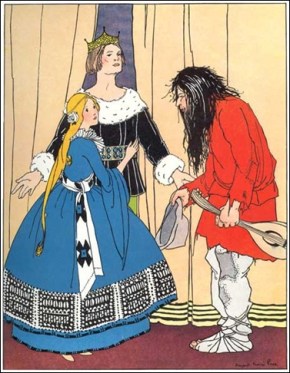
 Margaret Evans Price

In a Different Light

King Thrushbeard”, like a lot of Grimm, is politically incorrect. In the course of depicting an ancient male-dominated world, the early tale tellers would have been perplexed, even aghast, at the feminism of the future. They didn’t know to give a passing nod to the modern feminist movement.

The gist of Thrushbeard is that a royal princess does not get to marry the king until she is humbled. At the start, her father wishes her to marry, but she belittles and insults all the suitors, including the one she nicknames “Thrushbeard”. Furious, her father pledges her to the next beggar who walks through the gates, and she is sent off with a beggar/fiddler. Now, living as a commoner, she has no skills and descends in status. When thoroughly humbled and full of remorse, it is revealed that her fiddler husband is actually King Thrushbeard in disguise, and she is restored to her former position by his hand.

Understandably, feminists gag on such tripe and look warily on anyone reading such demeaning-to-women works. The last time I read “King Thrushbeard” I did so at night, under the covers with a flashlight.

However, my flashlight was made by Anima & Animus Inc. a Division of Jung Industries. It shed a different light.

To oversimplify the Anima/Animus concept, it is the woman in every man, and the man in every woman. (May Jung forgive me.)

The princess, in her rejection of the suitors, is aggressive, controlling and confrontational. She clearly displays her animus in the form of negative masculine attributes. Outside of her beauty, she lacks anything feminine.

In King Thrushbeard, disguised as a beggar, we see his masculine side as cold, uncaring, and logical, applying his princess/wife unsuccessfully to various forms of manual labor, until she devolves to a mere kitchen wench. At the end of the tale, he reveals his true nature and purpose during the wedding feast. In this, he is tender, patient and forgiving. We see his anima.

Interestingly, the princess does not recognize the beggar as King Thrushbeard, even though the king has remarkable physical features. As the beggar, he hides his anima; all she sees is his male side. She sees only half a person. That is the real disguise.

Not until they both inhabit the feminine realm can there be a marriage. While her animus dominates, while she demeans all suitors, she remains unattainable. Fairy tales are generally supportive of feminine attributes in both the hero and the heroine. Usually, act of kindness, thoughtfulness and honesty win the day, rather than do-or-die heroics. What fairy tale ends with “To the victor belong the spoils!”? King Thrushbeard wins his wife by subtlety and not by the sword.

Your thoughts?

  1. After a little more research, I found Marie-Louise Von Franz, a Jungian who wrote a lot about the psychology behind fairy tales, wrote about King Thrushbeard in terms of the anima and animus. Just when I thought I’d come up with a pretty good idea… Well, as that old Egyptian saying goes, “There’s nothing new under the sun.”