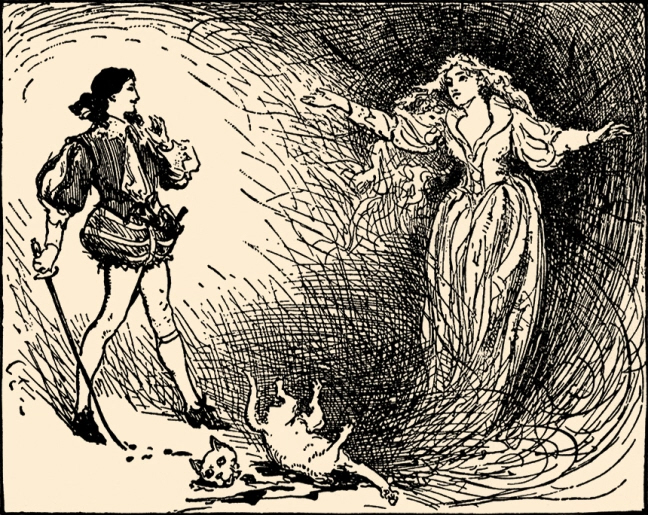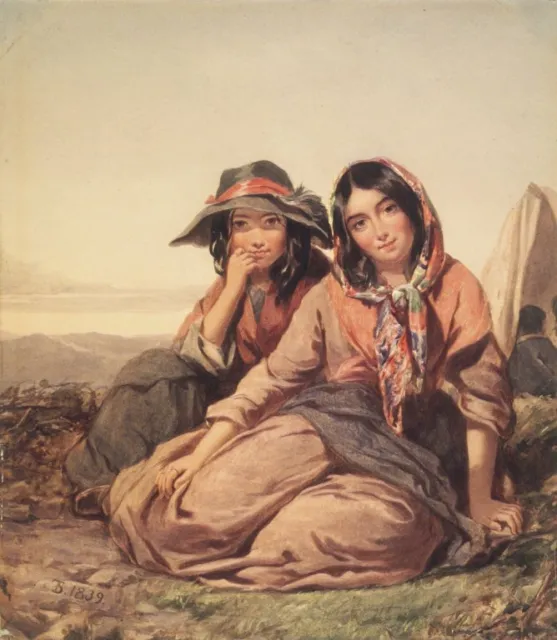
Fairy Tale of the Month: December 2024 How Cormac Mac Art Went to Faery – Part One

John D. Batten

At Melissa’s

I have never been in Melissa’s rooms above her store before. They are what I should have expected if I thought about it. A little spartan, no clutter (unlike my place) but full of Victorian touches. There is not a piece of furniture I would call modern. I am amused to see no bookshelves.

In her small dining room, she promises to lay out a Christmas Eve supper for me, Thalia, and Jini. Oddly, it is lasagna. “My family tradition,” she explains.

While the lasagna is baking in the oven, filling her apartment with an encouraging aroma, we settle in her parlor with drinks—appropriate to our ages—and cookies.

“Tonight, it is I who has a story to read to you,” Melissa says. “It is Celtic and has to do with the giving of gifts.” I see her pick up a copy of More Celtic Fairy Tales, and she continues. “The story is called How Cormac Mac Art Went to Faery.”

Cormac Mac Art, son of Art, son of Conn of the Hundred Battles, King of Ireland, who resided in Tara, purchased a fairy branch with nine apples hanging from its limbs from a youth for whatever the asking price. The price turned out to be his wife, son, and daughter. All protests Cormac quelled by shaking the fairy branch, which uttered music so dear that it tempered everyone’s fears, casting an aura of peace upon all.

After a year, Cormac decided to see if he could not reclaim his wife and children, and he followed the path the youth had taken. In his travels, he came upon three curious sights. The first was a house being thatched with feathers by warriors. After they had feathered on one side, they rode off to find more feathers. When they returned, the feathers they had thatched were gone.

The second sight was a young man consigning a tree to fire. But before he could find another tree, the first would be consumed completely. Again, the labor appeared endless.

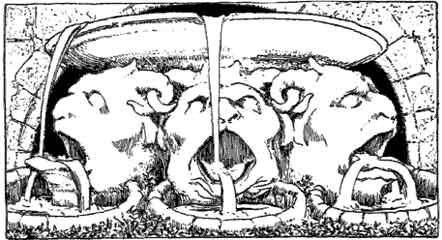
The third was of three wells. From the first flowed three streams, from the second two streams, and from the third one stream.

Traveling over the plain he had entered, he came upon a dwelling where a couple dressed in multicolored robes greeted him and offered him shelter for the night.

When it came to the evening meal, Cormac was given a boar and a log and told to cook a meal for himself. He told his host that he did not see how that could be done. The host explained that Cormac must quarter the boar, quarter the log, then place the meat over the log, and then tell a true story. The log would burst into flames and cook the meat.  

Cormac then asked his host to demonstrate. The host told the story of the boar they were about to eat. He had seven boars with which he could feed the world. When one of the boars was slaughtered, they need only throw the bones back into its stall, and in the morning the boar would be whole again. As the host finished the story, his quarter of the boar was cooked.

Cormac asked the mistress for her story. She said she had seven white cows that gave enough milk to feed the world if they were present. Soon the second serving of meat was cooked. Cormac told the story of the fairy branch and the disappearance of his wife and children.

Although the meat was cooked, Cormac hesitated to feast with so few friends in the room. The host brought Cormac’s wife and children into the room and took on his true form, that of the god Manannan Mac Lir.

We hear the beeping from the kitchen. The lasagna is ready.

Fairy Tale of the Month: December 2024 How Cormac Mac Art Went to Faery
John D. Batten

True Story

I am into my second serving of lasagna when Melissa, more easily sated than I and the girls, picks up her story again.

“Cormac,” said Manannan, “I was the youth that lured you into buying the fairy branch at the expense of your family, knowing you would follow me to faery and be here tonight. Now you and I can feast.”

“Feast I will,” said Cormac, “when I have heard the meaning of the three things I saw today.”

“That I will tell you,” Manannan said.

The god told Cormac that the warriors thatching the house with feathers were the like of those that go forth into the world seeking riches and fortune, but when they return home, they find it bare and must venture out again.

The young man dragging up the trees to make a fire is the likeness of those who labor for others and never get to warm themselves by the fire they made.

The wells represent the three types of men. There are those who give as freely as they get. Then there are others who get little but still give freely. And lastly, despite what they get, give little.

Now Cormac agreed to feast. Manannan spread before his company a tablecloth, declaring it a special thing. All they need do was to think of a food or drink, and it would manifest before them for their pleasure.

Then Manannan set down a goblet, saying that the goblet would shatter when a false story was told and mend when it heard a true one. These objects, along with the fairy branch, he gave to Cormac Mac Art.

At the courtesy of the tablecloth, they all feasted. When the feast ended, they took to their beds. In the morning Cormac, his wife, and children found themselves waking up in
Tara, still in possession of the tablecloth, goblet, and fairy branch.

We all drop our forks and applaud.

“Did they have lasagna?” I say.

“Only if they knew to ask for it,” Melissa smiles.

“Wait,” says Jini, “I’m doing the math. What happened to the fourth quarter of the boar?”

“I’ve thought of that.” Melissa blinks. “It could be the Celts didn’t bother to count, but I think the fourth quarter belongs to the listeners of this tale. But we would have to tell a true tale.”

 Thalia and Jini exchange furtive glances. I am sure they have their own little secrets. Secrets old men should not hear.

“I can tell a true story,” I say.

They look at me expectantly.

“I ate too much.” I pat my belly.

“That is not a story,” Melissa laughs. “Although it is true. But I am thinking I have some truth to explore. Yet, it, too, is not a story.

“This tale dwells on true stories. The meat will not be cooked without a true story. The goblet will break at the sound of a false story and mend only by a true one. What is the truth of fairy tales?

‘We, here in this room, live in the presence of magic because of you.” Melissa looks directly at me. “Fairy tales flitter about our everyday lives. They move between the mundane and our dreams, and we cannot tell which is which.

“Again, I ask, what is the truth of fairy tales?”

Fairy Tale of the Month: December 2024 How Cormac Mac Art Went to Faery
Arthur Rackham

Truer Tale

“Oh good,” I say with a touch of sarcasm. “First you lead me into an Italian food-induced coma, with a bit of wine, and then ask me to think clearly.”

Melissa wags a finger at me. “I didn’t force you to overindulge.” The girls giggle.

“Well,” I continue, “your question brings to my mind a storyteller’s adage I once heard. ‘Every story I tell is true, whether it happened or not.’”

I see calculations going on behind Thalia’s eyes. “Hmmm,” she says. “It seems to me stories make more sense than real life, no matter how fanciful they are.”

“I agree.” Melissa gestures with a hand. “Stories have a beginning, a middle, and an end. In real life, the beginning is our birth, the ending is our death, and the middle is hopefully long, but in any case, confusing. A listener or reader may get bored and lost by the incoherent middle of that long tale.”

“Does that mean,” Jini asks, a little wide-eyed, “stories break down our lives into smaller pieces so that we can understand it?”

“That is probably a good way of describing it,” Melissa answers with a bit of hesitation in her voice. I pick up on her hesitation.

“I think we are now talking about story in its broadest sense, that is, from nursery rhymes to the great works of literature. They are all story, from the Itsy-Bitsy Spider to The Iliad. But Melissa’s question regards the truth of fairy tales. I will suggest its stock in trade is with the passing on of morals and with wish fulfillment if we allow ourselves to call these truths.”

Melissa taps her fingertips together. “Give us an example.”

I take a deep breath and consider.

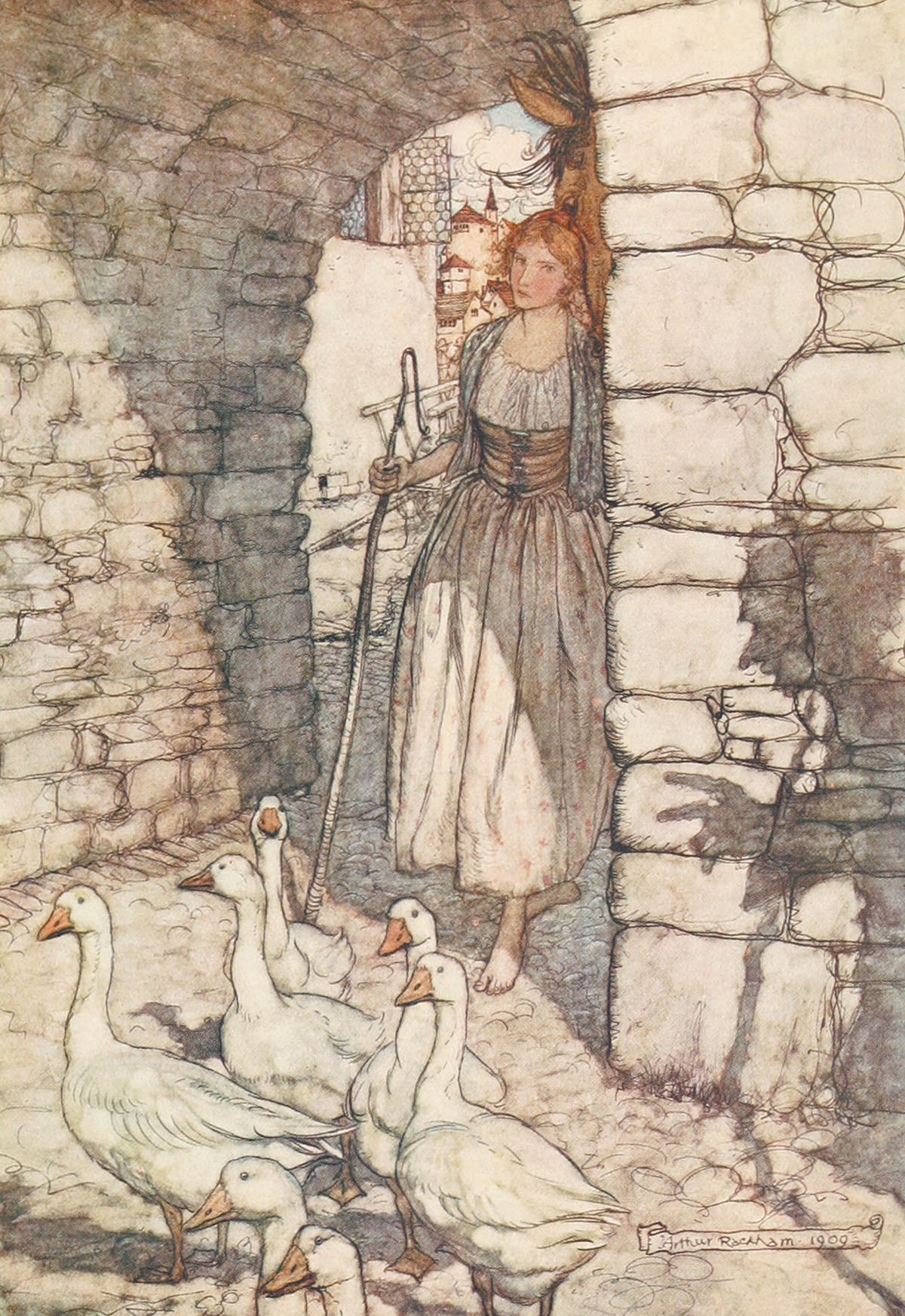
The Goose Girl,” I say.

“I know it,” says Melissa. Thalia nods. Jini looks perplexed.

“To keep it in context,” I explain, looking at Jini, “the goose girl is really a princess whose role—let’s call it identity theft—has been taken over by a maid-in-waiting. The real princess is demoted to being a goose girl. The maid-in-waiting has forced the real princess to swear in the name of God not to reveal the exchange of status.

“Because this is a fairy tale, there is a royal marriage involved. The false princess is to marry a king’s son. However, the goose girl uses magic, which royalty in fairy tales are entitled to, in her everyday dealings. A peasant boy observes her doings so, which eventually leads to the king learning of her true nature and that she was meant to marry his son.”

“The moral?” asks Melissa.

“That the true princess should keep her vow to God, even though given under duress with the threat of death, and trust that the truth will out.”

“And the wish fulfillment?”

“That even a goose girl can rise to be a queen when her true nature is recognized.”

“Rise to be a queen!” exclaims Thalia. “That’s us.” She points between herself and Jini, who buries her face in her hands.

“Your point is taken and demonstrated,” says Melissa with a hint of mirth.

Your thoughts?

Fairy Tale of the Month: November 2024 Peter Bull – Part One

Microsoft Image Generator

Staying Afloat

There is something about the plunge of an oar into the water and the glide of the boat propelled by men’s muscles that is soothing to the soul. Duckworth and I have taken to the Isis, our upper part of the Thames, to do a bit of rowing before the weather becomes too brisk.

Duckworth always humors me by asking about what fairy tale I am delving into. I doubt he concerns himself with the tales outside of my presence. I am his sole source on the topic, and he humors me now.

“So . . .” He hardly needs to ask.

“A tale called Peter Bull,” I respond as we continue to pull on the oars.

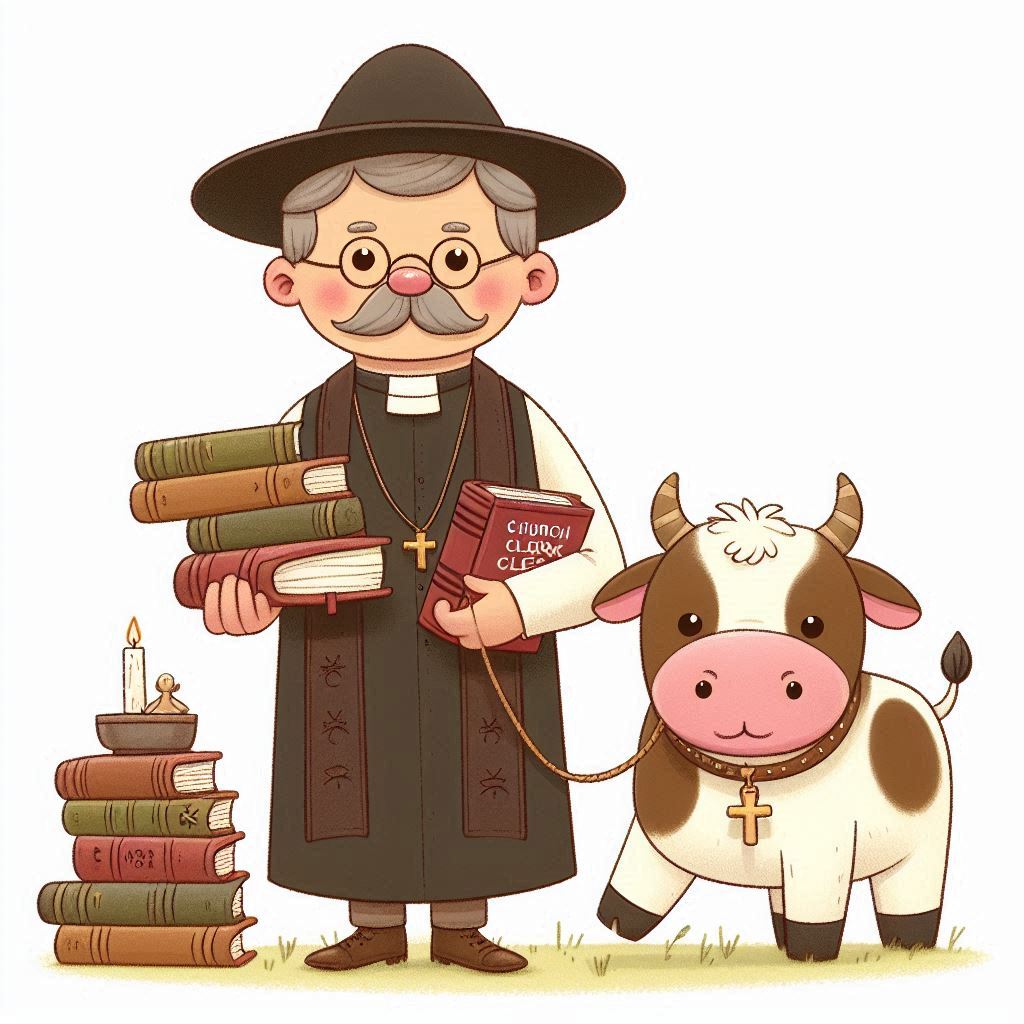
A well-to-do Danish farmer and his wife lived happily but for one thing. They had no children. Because of that, they became attached to one of their bull calves, which they named Peter. The husband speculated that perhaps the church clerk, known as an educated and clever man, might be able to teach Peter how to speak, and his wife agreed.

The clerk, seeing an opportunity, consented to educating Peter under certain conditions. First, the education must be done in secrecy, especially hidden from the priest, since it was forbidden. Second, there would be a cost because the books required to educate the calf were expensive.

Gleefully, the farmer turned Peter over to the clerk and gave him a hundred dalers. After a week, the farmer visited the clerk to see how things were going. The clerk reported that Peter was making progress, but the farmer could not see him. Peter loved the farmer and his wife so much, he would want to go back home and interrupt his learning. The farmer understood this and left another hundred dalers for the necessary books at the clerk’s request.

This sort of thing went on for some time. The visits from the farmer became less frequent in that they cost him a hundred dalers each time. Eventually, when the calf was fat enough, the clerk slaughtered it for a number of excellent veal meals.

“No, wait,” Duckworth exclaims. “Are you kidding?”

“Stay with me,” I say. “The tomfoolery gets worse.”

Soon after the clerk slaughtered the calf, he went to visit the farmer, declaring Peter’s education was complete and that Peter wished to return home. In fact, they had started out together, but the clerk returned home for his walking stick. Setting off again, he realized Peter had not waited for him, and the clerk asked the farmer if the calf hadn’t gotten there before him? They inquired around the neighborhood for the lost Peter, but it bore no results.

Sometime later, the clerk came across an article in a newspaper that referred to a Mr. Peter Bull, a young, struggling merchant. The clerk cut out the article and presented it to the farmer, suggesting that this might be their son. The farmer took off immediately for a few days’ journey, arriving at his destination early in the morning, invading poor Mr. Bull’s bedroom. Peter Bull was a bullish-looking fellow, and the farmer felt he recognized his Peter in him. Peter Bull dealt with the lunatic cautiously until he understood that the farmer intended to make him heir, at which point Peter warmed up to him and agreed to call him “father.”

In the end, the farmer sold his possessions, gave the clerk another two hundred dalers for his good services, and he and his wife moved in with the merchant, making him wealthy, and in return the merchant took good care of them for the rest of their happy lives.

Duckworth gives me a dubious glance, but he can’t suppress his grin.

Fairy Tale of the Month: November 2024 Peter Bull – Part Two

Microsoft Image Generator

Correct Me

“Correct me if I’m wrong, but aren’t fairy tales supposed to have a moral?”

“I am happy to correct you, Duckworth. You are wrong.”

“Explain.”

“I will speculate that the notion that fairy tales should have a moral comes from two sources. First is Aesop, that admirable Greek slave, whose formula for storytelling did have a moral at the end. Second are the Grimm Brothers, who were appealing to a Protestant, bourgeois audience and therefore implied a moral at the end of many of their tales.

“But they were not as consistent as Aesop in moralizing. For example, one of my favorite Grimm tales is The Three Spinners. It is similar to their Rumpelstiltskin, with some significant differences.

“In the story, a mother, rather than admit that her daughter—although pretty—was a wastrel, declared the girl could spin flax into gold. The queen took the girl up to the castle, relieving the mother of a useless daughter. On pain of death, the girl was to spin rooms of flax into gold.

“Three ugly fairy women appear, and for two nights, accomplish the task for mere trinkets. On the third night of this endeavor, the poor girl runs out of trinkets. Then the fairies request she invite them to her wedding to the queen’s son, which they know will happen.

“This small request the girl remembered to make when the wedding plans were made. She described them as cousins. When the wedding feast began, the three ugly fairies entered the hall to the notice of everyone.

“The prince, the girl’s new husband, approached the fairy women, rather rudely, and asked about their deformities. One had a huge foot from running the treadle, the second a gargantuan thumb from rubbing the thread, and the third a large drooping lip from wetting the thread. The prince looked at the three women, then his beautiful bride, and declared she would never again spin flax.”

Duckworth drops his oars and applauds.

“And,” I continue, “I can think of another lacking-a-moral Grimm tale called The Master Thief, a Robinhood sort of figure who, on a dare, for example, steals the bedsheet of a lord during the night.”

“Clever,” remarks Duckworth.

“Yes, clever,” I say. “There is also The Clever Farmer’s Daughter, who wins a king because of her cleverness, loses him because of her cleverness, then wins him back again through cleverness.

“Ah, but then there is Clever Else, who is not so clever and fools herself into thinking she is not herself. Clever Hans doesn’t do any better, and neither do the characters in The Clever People. “

“I think I see a pattern emerging.” Duckworth grins at me. “You are suggested there are many stories in the Grimm collection with the themes of cleverness or its opposite, beside those with a moral.”

“I still have to mention The Clever Little Tailor, The Clever Servant, and Clever Gretel.

“Well, now you have,” he returned.

“But then there’s Doctor Know-It-All.”

“Enough!” Duckworth shook his head at me.

I guess I made my point.

Fairy Tale of the Month: November 2024 Peter Bull – Part Three

Microsoft Image Generator

But Seriously


“But seriously, now,” Duckworth speaks after a short while, “you have pointed out to me that there are different kinds of fairy tales, but what makes a fairy tale a fairy tale?”

“Oh, you want me to pontificate, don’t you?”

“I want to see if you will run out of breath before we finish rowing,” Duckworth jests.

 “Well,” I begin, “it comes out of the oral tradition along with its companions, myths and legends. That is another way of saying the oral tradition is not literary. Myths, legends, and fairy tales have been written down, but they do not have an author.”

“Wait,” Duckworth interrupts, “didn’t Hans Christian Andersen write fairy tales?”

“No, he did not. He wrote literary fairy tales; he made them up. He was the author. He borrowed from fairy-tale structure, which made them sound like fairy tales.

“But this is the point where distinctions get cloudy. The Brothers Grimm collected their fairy tales, often from secondary sources, and put them closer to literary standards than the material they collected. However, they did manage not to overstep the genré rules for these tales.”

“And those rules are, may I ask?”

I think Duckworth is actually interested.

“I will start with the observation that few characters have names. Typically, they are identified by their position—king, queen, youngest son, old soldier. Often, it is the minor characters that have names.

“Followed by the convention that descriptions are sparse. We are told little about how things look.

“Next, the tales are in the third-person objective. We never get inside the characters’ heads.

“Also, the tales are not dialog driven. Dialog is used to highlight parts of the story. There is more telling than showing. Showing is a wordier process than telling. Telling is succinct, as are the tales.

“There is a propensity for the number ‘three.’ For example, in The Goose Girl, we see three drops of blood. Later on in the story, there are three streams to cross and three passages through the dark gateway.

“Royalty has magical powers. This is always assumed, perhaps a reflection of the times.

“Animals can talk, and not simply animals talking to animals, but also animals talking to humans.

“Evil, of the magical sort, must be punished and good rewarded. Naughtiness and deception, as in the clever tales, not necessary so.  Typically, evil is destroyed in rather graphic terms.

“The story usually ends happily. You can have a fairy tale without fairies, but happy endings are the rule. However, there are cautionary tales that do not end so happily.”

“That is a pretty extensive list,” Duckworth argues. “Can you make it more concise?”

“Yes. Fairy tales make bad literature. Really, they violate most of the rules of good literature. They stick to one POV, third-person objective. They ‘tell’ don’t ‘show.’ There are no beautiful, florid, or even accurate descriptions. And what is with the number ‘three’ all the time? It is more overused than ‘clever.’”

I get a chuckle from Duckworth.

“But seriously,” I say, “for me, the fairy tales are the stuff of dreams. Not those things we strive for, but those things that come to us, unbidden, in the night. There is a good reason for the tales to end happily. Theirs is the resolution that protects us from witches, demons, and the devil himself we encounter in the tales. All those things that make us uneasy while we sleep.”

Your thoughts?

Fairy Tales of the Month: August 2024 The Jewel Mountain and the Dove Maiden- Part One

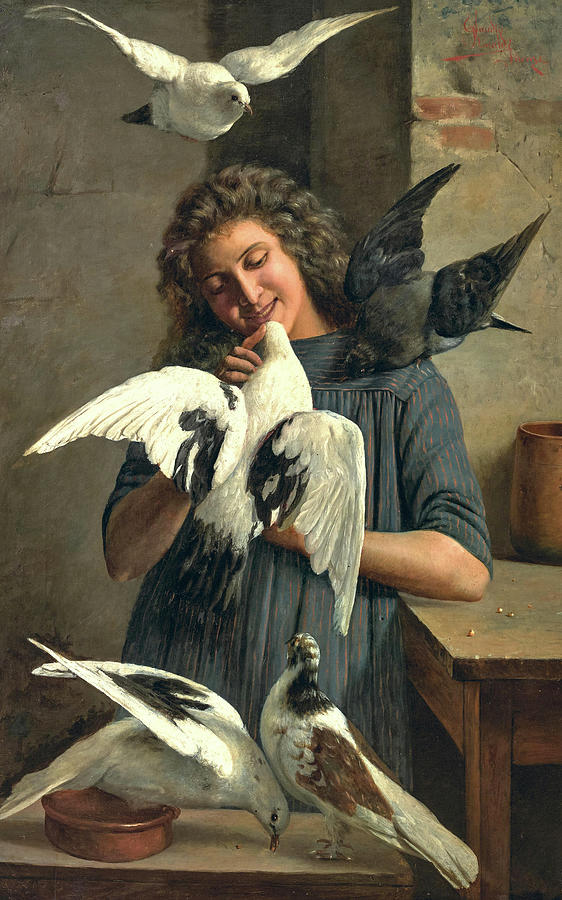
Dove Maiden Feeding the Doves – Claudio Rinaldi

Usual Crowd

The usual weekday crowd has gathered: Thalia and myself in our comfy chairs, Johannes on the window-seat pillow, the fairy on Thalia’s shoulder, and the brownies lurking in the dark corners for the post-supperial entertainment. (Don’t try looking that up.  You won’t find it. It means post-supper with an inference of being superior.)

In our study/sanctuary, Thalia fingers my copy of Modern Greek Folktales, by R. M. Dawkins.

“Tonight’s reading is The Mountain of Jewels and the Dove Maiden.”

A young woodcutter, who worked morning till night to support himself and his widowed mother, fell in with a merchant with a scheme to acquire great wealth. Taking to sea with his fleet, the merchant brought them to an island dominated by a lofty mountain, its peak in the clouds.

The merchant gave the youth a sword, sewed him into an animal skin, and told him an eagle would carry him to the mountain’s top. The merchant instructed the lad to cut himself out of the animal-skin bag and throw down to him whatever he found.

All this happened, and the young man found the mountain top cluttered with diamonds, gold, pearls, and sapphires. These he threw over the mountain’s cliff to the merchant below. When the merchant’s ships were filled, he sailed away, abandoning the youth on the mountaintop.

Desperate, the lad searched for escape and found a subterranean staircase into a palace. There dwelt a blind ogre. Although at first frightened, the youth befriended the ogre, who doted upon him, giving him the forty keys to the palace rooms, but with the instruction not to enter the fortieth room.

Needless to say, the fortieth room was entered, where the youth found a magnificent garden, in which he saw a marble-lined cistern, into which descended three doves that removed their plumage, transforming into beautiful girls. The three splashed about in the water as he fell in love with the youngest. As quickly as they had come, they put back on their feathers and flew away.

Brokenhearted, the youth returned to the ogre and confessed what he had done. The ogre, rather than being angry, sympathized and told him to steal the plumage of the youngest, and she would become his wife.

This the youth did. After some time, and two children, the ogre allowed the family to return to the lad’s widowed mother. All went well until the dove maiden rediscovered her plumage. Before flying off, she told the widow how the husband could find her in the place that is all green, all red, with five white towers.

The youth returned to the ogre for help in his search, and the ogre assisted him by giving him iron shoes and an iron staff. During his wanderings, he came across two men arguing over the possession of three magical devices: a hat of invisibility, a flying carpet, and an invincible sword. These items soon belonged to the lad, if by deceit. He wished himself to the place that is all green, all red, with five white towers.

He found his wife demoted, living in the stable of her father, the king. In order for him to reclaim her, they needed her father’s permission. The father would rather destroy the youth, but because of the hat of invisibility, he could not find him. Instead, he set the condition that the lad needed to turn a mountain into a garden overnight.

The dove maiden gave her husband a tile to be thrown down a particular well, from which would emerge thousands of men to do his bidding. By morning, the mountain had become a garden.

The father then demanded that the garden become the sea. With another tile, the youth accomplished the task.

The father then demanded to see the husband of his daughter. When he revealed himself, both the king and the queen rushed forward to devour him, but with the invincible sword, he slew them.

Reunited, the husband and wife returned to the ogre’s palace, where, in gratitude, the dove maiden restored the ogre’s sight, for it was she and her sisters who had stolen his eyes and hid them in a cave.

Thereafter, all lived in good health.

Huh. This is one for Augustus to interpret.

Fairy Tale of the Month: August 2024 The Jewel Mountain and the Dove Maiden – Part Two

John D. Batten

Augustus Interprets

“Not Elfish Gold?” Augustus exclaims with mock shock.

“I suppose my tastes have taken a turn toward the dark side. Black Dwarf and Fairies’ Delight will fill the bill this time.”

Augustus considers. “Toward the dark side, eh? Then let me tempt you with a bowl of Raven Black.”

“Raven Black; I think I had that once.”

“You did, but I have changed the blend a bit, I think for the better.”

We are already stepping into his testing room, he carrying a small canister. When our pipes are packed, we settle in.

“You have, I assume,” says Augustus, “a story to share.”

“Have you heard of The Jewel Mountain and the Dove Maiden?”

“I have not.”

“Greek,” I say and tell him the story.

When I finish, he contemplates for a while.

“I have not heard this story before,” he says, “and yet I have.”

I nod in agreement. “It is made up of well-known tropes.”

“And yet,  there is something fresh about it. Well, let’s pick it apart.”

He blows a couple of smoke rings before continuing.

“The theme of the woodcutter and his widowed mother is as old as it gets. The lad being waylaid by a merchant rings of Aladdin and the Lamp, which does not surprise me. There is only the Aegean Sea between Greece and the Middle East.

“The subterranean palace I know from A Sprig of Rosemary if nowhere else.”

The Twelve Dancing Princesses has a subterranean palace as well,” I comment.

“Ah!” Augustus gestures with his pipe. “A blind ogre, that is new, and a sympathetic, friendly ogre as well. The Greek tales are filled with ogres, but not too many are friendly.”

“Now,” I say, “we come to the forbidden-room motif. A hero, yet more often a heroine, is given the keys to the castle and told not to use a certain one.”

Augustus frowns. “I think you are conflating two rather distinct motifs. In our story, it is the hero—and not a heroine—who gets the keys to the forty rooms of the palace and told not to enter the fortieth room. It shares similarities with another Greek tale, The Quest for the Fair One of the World—notice how long some of these Greek titles are—not to mention that part of the world’s obsession with the number forty.”

I skip over the number-forty obsession and focus on the gender question just raised.

“In the European tales,” I reflect as I speak, “when the heroine opens the forbidden door, there is something awful behind it. In the Greek tradition, when the hero opens the forbidden door, there  is a marvel, dangerous, but a marvel.”

“Have you . . .” Augustus hesitates for a second. “Have you ever had a dream about being in a house, a house you know very well, but you should not be there?”

I am a little stunned. “There is a third floor to my house,” I confess, “that appears to me a little uncanny.”

“In my dream,” Augustus goes on, “I am in my great-grandmother’s dining room, hiding under her table. All about me is the high-Victorian décor and its mysteries. I fear being overwhelmed.”

Are dreams and fairy tales our way of dealing with our invented realities?” I wonder.

Fairy Tale of the Month: August 2024 The Jewel Mountian and the Dove Maiden – Part Three

AI – Google Gemini

Wonder Tales

I pick up the thread of our conversation. “Next up is stealing the dove maiden’s plumage to oblige her to be his wife.”

“Again,” says Agustus, relighting his pipe, “another well-known trope. With mermaids it is their fishtails, with swan maidens their feathered robes. Invariably, they get their accoutrements back again. They cannot resist them when back in their hands, even to the point of abandoning their children by their forced marriages.

“However, I cannot help noticing that the dove maiden says, before flying away, ‘Look for me in the place where . . .’ instead of the usual, ‘You will never find me until . . .’ She appears to be encouraging her husband to find her.”

“And he does find her,” I say between puffs, “with the help of the ogre and three magical devices.”

“Yes, yes, the magical devices. Notice that one of them is a flying carpet instead of the seven-league boots, a nod to its Middle East influences.

“I find it a bit interesting in this fairy-tale motif that our heroes are not above trickery to acquire the devices, yet we don’t think any less of them for it, but rather how clever they are.”

I tap out my pipe and refill it with more Raven Black. “Add an ounce of this to my order, please.”

Augustus smiles. “The dove maiden’s predicament, I did not expect. Her father, the king, consigned her to the stable in punishment for . . . “ Augustus trails off.

“In punishment for marrying a human?” I suggest.

“Possible, even though that was not her fault; she was being humiliated.”

“It is also apparent,” I put in, “her husband cannot simply put her on the magic carpet and make an escape. There are three ordeals to face.”

“Which he does,” Augustus climes in, “with the help of magic, including his wife’s magic. This scene in the story has the freshness I mentioned before. Not only the dove maiden dilemma, but I am not sure I have run across the impossible tasks of turning a mountain into a garden and then the garden into the sea. And she aids her husband with a tile to be thrown into a well to produce an army for men to do the tasks. Where does that come from?”

“A sort of wishing well, with tiles instead of coins?” I speculate.

“Maybe.”

“The third task,” I continue, “is a bit different than the first two. The youth has been hiding beneath the hat of invisibility, and the king demands to see him.”

“Right, and as soon as he does, the king and queen attack to eat him. This event comes at the end of the story, but it is the first clue we have that they, too, are ogres.”

“And dispatched with the invincible sword,” I add. “Making good use of the magic available to him.”

“I think,” Augustus taps out his pipe, “the craziest thing about this story is the surprise ending where the dove maiden restores the eyes of the blind ogre that she and her sisters had stolen.

“This hints of an entirely other tale. I imagine the ogre seeing the bathing dove maidens, just like the lad did, but was found out and punished by them by having his sight taken away.”

“Hmmm,” I say, “you could be right. The ogre had access to that world through the fortieth door and warned the youth against opening it. But where was that world; all green, all red, with five white towers?”

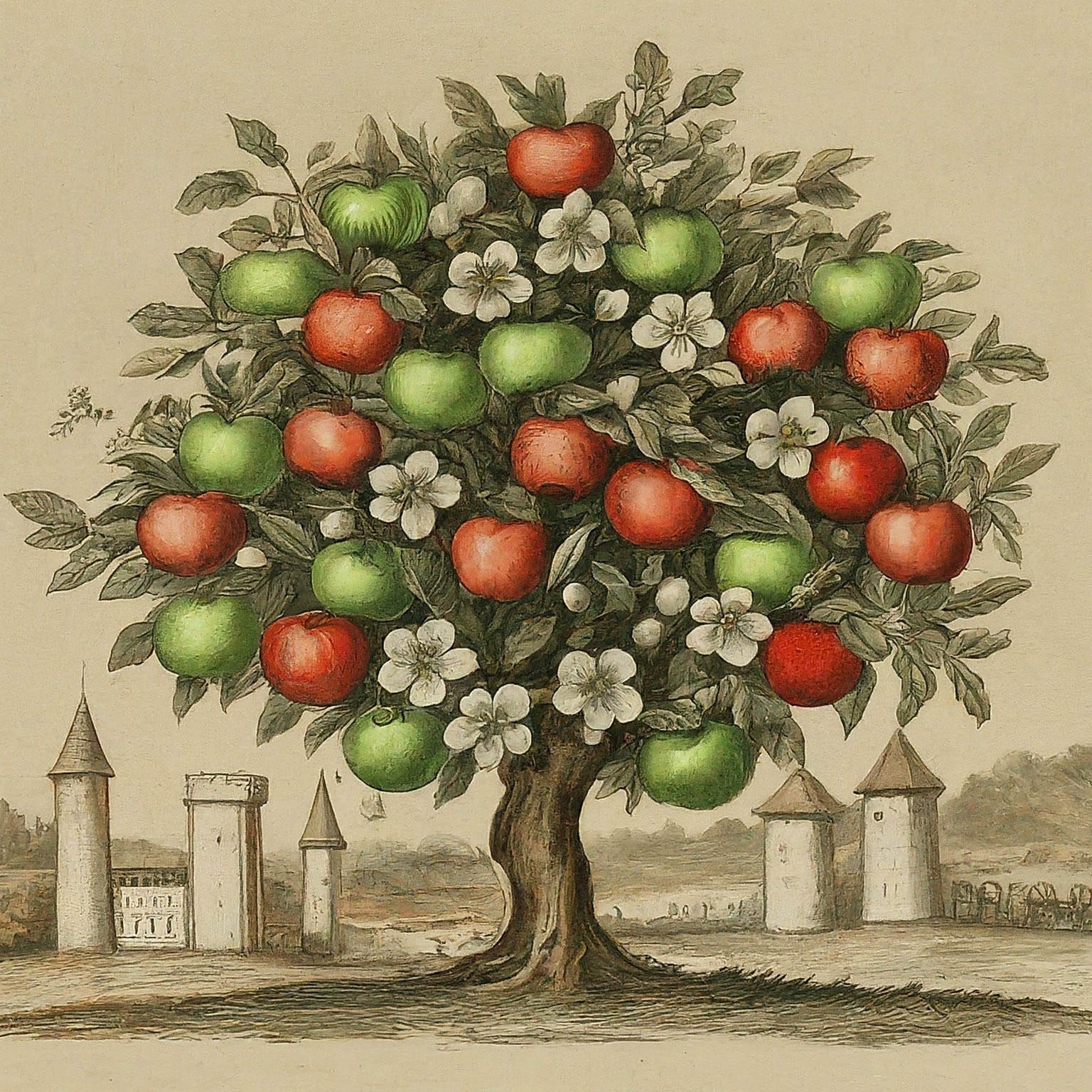
“That, I am convinced, is a riddle, my answer to which is an apple.”

“An apple.” I echo.

“The unripe fruit is all green, the ripe fruit all red, and the towers are the five white petals of the apple blooms.”

“I like it,” I say. “All we need do is imagine a world inside an apple.”

“And that, my friend,” concludes Augustus, “is why ‘fairy tales’ should be called ‘wonder tales.’”

Your thoughts?

Fairy Tale of the Month: July 2024 The Girl-Fish – Part One

H J Ford

Green Tea

“Look what Jini brought,” Thalia says as she and Jini march into the kitchen, setting on the table a pink-and-green aluminum can, while they grab three glasses and fill them with ice from the fridge. In bold letters on the can is the label “Nixie.” Further, I read that it is pomegranate green tea sparkling water.

“Courtesy of my cousin in America. This is his favorite drink,” Jini explains. “Well, non-alcoholic.”

Thalia giggles.

“Fitting,” I say, “naming a drink after a water spirit.”

We all take a sip. Pleasant. Sweet, but not too sweet.

“This is a little serendipitous, you know,” says Thalia. “Last night I read The Girl-Fish.”

“Oh?” Jini and I chorus. That’s all the encouragement Thalia needs to relate the tale.

There was a willful girl—pretty—but willful. Though dearly loved by her parents, she would do nothing to try to please them. Until, one day, her mother was so weary that even the girl could not ignore it, asked what she might do to help, and was sent down to the river to mend her father’s fishing net. She no sooner finished the repairs when she heard a fish splashing in the water. She cast the net and caught it.

However, the fish warned her, if she ate it, she would turn into a fish herself. The girl’s willfulness returned, and thinking that the fish held no power over her, she had her mother cook the fish for her. As predicted, she turned into a fish and managed to flop into the river.

Carried downstream to the sea, she met other once-human fish who took her to their queen. The fish-queen’s story was that she had once been an earthly queen, but soon after her son was born, a giant seized her crown as well as herself and her ladies-in-waiting, replacing them with his daughter and her minions, and placed a glamour upon the interlopers so that the king would never notice.

In despair, the real queen and her ladies threw themselves into the sea and transformed into fish. That was many years ago. Since then, the false queen died, returning the crown to her father, the giant. If the crown could be regained, they all could return to  their human form. The queen gave the girl-fish the ability to transform herself into any creature she called for to aid in getting the crown from the giant’s castle on a high mountain.

The first transformation was into a deer so that she could travel quickly. However, a prince was out hunting and cornered her. She pled with him, in her human voice, to spare her. Dumbfounded, he let her escape, and, belatedly, decided she must have been an enchanted maid and that he would marry no one else.

By turns, transforming into an ant, a monkey, and a parrot, she gained access to the giant’s castle and demanded the return of the crown. The giant bargained with her and requested a collar made up of precious blue stones from the Arch of St. Martin. This she achieved in the form of an eagle with a strong beak. Not contented, the giant asked for a crown made of stars in exchange for the fish-queen’s crown.

In the form of a frog, she collected the light of the stars reflected in a pond and wove the reflected light into a crown. The giant accepted this crown, fearing the girl’s powers might be greater than his own. With the queen’s crown returned, all the fish-people took on their human form.

They returned to the queen’s earthly home but found much had changed. The queen’s husband had also died, and their son was now king. The new king was delighted to find his real mother still lived, but she sensed in him a great sadness. He revealed to her that he was hopelessly in love with an enchanted maid in the form of a deer. With the queen’s help, the new king and the girl-fish were soon married.

“Wow, what a story,” Jini grins.

Thalia fingers the label of the sparkling-water can. “I’m thinking of asking our nixie about this tale.”

Jini’s eyes widen. “You have a nixie?”

“In the Magic Forest,” Thalia nods.

“Does she drown young men?”

“I hope not.” Thalia looks concerned.

“Maybe,” I say.

Fairy Tale of the Month: July 2024 The Girl-Fish – Part Two

AI art

More Popcorn

I have armed the girls with a paper bag of popcorn. I can’t recall when I realized the nixie loves popcorn, but it has been a staple in my interactions with her ever since. I sit high on the bank and toss popped kernels to her down below. I am safe from being dragged down into the water by her, and the popcorn is an incentive for her to entertain my presence.

However, today, as we enter the Magic Forest and come near the nixie’s pond, a siren song is carried on the air.

“Oh, how pretty!” Thalia exclaims.

“Pretty” is not the word for it.

I feel it pulling at my soul.

When we come into view of the pond, there is Melissa sitting at the water’s edge, not three feet from the nixie, whose serenading has just ended, releasing me from its spell.

“Oh, how lovely,” says Melissa, then, looking up, sees the girls and smilingly motions them to come and sit beside her. The girls prance down the bank, settling themselves on either side of her.

What have I done?

When the nixie glances curiously at Jini, the girl hands over the bag of popcorn, which the nixie takes with delight.

No! That’s not how it’s done.”

I collapse to the ground, high up on the bank, out of reach.

“I have a story.” Thalia’s tone is formal, infused with respect for the nixie. “About which I’d like to hear what you have to say.”

The nixie nods, lying back into the water until only her face, haloed by floating green hair, and her hands, holding the popcorn bag, are above the surface. As Thalia tells the tale, the nixie lazily drops the treats into her mouth. I have never before noticed how sharp her teeth appear.

“I do remember her,” the nixie says when Thalia ends the tale. “Why she didn’t want to remain queen of the fishes, I don’t understand. What is this attraction to the land? Some of the mermaids have it. I don’t see what lures them.”

“Well,” says Thalia, “the fish-queen and girl-fish were born on land. I guess that’s a bond hard to break. One’s first home, I mean.”

The nixie nods her consent as Jini picks up the thread of the discussion. “But what of the girl-fish’s willfulness? Ultimately, she is rewarded. Why should willfulness be rewarded?”

The nixie rises from the water, half her length, trying to contain her laughter. It, nonetheless, comes out as a frightening cackle. “Willful? She? Oh, you mortals do not grasp willfulness. We immortals are willful by our existence. Seldom do you who die retain your willfulness much beyond infancy. No, for me, this is a story of a girl losing hers.

“She starts out having her way. Then, for a moment, she has pity for her mother. After that, all is lost.”

“But didn’t her willful nature lead her to ignore the fish’s warning?” Jini points out.

“You might wish to see it that way,” the nixie responds. “But I can’t see becoming a fish as tragic as the story implies. The tragedy comes in the girl-fish falling into subservience to the queen, and all traces of her precious willfulness disappear.”

“Well,” Melissa suggests, “she does get to marry a prince.”

“All the more subservient,” the nixie pouts, settling back into the water and her popcorn.

Fairy Tale of the Month: July 2024 The Girl-Fish – Part Three

AI art

Popcorn Bag

“I see this as a story of transitions.” Melissa taps a finger on her chin. “The heroine is first changed into a fish, against her will. Then she is given the ability to transform into whatever she calls for to reach her goals.”

“Oh, the frog,” says Jini. “That was my favorite. In that form, she collects starlight to make a crown. So cool.”

“That was my favorite as well,” says the nixie. “Collecting reflected starlight; I am going to have to try that. Probably on winter solstice when the night is longest.”

“I like the deer,” Thalia chimes in. “Deer are so elegant looking. I can just see her leaping away from the prince, his mouth hanging open.”

“My admiration,” Melissa smiles, “goes to her choice of becoming an ant to scale the giant’s castle wall.”

Both Jini and Thalia nod their agreement, and Melissa continues. “But the ultimate transformation, or more correctly transition, is the heroine’s change from the person she was at the start of the story to the person she becomes by the end.” Melissa turns to the nixie and adds, “For better or for worse.”

The girls giggle. The nixie rolls her eyes.

“What about the giant?” Jini asks. “I thought his ideas for the tasks were odd. He wanted jewelry. What giant wears precious stones and a starry crown?”

“And only two tasks,” adds Thalia, “not three.”

“Never liked that giant,” the nixie sniffs. “Not bright, but most giants usually aren’t.”

“Could be,” Melissa contemplates, “he was trying to think of difficult or impossible tasks. The first task wasn’t all that hard, but by the time she returned, he had come up with, what he thought to be, an impossible one.”

“But why not a third task?” Thalia presses.

“Because,” Melissa conjectures, “when he realized she could do the impossible, he became afraid of her power and surrendered the queen’s crown as he had promised.”

“Well,” says the nixie, “he is a coward, and, although he has had his moments, usually he can’t come up with more than two thoughts.”

There is another round of giggles from the girls.

The evening is coming on, and I don’t think it wise to be in the Magic Forest by nightfall.

“We should be going soon,” I call down the suggestion to them.

“OK,” the girls say together, then turn their attention back to the nixie. The nixie glances up and gives me an evil smile.

I know the nixie has the reputation for drowning young men, and while I am not youthful, she is immortal, which makes me look comparatively young. I creep a few more feet up the bank.

Now I can no longer hear what they are talking about. It goes on far too long for me, but eventually they stir; Melissa, Thalia, and Jini rising to their feet. The girls give the nixie an enthusiastic hand-waving, then turn to climb up the bank toward me.

What a relief. I am trying not to be obvious that I think this is an escape as I usher them down the path toward home, when I realize Melissa is not with us.

Turning around, I see her kneeling beside the pond’s edge. The long, slender fingers of her pale hand touch the tips of the nixie’s green, webbed fingers. The nixie speaks to her, then slips beneath the water’s surface. Melissa retrieves the floating, empty popcorn bag. I know her body language. She is deep in thought.

Your thoughts?
Fairy Tale of the Month: June 2024 Bird Dauntless – Part One

Twelve Heads

We don’t have as many evening reads as we did when Thalia was little. In fact, the pattern has settled into readings on Sunday nights. A good way to start a week. Thalia, some time ago, took over the duties of being the reader. I enjoy being read to, and Thalia has such a soothing, yet articulate voice.

We have all gathered as usual, Thalia and I in our comfy chairs, Johannes curled up on the window seat, the fairy on Thalia’s shoulder, and the brownies lurking in a dark corner.

Thalia holds a new acquisition in her hand from Melissa’s bookshop. “Fairy Tales From the Far North, by P. C. Asbjornsen,” she announces. “From which I will read Bird Dauntless.”

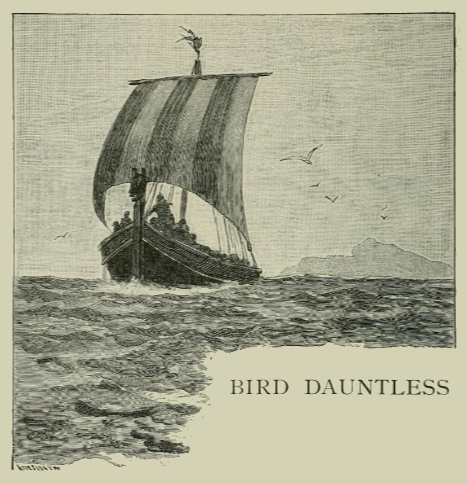
There is a king with twelve daughters, of whom he thinks the world, but one day they disappear. Word of this strange event comes to a realm whose king has twelve sons. The brothers determine to find and marry the twelve princesses. Their father gives them a ship with Knight Redbeard to command and steer.

They search for seven years until they encounter a storm that lasts for three days. At the end of it, all are so exhausted that they fall asleep, except for the youngest prince. He sees a dog on an island and lowers a boat to rescue it. The dog leads him to a castle, and turns into a beautiful maid, with her father, a fearsome troll, sitting beside her.

From the troll, the prince learns that the twelve princesses were stolen away by the troll’s master/king to scratch his twelve heads. The troll gives the prince a sword with which to slay his master/king, allowing the troll friend to be the new king. The troll says there is still another seven-year journey before them in order to get to their destination. The troll also warns that Knight Redbeard hates the prince and will kill him if given the chance.

After seven years, the pattern of the three days of storm repeats, and the youngest prince slips away from the ship as the others sleep, enters the castle of the twelve-headed troll, and finds him asleep as his friend, the troll, had predicted. He waves the princesses to stand back and quickly slays the king troll.

Having already started their return voyage, the princesses realize they have forgotten their crowns. The youngest prince offers to return for them while the rest remain at sea. The Knight Redbeard takes the opportunity to abandon the prince with threats of death for anyone who defies him. The prince is left stranded on the old troll king’s island.

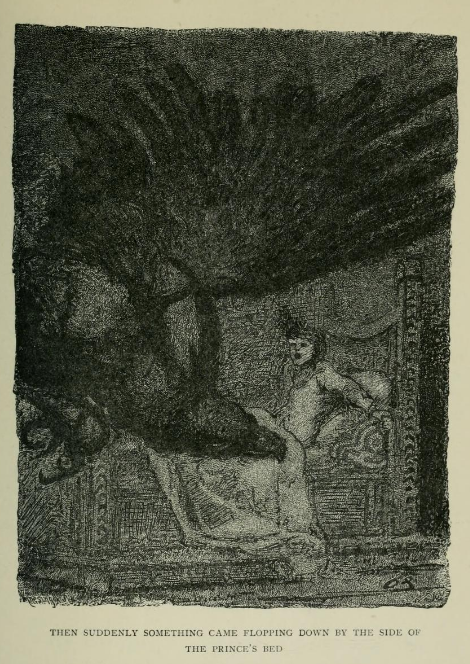
To the prince’s aid comes the Bird Dauntless, an apparent resident of the old troll king’s palace. It flies him back to the new troll king’s palace—the prince’s friend—with magical speed.

Seven years later, after a three-day storm, the sleeping crew comes to the new troll king’s island. The youngest prince boards the ship, reclaims the sword of the new troll king for him, and sees that the youngest princess sleeps with a naked sword by her side and that the Knight Redbeard sleeps at her feet.

Another seven years pass as the crew travels back to the kingdom of the twelve princesses’ father. Toward the end of the seven years, the new troll king gives the prince an iron boat that will take him back and return by itself. When the prince comes in sight of his brothers’ ship, he raises an iron club to evoke a storm that allows him to pass by them unnoticed.

Pretending to be a storm-tossed sailor, the prince creates the rumor (however true) that the princesses are returning. When they do return, there is much joy except for the youngest princess, who is now obliged to marry the Knight Redbeard.

The prince, now pretending to be a beggar, offers up the crowns. Seeing this, the youngest princess reveals the deceit of the Knight Redbeard. The king has Knight Redbeard executed before he can do any more harm.

“And all, as you may suspect,” says Thalia, “live happily ever after.”

Fairy Tale of the Month: June 2024 Bird Dauntless – Part Two

Twenty-eight Years

“Twenty-eight years!” Melissa marvels. “Seven to the troll’s island, seven more to the king troll’s island, and fourteen more returning. What a patient people they must have been.”

I smile at her quip. “This is the stuff of fairy tales.”

We are sitting, again, on Melissa’s reading-space couch. She has generously provided a full teapot and cups.

“Obviously, you know the story,” I say.

“I read the book before I sold it to Thalia. That is one of the perks of being a bookseller. I read them before I sell them to my profit.”

“Very good,” I say. “But what are your thoughts on this tale?”

“Well, first is the twenty-eight-year saga.” Melissa holds her teacup to her mouth but does not drink, frozen in thought. “There is a cultural context to this tale that came out of the Middle Ages. The peasantry was tied to the land. They existed pretty much from hand to mouth. It was a mark of privilege to have the ability to travel. Besides religious pilgrimages, there were the Crusades. That men of royalty would go off for extended periods of time seemed to have been expected. Twenty-eight years is still excessive, but for the listeners of the time, not unimaginable.”

She finishes taking a sip of tea and continues.

“Then there is the strong suggestion that none of the characters age.”

“No, wait!” I exclaim. “The story does not say that.”

“You are right; it does not, but it is implied. Note that the heroes and heroines get married and live happily ever after. ‘Ever after,’ not ‘for the rest of their lives.’

“Death in the fairy tales is reserved for three categories of characters: witches, trolls, giants, and all other evildoers; kings that are old when the story starts so that the hero can inherit the kingdom; and mothers so that their progeny can have an evil stepmother. There is the caveat that if the king gives half his kingdom to the hero, he can avoid mention of his demise. Even taking an axe and cutting off the head of a fox may produce the enchanted brother of the heroine. Death is a bit elusive in the tales.”

“I am going to suggest you are exaggerating.” I sip my tea.

“Let’s take our tale,” Melissa persists, pouring herself another cup. “Our heroes and heroines return on the cramped quarters of a ship for fourteen years, at the end of which there is no mention of children being born during that time.”

Oh, she may have a point here.

Melissa takes another sip of tea. “They don’t get grumpy, there is no mention of graying hair, there are no medical issues. Why? Because they are suspended in time.”

“Now there is a notion I have not entertained before.” I set down my teacup. “Time often moves differently in the Celtic fairy world than it does in our world. Why shouldn’t it not move strangely in other tales as well? I will buy into your analysis.”

Melissa smiles. She has her little victory.

Fairy Tale of the month: June 2024 Bird Dauntless – Part Three

Peter Christen Asbjornsen

 So Many

“There is also quite a cast of characters.” Melissa absently rotates her teacup with her fingers. “This tale starts with twelve princesses, twelve princes, and their two fathers.”

“That’s twenty-six,” I say.

“Then there is the Knight Redbeard, two trolls, one troll daughter, and the Bird Dauntless.”

“Making an uneven thirty-one,” I calculate. “Unless we count the king troll’s twelve individual heads.”

“No, don’t.” Melissa smiles and takes another sip of tea. “Eleven of the princesses and eleven of the princes are a sort of corps de ballet, dancing around in the background, not coming front and center. Only the youngest prince and princess do we actually see.”

“Hmmm, a form of crowd control?” I say.

Melissa ignores my quip. “Out of the thirty-one characters, only two have names: the Knight Redbeard and the Bird Dauntless.”

I raise a finger. “Knight Redbeard I recognize. In the Danish folk tales with which I am familiar, he is the Red Knight, the stock villain. He is in the story to cause trouble, sometimes only for the sake of causing trouble.”

“I recognized him too. He is the one to be punished by death at the end of the tale and is brought back again in another tale to be killed once again. I must wonder if this was not a running joke among the tellers to recycle the bad guy.

“What I found most curious was the Bird Dauntless, starting with that curious name. Asbjornsen thought it important enough to name the story after it. The bird is a necessary component of the tale. The young prince would otherwise remain abandoned. Nonetheless, the bird only has a brief appearance and then disappears from the tale.”

“I have,” I say, “run across large birds rescuing heroes before. What jumps to my mind, for example, is The Underworld Adventure. In that story, the hero is abandoned by his two brothers when they are looking for missing ladies in an underworld. It is a huge bird that flies back to the upperworld, similar in feel to our tale. There, too, the bird serves its purpose and then is gone.”

Melissa considers this while drumming her fingers. “I suppose it is not unusual for characters to disappear from these tales. Besides the Bird Dauntless coming and going, the princes’ father gives them a ship, and then the story is done with him. We don’t even hear him being invited to the wedding. I also think the troll’s daughter got left behind—a beautiful maiden and shape-shifter—the story could have done more with her for my liking.”

“For myself,” I say, “I found the use of the three-day storm an interesting device. Every time the ship comes to one of the troll islands, their arrival is preceded by a storm, after which the crew falls asleep except for the youngest prince, who forwards the story.

“On the return trip, he raises an iron club, given to him by his troll friend, to create a storm so that he could slip by them unnoticed. I don’t recall ever seeing a troll/storm  relationship before.”

“Let me return to the character of the bird,” says Melissa. “What of the name ‘Bird Dauntless?’”

“I did Google search that,” I say. “I came up with nothing.”

Your thoughts?
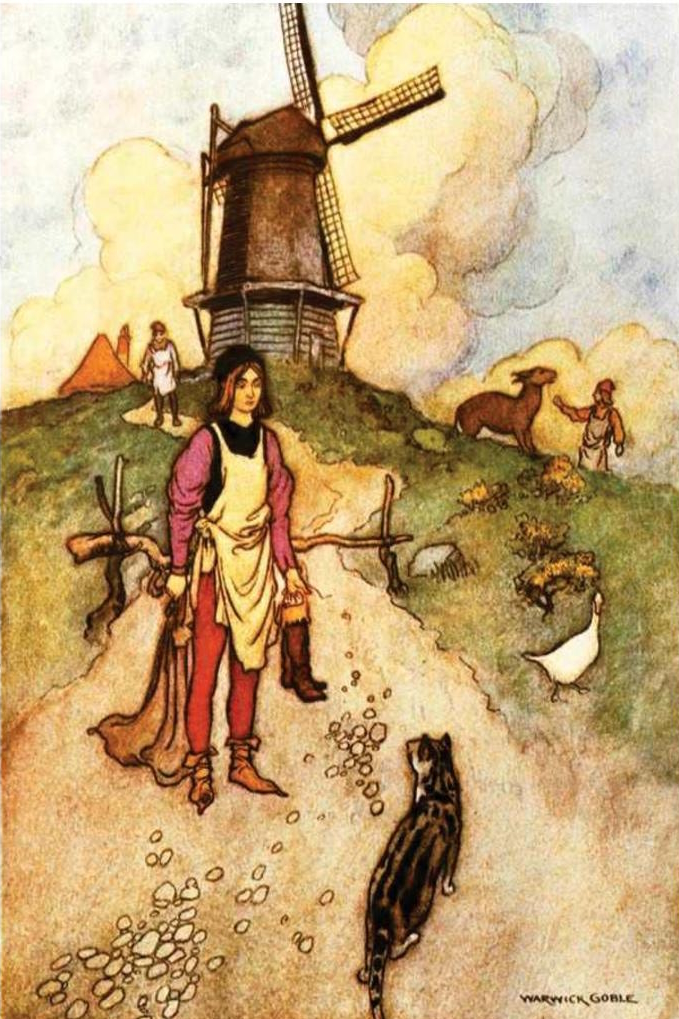
Fairy Tale of the Month: April 2024 The White Cat – Part One

G P Jacomb Hood

White Cat

“Only if I can read a story,” I say.

Thalia and Jini look at me a little curiously.

“OK,” says Thalia cautiously.

“I ran across a story last night,” I explain, “that I think all three of you will enjoy.”

“Three?” Jini asks with a frown.

“He is talking about Ultima,” Thalia fills in.

“Who?” Jini’s perplexed look I find entertaining.

Jini has not been to the Enchanted Forest, our destination for an April picnic that we are planning. The weather is always fine there.

“Ultima,” Thalia explains, “always knows when we are coming, and she will be there.”

“I wonder if she will bring her dragon this time?” I offer.

Jini’s eyes widen.

The story I plan to read is The White Cat, by Contessa d’Aulnoy, or, in other words, a French tale.

There was a king who feared his three clever sons might take away his kingdom for themselves before he intended to let it go. To divert them, he asked that they find him a petite dog to entertain him in his retirement, for which he had no plans.

With goodwill, the three brothers agreed to meet at a certain place in a year’s time and from there return to their father.

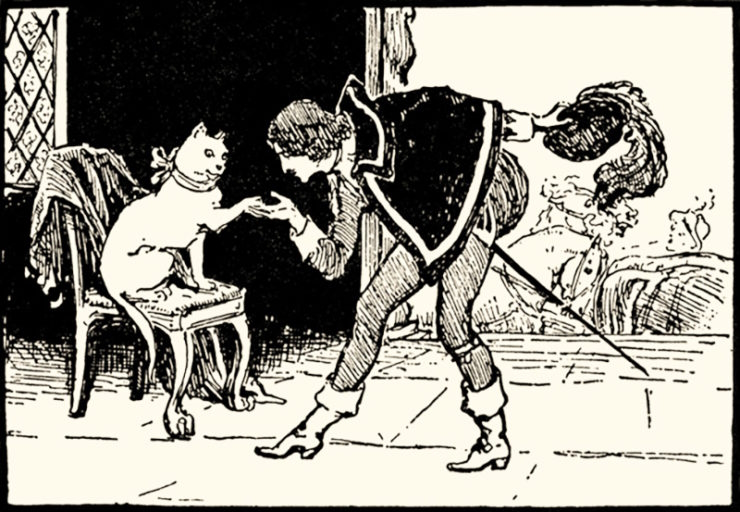
Following the adventures of the youngest son, we find him, drenched to the bone, at the door of a mysterious castle, knocking with a deer’s hoof that hung on a diamond-studded chain. Disembodied hands conducted him into the castle and royally dressed him. He was entertained by musicians, all of whom were cats, until the queen of the cats, a white cat, arrived to greet him.

In like manner, the white cat pleased him with all sorts of diversions for a year, at the end of which, she reminded him of his quest. Alarmed at his forgetfulness (He was under a spell.), he pleaded for help, freely given in the form of an acorn in which was the most petite of all dogs.

The young prince was clearly the winner over his brothers. However, the king, unwilling to relinquish the throne, proposed another challenge. He wished for muslin that was so fine that it could pass through the eye of a needle. Off went the brothers on their new quest.

The young prince returned to his white cat and was joyfully received for another year’s stay, at the end of which he was given a walnut, which he assumed held fine muslin. But when he opened it in the presence of his brothers and the king, inside was a hazelnut. Inside the hazelnut was a cherry stone. Inside the cherry stone is its own kernel. Inside the kernel is a wheat grain, and inside the wheat grain is a millet seed.

The young prince began to wonder if the white cat had played a trick on him, but inside the millet seed was a piece of muslin four hundred ells long, woven with wonderful colors and patterns. It did, of course, pass through the eye of a needle.

Once more, the king staved off the inevitable, declaring the sons must go off once again and find brides before one of them could take the throne.

Returning to his white cat, the young prince was appalled when, at the end of a year’s time, she instructed him to cut off her head. With extreme reluctance, he does so, and she transformed into a beautiful princess, the other cats turned into her court, and the disembodied hands into servants.

She then explained the history of her curse. As a child, she had been abducted from her royal parents by the fairies, and they arranged she should marry the king of the dwarves. However, one day, from her tower-prison window, she spied a young prince out hunting. They became friends, then lovers, and at the point of escape, the prince was eaten by the fairies’ dragon.

Furious at her deceit, the fairies returned her to her father’s court, turning them all into cats and hands. The only way to break the spell was to have another prince, identical to her lover, also fall in love with her. And that was what happened.

The young prince returned to his father’s court with his bride. Not only was she clearly the loveliest, but she also told them she had six kingdoms and would give the king one of them, and one for each of the brothers, still retaining three for herself and her new husband.

And so, all ended happily.

Fairy Tale of the Month: April 2024 The White Cat – Part Two

G P Jacomb Hood

So French

“French!” declares Thalia as I finish the story. We sit along the bank of the Enchanted Forest’s pond. Ultima’s brows knit. “You mean the Franks?” She sits with her back resting against the curled-up bulk of her napping dragon.

“Well,” I say, “in our world, the Franks are the ancestors of the French, the people of France.”

“Are we talking about a province of the Holy Roman Empire?” Ultima quizzes.

“Oh,” says Thalia, “we got rid of them a long time ago.”

“Got rid of?” Ultima’s eyes goggle. “Who would do such a thing?”

“Nationalists,” I reply.

“Well, whatever religion they may be, our dragons would never allow such chaos. I think that’s the trouble with your world; no dragons to keep the order.”

I will not argue the point.

“This tale,” I say, diverting us from anything political, “is really a literary fairy tale by Madame d’Aulnoy, a contemporary of Charles Perrault, a woman not known for fidelity.”

I observe my listeners. Ultima has a raised eyebrow. Thalia is smirking. Jini is staring at the dragon, not hearing a word of my exposition.

I continue.

“Her infidelity was not entirely her fault, I will argue. Her father married her off at fifteen to the Baron d’Aulnoy, thirty years her elder.”

Thalia’s expression dissolves into empathetic distress.

I forge on.

“The baron was accused of treason by two men, both of whom were Madame d’Aulnoy’s lovers. The baron spent three years in the Bastille.”

Thalia’s smirk returns. Ultima’s eyebrow remains raised. Jini continues to be oblivious to everything except the dragon.

“The baron eventually convinced the court that he was innocent and turned the tables on his accusers, who were executed in his stead. Madame d’Aulnoy avoided her arrest warrant by slipping out of a window and hiding in a church. She and her mother, who was also complicit in the scheme, fled the country.

“Her history gets a little murky at this point. She traveled to Spain, Holland, and
England, a hiatus of fifteen years, then was allowed to return to Paris, possibly as repayment for being a spy.

“On returning to Paris, she became a hostess for the salon scene, the gathering of intellectuals and social elites of the day. That was until a close friend was beheaded for trying to murder her abusive husband, she also a victim of an arranged marriage, not unlike Madame d’Aulnoy’s. Accused of being involved, Madame d’Aulnoy escaped being prosecuted, but for the next twenty years, withdrew herself from the Parisian social scene.

“During all this hectic life, she managed to have six children, arguably none of whom were the baron’s, and wrote twelve books of history, fiction (these two categories not clearly distinct in her mind), and fairy tales.

“Her best-remembered works are Contes de fées (1697), which translates into Fairy Tales and Les Contes nouveaux ou les fées à la mode (1698) which translates into New Tales, or the Fancy of the Fairies, similar in style to that of Charles Perrault but laced with her own sardonic touches.”

Ultima’s dragon stirs and looks around sleepily.

Fairy Tale of the Month: April 2024 The White Cat – Part Three

Can I . . .

“Can I touch him?” I hear a hint of fear in Jini’s voice.

“Oh, of course, dearie,” Ultima smiles. “Scratch him behind one of his horns; he likes that.”

As Jini does so, the dragon leans into it, nearly knocking her over.

“What’s his name?” Thalia asks.

“Cedric,” Ultima replies. “But tell me, your white cat does not sound feral.”

“Cats in our world,” I say, “are domesticated. A feral cat is simply homeless.”

Ultima raises a finger in the air. “So I have come to suppose from the evidence in this tale. I think of cats as nasty creatures, but d’Aulnoy’s white cat is all about grace and manners. That was a hard thing for me to swallow.”

“Fairy tales,” I say, “involve the Coleridge adage about ‘the willing suspension of disbelief.’ If you think an element of a story can’t be true, then you miss the truth of the story.”

I see that Jini, totally focused on Cedric, has willingly suspended her disbelief as she strokes his massive snout, now resting on her lap. I am a little nervous for her physical safety—he is so big—but all appears under control.

“The disembodied hands grabbed me. Pun intended,” Ultima winks. “That is a surreal image that sticks in the imagination. A tad frightening, really.”

“I agree.” Anything unnaturally disembodied makes me uneasy.

Ultima’s blank stare indicates contemplation. “I found unusual d’Aulnoy’s treatment of the three brothers. They were always civil with each other. They didn’t fall into murderous sibling rivalry, the expected trope for fairy-tale brothers.”

“Yes,” I say. “None of the biblical Joseph and the many-colored cloak business.”

“A little bit of a shame,” she returns. “It would have added some much-needed tension to the story.”

“Tension?” I query.

“All stories,” Ultima insists, “spoken or written, ought to have some tension in there to keep things interesting.”

I feel my brows automatically frown. “Shouldn’t intellectual content and insight be of enough interest?”

“Nope, sorry, give me tension.”

I sigh. I hear Thalia giggle at my distress.

“The only tension,” Ultima continues, “is the beheading; yet, what is that all about? Gratuitous violence to close out the story? OK, I know it is another trope, but then there is nothing in this story that is not a trope, except the disembodied hand and the kindly brothers.”

“Isn’t that enough to make it unique?”

“Nope.”

I sigh again. Thalia giggles.

“So what about the beheading?” Ultima cocks her head.

This is hard to explain.

“Beheading is an ancient practice to end an antagonist’s existence without honor, held in public. In the fairy tale, the beheading is between two protagonists, in private, for the purpose of transitioning one of them from a spell-state back to their original form, their true being. I think it may be the fairy-tale version of the Christian death and resurrection. The fairy tale, if nothing else, is about transition.”

I see Cedric has gone back to snoozing, his snout still in Jini’s lap, tears of joy streaking down her cheeks.

Your thoughts?
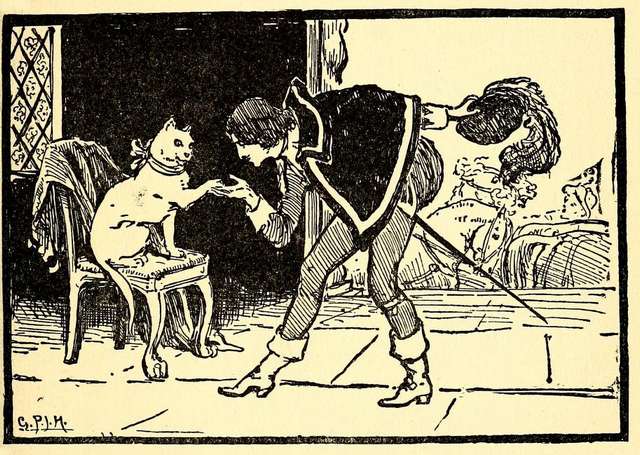
Fairy Tale of the Month: January 2024 Romany Tales – Part One

French oil painting

Three Crones

I find the winter doldrums a good time to straighten things up around the house, especially my study. My table, piled high with stacks of books, became my first target to establish orderliness.

I have them mostly back in their proper places on the bookshelves, but here in front of me, previously hidden by dusty tomes, are three clear, acrylic paperweights with a blooming flower captured at each of their centers. The three sat in the box they came in. A gift from—I don’t recall.

How long have they been here?

I pick the box up and head for the third floor, to what I think of as the nick-nack room. It brims with items I own but have no use for.

The bare, wooden stairwell up to the third floor echoes with the hollow sound of my footsteps. I should probably carpet this someday. I open the door to the nick-nack room and am greeted by darkness and a cold draft. A window must have been left cracked open.

I reach for the light switch and find my hand touching the bark of a tree trunk. Around me are other trees barely visible in the moonlight. Not far ahead is a campfire, its light showing the arc of a wagon wheel and the broad side of a caravan, as well as the figures of three, black shawled, seated women. I venture forward.

“Ladies,” I say in greeting.

“Ah! Here he is at last,” says one of the three ancient crones I see before me. “Sit, sir. You have taken your time. Look at us! What makes you think we would last much longer?”

“Oh, sister,” says another of them. “Don’t be hard on him. He is here in time for us.”

“And so he is,” says the third. “I will start the stories.”

In a fair forest lived a girl along with her four brothers, father, and mother. She had fallen in love with a handsome, rich huntsman, but he would take no notice of her, never answering her calls to him.

She entreated the devil to aid her. He gave her a mirror and told her to show it to the huntsman. She did, but the huntsman knew this to be the work of the devil and ran away. Too late, the girl found out that whoever looked into the mirror thereafter belonged to the devil and that both she and the huntsman were now his.

Still, the devil promised she would get her huntsman if she would give him her four brothers, father, and mother. The girl, for her love of the huntsman, did so.

The four brothers, the devil turned into four strings, each of a different thickness. The father, the devil made into a strangely shaped wooden box with one long arm. The mother became a stick with her hair becoming horsehair.

Stringing the father with the four brothers and drawing the mother across the strings, the devil invented the violin. The music he played caused the girl to laugh and cry. The devil told the girl to play the violin to attract her huntsman. This she did, and the huntsman was drawn to her.

They only had nine days together before the devil returned and demanded they worship him. They refused, and the devil took them away, leaving the violin on the forest floor. One of the Roma found it and played it for all who would listen, causing them to laugh or cry at his will, depending on how he played.

“Do my eyes play tricks on me?” I say. “Now that this story has ended, the three of you look a good bit younger than when I sat down with you.”

They laugh, smile, and nod to each other.

Fairy Tale of the Month: January 2024 Romany Tales – Part Two

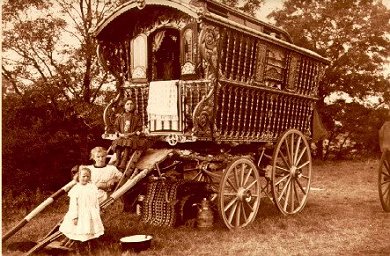
Caravan

Next Tale

The second of the Roma women feeds the campfire. Sparks fly up like little stars ascending to heaven. She adjusts her shawl around her shoulders and begins her tale.

The emperor of Bukovina gave a ball, during which a mist descended and carried away the empress. The emperor’s three sons set off to search for their mother.

They came to a place in the road that went off in three directions. Each brother took one of the paths. The youngest, a seer as well as a prince, suggested they each take a bugle to blow upon and call the others should they find their mother.

Entering a forest, the youngest eats an apple from a tree, and two horns grow on his head. While crossing a stream, the flesh fell from his body. At another apple tree, he declared he would follow God’s will and eat another apple. The horns fell from his head, and when he forded another stream, his flesh was restored.

On a mountain, he found a spot bare of trees with a boulder setting at its center. He found he had the power to move the rock easily, which covered a huge, deep hole. With his bugle, he called his brothers. They made a rope from the bark of trees, and it was the youngest who was lowered in a basket into the hole; the elder brothers not willing to try.

In the world below, he came to a house in which dwelt a princess, carried off and kept there by a dragon. The prince inquired of his mother, and the princess sent him to her sister’s house, and she on to the youngest sister’s house. It was she who knew where to find the empress.

He rescued his mother as well as the three princesses and had his brothers pull them up one by one in the basket. Before he sent the youngest princess up, they pledged marriage.  

Not trusting his brothers, he put a stone in the basket, and, as he suspected, halfway up, the brothers let go of the rope. Wandering into the dragon’s palace, he found a rusted ring. When he polished it, a little man appeared to grant his wishes. The youth wished to be in the upper world.

After returning, he washed his face with certain water, which altered his appearance. He went to his father’s tailor to become his apprentice, knowing the wedding clothes would soon be ordered. 

The youngest princess refused to marry either of the two brothers, so they arranged to marry the other two sisters. The youngest prince/apprentice, with the help of the magic ring, made marvelous wedding clothes and was invited to the palace.  The brothers decided to marry off the youngest princess, who had refused them, to this apprentice. She, at first, again refused to marry, but the apprentice revealed his identity to her, and she accepted.

The apprentice/prince had his little man build a three-story castle that turned on a screw to follow the sun. The roof of the castle was made of glass in which swam fish so that guests would look up and see fish sporting about.

During the wedding feast, the younger brother washed his face with other certain water, and all now recognized him. He challenged his brothers to come out with him, so that all three could cast their swords high into the air. If they were innocent, their swords would fall in front of them. If not, the swords would strike them on their heads. In this manner, the two elder brothers killed themselves.

“I am sure of it now,” I say. “You all are indeed younger. Your skin, no longer wrinkled.”

Even their shawls have changed. Instead of somber black, they are laced with red and blue threads.

“Of course,” says the second of them, “that is why you are here.”

Fairy Tale of the Month: January 2024 Romany Tales – Part Three

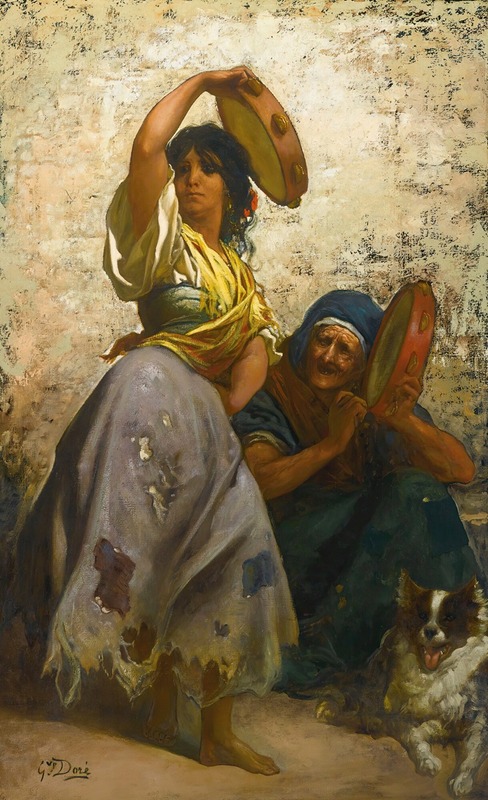
Gustave Doré

Last Story

The third woman puts a log on the fire, sending up another wave of sparks. I am sure her story is next in the round-robin of Romany tales.

She sits quietly, looking into the flame before speaking.

The Red King declared he would reward anyone who could tell him who it was that every evening stole the food he had locked away for himself. His three sons tried in turn, but only the youngest managed to stay awake. He witnessed his baby sister turn into a hideous witch, steal the food, and, with a somersault, turn back into a baby.

Instead of telling his father about what he saw, he asked for money and a horse so that he may go out into the world and find a wife. He buried the money in a stone chest and marked the spot with a stone cross.

He traveled for eight years until he came to the Queen of the Birds. He told her he looked for the place where there was no death or old age before he would marry. She told him that with her, there would be no death or old age until she had whittled away her forest. That did not satisfy the prince.

He traveled on for another eight years until he came to the Maiden of the Copper Castle. She told him there would be no death or old age with her until the mountain and forest were leveled.

Again, the prince traveled on until his horse warned him they had come to the Plain of Regret, and they must flee.

 They came next to the home of the wind, who appeared to be a lad. Here there was no death or old age, and the prince declared he would never leave.

After a hundred years, he was warned by the wind to never go near the Mountain of Regret or the Valley of Grief. The prince did not listen, went there, was overcome with both, and desired to go home.

The wind told him that nothing remained of the Red King’s realm and that, in fact, a million years had passed. Again, the prince did not listen. While returning, he came across the Maiden of the Copper Castle. Nothing was left but the dying maiden. He buried her and went on. The very same thing happened with the Queen of the Birds.

When he arrived at the place of his father’s kingdom, all he could find was his father’s well. There was his witch/sister, who attacked him, but she, too, perished when he made the sign of the cross.

He met an old man who would not believe his story. To convince the old man, the prince found the spot where he buried the stone chest. Only the very tip of the stone cross remained above ground.

The prince dug up the stone chest and opened it. Inside, sitting on the coins, were death and old age, who leapt out and seized the prince. The old man gave him a decent burial, placed the stone cross at his head, and left with the money and the prince’s horse.

“Well, well,” I mutter.

The three young girls, brightly dressed in scarves, bangles hanging from their wrists—the shawls gone—smile back at me. The sun is rising, and I see my box of paperweights lies in my lap. I hand each of the girls a present, over which they ooh and aah.

“Ah, but kind sir,” one says, “we must now take from you your memory of this evening that we can remember ourselves as you see us now; then we will not forget and become old again.”

Lightly, they touch their fingertips to my head. I thrill at this odd sensation, then find myself at the nick-nack door.

Why am I standing here? What did I come for? Ah! This short-term memory stuff! It is so annoying getting old.

Your thoughts?
(Source: Gypsy Folk Tales by Francis Hindes Groome)

Fairy Tale of the Month: May 2023 The Girl Who Went To War – Part One

Battle of Castillon

Row Row

Rowing on the Isis with Duckworth is one of my delights. The month of May is the perfect time for such an exercise. He and I apply our backs to the oars. But something is not right.

“Duckworth,” I say, “you are being rather quiet.”

“Am I? Sorry. I am distracted.”

“Over what?” I ask, still applying strength to the oars.

“It’s my eldest daughter. She is thinking of joining the military. I am not at all fond of the idea.”

“Wait. How old is she?”

“Thirteen.”

“Oh, Duckworth, there is plenty of time for her to change her mind.”

“Yes, I know,” he concedes, “but she is single-minded.”

“Well,” I say, “call it synchronicity, but I read a tale last night dealing with this issue.”

“What? My daughter joining the military?”

“Quite so. It’s a story collected by R. M. Dawkins in his Modern Greek Folktales, called The Girl Who Went to War.”

Three sisters decide, taking a dim view of their marriage prospects, to become soldiers instead when their country is invaded. Their father dissuades them, one by one, as they venture out, by disguising himself as a warrior and threatening with his sword.

However, the youngest, who when younger, had found a colt by the seaside and raised it as her own. Fully grown, it could breathe fire and had the power of speech. When she dresses herself as a young man, arms herself, and sets off to war, the horse warns her of her father’s ruse. When confronted by him, she attacks. Realizing there is no dissuading her, he gives his daughter his blessing.

“Yup,” says Duckworth, “that’s my daughter.”

Coming to the battle, she draws her double-edged sword, and her horse is soon knee-deep in blood. Single-handedly, she drives the enemy into submission.

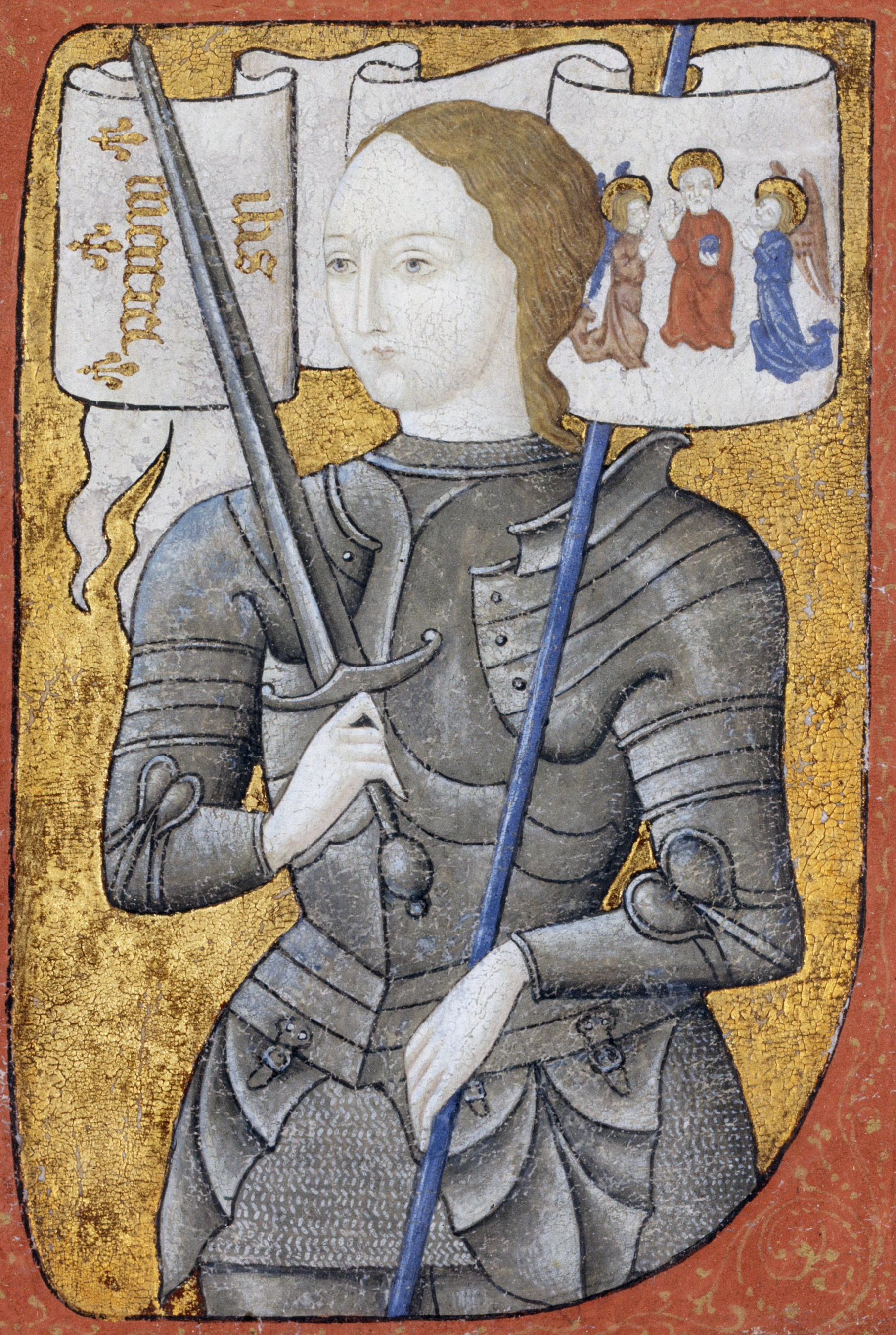
“That’s rather Joan of Arc-ish,” Duckworth comments.

Her king, who is unaware of her true identity, is delighted with his new hero, marrying this warrior off to his very own daughter.

“Oops,” says Duckworth.

The newly wed princess is distressed when her “husband” puts a sword between them in their bed, commanding she shall not cross over it. Both the princess and the queen are enraged and convince the reluctant king to send the “youth” on an impossible quest.

The king asks his esteemed warrior to bring him an apple from paradise. With the horse’s advice, the youngest steals the clothing of one of the girls of paradise while she is bathing and returns the garments for an apple.

“That’s one,” Duckworth nods. “I bet there are two more.”

Next, she is given the task of collecting seven years of taxes from a notoriously resistive village. However, with the horse’s advice and not too many deaths, she succeeds.

For the third task, it is the queen who makes the request. There is a wild mare that guards ten thousand acres of fertile land and wears a band plaited with diamonds and “brilliants” that shine so brightly that no one can go close to it. The queen wants the mare defeated and brought to her.

With great trepidation, the girl’s horse comes up with a plan, battles with the mare, and defeats her through trickery.

For the fourth task . . .

“Wait, a fourth task? That’s not right.”

For the fourth task, they enlist the horse’s mother, who rises from the sea and would devour the girl but for the horse’s insistence that she does not. The girl rides the mare into the land of the one-eyed giants to steal their fire. By throwing magical devices behind them, they outrun the giants. Unable to cross their boundary, the giants hurtle a curse upon the girl. “If you are a boy, you will become a girl. If you are a girl, you will become a boy.”

“Ha!” says Duckworth. “Brilliant.”

Fairy Tale of the Month: May 2023 The Girl Who Went To War – Part Two

Joan of Arc – 15th Century

More Rowing

“Would you call that a ‘trans’ fairy tale?” Duckworth inquires. “If so, the tale is way ahead of its time.”

“No, no, not at all. Questions of sexuality have always been with us. This tale only reflects that. I can think of another of this ilk, a Danish tale simply called The Princess Who Became a Man.”

The rhythm of our rowing lets my mind wander. “There is also another tale called The Lute Player. In that case, a queen disguises herself as a young male musician in order to rescue her husband. There is no question of sexual identity on her part, but she knows she’d make an attractive young man.”

“Ah, I see your point.” Duckworth stops rowing to tap a finger to his head. “Shakespeare was known to dress his female characters up as men. Let me remember; Rosalind in As You Like It and Viola in Twelfth Night.”

“I’m impressed with your memory. Have you ever considered going on a quiz show?”

Duckworth waves off my compliment. “Cross-dressing for comic effect, as Shakespeare did—having other women fall in love with the hero/heroine—and an actual ‘trans’ experience are two different things. This tale you just told me has both.”

“There is an irony in all that,” I say, still rowing, “In Shakespeare’s day, women were not allowed to perform on stage. Young men were used to represent women. In Rosalind’s and Viola’s cases, young men were pretending to be women who were pretending to be men. Did anyone ever notice?”

Duckworth takes up his share of the rowing again. “I quipped a few minutes ago about how Joan of Arc-ish the main character is, but I’m beginning to take my comment more seriously.”

“That sounds dangerous.”

Duckworth ignores the comment and continues. “When were the fairy tales, as we know them, created?”

“Oh, starting around the twelfth century they were first recorded, but certainly they evolved before that and since.”

Duckworth puts down his oars to fact-check. My shoulders are getting a bit stiff.

“Right, so, Joan of Arc is early fifteenth century. Goodness, she was only seventeen when all that started and burned as a heretic by nineteen. Ah, here is what I was looking for. She was captured by the Burgundians, who turned her over to the English. They put her on trial for heresy, one of the charges being blasphemy for wearing men’s clothing.”

Duckworth’s eyes are fixed on his cell. “This is all in the context of the Hundred Years’ War. It was her influence, even after her death, that inspired the French to keep fighting and eventually win.

“I can’t help but see shades of Joan’s history in this tale. A woman dressing as a man bursts onto the battle scene, driving the enemy before her, in a sense, single-handedly.”

Not keeping doubt from my voice, I say, “If that is so, should not there be a French version of this tale instead of a Greek one that has come down to us?”

“Stories travel,” he defends.

“Yes, they do, but the parallel between Joan of Arc and our heroine ends with the cross-dressing and the initial battle. There is neither talk of any kind of marriage concerning Joan nor does she have a talking horse.”

“Well, I did say ‘shades of Joan’s history.’ Joan’s history did not have a fairy-tale ending.”

That is true enough.

Fairy Tale of the Month: May 2023 The Girl Who Went To War – Part Three

John Bauer

Merrily Merrily

“What about all those horses in this story?” Duckworth has returned to rowing.

“Well,” I say, “talking horses are not rare in these tales. Horses contesting with each other are well enough known. However, a horse calling on its dam from out of the sea, I have not encountered before. I am not sure what to make of her.”

“I suppose,” says Duckworth, doing a good job at the oars again, “all animals can talk in the tales.”

I hesitate. “Not exactly. I think it falls into categories.”

“Ah,” Duckworth returns, “categorize away. I am listening.”

“I am thinking out loud,” I warn. First off, the animals that can talk are rather culturally dependent. For example, folktales from India can have snakes talking, which rarely, if ever, happens in European tales, despite Old Testament references to such a thing. I will stick to the European tales, which I know better.

“Category one: Animals talking to other animals. Actually, I think that category is pretty universal. I have been led to believe that in China there is a prejudice against animals and people talking to each other. I read somewhere that Alice in Wonderland was banned in China in the 1930s for that reason. Nonetheless, animals talking to animals was fine with them.

“Category two:—perforce—is animals talking to people.  Under this category, I can make a number of subcategories.”

“You are pretty detailed,” Duckworth interrupts, “for just thinking out loud.”

My turn to ignore. “Subcategory one: Talking animals who are actually royalty under enchantment.”

“Oh, lots of those,” says he.

“Think I’ll call this the “East of the Sun” category. It is well populated by bears but also foxes, as in The Golden Bird. I cannot forget the frog in The Frog King, nor the beast of beauty fame.”

“My favorite is the flounder,” Duckworth puts in.

The Fisherman and His Wife, yes, and interestingly, something of an exception. We hear from the start that the flounder is an enchanted prince and, in the course of the story, remains so. All the other tales have the talking creatures transformed at the end of the tale and revealed as humans.”

“What about,” Duckworth interjects, “characters that are transformed into animals by a witch or to escape a witch?”

“Such as in Brother and Sister? Hmmm. Difficult. That group is transformed during the story, not before the story began, and may or may not be of royalty, and may or may not talk while in that state. I might need a sub-subcategory.

“I will exclude characters that learn the language of animals and birds. That would be a bit of a cheat to get into one of my categories.”

“Oh,” says Duckworth, “now there is competition for this honor.”

I get to ignore him again. “Subcategory two comprises the animal helpers.”

“Lots of them too.”

“And here we return to the horse, mare, and dam of our story. The horse is the magical helper. He coerces the mares to do his will. I wonder if the mare and the dam were the same being in an earlier iteration of this tale. That would have been more logical, but the tales are weak on logical construction. The tellers/creators of the fairy tales were more in tune with emotional impulses than striving for believability.”

“Hmm. That might explain some things.”

“Also note, all talking animals, whether enchanted or helpers, nonetheless are helpful. The hero/heroine never receives a threat from a talking animal. From giants, witches, trolls, and dwarves, yes, but from animals, no.”

“I’ll try to remember that if ever my dog starts talking to me,” he smiles.

“And,” I’m not done yet, “horses are never enchanted royalty. They can be eerie, like the severed horse’s head hanging in the dark gateway of the city as in The Goose Girl, but not royalty.”

Duckworth nods in contemplation.

“My,” I say, “our conversation has wandered far from the subject of your daughter’s career options.”

I immediately wish I’d not said that as I see him slip back into gloominess.

“What career would you rather she follow?”

“Dentistry.”

Dentistry? Where did that come from?

“You know,” I say, “the military does offer the opportunity to travel.”

Your thoughts?

Fairy Tale of the Month: March 2023 Tinker of Tamlacht – Part One

A Visitor

We are making ourselves comfortable in the study after celebrating Saint Patrick’s Day with a feast. For the menu, Melissa and Thalia had settled on corned beef and cabbage, colcannon, leek soup, and soda bread. Now, Melissa and I cradle glasses of Guinness in our hands, while the girls have warm cider.

Yes, girls. Jini is with us, having been sworn to secrecy. She and Thalia decided best friends cannot have secrets from one another.

We have given her the somewhat overstuffed Queen Anne’s chair. To her delight and my surprise, Johannes has jumped into her lap and curled up. She pets him gently as her eyes try to penetrate the dark corners of the room where the brownies are scuttling about.

I watch her closely. Sure enough, as I hear the fairy fluttering through the study’s archway, her eyes go anime.

“Ah, she can see our fairy. I don’t think everyone can.”

Thalia hardly notices the fairy alight on her shoulder as she opens her book, Hibernian Nights, and announces the story, The Tinker of Tamlacht.

There lived in Donegal, in the village of Tamlacht, a poor tinker, who one day finds himself in a bog after trying to take a shortcut. He declares, “May the devil take me if I ever come this way again.”

When he gets back on the proper road, three beggars meet him in turn, to whom he gives what little money he has. The three beggars turn out to be an angel, and the angel gives him three wishes. 

First, the tinker wishes for a full meal chest; second, that what goes into his workbag stays there until he lets or takes it out; and third, those who take the apples from his tree will stick there until he releases them.

Sometime after that, he again tries the bog shortcut and meets the devil, who reminds the tinker of the vow he made. Fortunately for the tinker, the road to hell leads through Tamlacht. The tinker convinces the unpopular devil to hide inside the workbag while they go through the village.

The poor, unsuspecting devil ends up being placed upon an anvil and beaten with hammers until he disappears in a column of fire.

The tinker returns home from that adventure to find his wife has had a baby. He goes out to find a godfather. He rejects the landlord, who takes advantage of the poor; he rejects God, who lets the landlord get away with his greed; but accepts Death as the godfather because he treats everyone equally.

Death rewards the tinker with a bottle of “The Ointment of Health,” which can cure anyone, providing that Death is not standing at the head of the bed but rather at the foot. By this device, the tinker became a wealthy doctor, curing many of the sick.

One day, in a moment of softheartedness, he tricks Death by having the bed turned around, putting Death at the foot of the bed. Death now taps the tinker on the shoulder and tells him to follow. The road, again, takes them through Tamlacht. The tinker asks Death to pick him an apple from his tree as a memento. The moment Death touches the apple he is stuck.

The tinker leaves Death there for a hundred years—during which no one dies—before taking pity on him. Death agrees to leave the tinker alone for another hundred years, which was well since Death had a lot of catching up to do.

However, when the tinker’s allotment comes due, he asks for the time it would take his burning candle stub to gutter out to make his will. Death agrees and the tinker blows out the candle so that it will never gutter out.

It takes Death another hundred years to find the candle, relight it, and watch it gutter out. Once more, the tinker asks for time to utter a pater-and-ave. This Death grants and the tinker refuses to say one.

A hundred years pass until Death in the disguise of a lost soul, tricks the tinker into saying a pater-and-ave for him. Death takes the tinker to heaven, but God will not allow him in for having refused him as godfather. The devil will not let him into hell, saying the tinker will make it too hot for him.

Death and the tinker settle on Death turning him into a salmon in the river Erne, where, to this day, he taunts and eludes sports fishermen.

“Ha! Clever,” says Johannes.

Jini, whose stare had been fixed on the fairy, now peers down, wide-eyed, at the cat curled in her lap.

Fairy Tale of the Month: March 2023 Tinker of Tamlacht – Part Two

Image courtesy of oldbailyonline.org

More Guinness

I put another log on the hearth fire, then return to my second glass of Guinness. The girls have gone off to Thalia’s bedroom—a young girl’s inner sanctum—with the fairy perched atop Thalia’s head and Johannes nestled in Jini’s arms. I can’t get over Johannes glomming onto Jini as he has.

“Thalia picked an appropriate tale for the evening,” Melissa comments, raising her glass. “Very Irish.”

“Long for one thing,” I say.

“And full of trickery.” Melissa swirled the stout in her glass. “At the start, the tinker tricks the devil. In the next part, he chooses Death as a godfather after insulting God. He soon proceeds to trick Death for hundreds of years. Death finally gets his bony hands on the tinker only to find he can’t get rid of him.”

I take a sip of my Guinness before answering. “It feels rather like more than one story stuck together except that the end is set up during the story. Death can’t get rid of the tinker because of what the tinker did earlier in the tale. It all holds together very well. Maybe a little too well. Might there be some literary influence by the editor?”

Melissa roots around in her purse for her cell phone. “If I recall the biography of Seamus MacManus, that is an arguable point.” Her fingers scan her phone. “It says he was an Irish dramatist, a poet, a prolific writer of popular stories, and important in the rise of Irish national literature.

“It doesn’t say anything about him being a collector or editor. This site goes on to list fifty books by MacManus. Story of the Irish Race seems to be the big one. It also seems that he was deep into the Irish Republican Movement.”

I sip my Guinness while she pokes around on her phone before she continues. “Yes, he married Ethna Carbery, daughter of a well-known leader of the Irish Republican Brotherhood. She was a poet and writer like himself, whose real name was Anna Bella Johnston. She and a few other women started the Shan Van Vocht, a national monthly on literature, history, and commentary. Very popular. MacManus was a contributor. I’ll guess that is how they met.

“Oh dear,” Melissa gasps, “she died a few months after they got married. How sad. It was MacManus who then published most of her poetry, also very popular. He had at least one play produced and wrote others. Oh! He was also a founding member of Sinn Féin!”

‘”Right,” I say. “You don’t get much deeper into Irish nationalism.”

“However,” Melissa goes on, “it does not look like he was in Ireland for the Easter Rising. In 1908 he is in America lecturing in literature at Notre Dame University, Indiana, getting remarried in 1911 in New York, and getting a doctorate of law conferred on him by the University in 1917.”

“When was the Easter Rising?” I ask.

“1916.”

“Who did he remarry?”

Melissa scrolls backward. “Catalina Violante Páez, a writer and granddaughter of the first president of Venezuela.

“Oh dear!” Melissa’s eyebrows rise.

“Oh dear again?” I say.

“He died in 1960 at the age of 92, falling out of a seventh-story window at a nursing home.”

“Now, that sounds a little suspicious,” I can’t help saying.

“Nonetheless,” Melissa insists, sipping her stout, “back to our original discussion. There is the claim that he was the last of the traditional shanachies but obviously well educated. Can one be well educated and a shanachie at the same time? I always think of the old storytellers as illiterate or semiliterate, not lecturing at a university.”

“Well,” I say, “maybe we should let him defend himself.”

Melissa looks at me blankly for a moment, then says, “Oh, Miss Cox’s garden.”

Fairy Tale of the Month: March 2023 Tinker of Tamlacht – Part Three

Ferguson, St. Louis Post-Dispatch

Seamus MacManus

Melissa and I have deposited ourselves on a wrought-iron bench with a small wrought-iron table in front of us and another bench on the other side; a new seating arrangement in the garden. The teapot in its cozy awaited us when we entered.

It is not long before a distinguished-looking gentleman enters through the gate, and we rise to greet him. He is trim in build, handsome with a long, pointed beard. Most animated is his expressive face.

I introduce Ms. Serious and myself, and Melissa pours out a round of tea. Seamus’s manner is easy and friendly as if we’ve known each other before this meeting.

“Mr. MacManus . . . “Melissa starts.

“Call me Seamus, please.”

“Mr. Seamus,” Melissa grins with a little deviltry, “I am curious how you came to collect such a large number of Irish tales?”

“Easily answered. By being a boy in old Donegal that hadn’t noticed that the world was changing. I grew up cutting peat bricks out of the bogs, herding sheep, and hearing stories. None of these are the occupations of lads today. It is still the smell of peat burning on the hearth that goes along with the stories in my memory. 

“By a hundred happy hearths on a thousand golden nights, then I, with my fellows, enthroned me under the chimney brace, or in circle, hunkered on the floor in the fire glow, heartening to the recital, and spellbound by the magic of the loved tales so lovingly told by fear-a’tighe (man-of-the-house) or bean-a-tighe (woman-of-the-house). Not many women could be termed shanachie, but she was a poor mother who had not at least a dozen or twenty tales on which to bring up her children.”

Seamus takes a sip of tea under Melissa’s admiring eyes.

“Thus and so, we Donegal children learnt the folk stories and the telling of them. Thus and so it was that we in turn propagated them. Thus and so it was that these fascinating tales through the long, long ages, gave to millions after millions, entertainment, happiness, joy, as well as the awakening and development in them of that beautiful imagination and sense of wonder that lightened, brightened and gilded lives that through near-hunger, hard labor and perpetual struggle with fate might well be expected to leave been sore and sour to bitterness.

“But the circumstances hard or otherwise, storytelling was ever a propagator of joy. The advent of printing and growth of reading it was that began the decline and finally the practical extinction of the hallowed art. Yet no multiplication of books and mushrooming of readers could compensate the world for the sad loss incurred. The read story never did, never will come near the benefiting quality of the told story. Two of the essential good qualities of the latter, the former never can capture. The read story may be said to be a dead story, prone on the printed page, entombed between boards, while the told story is a very much alive story, glowing, appealing, and dancing with energetic vitality—the personality and inspiration that the good storyteller can always command into the tale he tells. While the read story may possess the value of the story alone, the told story carries, superimposed on it, the golden worth of a good storyteller’s captivating art and enhancing personality—trebling in wealth.”

“Well,” says Melissa, “I do believe you may be the last of the shanachies.”

Your thoughts?

Fairy Tale of the Month: February 2023 The Poor Miller’s Apprentice and the Cat

Warwick Goble

Good Bread

“We’re here for the bread,” Melissa states.

“And a glass of wine?” I suggest.

“And a glass of wine.”

We are entering Noble Rot, the Lamb’s Conduit Street location. I know they also have a shop in Soho. The place is quite inviting; dimly lit in a cozy way, wooden floors, dark green wainscoting, which runs around most of the room, and each table has a tea light in its center. We take a table near the crackling fireplace. It is February after all.

“A bread plate each is all we need,” Melissa tells the waiter.

I am looking at the menu. “And, perhaps, the slip sole,” I add.

Melissa rolls her eyes.

“And a splash of wine?” the waiter asks.

“Oh, yes,” I say, picking up the wine list.

My lord, it’s the size of a novella!

Thirty-two pages. I am overwhelmed.

“I guess white wine with bread.” I venture.

“And German,” says Melissa.

“By the glass?”

We nod.

“Then it will be the Stein Palmbury Reisling.”

“Excellent,” I say. As the waiter leaves, I ask Melissa, “Why German? You’re being thematic, I will guess.”

“I am. I’ve been rather curious about a Grimm tale, The Poor Miller’s Apprentice and the Cat.

“Delightful. Refresh my memory.”

Actually, I don’t think I ever read it.

“It is something of a Puss and Boots and The White Cat variant.”

An old miller, with no wife or child, neared his retirement; a time, he said, when he wished to sit by the stove. He told his three apprentices that he would give the mill to one of them, providing that the new owner would sustain him in his old age. The contest would be decided by who could venture out and bring back the best horse.

The three apprentices started out together, but the elder two soon found a way to abandon Hans, the youngest. Wandering about, with no direction, he was approached by a multicolored she-cat that offered to give him a horse—the cat already knowing his need—if he would be her servant for seven years.

He agreed and was taken to her castle, where all the servants were kittens.  They served Hans and the cat their dinner, during which the kittens played on a double bass, a fiddle, and a trumpet for their entertainment. When the meal was over, the cat asked Hans if he would dance with her. He refused, saying he did not dance with pussycats. She then instructed the kittens to take him to his bed. The kittens tucked him in and then in the morning they woke him, washed him, dried him with their tails, and got him dressed.

After that, he proceeded to be the cat’s servant, for the most part chopping wood with tools made of silver. He also mowed her meadow with a sliver scythe and built a silver cottage with silver tools.

When the seven years were up, the spotted cat showed him his fine horse, told him to return to the mill, and said, in three days, she would come with the horse. Unfortunately for Hans, during the seven years, she had not given him any new clothes. Ragged as he was, the miller and the other two apprentices laughed at him and would not let him eat or sleep in the mill. He had to content himself by sleeping in the goose house. Since he did not return with a horse, they mocked him. They, at least, returned with horses, although one was blind and the other lame.

However, on the third day, a princess arrived in a coach pulled by six fine horses with a servant leading a seventh horse, the likes of which had never graced the miller’s yard before. The princess had her faithful Hans washed up and nobly dressed, and he appeared to be as handsome a lord as any. She told the miller he could keep his mill as well as the horse.

She and Hans returned to the silver cottage he had built, which had become a huge silver and gold castle. The marriage followed and Hans never wanted for more.

Our waiter returns with the plates of bread. The delectable aroma alone is worth the sojourn to Noble Rot. 

Fairy Tale of the Month: February 2023 The Poor Miller’s Apprentice and The Cat

George Percy Jacomb-Hood

An Insertion

On the plate are three kinds of bread, two pieces of each kind: soda bread, focaccia, and sourdough, plus a pat of butter. The waiter sets down the glasses of riesling to complete the picture. Knife in hand, I apply the butter to a piece of soda bread as a starter.

“I rather like the bit about the kitten servants drying Hans off with their tails,” I say.

“I did too.” Melissa takes a sip of wine. “Which is why I have half a mind to call Wilhelm to Miss Cox’s garden and scold him.”

“Whatever for?”

“When I came to the part about the spotted cat wining and dining Hans, who then refused to dance with her, that struck me as a significant moment in the story.”

The soda bread might be my favorite, even though I haven’t tried the other two.

“However, she does not seem to take offense. The next day, Hans appears to take up his duties as a servant and the events go on from there.

“I’d not run across this refusal-to-dance motif before. I racked my brain to think of a parallel. What could this signify in the folk mind in which these tales arose? Out of caution, I went back to the 1815 version of the tales in Jack Zipe’s book, The Original Folk and Fairy Tales of the Brothers Grimm. I discovered that the stuff about the kittens, the music, the wining and dining, and tail drying were not there. At all. The 1815 story goes from Hans agreeing to be the spotted cat’s servant to a description of his duties for the next seven years.

“Here I’d gone off, mistakenly, into thinking the refusal-to-dance might be an unrecognized story element, perhaps steeped in Germanic folklore. Instead, it turns out to be Wilhelm’s fanciful insertion.”

I laugh gently while sampling my focaccia. “I know the Grimms did alter the stories when they realized they had a younger audience than for which the first edition had been intended. They removed sexual content, replaced pagan elements with Christian subjects, and turned evil mothers into stepmothers.”

“True,” Melissa frowns. “But this change does not qualify for any of those reasons. I assume Wilhelm attempted to appeal to his bourgeois audience. He simply upped the storyline a little. It makes me wonder how often he allowed his German Romanticism to creep into these reputedly folk-inspired fairy tales.”

No, the focaccia might be my favorite.

“I guess,” I muse, “we should have been suspicious when the story gave too much visual description; the double bass, the fiddle, and the trumpet, not to mention the delightful thing about the tails used for drying. Details like that are sparingly given unless necessary for the storyline.”

Melissa nods, nibbling her sourdough. “After I saw what must have happened, it became clear to me that the tone of the section with the kittens differed from what went before and what followed. On consideration, I conclude it was a rather clumsy, somewhat confusing, unnecessary thing for Wilhelm to have done.”

Oh my, the sourdough is as good as the other two.  

Fairy Tale of the Month: February 2023 The Poor Miller’s Apprentice and The Cat

Something More

The slip sole arrives, a small flatfish fillet with a smoky, honey glaze that creates an olfactory sensation.

“I tried,” Melissa continues, “checking the Grimm notes in Margaret Hunt’s book to see if there might be some enlightenment. All I got was an even crazier version of the tale. Are you ready for this one?”

“Carry on,” I say. I am happy to let her chatter while my epicurean soul delights in the aquatic sole.

A miller sends his three sons out to find the best horse and claim the mill. The youngest meets a little gray man, whom the lad serves as a woodcutter for a year in return for a good horse. The lad meets his brothers on the way home. Their horses are either lame or blind. In jealousy, they throw their younger brother into a lime pit. The little gray man pulls him out, restores the lad to life, and retrieves the horse. 

For reasons unexplained, the father decides the mill will go to the son who can bring him the best shirt. The lad gets the best shirt, meets up again with his brothers, who tie him to a tree and shoot him dead. Again, the little gray man appears and brings him back to life.

When the lad returns to the mill the second time after dying, the elder brothers convince their father that the younger is in league with the devil. (Which from their point of view was arguably true given they had left him for dead twice). The father proposes a third test; this time one of them must bring back the best loaf of bread, since, as the story states, “. . . the devil has no power over bread.”

The lad, on his quest, shares his food with an old woman in the forest, who gives him a wishing-rod. When he uses it, a little tortoise comes to him declaring, “Take me with you.” He puts the tortoise in his pocket, and the next time he puts his hand in, there is the tortoise and lots of money.

He sets the tortoise up in the best room at an inn and travels on from there for a year, unsuccessfully searching for the best loaf of bread. (The arrangements for the tortoise to live at the inn in the meantime are not well explained.) Upon returning to the inn, the lad sees that the tortoise has two, pretty, white feet. That evening, he sees a shadowy figure kneading bread. In the morning, there is a perfect loaf of bread. Taking the loaf home, he can no longer be denied ownership of the mill.

On his return again to the inn, there in the bed is a princess as well as the tortoise. She explains that he has broken the spell over her, and they can now marry. But first, he must return home and wait for her. She tells him that when he hears the first cannon, she will be getting dressed. When he hears the second cannon, she will be getting into a carriage. When he hears the third, he should look for a carriage being pulled by six white horses.

Afterward, they are married and might have lived happily ever after except that he let the tortoise fall into the fire. Outraged, the princess spits in his face. Devastated, he goes off, digs a deep cave for himself, over which is carved the inscription, “Here none shall find me, save God alone.” There he lives and prays for many years.

Eventually, an old king, having fallen ill, travels the country looking for a physician to cure him but without success. He comes by accident to the cave and is miraculously cured. Seeing the inscription, he instructs his people to “dig down” until they find the hermit.

When the king finds out that this hermit is his son-in-law, he brings about reconciliation between his daughter and the hermit, and they all live long and happily.

“Good grief,” is all I can say.

“Yes, well,” Melissa smiles, sipping the last of her glass, “I think our bread and wine was the perfect little repast.”

I agree, but I am fingering the menu, and my eyes fall upon the dessert section.

Basque Cheesecake and Rhubarb.

Your thoughts?