
Grimm Again
Earlier this evening, I found Thalia and Jini popping popcorn in the kitchen.
“Movie night?” I asked.
“Nixie night,” they replied.
I was a little stunned. “You’re visiting the Nixie? Why?”
Thalia and Jini glanced at each other. “Girl stuff,” they said.
“She’s dangerous, you know?”
“We know. Melissa has warned us as well.”
I let it go at that. I had tried to set up unbreakable rules with my daughter, which only led to the appeal of forbidden fruit. I tried to keep her from making mistakes, but it only kicked the can down the road for her to make mistakes later.
Nonetheless, I feel uneasy. I divert my attention by picking up Grimm when I settle into my comfy chair. Using Thalia’s childhood method of choosing a story, I close my eyes, whirl a finger in the air, and bring it down at random on the table of contents.
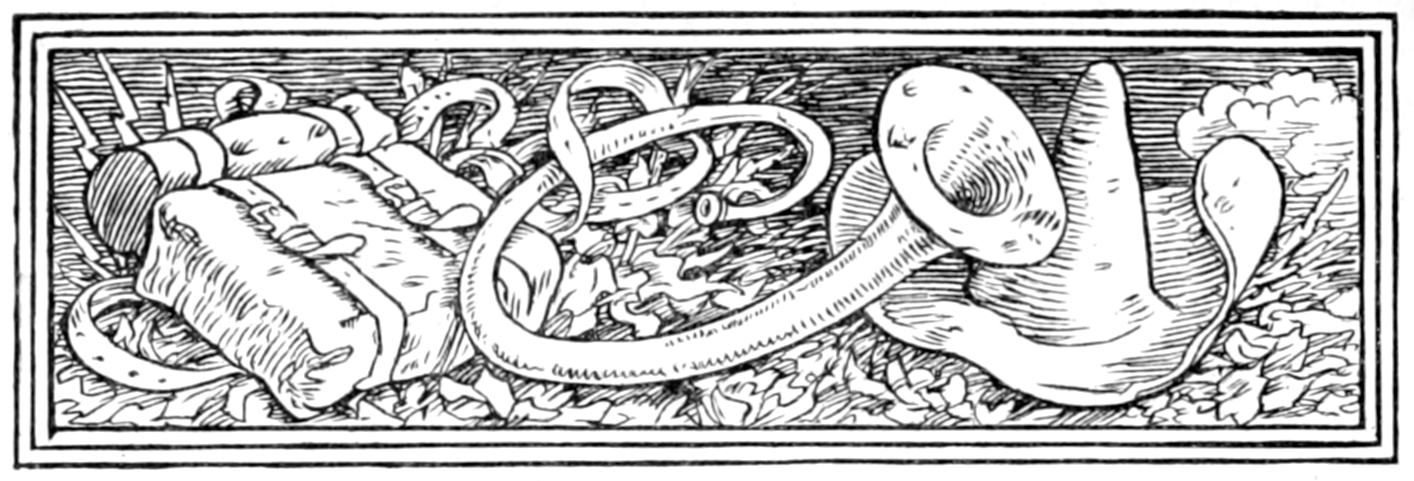
The Knapsack, the Hat, and the Horn.
I don’t think I have read this one.
Three young brothers, who found themselves getting poorer and poorer, decided to try their luck in the greater world. After much travel, they found a mountain made of silver. The eldest brother took as much as he could carry and returned home. The other two traveled on until they found a mountain made of gold. This contented the middle brother, but not the youngest.
The youngest entered what seemed to be an endless forest, in the middle of which he wished for something to eat. Magically, a table appears covered with a tablecloth itself covered with food and drink. He gladly feasts and then takes the tablecloth with him. It never failed to provide food.
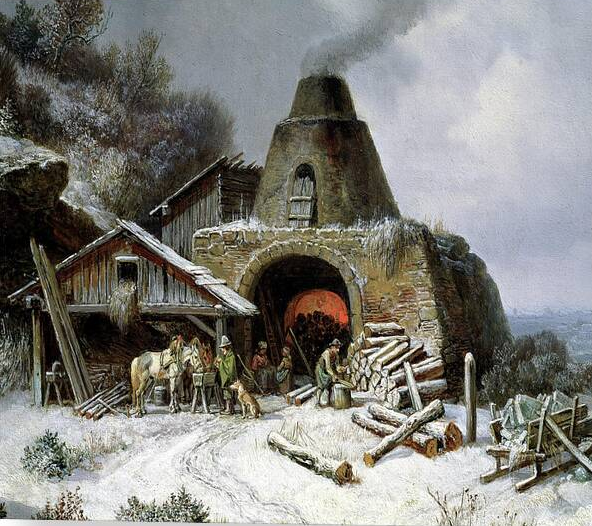
During his travels, he comes upon a charcoal burner preparing his sorry meal of potatoes. The young traveler offered a better repast. Impressed, the charcoal burner proposed to exchange magical gifts. He had a knapsack that could produce seven soldiers to do one’s bidding.
The exchange was made, and the traveler took to the road again. After a short while, he tested the knapsack and sent the seven soldiers back to the charcoal burner to seize the tablecloth. Thus began his career of deception.
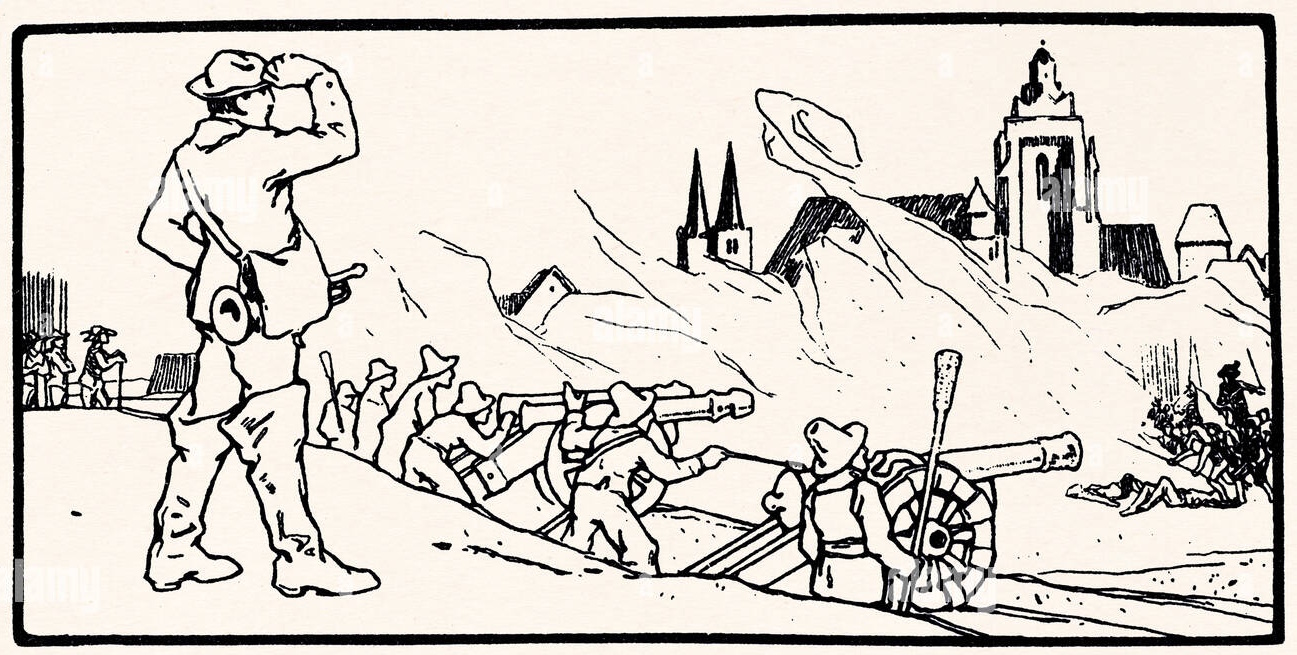
Next, he came upon another charcoal burner who had a hat, which, when turned about, produced cannons firing at will. The scenario repeats itself.
At last, a third charcoal burner had a horn that, when blown, would bring down walls, not unlike the horn at Jericho.
Armed with these three magical gifts, plus the tablecloth, he returns home. His brothers do not recognize him dressed in a tattered coat, carrying a worn knapsack, and wearing an old hat. Offended, the youngest produced an army to defeat his brothers.
The king got wind of this conflict and sent his army to quell the dispute. With a turn of the hat, the king’s army was sent packing. Seeing his advantage, the youngest demanded the king’s daughter in marriage and rule over the kingdom. The king could not resist and gave over his daughter.
She wheedled out of him the nature of the old knapsack, which she stole, and sent the soldiers back to kick her new husband out of the kingdom. But he still had the hat, and the cannons forced her and her father to relent.
Again, she seduced him to reveal the power of the hat and stole it when he slept. Enraged, and still possessing the horn, he blew it in revenge, bringing down the castle fortification and city walls, crushing the king and the princess to death. He was then king.
WHAT A HORRIBLE STORY.
Where is the moral? The Grimms were good Lutherans.
In the background, I hear Thalia and Jini returning. They are giggling. They are giggling teenagers. Everything is fine.
Part Two
Soldiers’ Tales
The bell over Augustus’s door greets me as usual. The heavy scent of tobacco dominates the air. Augustus, reading a newspaper, looks up, sees me, and reaches for the canister of Elfish Gold.
“And fifty grams of Traveler’s Due,” I answer an unspoken question.
He nods in understanding, then frowns a little. “You haven’t ordered Traveler’s Due in quite some time.”
“A story I read last night brought it to mind.”
“Ah, yes, a story, of course. Which one?” He scoops out tobacco from the canister, measuring it by eye, and dumps it into a small paper bag on a scale. Fifty grams exactly.
“It was a Grimm story about which I am upset.”
“Really, let me guess. The Knapsack, the Hat, and the Horn.”
“How did you know?”
“It might be the most upsetting tale in the Grimms’ collection. But see here, I am glad you asked for Traveler’s Due. I have changed the mixture slightly and will value your opinion while we discuss the tale.”
That is his cue for us to head to his “testing room” as we always do. His comfy chairs are more well-worn than mine and covered with a dinge of smoky grey. If he were to upgrade and replace them, I would be scandalized. We light our pipes and settle in.
“I imagine,” says Augustus, through a haze of smoke, “you were taken aback by the lack of a moral, as was I.”
“Quite right.”
“There are,” Augustus continues, “many soldiers that figure into the Grimms’ tales in one way or another. Let me enumerate a few. There is The Three Army Surgeons to start. Then there are the soldiers in The Worn-Out Dancing Shoes, The Devil’s Sooty Brother, The Blue Light, and The Devil and His Grandmother. I am sure I could find other examples.”
“Point taken,” I say. “But the youngest brother is not a soldier.”
“He may as well be. He holds weapons of mass destruction.”
“OK, I will buy it, but where are you going with this line of thought?”
“Good question. I am thinking out loud. Would many of the audience for these stories be, themselves, soldiers in taverns or sitting around campfires? They might well be discharged soldiers wandering around, hoping for another war to employ them. A story where a common soldier wins out over everyone else—including royalty—would appeal to them. They would not be looking for moral messages. Rather, something to entertain them and suggest possibilities.
“While the Grimms were quick to promote Christian values, they were also looking for stories that represented the German folk voice. Soldiers were among that folk.”
I think on this for a moment. “That soldiers may not be longing for a moral in the stories they hear, I will concede. However, this is still a story with an unsympathetic protagonist. All the tropes of a fairy tale are there. There are three brothers starting out into the world. There are magical devices, a mountain of silver, a mountain of gold, a king, a princess, a marriage. It’s all there except a moral. Our protagonist gets away with murder. Even soldiers must have a sense of fairness.”
“I am not defending the tale,” Augustus responds.
I nod. “I guess what I am saying is this is an unusual tale for the Grimm collection.”
Augustus blows an exquisite smoke ring. “There we can agree.”
Part Three
Another Thought
I clean out my pipe and repack it. “I approve of the new mixture. What did you do?’
“For the most part, I added a little Latakia. I felt it needed a bit more punch.”
“Well, back to our subject,” I say. “What about these charcoal burners? Where did they come from?”
Augustus chuckles. ”I am glad you have asked that question. I will pontificate on this item. My family history tells me that my great-grandfather was one of them by trade.
“Charcoal burners have been underserved by the fairy tales, a missed opportunity. Oh, they do appear at times, usually in variants of known tales, especially in the lore of Scandinavian, Slavic, and—for some reason— particularly Czech populations, yet rarely. Such a shame. They are the perfect magical helper.
“At first glance, the charcoal burner is the male version of a henwife—practitioner of the black arts—and the old-woman-in-the-wood character. But he holds a unique position. His abode is in the forest, away from society. Forests, in the minds of pre-industrial people, were associated with danger and mystery, especially a deep, dark one. The charcoal burner was elemental to that environment.
Like the henwife, he was always poor. Forgive me an aside; these two occupations are lowly, affording little benefit, yet, in the tales, the practitioners have access to magic but do not take much advantage of it to improve their condition. I find that a curious point.
“But, back to my argument. Since our heroes often find themselves wandering around in the wilderness on their quests, who more likely are they to run into than a charcoal burner and his humble hospitality? A convenient story element. And if they have a magical device to share, all the better.”
I lift an eyebrow at that one. “I doubt the fairy-tale Michelin Guide would list these lodgings.”
“I’ll ignore that,” he says. “Metaphorically, though—and here is my strongest point—he is transforming wood into charcoal, transforming one thing into another, like our protagonist transforming from a commoner into a king. The tales are about transformation. Why do they not take advantage of this symbolism more often?”
I tamp my pipe and relight. “I have noticed that those with magical powers—the black arts—are usually women, witches. There are a few wizards in the tales. Oh, lots in modern fantasy writing, but not in the traditional fairy tales, just like there are lots of dragons in modern fantasy and few in fairy tales. Also note, there are not many fairies in fairy tales.”
Augustus applauds. “They should be called wonder tales.”
“I agree, but I am straying from what I meant to say. Ah, yes. Magical devices can fall into the hands of males, be they giants or humans, and they usually lose them to the protagonist through trickery, as in our story.”
“Your point being as it applies to charcoal burners?” Augustus looks at me quizzically.
What is my point? What am I talking about?
“I think I am trying to say men, in the tales, be they anything other than a wizard, do not hold the keys to transformation, even if they are charcoal burners who transform wood. True transformation is in the hands of women. Charcoal burners can only blunder about, not appreciating magical devices they happen to have.”
Augustus smirks at me. “Would Melissa approve of your notion that women excel in the dark arts, while men are simply amateurs?”
“That men are amateurs, she would agree. Associating women with evil, not so much. Say?” I hold my pipe in front of my face. “This mixture is making my mind fuzzy. You didn’t put something like opium in it, did you?”
Augustus smiles but does not answer.
Your thoughts?
 Fairy Tale of the Month