
A Picnic
It is August, and we have had no picnic. Well, the weather has been hotter than usual, to understate the case, but still.
Duckworth, Thalia, Jini, and I conferred and looked for a day that was predicted to be cloudy. We then determined the picnic would be more of a dinner than a lunch, occurring after 4:00 p.m. when the day would be cooling off. We might come home toward dark, but that would be better than being sunburned.
Where should we picnic became the next question. We ended up deciding on Christ Church Meadow. This involved a drive down to Oxford and renting a boat to row to the meadow. All this was at Duckworth’s insistence, he having a penchant for the Isis, which is silly of him. It is the Thames until it comes to Oxford, and it is then renamed the Isis. Duckworth is noted by me for cold logic until it comes to this one frivolous exception.
Thalia and Jini luxuriated in being rowed on the river as Duckworth and I labored at our task. Having no goal but the general direction of Christ Church Meadow, we were attentive when Thalia exclaimed, “That’s the spot.”
As we laid out our blanket, I admired Oxford University’s college towers rising up behind our greensward. Thalia and Jini set out a feast but would not let Duckworth and me partake of anything but some wine and cheese until Jini had read the story of the day.
She sat before us, cross-legged, the book Indian Fairy Talesin her hands.
“This is my new favorite tale, How the Raja’s Son Won the Princess Labam.”
One day, the raja’s son was out hunting in a jungle his mother had warned him never to enter. There he heard the parrots talking of Princess Labam, which is what his mother had feared. He determined to leave his father and mother and find her.
When he left, his mother gave him sweetmeats to eat along the way. When he took them out, they were covered with ants. True to his gentle nature, he offered up the sweetmeats to the ants. The raja of the ants promised to help him when he might be in need.
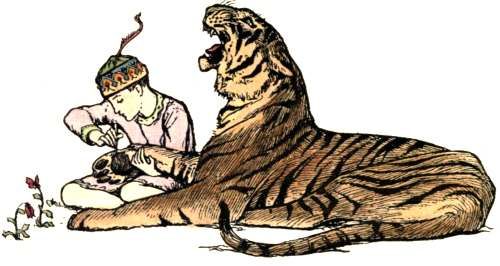
Next, the youth came across a tiger who had suffered from a thorn in its paw for twelve years. The youth offered to extract the thorn if the tiger agreed not to eat him. Both the tiger and his tigress complied, then promised to help him when needed.
The lad’s third encounter involved three fakirs (magicians) who argued over their deceased master’s possessions: a bed that could transport its sleeper anywhere, a bag that could contain whatever the owner wanted, a stone bowl that would always contain water, and a stick and rope that could defeat and bind any enemy.
The youth offered to shoot four arrows off in four directions. Whoever retrieved an arrow first got to choose first; the second to choose second, etc. As the fakirs pursued the arrows, the youth took off with all of the possessions, telling the bed to take him to the country of Princess Labam.
Once there, he took shelter with an old woman who protected him against the king, who abhorred foreigners. In exchange, he provided her with food from the bag and water from the bowl.
Thalia, realizing this was a long story, relented and began serving the potato salad and cucumber sandwiches. Duckworth and I had done all the rowing, after all.
Part Two
Second Half
Jini polished off a cucumber sandwich and took a sip of iced tea before continuing the story.
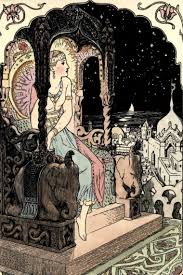
That evening, the old woman did not light a lamp. She explained that every evening the Princess Labam came out onto the roof of the palace and stayed there until midnight. Her radiance made the night as bright as day. The youth could see the princess sitting on the palace roof and admired her beauty.
After all were in bed, the lad asked his bed to take him to Labam’s bedchamber. There, from the bag, he left a good quantity of betel leaves as a present. In the morning, the servants much enjoyed eating the leaves, but no one knew where they came from.
The next night he left a wonderful shawl. Still, no one knew who gifted it. On the third night he decided on a glorious ring, but when he tried to slip it on her finger, she woke up. At first frightened, she soon realized he loved her, and she then wished to marry him.
Upon hearing of this, the king proposed a task, which the lad had to perform in order to marry his daughter. The king required of the lad—not the first suitor to face death if he did not achieve the impossible task—to squeeze the oil out of forty pounds of mustard seed in one day. The lad called upon the ants to help him.
Next, the king assigned him to kill two demons who were a concern to him. The lad called upon his two tigers. To beat the king’s kettle drum in the sky comprised the third task. The youth’s bed got him there.
Three tasks should have been enough, but the king proposed a fourth. He gave the lad a wax hatchet to cut a tremendous tree trunk. The lad had run out of helpers to complete the impossible challenges. That night, he visited Labam’s bedchamber once again and told her of her father’s demand.
“Do not be afraid,” she said, pulling a hair from her head and instructing him to tell the tree that Princess Labam says it must allow itself to be cut in two by the hair. He must then line the edge of the wax hatchet with the hair. This he did and succeeded.
Soon the marriage took place, and they returned to the raja’s son’s kingdom. The youth kept the bed, the bag, the bowl, and the stick, but given his peaceful nature, he never had need of the stick.
As the story ends, Thalia brings out the cold chicken curry and the stuffed eggs. I love stuffed eggs.
“I find that one an interesting story,” Duckworth says. “Because of him,” he points to me, “I have heard a lot of fairy tales. In this one we come across familiar motifs and then new elements side by side.
“The hero, hearing of a beautiful princess, goes off to find her—Sleeping Beauty—I have heard of. I have also heard of the tasks to win the princess in marriage, with death looming over the enterprise. The ants as helpers are perennial favorites.
“But then there are the tigers—not lions, popular in European tales—with a thorn in a paw that harkens back to Androcles and the Lion. Defeating two demons I don’t recall. The wax hatchet with the hair’s edge is totally new to me. Oh, and Labam lighting up the night and the king’s kettle drum in the sky? What are those about?”
“I think I can explain some of it,” Jini says.
We wait for her to gather her thoughts.
Part Three
Hindu Echoes
“I am sure,” Jini says, “anyone who sees me thinks I am from India. Actually, I was born here. My family is from Nepal. In any case, I am Hindu, but—because I did not grow up in Nepal— my parents have made a point of educating me about our sacred stories so that I won’t forget where we came from. I may know more of these tales than a real Nepalese teenager.
“This story is not a steal from any Hindu tales, but all the pieces are there. Indra is the thunder god, and it is he who destroys the demons Vritra and Vala. These are echoed in the king’s kettle drum in the sky and in the destruction of the two demons.any a
“Chandra is the moon god and has twenty-seven wives, having to do with the twenty-seven celestial mansions
, a sort of zodiac, so there are plenty of moon goddesses. I’m going to guess Labam could be a reflection of the wife Chitra, known for her radiant beauty.
“Chandra’s wives are all sisters, daughters of the sage Daksha. Unfortunately, Chandra had a strong preference for the wife Rohini over the others, and the others complained to their father, who cursed Chandra with illness. Lord Shiva intervened and softened the curse so that Chandra would be sick only half the time, which is why the moon waxes and wanes.
“Anyway, I see Indra, Vritra, Vala, and Chitra in this tale, but I don’t know where the raja’s son, helpful ants and tigers, or the magic bed, bag, and bowl come from.”
I serve myself some curry chicken and grab a sausage roll.
“Jini,” I say, “turn to the notes at the back of the book. I believe Jacobs talks a bit about that.”
She does after nibbling a pickle with chutney, then wiping her hands. I see her read, frown, and go wide-eyed.
“Oh, wow,” she remarks. “He thinks it all comes from India, even the Androcles-and-the-lion thing. He suggests the motifs came to Europe with the returning soldiers of the Crusades.”
“That sounds about right to me.” I grab another stuffed egg. “Most of the fairy tales date from about the twelfth century.”
“No, wait.” Duckworth’s sausage roll nearly drops from his hand. “Are you saying all the fairy tales come from India?”
“Well,” I hesitate, “maybe. I am thinking of Jessie Weston’s From Ritual to Romance, where she traces the Arthurian tales back to Indian sources.”
“That I cannot abide!” Duckworth objects.
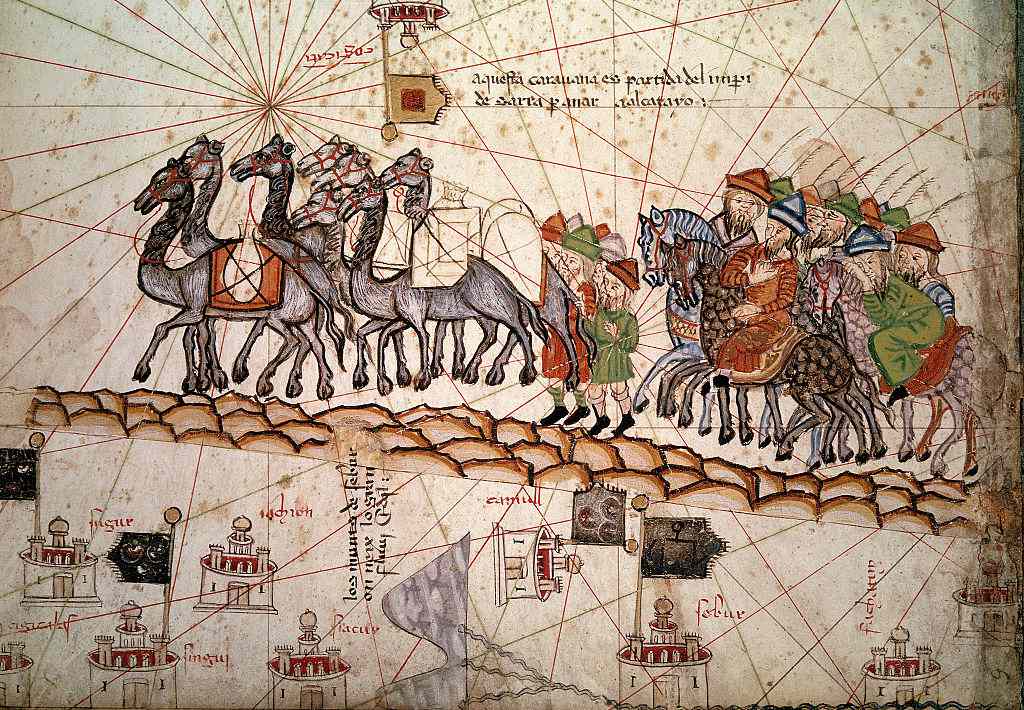
“Well,” I reach for another stuffed egg, “it seems to me Western storytellers were sponges for story ideas and motifs, no matter where they came from. Even before the Crusades, there was commerce between Europe and the East. I am thinking of what was called ‘The Silk Road.’ Now I am thinking of another scholar, Alan Dundes, who traces Cinderella back to China.”
“China!” Duckworth guffaws. “We’re getting farther and farther away.”
“The Eastern cultures,” Thalia puts in, “are older than ours. We were seen as barbarians, if I recall my history lessons. I think they had a head start on us.”
There is an unspoken agreement among us to let Thalia have the last word on this debate. She just laid out the Victoria sponge cake.
Your thoughts?

