
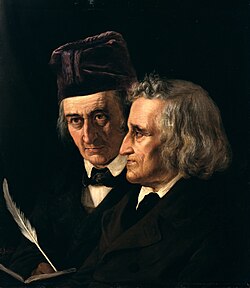
A Little About the Grimms
This month, I am going to continue with my biography vein. Back in June, I covered Philipp Otto Runge, which brings to mind the Grimm brothers, Jacob and Wilhelm. They are among the internationally known names, right up there with Napoleon Bonaparte, with whom they were contemporaries.
The Grimm brothers were born blessed, two of nine children from the union of Philipp Wilhelm Grimm, a jurist, and Dorothea Zimmer, daughter of a city councilman. They were upper class until Philipp died of pneumonia. They immediately descended into poverty, from which they never emerged.
Supported by relatives, Jacob and Wilhelm attended the University of Marburg. There, they found they were prejudiced against for being poor and were not allowed to participate in any significant student events or gatherings. Nonetheless, they graduated at the head of their class (one year apart) and drew the attention of some of their professors.
Following graduation, they made their way through the world as librarians, professors, and scholars at various universities in the context of the demise of the Holy Roman Empire (which Voltaire described as neither holy, Roman, nor an empire, but rather a loose collection of largely Germanic principalities), the Napoleonic Wars, and the rise of German Nationalism, as well as the German Romantic Movement.
These last two items, German Nationalism and the German Romantic Movement, became central to the Grimm brothers’ thinking. While they were both in the faculty of the University of Göttingen, Ernest Augustus, King of Hanover, dissolved its parliament and demanded oaths of allegiance, which included those employed at the university. The Grimms refused and escaped to safety. After the Revolution of 1848, the brothers were elected to the civil parliament. Jacob became a prominent member of the National Assembly.
Primarily, though, they remained writers and scholars. Children’s and Household Tales (Kinder-und Hausmärchen) was their first scholarly work, published in 1812 and 1815 (two volumes), consisting of 86 stories. They quickly recognized they had a bourgeois children’s audience and made many changes to the stories to accommodate them, covering over 200 tales by 1857.
They both published other scholarly works, particularly Jacob, while Wilhelm took over the fairy tale collection. Jacob, among other publications, labored over compiling a German dictionary. When he died in 1863, he had only gotten to the letter F. Others took up the effort, and it was finished in 2016 (not a typo), when his original efforts were revised. Apparently, he rambled a bit.
Ultimately, they had the goal of finding the Germanic folk voice. They are among the heroes of Germany’s rise to becoming a nation. Unfortunately, for a time, the Nazis embraced them as necessary reading in all German households. Well, there is The Jew in the Throne Bush. While the brothers had faced prejudice, they apparently did not sympathize with other subjugated groups.
I have one more, a little off-the-wall comment. Wilhelm married, but Jacob did not. Wilhelm united with Henriette Dorothea Wild, a childhood friend who had given the brothers several stories. Jacob always remained in their household. These two brothers were dedicated to each other.

