
A Moment
I see this as the perfect moment, one I will attempt to remember the rest of my life.
We had a most pleasant meal tonight: the girls, Melissa, and me . I made a meatless lasagna and served good bread, along with salad. The occasion celebrated Thalia’s announcement on Thursday that tonight (Friday—not a school night) would be story night and a Jini sleepover. I quickly added Melissa to the gathering.
We are now settling into the study. Johannes is curled up on Jinni’s lap, pretending to ignore the rest of us. Melissa has found her spot on the sofa with an occasional table for her wine glass. Thalia is in her comfy chair with a book as the fairy settles on her shoulder. I can hear the brownies scuffling in the dark corners; I know what sounds to listen for.
We are in the moment before a story begins, with comfortable anticipation. Is this not a perfect moment?
I take a sip from my third glass of claret.
“The Haggary Nag,” Thalia starts. She is holding a new acquisition from Melissa’s bookstore, The Well O՛ the World’s End, by Seumas MacManus.
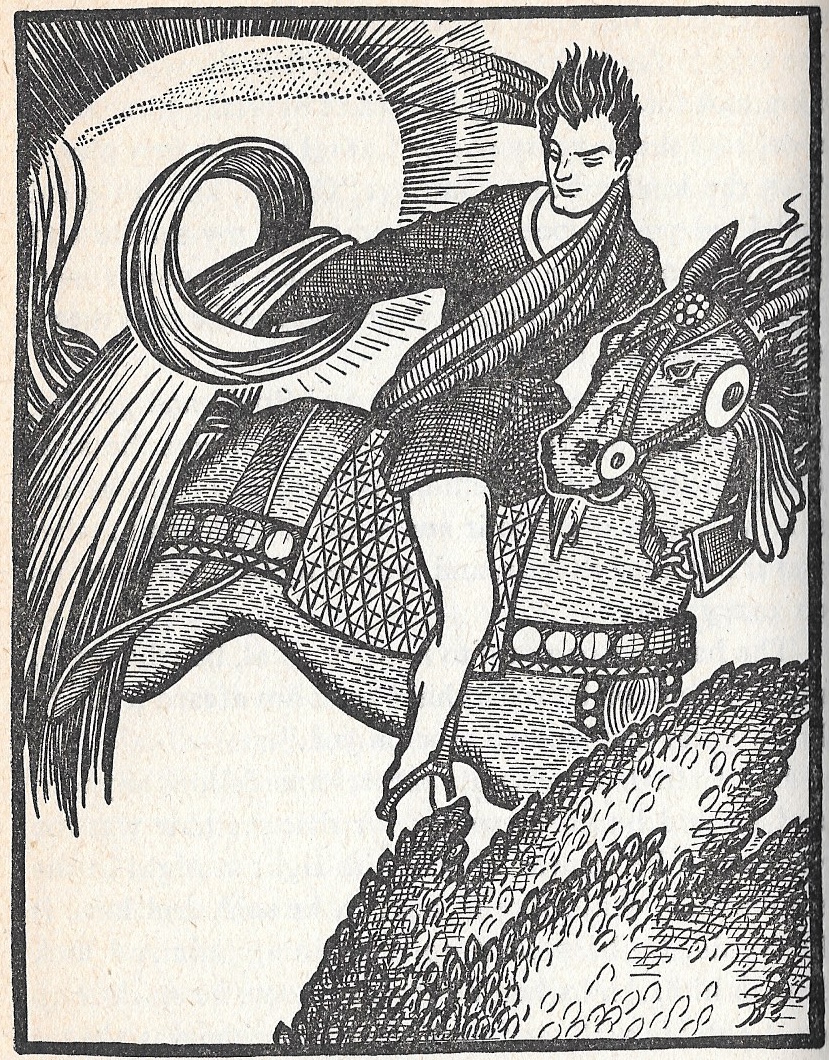
A poor widow’s son, named Cathal, took the position of stableboy with a cruel king. He gave Cathal charge of ninety-nine magnificent steeds and one poor, haggary, little nag, which the king told Cathal to treat badly on purpose. On purpose, and contrarily, he treated the nag well.
Three months into his employment, the king ordered him to take the fastest steed and deliver a message to the king of Spain. Cathal chose to ride the nag. To his surprise, the hooves only touched the tops of the hills as they sped along. The nag also spoke to him, thanking him for his kind treatment.
On their return trip, Cathal found a lady’s hair that shone as bright as day. The nag advised him not to pick it up lest it bring trouble, but Cathal determined to have it to light the stable. Some time later, the king entered the stable to find it lit by the hair. He wished to marry the woman whose hair it was and sent Cathal off to find her on pain of death if he failed.
Off went Cathal and the nag, traveling seven days and seven nights, the nag’s hooves touching only the tops of the hills, to find the White Mare of the Rowen-tree Wood. She knew the hair belonged to the Princess of the Hill of the World’s End, but not how to find her. The mare gave them an ointment to protect them from the Forest of Spears as they traveled for days to the Brown Mare of the Oak-tree Wood.
The Brown Mare did not know where the princess could be found but gave them a bottle of the Water of Life to aid them in crossing the River of Deadly Poison on their way to the Black Mare of the Pine-tree Wood.
The Black Mare gave them directions, another potion to ward against the Lake of Burning Brimstone, and the caution to approach the princess while she combs her hair, at which time she will grant requests and not have intruders killed.
In this way, they carry the princess off to the king, but she refused to marry anyone but the one who would get her three drops of blood from the Ravens of Life. The king sent Cathal on another quest.
With the help of the three mares, Cathal ended up on the top of the Hill of the World’s End, where he blew a magic silver whistle to call the enormous Ravens of Life. Further, the nag killed herself after giving Cathal instructions to cut out her entrails and hide in her carcass. When the ravens come to feast, he must kill them with his dagger, then restore her with the blood of the ravens. Accomplishing this, they return to their kingdom.
Now the princess had another condition. She would marry the man who could do as she did, which was to fling herself from a tower onto a bed of spears. She did this without harm by swallowing the three drops of raven’s blood. The king, mad with love, attempted the feat and died. Cathal, knowing of the raven’s blood, succeeded, and he and the princess were happily married.
Immediately, the Haggary Nag disappeared for a while, but soon three princes appeared and explained they were the nag, one being the nag and the other two the saddle and bridle. The evil king had put a spell on them, which broke when the king died.
I close my eyes to contemplate this long Irish tale.
Part Two
A Haggary
I startle awake at Jini’s voice asking, “What is a haggary?”
Wine nearly spills from the glass that rests between my fingers and my lap.
“It usually means rough ground,” Melissa explains, “but in this context, I think it means unkempt.
“What I love,” she continues, “were the names: The White Mare of the Rowen-tree Wood, The Brown Mare of the Oak-tree Wood, The Black Mare of the Pine-tree Wood, The Forest of Spears, The River of Deadly Poison, The Lake of Burning Brimstone, and The Hill of the World’s End. How wonderfully pompous. Oh, let’s not forget The Water of Life and The Ravens of Life, even if the ravens have more to do with death.”
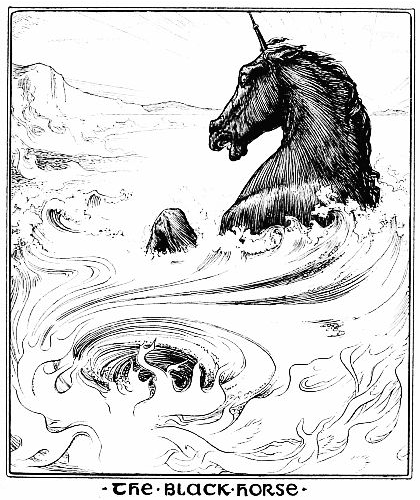
“It reminds me of,” I say, coming out of my stupor for a moment, “The Black Horse, another Celtic tale. They are similar and yet strikingly different, not a mere variation.
“In this tale, a young prince, the youngest of his siblings, has inherited nothing but a lame horse that he exchanges for a troublesome black horse that carries him off to The Realm Underwaves. It is the Prince of Underwaves who sends the hero and his horse off to abduct the daughter of the King of Greece to be his bride, similar to the evil king sending Cathal and the nag to find his bride.”
I take another sip of my wine.
“The Greek princess makes conditions for marriage. First is that she must have the silver cup used in her grandmother’s and her mother’s wedding, as opposed to the three drops of blood from The Ravens of Life. The Black Horse instructs the hero how to steal the cup.
“Next, the princess needs the silver ring used in her grandmother’s and mother’s wedding. Here is where this story gets very strange. They go to a loch, approached via a dangerous journey. There, the hero drives iron spikes into every ‘bone end’ of the horse’s body. The Black Horse dives into the loch as its surface erupts into flames that burn all night. In the morning, the flames die out, and the Black Horse emerges with one iron spike left, with the silver ring dangling from its head. The hero takes care of the exhausted animal, the horse rallies, and they return to the kingdom of Underwaves.
“In The Haggary Nag, the princess asks that her suitors emulate her action of leaping upon the bed of spears, which led to the death of the evil king. In The Black Horse, the path is a bit different. The princess’s next demand is a sumptuous palace to be built overnight, one of the elements being an adequate well.
“After the challenge of the ring, this is an easy task. Before the marriage, the princess insists they inspect the palace. When they come to the well, she shoves her betrothed into it and suggests that she should marry the one who did all the prince’s bidding.”
I take another sip of my wine as I come to the climax of my point.
“The demise of the Haggary Nag and the Black Horse are the same and different. In the case of the nag, it disappears and becomes three young princes returned to their true form. In The Black Horse, the hero forgets about his horse for three years, then suddenly remembers. The Black Horse is still in his stable and demands that the hero cut off its head. With great reluctance, the hero does so, and the horse transforms into the hero’s wife’s brother, who had been under enchantment. They all return to Greece for another wedding.”
Melissa frowns. “In the nag story, she kills herself but is resurrected by the ravens’ blood. The transformation into the princes is delayed until the evil king’s death. Yet, overarching in both stories is the idea of death and resurrection causing a transformation.”
“I agree,” I say.
We all pause to consider the idea, and I nod off.
Part Three
Golden Hair
As I rouse from slumber again, my glass is lying on its side in my lap. Fortunately, I drank all of the wine. I think I have had enough.
Melissa is speaking. “Golden-haired princesses in the tales are worth a pence, but the golden-haired princess that this tale reminds me of is Zlatorlaska the Golden-haired: The
Story of Yirik and the Snake.”
“That’s a mouthful!” Thalia giggles.
“Well,” says Melissa, “my grandmother was Czechoslovakian, and it was she who told me the story. I can still hear her voice. It is rather close to The Haggary Nag, but it is Slavic rather than Celtic, yet it starts out like Grimm’s The White Snake and retains some of that story’s elements.
“A king receives the gift of a snake, which, when cooked and eaten, will give the consumer the power to understand the language of all living creatures. On pain of death, his cook, Yirik, is ordered to prepare the snake but not eat any of it. Yirik had never prepared a meal that he had not tasted and made no exception. As a consequence, both he and the king understood the language of animals.
“The king suspects Yirik did not follow orders, and when two birds fly into the chamber while Yirik is pouring wine for the king, arguing over three golden hairs snatched from a maiden combing her tresses, the king can see his cook understands what they are saying.
“As the two birds fight, one of the hairs falls to the floor with a musical tinkle. The king suspends his order of death for Yirik if the lad will find the maiden of the golden hair for him to marry.
“Yirik ventures off on his quest. On the journey, he saves a colony of ants, two baby ravens, and a golden-scaled fish. Soon, he finds the home of the maiden, Zlatorlaska, daughter of the King of the Crystal Palace. He is told that the golden dawn is caused by this princess combing her hair.
“In order for Yirik to claim Zlatorlaska for his master, he needs to perform three tasks. First, he must find the pearls of a necklace scattered in a field of grass, with which task the ants he saved help him. Second, he must find a golden ring lost in the sea. It is the golden fish that recovers it for him. Third, he must get bottles of the Water of Death and the Water of Life. This the two ravens do for him.
“On his way back, he sees a fly caught in a spider’s web. He flicks a drop of the Water of Death on the spider and a drop of the Water of Life on the fly, freeing it.
“Though Yirik has accomplished the three tasks, the king nonetheless imposes another upon him. The king’s twelve daughters are lined up, covered by veils, in order for Yirik to choose which is Zlatorlaska. It is the fly he saved that guides his choice.
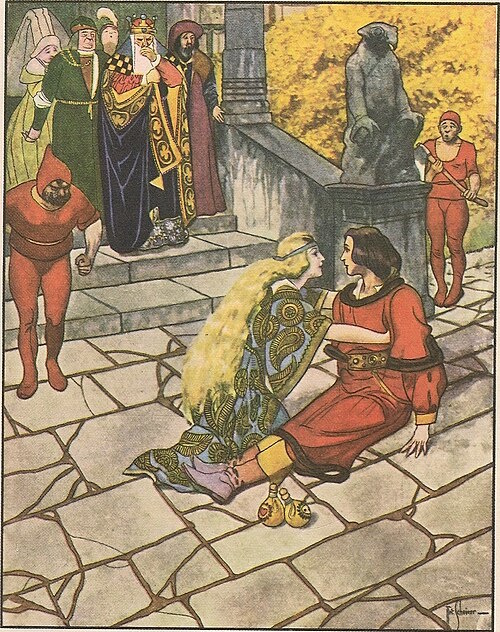
“He returns to his master, who is delighted and rewards Yirik by not hanging him like a common thief but by having his head cut off and by promising to give him a decent burial. But the princess asks to be given the corpse. She sprinkles the Water of Death upon him, and the head is reattached to the body. She then sprinkles the Water of Life onto the corpse, and Yirik arises younger and more handsome than before.
“The old king, hoping to be restored to his youth, demands that he be beheaded and brought back by his bride. She tries, but fails, on purpose. No longer having a king, the people declare that Yirik should be their regent. Zlatorlaska, who had fallen in love with Yirik, does not resist and voices no conditions.”
“Wow,” says Jini, “in all three of these tales a forced marriage is turned on its head by the victim-bride through violence. I need to think about that.”
A good point, and I close my eyes again to contemplate it.
Your thoughts?

