Fairy Tale of the Month: March 2013 The Devil with Three Golden Hairs – Part One

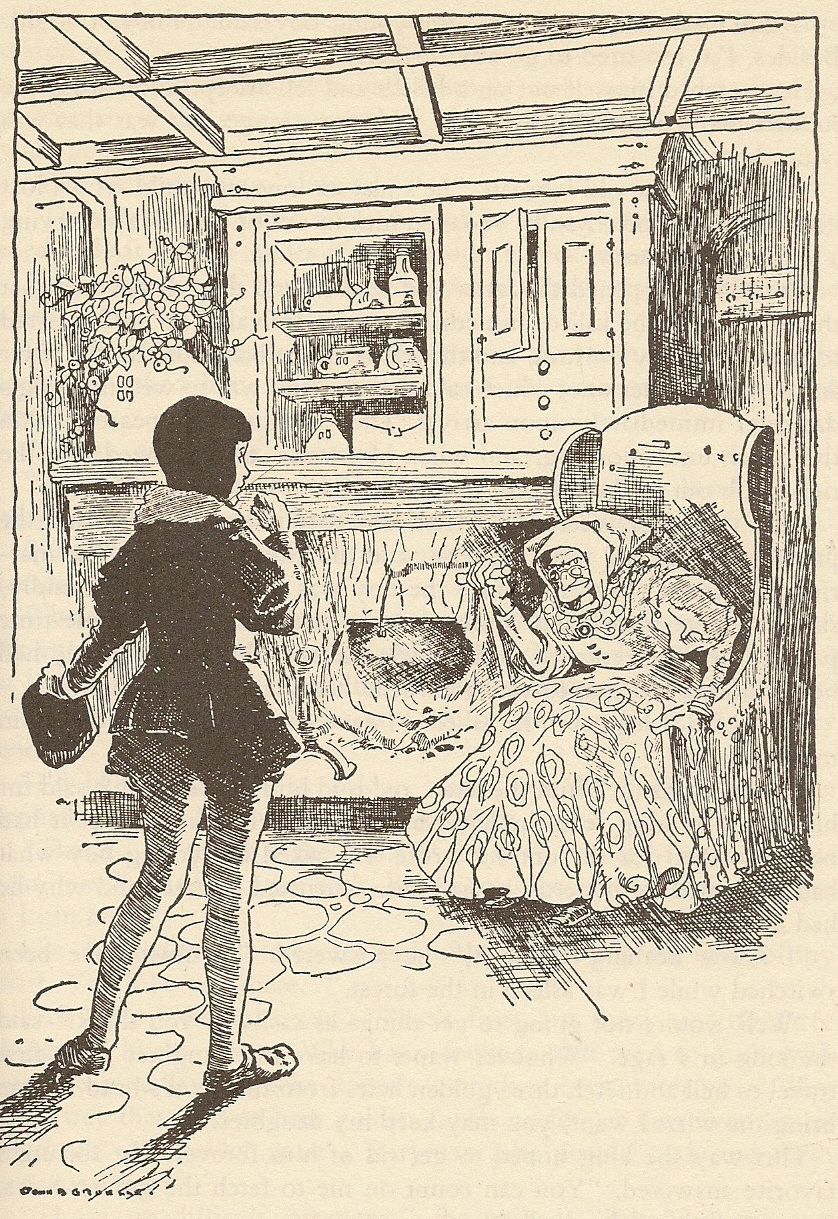
John B. Gruelle crone John B. Gruelle

Nodding Off

Thalia and her teddy fell asleep on my lap as I read The Devil with Three Golden Hairs. I am nodding myself. Wilhelm sits in the corner of my study at the writing desk, composing a letter, he being more alive than the rest of us apparently.

Thalia and I only got through the first third of the story. It started with a lad born with a caul. How do you delicately explain a caul to a child? I did my best by telling her to image a baby born with a piece of skin worn on his head like a little cap. She wrinkled her nose at that. Well she should. A caul is actually a portion of the birth membrane.

The idea that the caul bears significance has a long history with references going back to Roman times. In the medieval period, in some places, being born with the caul meant good luck for those children, or that a destiny of greatness awaited them. In Eastern Europe the caul-children did not fare so well, destined as they were to become vampires. I have run across indications that the church burned caul-bearers as witches.

Mostly though, owning a caul, even by purchase, was prized by sailors as a talisman against drowning well into the twentieth century.

For our child in our story, the village fortune-teller declares that the boy, at the age of fourteen, will marry the king’s daughter. Upon hearing this, the king, in disguise, persuades the parents with promises and money to give him the child. The king throws the boy into the river, not knowing that the boy was rescued and raised by a childless miller and his wife.

Fourteen years later the king happens to take shelter in the mill during a storm and hears the story of the foundling boy. Realizing who he is, the king asks to have the lad deliver a letter to the queen.

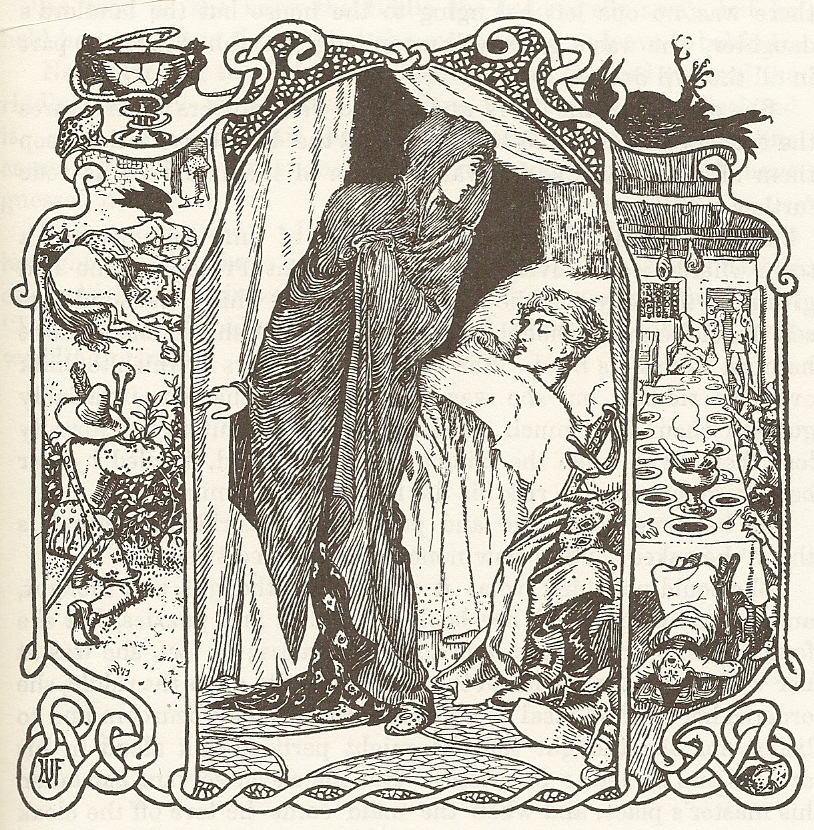
The boy, ironically carrying instructions to the queen to have him killed, loses his way and ends up in a den of thieves, but is protected by an old woman. As the lad sleeps, they read the letter, and not being loyal subjects to the king, rewrite the letter to have the lad marry the princess, sending him on his way in the morning, showing him the right direction

Up to this point, the story is remarkably similar to the English tale The Fish and the Ring with these notable exceptions: The talisman is a ring instead of a caul; the fortune-teller is the king himself; and the protagonist is female. Both tales contain the king’s failed attempt at infanticide, the child becoming a foundling, the king’s second attempt at murder through the device of a letter proscribing the child’s death, and the bearer of the letter falling in among thieves who rectify fate.

I’d say more, but that is where Thalia, the teddy bear, and I fell asleep. I nodded awake to find Wilhelm gone, and a letter lying on the table in front of me, a letter addressed to Evald Tang Kristensen with no address or stamp.

I knew what that meant. Another visit to Miss Cox’s garden.

Fairy Tale of the Month: March 2013 The Devil with Three Golden Hairs – Part Two

Evald_Tang_Kristensen Evald Tang Kristensen

A Pleasant Encounter

Two tulip shot glasses of Rǿd Aalborg Akvavit, awaiting my and Evald’s arrival, are set upon the wrought-iron table in front of its matching iron bench. The odor of caraway fills the still air around me.

I see him entering at the gate, looking around. I note discomfort in his movements and expression. He never appeared to be at ease outside of his beloved Jutland. Even other parts of Denmark set him on edge.

I’d done my homework on him. Born of peasant stock in 1843, he suffered much from neglect by his stepfather and by his mother’s preference for her new family. Rather a classic Cinderella motif with gender reversal. The thought that Wilhelm and Jacob also lost their father at an early age floats around in the back of my mind.

Evald, being bright, rose above his peasant status to gain enough education to become a school teacher. In his early twenties, around the time of his first wife’s death (He married three times.), he began collecting local folk songs. This soon blossomed into other areas of folklore. By his death in 1929 he had made record of 3,000 songs, 2,700 fairy tales, 2,500 jokes, plus numerous legends, sayings, poems, and riddles. His field notes alone took up 24,000 pages. His 79 publications comprised a sampling of his collection.

Despite his monumental effort, he never gained much respect outside the admiration of fellow collectors. He did receive a state grant that allowed him to collect full time, and an eventual induction into the Order of Dannebrog (knighthood), but he struggled all his life against the upper-class intellectual’s downward glance at his peasant origins.

My rising to greet him caught his eye.

“Mr. Kristensen.” (I would not dare call him by the familiar “Evald,” although I’d begun to think of him by that name.) “I have a note for you from Mr. Wilhelm Carl Grimm.”

His countenance brightens. Communicating with a fellow collector puts him at ease and in his element. He sits beside me on the bench, translating aloud in his thick Danish accent. Wilhelm, after acknowledging Evald’s expertise, inquired if the motif of the purloined letter occurred in the Danish tales. Evald turns the paper over and explains his answer to me as he pens his reply.

The motif did occur in the tale of King Wyvern, but unlike The Devil with the Three Golden Hairs, it was patterned after The Maid with No Hands. In King Wyvern, the queen, having saved her husband from a curse in part one of the story, bears him two boys while the king is absent. The letter sent with the good news is carried by the Red Knight, the stock villain of the Danish tales, a Loki-like character who sow seeds of discord. The Red Knight reads and alters the letter to say the queen has given birth to puppies. He does this with no other motivation than deviltry. In The Maid with No Hands the role is played by the devil himself to exact revenge.

Evald refolds the letter and returns it to the envelope; then we toast with the shots of Akvavit, tossing them back in one gulp as is traditional. I return to my study, light-hearted for having met the notable Mr. Kristensen and light-headed from the Akvavit.

Your thoughts?
PS. My thanks to Stephen Badman for his continuing translations of Evald Kristensen’s works, and his advice on things Danish.


Fairy Tale of the Month: March 2013 The Devil with the Three Golden Hairs – Part Three

John B. Gruelle devilJohn B. Gruelle

Three Questions

“Whoever wants to have my daughter must first travel to hell and fetch three golden hairs from the devil’s head. If you bring me what I want, you may keep my daughter.”

Thalia and I are well into The Devil with Three Golden Hairs, and will finish it this time. Fortune’s Favorite, as the story calls the caul-child, takes up the challenge. At the first city to which he comes, the watchman at the gate asks him his trade and what he knows.

“I know everything.” (Typical teenager.)

The watchman wants to know why their fountain in the market place that once flowed with wine has not even water. The boy replies, “Just wait until I return and you shall hear the reason why.”

The next city has a tree that no longer bears golden apples nor even leaves. When the lad crosses a river, the ferryman wants to know why no one will relieve him from his task.

This part of the story I know as the Armenian folktale The Fool, in which a foolish man, while looking for his fortune has three questions posed to him. They lead to his fortune, but he does not recognize it, and bad fortune overtakes and actually eats him.

Our lad enters hell after crossing the river (evoking thoughts of the river Stix and its ferryman, Charon), there finding the devil’s grandmother, who becomes his protector and aide. The parallel between her and the crone in the den of thieves jumps to mind.

In the Christian tradition Satan is a fallen angel. In folk sensibilities the devil has a genealogy. The devil’s grandmother must be the oldest and ultimate crone.

She hides Fortune’s Favorite by turning him into an ant that crawls into the folds of her skirt. The devil soon returns home.

“I smell, I smell the flesh of a man.” He doesn’t have to say, “Fe, fi, fo, fum,” for us to recognize the start of this motif. The same sort of conversation happens in a lesser known Grimm tale, The Griffin, between the Griffin and his wife, while the lad hides under the bed.

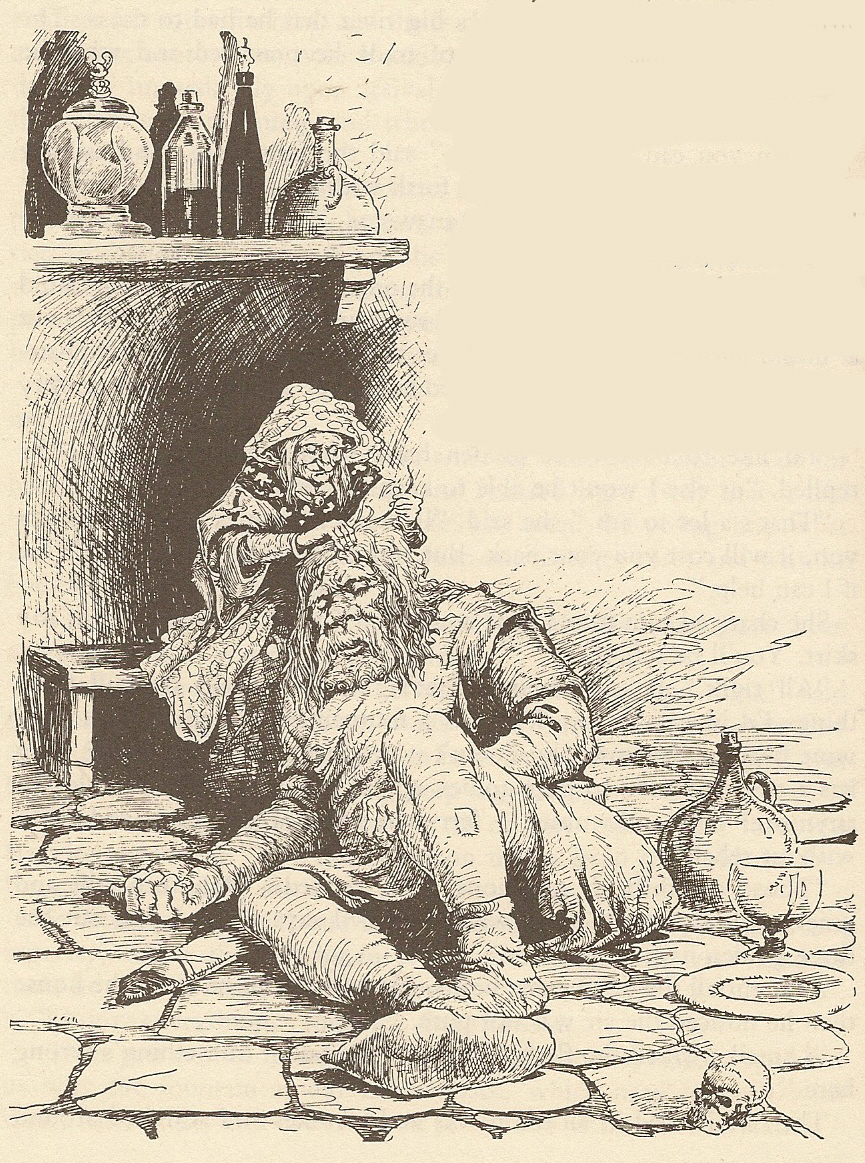
The grandmother quiets him down, feeds him; then he lays his head in her lap, and she delouses his hair as he falls asleep. Knowing the lad’s needs, she plucks one of the devil’s golden hairs and when he wakes up asks him for the answer to the first question. This happens three times, giving the lad his three hairs and three answers for his return trip.

The two cities, grateful for the answers, give the boy considerable amounts of gold. The king, in his greed, asks his son-in-law where he got this wealth. The boy practices a bit of deceit, telling his father-in-law that gold is lying around on the far side of the river.

The king rushes off, coming to the river and its ferryman. Previously, the lad told the ferryman what the devil had said. All he need do is hand the pole used to propel the raft to the next passenger. Thus the king is punished for his wickedness.

Thalia smiles at this just punishment of the evil monarch. I reflect on the structure of this tale.

The story came to the Grimms from Dorothea Viehmann, a produce seller. She grew up the daughter of an innkeeper, hearing tales told by patrons. I can’t help but wonder if The Devil with Three Golden Hairs was not her invention. The tale is an accretion of other stories assembled, I like to think, by a young girl working for her family in a tavern, never thinking her version would be preserved in writing for centuries to come.

Your thoughts?
Fairy Tale of the Month: February 2013 Old Rinkrank – Part One

Marianna stokes Marianna Stokes

Glass Mountain

I stand at the foot of the glass mountain. Its sheer, hard wall sloping upward, the crest beyond my sight. Many a knight and his horse have clambered up its side, striving for the pinnacle and its prize, only to lose their footing and slide back down to their harm or death.

How many glass mountains are there? Maybe as many as there are people. For me, the most devious of glass mountains appears in the Grimm tale Old Rinkrank.

In this tale, as the princess and her suitor climb, she slips; the glass mountain opens up and swallows her. She is found by Old Rinkrank in the cave she falls into. He offers her death or servitude.

As his servant, she washes his dishes, makes his bed, and grows old. He takes to calling her Mother Mansrot. Every day Old Rinkrank takes his ladder out of his pocket, using it to climb to the top of mountain, and pulls the ladder up behind him. Every evening he returns with gold and silver to add to his hoard.

One day Mother Mansrot washes his dishes, makes his bed, then shuts all the doors and windows, except one small window. She refuses to open up when Rinkrank returns. He looks through the small window to see what she is up to, and she slams the window sash on his beard. Trapped, he must surrender the ladder.

After climbing to the top of the mountain, she releases him by pulling on a long rope. Returning to her father and betrothed, she tells them what has happened to her. The king condemns Old Rinkrank to death, taking his gold and silver. The princess finally marries, and they live in splendor and joy.

This story did not appear in the Grimms’ collection until the sixth edition of the seven they produced. They found it in Frisian Archiv von Ehrentraut, written in Frisian dialect, which I imagine appealed to the Grimms because of its rustic nature, but which is difficult to read in German and more difficult to translate into English. One verse of a rhyme in particular has been construed variously as “Here stand I, poor Rinkrank, On my seventeen long shanks, On my weary, worn-out foot,” and “Here I stand, poor Rinkrank, Seventeen feet long I stand on planks, On my tired-out feet.” Also as “On my seventeen legs long.”

There are numerous glass mountain stories. They harken back to Brunhilda’s deliverance from the Hall of Flame, protected by a wall of shields atop Mount Hindarfjall, which only the horse Grani could reach. Usually the variants involve a princess sitting on top of the glass mountain, often holding a golden apple, to which knights on horseback must ascend.

In Old Rinkrank, the accoutrements have fallen away. No golden apple, no horses. The princess is climbing with her young man when she slips and falls into the mountain, which opens up to receive her.

Not unlike The Turnip Princess, of which I have spoken before, the images and connections in Old Rinkrank are surreal, suggesting the art of literary correctness has not been applied to this tale. It is close to its rude, peasant origins.

Bruno Bettelheim in his Uses of Enchantment dissected a number of fairy tales to reveal their hidden meaning. He did not take on Old Rinkrank. I am a little surprised. If any of the fairy tales hold a hidden meaning, this is the one. It calls out to us, “Look deeper, look deeper.”

Fairy Tale of the Month: February 2013 Old Rinkrank – Part Two

Elf_-_Old_Man

Old Rinkrank vs Mother Mansrot

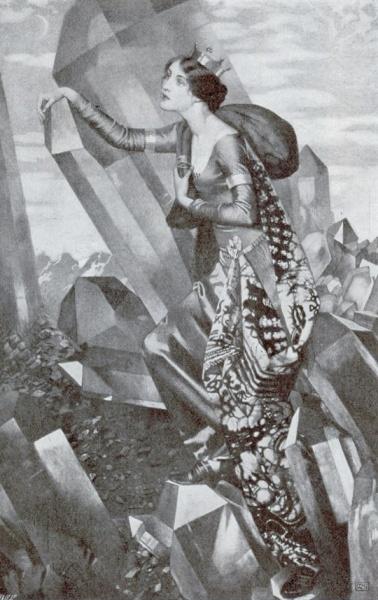
I am sure there is no edifice in fairy world more dangerous than the glass mountain. Mine towers over me, reflecting the sun to the point of blindness. I can’t see the shards of crystal that make up its face, jagged, razor-like, waiting for me to put my hand on them.

The princess of Old Rinkrank fell into her glass mountain. One moment she is beside the man she adores. In the next she finds herself in a dark cave, facing an old man with a long gray beard, who holds her life in his hands.

Did she slip and fall because of her own carelessness, or was the fall an inevitable result of her venture? In either case the event happens with disconcerting suddenness, with little recourse.

The story states, “When she had spent many years with him and had become very old, he called her Mother Mansrot, and she had to call him Old Rinkrank.” Therein lies the uniqueness of this tale, and nothing less than its horror.

Many a fairy tale ends in marriage, as does this one. Typically, the princess falls into a deathlike sleep from a bite of poison apple lodged in her throat, or swoons for a hundred years after pricking her finger on a spindle. I don’t know of any version where the princess grows old, except in Old Rinkrank.

In most of the princess tales, the heroine goes through a transformation, if only into other clothing. They might hide who they truly are, but none of these pretty girls lose their identity, lose themselves, and become “Mother Mansrot.” This name is put upon the entrapped princess by her captor. He has redefined her. Adding to the injury, she “had to call him Old Rinkrank.” This was not an exchange of fond nicknames. Through naming her, and dictating how he is to be called, he demands complete control.

The story cannot be a fairy tale unless our protagonist finds a way out of her dilemma. Mother Mansrot manages to turn her captivity into escape.

Here is the second unique feature of our story. Having lost control, the princess takes it back without the aid of a prince or a magical helper. She succeeds by her own devices.

The final surprise comes when, after all these years, she returns to her father and her betrothed. They are still there. What comes to mind is the use of time in the Celtic tales, where a day in the fairy world is a year in reality. I am tempted to think a year in the glass mountain is only a day in our time. But the story does not say that, and I’d be missing the point. Her former identity, her former world, remained suspended until she resolved her conflict, however long that took her.

I’ll play the part of Bruno Bettelheim, and put words in his mouth. The conflict and struggle between Mother Mansrot and Old Rinkrank reflects the internal struggle of an individual in whom the authoritarian superego (Rinkrank) has subjugated the id (the princess’s wants and desires) until the ego (in a burst of tenacity) releases the superego’s stranglehold and restores equilibrium, allowing the individual to reintegrate their personality.

I know a better explanation of this story. In my mind’s eye, I see an ancient Mother Goose, sitting close to the hearth to keep herself warm, weaving a tale for her listeners, who are young, old, some of her blood, some not. The story is taken from glass mountain tales she has heard; it is taken as well from her long struggle as a woman in a male-dominated world, reshaping both into part cautionary tale, part critique of her culture, and a plea for equality.

The cottage in which she told the tale has long disappeared, the hearth stones cold and scattered, but her story and her struggle remain.


Fairy Tale of the Month: February 2013 Old Rinkrank – Part Three

John Tenniel Alice Through the Looking-GlassJohn Tenniel

Mirroring

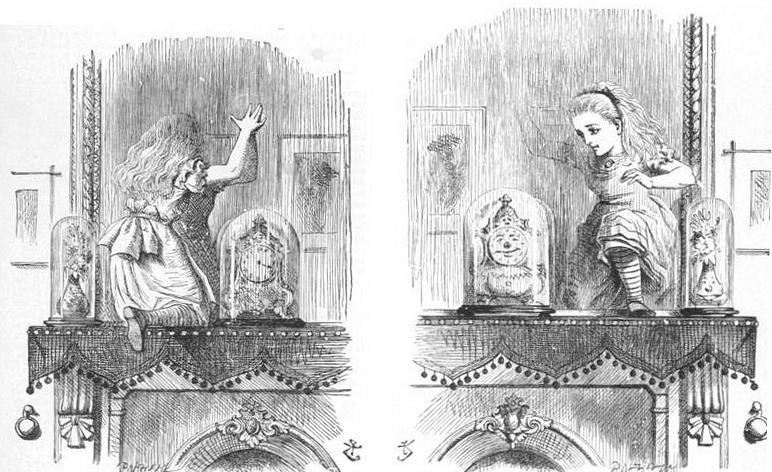
In a stupor, I remain gazing up from the foot of my glass mountain. Images, in free association, float around my brain, projecting themselves onto the clear, light-filled glass in front of me. I see a small, high window with a long rope hanging from it, a narrow ladder extending up and up, the White Knight urging his horse up the side of the mountain; by him is the Red Queen saying “—turn out your toes as you walk—and remember who you are!”

Unbidden, Old Rinkrank and Through the Looking Glass conflate in my thoughts. If you will forgive my undisciplined reasoning, I’ll argue for the connections between the two stories.

Through the Looking Glass is not a collected story as is Old Rinkrank, but it is a self-declared fairy tale. In Lewis Carroll’s opening verse to his story is the line:

Thy loving smile will surely hail,

The love-gift of a fairy tale.

I’ll take the Reverend’s word on this.

Most striking to me is that both stories depend on surreal images, creating their dreamlike existences. At one point, Alice is in a shop attended by a sheep who sits contentedly knitting. The shelves are filled with merchandise, but appear empty when Alice looks directly at them.

The princess lives in Old Rinkrank’s house, which is in a cave or is a cave, at the foot of a mountain, which is the glass mountain, or inside the glass mountain. Hard to tell where the house is, or if there really is anything on the shelves.

Alice goes through the mirror by climbing up onto the fireplace mantle. Once inside the mirror she becomes a pawn in a large chess game, and eventually forgets her name when wandering in a forest with a fawn as companion.

The princess enters the glass mountain while attempting to climb to its top. She loses all her royal status and becomes a servant to a gray-bearded man. Her name is forgotten when she becomes Mother Mansrot.

Alice is pushed around by most of the characters in her story, including flowers.

The princess is pushed around by her sole detractor, Old Rinkrank.

Both stories have bits of poetry in them. (Carroll’s is superior.)

Near the conclusion, Alice, now a queen, pulls the tablecloth out from under the chaotic feast.

The princess, now in control, climbs the ladder and pulls on the rope.

Likely, all these similarities are coincidental. Perhaps Lewis Carroll read Old Rinkrank. I want to think that he and my ancient Mother Goose were tapping into the same subconscious stream of thought, both recognizing that dreams deal with personal conflicts in their own illusive way. Maybe there are racial memories that people hold in common. That the same symbols come up again and again with similar meanings does point to a shared body of images.

Glass is one of those images, reflecting our features back at us, but in reverse of our reality. Magic mirrors have a way of distorting and also challenging us.

Looking at my glass mountain, I can see the ghostly outline of myself on the surface. Tentatively, I put my foot on the crystalline rock, and take my first step upward.

Your thoughts?
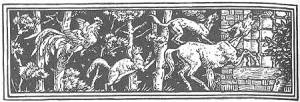
Fairy Tale of the Month: January 2013 Master Thief – Part One

Frontal Piece 4

In Disguise

Call me dishonest. I will not defend myself. I made a promise (by implication) but now I will break it.

My dishonesty snuck up on me. I like writing about some of the lesser known Grimm fairy tales that have managed to stay hidden. Deep in my volume of Brothers Grimm (tale #192) is a dandy story I decided to bring into the light of day. However, once in the light I immediately saw its disguise and knew it not to be a fairy tale at all.

I am going to write about it anyway. What story has stolen my attention and broken into the Fairy Tale of the Month? The Master Thief. The master thief in this tale never resorts to magic (the defining element of fairy tales), but plies his craft through his cleverness.

A wealthy young gentleman appears to an old couple and soon reveals himself to be their son who ran away many years ago. The old couple is at first delighted, but then depairs when they hear he had come into his wealth by thievery. The young man’s assurance that he only steals from the wealthy is of little consolation.  They are afraid if their lord, the Count, who is the young man’s godfather, finds out, he will hang their son. The young man declares he will visit the Count that very day and introduce himself as a thief.

The Count, because the youth is his godson, shows leniency and declares if the master thief can prove his abilities, then he will go free and not be hung. The first task: steal the Count’s horse from the stable while the animal is under guard by his soldiers. The master thief appears disguised as an old woman who trades her jug of drugged wine for shelter in the stable for the evening. The thief returns the next morning with the lord’s horse.

The second task is to steal the bed sheets from under the Count and his wife along with the wife’s wedding ring. The Count lies in wait, and when a ladder is set up against the bedroom window and the head of the thief is framed in the opening, the Count fires his pistol.  However, the thief is pushing a corpse in front of him up the ladder. While the Count goes off to bury the corpse, the thief enters the bedchamber pretending to be the lord. He tells the wife to give him the bed sheets the wrap the body in and her wedding ring, for which the sinner died, to be buried with him. These, too, are returned in the morning.

The third task, to steal the parson and the clerk from the church, is accomplished when the master thief, now disguised as Saint Peter, convinces them that Judgment Day has arrived. If only they will crawl into his sack, their souls will be saved.

The Count, bested by the master thief, banishes the youth, who leaves, never to be heard from again.

I hope my dishonesty in presenting this yarn as a fairy tale will not be taken with too much offense. It “feels” like a fairy tale.  The master thief appears out of nowhere and returns there. His sleight of hand is so good and so entertaining that there is something almost magical about him.

If he has stolen my attention, perhaps he will arrest yours.

Fairy Tale of the Month: January 2013 Master Thief – Part Two

Frontal Piece 2

Our Betters

One of the favorite topics of the spoken tale might be classified as “The Besting of Our Betters,” in which an underling rises to outsmart someone of higher social rank. Besting one’s betters is common to the general folk tale genre, but rather rare in the fairy tale.

I will not make too much of this point. The distinction between folk tales and fairy tales is in truth slight. The Grimms put both these tales in their book side by side, entitling their workChildren’s and Household Tales and not The Brothers Grimm Fairy Tales. By the way, we have Marie-Catherine Le Jumel de Barneville, Baroness d’Aulnoy (1650-1705), also known asCountess d’Aulnoy, to thank for the latter term when she called her works contes de fées(fairy tales).

The besting in The Master Thief is leveled at the three prominent hierarchies of the day: the military, the aristocratic government, and the church.

In the first task of stealing the Count’s horse away from the protection of the soldiers, the tone of the deception is mild compared to what follows. The thief plays on the soldiers’ simple human weakness for comfort. In social rank, soldiers were close to the listeners of the raconteurs who told this tale, and may have been among their listeners. The tellers were not about to insult them too deeply.

Making fun of members of the aristocracy was another matter. The Count stood as fair game. Of course it was not good form, and sometimes dangerous, for commoners to show disrespect to members of the upper classes, but behind their backs and out of hearing much would be said.

The wealth of the aristocracy fortified barriers between themselves and the rabble. Their palatial homes were separate from the hovels of the poor. Marriage seldom took place between the two societies. The rich put themselves on a pedestal, from which the poor took delight in knocking them down, if only in story form.

The Count set out the second task of stealing the bed sheets and wedding ring, and in meeting the dare the youth, perforce, dealt the Count a deep insult (not to mention providing the story with some macabre humor).

Concerning the third task, there is a long history of anticlericalism in Europe, directed particularly at the Roman Catholic Church, but even the Protestant clergy came in for ridicule-and for reasons similar to those that prompted stories mocking the rich. The clergy, too, many of them being educated, saw themselves as above the rabble and had a hard time not being holier-than-thou. They, too, stepped up onto that perilous pedestal. The master thief used the sacred beliefs of the parson and the clerk against them.

Poking fun at the prosperous is not peculiar to the old tales. One need only look to the Marx Brothers’ movies of the 1930s during the Depression, and view Groucho taking Margaret Dumont to task, to see a modern version of besting our betters.

Be it Groucho Marx or the master thief, underlying both is a bit of social commentary on the divide between classes, about which another Marx had a lot to say.


Fairy Tale of the Month: January 2013 Master Thief – Part Three

Frontal Piece 5

Robbers in Our Midst

“Someone took my Grimm’s.” Thalia’s look held accusation. “Teddy thinks it was you.” She held up Teddy so I could see Teddy’s look of accusation.

“Me?” I feigned innocence as I held the volume tighter behind my back. “What about the Master Thief?”

Thalia thought about that for a moment. “He wouldn’t steal from little girls.”

“Ah, you are quite right; he would not. Well then, there is the thief from The Thief and His Master; he could use magic in his thefts, and was clever enough to outsmart his master. He might have taken your book.”

Skepticism crossed her face.

“Oh,” I continued, “what about that lot of robbers in Thumbling? They were not up to any good. Or the robbers in The Bremen Town Musicians. They are still at large.”

Thalia grew thoughtful. “Maybe,” she said, “the robbers in Strong Hans. They were a bunch of drunks.”

“Or,” I suggested, “the band in The Boots of Buffalo Leather.”

“They’re all in jail.”

“Right, and the band from The Robber Bridegroom were hung.”

Thalia shuddered and I immediately regretted bringing him up. “Then,” I went on quickly, “there is that bunch in Freddy and Katy.”

She giggled at the remembrance, then said, “Oh, and a whole forest of robbers in Simeli Mountain.”

“And,” I continued the roll, “three thieving brothers in The Three Green Twigs.”

“No,” she said, “they turned Christian. They wouldn’t take my book.”

“Ah, you are right again. How about the one in The Three Army Surgeons?”

“That’s just a thief’s hand!” Thalia protested.

The Six Swans?”

“Robbers are barely mentioned.”

“Ah, then there are more robbers in The Devil With the Three Golden Hairs.”

“They were nice! They saved the little boy.”

“Yes, that they did. Well, there are three more robbers in The Raven.”

“They’re not good. They got stolen from.”

“The thief brother in The Four Skillful Brothers showed ability. Maybe he took your book.”

Thalia appeared doubtful.

I went on. “There is another set of brothers who are thieves in The Robber and His Sons.”

“I liked the daddy robber,” Thalia smiled. “He was a good storyteller.” Then she knitted her brow. “Are all storytellers thieves?”

She had noticed my hands were behind my back. She set Teddy down on the table and slipped behind me. Quickly I set her book behind the bear. When she looked up I scratched my ear with that hand.

“Let us not forget,” I said, “there are any number of dishonest inn keepers and servants. Oh, I bet it was the servants in Doctor Know-It-All who took your book. It would be just like them.”

Thalia saw her book lying behind Teddy and, uttering a gasp, she grabbed it. With their chins in the air, she, Teddy and Grimm’s marched off.

Your thoughts?
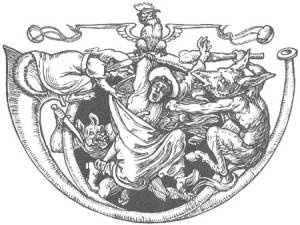
PS. I could have mentioned Thumbling’s Travels and Fools Gold, but they are variants ofThumbling and Freddy and Katy. I may have missed one or two. There are as many thieves as tailors in Grimm‘s.


Fairy Tale of the Month: December 2012 Vasilisa the Beautiful – Part One

bilibinbabawhite Ivan Bilibin

Edge of the Forest

The forest before me is dark, darker than the twilight surrounding me. Really, it is too cold to be out here, but I have on my heavy fur coat and there is the warmth of the pipe I am smoking.

Vasilisa the Beautiful entered this forest, not of her own will, but not without good advice.

Although the daughter of a well-to-do merchant, she became the victim of a stepmother with two preferred daughters. A small wooden doll, given to Vasilisa by her mother, as she lay on her deathbed, protects the girl from harm. Vasilisa, heeding her mother’s instructions, feeds the doll food and drink, reciting, “There, my little doll, take it. Eat a little, and drink a little, and listen to my grief.” The doll’s eyes shine; it comes to life, eats, drinks, then gives Vasilisa advice and aid.

The stepmother’s cruelty finds its greatest expression when Vasilisa is sent to the home of the witch Baba Yaga for light when their own home falls into darkness. On her way to Baba Yaga’s  hut, she sees a man all in white on a white horse and a man all in red on a red horse. Standing before Baba Yaga’s home, she sees a man all in black on a black horse. Baba Yaga comes on a great wind, riding a mortar propelled by rowing the pestle.

Baba Yaga takes Vasilisa within the fence of human bones lined with skulls, to her hut, which moves around on chicken legs. Baba Yaga gives the girl impossible tasks to perform the next day—or be eaten for supper. With the aid of the wooden doll, the tasks are accomplished for two days.

The witch then encourages the girl to ask questions. Vasilisa asks about the three riders. Baba Yaga replies they are her servants, the day, the sun, and the night, but had Vasilisa asked about things inside of the hut she would have eaten her.

Baba Yaga then asked a question of her own. How was it that the girl could complete the tasks given her? Afraid to tell the witch about the wooden doll, she replies, “The blessing of my dead mother helps me.”

Not being fond of blessed children, Baba Yaga kicks the girl out, throwing a skull with flaming eyes after her as payment for her work. Carrying the skull at the end of a stick to light her way, she returns home. Upon entering the house the skull’s eyes burn brighter, incinerating the step-relatives.

The story does not end here. Vasilisa moves in with a kindly old woman, and takes to weaving flax into linen with such craft that the fine linen eventually attracts the attention of the tsar, who, upon meeting Vasilisa the Beautiful, marries her.

Vasilisa entered the forest and returned with power and wisdom she did not have before. Baba Yaga’s home is not merely the hut of a witch. Its boney fence, the profusion of skulls, and its resident’s desire to eat children, all speak of a realm of the dead. Yet, from there Baba Yaga flies forth daily with her mortar and pestle, along with the white rider and the red rider. In the evening she returns with the black rider, suggesting there are cosmic forces at work.

To such places we vicariously follow our heroes and heroines. We crept along with the old soldier as he stole behind the twelve dancing princesses into the underworld with groves of silver, gold, and diamond trees. Likewise, we traveled with the rosemary maiden when she sought out the sun, moon, and wind to help her reclaim her husband.  Did we not trail after the youngest daughter as she rode on the back of the white bear slouching its way toward a great mountain?

I stand at the edge of the forest as the last of the day’s light fades, and startle the night with my match as I relight my pipe, then turn my back to the wood and my eyes toward home. I will not enter the forest. I might not return. I suspect only children have the courage, born of naivety and lack of cynicism, to enter.


Fairy Tales of the Month: December 2012 Vasilisa the Beautiful – Part Two

bilibinbabayaga Ivan Bilibin

Visit With a Friend

When I got to Miss Cox’s garden, my friend Alexander Afanasyev, all bundled up in a coat, scarf, and cap, sat on the wrought iron bench waiting for me. Over time I have come to realize that all of the 19th century folklorists are comfortable in Miss Cox’s garden, despite the weather. They will always agree to meet me here.

I feel sorry for Alexander. He died at age 45 (1871). Tuberculosis, he told me. I knew things had gone badly for him toward the end. He kept himself alive by selling off his library. Tsarist Russia was never kind to commoners, especially those with socialist leanings.  Alex fell afoul of its authoritarian censors more than once.

His claim to fame remains his eight volumes of Russian folktales, plus other volumes, one meant for children and another not meant for children that was published anonymously in Switzerland.

“Alex,” I said. “What can you tell me of Baba Yaga?”

“Ah, she is either the witch of all witches or not a witch at all. The ‘Baba’ part of her name means ‘grandmother’ or ‘old woman.’ The ’Yaga’ part, I believe, is connected with the Sanskrit word for ‘snake.’ Another good translation might be the word ‘horror.’ Besides being unusually ugly, she is known for eating children.”

“She appears in a number of stories, not just Vasilisa the Beautiful. Common to these stories is her flying in a steel mortar, navigating with the pestle, and covering her tracks with a broom. A fence of human bones surrounds Baba Yaga’s hut, with skulls on top of the pickets. At night the eye sockets glow, giving off an eerie light. In some stories there is room on the fence for one more skull. The gate has a lock made of jaw bones that opens and closes with a spell.

“The hut stands on chicken legs, the door turned away from visitors. One needs to get it to turn around by saying, ‘Little house, little house, Stand the way thy mother placed thee, Turn thy back to the forest and thy face to me!’ Inside the hut are disembodied hands that do the witch’s bidding. Baba Yaga always eats a supper large enough for a crowd, then falls asleep stretched out over her stove.”

I am listening to Alex, but also distracted by a firebird strutting around the garden like a peacock. It has come over to us and is pecking at Alex’s shoe.

“I did,” he continues, “collect one version in which there are three Baba Yaga sisters, all named Baba Yaga. What do you make of that?” Alex lifts an eyebrow.

I consider for a moment. “Brings to my mind the White Goddess, whom Robert Graves called the threefold muse.”

“Very good,” Alex nods at me.  “I concur. The pantheon of nature gods and goddesses are numerous with triads. As I said, Baba Yaga may not be a witch at all, but rather a reflection of an earlier mother goddess or goddesses.”

I return his nod, and reply to his point. “The day, sun, and night are at her service.”

“Exactly!”

The firebird startles and flaps away, losing a tail feather in its flight. I pick it up to admire it; an exquisite feather. I think I’ll give it to Thalia.

Fairy Tales of the Month: December 2012 Vasilisa the Beautiful – Part Three

bilibinbabalightIvan Bilibin

In Exchange

Joseph Campbell’s The Hero with a Thousand Faces, lays out the hero’s journey, the various stages the hero or heroine is likely to enter upon. In one stage the protagonist crosses the threshold into adventure after being called to do so. Or the protagonist may refuse the call initially, and later will labor through an ordeal to achieve the reward. Not every story will have every stage Campbell writes about. However, few fairy-tales do not have the meeting with the mentor. In Vladimir Propp’s list of fairy tale character roles the mentor is the magical helper and/or donor (of magical devices).

This mentor/donor/helper appears in many forms. In Snow White the seven dwarves fill this role, in Cinderella the fairy godmother,or in The Golden Bird the fox. The old woman in the wood helps the old soldier in The Twelve Dancing Princesses. The heroine in Sprig of Rosemary is helped by entities no less than the sun, moon, and wind.

In our story, Vasilisa the Beautiful, the helper is a wooden doll given to the heroine by her mother. Vasilisa gives the doll food and drink in exchange for advice and help.  The story makes it clear; Vasilisa would not survive without the doll.

Stepping back and taking a look at all of these magical helpers, putting aside that they are an expected part of the fairy-tale genre, let us ask, Why are they there? If we say they function to help the protagonist, then we need ask, Why do our heroes and heroines need help? As story structure goes, are not the magical helpers a cheat, a convenient answer to the way out of trouble? Why do we, the readers/listeners, want there to be magical helpers?

Perhaps the magical helpers are there because they carry a message that bears repeating. In our story, when Vasilisa faces her first hardship, the story does not say, “But Vasilisa had a magic wooden doll to give her advice.” Vasilisa was not born with the wooden doll in her pocket; she acquired it from her mother. The doll served as an extension of the mother’s wish to protect her daughter.

Further, there is an exchange. For the doll’s advice and aid, Vasilisa gives the doll food and drink. Food and drink in exchange for magical help is ever so prominent in these tales. When the heroine in The Three Forest Gnomes shares her meager crust of bread, she finds the strawberries she is seeking and departs with three other boons.

In The White Snake the hero receives help from magical creatures in exchange for having helped them. The old woman in the wood did not walk up to the soldier and tap him on the shoulder, saying, “Here, take this cloak of invisibility; you’re going to need it.” An exchange takes place between them before that happens.

We—living in a society—do not exist in a vacuum. We are constantly in a state of exchange with each other. Sometimes we exchange coins for an apple. Sometimes we exchange greetings over the phone. We might exchange a kiss, but we are always in a state of exchange.

The best exchanges are those that occur when we are helping each other. There is the message that bears repeating. That is the message we need to remember and, perhaps in those helpful moments, there is some magic.

Your Thoughts?

PS. Let me make a personal note. For me, the wooden doll is the creepiest magical helper. Dwarves, fairies, animals, old women—fine. A wooden doll that comes to life, eats, drinks, talks, works, then returns to its dormant state? Sounds like voodoo to me.

Fairy Tale of the Month: November 2012 The Bremen Town Musicians – Part One

Arthur Rackman

Arthur Rackham

A Humorous Tale

The Grimm brothers’ collection of fairy tales is known for carrying a message, a moral (though rarely as well spelled out as in the Aesop fables’ instructive tag lines): Good triumphs over evil, faithfulness will be rewarded, and patience is a virtue.

But not always. In fact a goodly number of the tales are quite humorous and unconcerned with passing on cultural values. The Bremen Town Musicians may be the most popular of these lighthearted stories.

A donkey, dog, cat, and rooster have all been turned out by their masters for being too old to be of service. The animals quickly agree to the donkey’s notion that they become town musicians for Bremen.

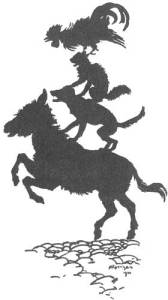
As night falls, they come across a den of robbers who are feasting. The animals decide to sing for their supper. The donkey puts his hooves on the window sill, the dog jumps on his back, the cat onto the dog’s back, and the rooster flies up on top, forming the enduring image of the story.

They bray, howl, caterwaul, and crow, then accidentally crash through the window. The robbers flee in terror and the minstrels settle onto the meal. Afterwards, the four friends retire for the night, the cat by the hearth, the dog by the door, the donkey by the dung heap, and the rooster in the rafters.

One robber is sent back by their captain to see if it is safe to return. He is scratched by the cat, bit by the dog, and kicked by the donkey; all the while the rooster is cock-a-doodle-dooing. To his companions the poor robber testifies he was clawed by a witch, knifed by a man, beaten by a monster with a club, and over them all a judge called, “Bring me the rascal!”

The robbers left. The animals stayed.

The tale ends with the nonsense tag line, “And the last person who told this tale has still got warm lips.” The Grimms seldom used nonsense tags. Of the two hundred and fifty tales, eight of them have these tag lines. Unexpectedly, Hansel and Gretel is one, otherwise filled with menacing images it ends, “My tale is done. See the mouse run. Catch it, whoever can, and then you can make a great big cap out of its fur.”

There are some followers of fairy tales who would give significance to the master/slave relationship between the animals and their owners. Some have taken the four creatures in turn and looked at the attributes these animals represent in other fairy tales. The egalitarian order of the animals’ band has been contrasted to the hierarchical arrangement of the robbers. But I hold to a simpler analysis.

It’s a silly story.

The Grimms had their agenda. When they put together their collection they wanted to capture the voice and mind-set of the German folk. Whether they got close to that is another question, considering the historic ebb and flow of Germanic and French speakers through the region. A number of the Grimms’ friends and neighbors, from some of whom they collected stories, were French Huguenot.

Nonetheless, the Bremen Town Musicians serve their place in the collection as an example of German folk humor, and, I believe, nothing more.

Fairy Tale of the Month: November 2012 The Bremen Town Musicians – Part Two

Watler Crane

Music to My Ears

I spent more time in the market square today than I should have. I wasted a good bit of it standing with a small crowd listening to the hurdy-gurdy player. I know this is not fine music, but the mind-numbing drone has its hypnotic charm. I left a coin in the musician’s hat. I wonder if Wilhelm would have done the same.

If one only looks at The Bremen Town Musicians, where the animals simply assume they can be musicians with no effort on their part, one might conclude the Grimms thought little of itinerant musicians. If one broadens the scope and considers The Marvelous Minstrel, The Jew in the Thorn Bush, and Hans My Hedgehog, the conclusion might be that… the Grimms thought little of itinerant musicians.

In The Marvelous Minstrel the musician attracts unwanted company when he plays his fiddle. In turn a wolf, a fox, and a rabbit show up, each animal wishing to learn to play the fiddle. The minstrel gets rid of them by agreeing to teach them, if the beasts will do exactly what he asks. In this way he entraps them, heartlessly leaving them to die.

Seeking revenge, the animals escape and pursue the scoundrel, but by then he has befriended a wood cutter, who defends the minstrel from the wronged creatures. The Grimms did not attempt to put a moral on this tale.

Reading The Jew in the Thorn Bush, one would think political correctness was not going to happen for another two hundred years. The musician in this story, who starts out looking like a nice young man, shoots the bird the Jew is admiring, sends the Jew into the thicket to retrieve the bird, then plays his magic fiddle, which forces the Jew to dance in the thorns. Despite this insult and in a turnaround of justice, the Jew is eventually hung. The Grimms apparently thought less of Jews than of itinerant musicians.

Hans My Hedgehog casts its musician in strange style. The hero, who is half man/half hedgehog, sits atop a rooster, playing his bagpipes while tending to his pigs and donkeys in the forest. The beautiful music of the bagpipes is heard by kings who are lost in the forest, and of whom Hans My Hedgehog takes advantage. When our hero finally sheds his beastly form he sheds the bagpipes as well. (The story ends with a nonsense tag, by the way: “My tale is done, and away it has run to little August’s house.”)

The Grimms, of course, did not write these stories, but they did some heavy editing and put their spin—and prejudice—upon them.

The Grimms were Reformed Calvinists. John Calvin considered music to be worldly and limited its role in the church to the unaccompanied singing of the Psalms. In contrast, Martin Luther, who loved music, allowed all sorts of instrumentation as long as it served the greater glory of God. The Lutherans’ propensity to play fast and loose with music in their sanctuary caused their Calvinist neighbors to judge their religious sincerity with suspicion and to view their fellow Protestants as strangers.

The Grimms, having grown up with the notion that music quickly slips into the profane, naturally handled the musicians in the tales in an appropriate manner: at arm’s length.


Fairy Tale of the Month: November 2012 The Bremen Town Musicals – Part Three

Walter Crdane

Walter Crane

Off With Their Heads

In 1266 at Fontenay-aux-Roses, a suburb of Paris, a pig was tried in a court of law, found guilty, and executed. Arguably, that was the first time an animal appeared as a defendant in a European court, but it was not the last time. Periodically other pigs as well as cattle and horses stood trial for murder or criminal damage.

I have been discussing this anomaly with my cat, albeit a one-sided conversation. While she did not acknowledge the validity of my point, or even condescend to answer a direct question, she was listening. Her stare remained steady.

My point was that human relationships with our fellow animals are fraught with illogic. For example, the very same animal that we routinely butcher and make into bacon, we have also put on trial for murder.

When I read The Bremen Town Musicians it crossed my mind that this might be the only story in the Grimms’ collection where the animals have deceived and gotten the better of humans. An hour or two of paging through the collection proved the opposite. I discovered half a dozen tales where domestic and wild creatures won out over us humans.

Of these half dozen stories I found The Dog and The Sparrow most interesting. A wagoner deliberately runs over and kills an old dog. The dog’s friend and protector, a sparrow, vows revenge, but the wagoner only taunts the bird.

The sparrow pecks out the bungs of the wine barrels, the wagoner’s freight. As the man inspects the damage, the sparrow pecks out the eyes of his horses. The wagoner flails at the sparrow with an axe, repeatedly missing the bird and killing his horses.

Abandoning his wagon, empty barrels, and dead horses, the man walks home to see the sparrow and a thousand of its relatives descending upon and devouring his wheat crop. When the sparrow gets into his house, the wagoner grabs the axe again, chopping up all of his possessions in pursuit of the bird. His wife, also axe in hand, fares worse, accidentally chopping off her husband’s head as the sparrow flies up and away.

In this tale an animal makes a moral judgment on a human, and is his jury and executioner. Surprisingly, I don’t find myself uncomfortable with the story. Justice does prevail. Evil is punished as it should be. However, the wagoner—we—have been judged by a bird!

I tried to explain to my cat that, when we look at the contradictory relationship we hold toward each other, the nonsense is easy to find.

Many humans, with no compunction, eat ham, bacon, veal, and steak, but we involuntarily recoil at the thought of eating our pets. (Other cultures have other reservations about what animals can or cannot be eaten, but the quandary is similar.)

Theologically speaking, animals do not have souls, but there are businesses available that provide the benefit of a proper burial for our nonhuman loved ones.

We call people we don’t like “asses.” Yet it was an ass that carried Jesus into Jerusalem and an ass that brought Mary to Bethlehem. Should we not honor the ass for that burden? And, in fact, almost every creche includes a donkey.

Perhaps, I told my cat, I made too much of this bit of illogic. We humans abound in illogical pursuits. For example, we make up, remember, and pass along fairy tales, which feed no one and bring little monetary profit, yet some of us persist.

My cat jumped to my lap, sniffed and rubbed her nose to mine, then abruptly leapt away. I think she was trying to console me.

Your thoughts?

Fairy Tale of the Month: October 2012 The Queen Bee – Part One

Of Little Consequence

Thalia had me read The Queen Bee three times before she would climb from my lap and amble off to bed, clutching her battered book and dragging her teddy bear.

In The Queen Bee the two eldest sons of a king have wandered off, ending up as wastrels. Their younger, simpleton brother goes out, finds them, and they travel on together. The youngest brother forbids the two eldest from harming ants, ducks, and bees for their pleasure.

They come to a castle, the stable for which houses stone horses in its stalls. They explore the castle, finding it empty except for a mute gray dwarf. The dwarf shows them hospitality for the evening and, in the morning, presents to the eldest brother three tablets that describe three tasks to be performed. The eldest takes up the challenge, the first task of which is to find a thousand pearls scattered in the forest. He fails and is turned into stone. The second brother suffers the same fate.

The third brother is helped by the creatures he spared. The ants gather the pearls, the ducks retrieve a key from the bottom of a lake, and a queen bee picks out the youngest sister from three sleeping princesses.

The spell is broken; the castle and its inhabitants return to life. Of course the youngest brother marries the youngest princess, they become king and queen, and the eldest two brothers are married off to the eldest two princesses.

“Again,” Thalia had said, upon returning to my study from her bedroom.

“I’ve read it three times.”

“I’m worried about the horses.”

“Oh! That part. I think I forgot to read that.” I reopened the book. “And when all the castle people returned to being themselves, including the stable boy, the horses nickered loudly for their grain. They hadn’t been fed in a long, long time.”

Satisfied, Thalia took back her book and, once again, toddled off with her teddy in tow.

Really, what about those stone horses?

It is one of the few descriptive details that the Grimms included in The Queen Bee, and certainly the most striking. What popped into my mind were the horses of the Wild Hunt in Tamlin:

O first let pass the black, lady,

And syne let pass the brown,

But quickly run to the milk-white steed,

Pu ye his rider down.

But certainly the horses of the Wild Hunt are not the stone horses.

Then there are the white horses with red ears seen by Childe Roland when he entered the fairy world and was obliged to cut off the head of the horse herder. These are not the stone horses either.

That the stone horses have a history, I have little doubt. Perhaps some teller, somewhere, at some time, could have made them up out of his or her imagination, but I am going to guess not.

My sense is that the old tellers were not out to surprise their listeners with something unusual and novel, but rather to present their audience with something familiar in new clothes. Often we find pieces of myth reflected in a fairy tale (A Sprig of Rosemary/Cupid and Psyche). Or a common spinning wheel becomes a device of magic (Sleeping Beauty).

One of the common crimes committed by modern-day storytellers and others who render these old tales for present consumption is to edit out elements no longer understood. How many twenty-first century children know about the duck in Hansel and Gretel, much less the cat and the pigeon on the roof?

I cannot say I know the significance of the stone horses, but when I tell that tale, or read it to Thalia, I leave in these immobile equine. Am I better off for facing my ignorance and passing it along, than to suppress those elements that cause us to wonder and question?

Fairy Tale of the Month: October 2012 The Queen Bee – Part Two

 Walter Crane


Perchance to Dream

The realm of the fairy tale and that place we go to when we dream may well be the same terrain. Those lands both share the feature of being surreal, always holding forth something inexplicable and unexplained to be treated as common fare within the illusion. The motif of the three sleeping princesses in The Queen Bee is one of those unexplained givens that populate the fairy tale.

In the Grimms’ Children’s and Household Tales we can find other sleeping princesses in the stories of Little Briar Rose, Snow White, and The Glass Coffin. The notion of the sleeping princess appears to be a borrowing from Germanic mythology. The Grimms boldly state in their notes that Briar Rose is the sleeping Brunhild of the Vőlsunga saga. There are various stories about the love between Brunhild and Sigurd, but common to them is Brunhild’s sleep within a ring of fire. Brunhild, one of the Valkyrie, offended Odin, who turned her into a mortal woman to be claimed by any man who could breach the magical flames. Only Sigurd had the strength and bravery to do so. Here was far too great an image to be left in the land of mythology. Storytellers quickly carried it off to the fairy-tale realm. (Content warning: this saga of love is mythological and therefore the romance ends badly, unlike fairy tales that, more than usually, end happily ever after, one of the defining differences between myths and fairy tales, as noted by Bruno Bettelheim.)

If I consider dreams and fairy tales as sharing the same ground, then how shall I view the three sleeping princesses, Briar Rose, or Snow White as they sleep within a dream?

The sleepers within the dream fall into a similar pattern. They are usually princesses for whom betrothal to a prince awaits them upon awakening. This sleep is not the property of commoners, although, in the case of the Grimms’ Little Briar Rose, everyone in the castle falls asleep, from the king to the kitchen boy; their sleep is conditional upon the princess’s sleep. In The Queen Bee it is implied that outside of the princesses all others are turned to stone, except their father, who is the gray dwarf. The Grimms’ Glass Coffin has a variation on the pattern in that the maiden is a daughter of a wealthy count, and the hero a tailor who rises in station with this marriage.

The sleeping-princess theme was popular with the Grimm brothers, but Giambattista Basile’sSun, Moon, and Talia and Charles Perrault’s Sleeping Beauty in the Wood, are both examples of sleeping princesses that predate the Grimms’ works.

Despite slight differences in the common theme, the tales feature the same progression from sleep, to awakening, then to marriage.

The subliminal fascination of the above stories is the magical nature of the repose of girls transforming into women. In what realms did they wander while we saw them as unsurpassed beauties in a death-like slumber?


Fairy Tales of the Month: October 2012 The Queen Bee – Part Three

 Walter Crane

Grateful Animals

There is an October rose in Miss Cox’s garden, one solitary bloom that has not given up on summer although the calendar marches toward winter. Today it was visited by one lone bee. A worker bee of course, but it turned my mind again to The Queen Bee.

I have found the queen bee in a second Grimm tale, The Two Travelers, and in another German tale, Rosemaiden (found in The  Seven Swabians and Other German Folktales.) In these tales she did heavy duty, making a castle of flowers in one story and a miniature castle of bee’s wax in the other, in each case fulfilling a young hero’s task. In The Queen Bee she needed only pick out the youngest of the identical three sisters. In all cases she was most helpful, taking her place among “The Grateful Animals,” which is Aarne-Thompson tale type 554.

These creatures are among the supernatural helpers so prolific in fairy tales. The grateful animals typically appear in sets of three who repay the hero for a kindness shown to them. In our fairy tale of the month they are ants, ducks, and bees, perhaps representing earth (ants), water (ducks), and air (bees). In The Two Travelers the supernatural helpers are a foal, a stork, a duck, and the queen bee (one more helper than the usual pattern allows).

Interestingly, in Rosemaiden the queen bee helps the hero at the beginning of the story entirely out of kindness. Later a raven, a fox, and a fish help the hero, as promised for having saved them in their moment of need.

Often there is only one helpful animal, as in Puss in Boots, where a young man’s inheritance from his father is a cat. The cat speaks to the lad, asking for a pair of boots and a bag, and goes about turning virtually nothing into great wealth for his master. The detail I find most interesting in Puss in Boots is the pair of boots that gives the cat almost human status, allowing him to be presentable to a king.

Another example of a sole animal helper is The Golden Bird. In this tale a fox inexhaustibly aids a foolish young man to win a princess. For his reward he asks the young man to slay him. Reluctantly the youth does, transforming the fox back into his human form, he having been a victim of enchantment. Along this line I could also cite The Frog King, in which the helpful but also annoying frog is actually an enchanted king.

All of these types of helpful and/or grateful animals are largely a European thing. Many other cultures are far less inclined toward talking animals. An animal talking to other animals is fine, but an animal talking to humans can be uncomfortable for non-Europeans. This kind of communication elevates them to human status, much like putting boots on a cat. Talking animals that are actually enchanted humans might be more acceptable, but, generally, talking animals are viewed as unnatural and offensive. At one time Alice in Wonderland was banned in China, largely because Alice conferred with dodos, mice, and mockturtles.

Curious to some other cultures is our willingness to elevate creatures to human status when we are as likely to eat, hunt, swat, or step upon them. What does that say about us?

The lone bee that flew about the October rose has come to settle on the sleeve of my coat. I wait for it to say something profound.

Your thoughts?

Fairy Tale of the Month: September 2012 The Blue Light – Part One

 Anonymous

Revenge

Evenings will often find me in my study. My routine, before I settle into work, is to take down one of the glass canisters of tobacco from the mantle and stuff my pipe. My choice is either Leprechaun Gold, Old Rinkrank, or Black Dwarf. I then light the bowl with my blue light. Actually, with The Blue Light, a gift from Wilhelm.

This story, if a bit like The Three Dogs, or Lars My Lad, or The Iron Man in some of its motifs, has its own distinct elements, not the least being unapologetic revenge.

Our story starts with the scarred and crippled soldier turned out of the king’s army without even the traditional loaf of bread. Near collapse, he begs food and shelter from a witch. She makes him work for his lodgings, one of his tasks being to reclaim her Blue Light from the bottom of a dry well. We are given no description of the Blue Light other than it never goes out.

The witch and the soldier disagree, and our protagonist ends up at the bottom of the dry well, albeit with the Blue Light. When using it to light his pipe it produces a magical black dwarf, who does the soldier’s bidding. Escape is first on the soldier’s mind, quickly followed by revenge on the witch. After consigning her to the gallows, he turns his thoughts to the king.

Having purloined the witch’s gold and established himself comfortably at an inn, the soldier has the black dwarf bring the king’s daughter to him at night to be his serving maid. The abuse of his daughter does not go unnoticed by the king, who succeeds in capturing the culprit despite the black dwarf’s efforts to protect his master from the consequences of such a less-than-admirable trick.

Imprisoned, separated from his Blue Light, the soldier’s last resource is one ducat. This is all he needs to bribe an old comrade of his to retrieve his pipe, tobacco, and Blue Light from the inn. After the king’s judges condemned the soldier to death for his high jinx, he asks to be allowed to have one last pipe. As the smoke rises, the black dwarf appears with a cudgel. In the 1815 version of the story, the black dwarf beats the judges to death, but by 1857 Wilhelm has softened this to simply beating them to the ground. In both versions, the king pleads for leniency and surrenders his kingdom and his daughter to the soldier.

The revenge element is clear and needs no further comment from me. What is not so clear, although it is the central element, is the nature of the Blue Light. I have not encountered a blue light in any other story, yet Aarne-Thompson type 562 is titled “Spirit in the Blue Light.” Heidi Anne Heiner (Sur La Lune) suggests it is a will-of-the-wisp, but I cannot agree. The will-of-the-wisp is seen by, or serves as a guide to, travelers. The Blue Light has more in common with Aladdin’s lamp.

Now and again, an element appears in these fairy tales that (pardon the pun) drops out of the blue. They seem to have no connections, no predecessors, no point. The Blue Light is one of these. The nature of the Blue Light remains at the bottom of the dry well. I have spoken of wells before, and they hold their secrets.

The Blue Light Wilhelm gave me came without the black dwarf. I wonder what he did with the dwarf. Imagine what a research assistant he’d make.

Fairy Tale of the Month: September 2012 The Blue Light – Part Two

About That Dwarf

I have a special affinity for the black dwarf who appears in The Blue Light, I being a Kiernan. That connection is not immediately obvious; it has to do with the meaning behind the name.

As a youth, I looked up the meaning of my surname, part of my adolescent search for identity. The result left me without further insight, there being some ambiguity. Kiernan is an alternate spelling for two Irish names. One is Tighearnaigh, also spelled Tierney, O’Tierney, MacTiernan, MacKiernan, and McKernon. It means “lord or master.” The other is Ciarán, anglicised as Ceiran, Kieran, Kieren, Kieron, or Kiernan, meaning “one of the little dark people.”

The first meaning sounded good to the adolescent me, the other would haunt me the rest of my life. That is the meaning that calls out to me, putting its claim on my soul.

When we think of Ireland we think of the Celtic people, but they came late to the party, waiting until the Iron Age. Before them came the Fomorians, Nemedians, Fir Bolg, Tuatha Dé Danann, and Milesians, if The Book of Invasions is to be trusted. They came as one Bronze Age immigration after another.

My fancy is struck by the Fir Bolg, described as a short, dark-skinned people. I can imagine them (my adopted ancient ancestors) roaming through a still-forested Ireland in a time before any Irishman forged an iron axe or farmed a potato. Across the water came the Tuatha Dé Danann, a tall, lighter-skinned people, who defeated the Fir Bolg, enslaving them or pushing them to the fringes of the land. As the Fir Bolg declined, were absorbed, and disappeared, they remained in the Tuatha Dé Danann memory as hidden, malignant beings, whose religion became dark magic, which they practiced by the light of the moon, populating the nightmares of Tuatha Dé Danann children.

History is repetitive and vengeful. On the sea’s horizon appeared the Milesians, a dark-skinned people from Iberia (Spain). After the Battle of Mag Tuired, the Tuatha Dé Danann withdrew to the fringes. Did they find there the remnants of the Fir Bolg? Did they come face to face with the demons of their dream world?

As the Tuatha Dé Danann disappeared, another world arose to absorb them: the fairy land—a time and place different from Ireland, yet forever tethered to it, the original moorings never lost.

Then arrived the Celts. They came bearing weapons and tools of iron, driving all other cultures before them into the fairy world as their chariots rolled across the land. Perhaps it is not by chance that iron is a talisman against fairy magic. The Celts were the last of the warrior cultures of Ireland. Christianity defeated them with a gentle hand.

Are all the characters of the fairy tales, my black dwarf included, remembrances of otherwise forgotten people? Kings and queens, princes and princesses, millers and farmers, sons and daughters, who once walked this earth, but through no fault of their own are now consigned to the fairy world, often losing their names, and sometimes their shape, becoming elves and dwarves.

These stories may not spring so much from the ingenuity of imagination as from the ageless yet half-forgotten memories of our kind.


Fairy Tale of the Month: September 2012 The Blue Light – Part Three

Lorenz Frølich

A Popularity Contest

As I sit in my overstuffed chair gazing through smoke drifting up from my bowl of Black Dwarf, and through the bay windows out onto the countryside beyond, I consider why The Blue Light is not more popular.

No one read The Blue Light to me during my childhood. I found it while paging through the table of contents while looking for something else. I see in this story a lot that should carry popular appeal.

Item one: Our protagonist is an underdog. I can’t speak for all audiences, but most hearts will go out to the underdog; certainly mine does. The poor soldier, disabled in service to the king is dismissed by the king because the soldier is no longer serviceable.

“You can go home,” says the monarch. “I don’t need you anymore, and you won’t get any pay because I pay wages only to those who can serve me.”

This fall from grace through no fault of his own, is similar to Cinderella’s loss of status when her father remarries and she is demoted to a scullery maid.

Item two: The soldier has his run-in with a witch, but keeps his wits about him. Although trapped, he escapes and brings about the witch’s demise. I see shades of Hansel and Gretelwhen Gretel keeps her wits about her and defeats the witch. We are always pleased to join in on a round of “Ding dong, the witch is dead.”

Item three: The humble soldier succeeds in outsmarting his supposed superiors. When they think they have the advantage, the soldier becomes a trickster and turns it around. Isn’t this in the same mode as Puss in Boots, who outwits giants and kings?

Item four: “From rags to riches” seldom fails to appeal to us. Our protagonist moves from being a soldier to the status of a king. (Now there’s veteran’s benefits for you.) Again I can evoke comparisons to Cinderella and Puss in Boots.

Why does this resourceful old fellow–down on his luck, but not down and out–not appeal to us? The answer you probably already share with me. We don’t like him.

When the story starts, the soldier has our sympathy. The king’s unfair treatment and the witch’s deceit lead the soldier to think his life is over. When the black dwarf appears, the soldier’s first thought is escape. After that it is all about revenge. We could forgive him for having the witch hung; evil should be punished. But when he takes out his grievance toward the king on the king’s daughter, he crosses the line of civility.

Even when the judges exceed justice, condemning him to death, and the soldier reverses the punishment, it is tit-for-tat. Wilhelm tried to soften the blow (literally) by having the dwarf beat the judges to the ground as opposed to killing them as in the earlier version, but it is too late. The soldier is morally no better than his victims.

A popular hero or heroine must be pure in heart, noble in spirit, and forgiving in nature. Any punishment dealt out to the evil ones needs to be done by other hands or by fate. The hero/heroine’s name cannot be sullied by retribution.

The Blue Light, in attitude, does reflect the real world and how people often do react to travail. But we do not read fairy tales for real-world reflections. That is the role of mainstream fiction. Fairy tales should take us to a different conclusion, getting there by different rules, followed by characters of a nature different from our own. The real world has no right intruding into fairyland.

Your thoughts?

Fairy Tale of the Month: August 2012 The Frog King, or Iron Heinrich – Part One

  Warwick Goble

A Kiss

I had been lounging in my study long enough for my evening cup of Lapsang Souchong to grow cold, when my granddaughter, Thalia, wandered in, the edges of her flannel nightgown dragging on the floor, and her battered copy of Favorite Grimm Tales in her hand.

“Read?” she said, with a hint of demand in her voice. I happily obliged. As she settled contentedly in my lap, I opened her book to the first story, “The Frog King, or Iron Heinrich.” After the first few sentences I remembered the story, although I recalled the title as “The Princess and the Frog.”

The story unfolded again, just as it did for me so many years ago. The princess cries by the well into which her golden ball has fallen. Up rises the frog to bargain with the helpless girl. For promises of kindness he dives down into the depths of the well to recover the ball. Thoughtlessly, the princess runs back to the castle, leaving the frog to his well.

I felt, again her agony and embarrassment when the frog intruded upon the castle, demanding entry. Her father, the king, with moral authority, made her fulfill her promises. The frog wheedled his way into eating off of her plate, drinking from her cup, and then to sleeping in her bedroom.

“She picked up the frog with two fingers,” I read to Thalia, “carried him to her room, and climbed into bed, but instead of laying him next to her, she threw him bang! against the wall. ‘Now you will leave me in peace, you ugly frog!’ ”

What! Where’s the kiss? I turned quickly to the title page. The words “Fractured Fairy Tales” did not appear anywhere. Surely this was a jest.

“Read!” This time Thalia was clearly demanding. I finished the story with an overwhelming sense of dissatisfaction (And where did this Heinrich guy—faithful servant to the frog, who wore iron bands around his heart—come from?)

Unperturbed by this miscarriage of justice, Thalia gave me a kiss goodnight and swished her flannel way out of my study. I grabbed my Jack Zipes’ translation of the tales and turned to its first story. There to my disappointment stood the wall and no kiss.

After an evening of research (I didn’t get to bed until 3:00 a.m.—thanks Thalia), I uncovered the following facts.

The kiss appears in none of the older variants. When it first appears is not clear, but Maria Tatar implies that it is of American origin.

There are Scottish tales of this motif. “The Queen Who Sought a Drink from a Certain Well,” “The Paddo,” and “The Well of the World’s End.” The common element in these three is that the frog requests to have his head chopped off before transforming into a prince.

Another wonderful variant, from Germany, is “The Enchanted Frog,” which is also a variant of the “Beauty and the Beast” story. The merchant father with three daughters, whose youngest wishes only for a rose, picks a rose from a beast’s garden. The beast is an enormous frog, who demands the young daughter as payment. This Beauty is not as noble as other Beauties, and when the enormous frog’s servants come for her, they drag her kicking and screaming from under her bed where she tries to hide. The frog’s song lulls her and she allows him into her bed.

It is not until the English version of this story, taken from Grimm but altered by Edgar Taylor, that we have a kinder and gentler ending. It is not uncommon for twentieth century versions of fairy tales to have the violence edited out. Taylor’s book appeared in 1823, not ten years after the Grimms’ publication.

I went to sleep that night, to dreams fill with amphibious images, and awoke in the morning with this conviction. All these antique variants, reaching back to the Middle Ages, devoid of the kiss, have no standing with me. They are simply un-American.


Fairy Tale of the Month: August 2012 The Frog King, or Iron Heinrich -Part Two

 John Batten

Wellspring

I am sitting by a well. This might be in Wales. It could be in Scotland. I am not waiting for a frog to rise up from its depths. It’s not that sort of well. It’s a spring really. There is a stone wall built around it, but the water bubbles to the surface; I can see the bottom.

From where I sit meadowland slopes gently upward. By the well grows an ancient thorn tree covered in bits of rag tied to every branch. I know the meaning of these strips of cloth. They were left by visitors who came to partake of the healing powers of these waters. The rags are offerings, tokens, talismans, left behind as a plea to, and in honor of the spirit of the well. Rags hung in trees, or bent pins thrown into the water, serve to heal aches, sores, and malaise. The practice comes out of pagan beliefs, but most healing wells have been assigned a Christian saint and continue on with their healing nature.

The wells in fairy tales are of a different order. Fairy-tale wells are deeper.

There is a healing well in one of the Grimm stories, “The Water of Life,” in which the three sons of the king seek the well of the Water of Life to heal their father. The eldest sons fail in what the youngest achieves, finding the well in a mysterious castle with the aid of a magical helper. There are no bits of rag around this well.

In “The Queen Who Sought a Drink from a Certain Well,” the daughters are sent out, one by one, to the True Well to bring back healing water for their mother. The well’s guardian, the frog, wants them to marry him in return for the water, to which only the youngest agrees, then tries to avoid the bargain. The matter is settled when she cuts off his head and he transforms into a prince.

I am sure there are other stories with healing wells to be found, but more frequent are young ladies sent off on the impossible task of getting water in a sieve. “Well of the World’s End,” “The Maiden and the Frog,” and “The Horned Women” being three of these. The traditional solution to the problem of carrying water in a sieve is to stop the holes with mud and moss, an unusually practical answer in a world of magic.

Other more ominous wells include the one into which two children fell and were snatched up by a nixie. Then there is the dry well of a witch who abandons a poor solider there when he does not cooperate in retrieving her blue light. In one version of Tamlane, Burd Janet casts her lover, who is in the shape of a flaming sword, into a well, thus breaking the spell put upon him.

Only in our tale of “The Frog King, or Iron Heinrich,” does the golden ball appear, a mere toy, even if made of precious metal, which falls into a well. No sieve, no healing water, no high stakes. That this child, playing with a toy, is a day away from becoming a bride makes this story almost unsettling.

A glimmer of this golden ball appears in “The Three Heads of the Well.” As the maiden sits by the well three golden heads rise to the surface singing,

“Wash me, and comb me,

And lay me down softly.

And lay me on a bank to dry,

That I may look pretty,

When somebody passes by.”

She takes them into her lap, combs their hair with a silver comb, and lays them on a primrose bank. For these courtesies they grant her three boons.

I hope for a little luck myself. I cast a copper coin into the well and make my wish. It is the wish I always make, but one day it may come true.

Fairy Tale of the Month: August 2012 The Frog King, or Iron Heinrich – Part Three

Walter Crane

Iron Heinrich

Who is Heinrich, or more to the point, from whence does Heinrich come into the story, “The Frog King, or Iron Heinrich”?

The title would cast him as a central figure in the story, but this is not the case. After the princess has thrown the frog up against the wall, the creature transforms into a prince, who explains to her that in the morning he will take her away to his kingdom. At sunrise a team of eight white horses decorated with ostrich plumes and gold chains arrives drawing a coach. Riding on the back is Iron Heinrich, the young king’s faithful servant, who, we are told, when the prince was turned into a frog had three iron bands wrapped around his heart to keep it from falling apart with grief.

As they drive off to the prince’s castle, three times the prince hears a noise that causes him to think the carriage is breaking, and three times Heinrich tells him it is the bands of iron snapping as his heart swells with joy.

This add-on to the end of the tale has a pleasant ring, but hardly warrants being part of the title. Heinrich is an incidental character, having nothing to do with the inciting incident, the arc of the story, or its climax. Nor does Iron Heinrich appear in any of the other versions.

From whence does Iron Heinrich come? Out of Wilhelm’s head, and proudly he made it part of the title.

In the Grimms’ notes on this story, they cite a variation. A king, who is ill, asks his three daughters for a drink from his well. The eldest draws a glass, but finds it cloudy. A frog hops up, reciting,

“If thou wilt my sweetheart be,

Clear, clear water I’ll give to thee;

But if my love thou wilt not be,

I’ll make it as muddy as muddy can be.”

The two eldest sisters will not consent to the amorous frog, but the youngest does.

That evening the frog comes at her door.

“Open thy door, open thy door,

Princess, youngest princess!

Hast thou forgotten what thou didst say

When I sat by the well this very day,

That thou wouldst my sweetheart be,

If clear, clear water I gave to thee?”

She keeps her promise and on the morning of the third night the spell over the frog is broken.

The Grimms’ notes then refer to a third version in which the prince departs, leaving with his betrothed a handkerchief with his name written in red. If the name turns black, he is either dead or unfaithful.

When the name turns black, she and her sisters disguise themselves as soldiers and join his army. They end up riding behind the prince’s coach when he is about to marry a false bride. The prince hears a noise and declares there is a problem with the carriage. The true bride tells him it is the sound of her heartstrings breaking. On the third sound he finally recognizes her despite her disguise and marries his true bride.

Wilhelm may have gotten the character of Heinrich from the sixteenth century writer, Georg Rollenhagen and his Old German Household Tales. The Grimms’ notes are cryptic and confusing on this point. I can’t find an English translation of Rollenhagen’s work, but the tale appears to be about a war between the frog and mouse kingdoms.

Do my suspicions about Wilhelm messing with the story matter? Not much. Perhaps I am on the trail of one of the changes made to this story, but what about the kiss? Who changed that?

The Grimms liked to put snatches of rhyme into their stories. Let me put one into my blog.

“Stories keep changing, as stories will do.

It happens by chance; it happens on cue.

Somebody changed it; had to, you see.

It might have been Wilhelm; it could be me.”

Your thoughts?

Fairy Tale of the Month: July 2012 Gold-Tree and Silver-Tree – Part One

John D. Batten

Tale Type 709

It is a little cold of Aarne and Thompson to have assigned numbers to fairy tales. I suppose they did it in the spirit of Aristotle, to organize the chaos of those things that have evolved without rules. “Gold-Tree and Silver-Tree” stood in line and received its number, but I see the story as standing alone, having come down a very different and longer path than her fellow 709ers.

The tale starts with a king, his queen, and their beautiful daughter. We are immediately alerted there is something different about this story by the names of the queen and her daughter: Silver-Tree and Gold-Tree (or Craobh-airgid and Craobh-oir in the Gaelic).

“On a certain day of the day” the queen, Silver-Tree, and her daughter, Gold-Tree, visit a glen in which is a well, in which is a trout, who, like the mirror in Grimm’s “Snow White and the Seven Dwarves,” informs the queen that Gold-Tree is more fair than she. The queen, enraged, takes to her sickbed, telling the king she will not be cured until she eats the heart and liver of their daughter.

The king (nameless as unusual) proves to be a real guy and comes up with a simple plan he thinks his wife won’t figure out. He sends Gold-Tree off to marry the son of a distant king, and gives his wife the heart and liver of a goat.

I mentioned above that the women visited the trout’s glen “on a certain day of the days.” The queen’s visits to the trout are always a year apart. This does suggest something ceremonial. Combine that with the women’s names, which we might guess have symbolic meaning, and the specter of something half-forgotten shimmers on the path behind this story.

The trout, whom the queen addresses as “Troutie, bonny little fellow,” tells her Gold-Tree yet lives. The queen goes to her husband, the king, saying she wishes to visit Gold-Tree, not having seen her for a long time. (It’s only been a year.) The king, having no suspicions (like I said, a real guy), puts a longship in order for her, and the queen personally takes the helm.

When the queen arrives, the prince is out hunting, and the servants lock Gold-Tree up in her room for protection. However, Gold-Tree relents at the entreaties of her mother, and sticks her little finger out of the keyhole for her mother to kiss. It is, instead, met with a poison “stab,” some sort of splinter apparently.

The prince keeps the body of Gold-Tree locked in a room; given that her beauty does not fade, he cannot bring himself to bury her.

The story goes on to state, “In the course of time he married again … .” This is a little confusing. Within the context of this tale less than a year lapses before Silver-Tree’s next visit to the trout, only to find that Gold-Tree still lives, and she returns to Gold-Tree. The reason Gold-Tree still lives is that the prince’s second wife (unnamed) discovers her and removes the stab, bring Gold-Tree back to life.

When Silver-Tree returns, the prince (guess what) is out hunting. Gold-Tree, as before, is helpless in avoiding her mother, and it is the second wife who tricks Silver-Tree into swallowing her own poison.

In the end, the princes and both his wives live together “pleased and peaceful.”

Tale type 709, “Gold-Tree and Silver-Tree,” standing in line with “Snow White and the Seven Dwarves?” Aarne and Thompson had their reasons, but I’ll take Gold-Tree’s hand anytime and go stand somewhere else.

Fairy Tale of the Month: July 2012 Gold-Tree and Silver-Tree – Part Two

John D.  Batten

Back to the Garden

I found myself sitting in Miss Cox’s garden again. I didn’t remember how I got there, but it is such a pleasant place. I heard the garden gate open and hoped for a moment Miss Cox would come to join me. Instead Alfred Nutt stood at the gate, gently closing it behind him. I recognized him from his photograph in the Folklore Society journal’s remembrance of him after his demise.

He walked straight up to my bench and looked down on me gravely. “I can hear your thoughts on this matter.”

“You mean on Gold-Tree and Silver-Tree?”

“I refer to your wild speculation on their having symbolic meaning.” He sat down beside me and continued. “Have you looked at the variants?”

“Yes. ‘Snow White’ of course, but also ‘The Young Slave,’ ‘Maria, the Wicked Stepmother, and the Seven Robbers,’ and ‘The Crystal Casket.’ ”

Alfred sniffed. “I refer to ‘The Lai of Eliduc,’ ‘Ille et Galeron,’ and the birth of Aed Slane in ‘The Four Masters.’

“Oh.”

“In none of these, your list or mine, are there any names remotely similar to Gold-Tree or Silver-Tree. In the ‘Lai of Eliduc’, our hero, Eliduc, a worthy knight, is obliged to venture off to serve an English king, leaving his dearly beloved wife, Guildeluec, in Breton. Eliduc quickly rises in the ranks of his new lord, and is soon in the company of the king’s daughter, Guilliadun.

“Their attraction to each other is unavoidable and fatal. It culminates with Eliduc abducting Guilliadun and attempting to sail back to Breton. A violent storm impedes their passage. Eliduc’s squire declares this to be God’s wrath for Eliduc’s infidelity. Upon hearing this, Guilliadun falls into a deathlike swoon from which she does not arise. Elliduc partly solves his problem by throwing the squire overboard and steering the boat to safety.

“He places Guilliadun’s lifeless, yet still beautiful, body in a chapel, where he visits her daily. Guildeluec, noting her husband’s daily absence and great sadness, discovers the chapel and with the aid of magic restores Guilliadun to life, being more concerned with Eliduc’s happiness than her own. She takes the veil and, in time, Guilliadun and Eliduc follow her in the service of God.”

Alfred paused a moment to collect his thoughts.

“The heroines in ‘Ille et Galeron’, they being Galeron and Ganor, both love Ille,” he continued, “but Galeron steps aside for Ganor and Ille’s happiness. Concerning the birth of Aed Slane, the wives of King Diarmaid, Mairend and Mugain, are not so cooperative.”

I stopped Alfred there. “Guildeluec/Guilliadun, Galeron/Ganor, Mairend/Mugain, Gold-Tree/Silver-Tree…”

“No, no … ” Alfred threw his hands in the air. “You are making suppositions!”

“But I see a pattern. There is a similarity in the names within each pair.”

“That is not enough.” I could see in Alfred’s eyes his struggle with patience.

“If,” he began again, “if you are looking for Gold-Tree/Silver-Tree connections you would do better to search Scandinavian tales. There is one called ‘The Castle by the Silver Wood,’ in which there are trees of both gold and silver color. Evald Tang Kristensen collected a story called ‘Twelve Black Men and Twelve Pairs of Shoes,’ in which appear a grove of silver trees and a grove of gold trees. You will recognize from the title alone its link to ‘The Twelve Dancing Princesses,’ but that was of French origin and they threw in a grove of diamonds. The French would, you know.”

Alfred rose abruptly and scowled down at me. “As a folklorist and a celtologist, let me give you a piece of advice.”

“Yes?”

“Keep your thoughts to yourself.” Alfred Nutt turned and let himself out at the gate.

Really, I thought him rather rude.


Fairy Tale of the Month: July 2012 Gold-Tree and Silver-Tree – Part Three

Polygamy—really?

After my conversation with Mr. Nutt, I felt embarrassed into doing more research. I found an article by him in The Folk-lore, vol 3, 1892. “Lai of Eliduc and the Märchen of Little Snow-White.

Deep into the article he states, “With regard to the evidence for polygamy among the early Gaels I will cite but one instance … .” That got my attention. He went on to write about the birth of Aed Slane as told in the “Four Masters,” a medieval collection of Irish Annals.

King Diarmaid came to a great gathering of the Gaels, bringing with him his wives Mairend the Bald and Mugain of Munster. Mugain, being jealous of Mairend, contrives a plan to—in public—knock off Mairend’s crown, which she used to hide her baldness. As the crown leaves her head, Mairend cries out, “God and St. Ciaran be my help!” In the next moment she is possessed of long, wavy, golden locks of hair.

Turning on her rival, she curses Mugain, who becomes barren. Mugain now fears Diarmaid will put her aside because she is barren, while—here is the kicker—all of his other wives—note the plural—are fruitful. Desperate, she prays to St. Finden.

Her return to childbearing is a little rough. She first gives birth to a lamb, then a silver trout (There is Troutie again.), and finally Aed Slane, who becomes high king of Ireland.

We must keep in mind Ireland had its own brand of Christianity long before St. Patrick arrived to start bringing them in line with Roman Catholicism, and it would be centuries before the process was complete. Nonetheless, having polygamous relationships and entreaties to the saints coexisting within the same narrative feels a bit exotic.

Alfred Nutt felt that the “Lai of Eliduc” and “Gold-Tree and Silver-Tree” drew from a common source. The Lai, written down and probably Christianized by Marie de France in the 12th century, was a medieval romance. Apparently, she, or perhaps her source, solved the polygamy problem by having the first wife decide to become a nun. In fact, Eliduc founds an abbey for her. Layering it on, the tale has Eliduc, later in life, also found a church, and dedicate himself to God, while Guilliadun joins Guildeleuc in the abbey, the three of them exhorting each other to the love of God.

What I found of particular interest is the survival of the polygamy part of the Gold-Tree/Silver-Tree tale. With the writing down of the Eliduc story by Marie de France, a Christian sentiment has crept into a much older story. Nutt claims, from the internal evidence, the story must date at least to 1056 AD, and probably is much older. As is natural, the Lai has taken on the values of the time and place in which it exists. This is how stories change and evolve.

“Gold-Tree and Silver-Tree” on the other hand, was collected not back in the 12th century, but around 1888 by Kenneth Macleod, the polygamy element very much intact.

What happened to stories adapting to their new environment? What happened to stories passing along the values of that society? Is this throwback a racial memory of a practice now gone by a thousand years?

I am sure Alfred will think I make too much of this, but I will state nonetheless, “How curious.”

Your thoughts?

PS. My thanks to Stephen Badman for pointing out the gold tree/silver tree motifs in the Danish tales.

Fairy Tale of the Month: June 2012 Snow White – Part One

 Charles Folkard

What Tales Tell

Many a fairy tale can be found between the hard bindings of forgotten books, collections made over the past four centuries to keep those tales from disappearing entirely. Still, they lurk in the darkness of a closed book, rarely seeing light spilling across the open page.

They are the lucky ones.

The popular tales suffer a worse fate. Stories like “Snow White and the Seven Dwarves” have been rewritten by Disney, dissected by Bruno Bettelheim, paired with The Three Stooges (Yes, Snow White and the Three Stooges, 20th Century Fox, 1961), and recently recast by Universal, until the popular culture would hardly recognize the Grimm version.

The story starts with one of my favorite motifs, the wish for a child or lover who embodies the colors white, red, and black. Black enters the picture in various ways, sometimes as a crow, but in our story as the black ebony frame of the window, through which Snow White’s mother-to-be peers at drops of her own blood on the snow below. In this motif the red and white are, invariably, blood on the snow.

When the wished-for child is born, the mother dies. A year later the king remarries (and exits from the story as fathers are wont to do in Grimm tales). At the tender age of seven, Snow White is declared to be “a thousand times more fair” than her stepmother by the latter’s own magic mirror. The stepmother/queen’s all-consuming vanity leads her to instruct her huntsman to take Snow White into the woods and kill her, returning with the girl’s lungs and liver for the queen to consume.

The huntsman takes pity on Snow White and allows her to flee, assuming she will be killed by forest beasts, but at least not by his hand. He returns to the queen with the lungs and liver of a boar and exits the story, I will guess, through the same door as the king. Snow White ends up in the home of the seven dwarves, entering their abode through a process strikingly similar to that of Goldilocks’ entrance into the home of the three bears, but with more agreeable results.

As the dwarves warn their new housekeeper, it isn’t long before the queen’s mirror is telling her where to find Snow White: in the home of the seven dwarves, which is, interestingly, over seven mountains.

Three times the queen, in disguise, attempts to kill Snow White: with staylaces drawn so tight as to take the breath away, a poisoned comb put into the hair, and, finally, a poisoned apple.

The dwarves thwart the first two attempts, but are at a loss to find the piece of apple in Snow White’s throat. When her beauty does not fade, they cannot bring themselves to bury her, but put her in a glass coffin over which one of them always stands guard. The glass coffin eventually is given as a gift to an admiring and romantic prince, who with a—no, not a kiss. It’s his bumbling servants, who nearly drop the glass coffin, but succeed in jolting the piece of apple from Snow White’s throat. She revives and is happily married to the prince. The stepmother/queen reluctantly comes to the wedding, where she in forced to dance in red-hot iron shoes until she drops down dead.

You know, all in all, the Disney version is a lot kinder and gentler. Universal’s rather graphic take is closer in spirit, if not in word, to the Grimms’. What might that say about Germany in 1815, America in 1937, and again in 2012? (I’ll skip 1961.)


Fairy Tale of the Month: June 2012 Snow White – Part Two

 Kay Nielsen

A Late-Night Snack

I am standing in front of my refrigerator, a box of Wheat Thins in hand, eyeing the plastic container of liver patè. I hold the door open, transfixed, my stomach growling, my thoughts leaping to the image of the evil queen thinking she is eating the lungs and liver of the innocent Snow White.

The Grimms never shied away from violence in their tales (much to the consternation of modern-day parents), particularly when it came as retribution for evil acts. Corporal punishment remained an acceptable norm well into the nineteenth century, fading as a practice in western society through the twentieth century. That the Grimms had their villains physically punished should not surprise us.

But cannibalism? The Grimms addressed a bourgeois audience. Certainly cannibalism did not enter into their day-to-day reality. I will guess the Queen’s request for Snow White’s lungs and liver came across as shocking to the Grimms’ first readers as it does today.

Fairy tales use cannibalism to exaggerate the evilness of the villain—no, I must correct myself, exaggerate the evilness of the villainess. In the tales, that crime is always committed by a woman.

In “Hansel and Gretel” a witch craves to eat Hansel. Looking farther afield, Baba Yaga is known to have an appetite for little children. (This cannibalism is not just a Grimm thing.) In “The Juniper Tree” the wife disguises her stepson’s murder by feeding the body to her husband.

In a variant on the cannibal theme, the heroine is falsely accused of eating her children. This comes up in “The Virgin Mary’s Child.” To punish a young queen for not confessing her sins, the Virgin takes away the queen’s children, after which the palace gossips accuse the queen of eating her offspring. Another example occurs in “The Six Swans” when the silent heroine’s children are stolen by the mother-in-law, who smears the girl’s lips with blood while she sleeps.

Never is the hero accused of eating his children, or consuming anyone else.

Blue Beard” (Grimm) and “Mr. Fox” (English) get very close to, but are not accused of, eating their brides. All the remains appear to be in the forbidden room as keepsakes, hardly less abominable than the eating of human flesh, but, nevertheless, remains of the crime of murder.

There are other characters in fairy tales that like to feast on humans: wolves, giants, ogres, and trolls; but, to be cannibal, one must eat one’s own species.

I finally close the refrigerator door, now with the liver patè container in my hand. I read the ingredients; whose liver is this?

That the tales purport cannibalism to be a female trait casts an ominous shadow on the story landscape. What is being said? Why is this most monstrous act reserved for woman? I haven’t a clue, but I have lost my taste for patè. I think I’ll just eat one of those apples I bought at the farmers’ market from that old hag.

Then again, maybe I won’t.

Fairy Tale of the Month: June 2012 Snow White – Part Three

 Walter Crane

In the Mind’s Eye

Fairy tales deal in images. More precisely they get the listener to create their own images. The tales give us the barest, sketchiest outline of the setting and characters: once upon a time there lived a poor fisherman, or there lived a king with a lovely daughter. The listener fills in with their fisherman (does he carry a net or a fishing pole?) or their idea of a lovely daughter (raven black hair or hair of spun gold?).

On occasion the tales will give us something more complete, Snow White and her dwarves being one of these. We know from her mother’s wishes, she has hair black as ebony, skin white as snow, and lips as red as blood. Around her gather seven ugly, bearded, kindly dwarves. The contrast between her and her companions is so engaging it fires the imagination.

It fired the imaginations of the Disney animators and writers, who, perhaps to our disadvantage, supplied us with all the details of that image, including the dwarves’ names (Sneezy, Sleepy, Dopey, Doc, Happy, Bashful, and Grumpy, just to review), supplanting anything we might have come up with.

This image of Snow White and the dwarves has become so familiar that we tend to forget one of its non-traits. The seven dwarves do not constitute a motif.

There is no mention of dwarves in the Snow White and the Seven Dwarves variants (Aarne-Thompson-Uther type 709) listed on D. L. Ashiman’s very useful site.

One of the variants on Ashiman’s list is “Maria, the Wicked Stepmother, and the Seven Robbers” (Italy). Maria, in Hansel and Gretel fashion, avoids her stepmother’s first attempt to abandon her in the forest, but ends up in the home of seven robbers after the second try. Like the dwarves, the seven robbers assist the poor girl, but the stepmother is not done with her, and Maria turns up in a coffin to be found by a king.

In another Italian variant on Ashiman’s list, “The Crystal Casket,” our heroine, Ermellina, falls from grace in a manner similar to Grimm’s “Three Forest Gnomes” until rescued by an eagle who deposits her among helpful fairies (number of which is not given.) Despite the fairies’ warnings, the stepmother has her way, and as the title suggests, Ermellina is confined to the ubiquitous coffin until rescued.

The Young Slave” (Italy again, via Giambattista Basile) has a strange variation on the Sleeping Beauty motif at the start of the tale, but has no collection of benevolent helpers anywhere in sight.

I want to say the seven dwarves appear to be unique, and exist nowhere else in the story realm. Alas, it is not true. Ashiman, at the bottom of his list, gives us a link to “The Death of the Seven Dwarves” (Switzerland). In this tale a pretty peasant girl, seeking shelter for the night, comes to the home of seven dwarves, who live on the edge of the Black Forest. They grant her entree, but, when an old woman shows up requesting the same, the girl answers the door explaining that the seven dwarves have only seven beds and there is no room for more sleepers. The old woman does the math and accuses her of being a slut. Enraged, the old woman returns that night with two men who break down the door, murder the dwarves, and burn down their house. What happens to the pretty peasant girl is not stated.

I didn’t start to write this blog post to malign the Swiss, but perhaps they had better stick to watches, cheese, and neutrality, and leave fairy tales to abler hands.

Your thoughts?

PS. Ashiman also listed “Gold-Tree and Silver-Tree” (Scotland) as a variant. It differs substantially from the other variants (no coffin), and is worthy of my time and its own blog post.