Fairy Tale of the Month: August 2023 Raja Rasalu – Part One

John D Batten

Another Picnic

Richmond Park, one of the royal parks, is the destination for our picnic. Oh yes, another picnic! What is summer without numerous picnics?

This one is Melissa’s idea. The park is her choice, the exact location in the park is her favorite, and the menu of her inspiration will be delightful if not as varied as our last picnic’s repast.

Both Thalia and Jini give quiet squeals of wonder when they spot a herd of fallow deer grazing contentedly, even before we reach our intended spot. We will hardly be out of sight of them the entire time, nor of the kestrels flying overhead.

I spread our blanket under an old, old oak tree, and we settle ourselves around it on low beach chairs. I, for one, need a bit of back support on such occasions.

Before opening Melissa’s basket, we look to Thalia for the traditional story. To my surprise, she nods to Jini.

“I have a story for you,” Jini says. “It’s from my people, called Raja Rasalu.”

Once there lived a great raja, whose name was Salabhan, and he had a queen, by name Lona, who, though she wept and prayed at many shrines, had never a child to gladden her eyes.”

To my pleasure, I realize Jini intends to recite, not read, her tale to us.

Eventually, before a child is granted to the queen, a fakir tells her that her son, whose name will be Rasalu, must not see the light of day for twelve years. If she and the king look upon his face for all that time, or all three will die.

The lad grows up constantly attended to, well educated, and in the company of a colt, born on the same day as he, and a parrot, both his constant companions. At eleven years of age and impatient, he goes out into the world before his time. His parents refuse to “see” him, and he leaves without meeting them face-to-face, never to be in their presence again.

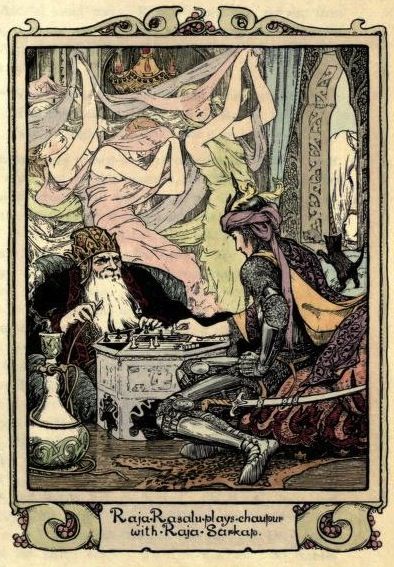
Rasalu, fully armed, astride his faithful horse, ventures forth determined to play games of chaupur with Raja Sarkap, in which the stakes are always high. During his travels, he takes shelter in a graveyard during a lightning storm and has a long conversation with a headless corpse. The corpse turns out to be the brother of Raja Sarkap, through whose hand he lost his head. He warns Rasalu and advises him to make a pair of dice out of a bone from the graveyard to match against Sarkap’s enchanted dice.

Traveling on, Rasalu saves a cricket from a fire, and the cricket gives Rasalu one of his feelers, promising him aid if he burns the feeler to evoke the cricket. Bemused, Rasalu accepts the gift.

Coming to Sarkap’s kingdom, he is greeted by the raja’s seventy daughters, the youngest of whom falls in love with him. The other sixty-nine want him to pass a test. They mix millet seed with sand and order him to separate them out. Rasalu calls upon the cricket, and the cricket’s swarm easily performs the task.

The seventy daughters then want him to push them on their swings. He puts them all in one swing and gives it such a push, they land on their heads. The youngest, now disenchanted, goes to her father to complain. Sarkap understands who Rasalu is and challenges him to games of chaupur.

Before the games, Rasalu—always compassionate toward the needy—saves the kittens of a mother cat, who gives him one of her litter to put in his pocket. During the rounds of chaupur, Rasalu loses his armour, his horse, and is about to lose his head, when his faithful horse reminds him of the bone dice.

During the game, Sarkap’s rat, Dhol, had been running about, knocking over the pieces to distract Rasalu, but now Rasalu insists upon using his dice and brings out the kitten to keep Dhol at bay. After that, Rasalu is victorious and claims Sarkap’s head.

At this point, Sarkap is informed that one of his wives has had a daughter. Rasalu trades Sarkap’s life for the daughter. The daughter is shut into an underground palace for twelve years, and a mango tree is planted at its entrance. Rasalu declares that he will marry the girl when the mango tree blooms.

Jini bows to indicate the end of her story.

We applaud.

Fairy Tale of the Month: August 2023 Raja Rasalu – Part Two

Source not known

Plot Thickens

Melissa opens up the wicker basket, setting out the quinoa-kale salad. “If that is a story of your people, I will assume your family is from the Punjab?”

Jini smiles. “You are right.”

“Raja Rasalu is something of Northern India’s Siegfried. There are a number of legends about Rasalu, poetic sagas, if I recall.” She looks at me, knowing how little I know about the subject.

“Yes,” says Jini. “My parents brought me up to be English, pushing our own culture aside. I am only now beginning to teach myself about my origins, and, like Thalia, love the fairy tales and legends. I see so much in them.”

“Good,” says Melissa, setting out scotch eggs (I snatch one immediately). “But like the Arthurian tales, for which there are multiple sources that don’t agree with each other, you will find the same disagreements in the Rasalu tales.”

“Such as?” Jini’s eyes glimmer as she stretches out her hand for a Jaffa Cake.

“Well, there is Rasalu’s older brother, Puran. According to some legends, it was Puran who, at his birth, was sequestered for twelve years and could not have his parents look upon him.”

As Melissa slices some bara brith, she continues. “In another version, Salabhan’s second and younger wife makes false accusations against Puran, the son of Salabhan’s first wife, after Puran rejects the younger wife’s advances. In fury, Salabhan has Puran’s hands and feet cut off, and his body thrown down a well.

“Puran survives for twelve years at the bottom of the well, being fed by birds and animals, until a fakir discovers him, retrieves Puran from the well, and, through his powers, restores the severed limbs. Puran studies under the fakir and becomes one himself.

“As a fakir, he returns, unrecognized, to his father and stepmother and grants the queen the long-sought-for child, but with the stipulations of the twelve-year isolation and no visitation. Something of a reflection of his own travail.”

“Wow,” says Thalia. “In Jini’s version, it is some fakir who sets up the terms, and here it is Rasalu’s saintly half-brother. That’s some heavy editing going on!”

I nibble on some Jacob’s Cream Crackers topped with Cornish Yarg. “I am afraid this has often happened when foreign tales get taken over by a different cultural viewpoint. They get disassembled and reassembled, kind of like a Picasso painting.”

“All tales, including these, may get bowdlerized as well,” Melissa adds.

“By the way,” I ask, pouring myself some blueberry-and-mint iced tea (I am glad she had the sense not to bring wine with two young girls in tow) “What is the game of chaupur?”

“Oh, very old,” Jini says. “The board is made of cloth in the form of a cross full of very colorful squares. Each arm of the cross has three columns of eight rows. Each player has four pawns. There can be two players or two teams of two players each for each arm of the cross. The pawns move depending on the value of the seven dice thrown.

“What I don’t get is the dice I always see are made of cowry shells, not bones. Anyway, it’s popular with old people. I don’t have the patience for its impossible rules. The game can go on forever. The game ends when someone gets all four of their pawns to the center.”

“Hmmm,” I say. “I’m old. I may have to try it.”

Jini blushes.

Fairy Tale of the Month: August 2023 Raja Rasalu- Part Three

Cover of Joesph Jacob’s book

Number Twelve

“I have to wonder about the number twelve,” I say, turning my attention to some crisps. “Here in the West, there are the twelve days of Christmas, the twelve months of the year, and the twelve-hour clock, all dealing with time.”

“Ah, but,” says Melissa, “I never heard of twelve years of isolation or confinement. In the Grimm canon, Maid Maleen is shut in a tower for seven years. The six swans’ sister has to not speak or laugh and sew six shirts out of aster flowers for six years. A twelve-year sentence of this nature, I don’t recall.”

Our conversation falls off for a while as we enjoy Melissa’s picnic offerings.

“That cricket,” Thalia says, finishing off a scotch egg, “sounded familiar. He was an animal helper, but there was only one, not the usual three.”

“What about the kitten?” Jini asks.

“Not the same thing. Animal helpers give the hero some way of calling them when in need. The kitten simply ended up in his pocket for his use.”

“You make a good point,” Melissa muses. “We may be seeing the origin of a motif. Let me suggest that this notion of an animal helper giving the hero a token or evocative chant to use when in distress, in exchange for a service rendered, came down the Silk Road to Europe.

“Our tellers, knowing a good thing when they heard it, tripled the effect, creating the motif of the three animal helpers. The West is warm to the pattern of threes.”

“I like the notion,” I say, “but who influenced whom?”

“Oh, they influenced us. Rasalu legends date from the second century AD. The fairy tales, as we know them, with their body of motifs, were developed around the twelfth century.”

“Oh,” says Thalia, “there’s the number twelve again.” Both she and Jini giggle.

Melissa smiles. “I am sure it is coincidental.”

“And then,” I say, goading, knowing there are teenage girls in company, “we have a talking horse that gives Rasalu good advice.”

“Yeah!” they chorus.

Melissa rolls her eyes. “If there is a horse in the tale, it is bound to say something. Any animal in fairy tales can talk, but I feel horses are particularly chatty.”

“I did notice,” says Jini, “there isn’t an animal in my tale that Rasalu cannot talk to.”

“And no one is ever surprised by it,” Thalia puts in. “Where in any fairy tale are the words, ‘Oh! You can talk.’ Doesn’t happen.”

“Another good point,” says Melissa. “There are certain assumptions that the fairy-tale genre always makes.” She ticks them off on her fingertips.

“Animals can talk.

“Royalty has magical powers.

“Witches appear poor, even if they have hoarded wealth.

“Rather few heroes and heroines have a name—well, that only applies to the European tales.

“There will likely be a marriage in the story.

“If there are siblings, there will be two, three, six, or seven. Never four or five. Well, okay, in Jini’s tale, there are seventy sisters.

“There are very few fairies in fairy tales. We should be calling them ‘wonder tales.’

“If I thought more about it, I could come up with other notions.”

“Does that mean fairy tales, or should I say ‘wonder tales,’ are rather predictable?” I argue.

“Not at all. But if so, as most popular literature does, even if predictable, it aims to satisfy.”

I am satisfied with that answer.

Your thoughts?

Fairy Tale of the Month: July 2023 Kidnapped by a Mermaid and a Dragon – Part One

John D. Batten

Magic Picnic

Thalia and I wander into the Magic Forest, she carrying a wicker picnic basket hastily provided with egg-and-cress sandwiches, two apples, some parlies, and two bottles of Karma Cola. It was a last-minute decision. Looking out the window at a glorious summer day, I suggested a picnic, and Thalia chose the Magic Forest as the location. That surprised me, but why not?

We go no farther into the forest than the pond and find a grassy sward on which to spread our blanket. We are just getting settled, when down another path comes Ultima.

“Hello again,” she smiles. “I have come to contribute this!” She holds up a small, colorful box. “To add to your picnic for a story in exchange.”

“Well, Ultima,” I say, “First things first. This is my granddaughter, Thalia.” They simply wave energetically at each other.  “Now, what is in the box?”

“Caramel Dragon Nuts.”

“Hmmm, dragon,” says Thalia. She reaches into our basket and pulls out Folk and Fairy Tales from Denmark, Volume Two, a collection l know she has been exploring. “In exchange,” Thalia offers, “here is Kidnapped by a Mermaid and a Dragon.”

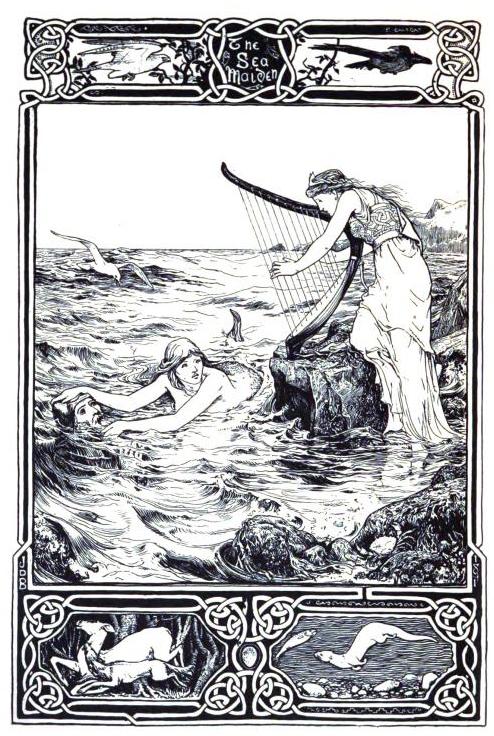
A poor fisherman, unable to provide for his family, is approached by a mermaid, who promises his wealth in fish if he will give her the son his wife is carrying in her womb. The fisherman, knowing he cannot feed another mouth, agrees to give up his son soon after the child’s twelfth birthday. The child, when he turns twelve, finds out what his father has done and flees from the sea to avoid the mermaid.

On his travels, he comes across a lion, a dog, a falcon, and a beetle arguing over a dead animal and who should consume it. The lion enlists the lad to solve their problem. Wisely, the lad divides the corpse among them, each to their own contentment. As reward, they give the lad the power to assume their shapes, only with twice the power, twice the speed, and twice the wisdom.

In the form of the falcon, he allows himself to be lured by a trail of breadcrumbs into the hands of a princess, who puts him in a decorative cage. That night, he turns into a beetle, crawls out of the cage, and approaches the princess’s bed as a man. She screams, and he retreats into the cage. The household thinks it is a bad dream, and this happens three nights in a row.

However, on the third night, before she can scream, he says, “Hush now. I am your falcon.” It was not long before they are plotting how to get married. The king, unfortunately, had declared no one could marry her until they could pick her out from her two other, identical sisters. Failing to do so carries the usual punishment.

There grew a hair on her neck that was unlike her sisters and with that clue, he picks her out three times in a row no matter how they dress.

But, as fate will have it, the newly married couple, on a walk, strolls too close to the sea, and the new prince is snatched away by the mermaid. The princess demands of her father a gold spinning wheel, a gold spinning reel, and a gold thread-winder—which with great reluctance he provides—for her to make a shirt for her husband. She does the spinning, reeling, and winding by the sea. The mermaid demands the devices, saying that she, the mermaid, should make the shirt for the husband. The princess agrees to surrender the gold instruments as long as she can once again see her husband. This the mermaid allows. The princess says, “If only my falcon were here.” The husband transforms into a falcon and escapes the mermaid.

Fate, once more, interferes. On their return, a dragon appears and steals away the princess. The king offers up one of his other daughters to the prince—they all look alike—but the prince will have none of that and sets out to find his wife.

In falcon form, he searches the world. One day, while resting on a mountaintop, he senses a strange odor. In dog form, he follows the scent to a mouse hole. In beetle form, he crawls into the mountain to find his wife and six other princesses crying into a vat. He stays long enough to discover how to destroy the dragon.

Every day, the dragon demands fifty pigs from the king of that land. The prince arranges to be the swineherd, then transforms into a lion and battles the dragon. This encounter happens three times. Each time, when they lay exhausted, no longer able to fight, the dragon says, “If I had the princesses’ tears to drink, you’d be dead by now.” To which the lion responds, “And if I had a sip of wine from the king’s table, your guts would be on the ground.”

On the third day, the prince brings a companion whose sole duty is to give him the wine. With that, the lion rips apart the dragon. As the prince knew would happen from his spying inside the mountain, a hare springs from the dragon’s body. In the form of the dog, the prince chases and kills it. From the hare, flies a dove. As a falcon, the prince kills the dove and dashes the egg inside it onto the mountain. The dragon’s mountain collapses, and everyone in it is freed. The prince and princess return home in honor.

Ultima applauds. “I am not sure about the evil dragon part. My dragon would not appreciate that a bit, but I like the story.”

Fairy Tale of the Month: July 2023 Kidnapped by a Mermaid and a Dragon – Part Two

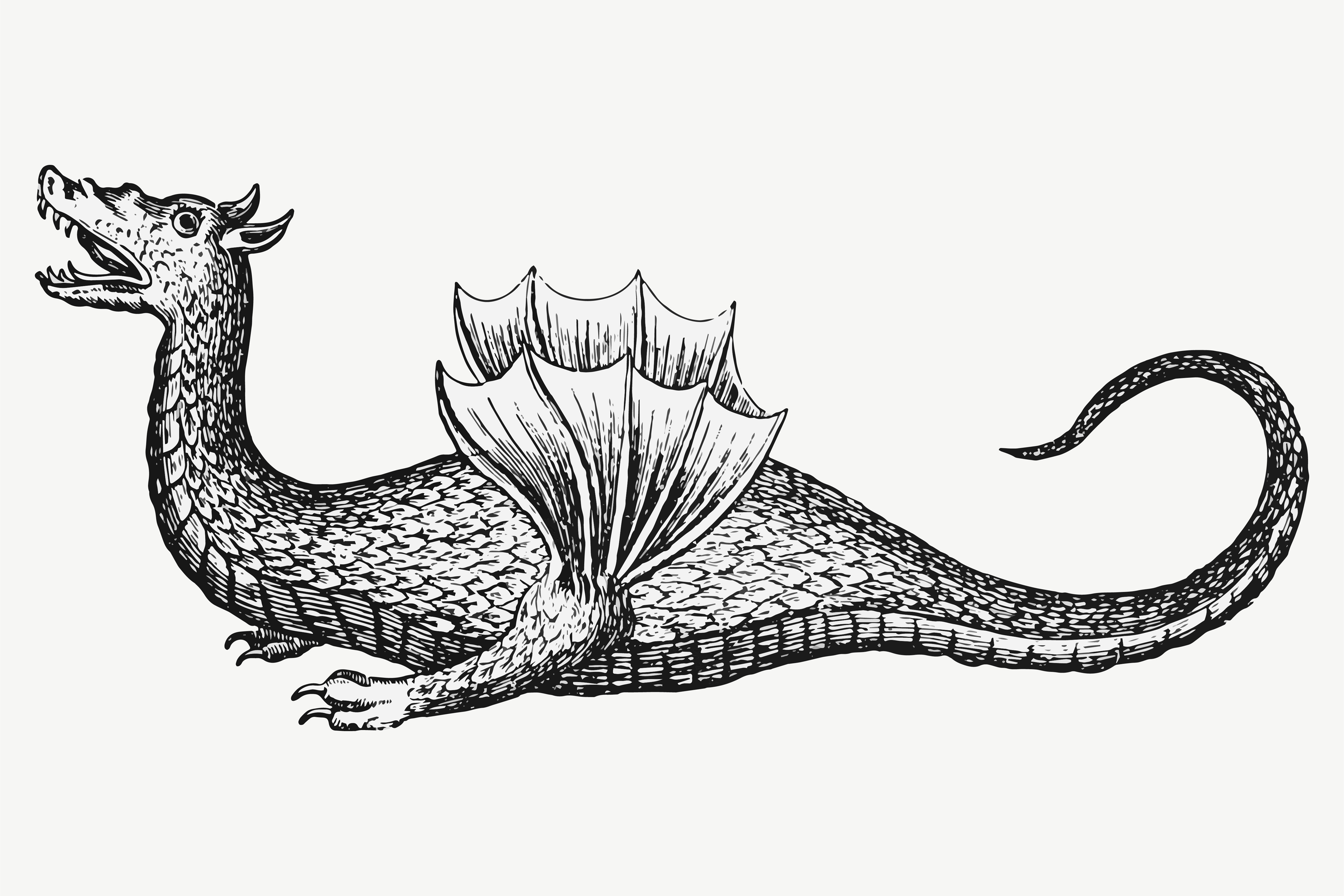
dragon by Athanasius Kircher

Other Food

“Now,” says Ultima, “if this is a proper picnic, I am sure you brought a bottle of wine.” She peers into our picnic basket.

“Ah, well, you see, this was sort of a last-minute . . .”

“Oh, a bottle of claret, how nice.”

What?

“And here are three glasses.  There now, you did know I was coming. You did bring a corkscrew, I hope.”

I see Thalia’s eyes light up at the prospect.

“Only half a glass for her,” I declare.

“I do have a question,” Ultima asks as she pours out two and a half glasses. “It seems to me, there is more than one motif being borrowed by this story.”

“Oh my, yes,” I say. “Let’s enumerate them.”

We all pause to take a sip. Thalia’s eyebrows flicker.

“First,” I describe, “is a fisherman bargaining with an entity from the sea. They invariably want a child. The sea is equivalent to the fairy world—another place where abducted children end up—except that the fairy world is in another dimension. The sea is in front of us. Obviously a different realm, but one we can at least wade into, but if embraced, would drown us.”

“That’s a setup,” says Thalia, “for what happens later on when he gets kidnapped, but what about the four animals arguing over who gets the dead one?”

“That is another trope,” I say, “that appears in lots of stories. The unusual feature in this one is the four contenders for the feast, as opposed to the typical three. For me, the lion stands for strength, the dog for speed, the falcon for cunning, and the beetle for wisdom.”

“Is there a Carl Jung in your world?” Ultima asks out of the blue.

“Yes,” I answer.

“Right. He talks about the four personality types. For me, the lion is the Sensor, the one who has rules for himself and others; the dog is the Feeler, the one who is concerned about others’ comfort; the falcon is the Intuitor, the one with flights of fancy and insight; and the beetle is the Thinker, the one who reasons things out.”

“Sooo,” Thalia is thinking out loud, “in either case, the hero’s meeting the four creatures is more than something that happens to him and he gets gifts, they become part of who he is. He absorbs them—at least their gifts. They become a part of his personality.”

I wonder if a little wine clarifies her thoughts.

“I like that idea,” Ultima smiles. “Magic can become part of you, more than something you just have. Well, if there is wine, there must be cheese.”

“At this point, I am not sure,” I say.

Ultima peers back into the wicker. “Oh my, a whole wheel of Jarlsberg. You are extravagant. Where’s the knife.”

How did that fit in there?

We are soon nibbling on wedges of cheese.

“What was the next stolen motif in our story?” Ultima breaks the silence.

“Next,” says Thalia, “the falcon is captured by the princess, and his,” Thalia clears her throat, “somewhat inappropriate behavior.  Is that a motif?”

 I hesitate. “I’ll say ‘no.’ I have run across something similar in The Earl of Mar’s Daughter, but I will call that a borrowing, not a motif.”

“What’s the difference?” Ultima frowns.

“A motif,” I suggest, “doesn’t just travel down the road of story from one teller to another, although it might, but originates in the human psyche, the collective unconscious. It is not any teller’s invention.”

“Next is the identical-sisters contest,” Ultima chimes in. “Is that a motif?”

“Most certainly, although it is usually not sisters but a larger troop of women of identical appearance, sometimes magically produced.”

“And what part of the human psyche does that tap into?” she asks.

“I’ll have to think about that,” I say.

“Easy,” Thalia responds. “It’s about making the right choice when there are lots of choices, like finding who is your best friend among all the people you know.”

Does wine spur her thinking, or is it simply making her loquacious?

Fairy Tale of the Month: July 2023 Kidnapped by a Mermaid and a Dragon – Part Three

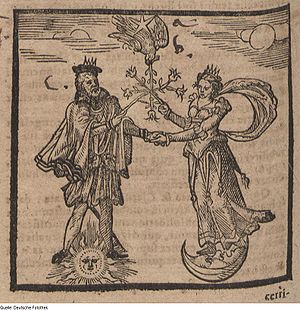
Rosarium Philosophorum 1550

More Food

Ultima lays out a platter of sizzling Angels on Horseback—bacon-wrapped oysters—and beside it, steaming Yorkshire pudding.

Hot appetizers?

“I believe that brings us up to the kidnappings.” Ultima samples a haggis sausage roll.

“Which brings us back to where the story started,” Thalia observes. “And why is it called ‘kid’ napping? Why not ‘princenapping’ and ‘princessnapping’?”

“Well,” I say, “in the plural, ‘princessesnapping’ would be hard to pronounce.”

Thalia giggles, and I continue. “As I said before, fairies and merfolk were given to bargaining for or stealing children. Losing one’s children is, I believe, rated as a primal fear among parents. But then, fairy tales have a way of reflecting all of our fears.

“In these abduction tales and similar stories, the silver lining is that the mother manages to get her  baby back, or the husband or wife regains their stolen spouse. Herein is a theme of loss and triumph.”

“Not in The Pied Piper of Hamelin,” Thalia states.

“True, but that only reinforces my idea of our fear of losing our children. The Pied Piper, a magical being, isn’t stealing a child for his benefit, but the children of an entire town as punishment for breaking their contract. No silver lining there. It is the other side of the coin, as it were.”

“I see the theme of fate being played out when the mermaid kidnaps the prince,” Ultima says.

“There is plenty of fate to be found in fairy tales,” I say. “However, we think of fate—at least in the English language—as the inevitable fall, or even demise, of its victim. Seldom, if ever, is the hero or heroine fated to good fortune. Good fortune comes of the defiance of fate. To use another simile, when the cards are stacked against the hero or heroine, they have an ace in the hole.”

“Oh!” says Thalia with wine-enhanced emphasis, “is that the role of magical devices? To help defy fate?”

“There’s another good thought,” says Ultima.

“Hmmm,” I analyze. “That is a good thought. The princess talked her reluctant father into providing her with golden thread-making tools. These were not magical, but being made of gold is just short of being magical.”

“Or,” says Ultima, “is gold magical?”

“We do treat it that way, don’t we.” I say. “In either case, the princess used these devices to trick the mermaid.”

“And so,” Ultima raises a finger, “the story comes full circle, fate is defied, and the story should end. But it doesn’t.”

“Yeah,” Thalia squints, “the dragon comes in as a random act of nastiness.”

“Right,” Ultima goes on. “What happened to the prince was a matter of fate. What happened to the princess—as you say, Thalia—was a random event. In either case, one mate had to save the other. That was kind of a given. It’s the origins of the dilemmas that I find interesting.

“I don’t think the teller was simply trying to make the story longer. I think the teller wanted to give equal time to the animus and anima within the listener.”

“The what?” Thalia’s eyes blink rapidly.

“My apologies for projecting Jungian thought into the story again,” Ultima says. “Simply put, the animus is the man in every woman, and the anima is the woman in every man. Just as everyone has elements of the four personality types, and one of the types will dominate, we all have elements of the animus and the anima, the dominance of which will depend on our sex.

“As I interpret the story, it tells us that the animus—the male part—may defy his fate through some device, be it physical or otherwise. Then the tale tells us that the anima—the female part—may solve an unlooked-for crisis through acquired knowledge and by getting to the origin of the matter.”

“Oh!” Thalia brightens. “The egg that held the dragon’s soul.”

“Egg-actly.”

I groan as I get around to tasting her caramel dragon nuts. “I don’t know if that would hold up as a scholarly paper, but I rather like your notion that the story speaks to all the different parts that make up our psyche.”

Ultima peers into the basket again, then looks at us warily. “Are we ready for the main course?”

Your thoughts?

Fairy Tale of the Month: June 2023 The Three Daughters of King O’Hara – Part One

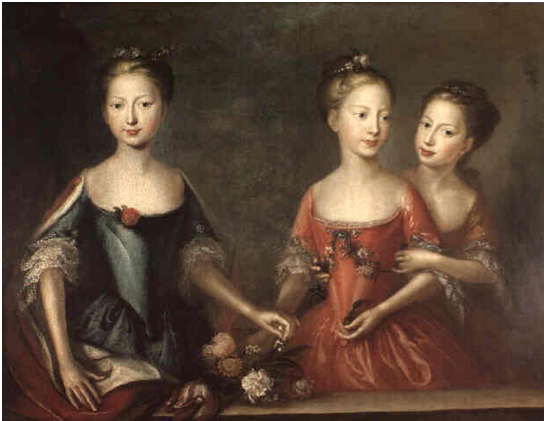
The daughters of George II (Anne, Amelia and Caroline) Martin Maingaud

A Request

I am uneasy, and I don’t know why. I imagine that is why I am uneasy.

We are in my study for the evening read: Thalia, Jini, the fairy, Johannes, and the brownies (out of sight). There is an air of tension between Thalia and Jini; they are all business. There hasn’t been a giggle passed back and forth.

In Thalia’s hands is my copy of Myths and Folk-Lore of Ireland, by Jeremiah Curtin. I have rarely seen her reading it.

“Tonight’s tale,” Thalia announces, “is The Three Daughters of King O’Hara.”

 The eldest daughter of King O’Hara decided how she would marry. She put on her father’s cloak of darkness and wished for the most handsome man in the world. He immediately appeared in a coach pulled by magnificent horses and whisked her away. The second daughter did the same, settling for the second-most handsome man.

These men came with a price. Being enchanted, they could spend either the day or the night as men, and the other half of the time as seals. Their wives had to choose, and both preferred they be men during the day.

The youngest put on the cloak of darkness and wished for a white dog. Appearing in a splendid coach, a white dog whisked her away and offered a similar condition as had been offered to her sisters. She chose he be a dog during the day and a man at night.

They had three children, two boys and a girl, who were carried away by a gray crow a week after their births. The white dog had forewarned the princess not to shed a tear over the loss, but she cried one tear over the girl, a tear that she caught in a handkerchief.

King O’Hara, at first angered at his daughters leaving him, reconciled with them and offered a feast. The husbands were welcome, but the king did not wish to entertain a dog. However, the youngest insisted.

The queen that evening, in the company of the cook, snuck into her daughters’ bedrooms to find the youngest with a most handsome man and the others sleeping with seals. Unfortunately, she also found the dog’s skin and threw it into the kitchen fire.

The husband of the youngest daughter began his flight to Tir na n-Og after explaining that had he been able to stay under her father’s roof for three nights with her, the curse over him would have been broken. She followed him, and the next three nights he instructed her to stay in certain houses, in each of which she was hosted by a woman, met one of her children, and was given magical gifts: a scissors, a comb, and a whistle. However, her daughter had only one eye. The princess restored the other eye with the tear she had caught in the handkerchief.

On the fourth day, the husband explained she must not follow him, for having lost his dog form, he must now marry the queen of Tir na n-Og. The princess hesitated a while but eventually followed.

She was befriended by a washerwoman and used the scissors and comb to benefit the children of a henwife. However, the henwife warned the queen of these two magical gifts. The queen demanded them, and the princess traded them, each in turn, for a night with her husband. This the queen granted, but she drugged the husband.

After those two failures, the princess used the whistle to call the birds. From them, she found out what she must do. The queen found out about the whistle and wanted it as well. On the third night, the princess left a letter with her husband’s trusted servant, telling her husband what they must do to kill the queen.

In front of the castle grew a holly tree that the husband then cut down. Out of the tree sprang a sheep. The princess released a fox that ran down and tore open the sheep, from which flew a duck. The princess released a hawk that downed the duck, smashing the egg inside the duck. The queen’s heart, hidden in the egg, broke, and the queen died.

They held a great feast, the washerwoman and the servant were rewarded, the henwife burnt alive in her house, and the princess and her husband reign in Tir na n-Og until this day.

Thalia closes the book, glances at Jini, raises the book and stares directly at me. “Will you take Jini and me to Miss Cox’s garden to meet Mr. Curtin?”

Ah, that’s the uneasiness in the air. Will I let Jini visit the garden?

“Of course I will.”

They giggle.

Fairy Tale of the Month: June 2023 The Three Daughters of King O’Hara – Part Two

A Meeting

It is a gorgeous June day in Miss Cox’s garden. When we left the house, a fine drizzle filled the air, but not here. A bench and two chairs surround a small round table, all of wrought iron. On the table sits a larger-than-usual teapot in its cozy and four china cups. How does Miss Cox know what to anticipate?

Our eyes, trained on the garden gate, soon gaze upon an elderly man with a somewhat scraggly beard and sad eyes. Yet his countenance has a merry tone. This is a man who has seen the world and found peace with it.

“Mr. Curtin,” I say, “Let me introduce my granddaughter, Thalia, and her dear friend Jini.”

He nods his greeting, sits, and Jini springs up to pour the tea. Thalia, prepared with a script in hand, starts the interview. “Mr. Curtin, Jini and I are particularly interested in The Three Daughters of King O’Hara. How did you come to write it?”

“To be clear, I did not write it, I collected it. Oh, I did translate it from the Gaelic language through an interpreter. Although I am born of Irish parents, my specialty ended up being Native American and Slavic languages. I am fluent in many tongues but not Gaelic.

“I worked for the Bureau of American Ethnology as a field researcher and did much work on Native American culture and their stories. I have also translated literary works from Slavic languages. Eventually though, my Irish heritage called to me. My wife, Alma, and I visited Ireland a number of times to collect stories.

“We were afraid many of the older tales we had come to collect may have died out. We found that not to be true, but the tales survived only among the Gaelic speakers, that is, the areas where Gaelic was the everyday language, such as the Aran Islands. We did not collect a single tale from an English speaker. The tales we collected were totally tied to the Gaelic language.”

Thalia nods and refers to her script. “Jini and I were attracted to the youngest daughter. We liked her pluck. What attracts you to tales like this one?”

“A tale may be considered a thing of value from three different points of view. From one point of view, it is valuable as a wonderful story and the way in which this story is told. A beautiful tale has a value all its own.

“From a second point of view, a tale is interesting for the social or antiquarian data that it preserves or for purposes of comparison with tales of another race. This is the folklorist approach.

“From a third, and very small class, a tale is valuable for the mythical material it contains, for its contribution to the history of the human mind.

“As for myself, it is hard not to hold all three points of view at once. I am charmed by the simplicity and straightforwardness of the narrative. I am titillated by its similarities and differences compared to other tales, and drawn in by the subtle suggestions it makes about the human condition.”

We all take a round of sipping tea before it gets cold.

Fairy Tale of the Month: June 2023 The Three Daughters of King O’Hara – Part Three

The game birds and wild fowl of Sweden and Norway, Illustrations by : Lloyd, L. (Llewelyn)

A Conclusion

Jini, with a bit of impatience in her voice, pipes up. “Why does she wish for a white dog?”

“Ah!” Jeremiah raises a finger. “Here we return to the point of view of the folklorist, who values the tales for their comparisons. Let me rephrase the question: Are there white dogs in Celtic myths and legends? The answer is ‘yes.’ There are a number of them.

“I’ll skip over the hounds of hell—white dogs with red ears—and go straight to Bran and Sceόlang (Raven and Survivor), the hounds of Fionn mac Cumhail. Fionn’s aunt, during the second of her three marriages, is turned into a dog by her unhappy mother-in-law. She gives birth to two white hounds before returning to her human form. The dogs, keeping their canine shape, are given to Fionn; Bran and Sceόlang actually being his cousins.

“In a work known as the Book of Invasions, there appears a poem about a creature that is a sheep by day and a hound at night, and what water touches the creature turns to wine.

“I should also mention Cuchulain, the hero of the Ulster Cycle, whose name translates as ‘Hound of Culann.’ He does not turn into a dog, but does become monstrous in battle.”

“Wait. They aren’t exactly the same as the princess’s white dog,” Thalia questions.

“No, but they are comparable. That is what interests the folklorist.”

“And the seal thing?” Jini wants to know.

Selkies!” Thalia chimes in.

“Quite right,” Jeremiah acknowledges. “There is a long tradition about the people of the sea, who are shapeshifters. They can be seals in the water and humans on land by removing their sealskins.

“A typical selkie tale is about a fisherman who sees a female selkie, or a group of selkies, in human form, and steals a sealskin, forcing its owner to marry him. They have children and are a family until she rediscovers her sealskin, puts it on, never to return, abandoning the children and her husband.”

“Oh, how sad,” Jini pouts.

“Again, not exactly the same as our story,” Thalia observes.

“And the thieving gray crow?” Jini asks.

Mr. Curtin hesitates. “It almost has to be Queen Eriu or Erin, from whose name the word ‘Ireland’ is derived. She was one of the last three queens before her people, the Tuatha Dé Danann, were driven into the fairy world, Tir na n-Og. The other three queens were her sisters, all married to three brothers. As a shapeshifter, her form was that of a gray crow. There are many crows and ravens in Celtic mythology, but no other than Eriu’s form that I know of is described as a gray crow.

“If the gray crow in our story is a reflection of Eriu, and the three women who take charge of the princess’s three children are she and her sisters, then the irony is that these women give the princess the magical gifts that become the instruments to trap and destroy the queen of Tir na n-Og.”

“Wow,” says Thalia.

“I can’t help but think,” I say, “that the motifs of the white hounds, the selkies, and Eriu were thrown into a caldron by the storytellers, heated up and blended, reemerging to appeal to a different palate.”

“That is not a solid folklorist analysis,” Jeremiah smiles, “but you may be right.”

Your thoughts?

Fairy Tale of the Month: May 2023 The Girl Who Went To War – Part One

Battle of Castillon

Row Row

Rowing on the Isis with Duckworth is one of my delights. The month of May is the perfect time for such an exercise. He and I apply our backs to the oars. But something is not right.

“Duckworth,” I say, “you are being rather quiet.”

“Am I? Sorry. I am distracted.”

“Over what?” I ask, still applying strength to the oars.

“It’s my eldest daughter. She is thinking of joining the military. I am not at all fond of the idea.”

“Wait. How old is she?”

“Thirteen.”

“Oh, Duckworth, there is plenty of time for her to change her mind.”

“Yes, I know,” he concedes, “but she is single-minded.”

“Well,” I say, “call it synchronicity, but I read a tale last night dealing with this issue.”

“What? My daughter joining the military?”

“Quite so. It’s a story collected by R. M. Dawkins in his Modern Greek Folktales, called The Girl Who Went to War.”

Three sisters decide, taking a dim view of their marriage prospects, to become soldiers instead when their country is invaded. Their father dissuades them, one by one, as they venture out, by disguising himself as a warrior and threatening with his sword.

However, the youngest, who when younger, had found a colt by the seaside and raised it as her own. Fully grown, it could breathe fire and had the power of speech. When she dresses herself as a young man, arms herself, and sets off to war, the horse warns her of her father’s ruse. When confronted by him, she attacks. Realizing there is no dissuading her, he gives his daughter his blessing.

“Yup,” says Duckworth, “that’s my daughter.”

Coming to the battle, she draws her double-edged sword, and her horse is soon knee-deep in blood. Single-handedly, she drives the enemy into submission.

“That’s rather Joan of Arc-ish,” Duckworth comments.

Her king, who is unaware of her true identity, is delighted with his new hero, marrying this warrior off to his very own daughter.

“Oops,” says Duckworth.

The newly wed princess is distressed when her “husband” puts a sword between them in their bed, commanding she shall not cross over it. Both the princess and the queen are enraged and convince the reluctant king to send the “youth” on an impossible quest.

The king asks his esteemed warrior to bring him an apple from paradise. With the horse’s advice, the youngest steals the clothing of one of the girls of paradise while she is bathing and returns the garments for an apple.

“That’s one,” Duckworth nods. “I bet there are two more.”

Next, she is given the task of collecting seven years of taxes from a notoriously resistive village. However, with the horse’s advice and not too many deaths, she succeeds.

For the third task, it is the queen who makes the request. There is a wild mare that guards ten thousand acres of fertile land and wears a band plaited with diamonds and “brilliants” that shine so brightly that no one can go close to it. The queen wants the mare defeated and brought to her.

With great trepidation, the girl’s horse comes up with a plan, battles with the mare, and defeats her through trickery.

For the fourth task . . .

“Wait, a fourth task? That’s not right.”

For the fourth task, they enlist the horse’s mother, who rises from the sea and would devour the girl but for the horse’s insistence that she does not. The girl rides the mare into the land of the one-eyed giants to steal their fire. By throwing magical devices behind them, they outrun the giants. Unable to cross their boundary, the giants hurtle a curse upon the girl. “If you are a boy, you will become a girl. If you are a girl, you will become a boy.”

“Ha!” says Duckworth. “Brilliant.”

Fairy Tale of the Month: May 2023 The Girl Who Went To War – Part Two

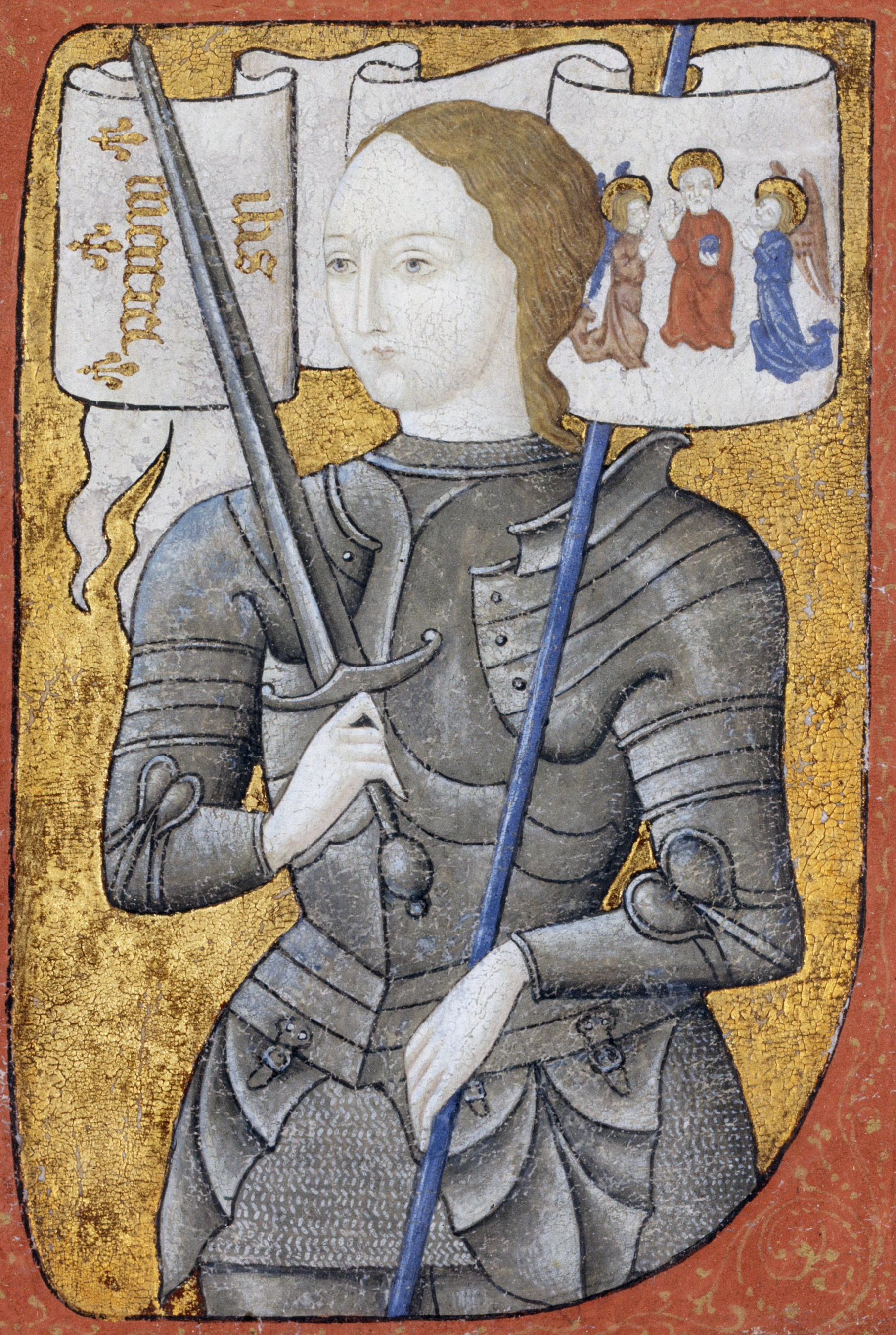
Joan of Arc – 15th Century

More Rowing

“Would you call that a ‘trans’ fairy tale?” Duckworth inquires. “If so, the tale is way ahead of its time.”

“No, no, not at all. Questions of sexuality have always been with us. This tale only reflects that. I can think of another of this ilk, a Danish tale simply called The Princess Who Became a Man.”

The rhythm of our rowing lets my mind wander. “There is also another tale called The Lute Player. In that case, a queen disguises herself as a young male musician in order to rescue her husband. There is no question of sexual identity on her part, but she knows she’d make an attractive young man.”

“Ah, I see your point.” Duckworth stops rowing to tap a finger to his head. “Shakespeare was known to dress his female characters up as men. Let me remember; Rosalind in As You Like It and Viola in Twelfth Night.”

“I’m impressed with your memory. Have you ever considered going on a quiz show?”

Duckworth waves off my compliment. “Cross-dressing for comic effect, as Shakespeare did—having other women fall in love with the hero/heroine—and an actual ‘trans’ experience are two different things. This tale you just told me has both.”

“There is an irony in all that,” I say, still rowing, “In Shakespeare’s day, women were not allowed to perform on stage. Young men were used to represent women. In Rosalind’s and Viola’s cases, young men were pretending to be women who were pretending to be men. Did anyone ever notice?”

Duckworth takes up his share of the rowing again. “I quipped a few minutes ago about how Joan of Arc-ish the main character is, but I’m beginning to take my comment more seriously.”

“That sounds dangerous.”

Duckworth ignores the comment and continues. “When were the fairy tales, as we know them, created?”

“Oh, starting around the twelfth century they were first recorded, but certainly they evolved before that and since.”

Duckworth puts down his oars to fact-check. My shoulders are getting a bit stiff.

“Right, so, Joan of Arc is early fifteenth century. Goodness, she was only seventeen when all that started and burned as a heretic by nineteen. Ah, here is what I was looking for. She was captured by the Burgundians, who turned her over to the English. They put her on trial for heresy, one of the charges being blasphemy for wearing men’s clothing.”

Duckworth’s eyes are fixed on his cell. “This is all in the context of the Hundred Years’ War. It was her influence, even after her death, that inspired the French to keep fighting and eventually win.

“I can’t help but see shades of Joan’s history in this tale. A woman dressing as a man bursts onto the battle scene, driving the enemy before her, in a sense, single-handedly.”

Not keeping doubt from my voice, I say, “If that is so, should not there be a French version of this tale instead of a Greek one that has come down to us?”

“Stories travel,” he defends.

“Yes, they do, but the parallel between Joan of Arc and our heroine ends with the cross-dressing and the initial battle. There is neither talk of any kind of marriage concerning Joan nor does she have a talking horse.”

“Well, I did say ‘shades of Joan’s history.’ Joan’s history did not have a fairy-tale ending.”

That is true enough.

Fairy Tale of the Month: May 2023 The Girl Who Went To War – Part Three

John Bauer

Merrily Merrily

“What about all those horses in this story?” Duckworth has returned to rowing.

“Well,” I say, “talking horses are not rare in these tales. Horses contesting with each other are well enough known. However, a horse calling on its dam from out of the sea, I have not encountered before. I am not sure what to make of her.”

“I suppose,” says Duckworth, doing a good job at the oars again, “all animals can talk in the tales.”

I hesitate. “Not exactly. I think it falls into categories.”

“Ah,” Duckworth returns, “categorize away. I am listening.”

“I am thinking out loud,” I warn. First off, the animals that can talk are rather culturally dependent. For example, folktales from India can have snakes talking, which rarely, if ever, happens in European tales, despite Old Testament references to such a thing. I will stick to the European tales, which I know better.

“Category one: Animals talking to other animals. Actually, I think that category is pretty universal. I have been led to believe that in China there is a prejudice against animals and people talking to each other. I read somewhere that Alice in Wonderland was banned in China in the 1930s for that reason. Nonetheless, animals talking to animals was fine with them.

“Category two:—perforce—is animals talking to people.  Under this category, I can make a number of subcategories.”

“You are pretty detailed,” Duckworth interrupts, “for just thinking out loud.”

My turn to ignore. “Subcategory one: Talking animals who are actually royalty under enchantment.”

“Oh, lots of those,” says he.

“Think I’ll call this the “East of the Sun” category. It is well populated by bears but also foxes, as in The Golden Bird. I cannot forget the frog in The Frog King, nor the beast of beauty fame.”

“My favorite is the flounder,” Duckworth puts in.

The Fisherman and His Wife, yes, and interestingly, something of an exception. We hear from the start that the flounder is an enchanted prince and, in the course of the story, remains so. All the other tales have the talking creatures transformed at the end of the tale and revealed as humans.”

“What about,” Duckworth interjects, “characters that are transformed into animals by a witch or to escape a witch?”

“Such as in Brother and Sister? Hmmm. Difficult. That group is transformed during the story, not before the story began, and may or may not be of royalty, and may or may not talk while in that state. I might need a sub-subcategory.

“I will exclude characters that learn the language of animals and birds. That would be a bit of a cheat to get into one of my categories.”

“Oh,” says Duckworth, “now there is competition for this honor.”

I get to ignore him again. “Subcategory two comprises the animal helpers.”

“Lots of them too.”

“And here we return to the horse, mare, and dam of our story. The horse is the magical helper. He coerces the mares to do his will. I wonder if the mare and the dam were the same being in an earlier iteration of this tale. That would have been more logical, but the tales are weak on logical construction. The tellers/creators of the fairy tales were more in tune with emotional impulses than striving for believability.”

“Hmm. That might explain some things.”

“Also note, all talking animals, whether enchanted or helpers, nonetheless are helpful. The hero/heroine never receives a threat from a talking animal. From giants, witches, trolls, and dwarves, yes, but from animals, no.”

“I’ll try to remember that if ever my dog starts talking to me,” he smiles.

“And,” I’m not done yet, “horses are never enchanted royalty. They can be eerie, like the severed horse’s head hanging in the dark gateway of the city as in The Goose Girl, but not royalty.”

Duckworth nods in contemplation.

“My,” I say, “our conversation has wandered far from the subject of your daughter’s career options.”

I immediately wish I’d not said that as I see him slip back into gloominess.

“What career would you rather she follow?”

“Dentistry.”

Dentistry? Where did that come from?

“You know,” I say, “the military does offer the opportunity to travel.”

Your thoughts?

Fairy Tale of the Month: April 2023 The Enchanted Head – Part One

Circa 1870

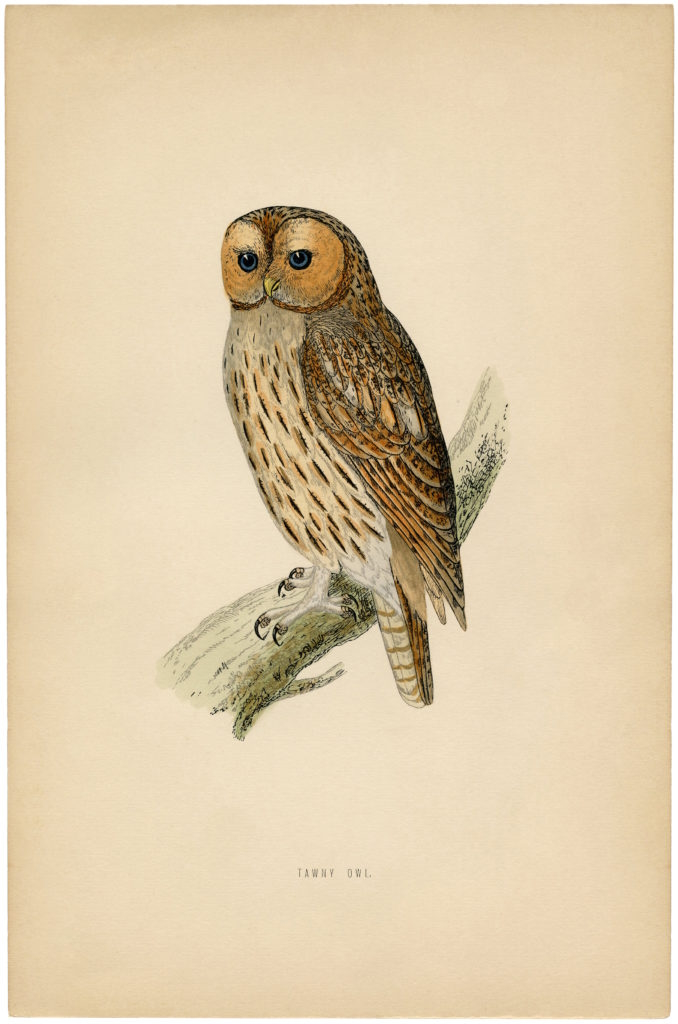
Owl Scowl

It is a brilliant moon that shines down on the Magic Forest below me. The night air supports me as I push against it with the wiry strength of my wings. Summoned, I cannot resist the call.

Wait a moment. Why am I a bird? What’s going on? Aren’t I in my study sipping Proper Twelve whiskey?

Below is the pond with Melissa sitting on a stone along its bank. I land on the branch of a tree above her. She is looking hard at the path from my house into the forest.

“Hello, you called?”

Startling, she looks up into my tree. “What are you doing up there? Yes, I called, but . . .  Oh dear,” she laughs, “this is my fault.”

“How so?”

“Well,” she stammers a bit, “I’ve begun to frequently visit the Magic Forest when I want to contemplate. This time I wanted your reflections, so I called for you. I know Ultima has done that at least once, but I felt the calling should be, at least, a little poetic. I called out three times, ‘Come, my friend, wise as an owl. Come, my friend, and bear me no scowl.’ And here you are.”

“Well and good,” I say. “But you could have called me on the cell.”

“Not as romantic,” she pouts.

“Fine.” My talons resettle themselves on the branch. “What is the issue?”

“A story, of course.” She smiles. “What else do I concern myself about?”

I blink my eyes and let her continue.

“The story is from Andrew Lang’s Brown Fairy Book. As you know, the fairy books were his wife’s production. The story that caught my attention was The Enchanted Head.”

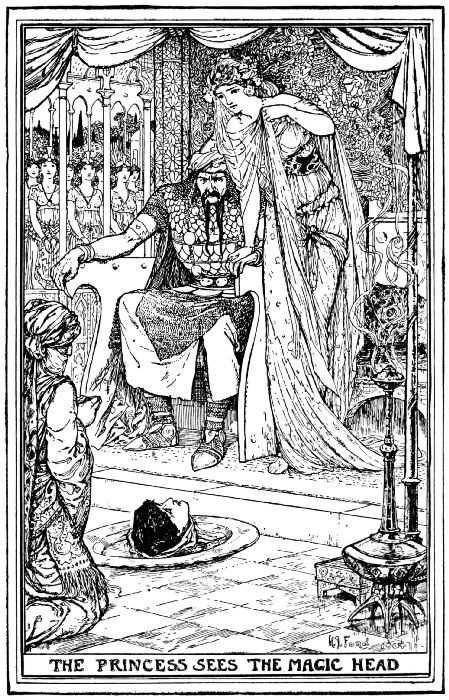
A poor, old woman and her two daughters earned their living by making veils that the old woman sold in the marketplace. To get to market, the old woman crossed a bridge, but one day a severed head lay on it. To the old woman’s horror, it spoke to her, asking to be taken to her home. The old woman fled, but the head rolled after her, following her into the house.

The head managed to ingratiate itself with the mother and daughters after sending the old woman out at midnight, back to the bridge, instructing her to call out, “Ahmet” three times, then asking Ahmet for the “green purse.” When she called out, a gigantic Negro appeared and fulfilled the request.

“I don’t think ‘Negro’ is the proper term these days,” I say.

“That is the word used by the story and wait, things get worse. I’ll explain in a minute.” Melissa returns to the narrative.

There was enough money in the purse for them to not only get food but also to rebuild their house, wear fine clothes, and not have to make veils. When the money ran out, the head sent the old woman back to the bridge to call out to a different servant and ask for the “red purse.” During the course of the story, the head has her call out to other servants, each one a Negro larger than the one before.

All goes well until one day the head requested the old woman to go to the sultan and ask for the princess’s hand in marriage to him. The old woman, although appalled, was convinced to carry out his wish. The old woman told the sultan that the suitor was very powerful. The sultan, mistakenly thinking the suitor was her son, proposed to test the suitor three times. The first task was to remove the mountain in front of the palace, replacing it with a formal garden, all within forty days.

On the thirty-ninth day, the head sent the old woman to the bridge with the request to remove the mountain and create a garden. It was accomplished in one night, which was a good thing because the sultan had planned to hang the old woman for trying to play a trick on him.

The next two tasks were to create a magnificent palace in forty days, and then staff the palace with forty beautiful, identical servants within the next forty days. On each of the thirty-ninth days, the old woman went back to the bridge.

However, the sultan was outraged when he discovered that his new son-in-law would be a severed head. Nonetheless, the princess agreed to the marriage, she finding it, after all, a handsome head.

After the marriage, the head appeared to her as a handsome man. He explained about the curse put upon him by a wicked fairy. Unfortunately, the curse was not broken, as one might expect. To her, he would appear as a man, but to everyone else, he would remain a severed head.

With that, the princess was content.

“What?” I say, ruffling my feathers. “That is an unusual ending.”

“Well,” Melissa smiles, “I rather liked the ending, until I discovered I’d been betrayed.”

Fairy Tale of the Month: April 2023 The Enchanted Head – Part Two

H. J. Ford

More Story

Hey, I really can turn my head all the way around.

“Are you listening to me?”

“Oh, sorry,” I say. “In what way were you betrayed?”

“Well, like you, I noticed the story ended on an unusual note. The origin of the story appeared to be Middle Eastern. The story source is Traditions Populaires de Toutes les Nations. The French I learned in college held me in good stead along with an internet word translator.”

“And what did you discover?” I am interested, but my body can’t help preening its feathers.

“I discovered Mrs. Lang told only half the story!”

“Only half?” I stop preening.

“Not only that, but where she left off, the story goes on to say that the enchanted head told her she must not tell anyone of this or the garden, palace, servants, and he himself would disappear. She would never see him again until she wore out three pairs of iron shoes and three iron walking sticks looking for him, and then he would appear as if dead until she filled a barrel with her tears.

“She, of course, promised to tell no one of their secret. However, the queen mother came to her daughter often to console her, only to find the daughter quite happy. The mystery of this intrigued the queen, and she would not relent until she discovered the reason. When finally she did, a pretty, golden canary flew out the window and the princess’s husband was gone.

“After a few days of crying, the princess, remembering his words, resolved to search for her husband. Three pairs of iron shoes and three iron walking sticks later, she found herself in front of a palace, which she entered to find her husband lying lifeless on a couch. Beside the couch stood a barrel.

“Again, remembering his words and seeing him, by all appearances, dead, she cried her tears into the barrel. By morning, the barrel was almost full. Filled with hope, she stopped crying.

“At that moment, a gypsy woman entered the room, asked what was the matter, offered to help—having pains of her own to cry over—and sent the princess off to rest. When the princess awoke, the gypsy had absconded with her husband. As she tore out her hair in lamentation, a Negro appeared, giving her three magical nuts to be opened when needed and a horse on which to ride to the capital city, where her husband would now be king.

“The gypsy, now queen, ordered the guard not to let her pass into the palace. The princess rented a room nearby and opened the first nut—a walnut—out of which came a hen with her chicks, all with brilliant plumage, and singing beautifully. These she put into a golden cage and hung it from her window where the queen could see it. The queen desired them and agreed to let the princess spend the night with the king, but not before she drugged his wine. The poor princess could not wake him up, and her entreaties went unheeded.

“The second nut—a hazelnut—produced a vast plain with rivers, streams, woods, and fields. This too she hung from her window.”

“Come again?” I say, blinking rapidly.

“That’s exactly what the story says. The same agreement occurs with the same result, only this time a faithful servant observed what happened and informed the king. When the third nut—a chestnut—was opened, out came a sea with its shores, islands, and all of its fish to be hung from the window. The king only pretended to drink the wine and was awake when the princess appeared.

“All was revealed and the false queen punished by being tried to the tail of a wild horse that dragged her over sharp rocks until she was torn to pieces.”

“Ouch.” My feather fluff out in empathy. “But, she did deserve it,” I resolve.

Fairy Tale of the Month: April 2023 The Enchanted Head – Part Three

H. J. Ford

Story’s End

I flap my wings, then focus my thoughts. “This is—I am sure you recognize—the Psyche and Cupid motif. At least the part that Mrs. Lang edited out.”

“Yes,” agrees Melissa. “There are many of those in the fairy-tale genre. I have to wonder if Mrs. Lang was simply tired of that trope and refused to face it one more time.”

“Perhaps,” I say, “but by doing so she obscured a marvelous version. Usually, the three gifts are items of clothing desired by the false bride. In this case, the walnut, with its multicolored, singing hen and chicks is striking enough. But then we are presented with the hazelnut containing a plain with rivers and streams, followed by the chestnut bringing forth a sea with islands and fish, all of them hung from the princess’s window. Well, it does stretch the imagination, in a good way.”

I begin preening as Melissa answers. “In that motif, the husbands appear in many forms, as beasts, bears, and even invisible beings, but I had not heard of any as a severed head. What do you make of that?”

“The severed heads do have their place. I am thinking of The Three Heads of the Well, not to mention the Celtic talking heads like Brân the Blessed and the Nordic Mímir. This story is Middle Eastern. I can’t speak to that, still, I’ll guess there is a similar tradition. I’ll suggest severed heads can appear wherever they want to.”

“Fair enough,” she agrees before going on. “While Mrs. Lang edited out the last half of the story, there are a number of things she did not include in the first half.”

I answer with a ruffling of feathers.

“First,” she enumerates, “the old woman and her daughters lived near the Bosphorus. Second, the market was in Constantinople. And three, the bridge she had to cross was called, in the story, “the bridge of the Golden Horn, which has to be the famed Galata Bridge.

“There is a conundrum. The story was told in February 1834, by Madame Martmerik Ge. The Galata Bridge had not been built by then. It had been talked about for a few centuries. I will have to assume a fairy built the bridge before the Ottomans could get around to it.”

“That was a lot of detail and color to have left out,” I observe. “Speaking of color, what was the ‘Negro’ thing all about?”

“Ah, the Langs, although highly educated and artistic, were still a product of their age. I believe the phrase ‘ethnic slur’ was not in their vocabulary or their understanding. Let me read to you parts of Andrew’s preface to the Brown Fairy Book.”

She produces a copy of the work from her canvas carry bag and reads.

“The stories in this Fairy Book come from all quarters of the world. For example, the adventures of ‘Ball-Carrier and the Bad One’ are told by Red Indian grandmothers to Red Indian children who never go to school, nor see pen and ink. ‘The Bunyip’ is known to even more uneducated little ones, running about with no clothes at all in the bush, in Australia.”

Melissa pauses and scans down the page. “Then there are tales like ‘The Fox and the Lapp’ from the very north of Europe. . . . The Lapps are a people not fond of soap and water, and very much given to art magic. . . . Other tales are told in various parts of Europe, and in many languages; but all people, black, white, brown, red, and yellow, are like each other when they tell stories. . . whether they go to school and wear clothes, or, on the other hand, wear skins of beasts, or even nothing at all, and live on grubs and lizards and hawks and crows and serpents, like the little Australian blacks.”

She closes the book.

“Good heavens,” I say, “I’d peck his eyes out if I could.”

Your thoughts?

Fairy Tale of the Month: March 2023 Tinker of Tamlacht – Part One

A Visitor

We are making ourselves comfortable in the study after celebrating Saint Patrick’s Day with a feast. For the menu, Melissa and Thalia had settled on corned beef and cabbage, colcannon, leek soup, and soda bread. Now, Melissa and I cradle glasses of Guinness in our hands, while the girls have warm cider.

Yes, girls. Jini is with us, having been sworn to secrecy. She and Thalia decided best friends cannot have secrets from one another.

We have given her the somewhat overstuffed Queen Anne’s chair. To her delight and my surprise, Johannes has jumped into her lap and curled up. She pets him gently as her eyes try to penetrate the dark corners of the room where the brownies are scuttling about.

I watch her closely. Sure enough, as I hear the fairy fluttering through the study’s archway, her eyes go anime.

“Ah, she can see our fairy. I don’t think everyone can.”

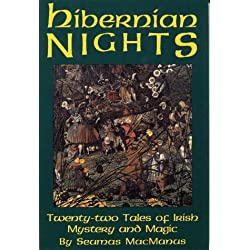
Thalia hardly notices the fairy alight on her shoulder as she opens her book, Hibernian Nights, and announces the story, The Tinker of Tamlacht.

There lived in Donegal, in the village of Tamlacht, a poor tinker, who one day finds himself in a bog after trying to take a shortcut. He declares, “May the devil take me if I ever come this way again.”

When he gets back on the proper road, three beggars meet him in turn, to whom he gives what little money he has. The three beggars turn out to be an angel, and the angel gives him three wishes. 

First, the tinker wishes for a full meal chest; second, that what goes into his workbag stays there until he lets or takes it out; and third, those who take the apples from his tree will stick there until he releases them.

Sometime after that, he again tries the bog shortcut and meets the devil, who reminds the tinker of the vow he made. Fortunately for the tinker, the road to hell leads through Tamlacht. The tinker convinces the unpopular devil to hide inside the workbag while they go through the village.

The poor, unsuspecting devil ends up being placed upon an anvil and beaten with hammers until he disappears in a column of fire.

The tinker returns home from that adventure to find his wife has had a baby. He goes out to find a godfather. He rejects the landlord, who takes advantage of the poor; he rejects God, who lets the landlord get away with his greed; but accepts Death as the godfather because he treats everyone equally.

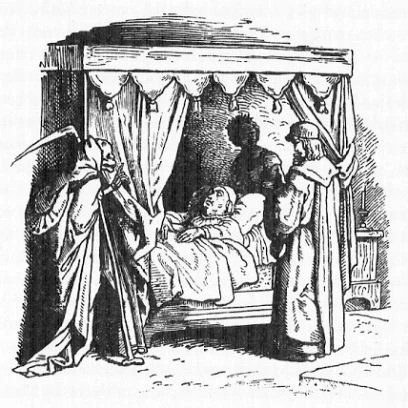
Death rewards the tinker with a bottle of “The Ointment of Health,” which can cure anyone, providing that Death is not standing at the head of the bed but rather at the foot. By this device, the tinker became a wealthy doctor, curing many of the sick.

One day, in a moment of softheartedness, he tricks Death by having the bed turned around, putting Death at the foot of the bed. Death now taps the tinker on the shoulder and tells him to follow. The road, again, takes them through Tamlacht. The tinker asks Death to pick him an apple from his tree as a memento. The moment Death touches the apple he is stuck.

The tinker leaves Death there for a hundred years—during which no one dies—before taking pity on him. Death agrees to leave the tinker alone for another hundred years, which was well since Death had a lot of catching up to do.

However, when the tinker’s allotment comes due, he asks for the time it would take his burning candle stub to gutter out to make his will. Death agrees and the tinker blows out the candle so that it will never gutter out.

It takes Death another hundred years to find the candle, relight it, and watch it gutter out. Once more, the tinker asks for time to utter a pater-and-ave. This Death grants and the tinker refuses to say one.

A hundred years pass until Death in the disguise of a lost soul, tricks the tinker into saying a pater-and-ave for him. Death takes the tinker to heaven, but God will not allow him in for having refused him as godfather. The devil will not let him into hell, saying the tinker will make it too hot for him.

Death and the tinker settle on Death turning him into a salmon in the river Erne, where, to this day, he taunts and eludes sports fishermen.

“Ha! Clever,” says Johannes.

Jini, whose stare had been fixed on the fairy, now peers down, wide-eyed, at the cat curled in her lap.

Fairy Tale of the Month: March 2023 Tinker of Tamlacht – Part Two

Image courtesy of oldbailyonline.org

More Guinness

I put another log on the hearth fire, then return to my second glass of Guinness. The girls have gone off to Thalia’s bedroom—a young girl’s inner sanctum—with the fairy perched atop Thalia’s head and Johannes nestled in Jini’s arms. I can’t get over Johannes glomming onto Jini as he has.

“Thalia picked an appropriate tale for the evening,” Melissa comments, raising her glass. “Very Irish.”

“Long for one thing,” I say.

“And full of trickery.” Melissa swirled the stout in her glass. “At the start, the tinker tricks the devil. In the next part, he chooses Death as a godfather after insulting God. He soon proceeds to trick Death for hundreds of years. Death finally gets his bony hands on the tinker only to find he can’t get rid of him.”

I take a sip of my Guinness before answering. “It feels rather like more than one story stuck together except that the end is set up during the story. Death can’t get rid of the tinker because of what the tinker did earlier in the tale. It all holds together very well. Maybe a little too well. Might there be some literary influence by the editor?”

Melissa roots around in her purse for her cell phone. “If I recall the biography of Seamus MacManus, that is an arguable point.” Her fingers scan her phone. “It says he was an Irish dramatist, a poet, a prolific writer of popular stories, and important in the rise of Irish national literature.

“It doesn’t say anything about him being a collector or editor. This site goes on to list fifty books by MacManus. Story of the Irish Race seems to be the big one. It also seems that he was deep into the Irish Republican Movement.”

I sip my Guinness while she pokes around on her phone before she continues. “Yes, he married Ethna Carbery, daughter of a well-known leader of the Irish Republican Brotherhood. She was a poet and writer like himself, whose real name was Anna Bella Johnston. She and a few other women started the Shan Van Vocht, a national monthly on literature, history, and commentary. Very popular. MacManus was a contributor. I’ll guess that is how they met.

“Oh dear,” Melissa gasps, “she died a few months after they got married. How sad. It was MacManus who then published most of her poetry, also very popular. He had at least one play produced and wrote others. Oh! He was also a founding member of Sinn Féin!”

‘”Right,” I say. “You don’t get much deeper into Irish nationalism.”

“However,” Melissa goes on, “it does not look like he was in Ireland for the Easter Rising. In 1908 he is in America lecturing in literature at Notre Dame University, Indiana, getting remarried in 1911 in New York, and getting a doctorate of law conferred on him by the University in 1917.”

“When was the Easter Rising?” I ask.

“1916.”

“Who did he remarry?”

Melissa scrolls backward. “Catalina Violante Páez, a writer and granddaughter of the first president of Venezuela.

“Oh dear!” Melissa’s eyebrows rise.

“Oh dear again?” I say.

“He died in 1960 at the age of 92, falling out of a seventh-story window at a nursing home.”

“Now, that sounds a little suspicious,” I can’t help saying.

“Nonetheless,” Melissa insists, sipping her stout, “back to our original discussion. There is the claim that he was the last of the traditional shanachies but obviously well educated. Can one be well educated and a shanachie at the same time? I always think of the old storytellers as illiterate or semiliterate, not lecturing at a university.”

“Well,” I say, “maybe we should let him defend himself.”

Melissa looks at me blankly for a moment, then says, “Oh, Miss Cox’s garden.”

Fairy Tale of the Month: March 2023 Tinker of Tamlacht – Part Three

Ferguson, St. Louis Post-Dispatch

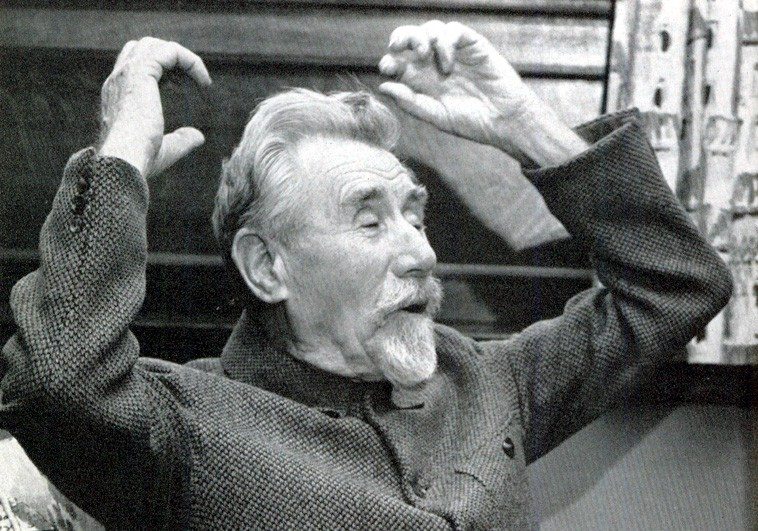
Seamus MacManus

Melissa and I have deposited ourselves on a wrought-iron bench with a small wrought-iron table in front of us and another bench on the other side; a new seating arrangement in the garden. The teapot in its cozy awaited us when we entered.

It is not long before a distinguished-looking gentleman enters through the gate, and we rise to greet him. He is trim in build, handsome with a long, pointed beard. Most animated is his expressive face.

I introduce Ms. Serious and myself, and Melissa pours out a round of tea. Seamus’s manner is easy and friendly as if we’ve known each other before this meeting.

“Mr. MacManus . . . “Melissa starts.

“Call me Seamus, please.”

“Mr. Seamus,” Melissa grins with a little deviltry, “I am curious how you came to collect such a large number of Irish tales?”

“Easily answered. By being a boy in old Donegal that hadn’t noticed that the world was changing. I grew up cutting peat bricks out of the bogs, herding sheep, and hearing stories. None of these are the occupations of lads today. It is still the smell of peat burning on the hearth that goes along with the stories in my memory. 

“By a hundred happy hearths on a thousand golden nights, then I, with my fellows, enthroned me under the chimney brace, or in circle, hunkered on the floor in the fire glow, heartening to the recital, and spellbound by the magic of the loved tales so lovingly told by fear-a’tighe (man-of-the-house) or bean-a-tighe (woman-of-the-house). Not many women could be termed shanachie, but she was a poor mother who had not at least a dozen or twenty tales on which to bring up her children.”

Seamus takes a sip of tea under Melissa’s admiring eyes.

“Thus and so, we Donegal children learnt the folk stories and the telling of them. Thus and so it was that we in turn propagated them. Thus and so it was that these fascinating tales through the long, long ages, gave to millions after millions, entertainment, happiness, joy, as well as the awakening and development in them of that beautiful imagination and sense of wonder that lightened, brightened and gilded lives that through near-hunger, hard labor and perpetual struggle with fate might well be expected to leave been sore and sour to bitterness.

“But the circumstances hard or otherwise, storytelling was ever a propagator of joy. The advent of printing and growth of reading it was that began the decline and finally the practical extinction of the hallowed art. Yet no multiplication of books and mushrooming of readers could compensate the world for the sad loss incurred. The read story never did, never will come near the benefiting quality of the told story. Two of the essential good qualities of the latter, the former never can capture. The read story may be said to be a dead story, prone on the printed page, entombed between boards, while the told story is a very much alive story, glowing, appealing, and dancing with energetic vitality—the personality and inspiration that the good storyteller can always command into the tale he tells. While the read story may possess the value of the story alone, the told story carries, superimposed on it, the golden worth of a good storyteller’s captivating art and enhancing personality—trebling in wealth.”

“Well,” says Melissa, “I do believe you may be the last of the shanachies.”

Your thoughts?

Fairy Tale of the Month: Mid-month Fantasy Promotion

All-Genre Spring Break Review Drive

Get these books fast! This promotion ends April 29th!

Yes, free books at the cost of a review. Here is the deal. For any of the books listed in the link below, you can apply to receive a free copy if you promise to review the book. Only honest reviews, please!

It appears most of my fellow authors in this promotion are in the fantasy genre, but I see a few others represented. Please check them out, and if you have not reviewed my book, here is your chance.

Fairy Tale of the Month: February 2023 The Poor Miller’s Apprentice and the Cat

Warwick Goble

Good Bread

“We’re here for the bread,” Melissa states.

“And a glass of wine?” I suggest.

“And a glass of wine.”

We are entering Noble Rot, the Lamb’s Conduit Street location. I know they also have a shop in Soho. The place is quite inviting; dimly lit in a cozy way, wooden floors, dark green wainscoting, which runs around most of the room, and each table has a tea light in its center. We take a table near the crackling fireplace. It is February after all.

“A bread plate each is all we need,” Melissa tells the waiter.

I am looking at the menu. “And, perhaps, the slip sole,” I add.

Melissa rolls her eyes.

“And a splash of wine?” the waiter asks.

“Oh, yes,” I say, picking up the wine list.

My lord, it’s the size of a novella!

Thirty-two pages. I am overwhelmed.

“I guess white wine with bread.” I venture.

“And German,” says Melissa.

“By the glass?”

We nod.

“Then it will be the Stein Palmbury Reisling.”

“Excellent,” I say. As the waiter leaves, I ask Melissa, “Why German? You’re being thematic, I will guess.”

“I am. I’ve been rather curious about a Grimm tale, The Poor Miller’s Apprentice and the Cat.

“Delightful. Refresh my memory.”

Actually, I don’t think I ever read it.

“It is something of a Puss and Boots and The White Cat variant.”

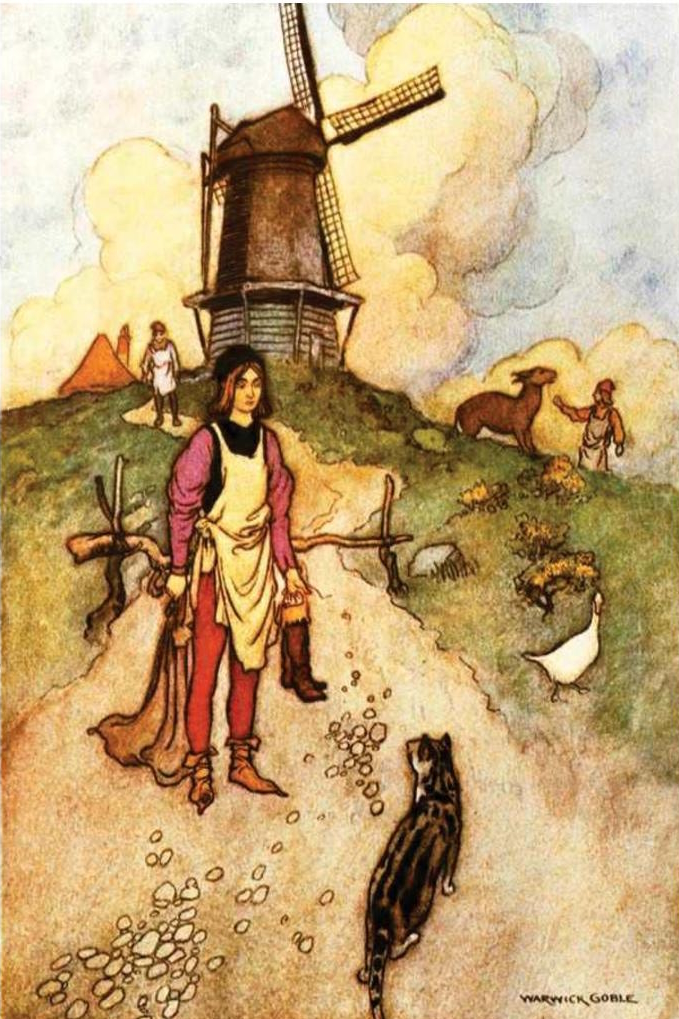
An old miller, with no wife or child, neared his retirement; a time, he said, when he wished to sit by the stove. He told his three apprentices that he would give the mill to one of them, providing that the new owner would sustain him in his old age. The contest would be decided by who could venture out and bring back the best horse.

The three apprentices started out together, but the elder two soon found a way to abandon Hans, the youngest. Wandering about, with no direction, he was approached by a multicolored she-cat that offered to give him a horse—the cat already knowing his need—if he would be her servant for seven years.

He agreed and was taken to her castle, where all the servants were kittens.  They served Hans and the cat their dinner, during which the kittens played on a double bass, a fiddle, and a trumpet for their entertainment. When the meal was over, the cat asked Hans if he would dance with her. He refused, saying he did not dance with pussycats. She then instructed the kittens to take him to his bed. The kittens tucked him in and then in the morning they woke him, washed him, dried him with their tails, and got him dressed.

After that, he proceeded to be the cat’s servant, for the most part chopping wood with tools made of silver. He also mowed her meadow with a sliver scythe and built a silver cottage with silver tools.

When the seven years were up, the spotted cat showed him his fine horse, told him to return to the mill, and said, in three days, she would come with the horse. Unfortunately for Hans, during the seven years, she had not given him any new clothes. Ragged as he was, the miller and the other two apprentices laughed at him and would not let him eat or sleep in the mill. He had to content himself by sleeping in the goose house. Since he did not return with a horse, they mocked him. They, at least, returned with horses, although one was blind and the other lame.

However, on the third day, a princess arrived in a coach pulled by six fine horses with a servant leading a seventh horse, the likes of which had never graced the miller’s yard before. The princess had her faithful Hans washed up and nobly dressed, and he appeared to be as handsome a lord as any. She told the miller he could keep his mill as well as the horse.

She and Hans returned to the silver cottage he had built, which had become a huge silver and gold castle. The marriage followed and Hans never wanted for more.

Our waiter returns with the plates of bread. The delectable aroma alone is worth the sojourn to Noble Rot. 

Fairy Tale of the Month: February 2023 The Poor Miller’s Apprentice and The Cat

George Percy Jacomb-Hood

An Insertion

On the plate are three kinds of bread, two pieces of each kind: soda bread, focaccia, and sourdough, plus a pat of butter. The waiter sets down the glasses of riesling to complete the picture. Knife in hand, I apply the butter to a piece of soda bread as a starter.

“I rather like the bit about the kitten servants drying Hans off with their tails,” I say.

“I did too.” Melissa takes a sip of wine. “Which is why I have half a mind to call Wilhelm to Miss Cox’s garden and scold him.”

“Whatever for?”

“When I came to the part about the spotted cat wining and dining Hans, who then refused to dance with her, that struck me as a significant moment in the story.”

The soda bread might be my favorite, even though I haven’t tried the other two.

“However, she does not seem to take offense. The next day, Hans appears to take up his duties as a servant and the events go on from there.

“I’d not run across this refusal-to-dance motif before. I racked my brain to think of a parallel. What could this signify in the folk mind in which these tales arose? Out of caution, I went back to the 1815 version of the tales in Jack Zipe’s book, The Original Folk and Fairy Tales of the Brothers Grimm. I discovered that the stuff about the kittens, the music, the wining and dining, and tail drying were not there. At all. The 1815 story goes from Hans agreeing to be the spotted cat’s servant to a description of his duties for the next seven years.

“Here I’d gone off, mistakenly, into thinking the refusal-to-dance might be an unrecognized story element, perhaps steeped in Germanic folklore. Instead, it turns out to be Wilhelm’s fanciful insertion.”

I laugh gently while sampling my focaccia. “I know the Grimms did alter the stories when they realized they had a younger audience than for which the first edition had been intended. They removed sexual content, replaced pagan elements with Christian subjects, and turned evil mothers into stepmothers.”

“True,” Melissa frowns. “But this change does not qualify for any of those reasons. I assume Wilhelm attempted to appeal to his bourgeois audience. He simply upped the storyline a little. It makes me wonder how often he allowed his German Romanticism to creep into these reputedly folk-inspired fairy tales.”

No, the focaccia might be my favorite.

“I guess,” I muse, “we should have been suspicious when the story gave too much visual description; the double bass, the fiddle, and the trumpet, not to mention the delightful thing about the tails used for drying. Details like that are sparingly given unless necessary for the storyline.”

Melissa nods, nibbling her sourdough. “After I saw what must have happened, it became clear to me that the tone of the section with the kittens differed from what went before and what followed. On consideration, I conclude it was a rather clumsy, somewhat confusing, unnecessary thing for Wilhelm to have done.”

Oh my, the sourdough is as good as the other two.  

Fairy Tale of the Month: February 2023 The Poor Miller’s Apprentice and The Cat

Something More

The slip sole arrives, a small flatfish fillet with a smoky, honey glaze that creates an olfactory sensation.

“I tried,” Melissa continues, “checking the Grimm notes in Margaret Hunt’s book to see if there might be some enlightenment. All I got was an even crazier version of the tale. Are you ready for this one?”

“Carry on,” I say. I am happy to let her chatter while my epicurean soul delights in the aquatic sole.

A miller sends his three sons out to find the best horse and claim the mill. The youngest meets a little gray man, whom the lad serves as a woodcutter for a year in return for a good horse. The lad meets his brothers on the way home. Their horses are either lame or blind. In jealousy, they throw their younger brother into a lime pit. The little gray man pulls him out, restores the lad to life, and retrieves the horse. 

For reasons unexplained, the father decides the mill will go to the son who can bring him the best shirt. The lad gets the best shirt, meets up again with his brothers, who tie him to a tree and shoot him dead. Again, the little gray man appears and brings him back to life.

When the lad returns to the mill the second time after dying, the elder brothers convince their father that the younger is in league with the devil. (Which from their point of view was arguably true given they had left him for dead twice). The father proposes a third test; this time one of them must bring back the best loaf of bread, since, as the story states, “. . . the devil has no power over bread.”

The lad, on his quest, shares his food with an old woman in the forest, who gives him a wishing-rod. When he uses it, a little tortoise comes to him declaring, “Take me with you.” He puts the tortoise in his pocket, and the next time he puts his hand in, there is the tortoise and lots of money.

He sets the tortoise up in the best room at an inn and travels on from there for a year, unsuccessfully searching for the best loaf of bread. (The arrangements for the tortoise to live at the inn in the meantime are not well explained.) Upon returning to the inn, the lad sees that the tortoise has two, pretty, white feet. That evening, he sees a shadowy figure kneading bread. In the morning, there is a perfect loaf of bread. Taking the loaf home, he can no longer be denied ownership of the mill.

On his return again to the inn, there in the bed is a princess as well as the tortoise. She explains that he has broken the spell over her, and they can now marry. But first, he must return home and wait for her. She tells him that when he hears the first cannon, she will be getting dressed. When he hears the second cannon, she will be getting into a carriage. When he hears the third, he should look for a carriage being pulled by six white horses.

Afterward, they are married and might have lived happily ever after except that he let the tortoise fall into the fire. Outraged, the princess spits in his face. Devastated, he goes off, digs a deep cave for himself, over which is carved the inscription, “Here none shall find me, save God alone.” There he lives and prays for many years.

Eventually, an old king, having fallen ill, travels the country looking for a physician to cure him but without success. He comes by accident to the cave and is miraculously cured. Seeing the inscription, he instructs his people to “dig down” until they find the hermit.

When the king finds out that this hermit is his son-in-law, he brings about reconciliation between his daughter and the hermit, and they all live long and happily.

“Good grief,” is all I can say.

“Yes, well,” Melissa smiles, sipping the last of her glass, “I think our bread and wine was the perfect little repast.”

I agree, but I am fingering the menu, and my eyes fall upon the dessert section.

Basque Cheesecake and Rhubarb.

Your thoughts?

Fairy Tale of the Month: Mid-month Fantasy Promotion

This mid-month promotion is about cats. 99¢ cats at that (well, cats and other creatures).

My book, A Vacant Throne: Dreams of the Sleeping Cat, will be on sale for 99¢ from February 19 to 25 on Amazon.

Trueterra is a world of cats. One in which Puss in Boots would have been comfortable. This thoughtful fantasy novel follows Sunny, a typical housecat, through a picture frame into a medieval world that awaits him. He appears to fulfill a prophecy, but he must grow into the role of hero to perform the task that lay destined in his path.

Ultimately, it is a story about purpose and new direction, discovery and consideration, life and death, with a little bit of fate thrown in.

One of my cohorts in this cross promotion is Bader M. Alsadeqi  with The Chosen Rainheart: A Grand Epic Fantasy (Daedalusian Legends Series).

In the magical rich world of Daedalus, there is a dark and immutable cycle fueled by the everyday evils practiced by the Humans, Elves, Beastfolk, and all races who inhabit the continents of the mortal world, due to an irreversible curse that will unknowingly and forever be passed on to their descendants, just as they had inherited it from their ancestors.

My other cohort is Mason Bell with her Galactic Fun Park: Book One.

Welcome to Galactic fun park, a universe of fun for kids… and the animals that live there! As the park gets more and more popular, careless visitors drop more food, which in turn feeds the critters who call The Galactic fun park home. Win ,Win. Right?

Except that the humans don’t want to share their park with critters and hire a greedy and overzealous exterminator.

Discover an unseen theme park world in this funny and fast-paced Middle-Grade chapter book.

Check us out Here.

And thanks.

PS. If these books are not at 99¢ on Amazon at the time you are checking, check back later.

Fairy Tale of the Month: January 2023 The Iron Shoes – Part One

Iron Shoes

It’s good to have Thalia back again, she having been stolen away from me during Christmas. As the winter doldrums set in, her presence is a continuing comfort. While the correct order of things has been restored, nothing stays quite the same. Shifts are usually subtle and minute.

Thalia sits in her comfy chair, a book on her lap, and the household tribe has gathered. I in my comfy chair, Johannes curled up on the window seat, the brownies in the shadows, and the fairy on Thalia’s shoulder.

But . . . the book on her lap is The Turnip Princess and Other Newly Discovered Fairy Tales. Not Grimm. Not Lang. Not Jacobs. But rather Schönwerth. She must have plucked the book from my library, a volume I had almost forgotten about. I am struck by the irony. The world almost forgot Schönwerth.

The scholar Erika Eichenseer came across hundreds of stories that Schönwerth collected in Bavaria in the late nineteenth century, stored in a German municipal archive. She dusted them off and published a good number of them that now lay on Thalia’s lap.

“The Iron Shoes,” Thalia proclaims.

Hans, a ne’er-do-well son, is kicked out of his home by his father, to make his way in the world. In his wanderings, he stumbles onto an abandoned castle, taking refuge in one of its rooms. A woman, dressed in black, appears, lays food on a table, points to a bed, and wordlessly leaves.

At midnight, a man comes into the room and tries to choke Hans and otherwise torture the lad. The next morning the woman reappears, dressed in grey, again silently leaving him food. That night two men come to torture Hans.

By morning, Hans has had quite enough and prepares to leave. The woman, now dressed in white, asks him to stay one more night. For her sake he does, and three men show up to abuse him.

In the midst of this pummeling of the lad, the woman interrupts, accompanied by thunder and lightning, and drives the abusers off. What Hans achieved was breaking a spell over a princess, who gives Hans her hand in marriage.

Now, awash in wealth, he desires to visit his father to prove his success.  The princess allows this, giving him a ring, which he need only turn on his finger for her to come to him. However, he must only do this in true distress.

His father, who works as the king’s groundskeeper, does not (could not, would not?) recognize his son. Hans ends up introducing himself to the king, who orders a feast to honor his guest.

The other noble guests, jealous of the lad’s handsome looks, challenge him to prove that his wife is as beautiful as he boasted. Hans turns the ring on his finger, and carriages roll up, from one of which steps his radiant princess.

Unfortunately for Hans, the next morning his old traveling clothing are laid out on the bed, a pair of iron shoes are on the floor, and a note states, “I am punishing you by leaving. Don’t try to find me. You will never discover where I am, even if you wear out these iron shoes.”

Undaunted, he searches for her, even though he cannot find their castle, where he met her. After some time, he comes across three fellows arguing over the ownership of three magical treasures: an unending bag of gold coins, a cloak of invisibility, and a pair of hundred-league boots. He agrees to settle their dispute but claims he needs to verify the magical validity of the items. Testing the cloak of invisibility, he steals the bag and the boots.

While fleeing rapidly, thanks to the boots, he sees a little man beside him, keeping pace. It is the wind, off to a certain town to dry the clothing of a princess who plans to marry that day. It turns out to be his wife. Hans crashes the wedding in his cloak, knocking the good book from the parson’s hands, and clobbering the bridegroom every time he tries to say, “I do.”

The marriage is given up, yet all go off to the wedding feast. Hans sits among the beggars, invisibly stealing food intended for the guests, and sharing it with his fellows. During his antics, he loses his ring. A servant finds it, and because it bears the princess’s initials, it is returned to her.

Realizing that Hans has found her, she calls for him, they are reconciled, and the real marriage takes place.

Thalia closes the book and smiles.

Fairy Tale of the Month: January 2023 The Iron Shoes – Part Two

Gras-Ober, Wikipedia/Wikimedia Commons

Franz Schönwerth

As I enter Augustus’s tobacco shop, the familiar, ever-welcoming tinkle of the bell above his door . . . is missing! I stop in my tracks and look up. The bracket is there. The coiled metal spring is there. The bell is missing.

“It fell off,” Augustus explains, standing behind the counter.

“You will repair it, won’t you?”

“Well, I don’t know.”

Oh, but you must. We can’t let the world slowly fall into disorder.”

Augustus smiles at me. “I don’t know that my missing bell qualifies as falling into disorder. Haven’t you been listening to the news? That is disorder.”

“Of course I haven’t. I make it a point not to listen. Oh, I did in my youth, avidly. Then I realized it wasn’t going to make me happy. So, I gave it up.”

“Admirable,” Augustus concedes. “I will make sure to repair the bell.”

I am content.

“Are you familiar with Franz Schönwerth?” I ask.

“Yes, a competent fellow at whatever he did.”

“I know him as a folklorist,” I say.

Augustus sits on his stool on his side of the counter and I sit on one on my side.

“He was a servant of the Bavarian state, trusted by the royal family. He became the private secretary to the Crown Prince Maximillian and was entrusted with managing the prince’s and his wife’s personal wealth.

“Schönwerth proved his loyalty when, during the revolutions of 1848, he transferred the royal family’s wealth to Nymphenberg Palace for safekeeping. He did this by disguising himself as a common workingman, loading three million thalers worth of cash, securities, and valuables onto a handcart and wheeling it through the streets of Munich, filled with the very rebels who would have otherwise plundered it.”

“Remarkable,” I say. “I hope he was rewarded for such a thing.”

“Oh, yes. He became ennobled, always rising in the soon-to-be king’s estimation. Schönwerth had the privilege of guiding the king in the patronage of the arts and sciences.”

“Excellent, but how did he get involved with folklore studies?”

“I suspect as he rose in stature he ended up with more free time to pursue his interests. Both he and his wife, Maria, were native Bavarians. Like other intellectuals of the nineteenth century, he saw his world going through upheaval and rapid change. The old ways of his beloved Bavaria were being lost and forgotten.

“He started collecting information from his wife, a person knowledgeable about folkways, then moved on to his housekeeper. His housekeeper introduced him to her acquaintances, leading him to make collecting tours through the countryside. He apparently had a knack for getting commoners to open up to him through the application of much coffee and cigars.

“And, he collected everything: legends, fairy tales, comic stories, children’s games, nursery rhymes, children’s songs, proverbs, how people lived, everyday-life details, customs, and traditional dress. Much of this material he published in a three-volume work, From the Upper Palatinate—Customs and Legends. The Grimms’ considered him heir to what they were accomplishing. They recognized his competence and skill as a folklorist.”

“Yet,” I say, “the better part of his work ended up collecting dust in that vault in Regensburg.”

“Well, for him it was a hobby. Also a passion, but he wasn’t trying to make a living at it as the Grimms were.

Fairy Tale of the Month: January 2023 The Iron Shoes – Part Three

H J Ford

Turn About

“Why, though,” inquires Augustus, “are you asking me about Schönwerth?”

“Ah, Thalia has taken an interest in him. She read The Iron Shoes . . . last night.” (I almost said “to us,” which would have needed an explanation.)

“Iron shoes,” murmured Augustus. “There is more than one story with iron shoes in it. There is the Grimms’ Little Snow White, where the witch/queen is danced to death in red-hot iron shoes. Then there’s The Enchanted Pig. In that the heroine must wear out three pairs of iron shoes looking for her husband.”

“You’re getting warmer,” I say.

“Now I remember. The Schönwerth version is where the Psyche-looking-for-her-husband motif gets turned on its head. The hero .  .  .”

“Hans,” I interject.

August rolls his eyes. “Of course it’s Hans. This is a German story. Hans is the one looking for his bride after violating some rule set up by the spouse, as is always the case in this motif. Let me find my copy of Schönwerth.”

I fill my pipe with Fairies’ Delight from the courtesy canister on the counter. As I light up, Augustus returns with book in hand, reading as he walks.

“Right. Hans is a delightful rogue, not the usual hero who starts out being portrayed as a simpleton but then shows unexpected wisdom. Hans stays something of a rogue straight through. He gets kicked out of his home by an irate father for being useless. He never does get reconciled with his father, but on the other hand, he bears no ill will toward anyone. He is happy-go-lucky.

“His luck is in finding the enchanted castle and its occupant, putting up with beatings for food, and almost unintentionally breaking the spell over the princess. Then he blows it all by not listening closely to his wife’s instructions about the ring. He calls her to him to show her off to the other nobles, not out of dire necessity.”

I pick up the thread of his thinking and say, “Roguishly, he steals the three magical gifts from the quarreling fellows. With the magical boots he can travel with the wind, which leads him to find the princess.

“But wait.” I ponder for a moment. “Hasn’t he exchanged the iron shoes for the magical boots? Is there some symbolic significance in that? Some act of transformation?”

Augustus is lighting his pipe and takes some time to reply. “Nope. Not likely. Not unless you decide to shoehorn a metaphor into the tale. When Schönwerth collected these stories, he was actually formulating for himself methods later used by professional folklorists. He did not allow his thoughts and opinions to creep into what he collected. With the tales, he recorded what he heard.

“Had the Grimms collected this tale, they would have edited it for their bourgeois audience.  Being romantics, they might have found a connection between the iron shoes and the magical boots and put that into the story. For the teller that Schönwerth recorded, the iron shoes were a challenge by the princess, thrown at Hans’s feet—notice my pun, please—for him to go find her. Having served that purpose, he could give them up for a better pair of footwear to help him.”

“I loved the bit about him punching the suitor in the mouth before he could say, ‘I do.’”

Augustus grins. “A loveable rogue, as I said.”

Your thoughts?