Fairy Tale of the Month: March 2023 Tinker of Tamlacht – Part One

A Visitor

We are making ourselves comfortable in the study after celebrating Saint Patrick’s Day with a feast. For the menu, Melissa and Thalia had settled on corned beef and cabbage, colcannon, leek soup, and soda bread. Now, Melissa and I cradle glasses of Guinness in our hands, while the girls have warm cider.

Yes, girls. Jini is with us, having been sworn to secrecy. She and Thalia decided best friends cannot have secrets from one another.

We have given her the somewhat overstuffed Queen Anne’s chair. To her delight and my surprise, Johannes has jumped into her lap and curled up. She pets him gently as her eyes try to penetrate the dark corners of the room where the brownies are scuttling about.

I watch her closely. Sure enough, as I hear the fairy fluttering through the study’s archway, her eyes go anime.

“Ah, she can see our fairy. I don’t think everyone can.”

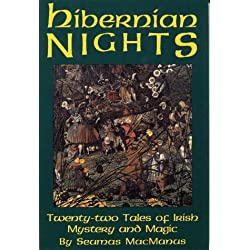
Thalia hardly notices the fairy alight on her shoulder as she opens her book, Hibernian Nights, and announces the story, The Tinker of Tamlacht.

There lived in Donegal, in the village of Tamlacht, a poor tinker, who one day finds himself in a bog after trying to take a shortcut. He declares, “May the devil take me if I ever come this way again.”

When he gets back on the proper road, three beggars meet him in turn, to whom he gives what little money he has. The three beggars turn out to be an angel, and the angel gives him three wishes. 

First, the tinker wishes for a full meal chest; second, that what goes into his workbag stays there until he lets or takes it out; and third, those who take the apples from his tree will stick there until he releases them.

Sometime after that, he again tries the bog shortcut and meets the devil, who reminds the tinker of the vow he made. Fortunately for the tinker, the road to hell leads through Tamlacht. The tinker convinces the unpopular devil to hide inside the workbag while they go through the village.

The poor, unsuspecting devil ends up being placed upon an anvil and beaten with hammers until he disappears in a column of fire.

The tinker returns home from that adventure to find his wife has had a baby. He goes out to find a godfather. He rejects the landlord, who takes advantage of the poor; he rejects God, who lets the landlord get away with his greed; but accepts Death as the godfather because he treats everyone equally.

Death rewards the tinker with a bottle of “The Ointment of Health,” which can cure anyone, providing that Death is not standing at the head of the bed but rather at the foot. By this device, the tinker became a wealthy doctor, curing many of the sick.

One day, in a moment of softheartedness, he tricks Death by having the bed turned around, putting Death at the foot of the bed. Death now taps the tinker on the shoulder and tells him to follow. The road, again, takes them through Tamlacht. The tinker asks Death to pick him an apple from his tree as a memento. The moment Death touches the apple he is stuck.

The tinker leaves Death there for a hundred years—during which no one dies—before taking pity on him. Death agrees to leave the tinker alone for another hundred years, which was well since Death had a lot of catching up to do.

However, when the tinker’s allotment comes due, he asks for the time it would take his burning candle stub to gutter out to make his will. Death agrees and the tinker blows out the candle so that it will never gutter out.

It takes Death another hundred years to find the candle, relight it, and watch it gutter out. Once more, the tinker asks for time to utter a pater-and-ave. This Death grants and the tinker refuses to say one.

A hundred years pass until Death in the disguise of a lost soul, tricks the tinker into saying a pater-and-ave for him. Death takes the tinker to heaven, but God will not allow him in for having refused him as godfather. The devil will not let him into hell, saying the tinker will make it too hot for him.

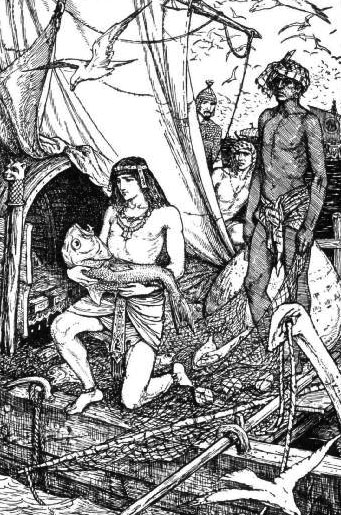
Death and the tinker settle on Death turning him into a salmon in the river Erne, where, to this day, he taunts and eludes sports fishermen.

“Ha! Clever,” says Johannes.

Jini, whose stare had been fixed on the fairy, now peers down, wide-eyed, at the cat curled in her lap.

Fairy Tale of the Month: March 2023 Tinker of Tamlacht – Part Two
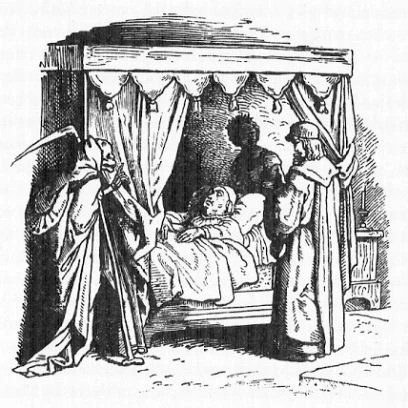
Image courtesy of oldbailyonline.org

More Guinness

I put another log on the hearth fire, then return to my second glass of Guinness. The girls have gone off to Thalia’s bedroom—a young girl’s inner sanctum—with the fairy perched atop Thalia’s head and Johannes nestled in Jini’s arms. I can’t get over Johannes glomming onto Jini as he has.

“Thalia picked an appropriate tale for the evening,” Melissa comments, raising her glass. “Very Irish.”

“Long for one thing,” I say.

“And full of trickery.” Melissa swirled the stout in her glass. “At the start, the tinker tricks the devil. In the next part, he chooses Death as a godfather after insulting God. He soon proceeds to trick Death for hundreds of years. Death finally gets his bony hands on the tinker only to find he can’t get rid of him.”

I take a sip of my Guinness before answering. “It feels rather like more than one story stuck together except that the end is set up during the story. Death can’t get rid of the tinker because of what the tinker did earlier in the tale. It all holds together very well. Maybe a little too well. Might there be some literary influence by the editor?”

Melissa roots around in her purse for her cell phone. “If I recall the biography of Seamus MacManus, that is an arguable point.” Her fingers scan her phone. “It says he was an Irish dramatist, a poet, a prolific writer of popular stories, and important in the rise of Irish national literature.

“It doesn’t say anything about him being a collector or editor. This site goes on to list fifty books by MacManus. Story of the Irish Race seems to be the big one. It also seems that he was deep into the Irish Republican Movement.”

I sip my Guinness while she pokes around on her phone before she continues. “Yes, he married Ethna Carbery, daughter of a well-known leader of the Irish Republican Brotherhood. She was a poet and writer like himself, whose real name was Anna Bella Johnston. She and a few other women started the Shan Van Vocht, a national monthly on literature, history, and commentary. Very popular. MacManus was a contributor. I’ll guess that is how they met.

“Oh dear,” Melissa gasps, “she died a few months after they got married. How sad. It was MacManus who then published most of her poetry, also very popular. He had at least one play produced and wrote others. Oh! He was also a founding member of Sinn Féin!”

‘”Right,” I say. “You don’t get much deeper into Irish nationalism.”

“However,” Melissa goes on, “it does not look like he was in Ireland for the Easter Rising. In 1908 he is in America lecturing in literature at Notre Dame University, Indiana, getting remarried in 1911 in New York, and getting a doctorate of law conferred on him by the University in 1917.”

“When was the Easter Rising?” I ask.

“1916.”

“Who did he remarry?”

Melissa scrolls backward. “Catalina Violante Páez, a writer and granddaughter of the first president of Venezuela.

“Oh dear!” Melissa’s eyebrows rise.

“Oh dear again?” I say.

“He died in 1960 at the age of 92, falling out of a seventh-story window at a nursing home.”

“Now, that sounds a little suspicious,” I can’t help saying.

“Nonetheless,” Melissa insists, sipping her stout, “back to our original discussion. There is the claim that he was the last of the traditional shanachies but obviously well educated. Can one be well educated and a shanachie at the same time? I always think of the old storytellers as illiterate or semiliterate, not lecturing at a university.”

“Well,” I say, “maybe we should let him defend himself.”

Melissa looks at me blankly for a moment, then says, “Oh, Miss Cox’s garden.”

Fairy Tale of the Month: March 2023 Tinker of Tamlacht – Part Three
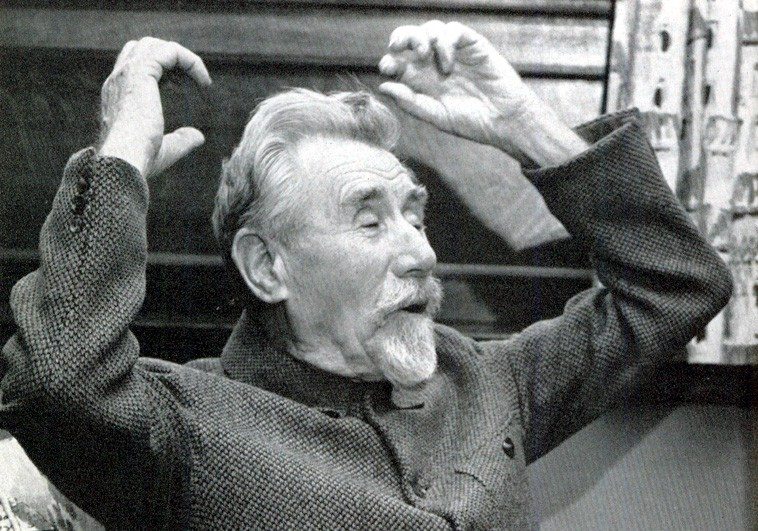
Ferguson, St. Louis Post-Dispatch

Seamus MacManus

Melissa and I have deposited ourselves on a wrought-iron bench with a small wrought-iron table in front of us and another bench on the other side; a new seating arrangement in the garden. The teapot in its cozy awaited us when we entered.

It is not long before a distinguished-looking gentleman enters through the gate, and we rise to greet him. He is trim in build, handsome with a long, pointed beard. Most animated is his expressive face.

I introduce Ms. Serious and myself, and Melissa pours out a round of tea. Seamus’s manner is easy and friendly as if we’ve known each other before this meeting.

“Mr. MacManus . . . “Melissa starts.

“Call me Seamus, please.”

“Mr. Seamus,” Melissa grins with a little deviltry, “I am curious how you came to collect such a large number of Irish tales?”

“Easily answered. By being a boy in old Donegal that hadn’t noticed that the world was changing. I grew up cutting peat bricks out of the bogs, herding sheep, and hearing stories. None of these are the occupations of lads today. It is still the smell of peat burning on the hearth that goes along with the stories in my memory. 

“By a hundred happy hearths on a thousand golden nights, then I, with my fellows, enthroned me under the chimney brace, or in circle, hunkered on the floor in the fire glow, heartening to the recital, and spellbound by the magic of the loved tales so lovingly told by fear-a’tighe (man-of-the-house) or bean-a-tighe (woman-of-the-house). Not many women could be termed shanachie, but she was a poor mother who had not at least a dozen or twenty tales on which to bring up her children.”

Seamus takes a sip of tea under Melissa’s admiring eyes.

“Thus and so, we Donegal children learnt the folk stories and the telling of them. Thus and so it was that we in turn propagated them. Thus and so it was that these fascinating tales through the long, long ages, gave to millions after millions, entertainment, happiness, joy, as well as the awakening and development in them of that beautiful imagination and sense of wonder that lightened, brightened and gilded lives that through near-hunger, hard labor and perpetual struggle with fate might well be expected to leave been sore and sour to bitterness.

“But the circumstances hard or otherwise, storytelling was ever a propagator of joy. The advent of printing and growth of reading it was that began the decline and finally the practical extinction of the hallowed art. Yet no multiplication of books and mushrooming of readers could compensate the world for the sad loss incurred. The read story never did, never will come near the benefiting quality of the told story. Two of the essential good qualities of the latter, the former never can capture. The read story may be said to be a dead story, prone on the printed page, entombed between boards, while the told story is a very much alive story, glowing, appealing, and dancing with energetic vitality—the personality and inspiration that the good storyteller can always command into the tale he tells. While the read story may possess the value of the story alone, the told story carries, superimposed on it, the golden worth of a good storyteller’s captivating art and enhancing personality—trebling in wealth.”

“Well,” says Melissa, “I do believe you may be the last of the shanachies.”

Your thoughts?
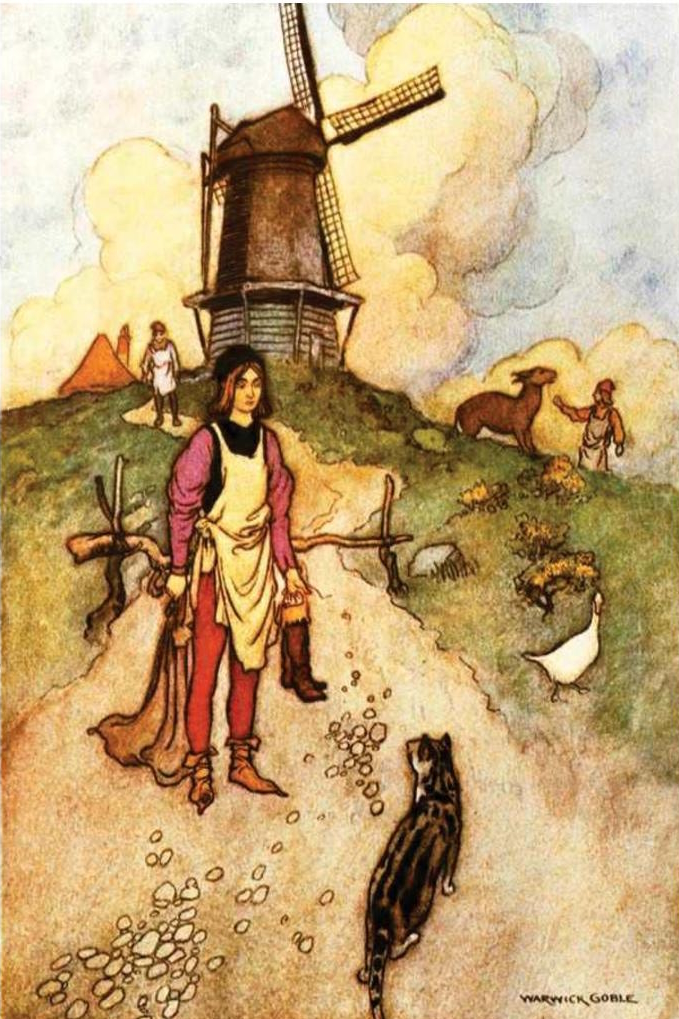
Fairy Tale of the Month: February 2023 The Poor Miller’s Apprentice and the Cat

Warwick Goble

Good Bread

“We’re here for the bread,” Melissa states.

“And a glass of wine?” I suggest.

“And a glass of wine.”

We are entering Noble Rot, the Lamb’s Conduit Street location. I know they also have a shop in Soho. The place is quite inviting; dimly lit in a cozy way, wooden floors, dark green wainscoting, which runs around most of the room, and each table has a tea light in its center. We take a table near the crackling fireplace. It is February after all.

“A bread plate each is all we need,” Melissa tells the waiter.

I am looking at the menu. “And, perhaps, the slip sole,” I add.

Melissa rolls her eyes.

“And a splash of wine?” the waiter asks.

“Oh, yes,” I say, picking up the wine list.

My lord, it’s the size of a novella!

Thirty-two pages. I am overwhelmed.

“I guess white wine with bread.” I venture.

“And German,” says Melissa.

“By the glass?”

We nod.

“Then it will be the Stein Palmbury Reisling.”

“Excellent,” I say. As the waiter leaves, I ask Melissa, “Why German? You’re being thematic, I will guess.”

“I am. I’ve been rather curious about a Grimm tale, The Poor Miller’s Apprentice and the Cat.

“Delightful. Refresh my memory.”

Actually, I don’t think I ever read it.

“It is something of a Puss and Boots and The White Cat variant.”

An old miller, with no wife or child, neared his retirement; a time, he said, when he wished to sit by the stove. He told his three apprentices that he would give the mill to one of them, providing that the new owner would sustain him in his old age. The contest would be decided by who could venture out and bring back the best horse.

The three apprentices started out together, but the elder two soon found a way to abandon Hans, the youngest. Wandering about, with no direction, he was approached by a multicolored she-cat that offered to give him a horse—the cat already knowing his need—if he would be her servant for seven years.

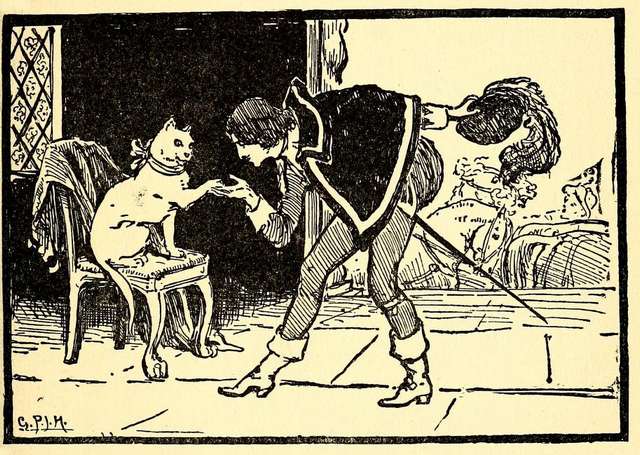
He agreed and was taken to her castle, where all the servants were kittens.  They served Hans and the cat their dinner, during which the kittens played on a double bass, a fiddle, and a trumpet for their entertainment. When the meal was over, the cat asked Hans if he would dance with her. He refused, saying he did not dance with pussycats. She then instructed the kittens to take him to his bed. The kittens tucked him in and then in the morning they woke him, washed him, dried him with their tails, and got him dressed.

After that, he proceeded to be the cat’s servant, for the most part chopping wood with tools made of silver. He also mowed her meadow with a sliver scythe and built a silver cottage with silver tools.

When the seven years were up, the spotted cat showed him his fine horse, told him to return to the mill, and said, in three days, she would come with the horse. Unfortunately for Hans, during the seven years, she had not given him any new clothes. Ragged as he was, the miller and the other two apprentices laughed at him and would not let him eat or sleep in the mill. He had to content himself by sleeping in the goose house. Since he did not return with a horse, they mocked him. They, at least, returned with horses, although one was blind and the other lame.

However, on the third day, a princess arrived in a coach pulled by six fine horses with a servant leading a seventh horse, the likes of which had never graced the miller’s yard before. The princess had her faithful Hans washed up and nobly dressed, and he appeared to be as handsome a lord as any. She told the miller he could keep his mill as well as the horse.

She and Hans returned to the silver cottage he had built, which had become a huge silver and gold castle. The marriage followed and Hans never wanted for more.

Our waiter returns with the plates of bread. The delectable aroma alone is worth the sojourn to Noble Rot. 

Fairy Tale of the Month: February 2023 The Poor Miller’s Apprentice and The Cat

George Percy Jacomb-Hood

An Insertion

On the plate are three kinds of bread, two pieces of each kind: soda bread, focaccia, and sourdough, plus a pat of butter. The waiter sets down the glasses of riesling to complete the picture. Knife in hand, I apply the butter to a piece of soda bread as a starter.

“I rather like the bit about the kitten servants drying Hans off with their tails,” I say.

“I did too.” Melissa takes a sip of wine. “Which is why I have half a mind to call Wilhelm to Miss Cox’s garden and scold him.”

“Whatever for?”

“When I came to the part about the spotted cat wining and dining Hans, who then refused to dance with her, that struck me as a significant moment in the story.”

The soda bread might be my favorite, even though I haven’t tried the other two.

“However, she does not seem to take offense. The next day, Hans appears to take up his duties as a servant and the events go on from there.

“I’d not run across this refusal-to-dance motif before. I racked my brain to think of a parallel. What could this signify in the folk mind in which these tales arose? Out of caution, I went back to the 1815 version of the tales in Jack Zipe’s book, The Original Folk and Fairy Tales of the Brothers Grimm. I discovered that the stuff about the kittens, the music, the wining and dining, and tail drying were not there. At all. The 1815 story goes from Hans agreeing to be the spotted cat’s servant to a description of his duties for the next seven years.

“Here I’d gone off, mistakenly, into thinking the refusal-to-dance might be an unrecognized story element, perhaps steeped in Germanic folklore. Instead, it turns out to be Wilhelm’s fanciful insertion.”

I laugh gently while sampling my focaccia. “I know the Grimms did alter the stories when they realized they had a younger audience than for which the first edition had been intended. They removed sexual content, replaced pagan elements with Christian subjects, and turned evil mothers into stepmothers.”

“True,” Melissa frowns. “But this change does not qualify for any of those reasons. I assume Wilhelm attempted to appeal to his bourgeois audience. He simply upped the storyline a little. It makes me wonder how often he allowed his German Romanticism to creep into these reputedly folk-inspired fairy tales.”

No, the focaccia might be my favorite.

“I guess,” I muse, “we should have been suspicious when the story gave too much visual description; the double bass, the fiddle, and the trumpet, not to mention the delightful thing about the tails used for drying. Details like that are sparingly given unless necessary for the storyline.”

Melissa nods, nibbling her sourdough. “After I saw what must have happened, it became clear to me that the tone of the section with the kittens differed from what went before and what followed. On consideration, I conclude it was a rather clumsy, somewhat confusing, unnecessary thing for Wilhelm to have done.”

Oh my, the sourdough is as good as the other two.  

Fairy Tale of the Month: February 2023 The Poor Miller’s Apprentice and The Cat

Something More

The slip sole arrives, a small flatfish fillet with a smoky, honey glaze that creates an olfactory sensation.

“I tried,” Melissa continues, “checking the Grimm notes in Margaret Hunt’s book to see if there might be some enlightenment. All I got was an even crazier version of the tale. Are you ready for this one?”

“Carry on,” I say. I am happy to let her chatter while my epicurean soul delights in the aquatic sole.

A miller sends his three sons out to find the best horse and claim the mill. The youngest meets a little gray man, whom the lad serves as a woodcutter for a year in return for a good horse. The lad meets his brothers on the way home. Their horses are either lame or blind. In jealousy, they throw their younger brother into a lime pit. The little gray man pulls him out, restores the lad to life, and retrieves the horse. 

For reasons unexplained, the father decides the mill will go to the son who can bring him the best shirt. The lad gets the best shirt, meets up again with his brothers, who tie him to a tree and shoot him dead. Again, the little gray man appears and brings him back to life.

When the lad returns to the mill the second time after dying, the elder brothers convince their father that the younger is in league with the devil. (Which from their point of view was arguably true given they had left him for dead twice). The father proposes a third test; this time one of them must bring back the best loaf of bread, since, as the story states, “. . . the devil has no power over bread.”

The lad, on his quest, shares his food with an old woman in the forest, who gives him a wishing-rod. When he uses it, a little tortoise comes to him declaring, “Take me with you.” He puts the tortoise in his pocket, and the next time he puts his hand in, there is the tortoise and lots of money.

He sets the tortoise up in the best room at an inn and travels on from there for a year, unsuccessfully searching for the best loaf of bread. (The arrangements for the tortoise to live at the inn in the meantime are not well explained.) Upon returning to the inn, the lad sees that the tortoise has two, pretty, white feet. That evening, he sees a shadowy figure kneading bread. In the morning, there is a perfect loaf of bread. Taking the loaf home, he can no longer be denied ownership of the mill.

On his return again to the inn, there in the bed is a princess as well as the tortoise. She explains that he has broken the spell over her, and they can now marry. But first, he must return home and wait for her. She tells him that when he hears the first cannon, she will be getting dressed. When he hears the second cannon, she will be getting into a carriage. When he hears the third, he should look for a carriage being pulled by six white horses.

Afterward, they are married and might have lived happily ever after except that he let the tortoise fall into the fire. Outraged, the princess spits in his face. Devastated, he goes off, digs a deep cave for himself, over which is carved the inscription, “Here none shall find me, save God alone.” There he lives and prays for many years.

Eventually, an old king, having fallen ill, travels the country looking for a physician to cure him but without success. He comes by accident to the cave and is miraculously cured. Seeing the inscription, he instructs his people to “dig down” until they find the hermit.

When the king finds out that this hermit is his son-in-law, he brings about reconciliation between his daughter and the hermit, and they all live long and happily.

“Good grief,” is all I can say.

“Yes, well,” Melissa smiles, sipping the last of her glass, “I think our bread and wine was the perfect little repast.”

I agree, but I am fingering the menu, and my eyes fall upon the dessert section.

Basque Cheesecake and Rhubarb.

Your thoughts?

Fairy Tale of the Month: January 2023 The Iron Shoes – Part One

Iron Shoes

It’s good to have Thalia back again, she having been stolen away from me during Christmas. As the winter doldrums set in, her presence is a continuing comfort. While the correct order of things has been restored, nothing stays quite the same. Shifts are usually subtle and minute.

Thalia sits in her comfy chair, a book on her lap, and the household tribe has gathered. I in my comfy chair, Johannes curled up on the window seat, the brownies in the shadows, and the fairy on Thalia’s shoulder.

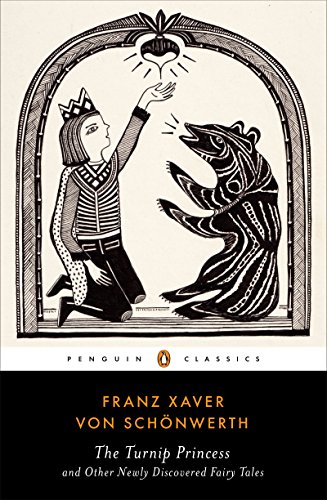
But . . . the book on her lap is The Turnip Princess and Other Newly Discovered Fairy Tales. Not Grimm. Not Lang. Not Jacobs. But rather Schönwerth. She must have plucked the book from my library, a volume I had almost forgotten about. I am struck by the irony. The world almost forgot Schönwerth.

The scholar Erika Eichenseer came across hundreds of stories that Schönwerth collected in Bavaria in the late nineteenth century, stored in a German municipal archive. She dusted them off and published a good number of them that now lay on Thalia’s lap.

“The Iron Shoes,” Thalia proclaims.

Hans, a ne’er-do-well son, is kicked out of his home by his father, to make his way in the world. In his wanderings, he stumbles onto an abandoned castle, taking refuge in one of its rooms. A woman, dressed in black, appears, lays food on a table, points to a bed, and wordlessly leaves.

At midnight, a man comes into the room and tries to choke Hans and otherwise torture the lad. The next morning the woman reappears, dressed in grey, again silently leaving him food. That night two men come to torture Hans.

By morning, Hans has had quite enough and prepares to leave. The woman, now dressed in white, asks him to stay one more night. For her sake he does, and three men show up to abuse him.

In the midst of this pummeling of the lad, the woman interrupts, accompanied by thunder and lightning, and drives the abusers off. What Hans achieved was breaking a spell over a princess, who gives Hans her hand in marriage.

Now, awash in wealth, he desires to visit his father to prove his success.  The princess allows this, giving him a ring, which he need only turn on his finger for her to come to him. However, he must only do this in true distress.

His father, who works as the king’s groundskeeper, does not (could not, would not?) recognize his son. Hans ends up introducing himself to the king, who orders a feast to honor his guest.

The other noble guests, jealous of the lad’s handsome looks, challenge him to prove that his wife is as beautiful as he boasted. Hans turns the ring on his finger, and carriages roll up, from one of which steps his radiant princess.

Unfortunately for Hans, the next morning his old traveling clothing are laid out on the bed, a pair of iron shoes are on the floor, and a note states, “I am punishing you by leaving. Don’t try to find me. You will never discover where I am, even if you wear out these iron shoes.”

Undaunted, he searches for her, even though he cannot find their castle, where he met her. After some time, he comes across three fellows arguing over the ownership of three magical treasures: an unending bag of gold coins, a cloak of invisibility, and a pair of hundred-league boots. He agrees to settle their dispute but claims he needs to verify the magical validity of the items. Testing the cloak of invisibility, he steals the bag and the boots.

While fleeing rapidly, thanks to the boots, he sees a little man beside him, keeping pace. It is the wind, off to a certain town to dry the clothing of a princess who plans to marry that day. It turns out to be his wife. Hans crashes the wedding in his cloak, knocking the good book from the parson’s hands, and clobbering the bridegroom every time he tries to say, “I do.”

The marriage is given up, yet all go off to the wedding feast. Hans sits among the beggars, invisibly stealing food intended for the guests, and sharing it with his fellows. During his antics, he loses his ring. A servant finds it, and because it bears the princess’s initials, it is returned to her.

Realizing that Hans has found her, she calls for him, they are reconciled, and the real marriage takes place.

Thalia closes the book and smiles.

Fairy Tale of the Month: January 2023 The Iron Shoes – Part Two

Gras-Ober, Wikipedia/Wikimedia Commons

Franz Schönwerth

As I enter Augustus’s tobacco shop, the familiar, ever-welcoming tinkle of the bell above his door . . . is missing! I stop in my tracks and look up. The bracket is there. The coiled metal spring is there. The bell is missing.

“It fell off,” Augustus explains, standing behind the counter.

“You will repair it, won’t you?”

“Well, I don’t know.”

Oh, but you must. We can’t let the world slowly fall into disorder.”

Augustus smiles at me. “I don’t know that my missing bell qualifies as falling into disorder. Haven’t you been listening to the news? That is disorder.”

“Of course I haven’t. I make it a point not to listen. Oh, I did in my youth, avidly. Then I realized it wasn’t going to make me happy. So, I gave it up.”

“Admirable,” Augustus concedes. “I will make sure to repair the bell.”

I am content.

“Are you familiar with Franz Schönwerth?” I ask.

“Yes, a competent fellow at whatever he did.”

“I know him as a folklorist,” I say.

Augustus sits on his stool on his side of the counter and I sit on one on my side.

“He was a servant of the Bavarian state, trusted by the royal family. He became the private secretary to the Crown Prince Maximillian and was entrusted with managing the prince’s and his wife’s personal wealth.

“Schönwerth proved his loyalty when, during the revolutions of 1848, he transferred the royal family’s wealth to Nymphenberg Palace for safekeeping. He did this by disguising himself as a common workingman, loading three million thalers worth of cash, securities, and valuables onto a handcart and wheeling it through the streets of Munich, filled with the very rebels who would have otherwise plundered it.”

“Remarkable,” I say. “I hope he was rewarded for such a thing.”

“Oh, yes. He became ennobled, always rising in the soon-to-be king’s estimation. Schönwerth had the privilege of guiding the king in the patronage of the arts and sciences.”

“Excellent, but how did he get involved with folklore studies?”

“I suspect as he rose in stature he ended up with more free time to pursue his interests. Both he and his wife, Maria, were native Bavarians. Like other intellectuals of the nineteenth century, he saw his world going through upheaval and rapid change. The old ways of his beloved Bavaria were being lost and forgotten.

“He started collecting information from his wife, a person knowledgeable about folkways, then moved on to his housekeeper. His housekeeper introduced him to her acquaintances, leading him to make collecting tours through the countryside. He apparently had a knack for getting commoners to open up to him through the application of much coffee and cigars.

“And, he collected everything: legends, fairy tales, comic stories, children’s games, nursery rhymes, children’s songs, proverbs, how people lived, everyday-life details, customs, and traditional dress. Much of this material he published in a three-volume work, From the Upper Palatinate—Customs and Legends. The Grimms’ considered him heir to what they were accomplishing. They recognized his competence and skill as a folklorist.”

“Yet,” I say, “the better part of his work ended up collecting dust in that vault in Regensburg.”

“Well, for him it was a hobby. Also a passion, but he wasn’t trying to make a living at it as the Grimms were.

Fairy Tale of the Month: January 2023 The Iron Shoes – Part Three

H J Ford

Turn About

“Why, though,” inquires Augustus, “are you asking me about Schönwerth?”

“Ah, Thalia has taken an interest in him. She read The Iron Shoes . . . last night.” (I almost said “to us,” which would have needed an explanation.)

“Iron shoes,” murmured Augustus. “There is more than one story with iron shoes in it. There is the Grimms’ Little Snow White, where the witch/queen is danced to death in red-hot iron shoes. Then there’s The Enchanted Pig. In that the heroine must wear out three pairs of iron shoes looking for her husband.”

“You’re getting warmer,” I say.

“Now I remember. The Schönwerth version is where the Psyche-looking-for-her-husband motif gets turned on its head. The hero .  .  .”

“Hans,” I interject.

August rolls his eyes. “Of course it’s Hans. This is a German story. Hans is the one looking for his bride after violating some rule set up by the spouse, as is always the case in this motif. Let me find my copy of Schönwerth.”

I fill my pipe with Fairies’ Delight from the courtesy canister on the counter. As I light up, Augustus returns with book in hand, reading as he walks.

“Right. Hans is a delightful rogue, not the usual hero who starts out being portrayed as a simpleton but then shows unexpected wisdom. Hans stays something of a rogue straight through. He gets kicked out of his home by an irate father for being useless. He never does get reconciled with his father, but on the other hand, he bears no ill will toward anyone. He is happy-go-lucky.

“His luck is in finding the enchanted castle and its occupant, putting up with beatings for food, and almost unintentionally breaking the spell over the princess. Then he blows it all by not listening closely to his wife’s instructions about the ring. He calls her to him to show her off to the other nobles, not out of dire necessity.”

I pick up the thread of his thinking and say, “Roguishly, he steals the three magical gifts from the quarreling fellows. With the magical boots he can travel with the wind, which leads him to find the princess.

“But wait.” I ponder for a moment. “Hasn’t he exchanged the iron shoes for the magical boots? Is there some symbolic significance in that? Some act of transformation?”

Augustus is lighting his pipe and takes some time to reply. “Nope. Not likely. Not unless you decide to shoehorn a metaphor into the tale. When Schönwerth collected these stories, he was actually formulating for himself methods later used by professional folklorists. He did not allow his thoughts and opinions to creep into what he collected. With the tales, he recorded what he heard.

“Had the Grimms collected this tale, they would have edited it for their bourgeois audience.  Being romantics, they might have found a connection between the iron shoes and the magical boots and put that into the story. For the teller that Schönwerth recorded, the iron shoes were a challenge by the princess, thrown at Hans’s feet—notice my pun, please—for him to go find her. Having served that purpose, he could give them up for a better pair of footwear to help him.”

“I loved the bit about him punching the suitor in the mouth before he could say, ‘I do.’”

Augustus grins. “A loveable rogue, as I said.”

Your thoughts?
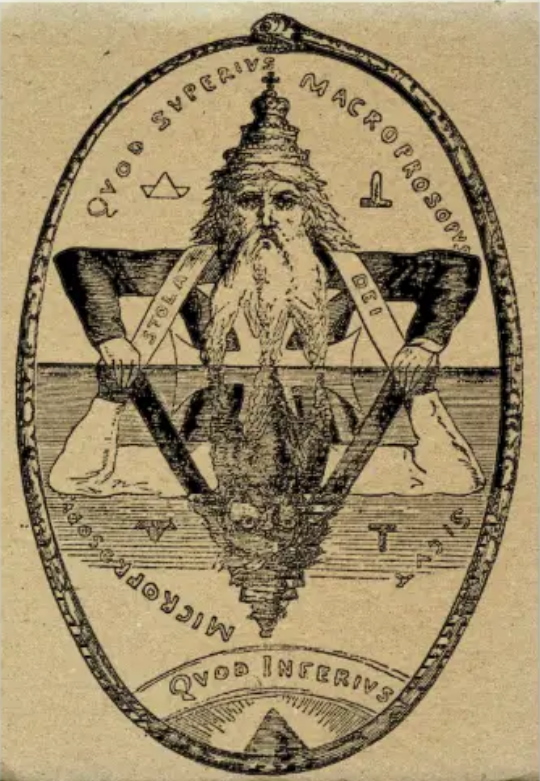
Fairy Tale of the Month: December 2022 Jack Frost – Part One

Arthur Rackham

Christmas Alone

Abandoned for Christmas! How has this happened? My daughter has taken Thalia to visit other relatives for the season. Part of me is glad that she is taking more interest in her progeny, but what about my Christmas without Thalia to hang her stocking at the foot of her bed?

The plot against me thickens when I realize Melissa, Augustus, and Duckworth have all gone off to visit family members. It is a relative conspiracy, I think. Ultima is of no use to me on this holiday. She and all her people have dragon familiars, and religion died out a long time ago in her world.

I will not be defeated. In October, I made my Christmas pudding. Yesterday, I bought all the ingredients for my Yorkshire pudding. (Why are they both called puddings when they are nothing alike?) I had to draw the line at the minced pie. I can only eat so much. Today, I went out and bought a Christmas tree, very small since I had to carry it home. I plan to read The Night Before Christmas to the brownies, the fairy, and Johannes on Christmas Eve. That is an oldie but goodie, American though it is, and maybe something else.

I now venture to the third floor to find my box of Christmas decorations. I can’t help noticing snow drifting from beneath the storage-room door.

Is there a window left up?

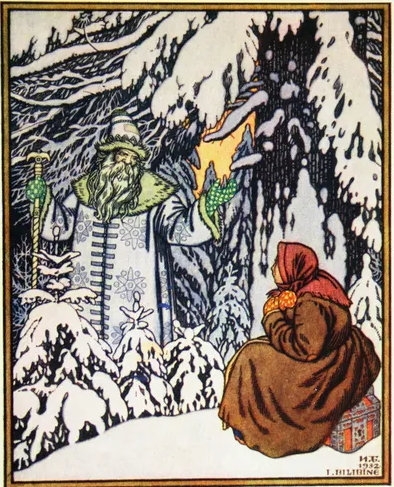
I open the door and am pulled into a wintery Russian landscape. It must be Russia because the crone sitting on a tree stump beckoning to me is, by her traditional headscarf, none other than Babushka. Despite my age, I sit at her feet in the snow like a two-year-old.

“Let me tell you the story called Jack Frost,” she says.

An old woman had a daughter and a stepdaughter. One day, she demanded that the old husband take his daughter out and abandon her to die. The father did not have the will to disobey his wife and took his daughter out on his sledge. Making the sign of the cross, he left her to die in an open field without any covering.

Jack Frost came saying, “Maiden, maiden, I am Jack Frost the Ruby-Nosed!” She answered, “Welcome Jack Frost! God must have sent you to save my sinful soul.” Jack Frost, touched by her gentle words, took pity and gave her a fur coat.

He approached her a second time in the same manner, and she answered him as before. He gave her a coffer filled with things for her dowry. On the third visit, he gave her a magnificent robe.

Meanwhile, the old woman prepared the funeral dinner and ordered the husband to bring back the corpse. The little dog under the table prophesized the stepdaughter would return in glory and no suitor would want the old woman’s daughter. The old woman fed the dog pancakes to cajole him into saying something other, but the animal would not change his tune.

When the stepdaughter did return in glory, the old woman commanded her husband to take her daughter out to the very same spot and leave her there to attain her dowry. Jack Frost approached the girl but hearing no kind words, killed her.

Again, the little dog predicted the end, and the old woman fed him pancakes to make him say something to her liking. Soon her husband returned with the frozen corpse of the old woman’s daughter.

As the story ends, the light fades, and the snow disappears along with the winter landscape. I find myself sitting in front of the box of Christmas ornaments that I’d come for.

Fairy Tale of the Month: December 2022 Jack Frost – Part Two

Ivan Bilibin

The Tree

I contemplate Babushka’s story as I trim my Christmas tree, taking out the ornaments one-by-one, old friends that come around once a year.

At first thought, Jack Frost is full of the usual tropes. Certainly, the evil stepmother is the most common of all. But as I think about it, the tale has its unusual aspects, its own feel as it were.

The weak and/or disappearing father figure is in the story but in its most extreme form. Often, as in Beauty and the Beast, the father brings disaster upon his daughter then disappears from the story. Another version of the weak/disappearing father is in Hansel and Gretel, where the father follows his wife’s advice to abandon their children to save themselves from starvation.

In Jack Frost, the wife directs her husband to expose his daughter to the elements for no other reason than her dislike of the girl. He has not the will to oppose her.

I have in my hand Thalia’s favorite ornament, a flat, cardboard cutout, very colorful, printed on both sides, depicting a Santa stuffing a naughty little boy into a sack. She never liked little boys. I hope that does not change too quickly. I hang the ornament with a sense of longing.

What occurs to me is that fairy tales containing the weak/disappearing father image exist in all European countries, which are male dominated. Isn’t this bad PR for men? Why do they put up with it? I have two, somewhat opposing, notions about this.

The first notion is that these fairy tales reflect the unrecognized reality that common women in the twelfth to fourteenth centuries—the time period in which our current fairy tales were being conceived—held greater status than has been recorded. They bore as heavy a workload as the men. If their husbands were off fighting in a war, enlisted or drafted, they bore all the workload of raising a family.

Among the upper classes, women seldom held property and were almost considered chattel. All the legalisms concerning women’s rights probably applied to them in that male-dominated sphere. The peasantry, male and female, were chattel. They, being equals at the bottom of the heap, could have quite a different relationship with each other than members of the royalty.

I now hold in my hand a spider ornament made out of pipe cleaners. I believe this may have been some school art project foisted upon Thalia. I know there is a German tale about a Christmas spider, but no arachnid will grace my Christmas tree. I put it back in the box.

My second notion about the weak/disappearing father is that it is intended to be a cautionary tale. In other words, this is what happens if a man leaves his wife in charge. They will make bad and cruel decisions. They do not have the moral fortitude of men. Etc.

Our young heroine achieves her new status by being subservient and humble, as a woman should be, and not controlling like the old woman. Of one thing I can be certain, I will not try to defend this position with Melissa.

I pick another ornament out of the box. It is one my wife bought in a charity shop. It is a blown-glass bulb, hand painted, inscribed with the name “Esther.” We never had a clue who Esther may have been, but the bulb meant something to someone at some time. Therefore, we honor her every year. The bulb goes on my tree.

And what about that little dog under the table? Talking animals are familiar, but this particular scenario I have not run across before. I cannot help feeling the little dog is not so much prophetic as it is playing the role of the super-ego. That would make the old woman the id, and the unfortunate husband the ego. I could toy with that idea.

The last peculiar bit of this story is that it does not end in marriage, as those of this type usually do, when the girl on her own is found by a prince. Rather, there is the acquisition of a dowry that assures a good marriage. Not romantic but practical. I wonder if that is not a Russian touch?

Coming to the end of the box’s useful contents, I now hold an angel in one hand and a star in the other. Which one should crown my tree this year?

Fairy Tale of the Month: December 2022 Jack Frost – Part Three

Maxfield Parrish

Jack Frost

“Is Jack Frost originally a Russian folk character?” I ask the hearth, where I have started a fire, pulled up my comfy chair, and settled down. To me, Jack Frost is English. Rising again, I get my laptop out of the closet. Usually, my questions are addressed to Thalia. She then takes her “oracle” out of her pocket and finds the answers. That is, if she is not talking on it, which she does more and more of late. After plugging myself in, I soon come across the following jumble of information.

The tale Jack Frost comes from the nineteenth-century collector Aleksandr Afanas՜ev, now compiled in Russian Fairy Tales. However, different translators have labeled the story Father Frost, or King Frost. In Russia, there is also a Grandfather Frost (Ded Moroz), who is really a Santa figure. All this does not give me much clarity.

As far as origins go, that is no clearer. Just about every mythology has some deity or deities connected to the cold; even sunny Greece (Khione and Boreas). The temptation is to connect Jack Frost with the Viking “Frosti” and his brother “Jokul,” sons of Kari, a wind god. Their names translate to “Frost” and “Icicle.” However, scholars see no connection between them and our Jack Frost.

The spritely Jack Frost that we know appears to have come out of the early nineteenth century. He is elvish and mischievous but not to be feared as is the character of our Russian tale. The English Jack Frost will nip your nose, cheeks, and ears but nothing worse. He is also assigned to paint the leaves on trees with their fall colors. I stumbled across a painting by Maxfield Parrish of Jack Frost at this task, the work labeled as a self-portrait.

Jack Frost often appears in popular culture. For example, L Frank Baum’s The Life and Adventures of Santa Claus (1902). In the 1940s, there was a comic-book series called Jack Frost, put out by Timely Comics, later named Marvel Comics.

There are two movies called Jack Frost. One is a sentimental story about a father who during his lifetime neglected his family. Upon his accidental death, he returns in the form of a snowman named Jack Frost, to help his young son. There are two notable items about the film. Three of Frank Zappa’s children have roles, and it was a box-office bomb, grossing about half of what it cost to produce.

The second production, critically panned but achieving a cult following, was a black-comedy, slasher, direct-to-video film. A serial murderer named Jack Frost is being driven to his execution in the fictional town of Snowmonton, when there is a collision with a “genetics” truck. The genetic material causes Jack’s body, lying in the snow, to mutate into a killer snowman.

Jack Frost 2: Revenge of the Mutant Killer Snowman has a family of ravenous snowmen attacking tourists on a tropical island. The director threatens a third film to be called Jackzilla. So far, we have been spared.

I suppose this is a study in what can happen to a popular icon or fairy-tale character. Santa may have started with Saint Nicholas, a third-century Greek who became a bishop in Myra, Turkey. Around him gathered a number of tales about gift giving.

The Dutch version of this saint was Sint Nicolaas, which became SinterKlaus and was anglicized in America to Santa Claus. Clement C. Moore (or was it Henry Livingston Jr. as some suggest) in his Twas the Night Before Christmas, made him a plump, jolly, old elf dressed in fur and driving a miniature sleigh and eight tiny reindeer. Coca-Cola, in 1931, codified Santa as being fully human in size, decked out in a red suit with white trim, bereft of the long cloak of previous Santa illustrations.

I close down my laptop and put it back in the closet. It crossed my mind to Google “Slasher Claus.” I am sure it is out there, but I don’t want to know.

Rather, I settle back in my comfy chair, clearing my mind of all that silliness, and consider the deeper meaning of Christmas by contemplating the star on the top of my tree.

Your thoughts?

Fairy Tale of the Month: November 2022 The Llanfabon Changeling – Part One

Theodore Kittelsen

The Changeling

I open my front door. It is an overcast, drizzly, gloomy Monday morning out there. I’m feeling a bit under the weather and feel the need to get out from beneath its oppression. Going into my study to look out of the French doors, I see the sky over the Magic Forest is clear and bright. I’ll go take a walk out there.

My notion is to wander deeper into the Magic Forest than I ever have before, but am saved from that adventure when I get to the pond, and there is Ultima, sitting under a walnut tree, her back against the trunk, reading a book.

“Ah, darling,” she says, “how good to see you.”

“My greetings in return. What are you reading?”

“One of the tomes from your library, The Welsh Fairy Book. I assume Welsh is one of your countries.”

“Wales,” I say. “How do you get into my library without me ever seeing you?”

“You’re never there when I visit.”

I suppose there is some time slippage between our two worlds.

“You are welcome to borrow my books, but now you must pay by reading me a story.”

I settle down on one of the comfortable sitting stones that line the pond’s banks. That these stones should be comfortable is one of the magical things of this place.

“Well,” says Ultima, “let’s try this one, which I just started. The Llanfabon Changeling.”

A young widow in the parish of Llanfabon had a son, who was all she had in the world and all she loved. Llanfabon was rife with fairies, the sort of fairies that would lead a man into the bogs at night with false lights. The widow knew that fairies would steal human infants, and she took precautions but to no avail.

One day, the sound of her cows in distress lured her out of the house, she forgetting, in the moment, to place the fire tongs crossways over the cradle in which her son slept. Upon returning, she felt uncertain that the child in the cradle was her own.

Over time, the once pleasant child became grouchy, less attractive, and didn’t grow. She went to a wise man, reputed to understand dark matters, and told him her story. He advised her to follow his instruction, faithfully and minutely, to brew beer in an eggshell, and to listen for what the child might say.

When she did this, the child, actually the changeling, expressed in rhyme that throughout his long life he’d never seen anyone brew beer in an eggshell.

She repeated the verse to the wise man. He then instructed her to go at midnight, under a full moon, to a specific crossroads to see what she could see, but without being seen herself upon danger to her life.

What she spied were hundreds of fairies in procession, playing music and singing, the likes of which she had never heard. However, among the procession came her own dear child. She could not rescue him and returned to the wise man.

He now told her to find a black hen with no other color of feathers on it, bake it over a wood fire (not peat) with feathers and all, and close up all passageways and holes except the chimney flue. As she did this, she was not to look at the child.

It took her a long time to find the black hen, but when she baked it and the last of its feathers burnt away, the changeling disappeared, and she heard the music she had heard at the crossroads coming from outside her door. Opening the door, there she found her own child, who could not account for where he had been but said that he had been listening to beautiful music.

Ultima closes the book. “The fairies in your world are not very nice!”

The Fairy Raid: Carrying off a Changeling, Midsummer Eve (oil on canvas) by Sir Joseph Noel Paton, 1867

Fairy Tale of the Month: November 2022 The Llanfabon Changeling – Part Two

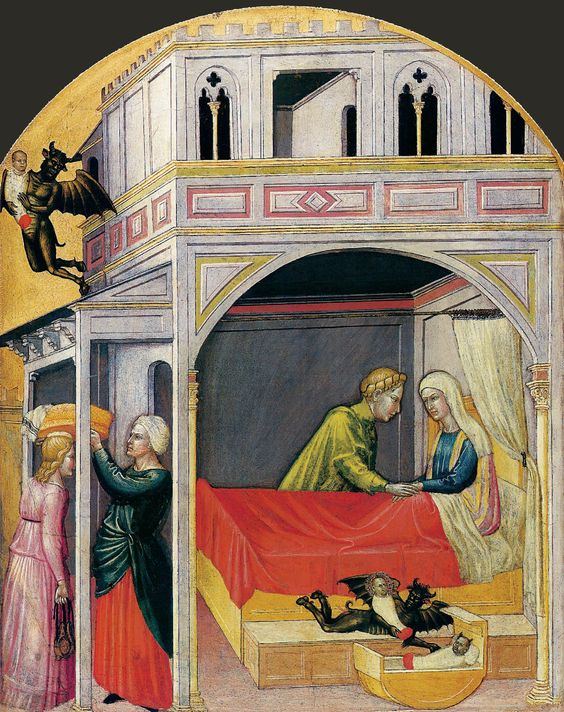
Martino di Bartolomeo

(c. 1389–1434)

Legend of St Stephen

Of Fairies

“Well,” I say, trying to keep defensiveness out of my voice, “there are three types of fairies.”

“Three?” Ultima cocks her head.

“The fairies of legend, folklore, and literature. What I think of as the original fairies are those of legend, such as the Tuatha De Danann. They are entirely of human shape if a bit more handsome and superior. They live in a realm separate from ours where time moves at a different pace.

“There is a tragic Irish legend of Oisίn, the warrior poet, and Niamh of the Golden Hair. Naimh, daughter of the sea god, Manannán mac Lir, kidnaps the willing Oisίn, taking him to Tir na nÓg, the land of the young. After living there for three years, he desires to see his family and friends again. What he finds is that in his birth world not three years have passed but three hundred years, and his family and friends are a distant memory.”

“Oh, how sad.” Ultima’s lips droop.

“It gets worse,” I confess. “When he dismounts from his fairy horse and his foot touches the ground, the three centuries catch up with him, and he turns into an ancient being.”

“Good gracious.” Ultima is perturbed.

“The folklore fairies,” I continue, “the fairies of our story, are of a different lot. These are the fallen angels. I guess I should ask, is there a Christian god in your world?

“Oh, plenty of gods, as well as goddesses,” Ultima assures me.

“Right. Do you have any angels in your world?”

“I believe the Zoroastrians do.”

“Close enough. In our tradition, there is a war in heaven among the angels, some siding with God and others with the angel Satan. The Satanic forces lose and are cast out of heaven. Some of them fall all the way to hell, but others fall only as far as earth. And here they wait until Judgement Day, not knowing if they will be allowed to return to heaven or spend eternity in the other place.

“Their relationship with humans can be very mixed. They are at least touchy to deal with. Visiting with the fairies may also have the time-lapse problem of Oisίn’s. What is notable, they, for the most part, have shrunk in stature, sometimes mistaken for children. As shown in our story, they are noted for producing the most beautiful music.

“When we come to, what I call, the literary fairies, or British fairies, their diminutive stature becomes more pronounced. They are the size of small birds, complete with wings.”

“Ah,” says Ultima, “those I would like. The fairies in my world are all of the legendary sort. Little winged people sound delightful.”

“I am told they can bite, but that has not been my experience.”

Ultima’s eyebrows narrow. “Why do your fairies keep getting smaller?”

I felt this question coming the longer I pontificated about the three fairy types.

“It has to do,” I say with shame, “with our fear of the ‘other.’ We cannot abide a thing different from ourselves. When placed up against a thing unfamiliar, we need to make it smaller in order to comprehend it. By then we have already distorted it.”

Ultima shakes her head. “You so need to have dragons in your lives. What would I be thinking without mine?”

Fairy Tale of the Month: 2022 The Llanfabon Changeling – Part Three

The Fairy Raid: Carrying Off a Changeling – 1867

by Sir Joseph Noel Paton

Considering Eggshells

“Tell me more about this changeling thing,” said Ultima. “Why did the fairies want human children?”

“The folktales are all over the map on that one. Some stories indicate fairies cannot nurse their own children, and they substitute their child for a human child. In other tales, a human wet nurse is either abducted or hired for a handsome wage.

“In our story, an old fairy, under a glamour to appear as a child, is taken care of by the duped mother while the fairies enjoy the company of the human child.

“Then there is the ‘tithe to hell,’ owed by the fairies every seven years.”

“That does not sound like it will bode well.” Ultima grimaces.

“No, not at all,” I say. “Rather than give one of their own for the tithe, they will kidnap and offer up a human. However, not necessarily a child. Adults, too, may be stolen.  The changeling in these cases can be a piece of wood glamoured to look like a sickly version of the person that soon passes away, leaving the living adult in the hands of the fairies with no one thinking to look for them.

“Perhaps the most famous of these humans destined to be the tithe to hell is Tam Lin. He fell into the hands of the Fairy Queen, who intended to sacrifice him for the tithe. However, Tam Lin instructs his lover, Janet, on how to save him. She is to go to a certain crossroads at midnight on Halloween and wait for the fairy procession.”

“Wait,” Ultima chimes in, “that is what the wise man told the young widow to do.”

“Exactly that, they are known as the Trouping Fairies. In the case of Tam Lin, they were on their way to give him over. He told Janet how to identify him, then drag him from his white horse, and hold him in her arms while the Fairy Queen appears to turn him into dangerous beasts and finally into red hot coals. This she does, stealing him back from the Fairy Queen.”

“Oh, that’s a much better story,” Ultima gushes. “But what about the funny bit with the young widow forgetting to put the iron tongs over the cradle to protect the child? What help would that have been?”

“Fire tongs were made of iron. Iron has always been a talisman against evil. It keeps away ghosts, witches, and fairies. In our world, cemeteries are often enclosed by iron fences and gates. It is not to keep people out at night but rather the ghosts in and not bothering the living.”

Ultima looks at me dubiously.

“As tradition,” I quickly add, “would have it.”

“And the brewing or cooking in an eggshell?” she asks.

“That is a curious item,” I admit. “The notion is to catch the fairy off guard and let him utter something in amazement about what he is witnessing. And, by the way, the kidnapped children are always boys. It is not until a girl becomes a young bride or a young mother that the fairies have any interest in her. Don’t ask me why.”

I saw that question rising in Ultima’s eyes.

“Nonetheless,” I continue, “the ruse almost always has to do with brewing or cooking in an eggshell in many of this story’s versions all throughout Europe. There is an association of eggshells with fairies. It is said a half-shell can serve as a boat for a fairy, but I suspect that may apply to the British fairies.”

I feel a raindrop and glance up at the darkening sky over the Magic Forest. Ultima and I sigh with disappointment. It appears I am back under the weather.

Your thoughts?

Fairy Tale of the Month: October 2022 The Three Army Surgeons – Part One

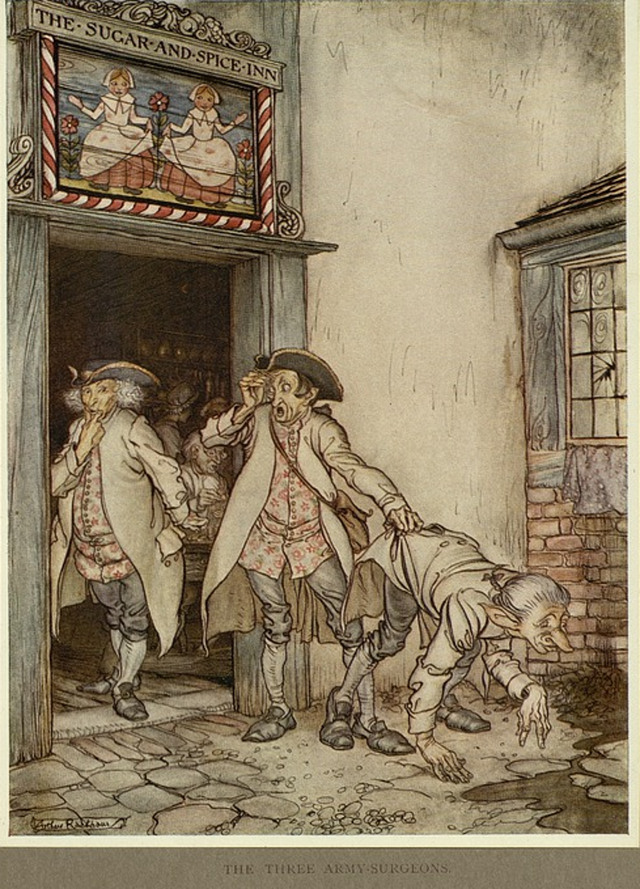
Arthur Rackham

Another Halloween

The usual crowd gathers for Thalia’s Halloween-night story: Melissa, Johannes, the fairy, the brownies, and myself. However, the story is being told early—the sun is not yet set—because Thalia will be going off to a Halloween party with Jini.

To Johannes’s amusement, I think, Thalia wears a black cat costume. It is made up of black leggings and a black jumper replete with a tail. Pointy ears and painted-on whiskers do the rest. When Jini and her mother come, she’ll be ready to go.

She waits until I get the fire in the hearth going, then announces, “The Three Army Surgeons.” She is holding her old, battered copy of Grimm’s fairy tales.

One evening, three army surgeons were at an inn where they intended to stay for the night. The friendly innkeeper asked them where they were going and what they did. They told him they traveled the world practicing their profession. This led to boasting. The first surgeon said he would cut off his hand that evening and restore it in the morning. The second said he would do the same with his heart, and the third said he would too with his eyes.

No one else knew that these surgeons had a magic salve that could heal anything.

Before the surgeons went to bed, they cut out their assigned body parts, the innkeeper put them on a platter, and the maid put them in a cupboard for safekeeping.

Unfortunately for all, this maid had a soldier/sweetheart who showed up after everyone else was asleep, and the maid brought out food for him, leaving the cupboard door open. In came the cat, who made a meal of the surgeons’ body parts. When the maid found out what had happened, she declared all was lost.

The clever soldier had other ideas. Borrowing a butcher knife, he popped out and returned with the hand of a thief he’d seen hanging from the gallows. Then he grabbed a cat and poked out its eyes.

“What!” objects Johannes. He rises from his window seat, his tail straight in the air, and, with indignation, strides from the study.

“Oh drat,” Thalia frowns. “I think I’ve offended him. He’s so touchy.”

“Well, my dear,” Melissa says, “he is a cat.”

“A cat-sìth, actually,” I say, “but still a cat.”

The brownies titter, Thalia sighs, and she continues.

The heart of a pig, butchered that day, made up for the last of the losses. In the morning, the surgeons restored the substituted body parts with the magic salve, much to the praise of the innkeeper.

The three surgeons traveled on their way, but the surgeon with the pig’s heart delayed their travel by rooting through whatever garbage he could find, while the others tried to drag him back by his coattails.

That evening, in the next inn, the surgeon with the thief’s hand, stole money from an unwary patron. After they had gone the bed, the surgeon with the cat’s eyes could see in the dark and commented upon all the mice in their room that the others could not see. They then concluded they didn’t have their original body parts, and it was the fault of the previous innkeeper.

They return, accusing the innocent man of cheating them. He—rightly so—accuses the maid. But the maid, seeing the surgeons coming, ducked out the back door never to be seen again. The surgeons demanded as much money as the innkeeper had or they would burn down his house. They got a goodly sum, but it was in no way a replacement for their lost body parts.

The doorbell rings.

“It’s them. Bye.” Thalia darts out the study door, leaving the fairy, previously settled on her shoulder, fluttering in mid-air.

Fairy Tale of the Month: October 2022 The Three Army Surgeons – Part Two

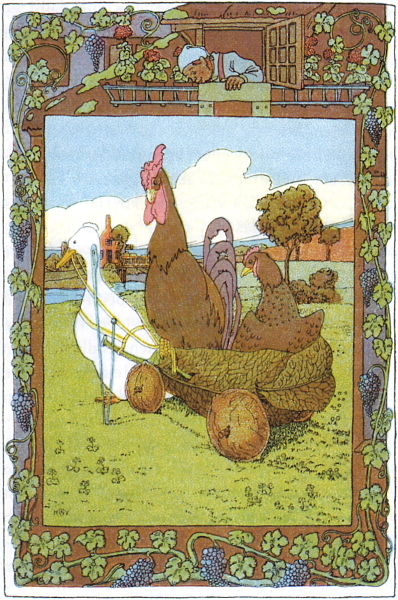
Heinrich Lefler

Some Riffraff

A little to our surprise, the fairy settles into Melissa’s lap and curls up to nap.

“I think I’ve been honored,” Melissa smiles, “but now I can’t get up. Will you pour me some more wine?”

I pour her half a glass.

“Oh,” she says, “you are remembering last year.”

“Yes, and not to mention we have started drinking early and on empty stomachs. However, I have made some pumpkin soup and squash toast for us to dine on.”

“That sounds much better than candy. What is squash toast?”

“You will see.”

I leave for the kitchen and soon return with steaming mugs of soup and small plates of squash toast. “It appears we will dine in the study since you are anchored by Thalia’s fairy.”

“Off to a Halloween party. My, but she’s growing up,” Melissa reflects.

We settle into sipping our soup by the hearth.

“What an odd Grimm tale,” she muses. “Not their usual fare.”

“Well,” I say, “there are a number of what I call ‘foolish tales’ in the Grimm collection, such as Riffraff.”

“I don’t recall that one.” Melissa samples the squash toast. “Oh, this is good!”

“As I recall, the story starts out with a rooster and his hen going up a hill to eat nuts before the squirrels get them all. After eating their fill, they don’t feel like walking home. Instead, the rooster builds a coach out of nutshells, then waylays a duck, with whom he has an argument, to pull the coach.

In this way, they journey until they come upon two other travelers.”

“Wait a moment,” Melissa says with laughter in her voice, “I thought they were just up a hill.”

“Home seems to be getting inexplicably farther away, but wait, it gets worse.

“The two travelers are a needle and a pin who had drunk too much beer at the Tailor’s Tavern—I am sure that was meant to be some sort of pun—and could not find their way home. The rooster allows them into the carriage since they did not take up much room.

“When they come to an inn, they decide not to travel any farther.”

“Oh dear,” Melissa smirks, “this coming back down the hill has gotten rather surreal.”

“Hasn’t it though. A foolish tale, as I said.

“Well, the innkeeper raises objections to their spending the night, but the rooster promises him the egg the hen laid along the way, plus he can keep the duck. After settling that, they have a merry evening.

“However, the rooster and the hen rise early, crack open the egg, and devour it. . .”

“Wait. What? That was cannibalistic of them,” she says.

“. . . then they take the still sleeping pin and needle, putting the pin in the innkeeper’s towel and the needle in his comfy chair, and fly off. The duck, seeing them escape, does the same.

“The innkeeper, of course, scratches his face with the pin and sits on the needle, declaring he’ll never allow riffraff like them again at his inn.”

“I see your point. Your foolish tales are those filled with absurdities rather than princes, princesses, and magic.”

“There is the magic salve in The Three Army Surgeons, but it is more of a prop than anything else.”

Melissa nods. “I can just hear these two tales being told at an inn along with much drinking. By the way, instead of more wine, can you get me more of this toast?”

That I am glad to do.  

Fairy Tale of the Month: October 2022 The Three Army Surgeons – Part Three

Jacques Callot 1633

About Gallows

I return with more squash toast to find the fairy still curled up in Melissa’s lap.

“I hope Johannes is not too upset about the cat in the story.” Melissa nibbles.

“He’ll get over it.”

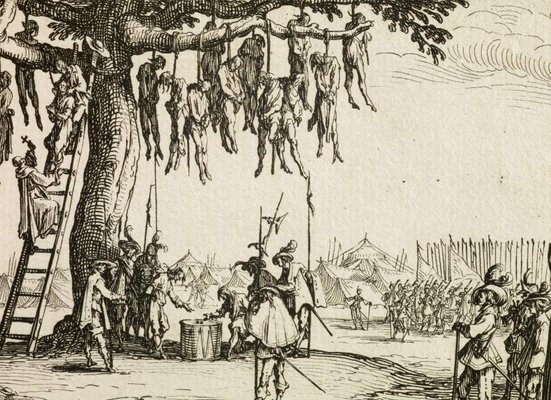
“The poor pig was already done for,” Melissa goes on, “but the image that got to me the most is that of the thief’s hand.”

“And why is that?”

“I’m not sure. The Grimms were a bit more descriptive about this soldier going to the gallows and cutting off the hand than they were about the demise of the animals. “

“Ahh,” I say, “the gallows. That is bound to engage the imagination. I think the Grimms knew that and referred to them numerous times in the tales.”

“Do they figure in other stories?” she asks.

“Well, let me think. There is The Two Travelers, in which one of the travelers has his eyes gouged out by the other as a matter of spite. The victim ends up falling asleep under a gallows. During the night, he hears two hanging corpses talking to each other and learns that the dew on the grass beneath them will restore a man’s sight.

As the story goes on, he acquires animal helpers and eventually ends up in the employment of a king who also employs his previous fellow traveler. The spiteful fellow causes trouble for our hero, but he is saved by his animal friends, and the villain is eventually banished. The villain ends up sleeping under the very same gallows as before. Crows, resting on the corpses, fly down and peek out his eyes.”

“Oh, how delightful,” Melissa can’t help saying.

“I recall another.” I hold up a finger. “Let me remember. A Tale About the Boy Who Went Forth to Learn What Fear Was.”

Melissa applauds my memory.

“In this tale, whose hero is rather dense, the lad has never felt fear, which he calls

‘the creeps.’ In part of the tale, he is assigned to spend a cold night under the gallows. The winter wind knocks the bodies together, and the lad feels sorry for them. He brings them down and sets them around his fire to warm them up a bit. They prove to be boring company; he can’t get a word out of them. In disappointment, he hangs them all back up again.”

I get another round of applause.

“Oh, how could I have forgotten,” I remember, “The Master Thief. A count has challenged a master thief to prove himself. One of the tasks is to steal the bedsheet from under him and his wife. One night the master thief cuts down a corpse from the gallows, sets a ladder up against the count’s bedroom window, and pushes the corpse ahead of him up the ladder.

“The count, expecting such a move, is ready with a pistol. When the corpse’s head appears in the window, the count fires. The master thief lets the corpse drop. The count rushes out to see what he has done, and the thief slips in, pretending, in the dark, to be the count, and tells the wife he has killed the man and needs the bedsheets in which to wrap the body. She, of course, complies. “

“Oh, how gruesome,” Melissa exclaims.

Her raised voice awakens the fairy, who yawns, stretches, flutters up, and leaves the study.

“Sorry,” Melissa calls after her. “Well, at least I can now get my own wine.”

Your thoughts?
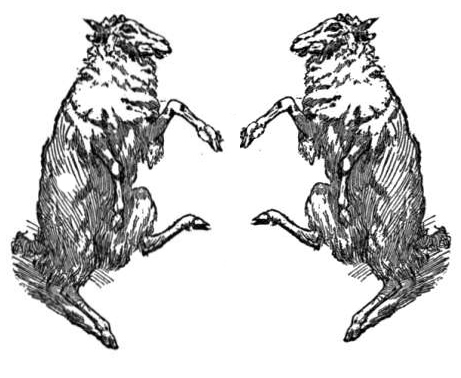
Fairy Tales of the Month: September 2022 The Red Ettin – Part One

H. J. Ford

A What?

The traditional evening gathering is at hand. Thalia has taken her position on her comfy chair closest to the hearth. The weather is cool enough for me to have lit a fire. I in my comfy chair, the fairy on Thalia’s shoulder, Johannes on the window pretending not to be listening, and the brownie lurking in the shadows despite how familiar we are with each other, have all gathered for the evening read in my study.

“Tonight,” Thalia announces, “I shall read from the English Fairy Tales, The Red Ettin.”

An old widow sends the older of her two sons off into the world to find his fortune. First, however, she instructs him to bring her water in a can for her to bake him a cake. The can leaks most of the water and, therefore, the cake is small. Then he has to choose if he will take half the cake with his mother’s blessings or the whole cake with her curse. The cake, being so small, he takes it whole.

Before leaving, he gives his brother a knife, telling him if the knife grows rusty then he, the elder brother, has met with trouble.

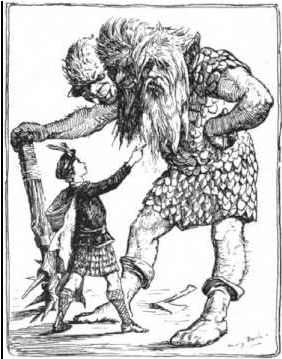
He soon comes across a shepherd, who, in these words, warns him of the Red Ettin, a three-headed monster:

             The Red Ettin of Ireland

             Once lived in Ballygan,

             And stole King Malcolm’s daughter

             The king of fair Scotland.

             He beats her, he binds her,

             He lays her on a band;

             And every day he strikes her

             With a bright silver wand.

             Like Julian the Roman,

             He’s one that fears no man.

             It’s said there’s one predestinate

             To be his mortal foe;

             But that man is yet unborn,

             And long may it be so.

The shepherd also warns him of the strange beasts he will soon encounter.

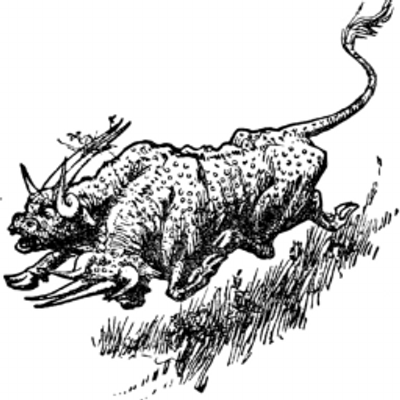
As the shepherd foretold, he comes across rampaging beasts with two heads and four horns on each. Terrified, he flees to a castle for shelter. Despite an old woman’s efforts, the Red Ettin, whose castle this is, discovers him but offers him that he can still save his life if he can answer three riddles.

The first head asks, “What is a thing without end?”

The second head says, “The smaller the more dangerous. What’s that?”

The third head asks, “When does the dead carry the living? Riddle me that.”

The young man cannot answer any of them, and the Ettin turns him into a stone pillar.

His brother sees the knife given to him covered in rust and tells his mother it is time for him to travel. She sends him with the leaky can to fetch water. A raven warns him that the water is being lost and he stops the leak.

The mother bakes a larger cake for him than she had for his brother but with the same conditions. He too chooses the larger cake with her curse.

He shares his cake with an old woman, actually a fairy, who gives him a magic wand and advice. He meets the shepherd, who repeats the verses but with one change. The last stanza is:

            But now I fear his end is near,

            And destiny at hand;

            And you’re to be, I plainly see,

            The heir of all his land.

He then confronts the rampaging beasts, and with the magic wand, he kills one of them, then goes off to the castle. The brother is warned by the old woman of the castle, but he does not attempt to hide from the Red Ettin.

The Ettin asks him the three riddles.

The first head asks, “What is a thing without end?” The brother, who has been given the answers by the fairy, answers, “A bowl.”

The second head says, “The smaller the more dangerous. What’s that?” The brother answers, “A bridge.”

The third head asks, “When does the dead carry the living? Riddle me that.” And the brother answers, “When a ship sails the sea with men inside her.”

The Red Ettin’s powers are undone, and the brother kills him with an axe. The old woman aids the brother, showing him where the king’s daughter is held along with many other ladies captured by the Red Ettin. With the magic wand, he also restores his brother back to life.

A happy entourage returns to the king’s castle, where the younger brother marries the king’s daughter and the older brother is wedded to a nobleman’s daughter. All ends in happily-ever-after.

“A red what?” I say. Thalia shrugs her shoulders, and the fairy flutters up.

Fairy Tale of the Month: September 2022 The Red Ettin – Part Two

John D. Batten

A Breakfast

I set the eggy bread and kippers on the breakfast table between Thalia and me. She forks herself an eggy bread without taking her eyes off her cell phone.

“This Red Ettin thing gets complicated.” She eats one-handedly, the other busy holding what I call her oracle. It has the answers to everything.

This is a conversation that would have taken place last evening except that Jini rang her up, and the rest of the night was gone.

“First, what is an ettin?” I dig into my kipper. Its smokey scent tickles my nose.

‘Well, besides being a character in Dungeons and Dragons, it’s the same as a Nordic jötunn.”

“That does not help.”

Thalia giggles. “There is a lot of gibberish here about what happened to the word as it moved from proto-German to Old English. Anyway, it more or less means ‘giant.’ The ettin is also a bogle, but there are different sorts of those; he’s just one kind.”

“Anything about the ‘red’ part of his name?” I ask.

“Not seeing anything.”

“What jumps to my mind is ‘redcap,’ a murderous goblin, who soaks his cap in his victim’s blood.”

“Cool.”

“My point being, ‘red’ can indicate malevolence.”

“Works for me. Anyway, the story’s got a variant.”

All the fairy tales have a variant, but go on.” I finish my kipper and start on the eggy bread.

“Well, there’s a Lang version that starts with two widows with three sons between them, which is kind of weird. The rusty knife is still there and the leaky can, but besides the shepherd, there is also a swineherd and a goatherd, all telling him the same stuff.”

Thalia pauses to take more eggy bread.

“When we get to the riddles, they are different and aren’t riddles. They are . . .” Thalia scans the information on her cell. “Which was inhabited first, Scotland or Ireland; was man made first or woman; and was man or brute made first. I think those are stupid riddles, but then the story doesn’t even give the answers, it just says the fairy woman told him everything.

“The only thing that makes sense was the third brother, who gets the bigger cake, only took half and got his mother’s blessing. Outside of that, I didn’t like the Lang version at all. Is there still some tea?”

I pour tea for her, then go find my copy of English Fairy Tales and check the “notes and references” for our story. Jacobs informs us he edited and simplified the story and found better riddles. Both he and Lang used Popular Rhymes of Scotland, by Robert Chambers, as their source. I also found that Lang reproduced his version word for word from Chambers, making Lang the more accurate folklorist. I point this out to Thalia.

“It’s still stupid,” she says.

I decide to play devil’s advocate. “Should not we try to stick to the oldest versions of these tales, the ones closest to their origins?”

“Not if they’re stupid.”

“Perhaps this is a question for the Magic Forest.”

Thalia looks at me sideways.

“Would you like to visit the Magic Forest?”

Thalia’s eyes glow.

Fairy Tales of the Month: September 2022 The Red Ettin – Part Three

Thalia’s Visit

Thalia and I cross the back garden and enter the Magic Forest. We take the trail past the pond and head for the Glass Mountain, Thalia’s wide eyes taking in everything.

There, as I knew he would be, sitting on the edge of a glass cliff, just out of reach, is Old Rinkrank.

“Thought I smelled you coming,” he sneers.

“Good to see you again,” I say.

“And who’s this with ya?” he expresses a little interest.

“This is my granddaughter, Thalia.”

She smiles and curtsies.

 “Good,” approves Rinkrank, “she has manners.”

Wait, she’s wearing a dress. She never wears dresses anymore. She planned on this.

We take our seats on smooth glass boulders at his feet, so to speak. Actually, we sit below his long dangling legs.

“We are here,” I announce, “to ask about the importance of finding a story’s origin.”

“I suppose I can’t stop ya,” he grumbles.

“You don’t think it is important?”

“Doesn’t matter to me.”

I try again.

“To be specific, Thalia has read to me The Red Ettin.”

“Nasty fellow. Deserved what he got.”

It crosses my mind that Rinkrank’s fate in his story was no better, but I won’t go there.

“Thalia’s story was collected by Joseph Jacobs, but we found another collected by Andrew Lang, each quite different. They both cited Robert Chambers as their source, but only Lang was faithful to the source.

“Therefore, is not Lang’s version better than Jacob’s?”

“Oh, I don’t know.” Rinkrank waves his bony-fingered hand in the air. “They’re all rumors. None of them were there when it happened, not even me.

“The rumor I heard from some fellow, I forget his name, there were two widows each with a son. One goes off to find his fortune, and later the other goes off to find the unfortunate. They both meet the Red Ettin’s herders, who tell them, in rhyme, the man has not been born who will kill the Red Ettin.

“Well, these sons of widows should’ve taken warning, but, no, on they go to get turned into stone pillars.

“Eventually, one of the two widows has another son,” Rinkrank chuckles. “Think about that for a moment.”

Thalia’s eyebrows rise and Rinkrank continues.

“He grows up and goes off on his adventure. The herders tell him he’s the one to kill the ettin, not to mention the magic wand the fairy gave him. He can’t lose.

“That’s the rumor I heard.”

“Ah,” I say, “the rhyme; that explains the inconsistency. I thought maybe there was some poetic license going on.”

“I noticed that too,” Thalia nods.

“Therefore,” I say, “I now declare this earlier version to be the better.”

“Nooo,” pouts Thalia.

“Why should that be?” Rinkrank shouts me down. “Just because it’s older? Bah! If ya want a rumor to keep going ya got to make it better, more interesting. Everyone who spreads a rumor puts their own touches on it. It’s their right to do so.

“Old, bah, I’m old, do you think I’m better for it?”

He’s got a point there.

I catch him winking at Thalia. Why do I talk to him? He’s so contrary.

Your thoughts?
Fairy Tale of the Month: August 2022 The Three Oranges – PartOne

A Friend

Duckworth and I put our backs to the oars, propelling us smoothly up the Isis with our passengers—Thalia and her friend Jini, or BFF as she calls her—seated at the bow. Jini is a dark-haired girl, as thin as Thalia, and from what Thalia has told me, just as bookish.

As our picnic spot comes into sight, I tuck my oars and let Duckworth glide us to the river bank.  He and I are soon settling back with our tobacco pipes as the girls put out the picnic they organized.

Actually, Jini will set out the picnic because Thaila has taken up my copy of Modern Greek Folktales and announces, “The Three Oranges,” and commences to reads aloud to us.

A child prince drops a golden apple from a balcony, smashing the cooking pot of an old woman below, who curses in anger that he shall marry no one but the girl bare in her shift. The queen makes quite a fuss over the strange curse, but the words were spoken and cannot be unspoken.

The prince grows to manhood, becomes king, and is hunting with two friends one day. They come to rest and refresh by a pond where grows a lemon tree. They each pluck a lemon, and later that day, after they have feasted, one of the friends takes his lemon and cuts it open.

Out jumps a lovely girl demanding water. They have no water and she dies. This happens a second time with the other friend. The young king gets some water before cutting into his lemon.

Out jumps a girl, fair as the sun, but dressed only in her shift. After giving her water, the king expresses his wish to marry her. She agrees but tells him to put her back in the lemon tree (her mother) and get her appropriate clothing.

When the queen hears the tale, she remembers the old woman’s curse, and for a week she refuses to allow her son to marry the lemon tree girl. In the meantime, an ogress comes to the lemon tree pond to fetch water, sees the reflection of the girl in the water, and thinks it is her own. The ogress decides she is far too beautiful to be doing humble chores, smashes the water pitcher, and goes home.

A second ogress sister comes for water to the same effect. The third and youngest sister does the same, but this time the girl speaks up and reveals the ogress’s foolishness. The ogress demands she come down and be devoured and to be quick about it since there is the kneading of bread to be done. The lemon tree girl tells her to go and do the kneading first, then come back and devour her. Later, the girl sends the ogress back to attend to the heating of the oven, and later still, to attend to the baking of the bread.

On the fourth return, there are no more tasks to be done. The ogress climbs into the tree to get the girl, who jumps into the pond and turns into a golden eel. At that moment, the king returns with clothing. The ogress tricks him into thinking her looks will be restored in time. Under that ruse, he marries her.

One day, the king sends a servant to fetch water from the lemon tree pond, and the golden eel slips into the pitcher. The king is delighted with this novelty, but the ogress knows what it is and insists on eating it and that every bone must be thrown into the sea. As the bones are taken away, one drops out by the garden gate. It grows into a splendid tree that, one day, tries to scratch out the ogress queen’s eyes.

The ogress has the tree cut down and taken away to be completely burnt. However, an old woman asks the workmen for the wood. When she splits open the trunk, she finds the girl and adopts her as a daughter.

The daughter proves skillful at embroidery and they sell her wares in the market. One day, the girl has the old woman buy her silk and satin, and she embroiders the story of her life into the cloth. She then asks the old woman to take it to the palace and offer it to the king to buy.

When the king sees it, he understands what is meant by it and invites the old woman and her daughter to dine with him the next day, during which the truth is revealed, the ogress sent away, and the king and the lemon tree girl are married.

Fariy Tale of the Month: August 2022 The
Three Oranges – Part Two

Sour Oranges

Jini cocks her head (rather charmingly) asking, “Why is the story called The Three Oranges when there are only lemons?”

“I don’t know,” Thalia scowls.

“Well,” I say, “I’ve run across such a thing before. In various translations of the Grimms’ The Juniper Tree, it is titled The Lemon Tree.”

I couldn’t help noticing Duckworth tapping away on his phone the moment Jini asked the question.

“According to Wiki,” he says, “sweet oranges were introduced into Europe from India in the fifteenth century. Before then there were only ‘sour oranges.’”

“Ah,” I say, “typically, fairy tales took their shape in the twelfth century. At the time this tale was probably being put together, the sour orange was the familiar fruit.”

“There certainly is enough broken crockery in this story,” Duckworth observes.

I take my paper plate and delve into the curried-chicken pasta, Jini’s contribution to the feast.

“The first to go was the cooking pot of the old woman,” Thalia muses. “The prince’s dropping of the golden apple is the start of the story.”

“Golden apple,” Jini repeats.

“Oh,” Thalia waves her hand in the air, “the Greek tales are full of golden apples. It’s their thing. I’m guessing it turned into the golden ball in Europe, which is kind of stupid. A golden ball is way too heavy to play with. Rubber is much better.

“But, as grandfather says,” she points to me, “fairy tales are not about logic.”

She is catching on.

Jini dishes herself some quinoa kale salad. “I’m horrified by the first two maidens jumping out of their lemons and dying.”

“That is disturbing,” I say, “but it makes the survival of the third that much more important.”

Jini contemplates that but does not appear happy with my excuse.

“There is that fairy-tale trope of the pattern of three,” Duckworth puts in, eyeing the Wiltshire ham. “There are the three lemon tree maidens, the three ogresses, the three times the girl tricks the ogress, and the three transformations to eel, to tree, and back to girl.”

“Yes!” I say. “The transformations are the heart of the story.”

“How’s that?” Thalia asks, nibbling a bit of Jarlsberg.

“I think the transformations from girl to eel, to tree, and back again to girl are more like reincarnations. As the lemon tree girl, she is tied to her mother, the tree itself. It appears she cannot easily leave her mother even when the ogress threatens to eat her. Only at the last moment does she leave her mother to become an eel, now confined to the water. She comes back into the king’s presence, which feels fated to happen, but the condition and time are not right. Another reincarnation is needed.

“One of the eel bones is transformed into a tree. We are not told what kind of tree, but it harkens back to her mother. Again, through the agency of the ogress, though not through her goodwill, the final reincarnation takes place. The girl is now, I believe, a real girl, able to control her fate with her art, that is to say, her talent at embroidery.”

Thalia and Jini applaud my analysis along with giggles. I accept it graciously and crunch down on the pumpernickel breadstick that I had been waving around like a baton during my exposition.

Fairy Tale of the Month: August 2022 The Three Oranges – Part Three

Bayeux tapestry embroidery

The Women

“I am wondering,” Duckworth says, who has given in to a goodly portion of the Wiltshire ham, “might the old woman at the start of the story be the same old woman at the end of the story?”

“No,” says Thalia. “Don’t think so.”

“Not quite the same old woman,” I suggest, “but an old woman nonetheless.”

“Meaning . . . ?” Duckworth prompts.

“Well, I see the old women, who populate many a fairy tale, as a type of character. They appear in the tale to perform a service to the story—sometimes as a helper, sometimes not—then disappear. She might give the hero a magic cloak for sharing food with her, then the story goes on without her.

“In our case, an old woman utters a strange curse that propels the rest of the story. Toward the end of the story, an old woman frees the girl from the tree’s trunk and adopts her.  There is no reason to think it is the very same old woman, but it is significant that an old woman performs the task.”

“What sort of woman-types are there in the tales?” Jini questions, opening a container of strawberries.

“The heroine, certainly,” says Thalia, spearing a berry with her fork.

“Evil stepmother,” I add.

“A witch,” Duckworth offers. “Though, in our story, I think the ogress stands in for the witch.”

“Yeah, well,” Thalia knits her brow, “ogresses are kind of a Greek witch but more brutish than magical. Not quite the same.”

“Oh, the fairy godmother!” Jini says brightly.

“Then there is the witch queen,” Duckworth goes on in a measured tone.

“Wait,” Jini emanates despair, “aren’t there any ‘good mothers’ in the tales?”

“Oh, yes, of course,” I say. “But they are obliged to die at the start of the stories to make way for the evil stepmothers.”

Jini slaps her forehead.

“Not always,” Thalia says carefully. “What about the mother in the Goose Girl?”

“I’ll argue,” I say, loading my fork with a couple of berries at once, “she fills the old woman role. At the start, she tries to provide for her daughter but is unsuccessful, even disastrous, then she disappears and is of no support in her daughter’s time of need. Not unlike that of the old woman’s curse on the young prince.

“Note too,” I start to pontificate again, “there aren’t any elderly heroines. Heroines are always young.”

“And get married.” Thalia scowls a little.

“Usually.” I reach for more berries. “There are heroines like Gretel in Hansel and Gretel, but these are being paired with a brother to share in the limelight.”

Both Thalia and Jini look grumpy.

Hold on. Is that Melissa’s voice echoing in the back of my head? I think she has indoctrinated me. I’d best change the subject.

“Duckworth, you didn’t try the quinoa kale salad.”

“I’m not a salad person, more of a meat and potatoes fellow.”

Shock crosses Jini’s face. “Potato salad. I forgot to put out the potato salad!” She roots through the picnic basket.

Potato salad? I love potato salad. Do I have room in my stomach for potato salad?

Your thoughts?
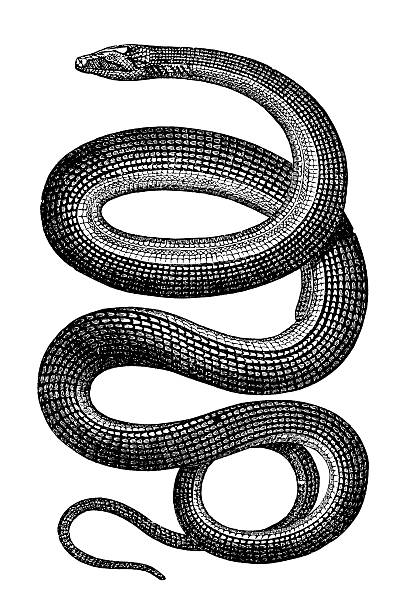
Fairy Tales of the Month: July 2022 The Magic Box – Part One

That Box

It’s three in the morning. Sleep, on gossamer wings, flitters above but will not alight on me. Folk and Fairy Tales of Denmark lies in my lap. I cannot read more.

My eyes fall on a little wooden box cluttering one of my bookshelves. It’s been there long before my wife died. Before my daughter was born? I don’t remember where it came from.

Picking it up, I remember again that I don’t have a key. I shake it. I hear nothing. But is it really empty?

Schrödinger’s Cat thought experiment.

My finding out what is in the box will alter what is in the box. There may be something in the box, but if I break it open, nothing will be there, and I will have destroyed the box. I need to get it out of my hands and out of sight before I let the cat out of the bag, to mix a metaphor. Well, it is three in the morning.

I am up the stairs and on the third-floor landing, when I hear, “Ohhh, you have the box.”

I should have known—actually, I do know—not to go to my third floor at night, but I am on a mission. A wizened old man sits on the windowsill at the end of the hall.

“Let me tell you the long story of that box.”

I approach the old man and offer him the item in question. Its brass fittings glow when he takes it into his hands and begins the tale.

A poor farmer, in exchange for his three infant daughters when they turn three years of age, is given a magic box by an old man. This magician explains that the farmer only needs to rap his knuckles on the box for it to give him whatever he wishes. When the farmer does so, a giant appears before him and grants the farmer’s wish for wealth.

He and his family live in great style for three years until the old man collects the three sisters. The mother and father soon die of grief, leaving behind their son, Hans the Daft. Through his inattention and the dishonesty of others, his inheritance is dissipated. He leaves with only an old barley-twist walking stick and a sheepskin coat, but in the pocket of the coat rests the box.

Discovering this boon and the giant/genie, he wishes for a violin, the music of which would make people dance for joy. In this way, Hans always found food, shelter, and good company.

One day, in his travels, he comes to a kingdom where lives a princess of such beauty that Hans falls in love. He takes the position of a shepherd, so that he might chance to gaze upon her every day.

However, as he herds the sheep, he plays his violin, and the sheep dance.  The princess, highly amused by this entertainment, promises to marry Hans if he makes the sheep dance for her, a promise she never intended to keep.

The king, finding out her misbehavior, forces her to keep her promise, then banishes the couple from his castle. Hans simply has the giant build another castle, but this does not satisfy the princess. Hans consoles himself by going out hunting every day. During his absence, the princess entertains a young gentleman and they plot against Hans.

The princess pretends to warm up to Hans, to his delight. She wheedles out of him the secret of the box, which he gives into her keeping.

When Hans returns from his hunt the next day, the princess and her lover have purloined the box and transported the castle to be hung by four golden chains over the middle of the Red Sea, leaving Hans to wander aimlessly and homeless.

After many months, Hans blunders into the presence of one of his lost sisters, who takes him to the cave of her bear-husband, an enchanted prince. Hans hears the story that the old man, who had given his father the box, intended to keep the sisters as his wives, but they were discovered by three prince brothers and rescued. In revenge, the old magician cursed the brothers with the animal forms of a bear, an eagle, and a fish.

The brothers give Hans tokens and aid. He recovers his castle and the box and destroys the princess and her lover. Hans returns to his old ways of a daily hunt and for three years forgets about his sisters and his brothers-in-law.

Upon rediscovering the tokens given to him, he calls up the giant to take him to the Waters of Life, where sits the queen/mother of the princes in the form of a hag with a white cat in her lap—the queen’s daughter. By placing the tokens in the hag’s lap, he breaks the curse and all are restored to their human form.

Hans gets to marry the queen’s daughter, and in a last act of grace—and at the giant’s request—he releases the genie from his curse and existence by throwing the box into the flames.

The old man hands the box back to me, and the glow of the brass fittings fades.

Fairy Tale of the Month: July 2022 The Magic Box – Part Two

But Wait

“But wait,” I say, “how can this be the box if it was burnt up?”

“It is burnt up every time the story is told,” is the reply. “Over and over again. Yes, that very box you hold was destroyed just now when I told you the story.”

I try to wrap my head around that thought, when a voice says, “That’s fine and all, but what is your moral?”

I look down to see Johannes padding up to us. I know he likes to prowl at night, but I didn’t know he followed me up the stairs. A little to my surprise, the fairy rides on the tip of his tail. She flutters up to the box, settling there, setting the brass fittings aglow again.

“Moral?” protests the magician. “I am not a moral being.”

Johannes scoffs, “Although you are of fairy-tale material, you are mortal, unlike the fairy and me. All mortals are intertwined with their morals. While we immortals are immoral, mortals have morals. Only the letter ‘T’ separates one from the other. I ask you again, what is the moral of your story?”

“I don’t know that I have one.” The old man crosses his arms on his chest.

“Well then, let’s find it,” Johannes instructs. “The farmer exchanges wealth for his own flesh and blood. After a short stint of luxury, this exchange proves fatal. Certainly there is a moral here, but the story is far from over.”

The old man nods in agreement, and Johannes continues.

“The moral will revolve around Hans the Daft. He is not a person of promising character. Through his indifference, all is lost to him but for a walking stick, a coat, and the box.

“On the other paw,” Johannes gestures, “his wealth came at the cost of his sisters. Should he feel much attachment to it?”

Again, the old man nods and continues to listen.

“When he finds the box, rather than following his father’s lead, he wishes for something much more modest if a little magical—the violin. In that satisfying little world of music and dance that he created for himself, he may have stayed if he had not fallen into the morass of love at first sight.

“Here, Hans’s daftness reasserted itself. As foolishly as his father wished for wealth, he wished for the princess to be his bride. Like his father, he gets his wish but to no benefit. Even worse than his father, he is cuckolded and goes through an emotional death.”

The old man’s eyebrows rise, as so do mine, as we see Johannes’s direction.

“Hans is reborn when he stumbles upon one of his lost sisters, and a family relationship is reestablished. Not to Hans’s credit, he participates in revenge, causing the death of the princess and her lover, then descends into three years of forgetfulness.

“To his credit, emerging from his doldrums, perhaps necessary for him to incorporate all of his experiences, he acts immediately to end the curse upon his family and release the giant from his bondage.”

“Thank you,’ says the magician. “You have put Hans into a different light than I would have ever allowed myself to think.”

“And now,” says Johannes, “the moral.”

The old man thinks. “Be careful what you wish for?”

“I think we can move beyond the ‘trite but true.’ Let me suggest something more along the lines of, ‘The struggle toward knowing one’s self might be worth the effort.’”

Fairy Tale of the Month: July 2022 The Magic Box – Part Three

Magical Talk

Now the fairy pipes up. I love the sound of her voice; it’s that of tinkling bells.

“Oh wise and evil one, how came you by a genie in a box; should not his prison be a lamp?”

The magician sniffs. “Not at all. A genie’s spirit can be captured in almost anything. However, most common are rings and brass vessels. King Solomon, the first to control the jinn—as some call them—used brass vessels with his seal over its mouth. Whatever the item,” the old man gestures to the box, “it’s Solomon’s Seal that retains the spirit.”

I see on the box’s lid glowing brass filigree embedded in the wood in the shape of a pentagram.

“When God created beings with language, he chose first to create the heavenly host, some of whom, after the war in heaven, became the fallen angels. Next came us who he formed out of earth. Last—and not recorded in the Bible, strangely—were the jinn whom he created from fire, a smokeless flame to be specific.

“While the jinn were granted much magical power and long life, they are not as substantial as man, being made of fire and not earth. Therefore, they are more easily imprisoned. It does not take a jail to hold them.

“As for the origin of my genie trapped in a box, I cannot tell you. I come from a great line of magicians and inherited the box. I suspect one of my ancestors had the cleverness to trap a genie. However, my father warned me to never use the power of the box. Whatever the genie would grant would lead to misfortune.

“Oh, I was tempted. Certainly, I would not fall for the tricks of the genie. Instead, I traded it for something else that I wanted, taking the temptation out of my hands and passing it to another’s.

“I see now, the genie played no tricks, rather we were all in the hands of fate that dealt out to us the grace or punishment it felt we deserved by whatever inscrutable scale of justice it held.”

“Answer also,” rings the fairy’s voice, “how chose you the form of your revenge on the princes?”

“I was angry, yet I saw the sisters’ affections were never to be mine. Although I had raised them from the age of three, with a firm hand, I had not counted on the rebelliousness of youth.

“Nonetheless, punishment was in order. I could not bring myself to harm the sisters. Instead, I chose to turn the princes into beasts, one of the earth, one of the air, and one of the water. There are no beasts of fire, except, perhaps, the salamander, but I am doubtful of those claims. Only the jinn are of that nature.

“Nor could my magic be complete. The princes returned to their human form every day for a few hours and there needed to be a way to break the spell. For every magical curse there must be a benefit, that is, a way out of the spell. We magicians can only push the natural order of things so far before it does a pendulum swing back again.

“Ah, speaking of the pendulum swing.” The magician holds up his hand, which becomes transparent as he fades. “The story calls me back again into itself. I enjoyed our conversation. I don’t get out very often.”

With no more to be said, Johannes turns and pads back down the hallway with the fairy again riding on the tip of his tail. They leave me standing alone with the box still in my hands.

Should . . . should I tap on it?

Your thoughts?
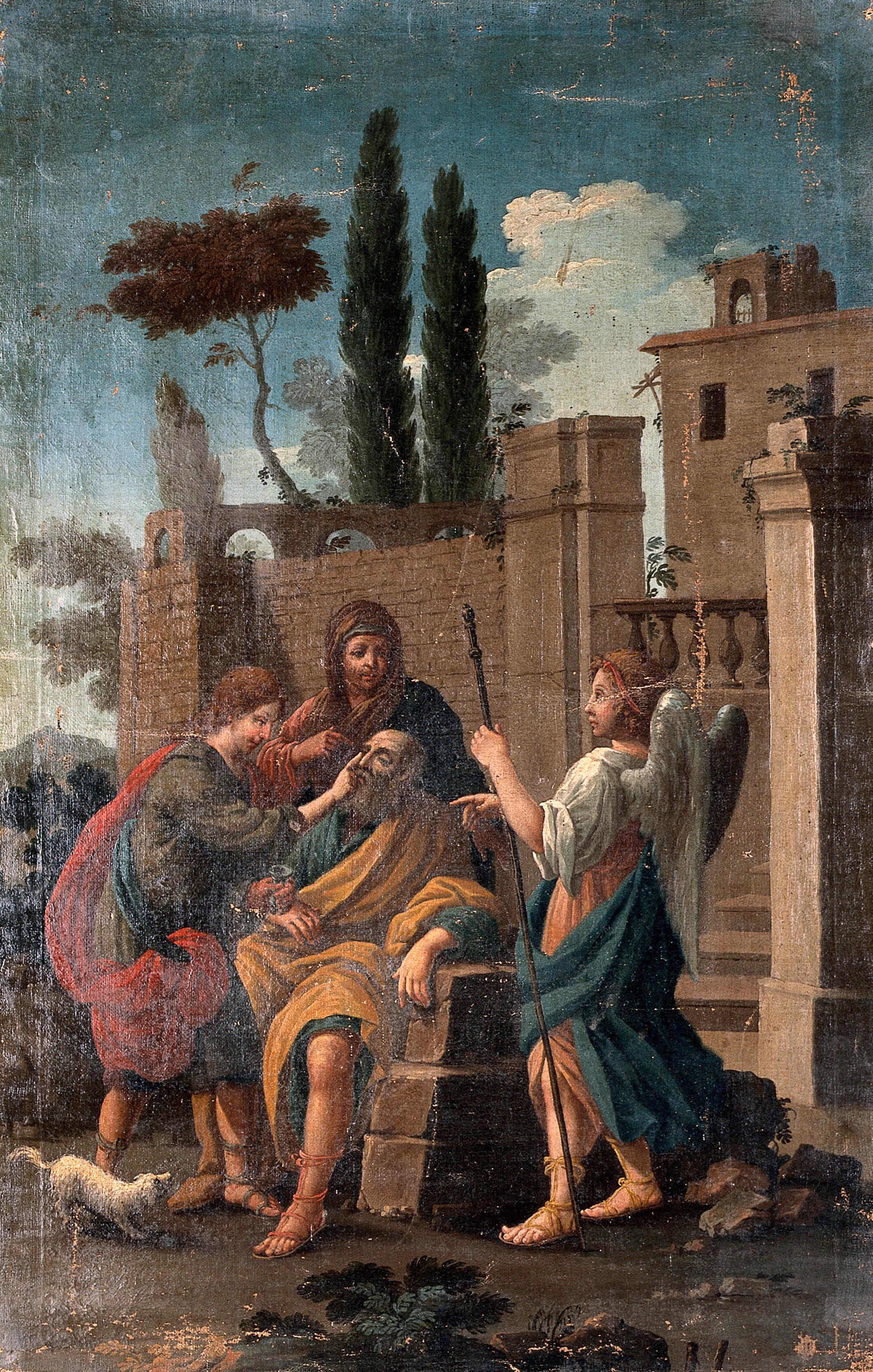
Fairy Tale of the Month: June 2022 The Golden-Headed Fish – Part One

H. J. Ford

Cold Starters

“Ohh! I must try satsivi; that sounds good.” Thalia scans the menu.

“Either that or the karmir bibar for me,” Melissa comments.

I am drooling over the thought of Armenian basturma and we’re only at the cold starters.

We are seated at a round booth in Erebuni Restaurant near Lancaster Gate, celebrating the start of summer. What an Armenian restaurant has to do with the start of summer I cannot answer, but this is the place Thalia chose. I do admire her willingness to explore. I think of it as the “blue and purple” restaurant because of the lighting scheme reflecting off of the teardrop chandeliers.

As we wait for the cold starters to arrive, Melissa asks me, with a raised eyebrow that suggests she knows the answer, “Do you know any Armenian fairy tales?”

“You know, by a very odd chance, I do.” I’d spent the evening before searching for one. “It’s called The Golden-Headed Fish.”

There was once a king of Egypt who, because of an illness, went blind. The physician of a foreign king happened to be traveling through the kingdom. He declared that a golden-headed fish swam in the sea and from its blood he could make a cure. However, he had to return to his own king and could tarry only a hundred days.

The king’s only son set off with a fleet of fishing boats to find the creature. After a hundred days, the prince, knowing it was too late, that the physician would have left before he could return to harbor, nonetheless fished one more day. On that day they caught the fish.

The prince held the fish in his arms like a baby, considering what to do. Seeing the piteous eyes of the fish, he released it back into the sea.

When the king heard what his son had done, he demanded the youth’s head. The queen smuggled her son out of the castle, dressed as a commoner, to a ship bound for an island she knew of. Before departing, she gave her son the strange advice not to hire a servant who wanted to be paid monthly.

The prince, pleased with the island his mother chose, settled down, and hired a servant, an Arab, who wished only to be paid what the prince thought he was worth and when he liked.

There were two sides to the island, the far side ravaged by a monster that nightly came out of the sea. The Arab went to the governor of the island and asked what would be given his master if he could kill the monster. The governor offered his daughter and what wealth the master wanted. The Arab talked the governor into giving his daughter half his wealth and they signed the deed.   

The Arab killed the monster, where the governor’s army had failed, then talked his reluctant master into taking the credit. The prince wished not to be married, but rather asked for a ship with which he could explore the world.

After some time, they came to a great kingdom. Again, the Arab arranged to marry off his master, this time to the daughter of the king. And, again, the prince trusted in his servant, even though the prince would be the princess’s two-hundredth husband. The others had all died on the wedding night.

Both Melissa and Thalia glanced up from their appetizers with worried looks.

After the wedding ceremony, the couple retired to their chamber for a private meal, as was the custom, with only the Arab to serve them. After the meal, the prince rose and walked to the balcony from where he saw workmen in the garden below digging his grave. From the princess’s mouth sprung a black snake that darted across the floor toward the prince. The Arab, alert for such a thing, killed the serpent with his saber. From that point on, the marriage proceeded happily.

One day a messenger arrived, bearing news that the King of Egypt had died and the prince was called to take the throne. Soon after, the Arab came to the new king saying the time had come for him to leave. The new king expressed his great regret, reminding the Arab of the time he saved his life. The Arab replied that his master had saved his life, he being the golden-headed fish.

“Cool,” says Thalia, finishing her spiced chicken. So engrossed in telling the tale, I’d ignored my beef strips, an oversight I set about to remedy. Fortunately, they are served cold.

Fairy Tale of the Month: June 2022 The Golden-Headed Fish – Part Two

Ikonographische Encyklopaedie der Wissenschaften und Kuenste
(Brockhaus, Leipzig) in 1844.

Main Dishes

Round two of our meal arrives. Thalia chose the ker u sus, (which translates into “eat and be quiet,” which I am sure she will not), a beef and potato sort of thing. Melissa, vegetarian that she is, chose the vegetarian dolma. I thought about the charcoal wild boar, but as it was being pricy, I settled for ischkan, trout cooked Armenian style, appropriate to the tale I told.

“I’ve heard this story before, sort of.” Melissa taps her finger to her forehead. “Kurdish, I believe, but it is the son of a fisherman who releases a marvelous fish that speaks to him. For this, his father banishes him. His mother gives him the advice to befriend the stranger who shares equally, and he befriends the stranger that does.

“They come to a kingdom where the king’s daughter is mute. Anyone who can cure her can claim her. The failure, of course, is death. The adventurers take up the challenge and spend three nights with the princess, the companion telling her stories that end with a question. By the third night, compelled to answer them, she speaks.

“She is awarded to both the fisherman’s son and the companion. The companion suggests they divide their wealth between them including the princess. The companion moves to cut the princess in half when snakes pour from her mouth.

“Having purified the princess, the companion explains that he is the fish the fisherman’s son released, and he returns to the sea.”

“Hmmm,” Thalia narrows her eyes. “I might like this version better. You get stories within a story and still get serpents coming out of her mouth.”

“I hear shades of A Thousand and One Nights,” I put in.

“Rather,” agrees Melissa. “I’ve also heard of a Roma version of this tale, but it’s an unburied corpse instead of a fish that kicks off the story. I think Aarne and friends classify this set of tales as “The Monster Bride.’”

“Ohh, this gets better and better,” Thalia grins.

“Although I like this story—or I would not have told it—” I say, “I am a little uncomfortable about how the tale treats women. Princesses in this set of tales both are the prize and embody evil.”

Melissa smiles. “Usually, I’d be the one to make that argument, but I am not sure a negative attitude toward women is being projected. The princesses are the prize, that part I will not dispute, but they are victims of some curse or possession from which the companion releases them.

“In your tale the king acts irrationally while the queen saves her son and sends him off with good advice. She is not a bad role model.”

I nod in agreement. “Still, the most striking image is the black snake coming from her mouth and slithering across the floor toward the prince, who is watching his grave being dug.”

Thalia claps a mock applause.

“Snakes from the princesses’ mouths is the unifying element in this set of monster bride stories. I have not seen it in other tales. It has not become a trope like the princess being the prize, or losing his head if the hero/protagonist fails the task.”

“Why are they always cutting off heads?” Thalia watches the waiter as he comes to remove our dishes.

Melissa and I are silent as he performs his duties.

Why are they always cutting off heads?

Fairy Tale of the Month: June 2022 Golden-Headed Fish – Part Three

Unidentified oil painting

The Dessert

Baklava,” I reply when the waiter asks if there will be anything else.

“And Armenian coffee for me,” says Melissa, and continues, “Why do they keep cutting off heads? It is such a common fairy-tale trope that I have never questioned it. What in the real world is comparable?”

“Well,” I say, “there are ‘winner-take-all’ contests.”

“Not the same as ‘win or die,” Thalia corrects me.

“Well then,” I suggest, “how about mercenary soldiers? In the old days they shared in the booty of war or died.”

“I don’t want to think of our fairy-tale heroes as mercenaries,” Melissa returns as her coffee arrives.

“Often the heroes,” I say, “as in these tales, are adventurers out to find their fortune. How different are they from soldiers of fortune?”

“No, no,” Melissa shakes her head then takes a sip of coffee. “Thalia, I believe the cutting-off-heads is a device used by the old tellers to quickly create tension, to increase the stakes, to give something for the hero to lose.”

“Ahh,” says Thalia, “there’s no saying, ‘Oh well, I tried,’ and walking away.”

“Exactly.”

I note my agreement got dismissed.

Thalia suddenly giggles. “And what about the governor’s daughter getting half his money?”

“That was odd.” Melissa frowns. “The Arab did her a favor, but I don’t think he intended to. I am guessing the Arab’s idea was rather than settle for a fixed amount, his master would have control over half the governor’s wealth by marrying the daughter. From the governor’s point of view, the money would stay in the family; a win/win proposition.”

I laugh. “The story does not say, but mentally, I see the Arab slapping his forehead when his master asks for a ship instead of the daughter. The Arab has to start all over again to find a wife for his master.”

“Tobit!” Melissa sets her cup down with a clatter.

“What?” I say.

“A thought tickled my brain the whole time you told the tale. This story is in the Book of Tobit. Let me remember—it’s in the apocrypha.

“Tobit is blind. He sends his son, Tobias, off to a faraway place to collect a debt. Tobias travels with a companion who is actually the archangel Raphael in disguise. They catch a fish and Raphael explains to Tobias its magical properties.

“Tobias uses the fish to drive out a demon from the woman Sarah, which has been killing her suitors on their wedding night. Tobias marries Sarah and they return to Tobit. Tobias, again with the fish, cures Tobit’s blindness. Raphael reveals his true identity before leaving their company.”

“Yeah,” Thalia’s voice holds hesitation. “The same but not the same.”

“To my mind,” I say, “it lacks the element of gratefulness on the part of the companion.  I imagine the angel preaches to them before leaving.”

“Oh, yes.”

“The angel Raphael is not the fish. The fish is used for the miracles, although I’ll grant fish are used in Christianity as a symbol of Christ, but I believe this is an Old Testament story.”

“Yes, which makes it a Jewish tale,” Melissa nods.

“Wow, I feel the weeds growing up around me.” Thalia giggles again.

Melissa and I ignore her.

“The question is,” Melissa states, “did the old storytellers take a biblical story and manipulate it to serve their message of gratefulness, or did biblical writers take a secular tale and manipulate it serve their higher purpose?”

The baklava arrives, and the question goes unanswered as we delve into the honeyed pastry. If you have never tried baklava, you must.

Your thoughts?