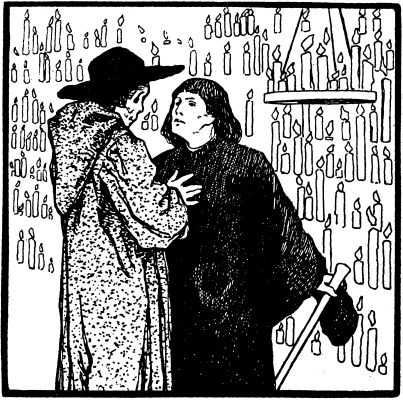
Fairy Tale of the Month: November 2024 Peter Bull – Part One

Microsoft Image Generator

Staying Afloat

There is something about the plunge of an oar into the water and the glide of the boat propelled by men’s muscles that is soothing to the soul. Duckworth and I have taken to the Isis, our upper part of the Thames, to do a bit of rowing before the weather becomes too brisk.

Duckworth always humors me by asking about what fairy tale I am delving into. I doubt he concerns himself with the tales outside of my presence. I am his sole source on the topic, and he humors me now.

“So . . .” He hardly needs to ask.

“A tale called Peter Bull,” I respond as we continue to pull on the oars.

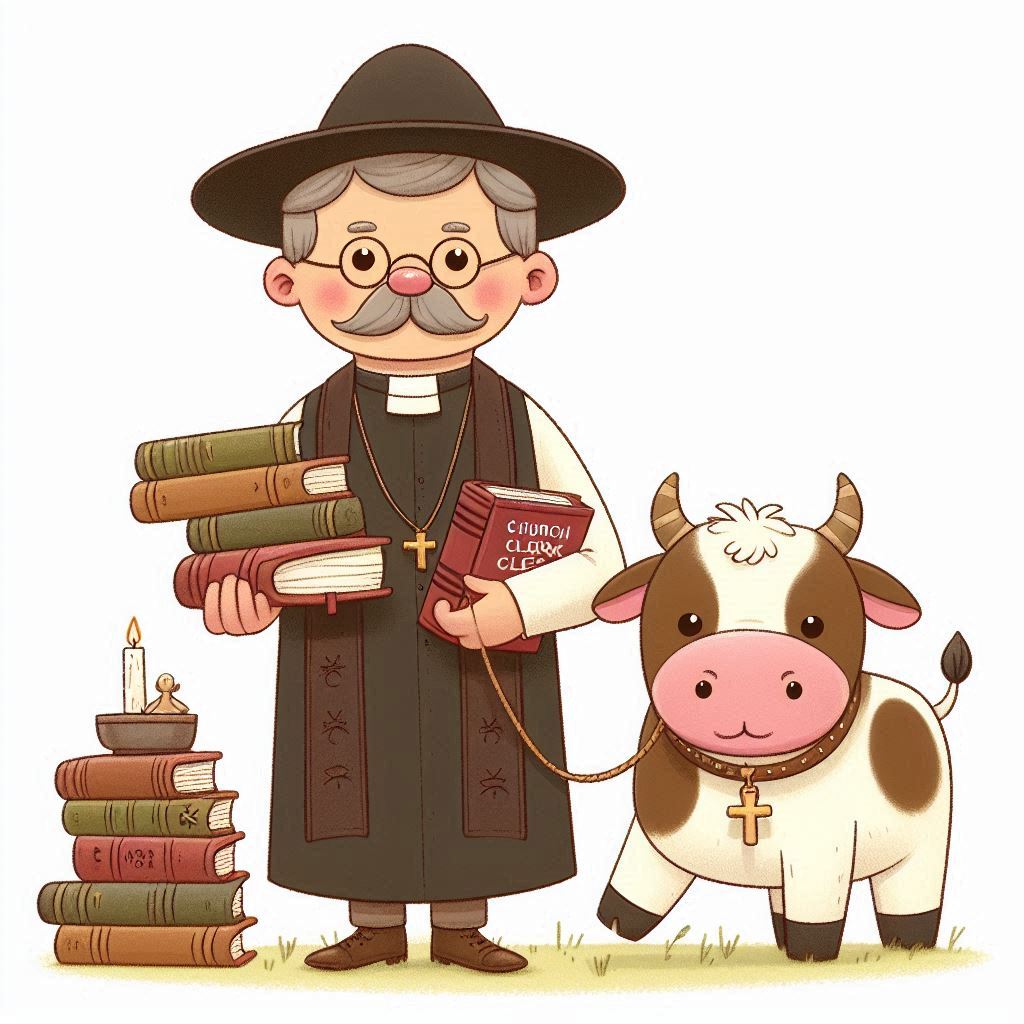
A well-to-do Danish farmer and his wife lived happily but for one thing. They had no children. Because of that, they became attached to one of their bull calves, which they named Peter. The husband speculated that perhaps the church clerk, known as an educated and clever man, might be able to teach Peter how to speak, and his wife agreed.

The clerk, seeing an opportunity, consented to educating Peter under certain conditions. First, the education must be done in secrecy, especially hidden from the priest, since it was forbidden. Second, there would be a cost because the books required to educate the calf were expensive.

Gleefully, the farmer turned Peter over to the clerk and gave him a hundred dalers. After a week, the farmer visited the clerk to see how things were going. The clerk reported that Peter was making progress, but the farmer could not see him. Peter loved the farmer and his wife so much, he would want to go back home and interrupt his learning. The farmer understood this and left another hundred dalers for the necessary books at the clerk’s request.

This sort of thing went on for some time. The visits from the farmer became less frequent in that they cost him a hundred dalers each time. Eventually, when the calf was fat enough, the clerk slaughtered it for a number of excellent veal meals.

“No, wait,” Duckworth exclaims. “Are you kidding?”

“Stay with me,” I say. “The tomfoolery gets worse.”

Soon after the clerk slaughtered the calf, he went to visit the farmer, declaring Peter’s education was complete and that Peter wished to return home. In fact, they had started out together, but the clerk returned home for his walking stick. Setting off again, he realized Peter had not waited for him, and the clerk asked the farmer if the calf hadn’t gotten there before him? They inquired around the neighborhood for the lost Peter, but it bore no results.

Sometime later, the clerk came across an article in a newspaper that referred to a Mr. Peter Bull, a young, struggling merchant. The clerk cut out the article and presented it to the farmer, suggesting that this might be their son. The farmer took off immediately for a few days’ journey, arriving at his destination early in the morning, invading poor Mr. Bull’s bedroom. Peter Bull was a bullish-looking fellow, and the farmer felt he recognized his Peter in him. Peter Bull dealt with the lunatic cautiously until he understood that the farmer intended to make him heir, at which point Peter warmed up to him and agreed to call him “father.”

In the end, the farmer sold his possessions, gave the clerk another two hundred dalers for his good services, and he and his wife moved in with the merchant, making him wealthy, and in return the merchant took good care of them for the rest of their happy lives.

Duckworth gives me a dubious glance, but he can’t suppress his grin.

Fairy Tale of the Month: November 2024 Peter Bull – Part Two
Microsoft Image Generator

Correct Me

“Correct me if I’m wrong, but aren’t fairy tales supposed to have a moral?”

“I am happy to correct you, Duckworth. You are wrong.”

“Explain.”

“I will speculate that the notion that fairy tales should have a moral comes from two sources. First is Aesop, that admirable Greek slave, whose formula for storytelling did have a moral at the end. Second are the Grimm Brothers, who were appealing to a Protestant, bourgeois audience and therefore implied a moral at the end of many of their tales.

“But they were not as consistent as Aesop in moralizing. For example, one of my favorite Grimm tales is The Three Spinners. It is similar to their Rumpelstiltskin, with some significant differences.

“In the story, a mother, rather than admit that her daughter—although pretty—was a wastrel, declared the girl could spin flax into gold. The queen took the girl up to the castle, relieving the mother of a useless daughter. On pain of death, the girl was to spin rooms of flax into gold.

“Three ugly fairy women appear, and for two nights, accomplish the task for mere trinkets. On the third night of this endeavor, the poor girl runs out of trinkets. Then the fairies request she invite them to her wedding to the queen’s son, which they know will happen.

“This small request the girl remembered to make when the wedding plans were made. She described them as cousins. When the wedding feast began, the three ugly fairies entered the hall to the notice of everyone.

“The prince, the girl’s new husband, approached the fairy women, rather rudely, and asked about their deformities. One had a huge foot from running the treadle, the second a gargantuan thumb from rubbing the thread, and the third a large drooping lip from wetting the thread. The prince looked at the three women, then his beautiful bride, and declared she would never again spin flax.”

Duckworth drops his oars and applauds.

“And,” I continue, “I can think of another lacking-a-moral Grimm tale called The Master Thief, a Robinhood sort of figure who, on a dare, for example, steals the bedsheet of a lord during the night.”

“Clever,” remarks Duckworth.

“Yes, clever,” I say. “There is also The Clever Farmer’s Daughter, who wins a king because of her cleverness, loses him because of her cleverness, then wins him back again through cleverness.

“Ah, but then there is Clever Else, who is not so clever and fools herself into thinking she is not herself. Clever Hans doesn’t do any better, and neither do the characters in The Clever People. “

“I think I see a pattern emerging.” Duckworth grins at me. “You are suggested there are many stories in the Grimm collection with the themes of cleverness or its opposite, beside those with a moral.”

“I still have to mention The Clever Little Tailor, The Clever Servant, and Clever Gretel.

“Well, now you have,” he returned.

“But then there’s Doctor Know-It-All.”

“Enough!” Duckworth shook his head at me.

I guess I made my point.

Fairy Tale of the Month: November 2024 Peter Bull – Part Three

Microsoft Image Generator

But Seriously


“But seriously, now,” Duckworth speaks after a short while, “you have pointed out to me that there are different kinds of fairy tales, but what makes a fairy tale a fairy tale?”

“Oh, you want me to pontificate, don’t you?”

“I want to see if you will run out of breath before we finish rowing,” Duckworth jests.

 “Well,” I begin, “it comes out of the oral tradition along with its companions, myths and legends. That is another way of saying the oral tradition is not literary. Myths, legends, and fairy tales have been written down, but they do not have an author.”

“Wait,” Duckworth interrupts, “didn’t Hans Christian Andersen write fairy tales?”

“No, he did not. He wrote literary fairy tales; he made them up. He was the author. He borrowed from fairy-tale structure, which made them sound like fairy tales.

“But this is the point where distinctions get cloudy. The Brothers Grimm collected their fairy tales, often from secondary sources, and put them closer to literary standards than the material they collected. However, they did manage not to overstep the genré rules for these tales.”

“And those rules are, may I ask?”

I think Duckworth is actually interested.

“I will start with the observation that few characters have names. Typically, they are identified by their position—king, queen, youngest son, old soldier. Often, it is the minor characters that have names.

“Followed by the convention that descriptions are sparse. We are told little about how things look.

“Next, the tales are in the third-person objective. We never get inside the characters’ heads.

“Also, the tales are not dialog driven. Dialog is used to highlight parts of the story. There is more telling than showing. Showing is a wordier process than telling. Telling is succinct, as are the tales.

“There is a propensity for the number ‘three.’ For example, in The Goose Girl, we see three drops of blood. Later on in the story, there are three streams to cross and three passages through the dark gateway.

“Royalty has magical powers. This is always assumed, perhaps a reflection of the times.

“Animals can talk, and not simply animals talking to animals, but also animals talking to humans.

“Evil, of the magical sort, must be punished and good rewarded. Naughtiness and deception, as in the clever tales, not necessary so.  Typically, evil is destroyed in rather graphic terms.

“The story usually ends happily. You can have a fairy tale without fairies, but happy endings are the rule. However, there are cautionary tales that do not end so happily.”

“That is a pretty extensive list,” Duckworth argues. “Can you make it more concise?”

“Yes. Fairy tales make bad literature. Really, they violate most of the rules of good literature. They stick to one POV, third-person objective. They ‘tell’ don’t ‘show.’ There are no beautiful, florid, or even accurate descriptions. And what is with the number ‘three’ all the time? It is more overused than ‘clever.’”

I get a chuckle from Duckworth.

“But seriously,” I say, “for me, the fairy tales are the stuff of dreams. Not those things we strive for, but those things that come to us, unbidden, in the night. There is a good reason for the tales to end happily. Theirs is the resolution that protects us from witches, demons, and the devil himself we encounter in the tales. All those things that make us uneasy while we sleep.”

Your thoughts?

Fairy Tale of the Month: February 2024 The Donkey – Part One

Author + AI

The Donkey

I had decided that I would not sulk around the house this year when my daughter, as is traditional, would whisk my Thalia away from me in February (school be damned) to visit her late husband’s relatives in Glasgow. Well, it has been three years, given the circumstances, since this visit was made. I did have a reprieve.

But now, Thalia is gone, and I rang up Duckworth to see if he was available for lunch. He, too, has been abandoned by his wife and children for a visit to her relatives, whom he cannot stand. He and I are compatriots.

We are sitting in Rock and Sole Plaice waiting for our meal. True, every pub in London has fish and chips on its menu. But here, there are nearly a dozen variations. Duckworth, adventurous soul that he is, ordered the calamari and chips. I stuck to the plaice, although tempted by the Proper King Prawns.

“Tell me,” says Duckworth as we wait. “What bizarre fairy tale have you stumbled across recently?”

“Well you should ask,” I say. “With Thalia gone, I contented myself last night by plunging into Grimm. I chanced upon a tale I had read before but taken little notice of. This time, it caught my curiosity.”

“I’m all ears,” Duckworth grins.

“Perhaps you should be,” I say. “Its about a donkey. In fact, it is called The Donkey.

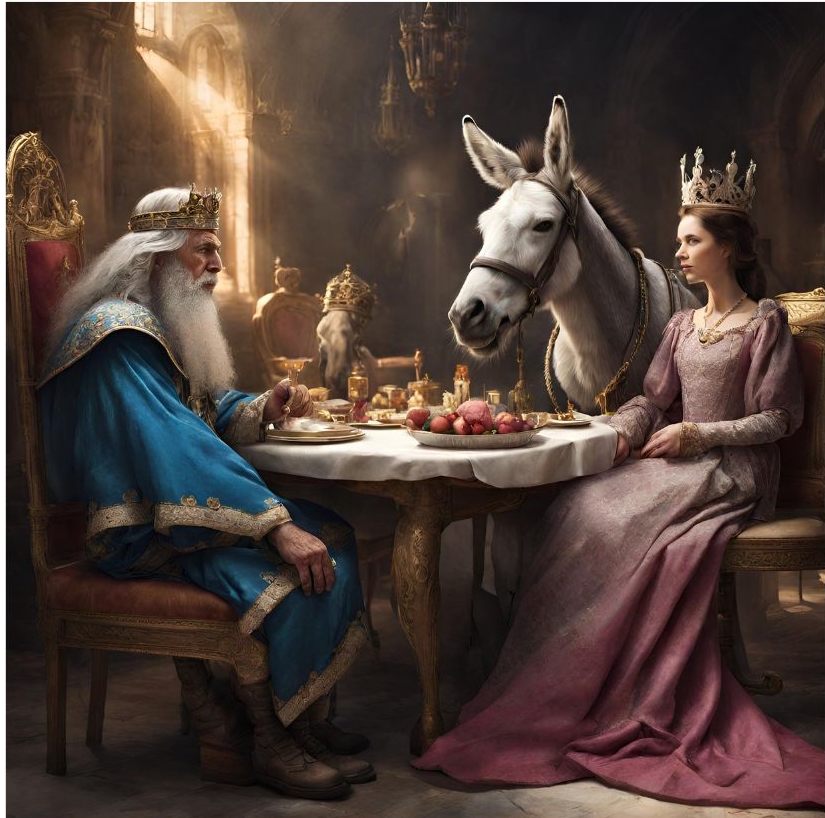
A king and queen at long last have a child, but it is a donkey. The queen wants to drown it, but the king says if this is God’s will, it will inherit the throne.

The donkey grows up with all the benefits of a prince. Being attracted to music, he learns to play the lute as well as his teacher, despite his hooves.

At length, he ventures into the world after seeing his reflection in still water and truly realizes he is, by all appearances, a donkey.

He travels to a distant kingdom, and there he asks for entrance into the castle as a guest. Being a donkey, his request is denied by the guard. The donkey sits down by the gate and plays his lute. The guard, amazed, reports this to the king. The king, entertained by the idea of a lute-playing donkey, invites the donkey into the castle.

The donkey refuses to eat with the servants or even the knights. Being of royal birth, he insists upon eating at the king’s table. The king, amused, agrees. The donkey’s manners are impeccable, and he is seated by the king’s lovely daughter.

As time goes on, the king becomes exceptionally fond of his “little donkey.” However, the donkey realizes the futility of his presence at this king’s court and asks leave to return to his home.

The king offers him gold and half his kingdom if he will stay, but this is not what the donkey wants. The king then offers his daughter in marriage. At that, the donkey agrees to stay.

That night, the wedding is held, but the king immediately has second thoughts and arranges that a servant hide himself in the bedchamber to assure that the donkey conducts himself properly.

When the donkey believes all is secure, he throws off his donkey skin and reveals his true, handsome self to his bride, who is delighted. In the morning, he returns to his donkey skin.

The servant reports to the king, who is amazed and wishes to see all this for himself. The servant advises that the king take the donkey skin and burn it, which the king does.

In the morning, the handsome prince cannot find his skin and tries to flee.  The king waylays him and offers, again, half his kingdom if the prince stays. The prince relents.

Eventually, he inherits all of the kingdom, plus his own father’s kingdom, and lives out his life in splendor.

“Oh, really?” says Duckworth, shaking his head. “Way too easy.”

Fairy Tale of the Month: February 2024 The Donkey – Part Two

Author + AI

Donkey’s Skin

The meals arrive, and conversation halts as we sample our choices.

“‘Way too easy’ you say?” I comment after I decide I made the right menu choice.

“Well.” Duckworth sets down his fork. “As I understand story structure, be it literary or oral, there must be a crisis, a high point of tension, at the climax of the story.

“In our case, the prince cannot find his familiar donkey skin, tries to flee, and is stopped by the king, who offers him half the kingdom if he stays. The prince says, ‘What the hell. Why not?’

“This is not a crisis. There is nothing to lose but the curse of a donkey skin in return for half a kingdom! The stakes are not high.”

“I do agree,” I confess. “The end of the story falls flat. I feel the same way as you, but the earlier part of the story holds promise.”

“Such as?” Duckworth picks up his fork again to attack his meal.

“Well,” I contemplate, setting my fork down, “I am encouraged by the donkey’s father refusing to drown the poor thing, but rather giving him all the benefits of royal birth. The donkey takes to music and learns to play the lute, which should be impossible. This shows the reader or listener that there is more to this creature than being just a donkey.

“Perhaps my favorite part is when he sees his reflection in still water and sees himself as the rest of the world sees him. This is the point—in Hero’s Journey terms—when he crosses the threshold and ventures into the greater world to try, I suppose, to find himself. What he knows is inside him, and what he sees in the still water are two different things he needs to reconcile.”

“I’ll buy that,” says Duckworth, dipping a chip into the sauce. “Go on.”

“He passes two tests: getting into the castle by a show of his musical talent, and then getting to the king’s table by insisting on his rank. The king appears more amused by the donkey’s claim than convinced, but nonetheless, seats the donkey beside his daughter.

“However, in time, the donkey, despite his achievements, could see no way forward, especially concerning the princess. When he asks leave to return home, the king, to the donkey’s delight, offers him his daughter in marriage to tempt the donkey to stay.”

Duckworth raises his fork. “Isn’t that, ah . . .”

“Sexist?” I supply. “Well yes, but women were property back then, and back then was not so long ago, and don’t get me started on that or I will lose my point.”

Duckworth lowers his fork and applies it to his calamari.

“Where was I?” I continue. “Oh yes. In the bridal chamber he finally reveals his true identity to the princess and, I will suggest, to himself. But then, in the morning, he retreats back into his lesser, familiar form. It is only when the king destroys the donkey skin is he forced to accept himself in his true nature.”

“That does put the story in a new light for me.” Duckworth salutes me with his last chip before popping it into his mouth.

“What fascinates me,” I continue, “is the fairy-tale trope of the hero feeling he has to disguise himself for no apparent purpose. That bit I have never figured out.”

“Wait.” Duckworth’s eyes narrow. “This is not your typical line of argument. Who have you been talking to?”

He’s caught me.

“I had this same conversation last night with Melissa.”

“I thought so. She has much influence over you, you know.”

Picking up my fork, I say, “For the better, I hope.”

Fairy Tale of the Month: February 2024 – Part Three

Author + AI

A Stroll

Leaving the Rock & Sole Plaice by hopping into Duckworth’s Morris Minor, we make our way down to Victoria Embankment Gardens to walk off some of the calories we absorbed and to visit Cleopatra’s Needle, simply to have a destination.

As we walk down a gravel path, Duckworth asks, “So, why do you think the Grimms wrote this story?”

“That’s a hard question to answer, given that they did not write them and yet they did.”

“Sounds like an answer off to a wrong start,” Duckworth quips.

“Well, it’s simply that the Grimm brothers collected the stories from various sources, including variants, then wrote them up in a coherent fashion, trying not to stray too far from the originals, at least in the first edition, which they considered to be a scholarly work.

“Their purpose was to establish a ‘German Folk Voice’ in the context of the rising German nationalism. Remember, this was in 1812, when the Holy Roman Empire still held sway. There  were only empires, no nations.”

We pass the erotic statue that graces the Arthur Sullivan Memorial. Arthur being of the famous operatic duo Gilbert and Sullivan.

Is that the definition of bad taste?

Duckworth glances sidelong at me. “I hear you leading to something amiss when you say, ‘at least in the first edition.’”

“Quite so. The Grimms quickly realized their larger audience was the children of bourgeois families. After the first edition, Wilhelm took over Kinder- und Hausmärchen, leaving Jacob to lead in their more scholarly works (a dictionary and a collection of Germanic mythology). There were six more editions of Kinder- und Hausmärchen; Wilhelm could not leave it alone.

“Wilhelm, in consideration of his Christian audience, eliminated most of the pagan references in the original stories and supplanted them with more Christian elements. Angels appeared in some of the rewritten versions, who had not haunted the tales before then.”

We now stroll beside the Thames. Duckworth returns to my earlier point. “They were seeking the ‘German Folk Voice’ you say?”

“Yes, which involved a bit of irony. A number of the better-known tales, like Little Red Riding Hood, Snow White, and Sleeping Beauty, the Grimms collected from a friend and neighbor, Marie Hassenpflug of a French Huguenot family. The daughters of another neighbor, the Wild family, also of Huguenot origin, supplied quite a few other tales. One of these girls, Wilhelm ended up marrying.”

“Oh my,” says Duckworth, “collecting tales was quite a different business in those days, was it not?”

Cleopatra’s Needle comes into view.

“The Grimms were not the ‘field’ folklore collectors that were to follow,” I continue, “but depended upon friends and acquaintances to gather their material. For example, Philipp Otto Runge. He was a German Romantic painter and color theorist—and an exquisite mind that passed away too young. He sent the Grimms two stories, The Fisherman and his Wife, and The Juniper Tree. When Wilhelm read these tales, he was much impressed by Runge’s ‘voice.’ Wilhelm patterned the collection’s style on Runge’s.”

“Well, now that we are here,” says Duckworth, “we can turn around and go back. I think we can spend a little time at Sullivan’s memorial.”

Good heavens!

Your thoughts?

Fairy Tale of the Month: October 2023 King of the Cats- Part One

John D Batten

Halloween Party

Halloween. Samhain. It marks the end of a yearly cycle. It’s not as well recognized as New Year’s Eve as the end of the year. For me, it is when we enter the colder days that bring about temporary death until the invigorating spring. Halloween is the transition.

Teenagers are persons in transition.

“No candy,” pronounces Thalia.

Jini backs her up. “Candy is for children.”

“Ah,” I say as we discuss our Halloween party menu, “then let’s go traditional with Mash of Nine Sort and bangers.

“Sounds cool,” says Thalia.

“What’s Mash of Nine Sort?” Jini asks.

“Basically, potatoes and other root vegetables,” I answer.

“Safe,” she says.

“How about caramel apples for dessert?”

They hesitate. These are candied apples, but they quickly cave.

American apple cider is a given in our household for such a party, not the British cider, which is, of course, alcoholic.

As we prepare the Mash of Nine Sort, I throw in my late wife’s wedding ring, to their confused looks.

‘You didn’t let him put a ring in it, did  you?” Melissa asks them when the party starts. Their wide-eyed, nonresponse answers her question. “Well then, whoever gets the ring in their serving is the next to get married.”

The girls gasp.

I chortle.

Melissa gives me a harsh glance.

We decide to start off our evening with Thalia’s reading. We all gather in the study. By “all” I mean Melissa, Jini, Thalia, the fairy, Johannes, the brownies (in the shadows as usual), and myself.

“Tonight’s story is dedicated  to Johannes. It’s called King of the Cats.”

Johannes’s eyes shine as he curls up on Jini’s lap.

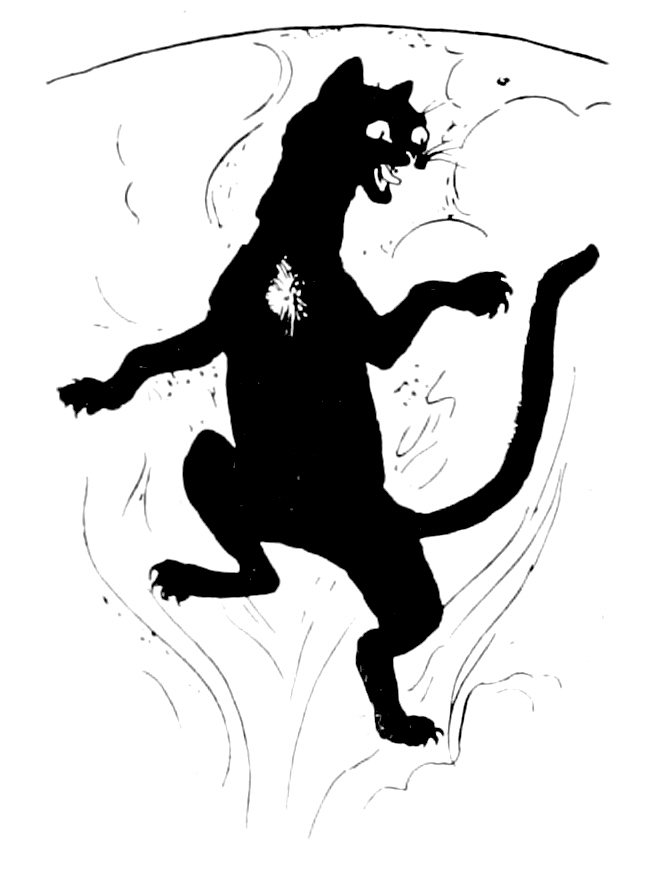
One winter’s night, the sexton’s wife is sitting by the fireside with their old, black tom cat lying in her lap, waiting for her husband to come home. He does, at last, return, but in a fit of excitement, shouting, “Who’s Tommy Tildrum?”

The wife demands an explanation, and her husband embarks on a wild tale.

He was digging a grave when he heard meows. Looking out over the top of the grave, he saw nine black cats, eight of them carrying a coffin covered with a black pall on top of which rested a small, gold crown. The procession was led by the ninth cat. On every third step, they all chorused a meow.

As the sexton tells his story, every time he refers to the meows of the cats, their cat, Old Tom, meows as well. The sexton twice notices that Old Tom seems to understand what he is saying, but the wife returns his attention to telling the tale.

The sexton relates that the funeral party of cats came parallel to the grave he was digging. The nineth cat came over to the grave’s edge and looked down upon him, saying, “Tell Tom Tildrum that Tim Tildrum is dead.”

Upon hearing this, Old Tom speaks up. “What? Old Tim is dead! Then I’m king of the cats.” And disappears up the chimney.

Fairy Tale of the Month: October 2023 King of the Cats – Part Two

G. P. Jacomb-Hood

Of Cats

“A mostly true tale,” Johannes offers. “I knew the Tildrum litter well, and I approve of the story. It doesn’t have us of the Cat Sith stealing souls and such things from the dead.”

“You black cats,” I comment, “do have a bad reputation on the whole. I have always heard it is unlucky to have a black cat cross your path, for example.”

Johannes hisses gently in resigned agreement. “And to think we were once worshipped in Egypt. It could have led to someone’s death to harm a cat back in those days. Gone are the times of Bastet.”

“Bastet?” Jini asks as Johannes leans into her hand while she scratches behind his ear.

“Daughter of the sun god Ra and Isis. She served as a protector against contagious diseases and evil spirits. Isn’t it ironic that by the Middle Ages our reputation became the opposite.”

“How did that happen?” Thalia queries.

“Christians, is the short answer.” Johannes’s tail thrashes. “They eradicated anything pagan that they could not put a Christian gloss upon. Not only were we cats worshipped by the Egyptians, but we drew the Norse goddess Freya’s chariot. We had far too much contact with other deities for the monotheists to be comfortable with us.

“We were accused of stealing babies’ breath, snatching souls before they could go to heaven; our bites were poisonous. When the Black Death came, many thought we were the cause. Thousands of cats were killed to slow down the plague, when it was we who hunted the rats who were the culprits.”

Melissa raises her hand. “Why did cats and witches become associated?”

“I believe you ask that question because you already know the answer.”

Melissa smiles at him.

“But for the benefit of others,” Johannes continues, “disadvantaged women and cats—themselves disadvantaged by their history—were thrown together by the ignorant, popular mind. Scapegoats are always needed, and here was a pairing not to be ignored.

“To be fair, Christianity is not the only religion or philosophy to denigrate women and cats. However, not since the fall of the pagans has anything feminine or feline been treated fairly.

“Whenever have you heard of a ‘sorcerer hunt’? It’s always a ‘witch hunt.’ Sorcerers have tomes, which they consult. Witches have familiars with whom they confer. The popular mind has cast different scenarios for men and women in the black arts.”

“Aren’t you being a little harsh?” Jini objects.

“I don’t think so. You are young. I have been about, perhaps, a little too long. Forgive me if I appear jaded, like an overworked horse.”

“Aren’t the Cat Sith inherently evil?” I prod.

“No!” Johannes’s fur bristles as Jini tries to pat it down. “Ah, you are baiting me. You got me on that score. Are my buttons so obvious that you must push them?”

It is my turn to smile.

Johannes growls a bit, despite Jini’s calming hand. “Evil is a relative state. Visit politics to see examples. Whose side are you then on?”

Good point.

Fairy Tale of the Month: October 2023 King of the Cats – Part Three

Gustave  Doré

Cats Considered

Melissa and I are in the kitchen, warming up the Mash of Nine Sort, cooking the bangers, and pouring ourselves some wine, leaving the girls to chat by the fireside with their American apple cider and Johannes contently curled in Jini’s lap.

“I feel like I am talking behind Johannes’ back.” Melissa sips her wine. “But what is the role of cats in fairy tales?”

“An interesting question to contemplate while we prepare our little feast,” I say, checking the oven temperature. “Let’s think on this.”

“The first to jump to mind is The Companionship of the Cat and the Mouse, which is almost the lead story in the Grimm collection. The tale does not end well for the mouse, and the cat is cast as villainous. The whole piece is a cautionary tale.

“Another of the cautionary tales is The Fox and the Cat.”

“I don’t recall that one. Remind me.”

“A fox and a cat were talking. The arrogant fox asked the cat what skills it could boast of compared to his many. The cat said she could climb trees, a talent that the fox belittled until hunting hounds suddenly descended upon them. The cat scampered up a tree, and the fox was killed.”

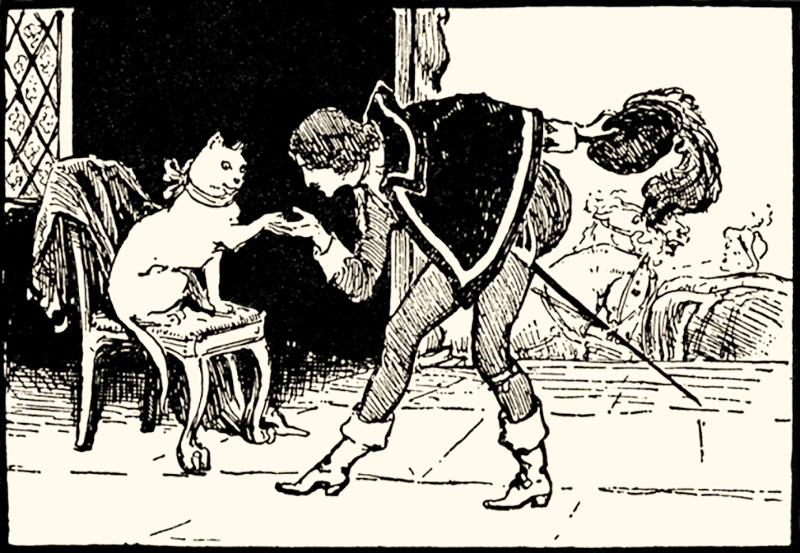
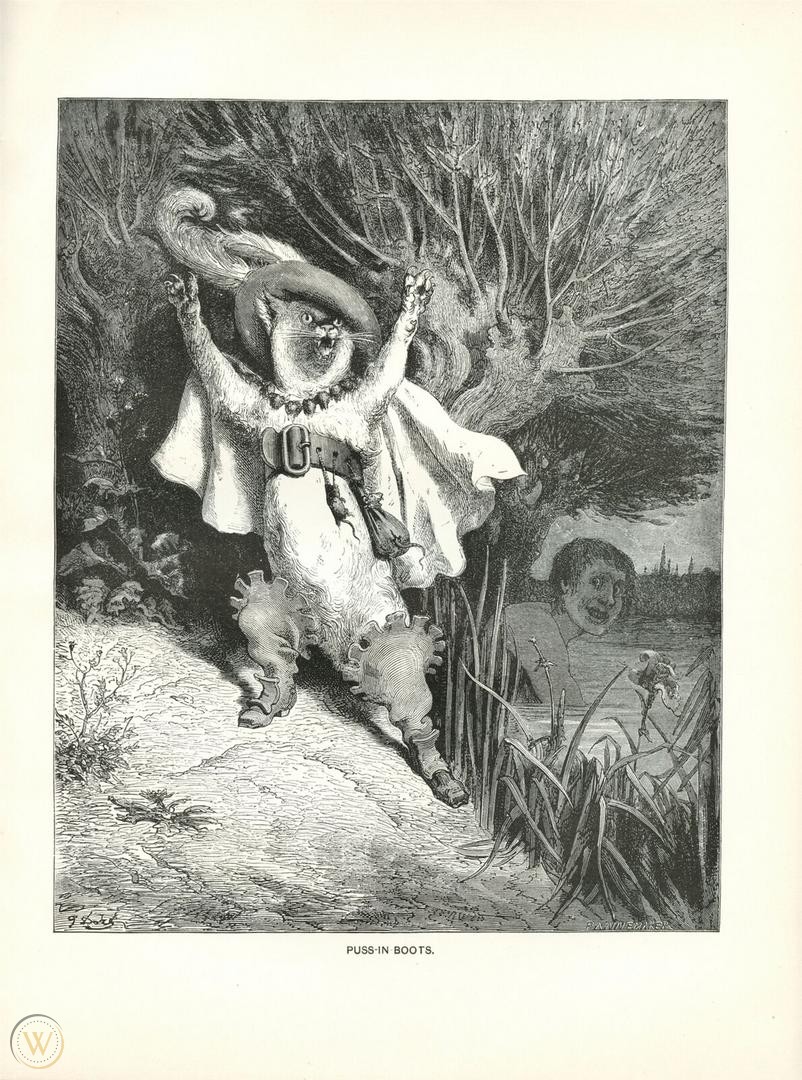
“I see. In this cautionary tale, the cat is in the right.” I move the bangers about before saying, “However, I think first mention should be given to Puss in Boots.”

“Oh yes, of course,” Melissa agrees. “Here the cat is the protagonist and a witty hero, outsmarting humans and ogres. Certain Johannes would approve.”

“I recently read Wood of Tontla,” I say. “In it is a cat having something to do with magic, but it has a small role and never says anything.”

“That makes me think of The Cat on the Dovrefell. The cat is just a cat, but its presence works into the pun at the end of the story.”

“A device, in other words, not a character like Puss in Boots,” I reflect. “And then there is The Bremen Town Musicians, one of whom is a cat.  The cat, and her companions, fall between being devices in the story and protagonists, maybe?”

“Let’s just label them as characters,” Melissa decides.

“I’ll buy that.” Melissa takes another sip of her wine. “Oh, Madame d’Aulnoy’s The White Cat! While the prince is the protagonist, the white cat is certainly the heroine.”

“But,” I protest, “the cat is really a princess under a spell and not a real cat. Does that count?”

“Well, she had enough claws on her front paws to count to ten. She counts in my book.”

I will not argue. “Ah, Gabriel Rider.” I raise my finger in the air. “In that story are the very Cat Sith representing evil that Johannes complained about. These cats are not devices or protagonists, but rather antagonists.”

Melissa considers. “That is the first story we have cited in which the cats are the minions of the devil. None of the stories we have mentioned had a witch and a black cat in them. The witch and black cat pairing is not a traditional fairy-tale convention.”

When the oven bell chimes, we finish our wine and carry the hot dishes into the study, along with the caramel apples the girls and I produced earlier in the day. We set the study table up as a dining table and have at it.

I take no more than two mouthfuls of the Mash of Nine Sort when my molars clamp down on a round, metal object. It makes a clink. The three others look up at me and smirk.

I should have known better.

Your thoughts?

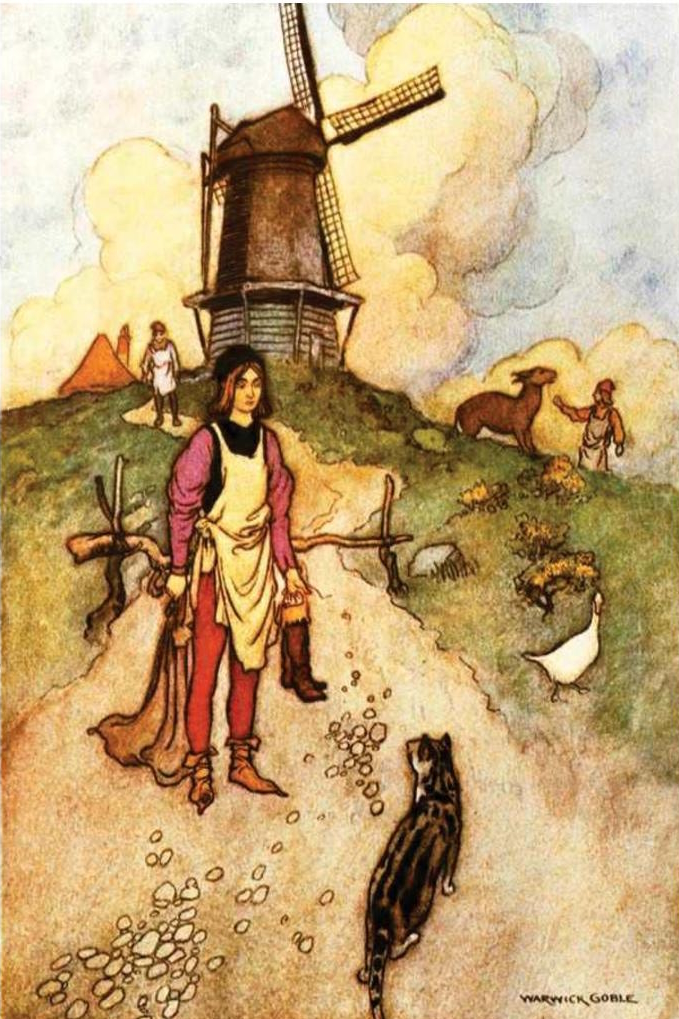
Fairy Tale of the Month: February 2023 The Poor Miller’s Apprentice and the Cat

Warwick Goble

Good Bread

“We’re here for the bread,” Melissa states.

“And a glass of wine?” I suggest.

“And a glass of wine.”

We are entering Noble Rot, the Lamb’s Conduit Street location. I know they also have a shop in Soho. The place is quite inviting; dimly lit in a cozy way, wooden floors, dark green wainscoting, which runs around most of the room, and each table has a tea light in its center. We take a table near the crackling fireplace. It is February after all.

“A bread plate each is all we need,” Melissa tells the waiter.

I am looking at the menu. “And, perhaps, the slip sole,” I add.

Melissa rolls her eyes.

“And a splash of wine?” the waiter asks.

“Oh, yes,” I say, picking up the wine list.

My lord, it’s the size of a novella!

Thirty-two pages. I am overwhelmed.

“I guess white wine with bread.” I venture.

“And German,” says Melissa.

“By the glass?”

We nod.

“Then it will be the Stein Palmbury Reisling.”

“Excellent,” I say. As the waiter leaves, I ask Melissa, “Why German? You’re being thematic, I will guess.”

“I am. I’ve been rather curious about a Grimm tale, The Poor Miller’s Apprentice and the Cat.

“Delightful. Refresh my memory.”

Actually, I don’t think I ever read it.

“It is something of a Puss and Boots and The White Cat variant.”

An old miller, with no wife or child, neared his retirement; a time, he said, when he wished to sit by the stove. He told his three apprentices that he would give the mill to one of them, providing that the new owner would sustain him in his old age. The contest would be decided by who could venture out and bring back the best horse.

The three apprentices started out together, but the elder two soon found a way to abandon Hans, the youngest. Wandering about, with no direction, he was approached by a multicolored she-cat that offered to give him a horse—the cat already knowing his need—if he would be her servant for seven years.

He agreed and was taken to her castle, where all the servants were kittens.  They served Hans and the cat their dinner, during which the kittens played on a double bass, a fiddle, and a trumpet for their entertainment. When the meal was over, the cat asked Hans if he would dance with her. He refused, saying he did not dance with pussycats. She then instructed the kittens to take him to his bed. The kittens tucked him in and then in the morning they woke him, washed him, dried him with their tails, and got him dressed.

After that, he proceeded to be the cat’s servant, for the most part chopping wood with tools made of silver. He also mowed her meadow with a sliver scythe and built a silver cottage with silver tools.

When the seven years were up, the spotted cat showed him his fine horse, told him to return to the mill, and said, in three days, she would come with the horse. Unfortunately for Hans, during the seven years, she had not given him any new clothes. Ragged as he was, the miller and the other two apprentices laughed at him and would not let him eat or sleep in the mill. He had to content himself by sleeping in the goose house. Since he did not return with a horse, they mocked him. They, at least, returned with horses, although one was blind and the other lame.

However, on the third day, a princess arrived in a coach pulled by six fine horses with a servant leading a seventh horse, the likes of which had never graced the miller’s yard before. The princess had her faithful Hans washed up and nobly dressed, and he appeared to be as handsome a lord as any. She told the miller he could keep his mill as well as the horse.

She and Hans returned to the silver cottage he had built, which had become a huge silver and gold castle. The marriage followed and Hans never wanted for more.

Our waiter returns with the plates of bread. The delectable aroma alone is worth the sojourn to Noble Rot. 

Fairy Tale of the Month: February 2023 The Poor Miller’s Apprentice and The Cat

George Percy Jacomb-Hood

An Insertion

On the plate are three kinds of bread, two pieces of each kind: soda bread, focaccia, and sourdough, plus a pat of butter. The waiter sets down the glasses of riesling to complete the picture. Knife in hand, I apply the butter to a piece of soda bread as a starter.

“I rather like the bit about the kitten servants drying Hans off with their tails,” I say.

“I did too.” Melissa takes a sip of wine. “Which is why I have half a mind to call Wilhelm to Miss Cox’s garden and scold him.”

“Whatever for?”

“When I came to the part about the spotted cat wining and dining Hans, who then refused to dance with her, that struck me as a significant moment in the story.”

The soda bread might be my favorite, even though I haven’t tried the other two.

“However, she does not seem to take offense. The next day, Hans appears to take up his duties as a servant and the events go on from there.

“I’d not run across this refusal-to-dance motif before. I racked my brain to think of a parallel. What could this signify in the folk mind in which these tales arose? Out of caution, I went back to the 1815 version of the tales in Jack Zipe’s book, The Original Folk and Fairy Tales of the Brothers Grimm. I discovered that the stuff about the kittens, the music, the wining and dining, and tail drying were not there. At all. The 1815 story goes from Hans agreeing to be the spotted cat’s servant to a description of his duties for the next seven years.

“Here I’d gone off, mistakenly, into thinking the refusal-to-dance might be an unrecognized story element, perhaps steeped in Germanic folklore. Instead, it turns out to be Wilhelm’s fanciful insertion.”

I laugh gently while sampling my focaccia. “I know the Grimms did alter the stories when they realized they had a younger audience than for which the first edition had been intended. They removed sexual content, replaced pagan elements with Christian subjects, and turned evil mothers into stepmothers.”

“True,” Melissa frowns. “But this change does not qualify for any of those reasons. I assume Wilhelm attempted to appeal to his bourgeois audience. He simply upped the storyline a little. It makes me wonder how often he allowed his German Romanticism to creep into these reputedly folk-inspired fairy tales.”

No, the focaccia might be my favorite.

“I guess,” I muse, “we should have been suspicious when the story gave too much visual description; the double bass, the fiddle, and the trumpet, not to mention the delightful thing about the tails used for drying. Details like that are sparingly given unless necessary for the storyline.”

Melissa nods, nibbling her sourdough. “After I saw what must have happened, it became clear to me that the tone of the section with the kittens differed from what went before and what followed. On consideration, I conclude it was a rather clumsy, somewhat confusing, unnecessary thing for Wilhelm to have done.”

Oh my, the sourdough is as good as the other two.  

Fairy Tale of the Month: February 2023 The Poor Miller’s Apprentice and The Cat

Something More

The slip sole arrives, a small flatfish fillet with a smoky, honey glaze that creates an olfactory sensation.

“I tried,” Melissa continues, “checking the Grimm notes in Margaret Hunt’s book to see if there might be some enlightenment. All I got was an even crazier version of the tale. Are you ready for this one?”

“Carry on,” I say. I am happy to let her chatter while my epicurean soul delights in the aquatic sole.

A miller sends his three sons out to find the best horse and claim the mill. The youngest meets a little gray man, whom the lad serves as a woodcutter for a year in return for a good horse. The lad meets his brothers on the way home. Their horses are either lame or blind. In jealousy, they throw their younger brother into a lime pit. The little gray man pulls him out, restores the lad to life, and retrieves the horse. 

For reasons unexplained, the father decides the mill will go to the son who can bring him the best shirt. The lad gets the best shirt, meets up again with his brothers, who tie him to a tree and shoot him dead. Again, the little gray man appears and brings him back to life.

When the lad returns to the mill the second time after dying, the elder brothers convince their father that the younger is in league with the devil. (Which from their point of view was arguably true given they had left him for dead twice). The father proposes a third test; this time one of them must bring back the best loaf of bread, since, as the story states, “. . . the devil has no power over bread.”

The lad, on his quest, shares his food with an old woman in the forest, who gives him a wishing-rod. When he uses it, a little tortoise comes to him declaring, “Take me with you.” He puts the tortoise in his pocket, and the next time he puts his hand in, there is the tortoise and lots of money.

He sets the tortoise up in the best room at an inn and travels on from there for a year, unsuccessfully searching for the best loaf of bread. (The arrangements for the tortoise to live at the inn in the meantime are not well explained.) Upon returning to the inn, the lad sees that the tortoise has two, pretty, white feet. That evening, he sees a shadowy figure kneading bread. In the morning, there is a perfect loaf of bread. Taking the loaf home, he can no longer be denied ownership of the mill.

On his return again to the inn, there in the bed is a princess as well as the tortoise. She explains that he has broken the spell over her, and they can now marry. But first, he must return home and wait for her. She tells him that when he hears the first cannon, she will be getting dressed. When he hears the second cannon, she will be getting into a carriage. When he hears the third, he should look for a carriage being pulled by six white horses.

Afterward, they are married and might have lived happily ever after except that he let the tortoise fall into the fire. Outraged, the princess spits in his face. Devastated, he goes off, digs a deep cave for himself, over which is carved the inscription, “Here none shall find me, save God alone.” There he lives and prays for many years.

Eventually, an old king, having fallen ill, travels the country looking for a physician to cure him but without success. He comes by accident to the cave and is miraculously cured. Seeing the inscription, he instructs his people to “dig down” until they find the hermit.

When the king finds out that this hermit is his son-in-law, he brings about reconciliation between his daughter and the hermit, and they all live long and happily.

“Good grief,” is all I can say.

“Yes, well,” Melissa smiles, sipping the last of her glass, “I think our bread and wine was the perfect little repast.”

I agree, but I am fingering the menu, and my eyes fall upon the dessert section.

Basque Cheesecake and Rhubarb.

Your thoughts?

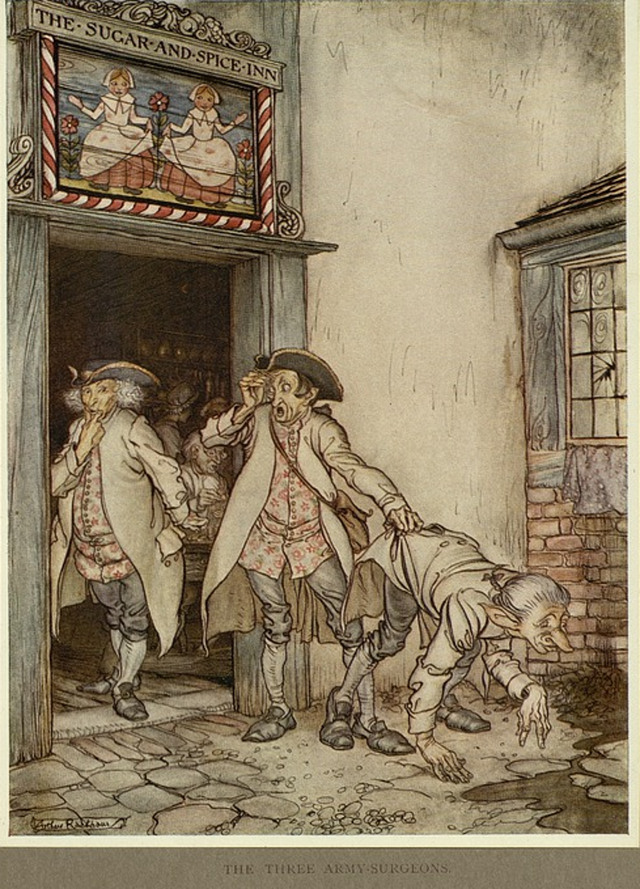
Fairy Tale of the Month: October 2022 The Three Army Surgeons – Part One

Arthur Rackham

Another Halloween

The usual crowd gathers for Thalia’s Halloween-night story: Melissa, Johannes, the fairy, the brownies, and myself. However, the story is being told early—the sun is not yet set—because Thalia will be going off to a Halloween party with Jini.

To Johannes’s amusement, I think, Thalia wears a black cat costume. It is made up of black leggings and a black jumper replete with a tail. Pointy ears and painted-on whiskers do the rest. When Jini and her mother come, she’ll be ready to go.

She waits until I get the fire in the hearth going, then announces, “The Three Army Surgeons.” She is holding her old, battered copy of Grimm’s fairy tales.

One evening, three army surgeons were at an inn where they intended to stay for the night. The friendly innkeeper asked them where they were going and what they did. They told him they traveled the world practicing their profession. This led to boasting. The first surgeon said he would cut off his hand that evening and restore it in the morning. The second said he would do the same with his heart, and the third said he would too with his eyes.

No one else knew that these surgeons had a magic salve that could heal anything.

Before the surgeons went to bed, they cut out their assigned body parts, the innkeeper put them on a platter, and the maid put them in a cupboard for safekeeping.

Unfortunately for all, this maid had a soldier/sweetheart who showed up after everyone else was asleep, and the maid brought out food for him, leaving the cupboard door open. In came the cat, who made a meal of the surgeons’ body parts. When the maid found out what had happened, she declared all was lost.

The clever soldier had other ideas. Borrowing a butcher knife, he popped out and returned with the hand of a thief he’d seen hanging from the gallows. Then he grabbed a cat and poked out its eyes.

“What!” objects Johannes. He rises from his window seat, his tail straight in the air, and, with indignation, strides from the study.

“Oh drat,” Thalia frowns. “I think I’ve offended him. He’s so touchy.”

“Well, my dear,” Melissa says, “he is a cat.”

“A cat-sìth, actually,” I say, “but still a cat.”

The brownies titter, Thalia sighs, and she continues.

The heart of a pig, butchered that day, made up for the last of the losses. In the morning, the surgeons restored the substituted body parts with the magic salve, much to the praise of the innkeeper.

The three surgeons traveled on their way, but the surgeon with the pig’s heart delayed their travel by rooting through whatever garbage he could find, while the others tried to drag him back by his coattails.

That evening, in the next inn, the surgeon with the thief’s hand, stole money from an unwary patron. After they had gone the bed, the surgeon with the cat’s eyes could see in the dark and commented upon all the mice in their room that the others could not see. They then concluded they didn’t have their original body parts, and it was the fault of the previous innkeeper.

They return, accusing the innocent man of cheating them. He—rightly so—accuses the maid. But the maid, seeing the surgeons coming, ducked out the back door never to be seen again. The surgeons demanded as much money as the innkeeper had or they would burn down his house. They got a goodly sum, but it was in no way a replacement for their lost body parts.

The doorbell rings.

“It’s them. Bye.” Thalia darts out the study door, leaving the fairy, previously settled on her shoulder, fluttering in mid-air.

Fairy Tale of the Month: October 2022 The Three Army Surgeons – Part Two

Heinrich Lefler

Some Riffraff

A little to our surprise, the fairy settles into Melissa’s lap and curls up to nap.

“I think I’ve been honored,” Melissa smiles, “but now I can’t get up. Will you pour me some more wine?”

I pour her half a glass.

“Oh,” she says, “you are remembering last year.”

“Yes, and not to mention we have started drinking early and on empty stomachs. However, I have made some pumpkin soup and squash toast for us to dine on.”

“That sounds much better than candy. What is squash toast?”

“You will see.”

I leave for the kitchen and soon return with steaming mugs of soup and small plates of squash toast. “It appears we will dine in the study since you are anchored by Thalia’s fairy.”

“Off to a Halloween party. My, but she’s growing up,” Melissa reflects.

We settle into sipping our soup by the hearth.

“What an odd Grimm tale,” she muses. “Not their usual fare.”

“Well,” I say, “there are a number of what I call ‘foolish tales’ in the Grimm collection, such as Riffraff.”

“I don’t recall that one.” Melissa samples the squash toast. “Oh, this is good!”

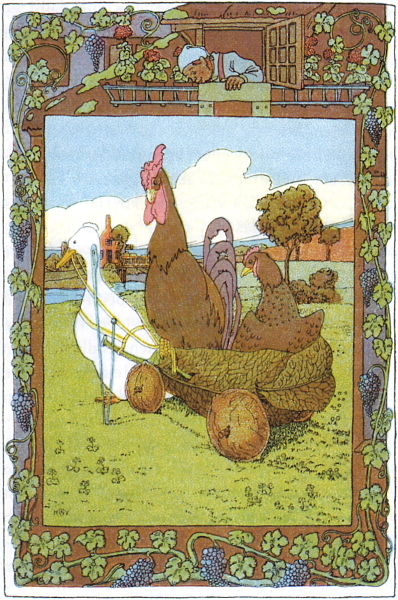
“As I recall, the story starts out with a rooster and his hen going up a hill to eat nuts before the squirrels get them all. After eating their fill, they don’t feel like walking home. Instead, the rooster builds a coach out of nutshells, then waylays a duck, with whom he has an argument, to pull the coach.

In this way, they journey until they come upon two other travelers.”

“Wait a moment,” Melissa says with laughter in her voice, “I thought they were just up a hill.”

“Home seems to be getting inexplicably farther away, but wait, it gets worse.

“The two travelers are a needle and a pin who had drunk too much beer at the Tailor’s Tavern—I am sure that was meant to be some sort of pun—and could not find their way home. The rooster allows them into the carriage since they did not take up much room.

“When they come to an inn, they decide not to travel any farther.”

“Oh dear,” Melissa smirks, “this coming back down the hill has gotten rather surreal.”

“Hasn’t it though. A foolish tale, as I said.

“Well, the innkeeper raises objections to their spending the night, but the rooster promises him the egg the hen laid along the way, plus he can keep the duck. After settling that, they have a merry evening.

“However, the rooster and the hen rise early, crack open the egg, and devour it. . .”

“Wait. What? That was cannibalistic of them,” she says.

“. . . then they take the still sleeping pin and needle, putting the pin in the innkeeper’s towel and the needle in his comfy chair, and fly off. The duck, seeing them escape, does the same.

“The innkeeper, of course, scratches his face with the pin and sits on the needle, declaring he’ll never allow riffraff like them again at his inn.”

“I see your point. Your foolish tales are those filled with absurdities rather than princes, princesses, and magic.”

“There is the magic salve in The Three Army Surgeons, but it is more of a prop than anything else.”

Melissa nods. “I can just hear these two tales being told at an inn along with much drinking. By the way, instead of more wine, can you get me more of this toast?”

That I am glad to do.  

Fairy Tale of the Month: October 2022 The Three Army Surgeons – Part Three

Jacques Callot 1633

About Gallows

I return with more squash toast to find the fairy still curled up in Melissa’s lap.

“I hope Johannes is not too upset about the cat in the story.” Melissa nibbles.

“He’ll get over it.”

“The poor pig was already done for,” Melissa goes on, “but the image that got to me the most is that of the thief’s hand.”

“And why is that?”

“I’m not sure. The Grimms were a bit more descriptive about this soldier going to the gallows and cutting off the hand than they were about the demise of the animals. “

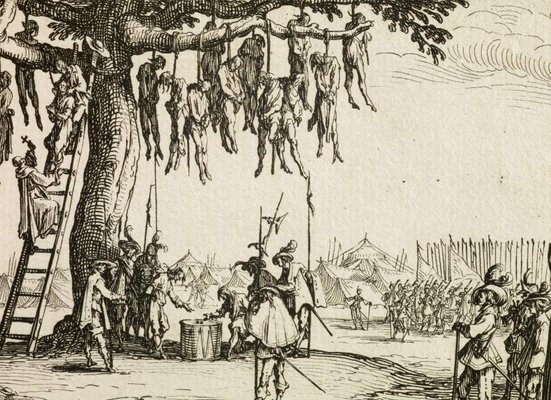
“Ahh,” I say, “the gallows. That is bound to engage the imagination. I think the Grimms knew that and referred to them numerous times in the tales.”

“Do they figure in other stories?” she asks.

“Well, let me think. There is The Two Travelers, in which one of the travelers has his eyes gouged out by the other as a matter of spite. The victim ends up falling asleep under a gallows. During the night, he hears two hanging corpses talking to each other and learns that the dew on the grass beneath them will restore a man’s sight.

As the story goes on, he acquires animal helpers and eventually ends up in the employment of a king who also employs his previous fellow traveler. The spiteful fellow causes trouble for our hero, but he is saved by his animal friends, and the villain is eventually banished. The villain ends up sleeping under the very same gallows as before. Crows, resting on the corpses, fly down and peek out his eyes.”

“Oh, how delightful,” Melissa can’t help saying.

“I recall another.” I hold up a finger. “Let me remember. A Tale About the Boy Who Went Forth to Learn What Fear Was.”

Melissa applauds my memory.

“In this tale, whose hero is rather dense, the lad has never felt fear, which he calls

‘the creeps.’ In part of the tale, he is assigned to spend a cold night under the gallows. The winter wind knocks the bodies together, and the lad feels sorry for them. He brings them down and sets them around his fire to warm them up a bit. They prove to be boring company; he can’t get a word out of them. In disappointment, he hangs them all back up again.”

I get another round of applause.

“Oh, how could I have forgotten,” I remember, “The Master Thief. A count has challenged a master thief to prove himself. One of the tasks is to steal the bedsheet from under him and his wife. One night the master thief cuts down a corpse from the gallows, sets a ladder up against the count’s bedroom window, and pushes the corpse ahead of him up the ladder.

“The count, expecting such a move, is ready with a pistol. When the corpse’s head appears in the window, the count fires. The master thief lets the corpse drop. The count rushes out to see what he has done, and the thief slips in, pretending, in the dark, to be the count, and tells the wife he has killed the man and needs the bedsheets in which to wrap the body. She, of course, complies. “

“Oh, how gruesome,” Melissa exclaims.

Her raised voice awakens the fairy, who yawns, stretches, flutters up, and leaves the study.

“Sorry,” Melissa calls after her. “Well, at least I can now get my own wine.”

Your thoughts?
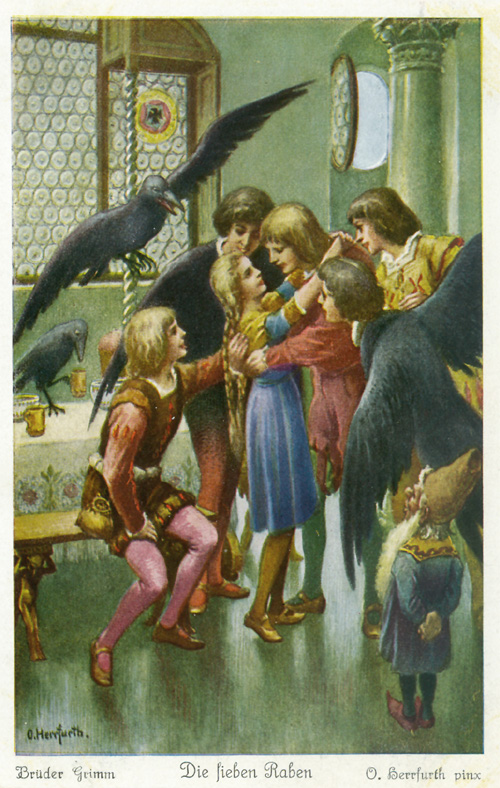
Fairy Tale of the Month: May 2022 The Seven Ravens – Part One

The Smokiest

Our tobacco smoke has rendered Augustus a dim outline of a person sitting in a comfy chair. I know in his hands is Jack Zipes’ The Original Folk and Fairy Tales of the Brothers Grimm, through which he pages briskly.

“Well, I know the story The Seven Ravens is in here.” He turns to the table of contents. “Ahh, The Three Ravens. In the Grimms’ first version, the story is different. The Grimms did that you know,” Augustus says, looking up, then returns his eyes to the book.

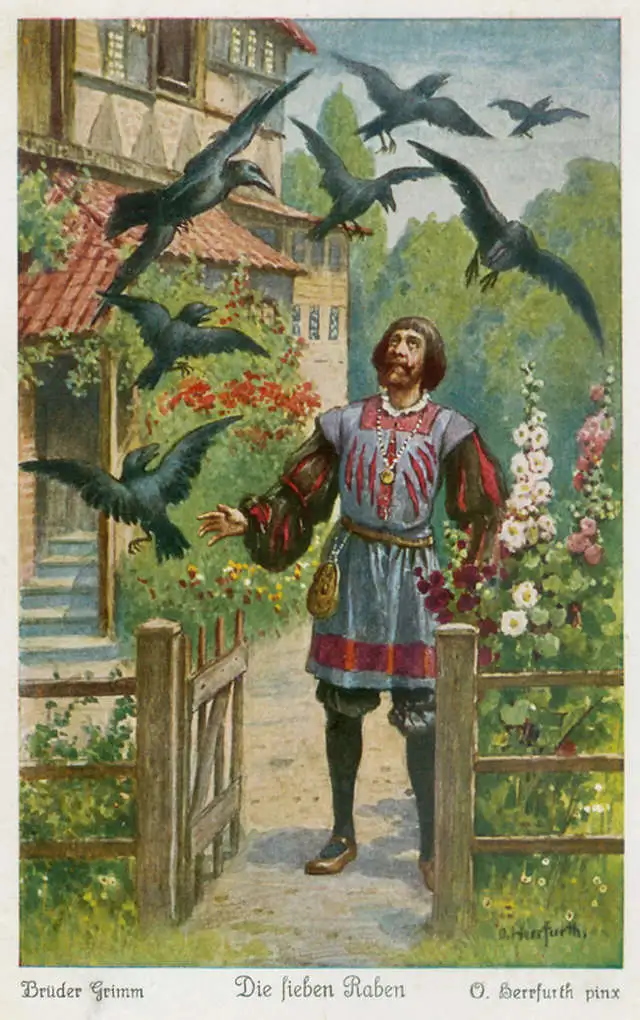
“If I remember,” he continues, “in The Seven Ravens, the father curses his seven sons, who failed to return home with baptismal water for the infant daughter, turning them into ravens. In this earlier version, there are three brothers playing cards on Sunday and they are cursed by their mother for their lack of morality.”

He peruses the pages. “That appears to be the major change between the two versions. I wonder why the Grimms—probably Wilhelm—felt the need to make this alteration.”

Augustus relates the tale.

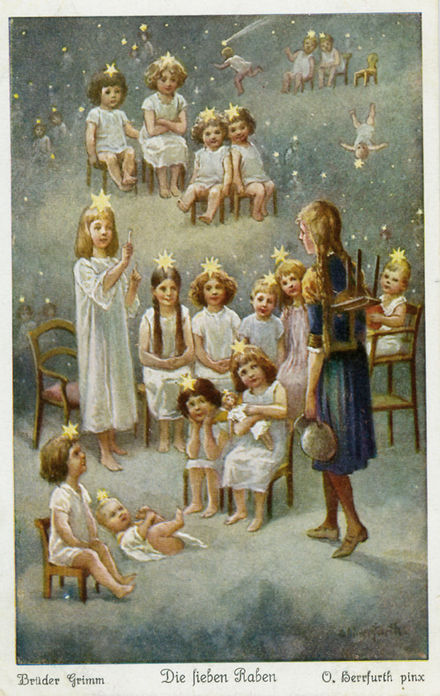
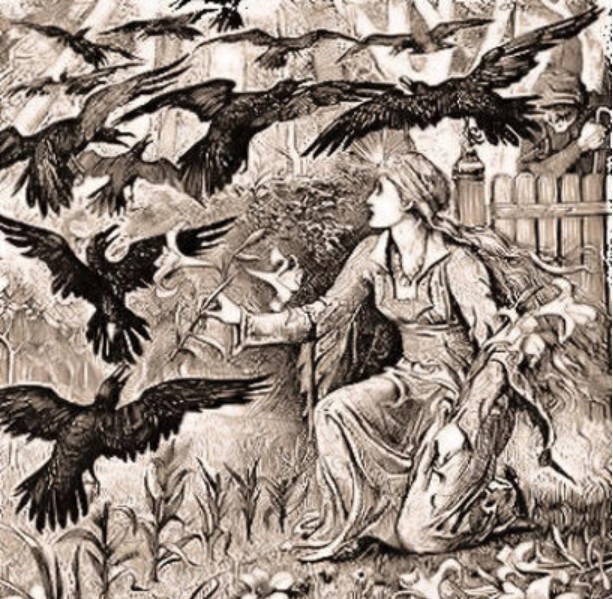
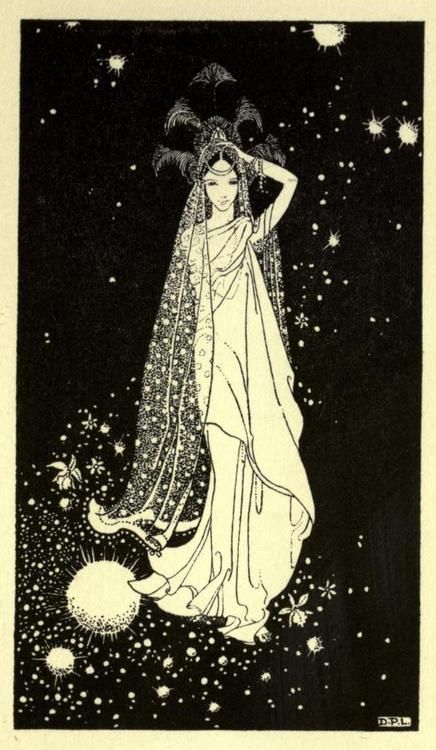
The sister of the raven brothers decides to go find and rescue them. She takes little with her other than a stool to rest upon, traveling to the end of the world. She flees from the sun and the moon, both known to eat little children. She finds the stars—each sitting on its own little stool—to be friendly.

The Evening Star gives her a chicken drumstick bone (in The Three Ravens it’s a little gammy leg) telling her she will need it to open the locked door to the Glass Mountain where her raven brothers now live.

Although she wrapped the bone in a cloth, when she gets to the doorway to the Glass Mountain the bone has vanished. Each of the two versions declare she lost the bone. Taking a knife, she cuts off her little finger, using it as the key to unlock the door.

She is greeted by a dwarf, who tells her the raven lords have not yet returned home for the day. Places are set at a table for the ravens’ meal. She eats a little from each plate and sips a little from each mug, dropping a ring that she knows the brothers will recognize into the mug of the youngest brother.

When the ravens arrive, they declare someone has eaten from their plates and drunk from their mugs. When the youngest finds the ring, the sister reveals herself, the brothers are restored to their human shape, and all return home.

“Hmmm,” I say, “that last bit sounds like Goldilocks and the Three Bears. In this case, the three ravens from the first version.”

“That is tempting, but I will discredit your notion immediately.”

I hear a smile in his voice, though I can’t really see his expression through the haze.

He continues. “Goldilocks and the Three Bears is pretty much an early nineteenth century invention, credited to the poet Robert Southey. However, his version has a nasty, dirty old woman invade the cottage of three ‘bachelor’ bears of different sizes. Another version, by Eleanor Mure, improved upon the punishment of the little old woman by having her impaled upon the steeple of St Paul’s Cathedral.

A decade or so later, Joseph Cundall did his version of the tale, only he changed the old woman into a young girl named Silverhair. After that, multiple authors played with the tale until a consensus was reached.

“There are similar stories that might be older than Goldilocks, such as Scrapefoot, about a fox intruding into the home of three bears.

“I’ll suggest Goldilocks and the ravens drew upon earlier sources, not the ravens drawing on Goldilocks.”

Fairy Tale of the Month: May 2022 The Seven Ravens – Part Two

Dense Smoke

I take a moment to tamp and relight my pipe, sending out a great plume of smoke.

“Well then, the next image to strike me is the sister, traveling to find her brothers, carrying a stool.”

“Yes,” Augustus hesitates. “That is an odd detail, but the fairy tales are filled with such things.”

“I note,” pursuing my point,” the stars are all sitting on stools.”

“True,” says Augustus. “And the significance you put upon that?”

“It does put her in the company of the stars. I am thinking back to The Twelve Brothers and the sister born with a star on her forehead.”

“Ahh, yes,” Augustus puffs harder on his pipe in concentration. “Let’s consider the through-line of stars in fairy tales. I’m not going to call the stars a motif but a reoccurring element.”

“What comes to my mind,” I say, “is the fairy-tale bride looking for her lost husband, going to the celestial bodies, who can’t answer her question, but give her useful gifts.”

“Yes, however,” Augustus puffs harder, “the celestial bodies in this tale are chancier. Only the stars are helpful.”

“The Evening Star,” I say, “gives her a bone for a key.”

“Which she loses,” Augustus finishes.

“That bothers me,” I return. “Both stories—the three and the seven ravens—are a little accusatory. She carefully wrapped it in a cloth, but still it vanishes. Might there be another force at play?”

Augustus considers a moment. “None but the story itself that requires her to make a sacrifice of some sort. The hero or heroine giving up some of their flesh is a common enough thing.

“But,” Augustus raises a finger, “back to the stars. We have characters with stars on their foreheads, stars as magical helpers, and also heroes and heroines who turn into stars. I am thinking of the Greek story The Little Boy and His Elder Sister, where the protagonists escape their fate by becoming the Star of Dawn and the Pleiad.”

Relighting my pipe again, I question, “Are the three items really related, other than having to do with stars? I want to think so, but the first is a token, the second a helper, and the third a transformation. Can they be said to reflect on each other?”

I realize Augustus is not listening to me. “Asters,” he says, leaving the room again and shortly returning with a few more volumes, the titles of which I cannot read through our dense tobacco smoke.

“In The Six Swans, the heroine must sew six shirts out of aster flowers. The word ‘aster’ in Greek means ‘star.’”

“In that case,” I speculate, “we might be able to make connections among brothers, sisters, birds and stars outside of these stories. Are there any bird constellations with mythic connections?”

“My thoughts exactly.” Augustus picks up another book. After a bit he says, “Well, here is the Raven Constellation. Actually, the Corvus Constellation. The raven was Apollo’s bird, whom he set to watch over one of his lovers. The raven watched as she fell in love with someone else and said nothing to Apollo until it was too late. Apollo’s cursing scorched the raven’s feathers forever.”

“Not,” I suggest, “the origin of our tale.”

Augustus searches on.

Fairy Tale of the Month: May 2022 The Seven Ravens – Part Three

Holy Smokes

“Next up in our constellation search is the Swan or Cygnus. It appears we have a selection of myths relating to this group of stars. Notable is Zeus coming to Leda in the form of a swan in order to seduce her.”

“Does not sound promising,” I say.

“Well, Leda does have two sets of twins, one set by Zeus, which is Pollux and Helen (as in Helen of Troy), and Castor and Clytemnestra by her mortal husband. Castor and Pollux become great friends, but if I recall my Iliad this dysfunctional family has more to do with murder than sibling support.”

“What are our other choices?” I realize my pipe has gone out again as Augustus scans the tome in his hands.

“Well, there are associations with Orpheus; Cycnus, son of Poseidon; and Cycnus, son of Ares. More prominent is the story of the friendship between the immortal Cycnus and the mortal Phaeton. In a race across the sky, they come too close to the sun and Phaeton perishes, falling into the river Eridanus. Cycnus asks Zeus to turn him into a swan—a mortal creature—so that he can dive into the river to retrieve his friend’s body for burial.”

“No sister retrieving her brothers?” I ask the wall of smoke. I cannot see Augustus anymore.

“No,” comes a disembodied voice from the gloom. “I recall Electra, who sacrifices to give her brother a decent burial, but that is not the same as a sister seeking her brothers. I think our search for a mythic origin has failed.”

“We haven’t addressed the Glass Mountain,” I say. “Is there a hint there?”

“Of the three stories we are considering, the ‘Six,’ the ‘Twelve,’ and the ‘Seven,’ only the last one has the Glass Mountain. In the ‘Six,’ the brothers live in a house of thieves; in the “Twelve,’ an enchanted cottage.”

I knit my brow. “These three stories have a sister searching for her brothers and end the same with the brothers being restored after becoming birds, but the details beyond that vary greatly.”

“Let us do another comparison,” Augustus instructs. “In the ‘Seven,’ the brothers turn into ravens and fly away. In the ‘Six,’ it is not until the evil queen finds them are the brothers transformed. In the ‘Twelve,’ the brothers flee their father and it is not until their sister finds them and picks the lilies are they changed.

“Further, in the ‘Seven,’ the sister sacrifices a little finger in order to get into the Glass Mountain.”

I interrupt Augustus. “I couldn’t help noting she does not climb the Glass Mountain but enters it like a house.”

“True, true,” Augustus continues. “In the ‘Six,’ she must remain silent for six years and sew six shirts of asters. In the ‘Twelve,’ she must remain silent for seven years but without the burden of sewing. Nothing like the silent treatment or the marriage to kings out hunting comes up in the ‘Seven.’ The sister simply appears and the spell is broken.”

“I must conclude,” I say, “these three stories are obviously the same story, but are so different in detail any one of them does not appear to be drawing off of one of the others. Yet we cannot find a common mythic origin.”

Augustus and I hear a commotion from the shop.

“That’s a noisy customer!” says Augustus.

I see him pass in front of me. In the archway between the testing room and the shop, Augustus bumps into a fireman clutching the end of a canvas hose with a shiny brass nozzle pointed in our direction.

Your thoughts?

Fairy Tale of the Month: April 2022 The Twelve Brothers – Part One

H J Ford

A Smoke

The bell over Augustus’s door to the tobacco shop rings as I enter. What an inviting sound. It has been a while since I visited to improve my stock of the good leaf.

“Ho, stranger,” Augustus acknowledges my entry.

“Good to see you again,” I say.

“Let me suppose,” he says as he reaches for a canister, “you’ll be wanting some Elfish Gold, Angel’s Glory, and a bit of Fairies’ Delight?”

“That will do nicely, along with some Black Dwarf. Have you a new blend to test?”

“I have been messing with Raven Black.”

We are soon in the testing room settling into our comfy chairs and tamping our pipes.

“And what,” Augustus says between puffs, “fairy-tale conundrum have you brought with you today?”

“I’ve been knitting my brow over The Twelve Brothers.”

“I’ve read that one, certainly, but I keep conflating it with The Six Swans. Sort it out for me.”

“It is well you should mix them up. The difference between the two is really what I’d like to talk about.”

A king has twelve sons but declares he will put them to death in preference for a daughter. The queen, when pregnant, confesses to the youngest son, Benjamin, what the king plans and shows him the twelve coffins that have been constructed.

The twelve brothers hide in the woods and wait for a signal from their mother: a white flag if it is a boy and a red for a girl. The red flag is raised and the brothers flee. They find a cottage in the forest that, unbeknownst to them, is enchanted. Here they live for ten years, Benjamin keeping house while the elder brothers go hunting.

By then, their sister, who was born with a star on her forehead, has grown into a beautiful, young lady. One day she finds her brothers’ shirts and asks her mother, the queen, about them. The story is revealed, and the princess goes off to find her brothers. They are reunited and live together happily.

One day, in the bewitched cottage’s garden, she picks twelve lilies—also called students—one for each brother. When she does, the brothers are turned into ravens that fly away, and the cottage and garden disappear. Beside her stands an old woman who scolds her for picking the lilies. To reclaim her brothers, she must now not speak nor laugh for seven years.

She climbs a tree and sits there spinning until discovered by the greyhound of a king who is out hunting. The princess, with a nod, consents to marry the king.

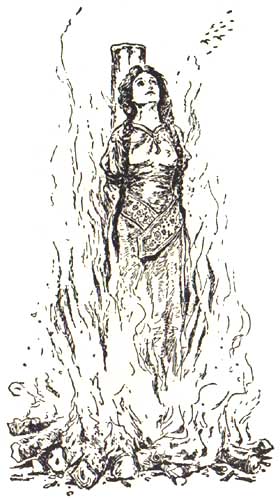
The king’s mother dislikes her and spreads false rumors until the king is obliged to have her burnt at the stake. The fire is lit just as the seven years expire. Twelve ravens fly in, turning into their human form as they touch the ground, and rescue her.

All live in happiness after the evil mother is put into a barrel of boiling oil and poisonous snakes.

“A barrel of boiling oil and poisonous snakes,” Augustus declares. “Really. I’d forgotten that. The Grimms outdid themselves on that bit of punishment.”

“Yes, rather,” I agree.

Fairy Tale of the Month: April 2022 The Twelve Brothers – Part Two

H J Ford

More Smoke

“Let’s compare the ‘Twelve’ and the ‘Six’ blow by blow,” Augustus suggests as he rises and leaves the testing room but soon returns with his well-thumbed copy of Jack Zipes’ The Original Folk and Fairy Tales of the Brothers Grimm.

“My,” I say, “your copy looks as battered as Thalia’s.”

Augustus smiles and pages through the volume, putting in bookmarkers at the start of the two stories.

“Now then,” he starts the proceedings, “in the ‘Twelve’ the king proposes to murder his twelve sons for the sake of a daughter.”

“That sounds terribly un-German to me,” I say.

“It’s terribly un-any-culture that I know of,” Augustus responds. He pages to the back of his book to the notes. “The Grimms cite Julia and Charlotte Ramus as the source for the ‘Twelve’ and mention Basile’s The Seven Little Doves.” 

He pages some more. “For the ‘Six’ they cite their source as Henriette Dorothea Wild—whom Wilhelm married by the way—but refer back to Greco-Roman myths, because of the swans I’ll guess.

“Now, if I recall, Julia and Charlotte Ramus were daughters of a French pastor. Since their last names never changed, I am guessing they never married and held a more feminine-centric view on life. I suggest the murder plot of the boys was the sisters’ invention. The Basile tale that the Grimms referred to didn’t have that element but did have the baby girl/baby boy signal device.”

“Very well,” I say. “The beginning of the ‘Six’ has a king out hunting who is waylaid by a witch who forces him to marry her daughter. Fearing that the new queen will harm them, the king hides his six sons and daughter by his former wife. Quite a different start of the story from the ‘Twelve.’”

“Oh yes, the magical ball of string,” Augustus grins. “The children are so well hidden, even the king cannot find them without the ball of string he throws on the ground and then follows it as it unrolls to the hiding place. A reverse of Ariadne’s thread.”

“However,” I say, tamping my pipe, “the evil queen discovers the ruse and purloins the ball of string. She throws white, silk shirts with a magical spell woven into them onto the six brothers, turning them into swans.”

“She didn’t know about the daughter,” Augustus recalls.

“Correct.”

“But listen,” he says. “Shirts appear in both stories but are used for entirely different purposes. In the ‘Twelve’ the shirts are not magical, but rather used as a device for discovery. In the ‘Six’ the sister has to knit shirts made of aster flowers while remaining silent for six years to reverse the spell.”

“Hmmm,” I contemplate. “In the ‘Six’ the evil queen turns the brothers into swans. In the ‘Twelve’ it is when the sister picks the lilies that the brothers are transformed.”

“And yet,” Augustus points his pipe at me, “it is the point in both stories that the sister falls silent in order to break the spell, which,” Augustus refers back to his book, “is Aarne-Thompson tale type 451.”

“Oh,” I say, “it has its own category.”

“Yes indeed.”

“Let me backtrack for a moment.” My pipe has gone out, and I refill it while saying, “What about the star on the princess’s forehead in the ‘Twelve?’”

“That is only a confirmation that she is of royalty and is special. I’ve come across it in such stories as Princess Belle-Etoilewhich I rather like, but it is French, florid, and goes on a bit too long.”

“Ah, the French do that,” I agree.

Fairy Tale of the Month: April 2022 The Twelve Brothers – Part Three

 John B. Gruelle

Very Smoky

“Alright then,” Augustus collects his thoughts. “We now have both princesses up in their respective trees, one spinning and the other knitting asters, both about to be discovered by a king out hunting. The stories at this point start to run parallel.”

“Let me interject a ‘however,’” I say through our tobacco fog. “Two points jump to my mind. First, the ‘Six’ starts with a king out hunting who returns with a wife. Halfway through the story another king is out hunting and returns with a wife. Talk about parallel.

“Second, the princess in the ‘Six’ is profitably engaged knitting aster-flower shirts. The princess in the ‘Twelve’ is spinning to no particular end. What is that about?”

“First,” echoes Augustus, “the spinning must be with a drop spindle. The image of a spinning wheel up a tree is too much to bear.

“Second, I suspect this princess spinning is a vestige of the magical shirts being dropped or forgotten from the story by a teller unknown.”

“I’ll accept that as possible. So, the shirts come and go, but the years of silence remain. I find that an interesting challenge for our heroines.”

“A test of patience and will as opposed to a test of strength and courage usually reserved for heroes,” Augustus acknowledges. “The next parallel in the stories is the king’s evil, disagreeable mother, who is dead set against the silent beauty.”

I re-tamp my pipe. “It doesn’t burn well.”

“Yes, I’ve noticed.” Disappointment edges his remark.

“In both stories it is a mother,” I point out, “not the usual evil stepmother who is the villain. The ‘Twelve’ is vague about the mother’s accusations, but the ‘Six’ is detailed about the mother stealing the newborn children, smearing the heroine’s mouth with blood, and accusing her of eating her own children.”

“Rather repulsive,” Augustus picks up the thread, “The princess is condemned to be burnt at the stake, a usual punishment for witches. Dramatically, the burning and the end of the many years’ wait coincide. The brothers return in their bird form to be immediately transformed into their human shape and rescue their sister. Again, parallel.”

“Also parallel,” I conclude, “the evil mother is killed in the princess’s stead. In the ‘Six’ she takes the princess’s place at the stake. In the ‘Twelve’, well, we know what happens. Might that be the origin of ‘snake oil’?”

“Don’t be silly,” Augustus snaps. “I believe we are suggesting that these are obviously the same story. A princess goes out to find her brothers, she must endure years of silence, marries a king, is threatened by the king’s mother, is at the point of death when her efforts pay off, the brothers are restored, and the evil mother pays with her life.

“And yet the story details are very different: a star on the forehead, a magical ball of string, aster-flower shirts, swans, ravens—Oh, ravens!” Augustus slaps his brow.

“What?”

The Seven RavensWe must talk about that Grimm story as well.”

This conversation is not done.

(To be continued.)

Your thoughts?

Fairy Tale of the Month: February 2022 Sleeping Beauty in the Wood – Part One

Walter Crane

Perrault’s Fault

“Grandfather, the falcon cannot hear the falconer!” Thalia is referring to one of my favorite poems but is waving a book in the air as she—with youthful histrionic drama that only young girls can affect—enters my study.

“Thalia, dear, what is the trouble?”

“This!” she says, holding her volume with both hands in front of my face. I read Perrault’s Fairy Tales with thirty-four full-page illustrations by Gustave Doré. It’s a large-format trade paperback that Melissa gave her for Christmas.

“Whom are you unhappy with, Perrault or Doré?”

“Perrault. I’ve only read the first story and it’s not right.”

“Well then, read me the story. It’s been a while since I’ve read anything by the Frenchman.”

Thalia settles into her comfy chair—it used to be my comfy chair—clears her throat and reads.

The Sleeping Beauty in the Wood.”

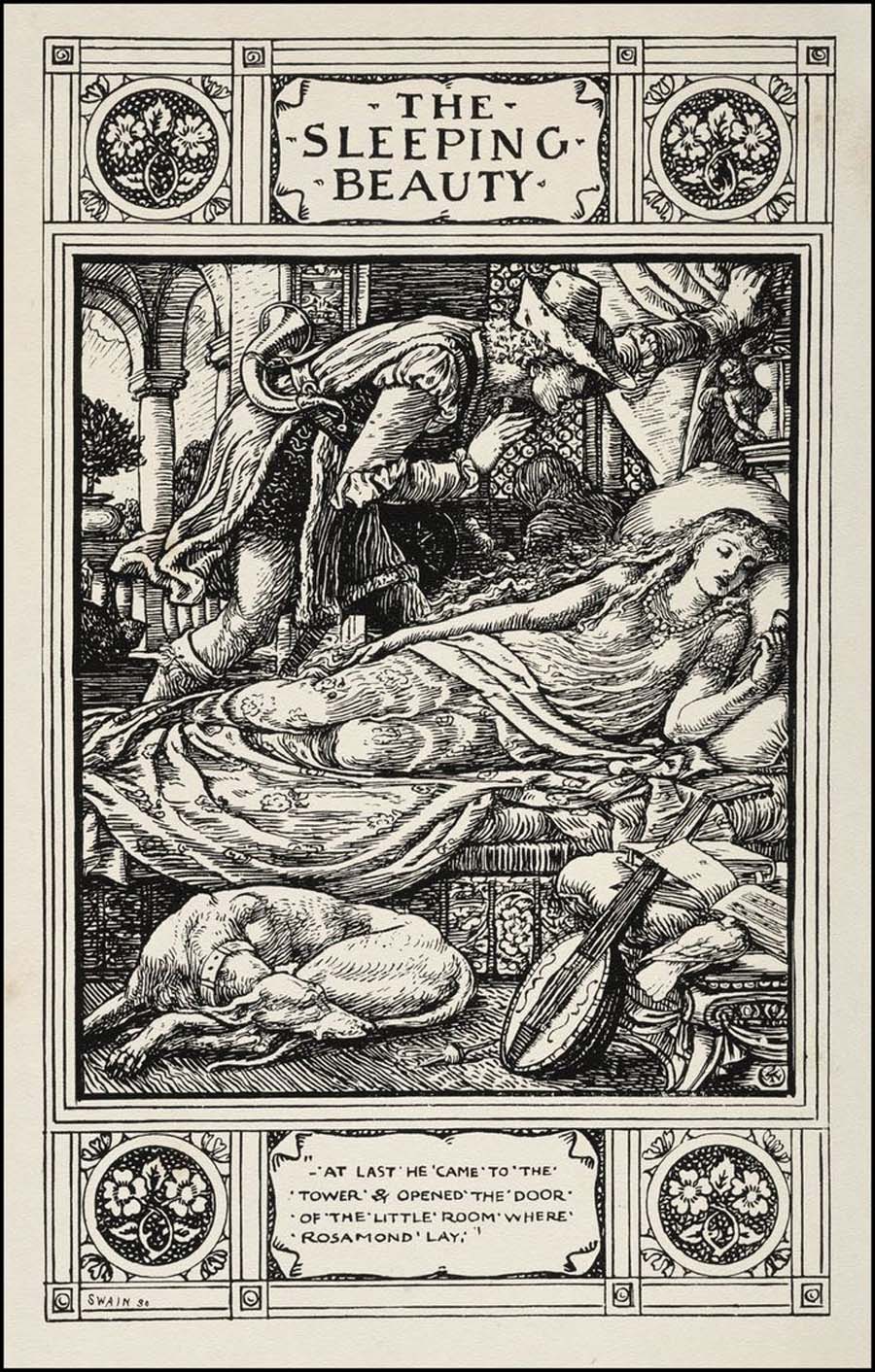
A king and queen, after a long wait, finally have a child, a girl. To the christening, they invite the seven fairies, for whom they make special gifts. However, at the christening, an eighth, an old fairy, who hadn’t been seen in fifty years, shows up and is insulted that there is no special gift for her.

One of the fairies, overhearing the old fairy’s grumblings, hides herself when the other fairies bestow their blessings of beauty, grace, and talents upon the child. The old fairy declares the girl will die one day after pricking her finger on a spindle.

The seventh fairy remediates the curse, saying the girl will not die, but rather fall into a hundred-year sleep to be awakened by a prince. The king, nonetheless, proclaims spinning wheels and spindles are banished from the kingdom.

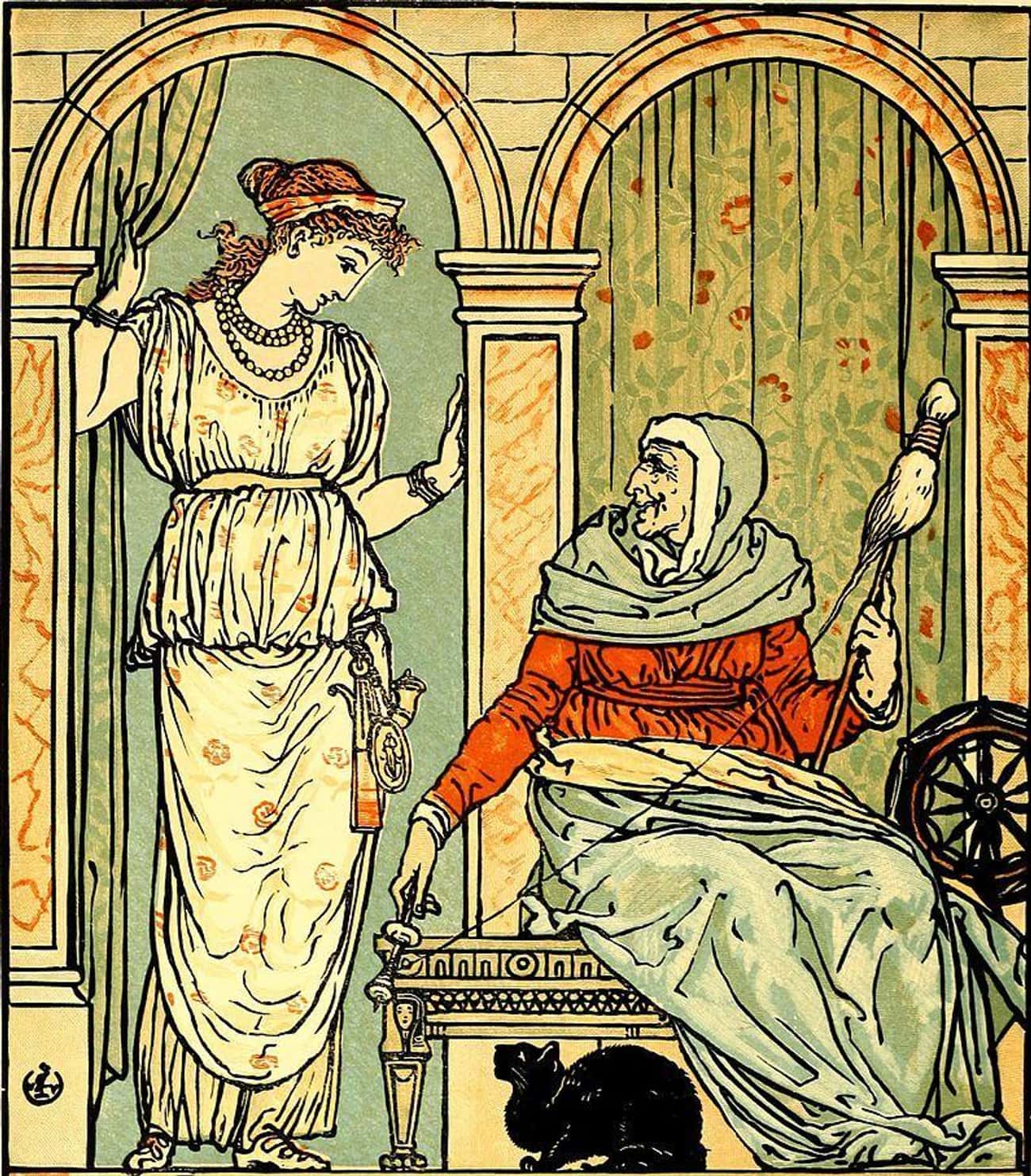
All goes well for fifteen or sixteen years until the girl, exploring the rooms in the castle, comes across an old woman who does not know about the proclamation and is spinning. The curse is soon fulfilled.

The seventh fairy, who is twelve thousand leagues away, soon hears news of the disaster from a little dwarf wearing seven-league boots. She returns in her chariot of fire drawn by dragons to put everyone to sleep except for the king and queen. They kiss their daughter goodbye and leave before trees and thorns quickly grow up around the castle, preventing anyone from entering.

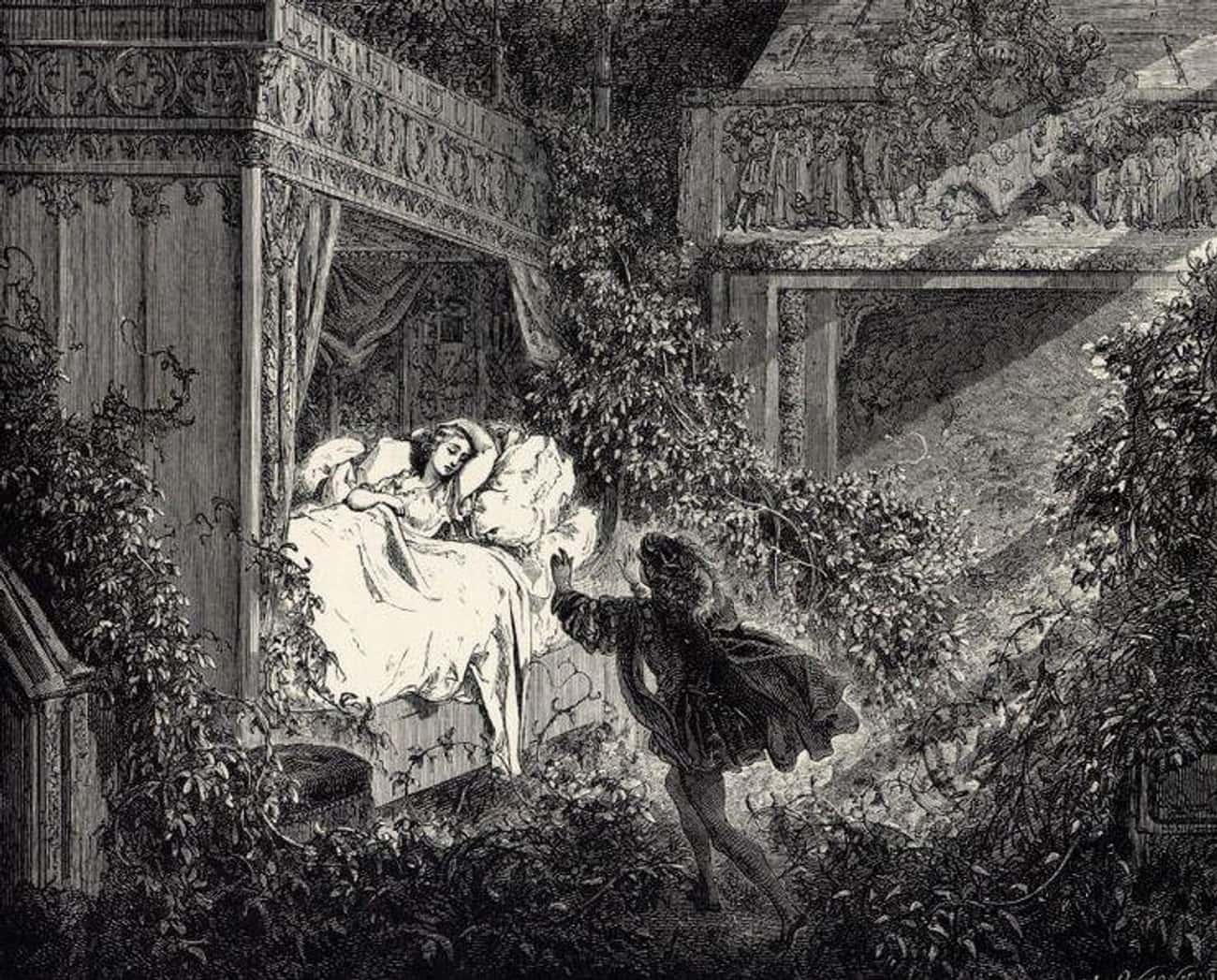
After a hundred years, the rule of the kingdom has passed to another family, and the prince of that family is out hunting when he hears the story of the sleeping princess. When he approaches the castle, the trees and thorns part for him. He no sooner finds the princess than she wakes up, the hundred years at that moment ending. There is much celebration in the castle, and the marriage is quickly held.

However, the prince does not reveal his secret marriage to his family for two years until his father dies and he becomes king. By then he and the princess have two children, “Dawn”, a girl, and “Day”, a boy, and he brings them to court.

Soon the new king is obliged to go to war and leave his wife and children in the care of his mother. She, unfortunately, is an ogress and decides to eat them instead of care for them. Her cook takes mercy on them and hides the princess and the children, dishing up animals in their place.

The ogress discovers the ruse. She causes a vat to be set up, filled with snakes, toads, and other hideous creatures, into which she intends to throw the princess, her children, the cook, and other accomplices. Just then the king returns, the ogress throws herself into the vat, and the innocents are spared.

Thalia closes the book with a pout pursing her lips.

Fairy Tale of the Month: February 2022 Sleeping Beauty in the Wood – Part Two

Gustave Doré

Dueling Devices

“My dear girl,” I say, “it’s simply a variant.”

“I know it’s a variant, but it’s so different, and why did he change it?”

“Let’s assume,” I chuckle, sensing a teachable moment, “you have made assumptions.”

“Like?” Thalia eyes me with suspicion.

“That you think either Disney or the Brothers Grimm provide the real story.”

“The Grimms, of course, although I think Disney is pretty cool.”

“And I’ll assume you have forgotten the Grimms’ version is called Briar Rose.”

“Oh.” Her eyes widen a little, “I did, but it’s the same story.”

“And I’ll assume you didn’t know the Grimms came along a hundred years after Perrault, with whom you are taking exception.”

“Oh.” She is a little stunned. Youth, including Thalia, live in the present where everything happens at once and think that history—the past—all happens at once as well.

“Then,” Thalia pauses, “it was the Grimms who changed the story.”

“Well, so did Disney, and I’ll bet Perrault did as well. I propose a race,” I say, pulling my laptop out of its drawer and plugging it in. “Let’s see which of us can find the most versions of Sleeping Beauty.”

Thalia is on her phone in a second; it’s the challenge of the dueling devices. Silence falls between us as we click and swipe away.

I head over to Wikipedia, which I consider to be the people’s encyclopedia. If nothing else, it is democratic with a small “d.” Wikipedia leads me to its entry on Perceforest, a chivalric romance, 1330 -1345, that I’d not heard of before. Apparently pre-Arthurian. However, the article does not point out to me where in this huge compendium our story is to be found.

“Oh, my!” Thalia’s voice breaks into my thoughts.

“What did you find?”

“Giam-something Basile, 1634.”

“Where are you?”

“Internet Archives.”

If it is public domain, it will be in the Internet Archives’ book collection. I find his Penatamerone.”

“Look for Sun, Moon, and Talia. Almost my namesake.”

I do. Oh, my. I didn’t intend to lead her towards something like this, and almost a namesake.

“Not politically correct,” I say.

“Rather indecent,” Thalia returns.

By simply searching the words “Perceforest Sleeping Beauty,” I come up with a link to the passage in question. I point this version out to Thalia, although it is not much of an improvement over Basile’s version. All that can be said is the prince is goaded toward his reprehensible behavior by the goddess Venus.

I head next to D. L. Ashliman’s site, University of Pittsburgh. His translation of the tale he calls Little Brier-Rose. In his notes, he infrms the reader of six other English translators of this tale, that the source was Marie Hassenpflug, and that the tale is listed as Aarne-Thompson-Uther tale type 410 – Sleeping Beauty.

I next check out Sur La Lune. On this site, Heidi Anne Heiner has annotated a number of tales, Sleeping Beauty being one of them, which I find useful. For example, Perrault made a reference to Hungary water in the tale. Heidi explains that Queen of Hungary Water is thought to be the first alcohol-based perfume, dating back to the 1300s. She also includes illustrations from many of the tales on her site.

I hear Thalia talking to her phone. “Disney, Sleeping Beauty,1959.”

This could be interesting. That was sixty-three years ago. Seems to me like yesterday.

Fairy Tale of the Month: February 2022 Sleeping Beauty in the Wood – Part Three

Walter Crane

More Searching

Thalia beams. “I found the Disney Wiki. It’s a fan site and the article on Sleeping Beauty is looong. I mean it goes on. A lot of production notes. I remember watching this when I was really little. They filmed live people for the animators to copy the movements. Who was Audrey Hepburn?”

“A well-known actress in my day.”

“Yeah, well, they based Aurora’s body on hers.”

“Minus the blond hair,” I say. “Audrey’s was dark. Aurora; I’d forgotten they’d given her a name.”

“Looks like they named about everyone. Princess Aurora, Prince Phillip, King Stefan, King Hubert, Queen Leah, Flora, Fauna, Merriweather, Maleficent—Oh, I like that name.”

I see Thalia going down the Disney rabbit hole. Surely she won’t run into Giambattista Basile there.

In Perceforest and in Pentamerone a number of characters had names, in Perrault’s tale only the two children, and in Grimm there is only one name given, Briar Rose, and that bestowed upon the princess halfway through the story. Then Disney comes along handing out names rather freely, much against fairy-tale norms. However, film is a different medium. I guess they felt the needs of a film audience to be different than that of a fairy-tale reader.

I remember that Margaret Hunt’s translation of Grimm included the author’s notes. I gamble on Project Gutenberg having a copy. They do, but the work is transcribed and the author notes are not included. I return to good old Internet Archive, where both volume one and volume two of the original book have been scanned in.

“According to the Grimm brothers’ notes,” I say proudly of my discovery to Thalia, “they trace the Sleeping Beauty story back to the Norse saga of Sigurd and Brünhild. The Valkyrie Brünhild, because of the sleep-thorn with which Odin has pierced her, sleeps inside a wall of flame that only Sigurd is able to penetrate.”

“Cool. A wall of flame. I guess we can’t get much further back than that. But I’m still at the other end with Walt Disney. He had two teams of writers reworking the story over a couple of years. In the end, they had the princess hiding out with three fairies, who she thought were her aunts, until she was sixteen. Also, she meets Prince Phillip, neither of them knowing their fathers have them engaged. Maleficent finds out where she is hiding, gets her to prick her finger, and then kidnaps Prince Phillip so he can’t kiss her. He escapes with the help of the fairies, battles Maleficent, who is in the form of a dragon, and finally gets to kiss Aurora.

“Wow, and I had begun to think the Grimms had changed the story too much. But Disney dropped the Perrault and Basile’s ending with the two children and lost the hundred-year’s wait. And after all that the film was a failure, but, yeah, made up for that big-time with the re-runs.”

“I wonder how much different the next iteration of Sleeping Beauty will be. Fairy tales will change to suit the times and the culture in which they find themselves you know.”

“Hmmm.”  Thalia has her contemplative look. “Maybe I’ll write the next version.”

Your thoughts?
Fairy Tale of the Month: November 2021 The Crystal Ball – Part One

Fulham Palace 1902

Another Search

Fulham Palace was the home to the bishops of London for better than a thousand years. Many of these bishops left their mark on the palace causing it today to be a muddle of architectural styles. However, Melissa and I are attracted to its thirteen acres of botanical gardens, a walled garden, and palace courtyards. There should be lots of gates, gateways, and doors. We also take in the five-hundred-year-old holm oak tree simply out of reverence.

We wander through the knot garden, which runs beside the greenhouse and a fabulous brick gateway that I point out to Melissa.

“How quaint,” she says. “It would make a fine entrance into the Magic Forest, but it is not the one of my vision.”

“I thought not,” I say. “ Let’s head for the palace proper. These gardens are a little past their seasonal prime, and I am getting chilled.”

We pass through the gateway, which leads us toward the palace.

“What has Thalia been reading to you?” Melissa inquires.

“Last night it was Grimm’s The Crystal Ball.”

“I don’t know that one.”

“I hadn’t noticed it either. It’s number 197 in the canon, stuck between Old Rinkrank and Maid Maleen toward the end of the book.”

A sorceress had three sons whom she did not trust. She turned the eldest into a whale, the second eldest into an eagle, but the youngest slipped away, intent both on avoiding transformation and on rescuing an enchanted princess at the Castle of the Golden Sun, although he did not know where the castle stood.

He came across two giants arguing over a magic hat. They wanted him to settle their dispute, and he proposed a race. He moved off to put distance between himself and the giants and thoughtlessly put on the hat. Soon, he stood at the gate of the Castle of the Golden Sun.

He found the princess, but she was ashen-gray and wrinkled. She told him to look at her reflection in a mirror to see her true form, upon which he saw a most beautiful woman.

She also told him that he would be the twenty-fourth to try to save her and die in the attempt, and also the last to be allowed to try. He, nonetheless, insisted on trying.

She instructed him that he must get a crystal ball and show it to the magician to break the spell he cast upon her. To do this, he must fight with and slay a bison that will turn into a firebird. In the firebird is an egg. As its yoke is the crystal ball. If the egg falls to earth, it will set all around it on fire and destroy itself, including the crystal ball.

 The youngest brother fought and slew the bison. The firebird was chased over the ocean by the eagle—the eldest brother—but the egg dropped not into the ocean but onto a fisherman’s hut by the shoreline. A wave, created by the whale—the second eldest—put out the fire, and the youngest retrieved the crystal ball undamaged.

The magician, his power destroyed, revealed that the youth was the new king of the Castle of the Golden Sun and had the power to restore his brothers. He returns to the princess, now in her true form, and they exchange rings. 

Melissa and I have come to the palace courtyard.

No,” she says, “I have not heard this one. Interesting elements.”

Fairy Tale of the Month: November 2021 The Crystal Ball – Part Two

Sorceress – Dorothy Lathrop

Some Reflection

“I am rather struck by the sorceress,” says Melissa, as her eyes scan the palace courtyard in search of her door.

“How so?” I ask.

“In that she does not quite fit the stereotype of a woman with magic; they are usually called a witch or a witch/queen. The term sorceress rarely applies. Her victims are often her new husband’s children—evil stepmother in other words—not her children. In the end, she gets her just punishment.

“Here it is a sorceress who doesn’t trust her own three sons and tries to do them harm. Having almost accomplished this, she disappears from the story and doesn’t come in for punishment.”

I consider her words. “I believe she is there for the story’s sake to set up the first two brothers as magical helpers, after which the story no longer needs her. Therefore, she disappears like so many fathers do in these tales after committing some initial harm.”

“Oh, I  understand that,” she says, peering at another gateway to wander through, “but if I were the storyteller—and given my modern sensibilities and education—I’d have the first brother go off to save the princess and get turned into an eagle by the magician. The second brother would follow suit and get turned into a whale, but the third brother would outsmart the magician and with the aid of his brothers, whom the magician ironically turned into magical helpers, defeat the magician. I’d have no need for a sorceress at all.”

“Dear me, you’re not going to start rewriting fairy tales are you?”

“No, no, I haven’t even finished that book on sacred wells I once started. I guess I am saying that the fairy-tale structure is not modern. It follows more of a dream structure. Things can be disjointed, loose in connections, contain unnecessary and quickly forgotten details, not explain motives; and that is all right for the genre.”

“It does hold to all the tenets of bad writing and yet remain popular,” I agree.

“Tell me more about the mirror thing,” she says unexpectedly.

“Well, if I recall Thalia’s reading, when the youth is disappointed in the princess’s appearance, she hands him a looking glass, saying human eyes can be fooled but not the image in a mirror. There is her true form.”

“Then,” she observes, “this is not Snow White’s mirror, mirror on the wall.”

“No, I think she handed him an ordinary mirror.”

Melissa stops walking. “What pops into my mind is the folklore about vampires not casting a reflection in ordinary mirrors. Both that legend and the Snow White tale have to do with mirrors but are quite different. Yet, both mirrors—magical or not—tell the truth.”

“There is the evil mirror in The Snow Queen,” I suggest.

Melissa waves a hand dismissively. “That’s Andersen, hardly of folk origins. I think we would find that mirrors in folklore have a reputation of honesty if they are a little cruel at times.

“But I am wondering if I should be looking about with a mirror to find my door. Perhaps human eyes can be fooled.”

Good grief!

“I suspect,” I say, “you might attract unwanted attention doing such a thing. But look, I understand the palace has a very pleasant café and it would be warm.”

Fairy Tales of the Month: November 2021 The Crystal Ball – Part Three

John Waterhouse

Crystal Ball

The café is in what was a drawing room of the palace, whose color scheme is gold and white. Along with chandeliers and large windows, it is a wonderfully bright room even on a cold, late-fall day.

With warmth in mind, I order the Autumn Porridge (coconut milk, cranberries, and apples, topped with cinnamon coconut flakes) and a large mug of hot chocolate. Melissa takes the Winter Root Vegetable Salad (which is what it sounds like) and tea.

As the hot chocolate warms up my brain, a remembrance comes to me. “I know of another mirror story, an Estonian tale called nothing less than The Magic Mirror, which I read a long time ago. It’s got the three-brothers motif. The king, their father, sends them off to look for a magic mirror that he’s heard of that would restore his youth if he looked into it.

The eldest two brothers are wastrels and hang out at an inn while the youngest brother enters a dark forest. He encounters three aged sisters in turn, each giving him aid, and travels on a hawk’s back to a remote island kingdom where a princess keeps the mirror.

With the hawk’s aid and advice, he steals the mirror and her golden ring. As he was returning, the older brothers steal the mirror from him in order to take credit for their father’s restoration and to get their brother banished from the kingdom.

However, with magical gifts from the three sisters, he becomes a king in his own right.  When the princess shows up, searching for her ring and mirror, they end up getting married, living happily ever after, of course, with the mirror somehow getting lost.”

My porridge arrives, and I ladle into it letting Melissa talk.

“That mirror,” she says, “like Snow White’s is a magical device. As well-known as the phrase ‘Mirror, mirror, on the wall’  is, the popularity of other magical mirrors is pretty nonexistent. I’m not counting literary treatments like The Snow Queen or Through the Looking Glass. I wonder if the mirror in Snow White is favored because it talks to the queen.”

“Inanimate objects talking does catch the imagination,” I agree, as I feel warmth return to my body. “I believe the crystal ball suffers the same fate as the noncommunicative mirrors. These glass balls turn up in fewer stories than one would predict, at least in the western European tales.

“Purportedly, druids used crystal balls, but I know of no Celtic tales that refer to them. Even the ball in our Grimm story is not used as a crystal ball should be used to look into the past, present, or future. Instead, it is an element in the motif of the heart/soul of a deathless wizard/giant inside of a duck/eagle, which is inside. . . etc.”

“I rather liked the image of the crystal ball serving as the yoke of the egg.” Melissa stops, and a glaze passes over her eyes. “A crystal ball,” she muses. “Maybe that is what I need to find my door.”

Well, that does sound more reasonable than stumbling around public gardens with a mirror.

Your thoughts?
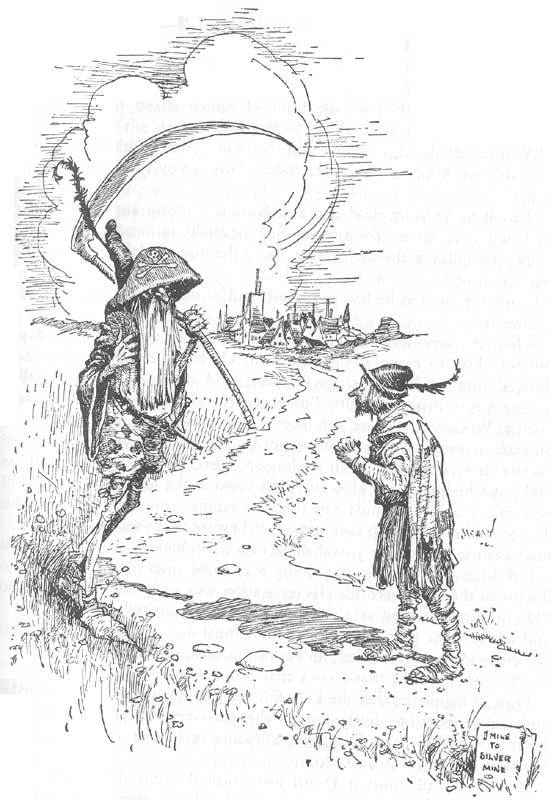
Fairy Tale of the Month: October 2020 Godfather Death – Part One

John Gruelle

All Hallows

Among Thalia, Melissa, and myself, we decided to observe All Hallows Eve with our own party; in costume, of course. Melissa considered whether or not she should do her same-old, same-old costume as a witch. I suggested she pose as Lady Godiva, and she told me to behave myself.

Melissa is dressed as a witch and I as a sorcerer. Thalia has chosen to be an imp. I think the pointy rubber ears become her.

Our party table is replete with three bowls of sweets that I allowed Thalia to pick out at the grocery. One bowl is full of Lion Chocolate Bars and Lion White Bars. (Thalia could not decide which she likes better.) The second bowl is of Walkers Nonsuch Salted Caramel Toffees, and the third of Taveners’ Jelly Babies. Melissa brought brownies with white chocolate chunks, and I baked a pumpkin pie dusted with icing sugar. We have to run back and forth from the study to the refrigerator in the kitchen to make the pie à la mode. Instead of apple cider there is Cidona (the fizzy, non-alcoholic one) at Thalia’s request. For those of us who prefer a drier sort of drink, a bottle of Renegade London Syrah graces the table. A sip of the syrah sends Thalia’s face into sour mode and she returns to her apple soda.

The climax of our little party is Melissa’s reading from Grimm: Godfather Death.

A poor man, on the birth of his thirteenth child, a boy, is looking for a godfather. He refuses both God and the Devil, who offer their services, and chooses Death, because he treats the rich and the poor alike. When the boy is of age, Death teaches him how to cure people with an herb. Death also tells him, if he sees Death standing at the head of the bed, the cure will work. If Death stands at the foot of the bed, the cure will not work.

Armed with this knowledge, the godson becomes a great and wealthy physician. However, when the godson is summoned to cure the king, he sees Death at the foot of the bed. Instead of allowing Death to take the king, the physician turns the king around on his bed so that Death is standing at the king’s head.

Death allows his godson to get away with that trick once, but when the physician tries the same trick again to save the princess, who’s cure promises her marriage and the kingship to the physician, Godfather Death has had enough. He whisks his godson down into the underworld.

There, in a cave, are thousands of burning candles, one candle for every living person. Death points out the physician’s candle, a short stub with a flickering flame. The godson pleads with Death to extend his life with another candle so that he may marry the princess and become a king. Death, feigning to do so, actually snuffs out the candle, and the godson falls down dead.

Thalia, a half-eaten Lion Bar in hand, contemplates the image.

“Candles. Cool.”

Fairy Tale of the Month: October 2020 Godfather Death – Part Two

George Cruikshank

Fatal Flames

“Candles indeed,” says Melissa, as her hand hovers over the three sweets bowls in turn, then dives in for a toffee. “It brings to my mind the Catholics’ blessed candles.”

“Or the Jewish yahrzeit candles,” I reply, considering a handful of Taveners’.

“There is a difference.” Melissa knits her brow under her witch’s hat. “The blessed candles are lit when it is thought that a person is dying. I believe the yahrzeit is a memorial candle.”

“Yes,” I say, “lit in honor of someone on the anniversary of their death.”

“If I recall correctly,” Melissa takes a sip of her wine, “in both cases, the candles should be made of beeswax; at least the Catholics are pretty insistent that it be no less than 51 percent beeswax.”

While we talk, Thalia jumps up, turns off the overhead light and table lamps, and returns to where we are sitting with a single lit candle.

“Atmosphere,” Thalia grins.

“Good thought,” agrees Melissa. “But really, I think the candles in our story are corpse-candles.”

Thalia’s eyes widen. “What are corspe-candles?”

“Supposedly,” Melissa’s eyebrows arch, “the souls of the dead may appear as flickering flames floating above their graves. Or worse, they float about the marshlands at night to lure lost travelers from the path into treacherous bogs.

“A number of the tales are about a man, usually a blacksmith, who is nasty and a trickster. He is clever enough to even trick the Devil, who has come for him, into letting him live longer. The blacksmith manages to trick the Devil more than once.

“But, eventually, the blacksmith must die. When he does, he has been too bad to go to heaven, and the Devil won’t let him into hell. The Devil’s only concession is to give the blacksmith an ember, telling him to go make his own hell.

“The blacksmith takes the ember, puts it into a carved-out turnip to serve as a lantern, and wanders around in the wilderness luring, as I said, unwary travelers to their death. The blacksmith is often named Will or Jack, and his spirit form is “will-o’-the-wisp” or “jack-o’-lantern.”

Thalia’s eyes light up in recognition. “And now it’s a pumpkin!”

“Quite right.” Melissa nods.

“There is an argument,” I say, “that the blacksmith and the Devil, and the tricking of Death or the Devil is quite an old story. By old, I mean Bronze Age.”

“How could anyone know that?” protests Melissa, taking another sip of wine.

“I heard about it over the BBC. It is a little hard to follow, but it has to do with ideas borrowed from evolutionary biology. I think it’s called the phylogenetic method.”

“Pardon?” Melissa scowls.

“Well, it studies and compares things like population histories, languages, marriage practices, political institutions, material culture, and even music. When it comes to the tales, it’s the “tree” of Indo-European languages that shows traces of the tales. Actually, the idea that the tales can be traced going back through the Indo-European languages was first suggested by the Grimm brothers.”

“The Grimm brothers notwithstanding, I’m not buying any of it.” Melissa’s eyebrows fairly dance under her hat. “Phylogenetic, my foot.”

Thalia giggles.

Fairy Tale of the Month: October 2020 Godfather Death – Part Three

Otto Ubbelohde

Cheating Death

The fairy flutters out of the dark, and perches on my granddaughter’s shoulder. Thalia holds her Lion Bar up to her. She sniffs it suspiciously, then glares sharply at Thalia.

“I guess not,” says our costumed imp.

Melissa can hardly take her eyes off the fairy. I don’t think Melissa has seen her since she invaded the bookstore, and Thalia had to come and retrieve her.

“While I can’t agree with your phylogenetic whoevers,” Melissa says, not averting her stare from the fairy, “the blacksmith and the Devil’s motif of cheating death is certainly a popular one in these tales.”

Melissa manages to pull her attention back to me, if only for a few seconds. “I do recall a Czechoslovakian version of Godfather Death, but in this case it is Godmother Death.”

“Oh, really,” I say.

“Yes, death is a woman, a bit nicer than Grimm’s godfather. The father of the son, for whom Death agrees to stand as godmother, is able to extend his own life by lighting a longer candle for himself. Death is not pleased, but lets him get away with it. She makes the father a physician. He plays the head-to-foot trick, and, again, gets away with it. However, this physician does not press his luck any further and lives a long life due to his trick with the candle.

“Godmother Death then causes his son, her godson, to also be a successful physician.”

All this while, Melissa and the fairy have been looking at each other. Melissa extends an index finger like a bird’s perch. The fairy takes the hint and flutters over to Melissa. It is Thalia’s turn to raise an eyebrow.

“I think she likes you.”

Melissa’s smile beams as the fairy cocks her head from side to side regarding the costumed witch.

“Returning to the thought of cheating death,” I say, not wanting to lose the thread of our conversation. “There are two things that come to me.”

I look into the candle flame to focus my thoughts. “First is that the impetus for wanting to cheat death is simply wishful thinking. Death has an unpleasant finality to it that we rather put off as long as possible. These story characters sometime succeed as we would like to do.

“Second, and conversely, I believe there is a rather abnormal amount of deaths in the fairy tales. Let us consider the count when you include mothers who die at the start, leaving the heroine an orphan; princes who were beheaded in the pursuit of the princess’s hand, even before the story starts; evil stepmothers’ punishment for their cruelty, witches’ punishment for their cruelty, and evil stepmothers who are also witches getting the same treatment; the occasional dragon and giant destroyed by the hero; and even kings who die of natural causes allowing the kingdom to pass to the hero and heroine.

“Really, I think that there are as many deaths as marriages in the tales.”

Looking up from the candle flame, I see Thalia and Melissa are both watching the fairy intently; she lounges on her new friend’s finger. They haven’t heard a word I said.

So much for costumed sorcerer’s pontifications.

Your thoughts?