Fairy Tale of the Month: July 2014 The Three Snake Leaves – Part One

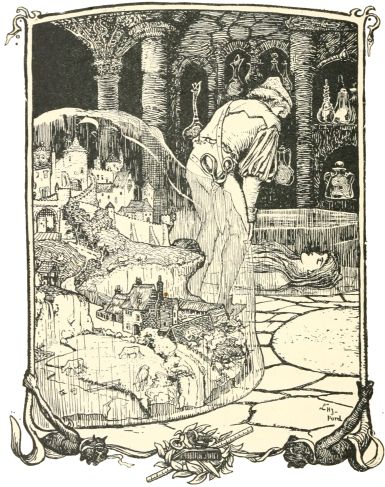
Three Snake Leaves FordH. J. Ford

Unfaithful

“What? Is that it?” Thalia is incredulous and indignant.

“Yes, I am afraid so.”

“I don’t like that story.” Thalia stalks off to bed with Teddy dragging behind.

I do like the story, but I shouldn’t expect a tale of infidelity to be a kid’s thing. What disturbs her is The Three Snake Leaves.

A poor, young soldier, through dint of senseless bravery, becomes the king’s favorite. More emotional than cautious, he falls in love with the king’s daughter.

The field for his pursuit is clear, given the princess’s declaration that she will marry no man who won’t agree to follow her to the grave, no matter when her death may occur, and she vows to do the same for her beloved.

He, she, and the king agree to the bargain, and the marriage soon follows. Her untimely death is not far behind.

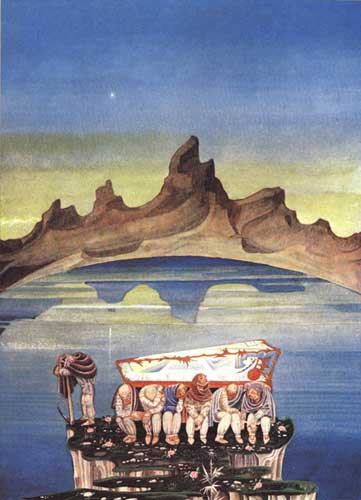
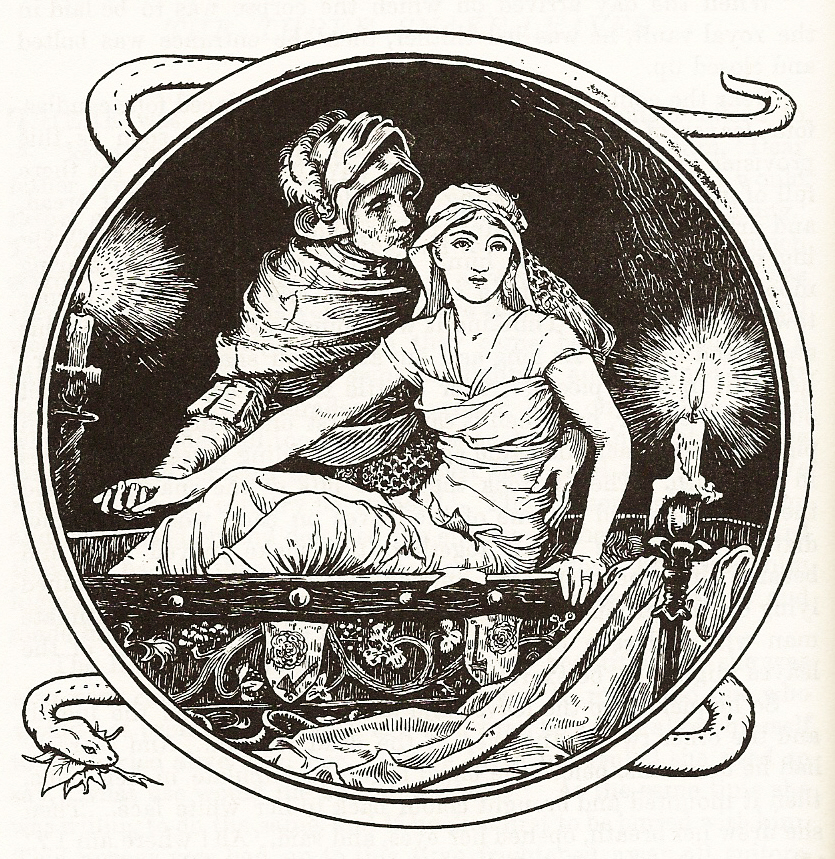
Sitting in the crypt with his wife’s corpse, he stares at the four loaves of bread, four bottles of wine, and four candles provided to him. These he rations, but death slowly approaches.

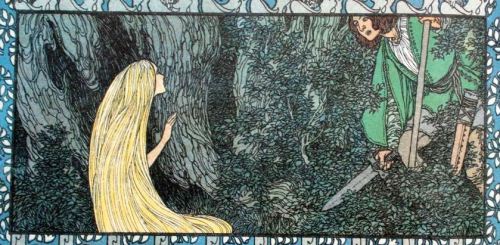
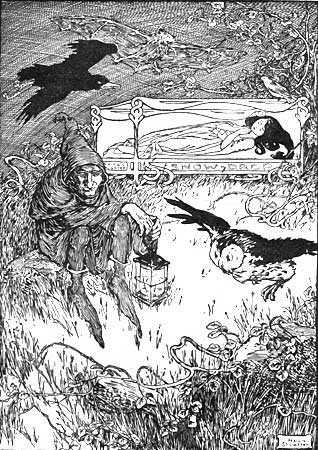
As he sits, waiting for his demise, a snake slithers into the tomb, moving toward the body of his love. He leaps up, sword in hand, cutting the snake into pieces. Presently, another snake appears, departs, and returns with leaves in its mouth. These it places on the body of its companion, which wiggles out from under the leaves, and they slither away together.

The youth takes the leaves and puts them on the eyes and mouth of his wife, and she begins to breathe.

Returned to life, his wife unaccountably loses her love for her husband. On a sea voyage, she develops a passion for the ship’s captain. Together, they throw her husband overboard to his death.

His faithful servant lowers a small boat, retrieves his master’s body, and restores him to life with the snake leaves. Together they row for home, returning before the faithless wife.

The king gives his daughter enough time to incriminate herself, then sends her off with her captain-lover, in a boat bored with holes, to sink beneath the waves.

No surprise that Thalia is not enamored of this story, but not all stories collected by the Grimms were told for a youthful audience. The tales were as often told among women for women. This one, I will guess, was told as a cautionary tale.

Not for the first time, I sense a feminine mind behind a story, challenging my masculine outlook. The hero of this tale is not in charge of his fate. First, he throws himself at the feet of valor. Soon, through passion, he places himself at the behest of his wife’s will. He triumphs, through luck, only to be murdered at the hand of the one he saved, then saved himself by a servant. In the end, the king, not our hero, decides everyone’s fate.

Had the story reversed the role of the sexes, had a heroine agreed to her husband’s demand to follow him to the grave, had she saved him only to have him be ungrateful and pursue another woman, we would nod our heads, identifying a familiar theme.

With The Three Snake Leaves I am a little stunned at the princess’s boldness, and ultimately, the passive nature of the hero.

Plus, where have I heard this tale before? I think a conversation with Augustus is in order.

Fairy Tale of the Month: July 2014 The Three Snake Leaves – Part Two

William-Adolphe_Bouguereau_(1825-1905)_-_Arion_on_a_Sea_Horse_(1855)William Adolphe Bouguereau

Arion

I stand at the door of Augustus’ shop, my hand on the latch, but my eyes on the sign that reads, “Closed. On Vacation.” My fingers, disbelieving, try the lock anyway. He goes on vacation this time every year and every year at this time I forget.

Deflated, I linger on the sidewalk. Across the street, in bold lettering on a plate-glass window I see, “Serious Books, New and Used, Melissa Serious, Proprietor.”

I have purpose again. As i enter the shop, a young red-haired woman, sitting behind the counter, gives me a pleasant nod and returns to her reading. I browse, noting the rather strange arrangement. The new books are not up front and the old in back, but are intermixed by subject. Simple handwritten signs list the subject headings: Literature (by far the largest section), Philosophy, Science, Religion, etcetera, but no signs for Romance, Mystery, or Self-help.

“No Self-help?” I query aloud from the back of the store.

“I don’t cater to the helpless,” she calls back, not looking up.

I come to the counter, “And no Romance. I’ll take it you’re not romantic.”

“Oh, I can be very romantic, as long as the subject is nineteenth-century Romantics.

“Excellent,” I say. “Have you Margaret Hunt’s translation of Grimm with the notes?”

“Oh, hard to come by. I can do a search. I am tenacious and can locate most titles within a month.”

“Good. Please do so.”

“That work is also available through Internet Archive,” she suggests.

“My dear, you’re not going to sell books by referring customers to the web.”

She fixes me with her green eyes. “You are the sort who wants a book in hand.”

She has me pegged.

As she takes my information for the book search, I notice she is reading a Penguin edition of Herodotus’ The Histories. The page is propped open with a glass paperweight to the section on the musician Arion. That’s where I heard the story before.

Melissa notices my wonderment.

“I am standing here,” I explain, pointing to her book, “realizing the story of Arion is the last half of The Three Snake Leaves.”

“Oh?” She picks up her book and reads aloud. Her contralto voice transports me. In this tale, Arion, a  musician at the court of King Periander, the ancient Greek tyrant ruler of Corinth, is robbed by the sailors on the ship that is carrying him home. He is given the choice of burial at sea or burial on land. Stalling, he offers them a song. The music attracts a dolphin, which, when Arion casts himself into the sea, carries him off. The sailors believe Arion has drowned. Arion returns to Corinth before the sailors appear, and King Periander lets the sailors falsely declare they buried Arion, revealing their deceit.

Melissa then goes to her Literature section and returns with Jack Zipes’ translation of Grimm.

“You don’t have a Children’s section, either,” I comment.

“I have plenty of children’s books, they are all under Literature.” She reads aloud The Three Snake Leaves much to my enjoyment.

“Yes,” she contemplates when she finishes reading. “The difference is the role of a woman—and not a woman to serve as a role model I must add—which put a different light on the moral. Instead of dealing with dishonesty, we witness unfaithfulness.

“Nonetheless, I feel sympathy for her. The woman she is at the start of the story is not the woman she is by the end. The princess suffers a loss of morals in her resurrection, assuring her return to death’s grip.”

I remain quiet as Melissa thinks, her hand to her chin.

“The hero,” she continues, “also is brought back to life by the snake leaves, but we hear nothing of a change in him. Nor do we hear a word from, nor do we really see, the captain.

“No, this story is not about the protagonist, the young man, it is about her.”

“Then, it is a woman’s story,” I conclude.

Melissa’s green eyes flicker. “Yes, yes it is.”


Fairy Tale of the Month: July 2014 The Three Snake Leaves – Part Three

Rod_of_Asclepius2Rod of Asclepius

Authorship

I can see the light of the moon washing over the enchanted forest through the bay windows of my study, prompting me to engage in an evening of late night-researching.

The two snakes in The Three Snake Leaves bring to mind the caduceus, the staff entwined with two snakes, carried by Hermes. Commentators state that the wand could wake the sleeping and put the awakened to sleep. Placed round the dying, death would be gentle; around the dead, the wand would return them to life. But the same commentators warn that the caduceus is confused with the Rod of Asclepius, which is one snake curled around a staff, the emblem of the Greek god Asclepius, the deity associated with healing and medicine. These two items make a suggestive muddle.

I follow Melissa’s suggestion and go online to find Margaret Hunt’s translation of the Grimms’ notes, although I look forward to having the Hunt translation on my shelf.

The notes mention two German sources from which the Grimms drew the tale, but speak more about its possible Greek origin, the story of Polyeidos and Glaucus. The seer Polyeidos (from Cornith just like Arion interestingly enough) is commanded by King Minos of Crete to return the youthful prince Glaucus to life. The young Glaucus has been found dead by Polyeidos, under extremely strange circumstances, in a barrel of honey down in the King’s wine cellar.

Minos imprisons the seer with the body of his son in the wine cellar until the seer can conduct a miracle. A snake crawls into the cellar and Polyeidos kills it. The companion snake appears, disappears, and returns with an herb to restore the deceased snake. Polyeidos uses the herb to restore the child.

The notes go on to cite the Norse saga of Asmund and Aswit, in which two friends swear to be as brothers and to follow each other to the grave. Aswit takes ill, dies, and Asmund holds to his promise, but takes provisions with him into the tomb.

What the Grimms don’t mention is that Asmund ends up wrestling with Aswit’s vampire-like ghost every night until Swedish grave robbers inadvertently release him. I find this not unlike the princess’s turn of nature after her passing through death, to become something of a monster.

I light my pipe and turn my comfy chair to look out the bay window at the forest, ghostly illuminated in moonbeams. What is this process of cobbling together pieces of other myths and legends, to come up with a story recreated by its teller?

Or, am I trying to give authorship to fairy tales? Likely there is no one author. Maybe these stories are not assembled by one teller, but rather are an accretion, added to by many tellers. That makes them the creation of a group mind. What do these tales then say about us? Have we created them in our own image?

This story, The Three Snake Leaves, draws from the stories of Arion, Polyeidos and Glaucus, Asmund and Aswit, or perhaps the variants they generated—sources in which the feminine aspect is missing. But in this tale, the princess’s will pushes the story forward. I can hear the mind of a single soul, lost somewhere in time, imbuing the plot with angst, a personal fear, projecting it forward, into my present. There is a She speaking to me.

Your thoughts?
Fairy Tale of the Month: June 2014 Old Woman in the Wood – Part One

Keyhole

Spying

I creep on tiptoe down the hall, returning from the linen closet with a fresh towel for my evening bath. Passing Thalia’s room I hear her piping voice. From its cadence I know she is reading aloud, obviously to Teddy.

If I am not mistaken, she reads The Old Woman in the Wood. I haven’t thought of that tale for a long time, and listen with my ear to the door to recall how it goes.

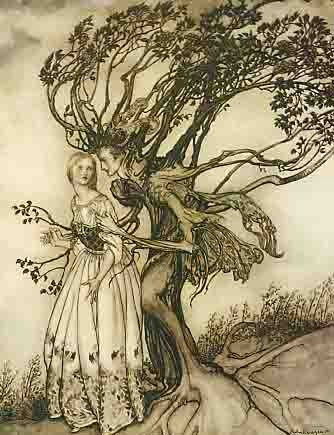
A poor serving girl travels with her masters into the depths of a large forest, where they are set upon by robbers. Jumping from the carriage, she saves herself while all the others are murdered. Friendless and helpless, she sits under a tree and awaits her fate.

A white dove appears with a golden key in its beak, telling her to open the lock on a certain tree. More keys and other trees provide the girl with all her needs.

The girl lives a contented and quiet life, until the bird makes a request. The girl is to go into the hut of the Woman of the Wood. The old woman will address her, but the girl is not to answer, but rather go into the next room where there is a table piled with ornate rings. She is to find a plain band and return with it.

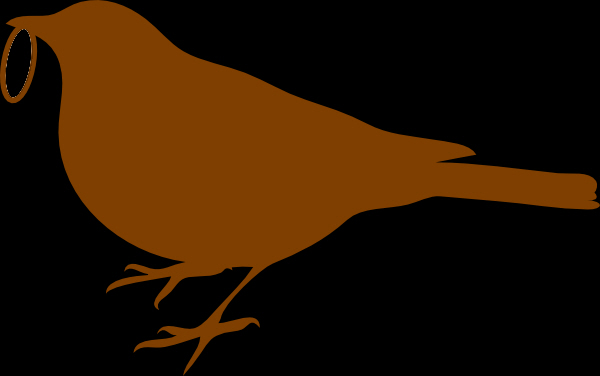
She does as the bird instructs, and the old woman is powerless to stop her, but  the girl cannot find a plain band among all the elaborate rings on the table. Catching the old woman creeping from the room carrying a bird cage, the girl gives chase, snatching away the cage. In it is a bird with a plain band in its beak.

With the band, she returns to her forest bower where one of the trees wraps it limbs around her and transforms into a handsome prince. Other trees turn into the prince’s entourage. The prince explains the witch turned him and his men into trees, but that he could also be a dove. They all go off to his kingdom where the girl and the prince will be married.

“I like the golden keys that open the tree trunks,” I hear Thalia say. “What about you?”

A little voice answers, “I like the table of rings.”

That can’t be Teddy, can it?

On my knees, I peek through the keyhole. Framed by the aperture, there is Thalia and, in front of her, the fairy.

“Oh,” Thalia claps her hands. “When the tree hugs her, I like that too.”

The fairy turns her head, her black hair floating about, and peers directly at me, her eyebrow raised. Seeing myself through her eyes, I am embarrassed. Peeking through a keyhole upon two innocents—whatever am I doing?

In the bath, I put aside my shame, and let the story images return to me.

What of the golden keys to the locks in the trees?

Why does not speaking to the old woman deny her power over the girl?

What of the table covered with rings?

What is the significance of the birds?

I may need to visit Augustus.

Fairy Tale of the Month: June 2014 Old Woman in the Wood – Part Two

Old Woman in the WoodArthur Rackham

Trees and Keys

Ah yes, Old Woman in the Wood,” says Augustus of my inquiry. “A personal favorite and one that has not gotten the recognition it deserves.”

The whitish smoke and rich vanilla odor of “Fairy’s Favorite” fills the air of his testing room, replete with comfy chairs, where he induces customers to try new blends. I can tell by the sparkle in his eyes I need only sit back and let him carry on.

“It is,” he says, “one of the most charming tales in the Grimm collection.”

“Charm?” I am taken back. “Her companions are all murdered in the opening scene.”

“Technically, yes. Symbolically, no.”

I rotate my hand to indicate he needs to explain this one.

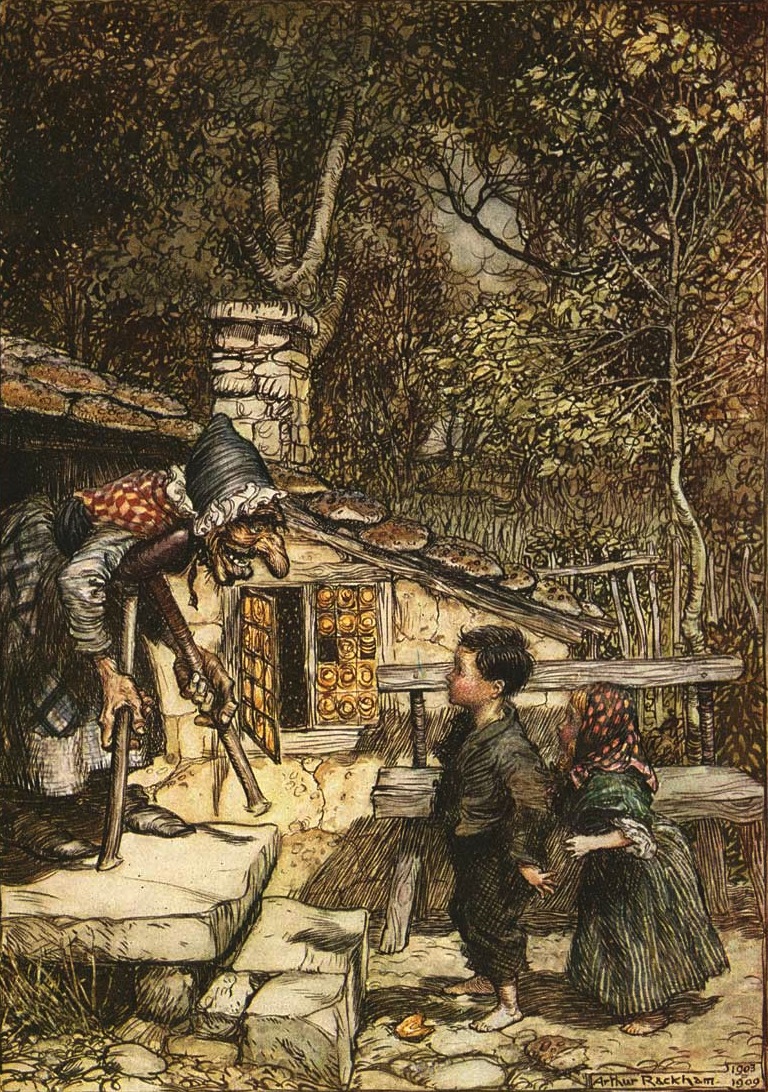
“You, of course, recall Hansel and Gretel, in which the evil stepmother casts out the children who fall under the control of the evil witch. When they destroy the evil witch, they return home to find the evil stepmother has died too.

“The same symbolic connection is here in this story between the entourage that is murdered by the robbers at the start and the entourage the serving girl restores at the end.”

I am left nodding approval. “What about the trees and the golden keys?”

“Aren’t they a lovely combination?” Augustus re-tamps his pipe and lights it again.

“A striking image,” I agree.

“Trees have a mysterious appeal. Norse mythology has Yggdrasil, the world tree. Magical baobab trees turn up in African tales. Tolkien took advantage of our fascination with tree mythos when he put the Ents into his trilogy,

The Old Woman in the Wood takes place deep in a forest, a place outside of the norm. Here resides enchantment. In this story the prince can transform into a dove for a short time each day. The trees magically provide the girl all of her needs. Enchanted beings have powers of  enchantment they did not have as humans, not unlike the flounder in The Fisherman and his Wife, who was also an enchanted prince. He had the power to grant wishes.”

“I hadn’t truly noticed that,” I confess. “And the golden keys?”

“Although trees and keys are associated in this story, they are of two different orders. Trees are living entities. Keys are inanimate and instrumental. A key never transforms into a prince. It remains a key.

“The keys given to the girl unlock the trees to provide her with food, clothes, and shelter. The image of tree trunks equipped with keylocks waiting to be opened, I find appealing. More often, keys unlock a forbidden room or box, and dire events follow.”

Augustus considers for a moment. “On the other hand there is The Golden Key.”

“I haven’t heard that one.”

“It’s deep in the book, tale number 200. It’s about a boy who finds a golden key on the forest floor. He reasons that where there is a key there might be a lock. He soon discovers a little iron chest. He puts the key into the lock, and the story ends with:

…he began turning it, and now we must wait until he unlocks the casket completely and lifts the cover. That’s when we’ll learn what wonderful things he found.”

Other customers enter the shop and Augustus rises to serve them. I must bide my time to ask the other questions.


Fairy Tale of the Month: June 2014 Old Woman in the Wood – Part Three


Bird with Ring

Rules

The veil of “Fairy’s Favorite” rises up around Augustus and me once again as we relight our pipes.

I speak first, “The dove asks the girl to bring him a ring from the hut of the woman in the wood. Quite clearly he instructs her not to speak to the witch. I sense there is something to that, which is not explained until we see the witch cannot stop her.”

“Rules of the game.”

“Rules of the game?” He is confusing me again.

“Fairy tales will often telegraph the action of their story by having a ‘helper’ explain the ‘rules of the game,’ as I like to call it, to the main character. For example, in The Twelve Dancing Princesses the old woman of the wood (of that story not ours) explains to the kind old soldier how to use the magic cloak to spy on the princesses and also warns him not to drink the wine offered by the eldest princess. The listener follows the old soldier and, with satisfaction, watches him act out the advice and succeed.

“In The Golden Bird the fox tells the young prince what he will see and what he must do at each of the castles they encounter. Unfortunately, the young prince is not good at playing by the rules and the listener sees the consequences, which are his continuing sorrows.

“It may be redundant to have the action that will happen predicted, but the interest for the listener comes in when the protagonist goes beyond what was instructed, such as the old soldier having to use his wits after following the princesses underground, or what follows when the protagonist neglects the rules, as happens between the fox and the prince.”

Another customer comes into the store, but Augustus is too intent on pursuing his point to acknowledge him.

“In our story, the girl, like the old soldier, does as she is told, but cannot find the ring. The dove’s instructions have failed her. However, she is clever enough to recognize that the witch is trying to sneak off with the prize.”

“What do you make of the bird in the cage with the ring in its beak?” I know I only have moments before the mercantile side of Augustus’s brain takes over.

“Birds are always fair game in these wonder tales. Look at some of the titles: The Raven, The Seven Ravens, The Six Swans, The Golden Bird, The Golden Goose.

“The image of the bird in the cage with the plain band in its beak is haunting, asking us to read significance into it. Is this bird the soul of the prince the witch captured and by returning the ring is the girl returning the soul to the prince?

“That explanation is tempting, but why then did the dove expect the ring to be on the table, hidden among other rings?

“Reading into these stories a clear set of symbols—logically organized, which by understanding we lift the shroud to see the secret code underlying the tale—is in itself a fairy tale.

“Trust me, these images are meant to convey only a sense, however surreal, of connections between elements in the story. To convey a sense, not to make sense of … What can I do for you, sir!”

I am sure there is more intended symbolism in not speaking to the witch, the table of rings, and the bird in the cage than Augustus is allowing. I’ll keep looking, even if it is through keyholes.

Your thoughts?
Fairy Tale of the Month: May 2014 Virgin Mary’s Child – Part One

Marys-child2 Heinrich Lefler and Joseph Urban

Good Heavens

This evening Wilhelm appeared in my study again. He does from time to time. Tonight he is content to ignore me, which is not unusual. His biography leads me to understand both he and his brother Jacob were diligent scholars, not easily distracted.

Wilhelm busies himself at my table, writing and occasionally staring off into the interior of the room. Thalia’s cat, Faithful Johannes, curls up at the end of the table.

Feigning to need a book from the shelves behind Wilhelm, I steal a glance over his shoulder. At the top of the manuscript he works on, I see the title Marienkind. Beside that lies the 1857 edition of Kinder- und Hausmärchen, open to the same story. Hasn’t he worked that one to death?

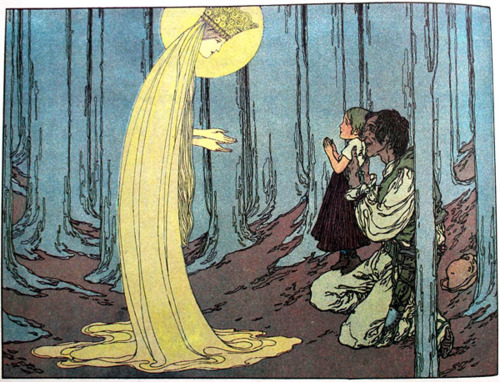
The English translation of the title is The Virgin Mary’s Child. The ever-misfortunate woodcutter is approached by the Virgin Mary, who offers to lift from him the burden of his young daughter. The girl is given over to her without a question. The child grows up in heaven with little angels as her playmates. When the child reaches the age of fourteen, Mary entrusts her with the keys to the thirteen doors of heaven. Allowed to enter twelve of the rooms, in each of which she finds an apostle, the thirteenth room she is forbidden to enter. As with all forbidden rooms in fairy tales it must be opened. She barely puts the key in the lock, when it flings open, terrifying the girl with the sight of the Holy Trinity.

Noting her fear, the Virgin Mary asks if she has entered the forbidden room. The girl denies this three times. Mary takes away her power of speech, and casts her from heaven, to be imprisoned in a forest wilderness. The girl lives in a hollow tree, surviving on roots, nuts, and berries. Piece by piece, clothing falls away, leaving her cloaked in her own hair.

After some years, a king finds this remarkable maiden, takes her from the forest prison, and marries her. On the birth of their child, the Virgin Mary reappears to the girl, now a queen, asking that she repent of her sin. When the queen refuses, Mary departs with the child. The pattern repeats itself for two more births, the queen refusing to confess. The people believe the queen has eaten her own children. Since she cannot speak in her own defense, she is condemned to be burned at the stake.

Only as the flames rise around her, does she repent. Mary appears in a blaze of glory, returns the children, loosens the queen’s tongue, and declares, “Whoever repents a sin and confesses it will be forgiven.”

As I watch Wilhelm scribbling away, I can’t help but suspect he has tampered with this tale rather than simply recordingjjn it. When there is a Christian gloss on the Grimms’ tales it can often be traced back to Wilhelm—to whom Jacob gave primary responsibility for the collection after the first edition—and is not a product of the teller of the source tale.

A self-evident example appears in the Grimms’ two versions of The Girl Without Hands. In the 1812 edition the hands are restored when the heroine wraps her arms around a certain tree. By 1857, the heroine is being attended to by an angel, during which time her hands grow back.

I need to keep in mind that the Grimms were, in their scholarship as well as in their worldview, romantics of the German Romantic Movement. The science of folklore study had only begun to develop. In addition, the Grimms were appealing to a larger audience than fellow scholars. They needed to make the stories acceptable to children, according to the standards of the time. Heavy-handed Christianity was acceptable.

I see Faithful Johannes curled up on the table, but Wilhelm has disappeared. I wonder where he goes when he isn’t here. I’ll suppose the deceased can be reclusive, and certainly they are free to make their own schedule.

Fairy Tale of the Month: May 2014 Virgin Mary’s Child – Part Two

marys-child Heinrich Lefler and Joseph Urban

In the Eye of the Cat

“Johannes,” I say, “Come here. I want to read you something.”

Faithful Johannes opens one eye, then closes it again. I reconsider my wording.

“Might it please you to hear a story? I value your opinion.”

Johannes slowly rises from his spot on the table, stretches, licks a paw, rubs an ear. Defining the word “gradually,” he makes his way over, and sits down beside me on the couch. I read to him The Virgin Mary’s Child.”

“I liked her until the end,” he says.

“Well, she had to save herself, didn’t she?”

“She showed weakness of character; gave in to confessing.”

“She would have died otherwise.”

“Don’t martyrs allow themselves to be killed?”

“She wasn’t a martyr.”

“Wasn’t she?” Johannes curls up again.

I am inclined to tell him that is nonsense, but I know better than to be glib with a cat. Besides, he has picked up on a sense of martyrdom coming from Mary’s child.

When the girl denies she opened the forbidden door, she is fearful, immature, and naïve.  After being cast from heaven, she suffers grievously in the wilderness for years. A king delivers her from her wretched life and together they have a child.

When the Virgin Mary reappears, the girl is now a queen and a mother. She has no secret to keep from the Virgin Mary, and knows Mary will take her child if she persists in her sin. Though she has nothing to gain, she does not repent.

Mary refers to her stubbornness and the narrator to her pride. Nowhere else in the tale does she show these traits. The story tells us the king marries her because she is so sweet and beautiful. The queen does not repent her state of sin at great cost, almost losing her life.

In the end, when she does confess to the obvious, I feel no satisfaction. Mary states, “Whoever repents a sin and confesses it will be forgiven,” which is both gracious and dogmatic.

I return my attention to Johannes. “OK, let’s go with our heroine as a martyr. What is her cause? She has sinned, after all, by lying.”

“Liar, liar, pants on fire; yes, she has. How dear to you humans is one foolish act? No harm comes to others from her deed, yet it alters the course of her life.

“Her cause,” Johannes continues, “is undue retribution. She witnesses the core of Christianity’s philosophy behind the thirteenth door. Should that be punishable?”

“And what would you have done had the Virgin Mary given you the keys?”

“I would have returned the twelve keys, taken the thirteenth, and told her to wait for me, I’d be right back.”

“That sounds rather brash!”

“No cat would have allowed themselves to be so duped. The forbidden door is no different than the forbidden fruit in the Garden of Eden, which led to the fall of man. In a cat’s eye that was the original setup. That curiosity can kill is better applied to you humans than to us felines.”

I pondered this a moment.

“You are ungracious, you know,” I scowl.

Fairy Tale of the Month: May 2014 Virgin Mary’s Child – Part Three

Marys-child5  Heinrich Lefler and Joseph Urban

Up In Smoke

My eyes rest on a canister of “Angel’s Glory,” while Augustus goes through the familiar routine of weighing out four ounces of “Elfish Gold” with a stainless steel scoop. Not taking his eyes from the scale he asks, “And what story have you been contemplating lately?”

The Virgin Mary’s Child.”

“Oh? No one bothers with that story; quite unpopular.”

“I agree, but I wonder why. While its moralizing makes me a little uncomfortable, I would think for others it is a safe story. It carries a clear message about the hazards of lying, and could be the basis for a Sunday school lesson, but I have never heard of it being used that way.”

“I share your misgivings.” Augustus empties the weighing bowl of “Elfish Gold” into a plastic baggie. “It feels contrived to me, which is an odd thing to say about a fairy tale, but this one goes beyond the norm.”

“In what ways, do you think?” I look for my wallet.

“Most striking to me is the way the forbidden-door motif is used. Within the Grimms’ collection, the motif comes up in Blue Beard and The Fitcher’s Bird. In both cases it is a despotic, evil character who sets the conditions and deals out mortal punishment when the inevitable happens. To put the Virgin Mary in that role, traditionally held by villains, strikes me as odd.”

I see Augustus lean against the counter behind him and fold his arms, as he slips into lecture mode.

“In the Grimms’ own notes they point to a variant in which the antagonist is a woman dressed in black, traveling in a black coach, and living in a black castle. Nor is this woman averse to a little violence. When the heroine peeks into the forbidden room, the woman in black slaps her on the face so hard the blood flows and the voice is lost.”

Augustus contemplates for a moment. “However, in fairness, I must say the Grimms also cited a Nordic version in which the antagonist, a wealthy woman, reveals her true identity at the end of the story as the Virgin Mary.”

“Ah!” I say raising my forefinger, “I’ll bet that is where Wilhelm drew inspiration for his version.”

“No,” says Augustus cautiously, “The notes say their version is from Hesse, but they explain nothing more.” Augustus knits his brow, “You think Wilhelm wrote this story?”

“I am sure of it.” My stance is firm.

“I am going to disagree. The tale adheres to Roman Catholic thinking. The Virgin Mary looms large in the popular Catholic consciousness to the extent of being a cult figure. Take note, there are more sightings of her than there are of Jesus. The confessional, where believers confess their sins, is as regular a part of their lives as the Holy Mass. The Virgin Mary’s Child is about the Virgin Mary and the confessing of sin.

“The Grimms were not Catholic. They were Calvinist. Given the political climate of the time, and the long-standing animosity between the Roman Catholic Church and all Protestant groups, it is not likely that Wilhelm would have been warm to reflecting Catholic norms in anything of his own creation.”

I hadn’t thought of that. “You are never kind to my pet theories, I’ll have you know.”

“Sorry. You can always ignore my criticisms if you like.”

“I’ll tell you what, sell me an ounce of ‘Angel’s Glory,’ and I will ponder what you have said while I smoke it.”

“Fair enough.”

Your thoughts?

Fairy Tale of the Month: April 2014 Kate Crackernuts – Part One

Kate Crackernut BattenJohn Batten

Ah, Nuts

This evening’s reading of Grimm’s The Worn-out Dancing Shoes to my granddaughter and her bear inspired me to find my copy of Joseph Jacob’s English Fairy Tales in which can be found the story, Kate Crackernuts.

While the motif of the underground dance is similar in both tales―though the gender has been switched from twelve giddy princesses to one unfortunate prince―other events in the two stories are unrelated.

Kate Crackernuts begins with a  queen and her stepdaughter, Anne, who is far “bonnier” than the queen’s own daughter, Kate. Jealous, the queen visits the henwife for advice. The henwife promises to cure Anne of her good looks, if the girl will come to her while fasting.

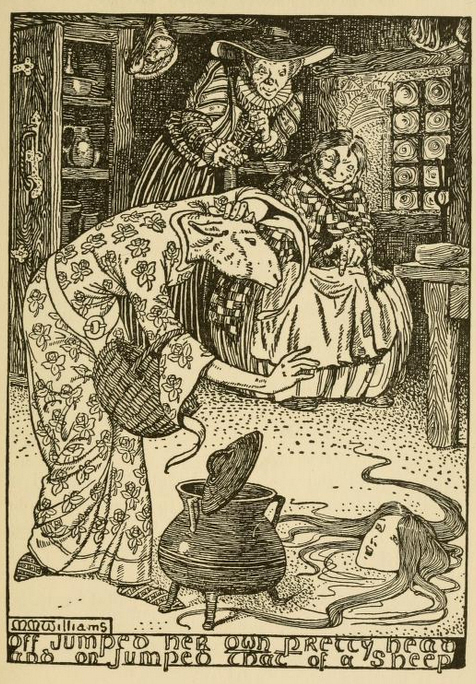
The first two attempts fail, for Anne, innocently, finds something to eat along the way. On the third attempt the henwife tells the hungry girl to lift the lid of a pot. When Anne does, her head falls off into the pot and out jumps a sheep’s head, which attaches itself to her neck. The queen is satisfied.

Kate is not happy; she loves her stepsister and now takes over the story. She wraps Anne’s head in linen and they leave the castle to make their way in the world. They end up at another castle, where there are two brothers, one of whom is mysteriously wasting away. Stranger still, those who attend to him at night disappear. The king offers a peck of silver to anyone who will watch over his son after sunset.

Kate takes up the challenge. At midnight the prince arises in a trance, and Kate tags along unnoticed though the greenwood. She collects nuts along the way, until they enter a fairy mound. Kate has the wit to hide herself and watch while the fairies dance the prince into exhaustion.

At dawn they return and the king enters the bedroom to find Kate sitting up cracking nuts. For a peck of gold she agrees to sit up the next night.

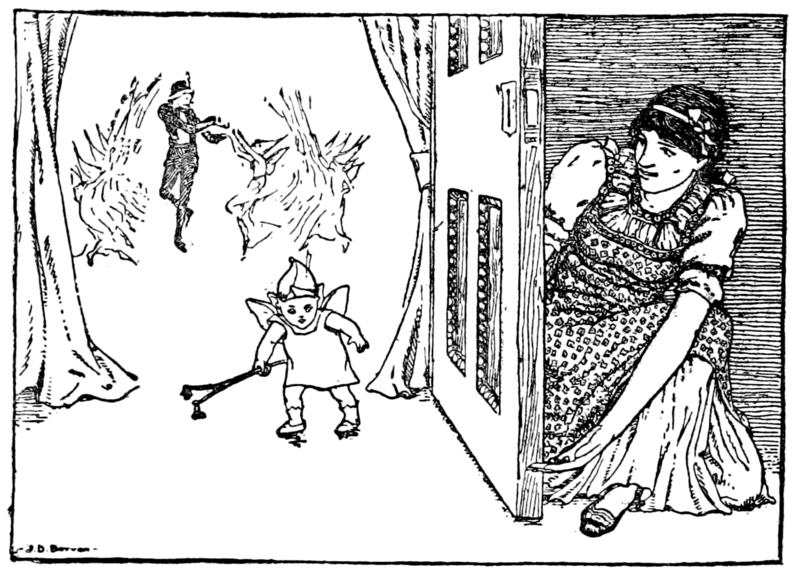
On the second night Kate overhears the fairies say that she could cure her stepsister with the wand that a baby fairy is holding while it toddles about. She rolls nuts to the baby, who has to put down the wand to pick up the nuts. Kate returns with the wand, and cures Anne.

Now she demands to marry the prince if she is to stay up another night. On the third trip to the fairy mound she deceives the baby fairy out of a little bird, which she has learned she can feed to the prince to break his spell. On the third morning the king finds Kate and his hale and hardy son cracking nuts.

Meantime, the prince’s brother has fallen in love with the restored Anne. The story tells us the well sister marries the sick brother, and the well brother marries the sick sister, and all live happily.

I read Joseph Jacob’s notes and references, which start with the disclaimer:

Oyez, oyez, oyez. The English Fairy Tales are now closed. Little boys and girls must not read any further.

The writing becomes much drier at this point. However, I am excited by his admission that he improved the tale from the garbled version put forward by Andrew Lang, in which both girls are named Kate.

My fairy-tale red flag pops up immediately. Is it garbled? I must talk to Mr. Jacobs.


Fairy Tale of the Month: April 2014 Kate Crackernuts – Part Two

Kate Crakernuts MMWilliamsMorris Meredith Williams

Two Heads Are Better Than One

I did my research on Joseph Jacobs, determined not to make the same mistake I made with Hans Christian Andersen. I invoked Hans for a visit to Miss Cox’s garden only to find he didn’t speak a word of English.

I am safe this time. Joseph Jacobs hailed from Australia, born there in 1854. At eighteen he went to England, taking his degree at St. John’s College, Cambridge.

I know Jacobs through four of his books: English Fairy Tales, More English Fairy Tales, Celtic Fairy Tales, and More Celtic Fairy Tales. Primarily though, he was a Jewish scholar. He ended up moving to the United States to become the revising editor of the Jewish Encyclopedia. His interest in folklore constituted something of a hobby during the latter half of his life.

Miss Cox’s garden supplies its usual delights. The daffodils are beginning to wane but the tulips show off their vitality. Mr. Jacobs and I arrive at the same time, introducing ourselves at the gate. A pot of tea nestled in a cozy brews on the wrought-iron table in front of a bench, which we visitors find appropriate to our Anglophile nature.

After pouring the tea, I drive straight to my point.

“In Kate Crackernuts you renamed the king’s daughter ‘Anne,’ rather than leave them both named ‘Kate.’ I am not certain the original storyteller confused his characters, but, rather, had a subconscious message.”

Joseph looks at me sideways. I put up a hand to stop his objection and push on.

“I realize I am talking Freud-speak, and the rustic teller had no knowledge of Sigmund Freud. Let me argue that Freud simply created an academic, formalized language acceptable to fellow scholars, which categorized an understanding that others, especially storytellers, felt rather than described. Their explanations came out through their story images.”

Joseph sips his tea and lets me continue (to hang myself?).

“Could the two Kates be two aspects of the same person? Do we not see ourselves in two lights? We have our rational side (your Kate) and our irrational side (your Anne).”

I note caution in his nod at my statement. I am undeterred.

“In this story the king’s daughter is the victim of the irrational. What she does is not irrational, but her stepmother’s jealousy and the henwife’s sorcery combine to magically destroy her beauty. Haven’t we looked at ourselves in the mirror and, irrationally, dwelt on our physical faults, no longer seeing our whole selves?”

I can see Joseph is thinking about this.

“Kate also faces the magical, but she does not allow herself to fall prey to it. She is aware of her whole self. She knows where she is and how to move forward rationally, given the circumstances.”

Joseph brightens and adds to my argument.

“We can also assign a passive element to Anne’s irrationality and an active element to Kate’s rationality.”

I delight in his observation. He goes on.

“The story tells us nothing about how Anne feels having a sheep’s head in place of her own. That is certainly passive. It is Kate we see taking action, defying her own mother. That is certainly active. Interesting, but I am sure you are wrong.”

I try not to make the sound of a deflating balloon.

“If the teller wanted both girls to bear the same name for a purpose,” he says, “he would have made that clear. The teller never puts the name of the two Kates in the same sentence. The teller does not make a point of them sharing a name. No, I will stay with my ‘garbled’ assertion. Many times these stories were told in taverns. When this story was told and recorded there may have been drink involved. Sorry, my friend, but you make a fairy mound out of a mole hill.”

Fairy Tale of the Month: April 2014 Kate Crackernuts – Part Three

hen-wife-Waitt Henwife of Castle Grant by Richard Waitt

Henwife

Oars dip into the water in a practiced rhythm, the sound of which usually is enough to lull me into contemplation, as Duckworth and I take our jaunt on the river. Today, however, I blather about what is on my mind, and Duckworth is not obliged to take me seriously. I have been plumbing the depths of Kate Crackernuts for him since we shoved off.

“The story has two distinct sections, although not like two tales arbitrarily stuck together. The second half, with Kate and the prince going to the dance underground, is a variant ofThe Worn-out Dancing Shoes.

“You mean The Twelve Dancing Princesses?” Duckworth brightens. “I love that story. Why hasn’t Disney done anything with it? Twelve princesses and one guy. Kind of a fairy-tale The Bachelor.

“Yes, that’s it,” I say, schooling dismissiveness out of my voice. “But the first half of my tale would make Disney uncomfortable.”

“Why so?”

“A henwife causes the beautiful sister’s head to fall into a pot and be replaced by a sheep’s head.”

“Good heavens—but what’s a henwife?”

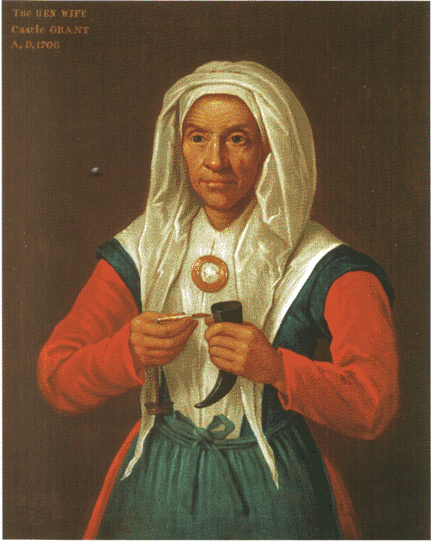
“Well, a woman who takes care of chickens. A lowly position, right there with washerwomen and kitchen wenches. However, henwives have the attribute of being independent, knowing charms and spells and possessing magical wisdom.”

“Perhaps she knows which came first.”

I smile as we scull past children fishing on the river bank. “If anyone does, it will be her. The henwife comes into a number of English, Scottish, and Celtic tales: The Three Daughters of King O’Hara; Fair, Brown, and Trembling; Childe Roland; and Catskins, come to mind. These crones range from being wisewomen to witches. I don’t know what their role is outside the British Isles, although the Russian witch, Baba Yaga, has a house that walks around on chicken legs.”

Duckworth and I approach a part of the river with boulders and a few rapids, and we need watch ourselves before picking up the conversation once more.

“Why,” asks Duckworth, “are witches always poor?”

“A good question. Not all witches are poor. The witch queens are young, attractive, and, of course, wealthy, but the usual ancient beings live on the fringe of society in hovels, and suffer poverty, living much like a henwife would live. Old women, witches or henwives, living not quite in the fold with normal folk, were set apart and viewed with suspicion. At times the witches have hidden treasures of gold and gems, which did them no profit.”

“Are you suggesting,” Duckworth locks his oars as we take a rest, “that henwives were the role model for the image of the witch?”

“Maybe.” I had not thought of it in quite that way.

“And what about the sheep’s head?” he continues.

I sigh audibly in answer.

Duckworth muses. “I had a Norwegian cousin serve me Smalahove one time.”

“What?”

“Smalahove, sheep’s head.”

“Really? How did it taste?”

“I don’t know. The smell was enough for me. I claimed vegetarianism, ate the mashed potatoes and rutabagas, and drank the Akvavit. The Akvavit made everything better.”

“Quite. Was the Smalahove boiled?”

“It is served boiled or steamed.”

“Hmmm, the henwife had the sheep’s head in a pot. I wonder… “

Your thoughts?
Fairy Tale of the Month: March 2014 Faithful Johannes – Part One

Fathful John Crane Walter Crane

Johannes

I am reading Faithful Johannes to Thalia this evening in honor of her new cat of the same name. She said Johannes followed her home from kindergarten, but I think he “followed” in her arms. I saw her carrying him into the house. Thalia and Teddy are in my lap, of course; Johannes has taken to the window seat overlooking the enchanted forest.

In Faithful Johannes the king, on his deathbed, calls for his faithful servant and puts upon him the onus of counseling the unreliable prince. The king gives Faithful Johannes the castle keys with the injunction not to let the prince into one particular room. In this room is a portrait of the Princess of the Golden Roof. If the prince sees the portrait he will fall in love and no good will likely come of it.

“Oh, oh,” says Thalia. We all see it coming.

After the king dies, Johannes gives the new king a tour of the castle and all its wealth, avoiding the chamber with the portrait. Unfortunately, the new king notices and demands to see what is there. Faithful Johannes tries to dissuade him, but must relent. The king sees the portrait and falls in love as the old king predicted.

“Oh, oh,” says Thalia. Johannes on the window seat blinks. Teddy, stuffed between Thalia and me, stares button-eyed.

The king entreats Faithful Johannes to come up with a plan to win the princess. Disguised as merchants, they sail to her home and trick her into boarding the ship to see their wonderful golden wares. As she marvels at golden merchandise, they cast off, abducting her. The king reveals his identity and his love for her, and she agrees to marry him.

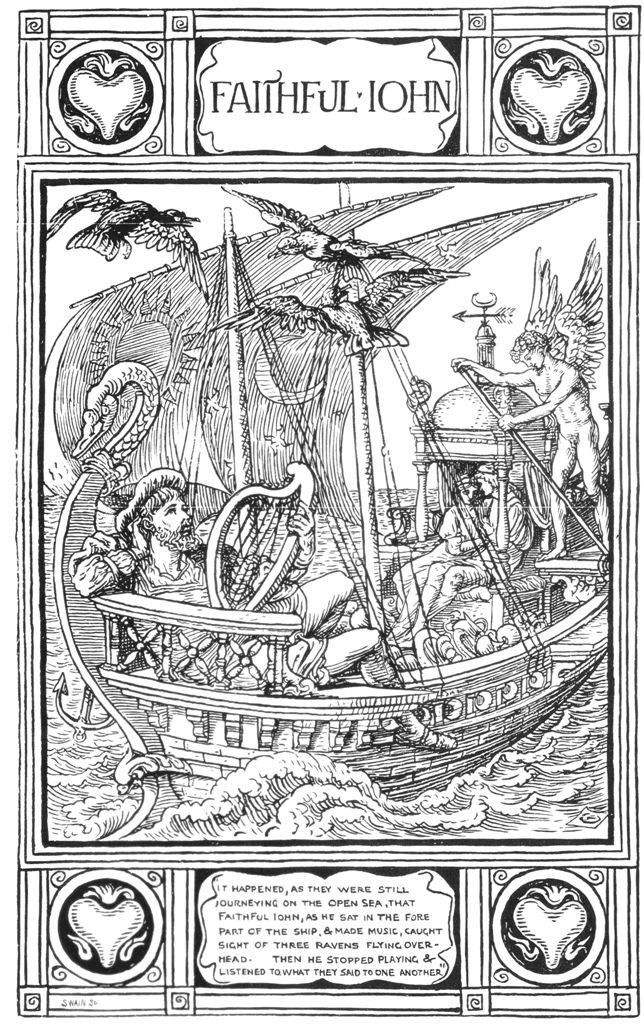
On the return trip Johannes listens to three ravens flying about and learns from them that the king must avoid three traps if he wishes to enjoy his life with his bride. The king must not ride the red horse waiting for him on the shore when they arrive home; he must not wear the wedding clothes laid out for him; and when his queen suddenly falls down and appears to be dead, someone must suck three drops of blood from her right breast. Further, if Johannes speaks of these things he will turn to stone.

Johannes shoots the red horse and burns the wedding clothes, giving no explanation. But it is too much for the king when Johannes sucks the blood from the queen’s breast. Johannes is condemned to death.

Before he is to be hung on the gallows, Johannes redeems himself by telling the king of the ravens’ words and promptly turns to stone. Full of remorse the king keeps the statue in the royal bedroom.

One day, after twin boys have been born to the king, the statue speaks, telling the king he can restore Johannes by rubbing the statue with the blood of the twin boys’ severed heads.

Thalia squirms in my lap as the king kills his sons to restore his faithful servant. Johannes rewards the king’s faithfulness by restoring the boys to life.

“Whew,” says Thalia.

When she and Teddy wander off to bed followed by the four-footed Johannes, I reflect on the tale. Why was the portrait in the room? Who set the three traps? What is the significance of rubbing the statue with blood?


Fairy Tales of the Month: March 2014 Faithful Johannes – Part Two

Cat

The Cat

While I ponder, weak and weary, over many a quaint and the curious volume of forgotten lore, Johannes returns to the study. He jumps up onto the edge of a table and strikes the pose of the Egyptian cat goddess Bastet I have seen in statues. We regard each other for some minutes.

“You can talk, can’t you?” I inquire.

“Of course,” he responds.

“How delightful! What did you think of your namesake’s story?”

“Rather little.”

“Oh?”

“I am indebted to Thalia for recognizing my worth and bringing me up to my proper social standing, leaving behind me the alley. But as to the name she chose to call me, I must object.”

“Why?”

“If I were to change Faithful Johannes into an animal he would be a dog.” He stretches out the word “dooog.” “Not someone after whom I wish to be named.”

“What is Johannes’s failing?”

“His unwarranted faithfulness; neither the old nor the new king shows any reason for him to be faithful other than their ownership of him.

“He’s a working dog too. First the old king gives him the task of minding the unruly new king. The new king burdens him with devising a plan to get the girl, which leads Johannes to saving the new king three times, ending with his temporary demise at the hands of the king.”

“But,” I object, “Johannes’ faithfulness is repaid when the king willingly sacrifices his sons to bring back the servant he wronged.”

“Perhaps. A fairly cheap price to pay. The king could always have another litter.”

Johannes licks the back of his paw and draws it across his face. I continue.

“Consider the story’s context, being told at a time when there existed a large serving class. Everyone understood the master/servant relationship and I doubt many questioned it. To tell a story where the servant bests the master might seem a little seditious.”

“Doesn’t make Faithful Johannes any less a dog. I’ll grant he did have magical powers that the kings did not.”

“Yes, I thought that unusual. Typically it is royalty who occupy the magical corner in the story.”

“And he listened to the advice of creatures.”

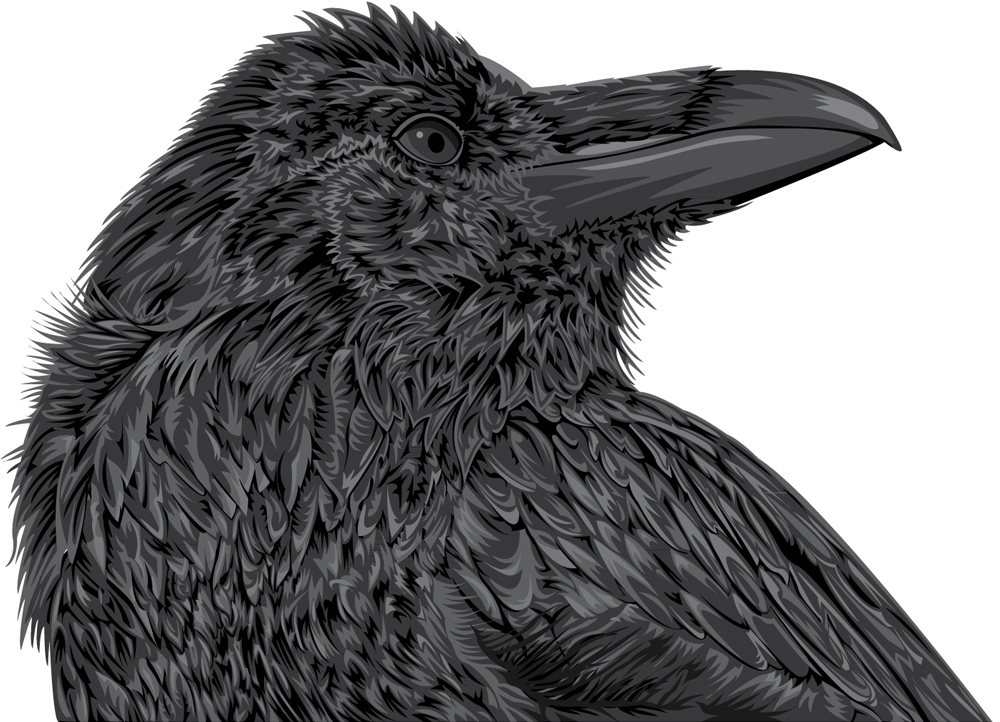
“Ah, the ravens. Thalia has an affinity for ravens. They come up in a number of stories in which they provide hidden secrets for the ears of those who need to hear them. I suspect the folk memory of their mystical significance goes back to shamanistic origins. What is your take on the ravens?”

“I’d eat them if I could catch them.”

“I meant their part in the story.”

“Well, besides acting like a dog, Johannes is also an eavesdropper. He overheard the ravens talking; the ravens weren’t talking to him, but rather among themselves.”

“You’re being hard on the poor man. I sensed he was a player in a struggle between unseen forces. A beneficial force led the ravens to him to warn of the traps being set by a malicious force. There is an undercurrent beneath the story’s inexplicable events.

“Take the portrait in the…”

Johannes jumps from the table, landing soft-pawed on the rug, and struts out the study door. Whether he heard the clatter of a dish, bringing to mind the possibility of food, or he felt himself finished with our conversation, I don’t know. Talking to him will be, I surmise, difficult. A raven might be a better conversationalist.

Fairy Tale of the Month: March 2014 Faithful Johannes – Part Three

forestscenebw

Ambling

I amble today in the enchanted forest, my mind wandering further than my legs carry me, though never far from Faithful Johannes. Three questions float about like the smoke from my pipe.

First: Why was the portrait in the room? Why did the old king give over a chamber to house a portrait of a princess he knew might waylay his son? These are obvious, logical questions, not answered in the story, nor should they be answered. They are the wrong questions.

The trick word is “logical.” Fairy tale logic is not the real-world logic of Aristotle, but its own poetic logic. Poetic logic makes the same surreal connections as dreams do until we wake up and the sense of it vanishes.

My questions are better served if I start with the forbidden room, which appears in many stories. The contents of the room take two forms. In one form the room holds a horror beyond endurance, often rotting, severed body parts. Good fare for Halloween.

In the other form we find a portrait, a book, or another item of interest¸ in itself not distressing, but having a profound effect on someone in the story. In our case, finding the portrait in the forbidden room is the inciting incident. The portrait points to the king’s destiny.

The story assumes the girl in the portrait is alive, well, and still looks like her picture. Real-world logic would question the age of this art work. This is not necessary with poetic logic.

I cross the stepping stones of the rivulet that flows quietly through the forest.

My second question: Who set the three traps for the king? Again, the story does not expect us to ask what fiend sent the red horse, laid out the wedding clothes, or caused the queen to collapse.

I want to surmise unseen forces afoot, beneficial and malignant beings using the people in Johannes’s world like pieces on a chessboard. We have kings and a queen, and Johannes could be a pawn. But the story does not beg an explanation.

That Johannes overhears the ravens and just happens to understand animal speech is far too convenient until we put the event in the context of poetic logic.

I sit on a fallen log; tap out, and refill my pipe. Question three: What is the significance of rubbing the statue with blood? The motif appears in a variant cited by the Grimms in their notes to Children’s and Household Tales, beside the version they collected from Dorothea Viehmann. (One must be cautious with the Grimms; they were not above inventing things for the sake of a good story, but this is not one of them.)

I want to think this a remembrance of a violent pagan ritual from far back in the dense mist of time. With a little research I found the mist not so thick. We need go no further back than 1087.

That is the year the pagan temple at Uppsala in Sweden was destroyed. Until then it housed the statues of Thor, Odin, and Freyr, to whom both animal and human sacrifices were made. Specifically, every nine years there were nine days of sacrificing of nine males of nine species. Horses and dogs were among the species and so were men. The bodies hung from the branches of trees near the temple. That sort of thing is not easily forgotten and bound to come up in folklore.

The enchanted forest always brings to me notions that do not come to me in my study. There’s magic for you.

Your thoughts?

Fairy Tale of the Month: February 2014 The Glass Coffin – Part One

Glass coffin two H J Ford

A Visit

I have a strange visitor in my study tonight. Earlier Thalia fell asleep quickly as I read to her. We’d been out most of the day—in the cold—feeding the tower ravens. I’d carried her off to bed, returned to the study, and settled down with my pipe, before realizing her battered copy of Grimm’s still lay on my table. I was considering returning it to her bedroom when my visitor flew in, landing on the table.

“There you are,” she said to the book.

She now stands at the foot of the open volume, her translucent wings catching the moonlight coming through the bay window, her fine, wild black hair moving about, blown by a draft I can’t feel. She reads aloud to herself.

“Let no one ever say that a poor tailor cannot advance far in the world and achieve great honors. He need only to hit upon the right person and, most important, to have good luck.”

She is reading The Glass Coffin.

In this tale, a poor tailor, lost in a forest, takes refuge in the hut of an old, cranky man. The next morning the tailor is awakened by a black bull and a stag battling outside. When the stag is victorious, it scoops the tailor up in its antlers and carries him off to a subterranean hall. A disembodied voice instructs him.

“Step upon the stone that lies in the middle of the hall,” my visitor, with both hands, turns a page. “Your great fortune awaits you.”

The tailor does, and the stone sinks down to a deeper level. There the tailor sees stacked along the walls, glass vases filled with colored vapors, and two glass coffins. In one is a miniature kingdom with a castle, farmhouses, barns, and stables.

In the other is a beautiful, sleeping girl who awakes as he watches her.

“Good heavens!” my fey reads, “I shall soon be free. Quick, quick, help me out of my prison. If you push back the bolt of this glass coffin, I’ll be saved.”

The tailor does this easily. Freed, she tells him her story.

She is the daughter of a rich count, raised by her brother after their parents’ death. Devoted to each other, they decide neither should marry.

One day they give shelter to a traveler. To their misfortune, he is a magician, who falls in love with her and tries to seduce her through his art. She repulses him and he takes his revenge by turning her brother into a stag, her people and servants into vapor, the kingdom into a miniature, putting it and her into glass coffins.

She bids the tailor help her move the glass coffin containing the kingdom onto the stone, which carries them to the upper world. When the coffin is opened, the kingdom grows into its proper size. From the glass vases, they release the vapors that turn back into the living. The brother, who in the form of the stag killed the magician in the form of the black bull, returns to his human shape.

As reward, the tailor marries the girl.

“By the breath of Oberon!” declares my petite guest. “That’s being in the right place at the right time.”

She struggles to close the heavy cover and pages until it makes the “plunk” that only a book can make, then flitters off without a glance at me.

I am taken aback by my conceit. I assumed fairy tales were created for the likes of me. I had noticed there are precious few fairies in fairy tales, and now see that the tales were never about fairies. These books should be printed in a much smaller form for their true, intended audience.

Fairy Tale of the Month: February 2014 The Glass Coffin – Part Two

nielsen_snowdrop Kay Nielsen

Coffins

I enter Augustus’ tobacco shop to the familiar ring of the bell above the door and the heavy odors in the air.

“Morning,” says Augustus.

“Morning. I know what I want today. Fairies’ Delight.”

“Oh?” Augustus is frowning. “That’s not your usual blend. It’s got a preponderance of Virginia.”

“I’m feeling ‘Arial’ today.”

As Augustus weighs out a few ounces, I pose my question.

“What is the role of coffins in fairy tales?”

“Hmmm. Good question. What prompted you to ask?”

“I listened to The Glass Coffin last night.”

“You listened? Is Thalia reading to you now?”

“Not exactly. I know I have run into coffins before in Grimm’s.”

“Of course you have, Snow White to start with. She too inhabited a glass coffin.”

Augustus pauses, weighing out my order on his scale.

The Twelve Brothers and The Three Snake Leaves come to mind. If memory serves, in The Twelve Brothers the king has twelve sons. His queen is pregnant and he declares—inexplicably—that if she has a girl he will prefer her and put his sons to death.

“He goes so far as to have twelve coffins made. The queen, to save her children, shows the coffins to her youngest son. They devise a plan to counter the king’s intent. A daughter is born, but her brothers are able to escape.

“Years later the sister is shown the twelve coffins by her mother. The girl vows to find her brothers and the story goes on without further mention of the coffins.”

Augustus weighs out the Fairies’ Delight.

“In the case of The Three Snake Leaves our protagonist accompanies his wife’s coffin into the sepulcher, to die beside her.

“A snake crawls into the chamber, which he kills with three strikes of his sword. Another snake appears with three green leaves to put upon the wounds. The dead snake returns to life and the two serpents slither off.

“The young man uses the snake leaves to restore his wife, and the story goes on, somewhat tragically.”

I watch him pour the Fairies’ Delight into a plastic bag.

“I can tell you are driving toward a point,” I say, “but I do not see it.”

Augustus flashes a smile. “When coffins appear in a story as a significant element, they signify the defiance of death.

“The twelve brothers escape their deaths, and the coffins remain empty.

“The snake leaves are used to bring the occupant of the coffin back from the dead.

“In the case of Snow White, she is not really dead, but under a spell, which the stumbling servants of the prince inadvertently break, jolting the bite of poison apple from her throat.

“Coffins appearing as a defiance of death is not restricted to fairy tales. Where does the vampire sleep? He is not dead.”

“You are edging into the macabre, but I guess that will happen if coffins are the subject.”

“Quite.” He hands me my tobacco.

As I pay, I ask, “By the way, do you believe in fairies?”

He gives a hardy guffaw. “Of course not.”

“Right,” I say. “Just checking.”

Fairy Tale of the Month: February 2014 The Glass Coffin – Part Three

stratton_snowdrop2 Helen Stratton

Wishful Thinking

The fairy had a point when she said, “That’s being in the right place at the right time.”

The tailor’s progress through the events of the story struck me as a series of conveniences. Perhaps being scooped up in the stag’s antlers and carried about can be seen as harrowing, but he came to no harm. After the wild ride he simply followed instructions that promised rewards. For what good deed does he get to marry the rich and beautiful girl? He pulled back the bolt on the glass coffin. Not exactly derring-do.

The Grimms culled this one from a romance, laboriously titled Polidor’s Strange and Most Amusing Life at School and the University, by Sylvano, and not through their usual contacts with acquaintances, friends, and family. Nonetheless, the Grimms heard enough authentic folk voice in the story to include it in their collection.

One of the wishful thoughts of the long-ago listener, which this story satisfies, is the act of a peasant rising above his class. This is a disturbingly popular theme, given the reality that peasants rising above the station to which they were born was pretty hopeless right into the mid-nineteenth century.

The Grimms were keenly aware of the rising middle class in Germany, which embodied the spirit of German nationalism. The Grimms’ books were published in the context of Germans being ruled over by the Holy Roman Empire. During the Grimms’ lifetime, Germany, as a country, had not come into existence. That did not happen until 1871 with the formation of the German Empire, eight years after Jacob Grimm’s death, Wilhelm having died earlier.

I am going to get out of hand. I intend to make wild and unsubstantiated statements, and blame it on my “Arial” attitude and the Fairies’ Delight I am smoking.

The Glass Coffin appealed to the Grimms because they saw it as emblematic of their own people’s struggle and hope.

In this story the brother, transformed from his true nature into a stag, represents the suppressed German people. The black bull would then be representing the aristocracy, members of the Holy Roman Empire’s upper class, who ruled over the better part of Europe with a heavy hand. In the struggle witnessed by the tailor, the stag defeats the black bull, symbolizing the Germans’ triumph over their oppressors.

The sister of the stag represents the Germanic spirit that the aristocracy would contain.

Germany is the miniature kingdom that is released from its coffin to expand to its proper size.

The people in the vases are the folk, who are released from their vaporous state.

Our tailor represents the middle class, who, in the Grimms’ view, deserve what good fortune comes their way. The marriage is between them and the Germanic spirit.

What could be more clear, except for my suspicion that I am dead wrong and the Grimms’ never thought anything of the sort.

But conjecture is so much fun! I could be right. I now believe in fairies; should I not believe in my own winged notions?

Your thoughts?

Fairy Tale of the Month: January 2014 The Golden Bird – Part One

Golden Bird Walter Crane

Golden

Thalia and her Teddy sit on my lap, she carefully paging through the familiar, battered copy of Grimms’. Her finger rises into the air and lands on a picture of a young prince riding on the tail of a fox. I turn the pages back to the beginning of the tale as Thalia nestles into the crook of my arm, and I read The Golden Bird.

The king, upset that golden apples from his tree in the pleasure garden are being stolen, one by one, each night, sets his sons to guard the tree. The eldest son stands guard the first night, the middle son the second, but it is the youngest on the third night who sees a golden bird take an apple.

The king sends out his eldest, into the wide world, to capture the golden bird. He is met by a fox, who advises him not to spend the night at the brightly-lit inn he will encounter, but rather stay at the dismal one across the street. The eldest is attracted to the merry sounds coming out of the better inn, and does not heed the fox.

The middle son soon joins his brother, also dismissing the fox’s counsel. The youngest prince is more attentive and spends the night in the dismal inn.

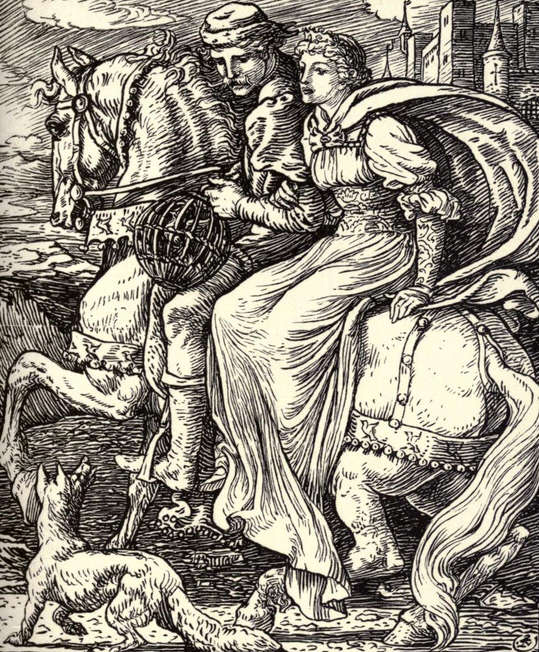
The fox joins him the next morning, carrying the prince on his tail to the castle of the Golden Bird. At the castle, all are asleep. The fox warns against using the golden cage at hand, but the prince, thinking so glorious a bird should not be in a wooden cage, puts the Golden Bird in the golden cage. The bird squawks, awakening the castle, leading to the prince’s capture and the condemnation of death.

However, the king of this castle gives the prince the opportunity to save himself and get the Golden Bird as a reward, if he will bring to the king the Golden Horse. Again the fox helps the prince, warning him against putting a golden saddle on the Golden Horse. The prince manages to awaken this castle too, and is condemned to death. Unless…

The king of the Golden Horse wants the princess of the Golden Castle. Ever faithful, if scolding, the fox helps. When the hapless prince is condemned to death for the third time, he still has a chance to win the princess if he can remove a mountain in eight days. He digs for a week with little result. The fox appears and sends him off to bed. The next morning the mountain is gone.

The prince, finally attuned to listening to the fox’s instructions, is able to trick everyone on his return trip, and ends up with the princess, the Golden Horse, and the Golden Bird. Plus, he rescues his brothers from being hanged. His brothers repay him by throwing him down a well, about which the fox had warned the young prince.

The two brothers return home in glory with their bounty as the fox helps the young prince out of the well. In disguise, the prince sneaks into the castle, and all is soon revealed, with the two brothers finally put to their proper deaths.

The fox reappears, asking the prince to shoot him, and cut off his head and paws. Reluctantly, the prince does so, and the fox is transformed into the brother of the princess of the Golden Castle. All live happily ever after.

Thalia shifts in my arms uneasily. “I’m going to ask mommy for a sister. I don’t like brothers.”

I am sure she is right.

Fairy Tale of the Month: January 2014 The Golden Bird – Part Two

Joseph Bibllical Joseph sold by his Brethren, Gustave Doré

Brothers

I know the clock on my mantle is chiming midnight, but I am standing in a Gothic cathedral. I am not sure to what age I have been transported, now or then. What I see are moonbeams struggling to illuminate a lead-glass window. Such stained-glass windows are and were great storytellers for the illiterate.

In the center of the tall, narrow, pointed arched window, the mosaic of colored glass depicts Cain about to kill Abel. A cloud covers the moon and the image fades.

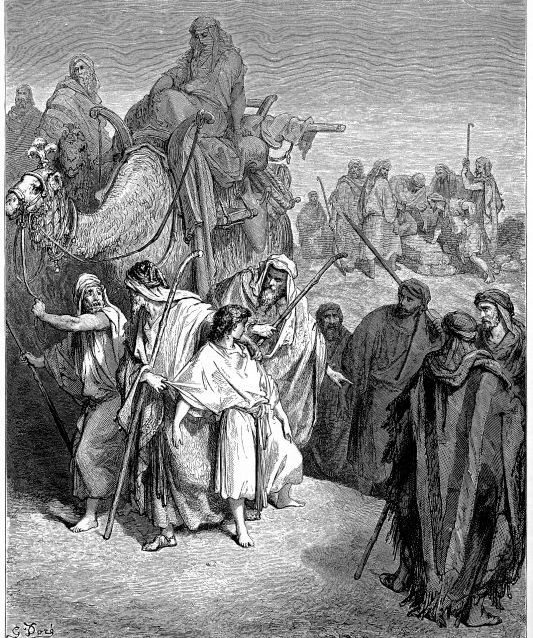
In The Golden Bird two wayward brothers dispose of their younger brother by throwing him down a well, raising to my mind’s eye the form of the biblical Joseph. He, too, was cast into a well by his jealous brothers before being sold into slavery.

Tellers knew this biblical tale, if only from seeing it pictured in glass, but other models may have served as an inspiration. The histories of the royal families of Europe are filled with the deaths of heirs and possible heirs at the hands of family members in ongoing power struggles.

But not all the brotherly relationships in fairy tales end in dire ways. In The Queen Bee the younger brother releases his two brothers from servitude when they tarry at an inn too long and beyond their means. His siblings misbehave even further, but never turn on him, and are rewarded with princesses as brides in the end.

Nonetheless, a pattern emerges from stories that have three brothers in them. The younger brother is named Simpleton, or is thought little of by his family, or is laughed at by his older brothers. Tasks to be performed are attempted first by the eldest, then by the second eldest, and at last by the third, who succeeds through kindness and/or generosity, with magical gifts, or by promises fulfilled by those he helped. If all the brothers succeed in some way, then the youngest clearly succeeds the most.

With humor, let me note the above applies when there are three brothers. If the story has two brothers, then one of them must save the other, unless one is rich and the other is poor, in which case their fortunes are reversed. If there are six, seven, or twelve brothers, likely they are turned into swans or ravens. Are these numbers significant?

Not really. Although there are patterns, we should not look too closely at these patterns to find meaning. We need to step back and look at the whole of these stories. We see stories with our mind’s eye, but need to filter them though our hearts.

The moonlight has returned, and again I see Cain creeping up behind Abel, a crime forever about to be committed, set in glass. Not only crime but also harassment, defamation, and deception directed against our brothers has been widely committed since that original act, boding ill for the future. Born to see ourselves as the center of our universe, we slowly learn to reckon where we are in the greater context. A task taken on by the fairy-tale genre is to help us visualize how our selfish acts affect all of us, no matter the number of brothers involved. And to see redemption when the hero sets self aside.

Cain looms over me as I light a candle and say a prayer for my brothers’ safety.


Fairy Tale of the Month: January 2014 The Golden Bird – Part Three

Goody Two Shoes From The History of Little Goody Two Shoes

Honor

“Well, what sort of unhealthy literature are you reading to Thalia these days?” There is a devilish glint in Duckworth’s eyes and I know I am being baited, but I take it gladly.

“Unhealthy? How can you cast a fairy tale as unhealthy?”

Duckworth and I are usually rowing partners out on the Isis, but the weather is too cold, and we have opted for a continuous ramble around the quad.

“Well, let’s take for example what you are reading to The Girl right now.”

I relate to him the bones of The Golden Bird. I see Duckworth scowl with a touch of animation at certain points.

“How can a boy ride on a fox’s tail?”

“Duckworth, it’s a fairy tale. No pun intended.

“Well, what about his inability to follow the fox’s directions? There is hardly anything admirable in that. Aren’t fairy tales supposed to instruct?”

“Fairy tales can and do instruct, but that is not their sole purpose. However, for our argument, I will say, yes, they do instruct, but not by Goody Two Shoes examples of good behavior that the listener is expected to admire.”

“Who from a State of Rags and Care,” Duckworth recited,

“And having Shoes but half a Pair;

Their Fortune and their Fame would fix,

And gallop in a Coach and Six.

You know, The History of Little Goody Two Shoes is the only kid’s book my mother ever read to me.

“There’s your problem.”

“What problem?” Duckworth smiled, then points. “Let’s sit awhile on the bench over there.”

We cut across the quad and commandeered a wooden bench.

“You know,” I say, “we walked by a sign that read, ‘Do not walk on the grass.’”

“I saw it,” Duckworth looks heavenward, “and enjoyed getting away with it. Neither you, your prince, nor I can follow instructions.” He waves his index finger dramatically, “Is this story then teaching defiance of authority?”

“You overstate,” I answer. “My take: The story speaks of honoring and dishonoring.”

Duckworth sits back, folds his hands, and is content to listen.

“Notice when the prince listens to the fox and when he does not. When the fox tells him to stay in the dismal inn, the prince does. There is no honor involved.

“The fox tells him not to use the golden cage or the golden saddle, and not to let the princess say goodbye to her parents. In the prince’s mind to leave the Golden Bird in the wooden cage is to dishonor the bird. To put the wooden saddle on the Golden Horse is to dishonor the horse. Not to let the princess say goodbye to her parents is to dishonor the girl. He can’t do it.

“On his return trip he allows himself to trick those who dishonored him through manipulation under threat of death.

“Nor can he dishonor his brothers by allowing them to be hanged, and this, again, to his disadvantage.

“In the end, he reluctantly kills the fox, torn between honoring his helper’s request, and honoring his helper’s life. The prince is not being stupid when he can’t follow the fox’s advice, he is following his code of honor.

“And please note, no judgment is made about the nature of honor. The story simply illustrates honor’s pitfalls and triumphs.”

Duckworth applauds, “Ably defended.”

Your thoughts?


Fairy Tale of the Month: December 2013 The Snow Queen – Part One

Snow Queen Milo Winter 2 Milo Winter

A Study in Snow

I am certain Thalia will grow to be a scholar. At her tender age, she has begun to do research. Her mother is planning to take her to see Disney’s Frozen, an adaptation of Hans Christian Andersen’s The Snow Queen. Therefore, Thalia set down her Grimm and picked up Andersen for me to read to her.

The Snow Queen is long and tough going. Andersen broke it down into seven “stories”—chapters in a way. Thalia and I read the tale over three nights. Twice I carry her off to bed. Tonight she pilots herself and her teddy from my study with the declaration, “I like the devil’s mirror best.”

The first story tells us of the devil’s mirror, which has the power to make good things look small and insignificant, while bad things look large and important. Thoroughly entertained by the mirror’s effect on humans, some demons try to carry the mirror to heaven to confound the angels. It slips from their grasp, shattering into millions and millions of slivers that lodge themselves into the eyes and hearts of people, distorting their vision of the world.

In the second story, we are introduced to Kai and Gerda, two poor, neighbor children who share the shelter of a rooftop garden and each other’s companionship.

The boy, Kai, gets slivers of the devil’s mirror in his eyes and heart, and is easily abducted by the Snow Queen, who whisks him off to her castle. There he remains, cold, alone, and oblivious to his former life.

In story three, hearing the rumor that Kai drowned in the river, Gerda gives the river her red shoes in return for Kai. She ends up being swept way and into the company of a benevolent witch. Gerda stays in a flower garden where it is always spring, but the witch takes away all memory of Kai. The flowers, in an odd aside, tell Gerda their stories. Finally, a rose reminds her of Kai, roses having been in their rooftop garden. She is off again on her search, the roses assuring her Kai is not among the dead. At this point Thalia falls asleep.

On evening two and story four, a crow tells Gerda he thinks he knows Kai, but the lad turns out to be a prince. The prince and his princess help Gerda by giving her a golden coach in which to travel. It is immediately set upon by robbers (story five), who kill the coachman and the footmen. The old robber woman wants to eat Gerda, but the robber daughter claims Gerda as her playmate. After hearing Gerda’s story the robber girl arranges Gerda’s escape, giving her a reindeer who knows where the Snow Queen’s castle stands. Despite all the action, Thalia nods off.

Story six involves a few minor encounters, followed by Gerda’a arrival at the castle (story seven). There Gerda finds Kai and washes away the glass slivers with her tears. Reunited, Gerda and Kai dance about as ice shards spell out the word “Eternity.”

Returning through warming lands they get home during summer to find they are a grown man and woman. The story concludes with two phrases, one from the Bible, “Except ye become as little children, ye shall in no wise enter into the kingdom of God,” and the other, words of the old song:

Roses bloom and cease to be,

But we shall the Christ-child see.

Thinking it is my time to do research, I leave the study to use my daughter’s computer as she puts Thalia to bed. Watching the trailer for Frozen, I keep in mind the themes of the fragility of memory, abiding friendship, and trust in God’s goodness that run through Andersen’s story.

I find the parallels between Frozen and The Snow Queen to be the following:

There is a reindeer.

Fairy Tale of the Month: December 2013 The Snow Queen – Part Two

Snow Quenn Honor Appleton Honor Appleton

Death by Definition

It is fair to say Frozen draws its inspiration from The Snow Queen, if only at the start of the movie project. Walt Disney himself considered animating Andersen’s story back in the 1940s. The project was picked up, rewritten, and dropped a few times before coming to fruition.

Both the Andersen story and the Disney production are considered to be fairy tales, but are they? What is a fairy tale?

Often the fairy tale is seen as a subcategory of folktales, its identifying element being magic. Whether I accept fairy tales as a subcategory or not, in either case the tale should not have a known author.

Stories that fulfill the above definition are solidly fairy tales, but these restrictions eliminate the Grimms’ Children’s and Household Tales. With a little historical investigation I find, in many cases, the Grimm stories were inspired by older fairy tales, but rewritten, sometimes changing substantially between editions, to appeal to their contemporary audience. Charles Perrault’s Tales of Mother Goose is of the same ilk, rewritten for his audience, the French court of the1690s. This is to say, both these works are authored.

But have not all storytellers put their marks on the stories they told, creating for us the variants to be collected by folklorists?  Is the only difference that they did not write their versions down and put their names on them?

Obviously, I need to expand my definition to include the works of Perrault and
Grimm, or I would look silly and out of step with literate society. I need only qualify and label such works as literary fairy tales.

When I come to Hans Christian Andersen, I hesitate. Are his works literary fairy tales? His stories, too, are inspired by fairy tales, but he takes them far beyond their usual form. He gives voice to inanimate objects such as tin soldiers and fir trees, he will start stories with dialog, and at times not include magic as an element.

If I accept Andersen as a writer of fairy tales (and I must or suffer well-deserved stares of incredulity), I feel obliged to create a subcategory to my subcategory. Grimm and Perrault drew from a reservoir of tales; Andersen included into the flow his own imagination. I will call his works überliterary fairy tales.

Not all of Andersen’s stories begin with “Once upon a time” or “Once there was.” Many are contemporary in setting. For us that was a long time ago, but not when they were written. Can there be modern fairy tales, a twenty-first century fairy tale?

I need to accept that a fairy tale can still be written. As proof, sitting on the table in my study is a copy of My Mother She Killed Me, My Father He Ate Me: Forty New Fairy Tales,edited by Kate Bernheimer. Disney’s Frozen is further proof.

I can solve my dilemma by creating a new sub-sub-subcategory. I now witness the neo-überliterary fairy tale.

What comes to my mind is the Ukrainian folktale The Mitten. A boy loses his mitten on the coldest day of the year. A mouse takes up residence along with every other animal that comes down the trail. By the end, the mouse, a frog, an owl, a rabbit, a fox, a wolf, and a boar have squeezed themselves into the warm mitten that creaks, groans, and stretches, with its seams popping. Over the rise comes a bear.

My attempt at a definition for my beloved fairy tales now lies in pieces as the mitten did in the snow.

Fairy Tale of the Month: December 2013 The Snow Queen – Part Three

Hans c Andersen two

A Garden Encounter

I have to confess, my meeting with Hans Christian Andersen in Miss Cox’s garden did not live up to my hopes.

In the bitter cold I nearly froze to death, as I waited on the bench. Finally, his tall, awkward form loomed in the arch of the garden entrance. He greeted me in Danish, then in German, and then, I think, in Italian. Andersen enjoyed traveling. In his amiable wanderings, he covered most of Europe. He also visited England where his fairy tales were more popular than in his native Denmark, despite the tales being badly translated. I knew he was a friend of Charles Dickens, so imagine my embarrassment when I realized he spoke not a word of English. I, who rarely venture ten miles from home, speak no other language.

There we sat on the bench, a world apart. I am sure he felt out of place, yet, that is the story of his life.

The son of a cobbler and a washerwoman, he entertained notions of being an actor, a dancer, or a singer. He hung around the theater in his hometown of Odense. Outwardly inept and inwardly confident, he cut a strange figure. He possessed an adequate singing voice, which became the calling card that got him into the houses of the local upper class as part of the entertainment for dinners. He liked what he saw.

At fourteen he departed for Copenhagen to join the Royal Theater. They told him to get a job. Even after his voice changed, ending his singing career, he persisted in acting and dancing, for which he had no aptitude yet for which he maintained a continued desire.

Still trying to find a place in the theater, he turned his hand to playwriting. Two plays were quickly rejected by the Royal Theater, although Jonas Collin, the financial director, saw a spark in the young Andersen that suffered from a lack of formal education.

Collin arranged for Andersen to enter grammar school. The seventeen-year-old Hans sat in a class of eleven-year-olds, becoming a natural lightning rod for his schoolmaster’s animosity, who heavy-handedly forbad his older student from such upper-class pretensions as creative writing. Andersen suffered four years of this treatment, falling into depression.

Years later, in the 1840s, after achieving literary and financial success, he still did not find his place in society. Moving among the upper class and even royalty, he remained in the minds of his new acquaintances the son of a cobbler—an oddity. Even his benefactor and adopted family, the Collins, addressed him formally, never intimately.

Andersen did not help matters. He persisted in falling romantically, sometime publicly, in love with unattainable women and men, notably the famed singer Jenny Lind and well-known dancer Harald Scharff.

Andersen found his place in establishing a body of writing that appealed to children and adults and that has neither clumsy moralism, nor needless florid description, as writing meant for children tended toward in that period (and beyond). His tales resounded with human experience, drawn from his own internal and external struggles, cast in the form of little mermaids, tin soldiers, and match girls. The stories were a mix of heartfelt emotion and social commentary. There really had been nothing like it before. He influenced future writers such as Lewis Carroll, Beatrix Potter, Kenneth Grahame, and A.A. Milne.

But for the moment, Andersen and I sat staring at each other. He put up a finger, the internationally-recognized sign for “wait,” took out a piece of paper and scissors from his inside coat pocket, and, folding the paper in half, skillfully and quickly cut away until he depicted two swans facing each other. He handed it to me as if that had been the purpose of his coming, then hastily escaped the confines of the garden.

I will treasure the paper cutting.

Your thoughts?

Fairy Tale of the Month: November 2013 Hansel and Gretel – Part One

hansel and Gretel nielsen Kay Neilsen

A Tale Not Told

I watch Thalia dragging Teddy behind her through the archway of my study door, opening it wide enough to slip out, leaving it ajar.

She almost chose to have me read Hansel and Gretel, but another story attracted her attention. However, it won’t be long before she will want me to read it. I dread the day.

I remember my mother reading me that story. I think it may have been out of a Golden Book. Rather clumsy, solid-color illustrations appear before my mind’s eye. The theme of child abandonment bothered me deeply, ingrained itself into my psyche, and bothers me still. I don’t want to pass that burden along to my granddaughter.

I decide I’d best prepare myself for this eventuality by reading the original version, but what I read is not quite the story I remember.

Facing starvation, Hansel and Gretel’s stepmother browbeats their father into agreeing to the scheme of abandoning the children in the forest. Overhearing them, Hansel devises a plan to drop white pebbles along the way in order to guide him and his sister back home.

The parents’ second attempt succeeds when Hansel is not able to collect pebbles, and, instead, relies on a trail of bread crumbs, which is eaten by birds.

In both cases, when Hansel drops his pebbles or crumbs, he turns his back to his parents, and the father asks him what he is doing. Hansel replies he is looking back at his cat sitting on the peak of the roof, or in the second case at his pigeon sitting there. Both times the stepmother answers that it is the sun shining off of the chimney. I don’t remember that at all in my mother’s reading.

Led by a white bird, the children end up being captured while eating the witch’s edible house (gingerbread is not mentioned). Gretel becomes the witch’s serving girl and Hansel is fattened for a feast.

The day Hansel is to be eaten, the witch tells Gretel to stick her head in the oven to see if it is hot enough. Gretel plays the simpleton, tricking the witch into poking her head into the oven. A quick shove and a slam of the iron door does in the witch.

Hansel and Gretel find treasure in the witch’s house; then they escape, aided by a duck that carries them across a lake to safety and home. Frankly, I don’t remember the duck, the white bird, nor the pigeon; or the cat, for that matter.

Upon returning home, they find their father happy to have them back, and their stepmother deceased.

The bird motif has caught my attention. Is this a reflection of a bird cult among the peasantry from whom the Grimms collected this story? Birds flit throughout this tale. I feel a long, sleepless night of research stretching out before me. I know this is true when I look up from my reading to see Wilhelm sitting by my fireside, staring pensively into the flames.

Fairy Tale of the Month: November 2013 Hansel and Gretel – Part Two

Hansel and Gretel crane Walter Crane

Misled

I look up at the clock ticking away on the mantle over the fireplace. I am not surprised at the late hour. The embers that Wilhelm has been studying all evening have died out, as has my pet theory of the evening, the one about the peasant bird cult. I should have known better. I am not going to tell Augustus of my fluttering after a notion, only to have my wings clipped. He’d smirk at me knowingly. I blame Wilhelm.

It is not clear where the Grimms got Hansel and Gretel. In their notes they say “from different stories current in Hesse.” Some feel Wilhelm heard it from Dortchen Wild, whom he later married.

Looking at three variants of this story, Finette Cendron (also a Cinderella variant), Hop-o’-My-Thumb, and Nennillo and Nennella, there are no birds other than the consumers of edible trails, be the trails of bread crumbs or peas. Even worse for my theory, in Finette Cendron a jackass eats the trail of bran strewn by the heroine.

There are other differences. Ogres take the role of the child-eating cannibal, except inNennillo and Nennella, where there is no cannibalism. No witches make an appearance in any of these stories. Only Nennillo and Nennella has a stepmother and a brother and sister.Finette Cendron has three sisters, and Hop-o’-My-Thumb has seven brothers. The only common element is the abandonment of the children.

Then I stumble across a comparison of the 1812 and 1857 versions that the Grimms published of Hansel and Gretel. Absent from the 1812 work is the white bird that led them to the witch’s house, and the duck that helped them across the lake.

Another change between the original and the later improvement is the substitution of the stepmother for the real mother, who insists on abandoning Hansel and Gretel in the 1812 tale.

The images of the cat and then the pigeon on the peak of the roof, and the sun shining off of the chimney (think about that for a moment), I suspect are all rather romantic
Wilhelm additions.

This is Wilhelm’s story.

Wilhelm and Jacob, being the two eldest children in the family, felt most keenly their father’s death. They idolized him. Philipp Wilhelm Grimm, a jurist, kept his family well provided, but with his death they fell into immediate poverty.

Although no longer of proper social standing, which disqualified them from full admission, they were allowed to study law at the University of Marburg. They did not get the usual stipend given to wealthier students, and were excluded from student activities and the university’s social life.

As professors at the University of Göttingen, they had to flee for their safety when they ended up on the wrong side, politically, of the Hanoverian King, Ernest Augustus I.

They were abandoned at every turn by their society, dominated by the heartless aristocracy of the Holy Roman Empire. In my Bettelheimish interpretation of Wilhelm, the stepmother represents the society that cast him out. Hansel and Gretel’s father stands in for his own father. An unusual forgiveness is extended to this woodcutter. Complicit in the crime, he should be punished. Instead, he is reconciled with his children and shares in the wealth they bring home.

In later years, after the brothers were published, they finally felt accepted by their peers. Is Wilhelm, through this tale, bringing his father back to life and sharing with him the brothers’ good fortune?

I will not scold Wilhelm for misleading me, but let him brood quietly in my study.

Fairy Tale of the Month: November 2013 Hansel and Gretel – Part Three

Hansel-and-gretel-rackham Arthur Rackham

Fears

I must consider that I am irresponsible. I will read Hansel and Gretel to Thalia when she asks for it. And I will do it in full knowledge of the effect it had, and still has, on me. Why will I do this?

Putting aside that my granddaughter has me wrapped around her little finger, I am an adult, and yet I lack the authority to deny a fairy tale. Who am I to question the voices of storytellers who carried this story and its ilk down many a century?

Uncomfortable subject matter is not uncommon in the fairy tale. Besides child abandonment, I can easily find tales dealing with incest, murder, and other cruelty. (I can come up with a longer list of woeful deeds, but I will let these three stand in for all the others.)

Are these not the things from which I want to shelter Thalia? That is what I think I want, but that is not what I do.

Media, if squeamish about incest, revels in murder and mayhem. It has made an industry out of these, starting with the nightly news, going on to video games and horror movies. I do little to protect Thalia from such entertainments, and, if I did, it would be seen as child abuse. I would lock her in a tower to keep out the world.

If I could keep her away from such knowledge, would that be profitable? Only if she could live in a world without misdeeds. To deny to Thalia that such things exist would be to lie to her.

Reality will intrude, even into my study. Certainly Thalia has seen television, video games, and movies. She has seen images of terrible events. What storytelling provides is the opening for her to imagine these terrible events for herself, to participate in the creation of the horrid images. The pictures come to her, not from a screen ready-made, but from within, of her own making. Therein lays the power and danger of storytelling.

Do I refuse to read certain stories to Thalia? I would be growing forbidden fruits for my little Eve to pick. Can I tell her it is only a story, and these things will never happen to her? Certainly not.

The misdeeds are out there. The fairy tales about those misdeeds are out there, and there for a purpose. The tales give Thalia the material to form images over which she has some control. The ready-made images of other media are someone else’s creation thrown at her. I am not belittling these other art forms; many are worthy of Thalia’s viewing, but they are not her own.

When my mother read that story to me, I created the story’s images, but I don’t think they created in me a new fear, one I had not known before. It gave to me a name for a formless, haunting fear, which for whatever reason, already existed within me. Actually, it gave me two names: Hansel and Gretel.

Your thoughts?

Fairy Tale of the Month: October 2013 The Raven – Part One


Golden Castle  Florence Lundborg

Just Another Glass Mountain

As it is an unusually cold October night, I build up the logs in the fireplace, before Thaila, Teddy, and I settle into the comfy chair. We have a comforter over our legs, which comes up to Teddy’s chin. Thalia has squeezed Teddy between us; from there he stares out, button-eyed. She peruses the table of contents of our book and stabs her finger at the page.

The Raven,” she says.

“Number 93,” I announce and turn to it.

The queen’s infant daughter is giving her mother no peace until the queen exclaims she wishes the child were a raven and would fly away. I remember my beleaguered daughter, Thalia’s mother, during Thalia’s infancy, and empathize with the queen. Thalia was fortunate, but the infant in the story turns into a raven and flies from her mother’s arms.

Sometime later a man in a forest hears the raven call to him. The bird wishes him to break her spell, which he can do if he will go to a certain cottage, not eat or drink the food offered to him by the old woman who lives there, then stand on a pile of tanbark in the garden at two o’clock in the afternoon.

“What’s tanbark?” Thalia’s eyes narrow.

“It is used for making leather.”

“What’s it doing in the garden?”

“I have no idea.”

The princess, apparently now in human form, will pass by in a carriage for three consecutive days. If the man can refrain from falling asleep on any one of them, she will be rescued, but she despairs he will be able to do so. He assures her he will, but, of course, the old woman coerces him into taking a sip of wine, causing him to fall asleep. Three times the princess tries to rouse him, and on the third leaves him a loaf of bread, a piece of meat, and a bottle of wine, which are inexhaustible. As a token, she puts a ring on his finger, then leaves a letter telling him he can still rescue her if he comes to the golden castle at Mount Stromberg.

He wanders for a long time looking for the golden castle, eventually seeking the aid of a giant, whom he convinces not to eat him with the aid of the inexhaustible feast. After sating his appetite, the giant gets out his maps. When he cannot find Stromberg, he suggests they wait for his brother. The brother, after a long search, finds Stromberg on one of his maps, only to discover it is thousands of miles away. The giant offers to take the man most of the way there, but must return to nurse their child.

“What?”

“That is what it says, ‘…I must return home and nurse our child.’”

“Can guys do that?”

“No.”

“I didn’t think so.”

The man comes to Mount Stromberg to find it is a glass mountain, atop of which sits the golden castle. He can see the princess in her carriage drive by above him, but cannot reach her. He builds a hut at the foot of the mountain and waits.

After a year his chance comes when robbers outside his hut are arguing over who should get the magical devices they have stolen: a stick that can open any door, a cloak of invisibility, and a horse that can climb anything, even the glass mountain. He tricks the robbers, takes the stick, cloak, and horse, then drives the scoundrels off.

The man now has what he needs to enter the castle, where, wearing the cloak of invisibility, he drops the ring into the princess’s wine glass. The man does not reveal himself right away, but goes back outside and mounts his horse before taking off the cloak. The princess finds him there and promises they will wed the next day.

“There are some improbabilities in there,” I say to Thalia.

“I like it.”

I do too, but I am not sure why a story that does not quite hang together should appeal to me.

Fairy Tale of the Month: October 2013 The Raven – Part Two

raven

Fiction

My thoughts are aflutter, my questions for Augustus not flying in formation. Therefore, I am grateful when he, helping other customers and not looking at me, gestures with a finger. The gesture means, “I’ll meet you in the back room when I can. Sample my new mixture in the canister on the table. I bet you have another dilly of a question.”

All in a gesture. This gives me time to sort out my musings.

I am into my second bowl of tobacco from the canister on the table labeled “Tom Tildrum”—with a light enough hint of vanilla to be delightful—when Augustus comes in, carrying his black cat in his arms. They install themselves in the other overstuffed chair.

“I can tell by the knit of your brow you are puzzled.” Augustus reaches for his pipe.

“Yes. Thalia and I read The Raven last night. She likes it. I cannot say I dislike it, but it bothers me.”

“Why so?”

“No single thing, rather a number of little things. I am sure I am going to sound petty, but take the raven talking to the man. That is the last point in the story—and we are still in the beginning—that we see her in her raven form. From that encounter on he is supposed to rescue her from what? From the golden castle? He doesn’t. And how did she get there? Why does becoming a raven put her on the glass mountain in a golden castle?

“Then there is that giant nursing his child. What is that about? I will suppose originally there was a giant and his wife, but Wilhelm changed the story to two giant brothers and forgot to edit that part out.”

“One might suppose that,” Augustus strokes his cat, which looks at me accusingly, “but the story appeared in their first edition. I can’t imagine the error stood through the next six editions. They were German after all.”

“Then my case is stronger that the story is not coherent. And another thing, the man lives at the foot of the glass mountain for a year, seeing the princess drive by above him every day, but she never sees him. When he gets to the top of the mountain, he drops the ring in her cup and plays hide and seek. For what purpose?”

Augustus shakes his head slowly. “I am disappointed in you. Haven’t you figured out by now that fairy tales are not fiction?”

“What?”

“Mark Twain observed that fiction needs to make sense. Real life is not so encumbered. A detective story, although clues are hidden, needs to make sense in the end. Romance novels, which wallow in lavish and gritty details that culminate in a kiss, need to follow a known pattern.

“Fairy tales, like our own lives, are rich in the ‘the unlooked-for.’ Children, such as Thalia, understand fairy tales because, in their young lives, things happen to them without the benefit of experience. Children just assume events are connected. They accept the unlooked-for.

“This acceptance of the unlooked-for is schooled out of us as we grow older and are taught the value of logic. We vainly apply logic to our life experience to make sense of it, but must end up seeking our childhood acceptance of the unfathomable. That is why you read the fairy tales.”

His cat closed its eyes and released me from its judgment.

Fairy Tale of the Month: October 2013 The Raven – Part Three

toth1

Fragile Humanity

I should have gone to bed long ago, but some evenings and their accompanying thoughts render me sleepless. The pipe in my hand, filled with “Tom Tildrurm,” smolders as I stand by my bay window, watching the moon move westward over the enchanted forest.

The thought that has kept me awake is the human fascination with our animal side. In The Raven an incautious word from her mother transforms the infant into a raven. Beauty and the Beast may pose the classic dilemma between our human and animal natures. East of the Sun, West of the Moon may be the second-best-known in that motif of the human bride and animal husband.

Humans trapped inside of animal bodies are common fare. In the Flounder and the Fisherman the flounder is an enchanted prince. In both the Six Swans and Seven Ravens a sister sacrifices herself to save her enchanted brothers. The Frog King presents us with a pushy reptile with an agenda to reclaim his human form. The Golden Bird has a fox that helps the hero and asks for the reward of having his head and paws chopped off, resulting in a return to his princely form.

Another class of human/animal characters is the selkie of Celtic lore, seals that can shed their skins and appear as human. Celtic mermaids are not far behind, being able to give up their fins for legs. Outside of the fairy tale, in less friendly territory, are the werewolves.

Moving on to mythology, many Egyptian gods were represented as having animal heads: Horus with his hawk head, Thoth with his Ibis head, and the frightening crocodile-headed god Sobek.

Interestingly, in the Greek pantheon the animal natures are in the bodies, not the heads. Fauns, centaurs, harpies, all had human facial features.

Christianity is not quite devoid of human/animal connections. In the art of stained glass windows, the four apostles have their nonhuman counterparts: Matthew/angel, Mark/lion, Luke/ox, and John/eagle. I will not leave out the Lamb of God.

This list could be extended, but what does it say about real or imagined connections to the animal world? It speaks to our fear of animals. Imagine being face to face with a crocodile-headed god. Zeus might be more congenial. Certainly a werewolf in the vicinity is a cause for worry. Selkies and mermaids prompt in us unsettled feelings.

As the moon touches the tops of the trees of the forest and I relight my pipe, my thoughts center on the fairy-tale animal transitions, which are different from the mythological divine/animal awe-inspiring presence, or the selkies and mermaids parading as humans, but are akin to the werewolves losing themselves to their animal side.

Fairy tales like The Raven—and there are many of them—revolve around a prince or princess who has been cursed and lost their human form. They struggle to overcome the spell. The fairy tale acknowledges that what underlies our fear of animals is the sense that our humanity can easily slip away. A few incautious words, or mean-spirited rhetoric can cast a spell. Once cursed, the fairy tale warns us, it is hard to reclaim our fragile humanity.

Your thoughts?