Fairy Tale of the Month: September 2015 The Toad Bride – Part One

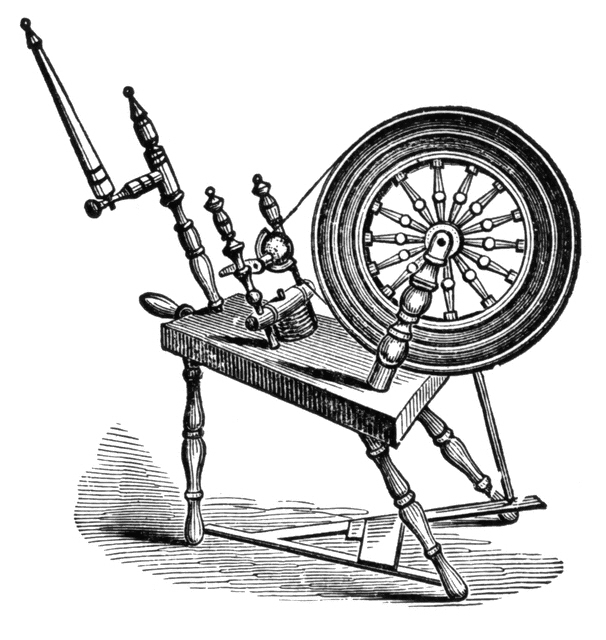
Toad Bride Wheel

Well Met

Melissa perches on Miss Cox’s bench, her hands in her lap, but her back straight, not touching the backrest. She won’t talk to or look at me, her eyes fixed on the garden gate. Her copy of The Turnip Princess lies on the wrought-iron table in front of us. I grab it as an escape from the surrounding air of doubt.

I open the book in its middle. My eyes fall upon one of its shorter stories, only a page long, The Toad Bride.

A man with three sons sets the challenge that the one who can spin the finest thread from flax will inherit his house. The elder brothers set about their task in a logical manner, but the younger, foolish brother “…takes the flax and runs with the wind…” until he gets mired in mud. A toad takes his flax, sets him free, and tells him to come back later.

When the foolish brother returns to the toad, he is given fine thread and in addition told to prepare for a marriage, with the injunction that he places a bridal gown and veil on the altar.

The youngest son wins the contest, and everyone assembles for his wedding. The groom is at the altar, the bells are ringing, but there is no bride.

A toad hops into the church, crawls into the bridal gown, and transforms into a beautiful woman. We soon find out that when the toad helped the young man by giving him the fine thread, she broke a witch’s curse. Of course they marry and live happily.

I glance at Melissa, who remains statue-still. If I were to cast us into this story, would I or Melissa be the toad?

Although I am hardly young, I can relate to the foolish part of the main character. Do I run with the wind until mired in mud? Metaphorically, I think I do. I wander alone in the Magic Forest and throw peanuts to a nixie. I do that at my peril.

That would make Melissa the magical toad. They are both feminine, but there the parallel ends. Melissa is not bewitched. Enchanted beings possess a certain amount of magic, and Melissa only now faces the existence of magic in the mode of can-this-be-true?

Rather, I must be the magical toad in this story. Magic and I are old friends. I won’t say I possess magic, but I do walk through magic. I see it all around me. Vaporous at times, but there nonetheless. I am the one bewitched—though willingly, not under a curse.

Can I cast Melissa as a foolish youth? Well, she is young, much younger than I. Foolish? She is sitting here in Miss Cox’s garden with me. “Foolish” is an applicable adjective.

Melissa takes in a breath and stirs. Entering the garden is a stately gentleman dressed in a tailored, black suit, though of a cut I do not recognize. His proud countenance is that of a man of a royal court. Melissa and I both rise.

Well, here we go.

Fairy Tale of the Month: September 2015 The Toad Bride – Part Two

Toad Bride medal2Bavarian Order of the Crown

The Meeting

There are people who radiate charm. Is it Schönwerth’s pleasant, confident smile? The ease of his stride as he approaches us? The tone of his voice?

“Guten Tag. Mit wem spreche ich, bitte?”

Oh, no. The language barrier. I haven’t thought of that since my awkward interview with Hans Christian Andersen.

“Ich bin Melissa Serious und es freut mich Sie kennenzulernen.”

I should have guessed Melissa would be good to the task. They settle onto the wrought-iron bench and immediately fall into an intense discussion. I find myself standing beside them, the bench holding only two. It is best that I take a stroll around the garden even though I am still hobbling at bit.

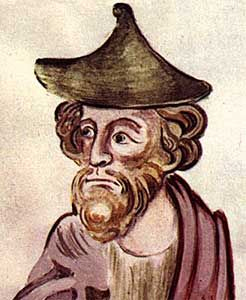
An interesting fellow, Schönwerth. Educated in both the arts and law, he held the position of private secretary to the crown prince Maximilian of Bavaria. Schönwerth’s duties included the management the prince’s wealth, a well-placed trust. During the upheaval of the 1848 revolt, Schönwerth, dressed as a laborer, wheeled three million thaler’s worth of cash and securities to safety in a handcart.

When the crown prince rose to kingship as Maximilian II, Schönwerth led his cabinet and guided the king’s patronage of the arts and sciences. Not surprisingly, he was knighted as well. Actually, twice: First as a knight of the Bavarian Order of St. Michael and later as a knight of the Bavarian Order of the Crown.

But Schönwerth had another dimension and passion, that of German folklore, specifically that of the Upper Palatinate. Erika Eichenseer’s recent translation of some of the fairy tales he collected has brought that piece of his collection to light, but he also collected and recorded nursery rhymes, games, songs, proverbs, customs, and made observations on the peasants’ everyday lives.

He went about this in a structured, scientific manner, leading the way toward modern folklore collecting techniques. He was Inspired by the Grimms and corresponded with them starting in 1858. Jacob Grimm wrote that Schönwerth was the obvious heir to their work.

Schönwerth showed an unusual talent for drawing out information from subjects he interviewed without appearing to pry and with little more inducement than coffee and cigars. What he collected was absolutely voluminous.

To his credit as a folklorist, Schönwerth did not refine the stories he collected to suit an audience. He recorded what he heard. The downside of that practice meant his published works never drew much popular attention during his life.

Through the efforts of Erika Eichenseer, there is a rising interest in Schönwerth’s work. At the University of Regensburg, where the collection is housed, research continues to unearth details hidden in the unsorted heaps of paper that make up his legacy.

Also, there is now a Schönwerth Fairytale Path near Regensburg, which presents eight nature tales illustrated by local artists and which I hear has been very well received by the public. Perhaps the long overdue notice has finally come to Franz Von Schönwerth.

I look across the garden to where the two of them are sitting knee to knee. I think I’ll stroll farther along.

As I amble about, an errant thought comes to me. The task proposed by the father does not conform to the typical challenge. In The Three Feathers, which this story resembles, the king sends his sons out to find the best of something, which he ends up doing three times because of the discontented elder brothers. In The Toad Bride, the brothers compete to make the finest linen thread, which is women’s work. The tale glosses over the fact that he youngest has help and doesn’t do it himself. The contest is a foil, simply to move the story forward. Fairness is not important.

Fairy Tale of the Month: September 2015 The Toad Bride – Part Three

Frog-program green H J Ford

Just Strolling

I wander down toward the pond in Miss Cox’s garden and continue to occupy my thoughts with The Toad Bride. I can easily find common elements this story shares with others of its ilk. The three brothers, with the youngest being the simpleton and victor in the contest proposed by the father; the animal helper who is really a human cursed by a witch to appear in animal form; and the concluding marriage, of course.

Although Schönwerth corresponded with the Grimms, and each had much respect for the other, he did not follow the Grimms’ habit of polishing the stories. The echo of the storyteller’s mindset comes through Schönwerth’s transcriptions more clearly than it does in those tales that went through the Grimm filter.

In the Grimms’ hands, the three brothers motif appears having the youngest being a simpleton, yet gentle, thoughtful, and kind. The two elder brothers discredit themselves by being rude, jealous, and  greedy. In some cases the simpleton is shown to be a lot smarter than first credited.

Not so with the teller of The Toad Bride. Here the elder brothers set about their task, and we hear no more of them for good or for ill. The younger runs about willy-nilly (I see him waving his share of the flax in the air) until he is trapped in a mud pit and needs to be rescued. The only thing he does that comes close to making him worthy is to follow the toad’s simple instructions. The tale has the feel of The Prodigal Son, void of Grimm-added character justifications.

I hear Melissa’s laughter ringing from the upper part of the garden. I know now she will let me back into her bookstore. I feel myself breathing easier.

Also, unlike Grimm, the magical helper is a female. Usually for Grimm, the helper is not only a male, but also a prince. In The Toad Bride the toad transforms into a beautiful woman with no mention of royal blood. That is not to say there are no female magical helpers in Grimm—a notable exception being The Three Feathers.

The youngest brother and the beautiful woman get married; a more traditional, happy ending I cannot think of. The striking image comes when the toad hops into the church and crawls into the wedding dress. I think this picture contains the tale’s meaning. She broke the curse when she helped the young man, but her transformation does not occur until the wedding. The teller that Schönwerth sat with and transcribed this tale may well have been thinking of the generative power of marriage as the tale’s message.

By the time I return to the upper garden, their goodbys have been said. I see Schönwerth disappearing through the garden gate. Melissa throws her arms around me in a hug.

“Thank you,” she says into my ear, “for showing me the garden and letting me into your world.”

I am the magical toad of this story, and happy about it.

Your thoughts?

Fairy Tale of the Month: August 2015 The Enchanted Quill – Part One

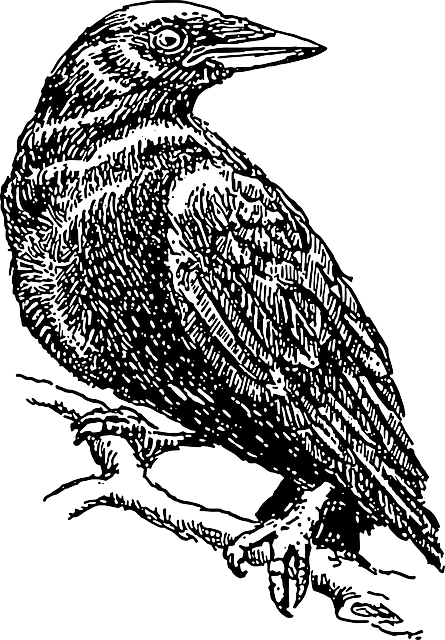
crow-48179_640

A Crow

I hear feet treading in the hallway. Let me guess. Thalia coming to visit her poor old grandfather laid up with a twisted ankle. The door opens and Thalia walks in backwards towing some else’s hand with both of hers.

“Melissa.” I start to rise to greet her, but pain sets me back down in my comfy chair.

Thalia pulls Melissa to me, who with a bemused smile, hands me the copy of The Turnip Princess and Other Newly Discovered Fairy Tales that I ordered.

“Oh,” I say, “You needn’t have taken all the trouble.”

“No trouble, really.” Her smile turns kindly. I gesture for her to take a seat. “Just for a minute,” she says.

“Read.” Thalia flopped into my lap, sending a lightning bolt of pain up my leg.

I open the book. The first story—same as the book’s title—I have already read to Thalia from an extract, and I move on to the second story, The Enchanted Quill.

A man falls asleep on horseback, and after three years a crow wakes him up, requesting one of the man’s three sisters as a wife. The crow gives the man a small picture of itself and flies away.

Two of the sisters are disgusted by the bird’s image, but the third blushes and keeps the picture. The next day a grand carriage appears and it is the youngest that invites the crow into their home.

Soon, all three sisters and the crow are in the carriage traveling to his castle. The way is dark and gloomy, and the sisters are afraid they are on the road to hell until the way opens up into a forest of lemon trees.

Once inside the castle, the crow tells the two older sisters not to be too curious, then takes the youngest off into another room. Nonetheless curious, the two sisters peek through a keyhole to see the crow is a handsome young man.

In the next moment, all three sisters are standing under a fig tree, the crow up in the branches scolding them.

In order to save the crow, the youngest, following his instructions, travels to the nearest town, dressed in rags, to take the first job offered her. She ends up as the local prince’s cook for which she has no talent and is mocked by her fellow servants.

The crow reappears, giving her one of his feathers to use as a quill. Whatever she writes down will happen. She writes the names of fine dishes and they appear. Her reputation as the cook of the castle rises, and because she is beautiful, the caretaker decides he wants her for his own.

When he comes into her room, she tells him to shut the door, and writes down that he should shut the door all night long, which he does repeatedly.

A huntsman and another servant are also suitors, but the huntsman takes his boots off and on, and the servant closes up the dovecote all night long.

Angered, the three suitors go after the cook with whips. She grabs her quill and the suitors end by lashing each other.

The crow returns, transformed into a prince, and takes the youngest sister off to his castle.

“That’s it?” Thalia’s face turns up to mine.

“Yup, that’s it. What did you think?”

“Sort of like it. I like crows, but weird.”

A good summation, I think.

Fairy Tale of the Month: August 2015 The Enchanted Quill – Part Two

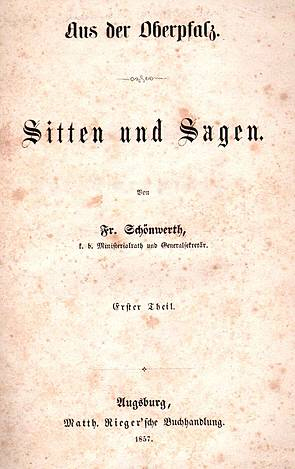
Title page Schonwerth

An Apology

“I must apologize,” Melissa says, as Thalia runs off to the kitchen to find herself some lemonade.

“Apologize for what?”

“For being unprofessional.”

“Is delivering a book to a customer unprofessional?”

“No, but reading it cover to cover before delivering it is.” Melissa blushes a little.

“Ah, and what did you think of it?” I fold my fingers together.

“Very engaging. So unlike the Grimm we have gotten used to.”

“Yes, Thalia wasn’t quite sure about The Enchanted Quill.”

“It is an interesting Beauty-and-the-Beast variant.” I see by her far-off expression she has slipped into thinking mode. I will be enjoying her company for more than the previously-stated minute.

“As I see it,” she continues, “the story breaks down into three distinct parts. First is the crow waking the man and asking for a bride, then giving him a picture. In the second part, we meet the sisters and observe their view of the crow. In the third, the youngest sister is on her own with some magical assistance from the crow, to establish herself and beat off the suitors.”

“I see a fourth part,” I say. “I’ve been reading Marie Louise Von Franz, and she states most fairy tales are in four parts, but the fourth is usually hard to see.”

Melissa gazes at me curiously. “What can be the fourth part? We’ve run out of story.”

I smile. “The crow comes and takes her away. It is the fourth and final act, different from what went on before it.”

Melissa nods and slips back into musing. I am enjoying her being in my study, thinking.

“What is most puzzling is that ending.” She reaches out, picking up the book, and reads the last paragraph of the story.

“The time had come. The crow arrived, and now he had turned into a prince. He rode with the beautiful cook to his magnificent castle.”

She sets the book back down. “That’s more of an in-case-you-didn’t-notice-the-story-is- over ending, rather than the culmination of all the preceding.”

I see her point. “Does that suggest the ending is not what the story is about?”

Melissa intertwines her fingers in her lap. “The ending certainly is cryptic. The teller could have at least dragged out the carriage with the four horses again. If the story is not about the ending, then what is it about?”

It is my turn to muse. “The youngest sister is the protagonist. The story is about her, not about saving the crow. He is under some sort of spell, but the story never bothers to tell us about it. He instigates the action by waking the man and requesting a wife. He interjects himself into the story, and is there at the conclusion. Yet, it is not his story.”

Melissa brightens. “It is her story. In the end she is using her magical gift effectively, all by herself. Her family has fallen away. Her brother is heard of at the start of part two, but disappears quickly. Her sisters all but betray her with their curiosity, and also disappear at the end of part two. Part three is all about her travail. But, ultimately, what is she about?”

I do like the way she thinks.

Fairy Tale of the Month: August 2015 The Enchanted Quill – Part Three

Joseph Jacobs Sig

The Autograph

I should be offering Melissa some tea, or ice tea given the warm weather, but it would be difficult to manage with crutches. Besides, she is deep in thought over The Enchanted Quill.

“What,” she says after some time, “is it that the youngest sister does or proves?”

“Well,” I contemplate, “she has inherent qualities. It is she who sees something in the crow’s picture that makes her blush.”

“Yes, the picture, isn’t that a queer item, not to mention the three-year sleep.”

“No dearth of threes in the story either: three-year sleep, three sisters, three suitors.”

Melissa’s brow knits. “Did the crow induce the sleep so that the brother would be obliged to him when awakened?”

“I get that sense.” I shift a little in my comfy chair and hope it will not hurt. “I think the crow set up the sisters as well by tempting them to spy, knowing what would happen. The crow is manipulating events and is testing the youngest sister.”

Melissa leans forward in her chair. “I think you’ve touched on something. I’m sure I’m projecting, and the fairy tales are good for projecting ourselves. This is a journey. Her older sisters adamantly refuse the crow, and her brother’s promise falls upon her. She submits. She is also submissive when the crow instructs her to go to the next town and take the first job offered. The crow has weaned her away from her family and cast her into an unfamiliar role. She hits bottom.”

I pick up on her line of thought. “Enter the magical device! The crow gives her one of his feathers with which to write. He has essentially given her power.”

“Yes, but,” Melissa raises a finger in the air, “with rather little instruction. Often fairy tales telegraph how the device will be used, but not in this case. She finds her own way to make it work for her.

“Now, when she is approached by the demanding suitors, she puts them in their place. She has moved from being submissive to assertive. That is what the crow is seeking, and he returns for her. As the story says, ‘The time had come.’”

“I assume,” I chuckle, “the bit about the suitors stuck opening and closing doors, and taking their boots off and on went over well in the taverns. Ahh, the power of the written word.”

I expect Melissa to agree, but her countenance has completely changed. With an accusing eye she glances at another book on the table between us. There, lying open to its title page, is English Fairy Tales, with Jacob’s autograph. She knows it was not there when she sold it to me.

“You forged . . . you wouldn’t . . .” Her eyes narrow. “You didn’t, you who cavort with fairies.” Her eyes grow wide and her skin pales. “Necromancy.”

“Good heavens, no!” I sit upright sending another jolt of pain up my leg. “It’s much more innocent.”

What do I say?

“It’s Miss Cox’s garden.”

Melissa folds her arms and with a toss of her red hair declares, “Explain this or I will never speak to you again, nor allow you in my shop.”

I could not bear that. I take a deep breath. “Whom from the past would you like to meet?”

She stares at me. I fear she will walk away.

She thumps her index finger on the book she brought. “Schönwerth.”

Your thoughts?


Fairy Tale of the Month: July 2015 The Pink Flower – Part One

pinnk true-myrtle-768

Pink

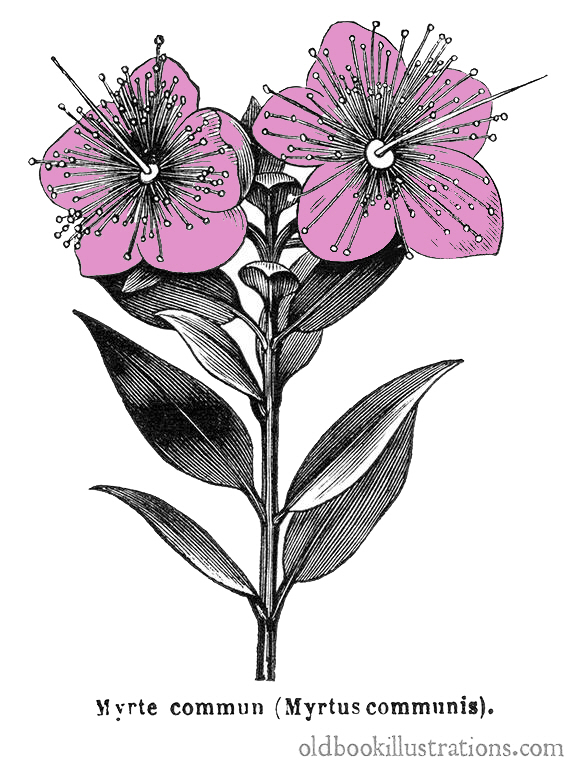
“Oh look.” Duckworth’s oars stop in midair. He nods toward the riverbank. It is solid with a growth of pinks.

“It reminds me of a Grimm story,” I say.

“Of course it does.” Duckworth resumes his rowing.

“No, really. It’s even called The Pink Flower.”

“There’s no escape. Go ahead. Tell me the story.”

A queen gives birth to a son to whom God grants the power of having every wish fulfilled. The castle cook steals the child, secreting him away with a wet nurse, and smears blood on the sleeping queen’s apron as if she carelessly let the child be eaten by a wild animal. Enraged, the king shuts his queen in a tower for seven years, in complete darkness with no food or drink. However, she is sustained by angels who come to her in the form of doves to bring her nourishment.

When the child is old enough to speak, the cook has him wish for a castle and lands, so that the cook can live like a lord. To entertain the lad, the cook has him wish for a beautiful maiden to look after him.

Later, afraid the young prince will one day wish to visit his father the king, the cook instructs the maiden to kill the prince in his sleep. When she reveals the plot to the prince, he wishes the villain into a poodle forced to eat hot coals until flames come from its mouth.

The prince then decides to return to his father’s kingdom to see what has become of his mother. He turns the maiden into a pink flower, puts it in his pocket, and with the poodle in tow, heads home.

He wishes for a ladder to climb the tower and calls inside to his mother, letting her know he has come to rescue her. He then presents himself as a huntsman to the king, promising him as much venison as he can want, although there has been no game in the kingdom for a long time.

The prince, still in disguise, leads the king’s huntsmen out, then wishes for deer to appear. They return with wagonloads of meat. The king is delighted and has the prince/huntsman sit by his side at the banquet. During the meal the prince wishes that someone would ask after the queen. The king does not want to speak of her, but the prince now reveals himself.

He tells the king it was the cook who stole him away, placing the blame upon the queen. The poodle is brought out to eat more hot coals before the prince wishes him back into his true state. Exposed as the kidnapper, the cook is thrown into the dungeons.

The prince then shows his father the pretty pink flower and wishes the maiden back into her form. The king calls for the release of his queen. She is brought to the banquet but refuses to eat or drink, declaring God has given her salvation, and dies happily three days later. The king has the cook drawn and quartered, but nonetheless grief overtakes the king and he soon dies.

“Good grief, is this a fairy tale or a Shakespeare tragedy I haven’t heard of?” Duckworth has stopped rowing again.

“Well, the prince and the flower girl get married in the end.”

“That hardly compensates for all the injustice.”

Fairy Tale of the Month: July 2015 The Pink Flower – Part Two

pink hydraulics-diagrams-768

The Math

Duckworth and I continue our rowing, but I can see by his knitted brow he is thinking about The Pink Flower.

“Hold on,” he says. “The math doesn’t work.”

“What math?” I know my story is in trouble.

“Listen, the cook steals the prince and hands him over to a wet nurse. So, let’s say the prince is two years old at most. The king shuts the queen in the tower for seven years. When the son returns, the queen is still in the tower; therefore, the seven years have not passed. I’ll give the story a little advantage and say that the seven years are almost over. The lad was two years old when abducted. Seven years have gone by. He is nine years old at best. He goes to the king and passes himself off as a huntsman? A nine-year-old huntsman?

“And further,” he says, (Oh my goodness, but he is on a roll.) “the prince wishes for a ladder to climb the tower, and then he calls to his mother. Through a door, a window? She is supposed to be in complete darkness, yet they can easily call to each other through some sort of opening. And why does the king have huntsmen when there has been no game to hunt?

“Now, about his knowing his own history that he reveals to the king: who told him about it? Certainly not the cook. The prince wished the maiden into existence after his kidnapping. How would she know about it? Who else is there?”

“Well,” I say, feeling cornered, “the story does not tell us.”

“And what about the ‘hello’ factor?”

“The ‘hello’ factor?”

“Yes, as in ‘Hello, why don’t you wish your parents to forget their history and think they are living happily ever after and don’t have to kill themselves.’ I have no respect for this character. He could have wished for world peace. What do we get? A fire-breathing poodle.”

“Duckworth, Duckworth,” I defend, “you can’t apply everyday logic to fairy tales. They are not that sturdy, nor are they meant to reflect some piece of reality as mainstream fiction might do. Fairy tales aren’t necessarily trying to make a point or pass on a moral. They are here to flex our imagination.”

We have come to our dock and Duckworth ties a rope around a mooring. “Still, there must be reasonable structure to any story.”

I unship my oars and stash them on the bottom of the boat. “Well, to start with, a fairy tale is a folktale with the element of magic.”

“Fair enough,” says Duckworth. “What are the rules?”

“What are the rules?” I ponder this as I step from the boat to the dock. I don’t quite make it. My foot slips and twists on the wet, mossy planks of the decking. In a moment I find myself in deep water. I hope there are no nixies about.

When you ask, What are the rules of fairy tales? you are in deep water.

Fairy Tale of the Month: July 2015 The Pink Flower – Part Three

Pink Tower Regensburg 1400-1410Regensburg 1400-1410

My Foot

I feel foolish sitting here in my study with my foot nestled on a pillow and elevated on a table to ease the swelling and throbbing of my twisted ankle. After Duckworth pulled me out of the river and got me home, I should have limped off to the doctor. But now it is late and I simply will have to wait till morning.

The throbbing is keeping me awake, so I contemplate Duckworth’s question. What are the rules for fairy tales?

Fairy tales turn on its head the literary injunction to writers to “Show, don’t tell.” Where the fairy tale tells you flatly that the king had a beautiful daughter, the writer of a literary tale might cover the same fact by saying:

“The door opened and into the great hall stepped a girl, perhaps twelve year of age, her blond hair falling about her slender shoulders.

“’Oh father,” she said to King William . . .'”

And more likely than not, in fairy tales neither character will have a name other than “the princess” or “the king.” Dialog tends to be sparse, and the point of view is usually third-person objective; that is, we don’t get inside their heads.

But that is not what Duckworth objected to in The Pink Flower. What stopped him was the nonsense. Perhaps my question should be, What are the rules for fairy-tale nonsense?

No, I’ll change that again. What are the rules for fairy-tale beyond-sense?

I see fairy-tale plot lines as a series of images, a storyboard if you will, but a sketchy storyboard. The tales give little description of the scene at hand. Is the king’s castle in a town? On a mountain? Is the cook young or old? There is no author trying to get the listener or reader to image exactly what they want them to see. In these authorless tales the listeners provide these details for themselves. The images that make up the story are created by and belong to the listener. This is where the beyond-sense comes in. The listener also creates what lies behind the images.

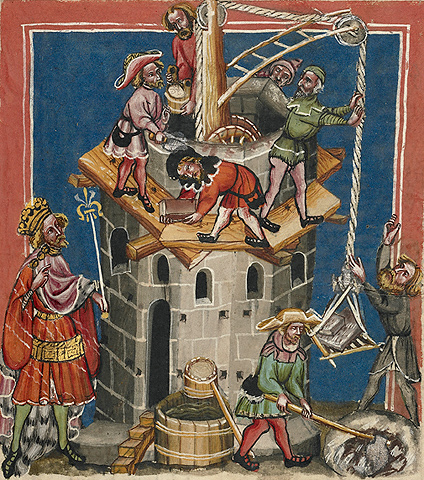
In The Pink Flower, I see the tower as the central image, a phallic symbol in which a female is imprisoned. This tower appears in other stories, its prisoner invariably a female, put there by a king or a witch.

The notion of the tower’s entrapment lies at the heart of this story and is reflected elsewhere in the tale. The cook kidnaps the baby prince to control his wishes. The young prince does not know any better, and is being mentally entrapped. When the cook fears the prince is about to break out of that entrapment, he tries to have him killed, a plan that backfires.

The maiden, wished into existence by the prince, is beholden to him. Her entrapment is a gentle, loving one, represented by his turning her into a flower, but an entrapment nonetheless.

But these are my insights behind my images of the story. For someone else, the tower may not resonate. Their central image may be the blood-smeared apron. For them this is a story about injustice rather than entrapment.

My wakefulness and throbbing foot have brought me to this conclusion. There may be no hard-and-fast rules governing fairy-tale images, but the images need to be of such a nature that our imaginations can seize upon them, take our cues, and rewrite them for ourselves.

The implications of a cook being turned into a fire-eating poodle, I will leave for others to ponder.

Your thoughts?

Fairy Tale of the Month: June 2015 The Three Rowan Trees – Part One

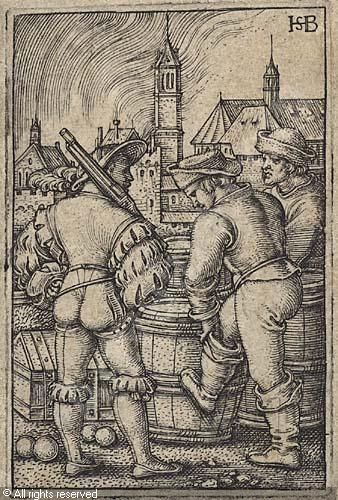
Three Soldiers Hans Sebald Beham2Hans Sebald Beham

A Trio

I sit on the window seat of the bay window in my study, watching the day disappearing over the magic forest in the near distance. I don’t usually sit here, but I have the windows open allowing the soft evening air to wash over me as I smoke a bowl of Dark Dwarf.

My thoughts—drifting away with the smoke—swirl about the three soldiers of The Devil and His Grandmother. While I can’t call the three soldiers a motif, the trio shows up in more than one Grimm story. To my thoughts comes The Three Army Surgeons, The Long Nose, and The Crows—although in this last one the three are not companionable. Outside of Grimm I can think of The Three Soldiers in Jacobs’ Europa’s Fairy Book, and the well-known Stone Soup.

I am sure with a quick search I can find another. Stephen Badman’s Odds and Sods sits atop a pile of books near me. I grab it and page through. Sure enough, I find The Three Rowan Trees.

Three soldiers are dismissed from service with little to show for their time. They agree to travel together and stumble across an empty castle in which all their needs are mysteriously met. That evening, to the soldier named Hans, comes a snake that crawls into his bed and turns into a princess.

She explains to Hans that she and her sisters are the three rowan trees growing in the garden. If Hans and his companions will bear being whipped all night long for three nights starting at Midsummer’s Night, the spell will be broken. Hans agrees to try.

In the morning he visits the rowan trees and is given three magical gifts: a purse that never empties, a cloak that will take him anywhere, and a bag that contains an army.

Immediately forgetting his promise, he and his companions travel to London via the cloak and Hans pursues the hand of the daughter of the King of England. She cheats him out of the magical gifts and abandons him. He is close to suicide when he comes across a tree of golden apples that cause a horn to grow out of one’s forehead, and a golden pear tree that removes it. Tricking the king, queen, and princess into eating the apples, they are beholden to him to have the horns removed. Thus he regains the magical gifts.

He uses the bag containing the army to release his companions who have gotten themselves into trouble, and returns to the castle by Midsummer’s Night. By keeping himself and his companions drunk for the next three days and nights, they survive the whippings and break the spell. Each marries a princess and Hans becomes king.

What is it about a trio of soldiers gallivanting around the countryside that engages the listener? Hans is the protagonist, but the other two companions are not completely necessary for the story. A teller could easily edit them out. Yet time and again a trio like this appears to populate a ribald tale.

I hear Thalia padding down the hall. For the moment, this puts an end to my reflections.

Fairy Tale of the Month: June 2015 The Three Rowan Trees – Part Two

Three Little Pigs jacobsJohn D. Batten

Threesome

After reading to Thalia, I return to my window seat and my pipe. The gentle evening air comes from the direction of the magic forest carrying with it the touch of enchantment. It has a hold on me and my wandering thoughts.

Oddly, Thalia asked me to read The Long Nose to her. It is a variant of The Three Rowan Trees; at least the element of a fruit tree causing disfigurement and another to cure it is in both, along with the soldier trio. While these two stories bear a resemblance to Jacobs’ The Three Soldiers, there is no one tale type that can be attached to the appearance of three soldiers.

Nor are these soldiers the only trio in the tales. From The Three Little Pigs to The Three Feathers we have other examples. I discern patterns with these threesomes, whether they be pigs, brothers, or comrades.

In the case of the pigs, the first and second were failures, while the third succeeded. When the trio is made up of brothers there is a hierarchy of age with the youngest appearing to be the least promising. In truth, the elder two have their shortcomings, while the youngest has what it takes to overcome hardships.

The pattern for the comrades is a little different. In the soldier stories the comrades are of equal status. Even in The Three Soldiers, where a sergeant, a corporal, and a private travel together, the sergeant never pulls rank on the other two. All decisions are made upon agreement.

I peer at the magic forest’s silhouetted tree line. Have I thought this through or is there another aspect?

In all three examples (pigs, brothers, and comrades) the lesser two members of the triad are a counterpoint to the nature of the third, who has become the protagonist. Hans, of The Three Rowan Trees, is an opportunist. It is Hans who suggests they all stick together. It is he who chooses the road they travel. Hans converses with the snake and a rowan tree. Hans pursues the princess in London. His companions almost wordlessly go along with him. The most they do is spend all their money and get into trouble, relying on Hans to get them out of their predicament. The companion’s lack of activity contrasts with Hans’ constant motion.

Watching my pipe smoke drifting along on the night air, my thoughts drift toward one more aspect.

The three soldiers offer up the chance for roguery. Hans’ conduct is not exactly exemplary. He clearly “slept” with a princess, and after receiving magical gifts from her, pursues yet another princess. Later, he uses trickery to get back the gifts he carelessly gave away. When he returns to the rowan trees (and just in the nick of time) to do the right thing, he does it by getting his comrades so drunk they don’t know they are being mysteriously whipped all night long.

These are antics the decent youngest brother could never get away with, behavior not even appropriate for pigs. But soldiers—well, we give them license for our own entertainment

Fairy Tale of the Month: June 2015 The Three Rowan Trees – Part Three

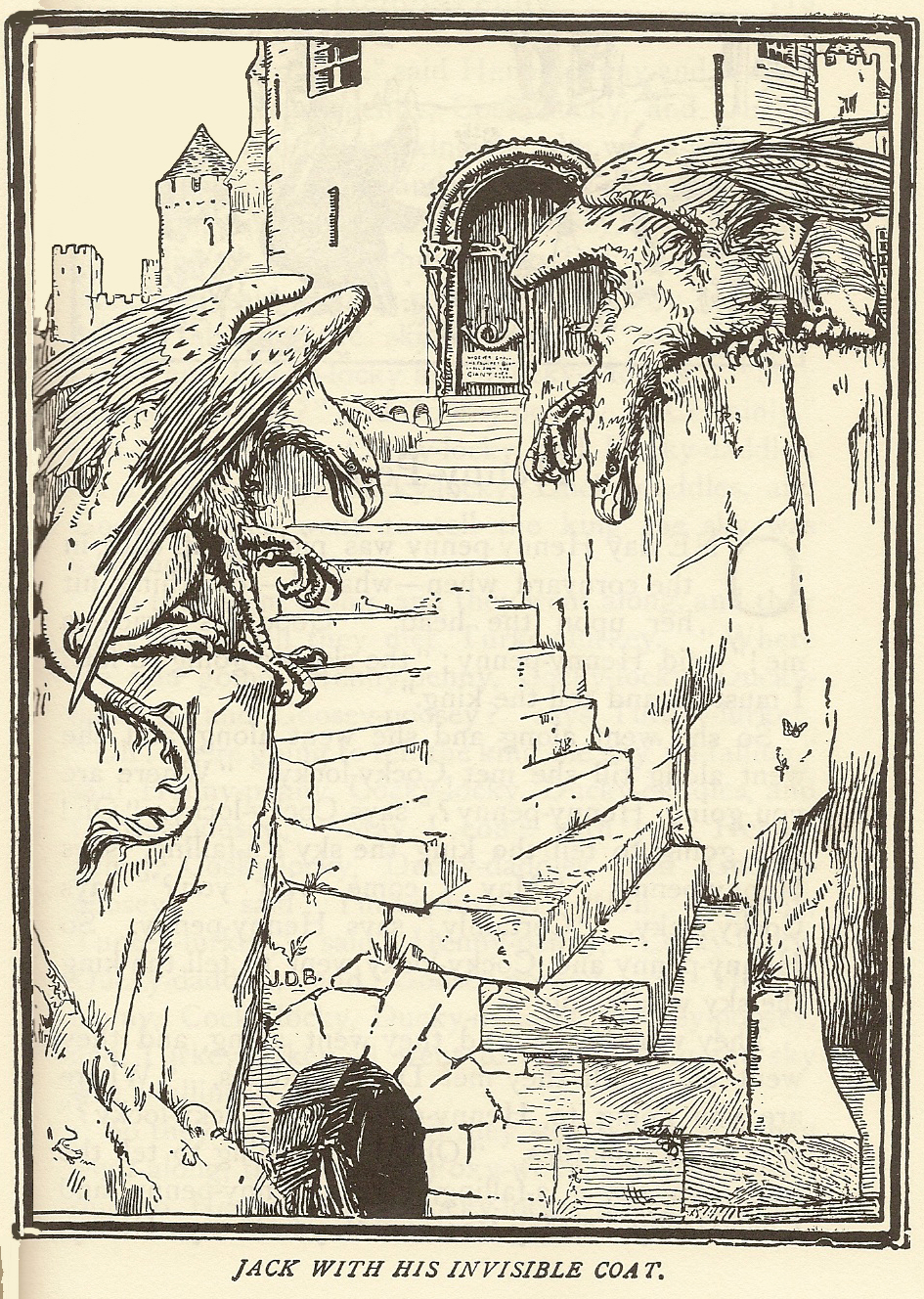
Magic Cloak BattenJohn D. Batten

Gifts

“There is a fairy in my bookstore!” Melissa’s eyes are wide with concern. She didn’t even say hello when I entered the shop. She fairly slammed her book down.

“Yes, I know. So sorry. Thalia was careless.”

“Thalia?”

“Yes, it was her fairy.”

Her expression softens. “Well then, I haven’t gone crazy. I’ve told three of my friends. Two of them suggested therapy, and the third an exterminator.”

“Exterminator. Oh dear no. Fairies are rather rare and need to be cherished.”

“There really is a fairy in my bookstore?” Melissa’s alarm is slipping toward wonderment.

“She has black, static-filled hair?” I prompt.

Melissa moves her hands about her head in imitation of the fairy’s floating locks.

“Consider her a magical gift,” I say.

“You mean like a purse that never empties, or a cloak of invisibility?”

“Rather like. Yes,” I say.

Actually, not, as I think about it. The magical gifts are inanimate objects imbued with magic. The fairy is alive and entirely a creature of the fey.

And where do the magical gifts come from? Who made them? In The Three Rowan Treesthe gifts of the magic purse, cloak, and bag are given by the enchanted rowan tree. Do the gifts fall from the branches like fruit? We are not told.

Sometimes in the fairy tales, the gifts are not objects, but rather attributes or events. A heroine may be given the gift of flowers falling from her lips when she speaks; she may grow more beautiful every day; or her destiny maybe to marry a prince. These are blessings granted at the moment of their uttering. But we get the sense that the magical objects preexist their being granted to the hero or heroine.

I suspect they preexist because they represent our wishful thinking for things such as wealth (the purse,) freedom (the cloak,) and power (the bag.) The cloak can give its owner the freedom to travel. Sometimes this ability to travel is represented, appropriately, by a hat. The cloak can also be one of invisibility (security). Another common gift is a glass vial, allowing the holder to become a great doctor (health.)

The gifts of attributes and events are more a reflection of the hero or heroine’s worthiness. These are more often conferred upon women, and not always to their benefit. Sleeping Beauty was one such recipient.

“What do you feed fairies?” Melissa jolts me away from my still-wandering thoughts.

“I don’t know. I never had to.” I think for a moment. “We always have milk out for Johannes. Maybe they are like house brownies and go after milk.”

Melissa’s brow knits.

“Listen,” I continue, “I have come for a purpose. I want to order a copy of The Turnip Princess and Other Newly Discovered Fairy Tales. These are the tales uncovered by Erika Eichenseer. The translation is by Maria Tatar, by the way.”

“Really.” Melissa grabs a pen and paper.

We return to our everyday world of mundane concerns, but our fairy, out of sight, flutters about the edges of our normality, and perhaps nibbles on it.

Your thoughts?

Fairy Tale of the Month: May 2015 The Devil and His Grandmother – Part One

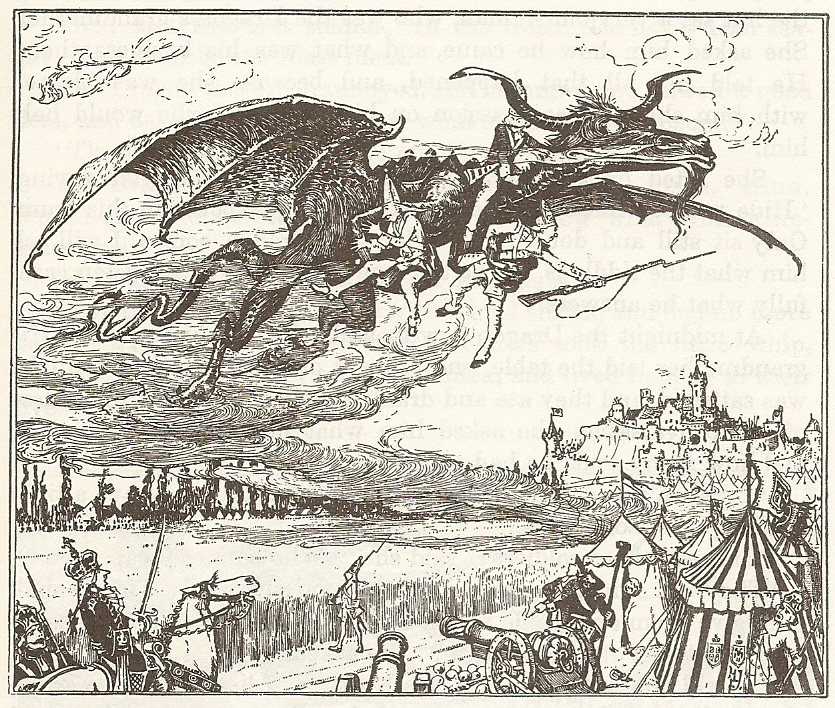
Devil Grandmother H J FordH J Ford

A Dragon

“Melissa stole my fairy.” Thalia enters my study in her pajamas, dragging Teddy behind her.

“She wouldn’t.”

“She did!”

I consider. “You took the fairy to the bookstore?”

“She crawled into my pocket.”

“She is a bookish fairy. I fear you tempted her fey nature to indulge herself. She probably thinks she is in Nirvana.”

Thalia and Teddy settle in beside me on the comfy chair. “Nearwana?”

“The best of all possible places.”

“Oh. Yeah. Melissa’s is pretty cool.”

“I am sure the fairy will come out every time you are there.”

“Maybe.” Thalia pouts.

“Well, tonight I have a story with a dragon in it.”

“Really?” she brightens.

I read her Grimms’ The Devil and His Grandmother.

Three soldiers desert by hiding in a wheat field, expecting the encampment to move on in the morning, leaving them behind. The army doesn’t move. By the second day the deserters are desperate.

“What’s a desserter?”

I note Thalia’s arms are crossed. “One who likes ice cream and does not want to fight in a war.”

A dragon, who proves to be the Devil, descends from the sky to ask them what they are doing. He then promises them if they will serve him for seven years he will get them out of their predicament. The soldiers readily agree. The dragon goes on to offer them an extravagant life for seven years at the end of which their souls belong to him unless they can guess his riddles. He gives them a small whip, which when they snap, sends gold coins dancing through the air.

“Can the Devil be a dragon?” Thalia’s brow knits.

“In this story he can.”

The seven years pass quickly—as time does when one is having fun—and two of the soldiers fall into depression as their end nears. The third of their number remains hopeful, and on the advice of an old woman, who comes wandering down the road, he visits the Devil’s grandmother to plead his case.

“The Devil has a grandmother?” Her brow knits again.

“Apparently. Did you ever notice that “Devil” is evil with a ‘D’?”

“Cool.”

The Devil’s grandmother takes a liking to this optimist and hides him in her cellar when the dragon comes home for supper. She engages her grandson in a conversation about the riddles for the next day. The devil is preparing a feast in hell for the three soldiers. To avoid the feast, they must guess that the roast will be a dead monkey floating in the North Sea, their spoon will be the rib bone of a whale, and their wine glass a hollow horse’s hoof.

Armed with the answers, the soldier returns to his companions. The next day the dragon is cheated out of his victims and loses his power over them. He flies off leaving them behind, along with the small whip that keeps them in luxury for the rest of their lives.

“I like the money whip. I don’t like the dead monkey,” she muses.

“Both are striking images.”

“I still want my fairy back.”

“I’m afraid that’s the fairy’s choice.”

Fairy Tale of the Month: May 2015 The Devil and His Grandmother – Part Two

Devil Grandmother John WaterhouseJohn Waterhouse

A Visit

“Hello, my nixie,” I call, as I settle myself on a rock above the water’s edge of the magic forest’s pond. Slowly she comes from below. I see her high cheekbones and the arc of her brow before she breaks the water’s surface.

“Hello, my human.”

I toss her an unshelled peanut from my paper bag, which she breaks between her long, pale greenish fingers to get the kernel inside.

“Can you tell me,” I ask, as I toss her another, “can the Devil be a dragon and have a grandmother?”

“No, I can’t.” She raises her hand for another peanut.

“Why won’t you tell me?” I withhold the nut.

“Because he is not of my pantheon. I know little of him.”

I relent and throw her the treat. “Sorry, I assumed all the (here I almost say ‘evil creatures’) adversaries of humans knew each other.”

“Adversaries? You and I are not adversaries. I am of the merfolk. We often have love for humans.”

“Whom you seduce, and sometimes drown,” I add.

“Drown if they deserve it, but that does not make us adversaries.”

“What can you tell me of the Devil?”

“He is a fallen angel, along with his other demons. Their conflict is with their god. I see where you mortals get trapped in the center.”

The nixie and I have fallen into a rhythm of tossing and catching peanuts as we talk.

“Now that you mention different pantheons, it occurs to me, I don’t recall any stories with merfolk and demons together in the same tale.”

“I wouldn’t keep company with them.” The nixie frowns.

“Nor do you merfolk look for souls to steal. You might steal the whole body, but you are not after the soul.”

“Steal?”

“Possess.” I correct. “Do you have a soul?”

“Of course not. Why would we immortals want souls, ours or anyone else’s, unless we have a heaven or hell to populate?”

I see a pattern I had not seen before. “You merfolk often look for human lovers. The Devil is looking for souls. Witches are looking to harm humans by death or enchantment.”

I absently shell a peanut and pop it into my mouth.

“Hey!” The nixie glares.

“Oh, sorry. Now elves are a little more complicated. They can be helpers or tricksters. Giants and trolls are simply problems.”

“Stepmothers?” the nixie puts in.

“Now there is an adversary,” I agree, “at least in fairy tales.”

I continue pitching her peanuts while I think.

“Wait a moment. Pantheons you say. What about the Roman pantheon? Fauns, satyrs, nymphs? The Romans conquered most of Europe and moved well into the Isles, but they left not a single dryad behind in the tales. Why is that?”

“Fauns, satyrs, and nymphs did not arise here. We did—the nixies, elves, dwarves, and giants. The mystic realms of this land belong to us.”

My hand rustles inside an empty paper bag. I look to find the peanuts are gone. I hear a splash and my nixie is gone as well.


Fairy Tale of the Month: May 2015 The Devil and His Grandmother – Part Three

Devil Grandmother Rackham Arthur Rackham

A Dragon’s Grandmother

“Tell me, can the Devil be a dragon and have a grandmother?”

Augustus eyes me suspiciously, then relaxes. “Ah, you are talking about The Devil and His Grandmother.” Augustus is easily the sharpest person I know; at least among fairy-tale aficionados like myself. As always, we inhabit his comfy chairs, surrounded by tobacco smoke.

“It is a rather unGrimm-like story; there is more of the tavern than the nursery in it.”

“True, Thalia was a little uneasy about parts. She didn’t like the dead monkey.”

“Yes, the dead monkey floating in the North Sea. What an image. I suspect that is the invention of a particular storyteller. Monkeys are not native to northern climes. By asking the poor soldiers to guess that it might be their roast, the Devil set up an impossible task. Storywise, the teller presents an informed, sophisticated device within the riddle. That speaks to a modern addition to the motif of the three questions. When did the monkey come into the folk consciousness? I think that might date this version for us.”

I take a pipe cleaner from Augustus’ supply on his side table and pull the stem from my bowl. “She also likes the money whip.”

“That is new for me too. Usually gold coins drop from mouths, are found under pillows in the morning, or come out of an endless bag of riches.”

“I keep thinking of The Devil and the Three Golden Hairs.” I reassemble my pipe.

“Well of course you do; it follows the same pattern of the grandmother helping the protagonist find out the questions.”

I relight my tobacco. “So what is with the Devil’s grandmother? He is a fallen angel, an immortal. He should not have a family linage.”

“There is a tendency for folklore to demote deities and heroes to folksy figures. Fionn mac Cumhaill, of the Irish tales, is an example. He was the leader of the Fianna warriors, and king of Tara. The latter-day tales about him—now called MacCool—cast him as a dumb giant dependent on the good advices of his wife.”

Augustus blows a few playful smoke rings, then continues.

“In the case of the Devil, the fallen-angel aspect is not frequently taught from the pulpit, and largely ignored by the folk. They did not discuss how many angels could dance on the head of a pin. The Devil to them had always been the Devil and nothing more. Jesus had a mother; why couldn’t the Devil have a grandmother?”

“What catches me,” I say, “is that we don’t hear of the Devil’s wife, mother, father, sisters, or brothers, only the grandmother.”

Augustus smiles. “Old women have a special status in these tales. There are two old women in the tales. One is a helper (as in our story), and the other is a witch. They are never the protagonist. Never is a story about a witch or a wise woman of the wood. These women always serve the story, for good or for ill, but never is the story about them.”

“And the Devil as a dragon?”

Augustus shifts uneasily in his comfy chair. “Having just said the folk didn’t connect with the fallen-angel thing, the Devil does appear as a great red dragon in the Book of Revelation in a battle where he is cast down to earth. That is perhaps the source for this image. I’ll suppose the storyteller picked and chose from the Bible what he liked and left the rest, but then, don’t we all.”

Your thoughts?

Fairy Tale of the Month: April 2015 The Golden Children – Part One

golden children gruellefisherman John Gruelle

Upstream

The rhythm of rowing puts me in a state of contentment. The weather stays mild and clear, letting the sun shine on the ripples that Duckworth and I make as we take our exercise on this leg of the Thames known as the Isis.

“Look, there,” Duckworth points. I see a flash of intense orange below the surface.

“What was it?” I look to Duckworth.

“A goldfish, well, carp really. I’ve read about it and have been looking for one. People who don’t want their pet goldfish anymore let them go into the Thames. That’s illegal. Some have been arrested. Invasive species and all that. This is the first time I have seen one. A big problem in some places.”

He gives me a challenging, sideways smile. “Got any fairy tales on goldfish?”

I think for a few. “Ah, yes, I do.”

Duckworth rolls his eyes. “I should know better.”

“It’s a Grimm, The Golden Children.” I give him the synopsis as we stroke our way up stream.

A fisherman catches a golden fish, who promises wealth if the man lets him go, but there is a condition. The fisherman must tell no one how he got his riches. His wife, unrelenting in her curiosity, gets her husband to tell her, and their fortune instantly disappears.

The fisherman returns to fishing only to catch the golden fish again. The same conditions are set, he returns home, and the same thing happens as before. The wife declares, “I’d rather live in poverty than not know who’s giving us all that wealth. After all, I want to keep my peace of mind.”

When the fisherman catches the golden fish for the third time, the fish concedes he is meant to be caught and instructs the man to cut him up into six pieces, feed two to his wife, two to his mare, and plant the remaining two.

The wife gives birth to two golden boys, the mare two golden colts, and two golden lilies spring from the ground.

When the boys come of age, they ride off on their golden horses. At an inn, on the first night, they are laughed at for being golden. Disheartened, one brother returns home, but the other ventures on. He takes the guise of a vagabond by covering himself and his horse with bear skins.

Soon after, he meets and falls in love with a maiden, who, unaccountably, falls in love with him. They are married on the spot, even before her father gets home. He is enraged and threats to kill the vagabond. Peeking into their marriage room, he sees his son-in-law is golden, and changes his attitude.

That night, however, the golden youth dreams of hunting a magnificent stag. In the morning, against his wife’s fears for his safety, he insists upon going hunting.

He spots the stag and the chase is on. By evening he loses sight of the beast, and finds himself in front of the cottage of a witch. When he threatens her annoying, yapping, little dog, she turns him into a stone.

Back home, one of the golden lilies wilts. The other golden youth comes to his rescue, forcing the witch to restore his form, after which one returns to his bride and the other returns home.

“What?” says Duckworth. “That’s it? What a horrible tale.”

“It’s not so bad,” I defend (weakly).

“Yes it is. Why, there’s no moral, no lesson learned.” Duckworth puts up his oars and folds his arms.

“Should there be? Must there be?” My oars hover in the air.

“Yes!” says Duckworth.

Fairy Tale of the Month: April 2015 The Golden Children – Part Two

Golden Children flyingfishNomenclator Aquatilium Animantium

Moral Reflections

I am bothered by Duckworth’s assertion that fairy tales ought to have a moral. I need to contemplate the problem he has posed for me. There are two places in which I can let my thoughts wander, my study, and the Magic Forest.

I have chosen the trail that leads to the Glass Mountain. I should fear the Magic Forest more than I do, but it seems to me to be safe if one does not get off the path. As to the Glass Mountain, it is a destination for the purpose of having one. I don’t intend to attempt a climb.

At the edge of the forest I light my pipe, then enter among the ancient trees.

Why does Duckworth assume a fairy tale should instruct? Aesop’s fables, which contain fairy-tale elements, are designed to inform. The Victorian literary fairy-tale authors, such as Hans Christian Andersen, were conscious of moral content. Many of the old fairy tales have a moral to them.

Certainly they do.

Do they?

I am so distracted that my pipe has gone out from my neglect to puff on it. I halt my progress, tamp down the tobacco again, and strike a match.

In the old fairy tales (not necessarily in the literary ones) the forces of good almost always triumph over those of evil, which is a fine thing, but is not the same as having a moral message. Morals have to do with the conduct of the characters, the rightfulness or wrongfulness, of their actions.

Certainly there are moral acts performed in these stories. In The Golden Children, the wife prefers their poverty over not knowing what bargain gave them their wealth. She values her peace of mind. That constitutes good moral conduct. The second golden youth puts himself in danger by confronting the witch to restore his brother’s humanity; also a moral act. But these events occur as incidental to the storyline, not at the story’s heart, allowing Duckworth to overlook them when he said the story had no moral, no lesson learned.

Scanning other fairy tales, I note similar quirks. Snow White makes a series of bad choices—nothing moral going on there. Gretel shoves an old lady into an oven—not proper conduct. Cinderella has supernatural aid—might that be an unfair advantage? Rapunzel has illegitimate children—well . . .

My path ends at the foot of the Glass Mountain. I look up at its imposing, glittering bulk, its sheer, smooth sides reaching toward the sky. Then I look straight ahead at the polished glass outcroppings in front of me.

There, distorted, fractured, reflected multiple times, I see images of myself. I also see the answer to my musings.

The fairy tales show us ourselves, distorted, fractured, reflected multiple times in the storyline. We see our hopes, disappointments, wishes, and fears. We witness our better nature and our reprehensible acts spread among the different characters. A moral act here and there is bound to come up. The tales are not about morals; they are about us—we multifaceted, complex, hard-to-comprehend beings.


Fairy Tale of the Month: April 2015 The Golden Children – Part Three

Golden Children two men

Something Borrowed

“You recall The Two Brothers don’t you?” Augustus waves his pipe in my direction.

“Yes—yes, of course, that’s where I heard some of this story before.” Why didn’t I remember?

Ensconced in his hospitality room, replete with comfy chairs, we test his experimental variation of “Elven Gold.” Our pipe smoke has laden the air. He increased the amount of Latakia I think.

Augustus blows a smoke ring and smiles. “Both stories have two brothers. Gold plays a part in each. One of the brothers gets married. When that brother chases a stag and encounters a witch, the other brother must come to save him.”

“Aren’t we talking about motifs?”

“Motifs? I can’t imagine that word being in an old storyteller’s vocabulary. To state it kindly, he ‘borrowed’ from other stories. It wouldn’t surprise me to know that a skilled storyteller had an endless supply of story-pieces, borrowed and stolen by ear.

“I get the sense that my storyteller took a little from one story and a little from another, then put a twist on it to make it his own. I see an old teller, sitting by the hearth of the inn, pulling the story-pieces out of his mental swag bag, but assembling the story he tells differently every time. One evening someone writes down what they heard, and creates the version that comes down to us.

“The notable difference between Two Brothers and The Golden Children is that in the former the brothers find gold coins under their pillows every morning. In the latter the brothers are gold.

“Oddly, in both cases the significance of the gold fades by the end of the story and the brotherly rescue becomes the point.

Actually, The Golden Children is filled with oddity. The marriage before the father gets home, and the thought of murder was interesting. The golden horses didn’t play much of a role for being golden and all that. Then we have the secret identity thing going on.”

“Yes, the bearskin,” I put in. “Why does that mean the youth will be taken as a vagabond? Does this relate to the Grimms’ Bearskin?”

“And the chase of the stag.” Augustus is waving his pipe again. “That comes right out of the beginning of The Six Swans.”

“Now that you point to it,” I say as I feel the Latakia going to my head, “The Golden Childrendoes feel like parts of other stories strung together. It starts out sounding like The Fisherman and His Wife, then slips into Two Brothers with a dash of Bearskin thrown in.”

Augustus nods his agreement. “What my teller hit upon—and a bold move on his part—was to make the brothers of gold, as well as their horses, and the lilies. Maybe it is my ignorance, but I think my storyteller came up with the golden children on his own.

“My fascination with these transcribed fairy tales is to hear the voice of a teller rise above the editing of literary collectors to come through to my ears. For that moment, I am sitting by the inn hearth listening to him.”

Your thoughts?

Fairy Tale of the Month: March 2015 Three Feathers – Part One

Three Feathers kingR. Emmett Owen

A Note

I stand across the street from the bookshop, reading the now familiar words painted on the plate-glass window, “Serious Books, New and Used, Melissa Serious, Proprietor.” In my pocket is a note from Ms. Serious delivered to me by Thalia, who spends her entire book allowance at Melissa’s. When the traffic ebbs, I cross over.

“Ah, I knew Thalia would not fail me.” Melissa raises her eyes from her book and smiles at me.

“Well, you are one of her favorite people. Of course she’d give me the message.”

“And what are you reading to her these days?”

Three Feathers—last night.”

Three Feathers? It’s been a long time since I read Grimm cover to cover. I don’t recall that one.”

I happily relate it to her.

In Three Feathers, a king contemplates which one of his three sons should inherit his kingdom. He proposes that whichever of the three can bring him the finest carpet will succeed him. He casts three feathers into the air. The eldest son follows his feather to the west, the middle brother follows his to the east. The feather intended for the youngest brother, Simpleton, immediately settles to the ground, followed by heartless derision from his brothers.

Sitting on the rock upon which the feather has fallen, intending to have a good cry, he discovers under it a trapdoor and steps leading downward. In an underground chamber he finds a large toad surrounded by little toads. When Simpleton tells the toads of his plight, he is given a beautiful carpet.

Meantime, his brothers take the easy way out and bring back the first carpet they can find. When they see Simpleton’s carpet, they protest that their youngest brother cannot possibly be king and demand another contest.

The king obliges and sets them the task to find the most beautiful ring. He casts the three feathers that float and fall as they did before. Simpleton returns to the underground chamber where the toads lives. The brothers go no farther than they possibly need to, returning with old wagon rings. The contest ends like the first.

Again, the elder two brothers protest and the king now calls for them to go out and return with the most beautiful woman. The three feathers are cast.

This time the large toad gives Simpleton a hollowed-out turnip to which are harnessed six mice. Simpleton picks out one of the little toads and puts it into the hollow turnip. In an instant the tiny conveyance transforms into a carriage pulled by six horses and carrying a beautiful woman.

The brothers, having learned nothing, return with pretty peasant girls.

Again, there really is no contest, but still the brothers protest, issuing a challenge that the kingdom should go to the brother whose woman can jump through the hoop hanging from the hall ceiling. The elder two think Simpleton’s woman is far too delicate for the task. Instead, the peasant girls injure themselves in the attempt, and the enchanted woman springs through with grace. The protests come to an end.

I see Melissa’s green eyes smoldering and wonder what terrible thing I’ve said.

“I don’t like,” she intones with emphasis, “women having to jump through hoops at the male’s pleasure.”

“Oh, I’m sure they didn’t have circus animals doing such tricks then.” I am not really sure.

“It’s worse than that. A friend of mine, a dog-show enthusiast, told me that in medieval times kings would have the dogs of peasants jump through small hoops. If the dog was too large, it meant the dog could be used for hunting, or in the king’s mind poaching, and he had the beast maimed.”

“Oh.” I am embarrassed. I didn’t see that implication.

Fairy Tale of the Month: March 2015 Three Feathers – Part Two

Three Feathers Rackham Arthur Rackham

A Must-Buy

“Oh,” Melissa says, “about the note . . .” She turns in her swivel chair to a pile of books with paper tabs sticking out from between their pages with various messages written to herself. The paper tab in the book she hands me has “For Thalia’s G-dad” written on it.

“I know you will buy this volume.” Melissa is one tough saleslady.

I look at the book’s title and I know she is right.

“When did this come out?” I am delighted.

“In October.”

I am holding The Original Folk and Fairy Tales of the Brothers Grimm: The Complete First Edition, translated by Jack Zipes.

“Zipes, of course. This is wonderful.” I turn immediately to Three Feathers and read. I am stunned.

I can’t help noticing Melissa’s smile at the shock that must be registered on my face.

“He changed it,” I blurt.

“He, who?” Melissa is enjoying my befuddlement.

“Wilhelm. Jacob left Wilhelm to handle the fairy-tale project while he worked on a German dictionary and other things. The Tales went through seven editions and I read that changes were made from the first in 1812—this edition,” I tap the book in my hand, “and the last in 1857, but good heavens.

“’Listen, in the original the tasks were to find the finest linen, then the finest carpet, and finally the most beautiful woman. That’s not that big a change. However, in this version the two elder brothers make an honest effort to find the best, but cannot compete against magical help.

“Next, the time Simpleton spends underground is different than time passing above ground. He goes down the stairs, gets the linen, and climbs back up the stairs. Meanwhile, his brothers have been traveling far and wide in their search, and are just now returning.

“Here’s the real kicker, there is no toad in the original. In his first visit, Simpleton finds a maiden in the subterranean chamber sitting at a flax wheel. She gives him the finest linen ever seen. On the second visit she is at a loom making an enchanting carpet for him.

“On the third visit she tells him to travel farther into the subterranean world to find the most beautiful woman. Here is where this version gets really strange. In another room, flickering with light from gold and gems, sits an ugly frog. Not a toad, a frog.”

“I know the difference,” says Melissa.

“The frog says, ‘Embrace me, and immerse yourself!’ She says this twice before the reluctant Simpleton picks her up, takes her back to the upper world, and jumps into a pond. The moment they hit the water she transforms, in his arms, into the most beautiful woman.

“Oh, I love that.” Melissa claps her hands.

“Yes, this version is so much better. Why did he change it? I am going to talk to Wilhelm about this.”

Melissa laughs at what she takes to be my little joke. Actually, it’s a slip of the tongue. I hand her my credit card.

Fairy Tale of the Month: March 2015 Three Feathers – Part Three

Three Feathers Goble Warwick Goble

So Why?

Back in my study, in the company of a glass of wine, I am reading my new book looking for clues as to why Wilhelm made the changes that he did to the Three Feathers. I know the Grimms started out (and remained) loyal to the idea of the German nationalistic spirit being embedded in the language, leading the brothers to study philology and mythology instead of the law, their original academic intent.

Yet—from what I am reading now and what I have read before—I gather that they shifted their focus to include practical concerns.

Their first collection of fairy tales, appearing in two volumes published in 1812 and 1815, was met with lackluster interest. By the second edition in 1819, Wilhelm caught onto the notion of making the work presentable to children. The scholarly notes went away (published separately) along with mothers who killed their children. Stepmothers now killed the children. Christian motifs replaced some of the pagan motifs, but thankfully not all. In 1825 the Grimms published a small edition of fifty stories intended for middle-class families with children, a rising segment of the population who might—and did—purchase the book.

I can well imagine the dilemma as they attempted to reconcile the idea of the tales as a nationally unifying heritage with the actual tastes and mores of broad swaths of the German population of the day.

Using this knowledge I conjecture why Wilhelm made those particular changes to the Three Feathers. I reach for my glass and take another sip. Wilhelm is standing by the fireplace glazing into the flames.

Dropping the linen and substituting a ring as one of the tasks is minor. A ring is more interesting than a piece of linen. However, in both versions I find the request for a carpet rather odd. Unless it flies, a carpet is uninteresting. Rings and beautiful women have ambiance. In the Grimms’ notes they cite a variant in which the king requests a dog small enough to jump through his wedding ring. That stopped me in light of Melissa’s comment about dogs, kings, and hoops. There may be a cultural reference in the story, now lost on us.

More notable is the change in the elder brothers’ nature. In the original version they diligently pursue the king’s requests, but lose out to Simpleton’s magical helpers. I assume that did not appeal to the current work ethic of their audience. Wilhelm denigrated the elder two brothers to justify the younger’s success. Now that the two lazy brothers spend little time on their tasks, a time difference between the upper and lower realms no longer makes sense; Wilhelm sacrificed it.

I glance up at him. He is watching me and nods, reading my thoughts.

Curiously, Wilhelm replaced the maiden and frog with toads. I’ll admit, the toad version is tidier. The Simpleton comes to the same place three times for the toad to grant his wishes. In the 1812 version, on the third visit he travels deeper into the subterranean world to encounter something uncanny.

I wonder if Wilhelm feared his Protestant readers might view the scene of Simpleton jumping into a pond with the frog for the sake of transformation as a mockery of the Christian baptism, and opted for the obviously more fanciful—and literary—version in which common creatures and objects turn into the glamourous in the blink of an eye.

I look up, Wilhelm has vanished.

The wine has made me sleepy and I put down the book. Like the wine, this English translation of the Grimms’ first book is a thing to savor.

Your thoughts?

Fairy Tale of the Month: February 2015 Foundling – Part One

John B. Gruelle

Not Quite

Teddy, Thalia, and I are all secure in the comfy chair; the light from the fireplace sends flickering shadows onto the blanket covering our legs. In our erratic progression through Grimms’ collection of over two hundred fairy tales, we have landed upon Foundling.

A forester, out hunting, hears the sound of a child crying. After a puzzling search, he finds the child in the top boughs of a tree. The story tells us that a hawk stole the child from the lap of his sleeping mother and left him on a tree top. The forester rescues the little lad and decides to raise him with his own daughter, Lena. Because he found the child, the forester names him Foundling.

As the two children grow, they become exceedingly fond of each other. If they are not together they soon become sad. One day Lena sees the old cook, Sanna, carrying a great number of water buckets into the kitchen. She asks Sanna why she does so, and Sanna, after making Lena promise to tell no one, confides that she intends to cook Foundling in the morning after the forester goes out hunting.

Early the next morning Lena tells Foundling, “If you won’t forsake me, I won’t forsake you.” To which Foundling replies, “Never ever.” That becomes a refrain throughout the rest of the story. Breaking her promise to Sanna, Lena tells Foundling of his plight, and they run off together.

When Sanna finds that both children are gone, she sends three servants to bring them back. Lena sees them from afar. She tells Foundling to turn himself into a rose tree; she becomes a rosebud upon that tree. When the servants come to where the children were, but cannot find them, they return to the cook, telling her that all they found was a rose tree.

Enraged, the cook sends the servants back to cut down the rose tree and bring her the rosebud. Again, Lena sees them coming, and this time the servants find a church—Foundling—and inside nothing but a chandelier—Lena.

Thwarted again, the cook accompanies the three servants to accomplish the task. Lena tells Foundling to turn into a pond; she turns into a duck swimming on the pond.  Seeing this, the cook kneels down and begins to drink up the pond. Quickly, Lena grabs the cook’s head in her beak and pulls her underwater, drowning the old woman. It is in this last moment that the story reveals the cook as a witch.

Lena and Foundling return home.

“Teddy and I don’t like that story.” Thalia is pouting.

“Why? What’s wrong with it?”

“It’s dumb. Read the next one.”

“The next one is King Thrushbeard. We’ve read that already.”

“Goody. Read it again.”

And so I do.

I find “dumb” an insufficient analysis. The tale has the basic fairy-tale components: a beginning, middle, and end (This is not to be taken for granted.); a protagonist (two actually); a villain; lots of magic; and a happy ending.

And yet, Thalia is right. There is something about this tale that does not quite satisfy.

Fairy Tale of the Month: February 2015 Foundling – Part Two

foundling H J FordH J Ford

Evil for Evil’s Sake

Foundling. Foundling.” Augustus’ eyebrows knit. He rises from the overstuffed chair and stands before his bookshelves, which are lined with notebooks.

I had gotten here just as he closed the shop for the day, and we tucked ourselves away in his study for a visit. Augustus pulls a notebook from a shelf, peruses it, replaces it, and picks another. I know he is a self-taught scholar, and claims to have come up with a tale-classification system simpler and more scientific that Aarne-Thompson’s. He explained it to me once until I became completely befuddled.

“Ah, here, yes. I recall it now.” He sits down with a binder in his lap. “I have it in my notes as ‘a failed tale.’ ”

“How unkind,” I say.

“I am afraid this tale suffers from Wilhelmitis.

“Pardon? I think you are coining a word.”

Augustus smiles. “I have two arguments to justify that statement. Starting with a minor point, Lena promises the cook she would not tell anyone of what was about to be said. Lena breaks that promise by warning Foundling of his impending doom.

“That’s excusable in the real world, but in the fairy-tale realm that cannot be done without dire consequences. Promises, however ill-advised in their making, are binding. For Lena there are no consequences. That is a clear violation of fairy-tale law.

“More pertinent to my argument, the Grimms’ stories’ popularity and longevity have to do with the literary polish the brothers—particularly Wilhelm—worked upon them. However, there were casualties and this tale is one of them.”

Augustus pages through his notes before continuing. “Because they wanted to appeal to a middle class audience—and note this was an evolving middle class caught between the minions of the old Holy Roman Empire and the rabble of the German nationalistic movements—Wilhelm quickly made changes to the stories to satisfy their tastes.

“In the original 1812 version, the foundling is a girl baby whom the forester names Birdie. Putting myself in Wilhelm’s shoes, I think he made the change from a female foundling to a male foundling simply to conform to the popularity of the fond-brother-and-sister theme

“A bigger problem for Wilhelm was that in at least one version of the collected tales the villain was not the cook, but the forester’s wife, who wanted to cook the intruding foundling.

“The motive for the wife’s action is easy to imagine; that she would confide in her own daughter makes more sense than the cook confiding in Lena, but Wilhelm faced having the daughter kill her own mother to save the foundling. He apparently didn’t think that would fly with his audience. The usual solution of substituting an evil stepmother now gets complicated with a new wife, stepdaughter, and adopted daughter. Wilhelm solves the problem by turning the wife into an old cook.”

“Ah,” I say, “but she is a villain with no motive. That is what Thalia sensed. The cook is evil for no reason. Now that is unsettling.”

Your thoughts?


Fairy Tale of the Month: February 2015 Foundling – Part Three

Ida Rentoul Outhwaite Ida Rentoul Outhwaite

Holding Magic

Our resident fairy is curled up and sleeping on Thalia’s copy of Grimm, which lies open to the Foundling; her black hair, filled with static electricity floats about her, moving and swirling with her breathing. I sit as close as I dare, contemplating the delicacy of her fey nature. Her beauty is that she is not common.

My “failed fairy tale” as Augustus calls it, has plenty of fairy-like magic in it. In the Foundlingthe children turn themselves into a rose tree, a rosebud, a church, a chandelier, a pond, and a duck. Not too shabby, but they have broken with acceptable decorum.

Mistakenly, some who imbibe story liquor allow that anything can happen in a fairy tale. Well, they are drunk. Fairy tales, in their own way, are stodgy teetotalers, walking a straight line of convention. The faux pas that the Foundling commits is granting commoners (Lena and Foundling) the power to transform themselves into other shapes, that is to say, possess magic.

No one has written the etiquette book for fairy tales but, if someone had, it would clearly state that commoners are not inherently magical. Magic is in the hands of witches, wizards (who rarely appear in the Grimm canon), fey beings, and royalty. This breakdown of who has magic fascinates me.

That fey beings, such as fairies, dwarves, and demons, have magic is a given. They are a class of beings all unto themselves.

Witches, however, are human. With a few exceptions, they are old, ugly, and poor. More accurately, they appear to be poor. Witches may have amassed wealth in the cellars and tunnels under their humble abodes. Still, even a gingerbread house does not rise to the level of a castle. In the Celtic tradition it is the henwife, poorest of the poor, who practices the uncanny arts.

At the other end of the medieval economic spectrum, royalty, by birth apparently, also hold magic. In the Goose Girl the elderly queen gives her daughter a protective token (three drops of blood on a handkerchief) and the talking horse, Falada. The young princess talks to the beheaded horse and raises winds to blow off the cap of an annoying little boy. The tale feels no need to explain these things. That the queen and the princess possess magic is as much a given as the fey beings having these skills.

The only magic commoners should have are those mysterious items given to them by magical helpers (old women in the wood, or little old men the protagonists chance to meet).

Quietly I tamp and light my pipe. The fairy opens one eye, but then slips off to sleep again. I am pleased she is not disturbed by my presence.

Magic is not common. It exists at the far ends of fairy-tale society, among poor old women, those privileged by birth, and the fey. Magic for the commoners should be doled out sparingly, a cloak of invisibility here, a magic sack there, and no more than three wishes at a time.

Watching the sleeping fairy, I resist the urge to pick her up and hold her in my hand. After all, she is magic and I a commoner.

Your thoughts?

Fairy Tale of the Month: January 2015 The Nixie in the Pond – Part One

nixieofthemillpondH. J. Ford

The Water’s Edge

“I didn’t know you liked fairy tales.” I address Thalia’s cat, Johannes, who sits on the study table, my copy of Jack Zipes’s translation of Grimm lying open in front of him.

“I never said I didn’t,” he answers coldly, inserting a deft claw between the pages, turning a leaf, and pinning the opposite page with his other claw. This explains why my books are not always where I leave them. They often end up on the floor.

Looking over his head, I see he is reading The Nixie in the Pond. In this tale a miller is approached by a nixie—a mermaid-like creature. He bargains for wealth in exchange for what is being born at that moment in the mill. He thinks it to be a dog or a cat, unaware that his wife is birthing a boy in the mill as they speak.

The miller cheats the nixie by keeping the lad away from the pond. The youth grows up, becomes a huntsman, and marries. One day, while hunting, he washes blood from his hands at the mill pond and is seized by the nixie.

His wife, discovering his plight, circles the mill pond, calling his name until she collapses and is taken by a dream. In the dream she climbs a mountain until she reaches a hut at the door of which an old woman beckons to her.

Upon waking, the young woman indeed climbs the mountain and meets the old woman who beckoned to her in the dream. The old woman gives the younger a golden comb with the instructions to comb her hair, in the moonlight, by the mill pond, then set the comb down by the water’s edge. When she does these things, the water rises up and takes the comb in exchange for a glimpse of her husband’s face.

Again, the woman dreams of climbing the mountain and, again, she actually does. The old woman gives her a golden flute to play by the mill pond. In exchange, the wife sees more of her husband.

Again the dream and the visit; this time the young woman returns with a golden spinning wheel. For it, the husband is fully revealed and escapes from the nixie. Together they flee, with the water rising quickly behind them. Fearful of drowning, the younger woman cries out to the older. She is transformed into a toad, and he into a frog. In these forms they survive the flood, but are separated. Returning to their human shape, each finds themself in a foreign land.

Lost and no longer together, they each become shepherds in order to make a living. For many years they drive their flocks from pasture to pasture, gradually moving closer together. When they again meet they do not recognize each other, but take comfort in each other’s company.

One evening the man plays a tune on his flute, the same that she played at the edge of the mill pond. She cries and tells her story. The veil falls from their eyes and they are reunited. And, ah yes, they live happily ever after.

“What do you think?” I ask Johannes.

“My fur bristled when she dunked him into the mill pond.”

“As well it might,” I say.

“And given the chance, I’d have scratched her eyes out.”

“You’re not a forgiving cat, Johannes.”

“Cats never forgive.”

“I’ll remember that.”

Johannes curls up and goes to sleep.

Fairy Tale of the Month: January 2015 The Nixie in the Pond – Part Two

Nixie  A. L. BowleyA. L. Bowley

The Pond

While contemplating The Nixie in the Pond, I decide to go to the authority on the topic. I do this despite the cold weather and the lateness of the day. In addition, it always feels a bit warmer in winter and cooler in summer in the magic forest than elsewhere. I grab a paper bag of unshelled peanuts and head out.

My destination is fairly deep into the forest, but I know it is safe, even under the moonlight, as long as I stay on the path. At the path’s end is the pond. It’s never frozen over. I am sure that has something to do with her. I sit on my rock at the top of the bank to wait.

Immediately she appears, posing on her rock at the pond’s edge, water flowing from her hair and arms as though she were a trickling fountain.

“Hello, my human.”

“Hello, my nixie.” We have never exchanged names. I doubt it is safe to do so. I shell a peanut and toss it to her. She catches it in her thin, pale-green hand and pops it into her mouth, rolling her eyes in ecstasy.

“I want to ask you about the miller’s son you abducted.”

“Which miller’s son? There are many.”

“The one who eluded you long enough to become a huntsman and to marry.”

“Oh, the one that got away. She did it with help you know.”

“Yes, I know. Why did you show her the huntsman, her husband?”

“I carved the golden comb, flute, and spinning wheel. We nixies make exchanges for the things we want. I knew what she wanted. Yet, I gave her only the sight of him. I did not intend to exchange all of him for the spinning wheel. He belongs to me. My fault was being too patient in collecting my due. He tasted being his own man. Willfully he abandoned me and prompted my anger.”

I can see that anger in her eyes and I throw more peanuts to placate her.

“They were husband and wife,” I reason.

“That is of no concern to me.” She is looking at a peanut kernel between her fingers.

“You nearly destroyed them, and set them each on a long, lonely journey. Was that not a bit harsh?”

The nixie looks at me with deviltry in her eye. “My human, I am immortal. You are mortal. Mortals live with their past in their thoughts. Our past is immense; we cannot keep it in mind. We live only in the present. Therefore, we love, we hate, we anger completely, untampered by what came before.”

As I shell more peanuts, I am thinking there is a bigger question, but I cannot wrap my mind around it.

“I see,” she says, “questions floating about in that human brain of yours. I will give you all the answers to your unasked questions.”

I am stunned by the offering. She sees into my soul. I am as transparent as glass. The enormity of this opportunity seizes me.

“I am interested. You are right, I am full of questions. Your offering of answers trembles my heart. You will do this for me in exchange for …? No, I am not going to ask!” Images of Thalia flicker in my mind. “Here.” I toss my nixie the bag of peanuts and make an escape.

Your thoughts?


Fairy Tale of the Month: January 2015 The Nixie in the Pond – Part Three

nixie ‘LITTLE SEAMAID’  Louis RheadLouis Rhead

By the Hearth

Back in my study, after checking in on Thalia sleeping peacefully, I light a fire in the hearth to soothe my shivering. Or am I trembling after my encounter with the nixie? I should know better than to underestimate anything fay, be it a tale or the real thing.

I settle into my comfy chair and let my thoughts wander back to The Nixie in the Pond. If Augustus were here, I think he’d agree that one of the striking features of this tale is the wife’s dreams.

There is something shamanistic about the wife dreaming three times and actualizing the dreams by climbing the mountain to see the old woman who beckoned to her. At this point in the story there are three realms: the nixie’s world under the water, the wife’s world on land, and the old woman’s world atop a mountain accessed by dreams.

When the husband escapes from the nixie, he and his wife are reunited briefly, but their world shifts; they are transformed into separate creatures—a frog and a toad—and swept away, each taken to a different land unknown to them. Now there are two realms, both alien.

Unaccountably, they become (transform into) shepherds, and slowly, unconsciously, drift back toward each other until they once again occupy the same realm. Yet, they do not recognize one another. It is not until they know each other’s story that their reunion takes place both physically and spiritually.

It is tempting to put this tale into Freudian terms. The three realms could be the Id (nixie), ego (wife), and superego (old woman). The two realms could stand for the disintegration of the personality (bi-polar, schizophrenia), and the one realm to represent the reintegration, the healing, of the personality. Many fairy tales fit neatly into the Freudian mold as Bruno Bettelheim famously noted.

With the fire tongs I work the unburnt ends of logs in toward the glowing embers.

I could view the tale in Campbellian terms (I looked that word up; it really does exist.), which is the “hero’s journey.” When the miller bargains with the nixie, I see that as the “call to adventure.” When the huntsman washes the blood from his hands and is snatched by the nixie, he enters the “belly of the whale.” The old woman whom the wife encounters is the “supernatural aid.”  Escaping from the nixie only bring them more hardship, casting them upon the “road of trial.” At the end of the tale the husband and wife are reunited, which is of course the “ultimate boon.

I could invent another scenario about how the story reflects on the trials of a mundane world’s marriage, but I need to stop somewhere.

The tension that pervades this tale is that of the tentativeness of our existence, an element which underlies most good fairy tales. I sympathize with both the husband’s and the wife’s travail. It’s the story’s pattern that leaves me with a sense of satisfaction. Events come full circle. And of course, there is a happy ending.

I notice my shivering has stopped and I drift off to sleep lounging before the fireplace.

Your thoughts?


Fairy Tale of the Month: December 2014 The Winter Rose – Part One


Winter Rose ford_beauty H J Ford

A Ceremony

Christmas Eve in my study has a form that must be followed. Thalia, although of tender years, insists on decorum. Traditions survive because of children.

We start with my reading The Night Before Christmas to her and Teddy, all of us squeezed between the arms of the comfy chair by the hearth. Over the hearth fire is a three-legged cast-iron pot containing mulled cider warming up to be ladled out into cups; the convenience of a microwave is not to be considered.

I recently found out there is a controversy surrounding C. C. Moore’s rendition of the poem, but that sort of thing cannot be mentioned now. The poem—tonight—is sacred.

Following that, it is my choice what to read. Grimm has nothing about Christmas in their canon. A winter-themed story that I have not already read to her and Teddy proves hard to come by, but I manage. I peruse my copy of Jack Zipe’s translation of Grimm, finding what I want in the third story from the last. The Winter Rose.

It is a Beauty and the Beast variant, complete with a traveling merchant, three daughters, and three requests, the youngest asking for a rose. As it is winter, the merchant cannot find a rose. On his return trip home, he comes across a garden, half in winter, half in summer.  The summer half has roses in bloom. The merchant picks a rose and returns to the road. A black beast chases after him, demanding with a threat that his rose be returned.

The merchant ends up keeping the rose, thinking he has outwitted the beast, but the beast forcefully seizes his youngest daughter and take her to his castle.

There the violence ends. The beast dotes on the girl until she becomes fond of him. After a time, she wishes news of her family. The beast shows her a mirror in which she can see what is happening at home. Her father lies on his deathbed.

At this point in the story, we stop to serve ourselves some cider. Thalia provides a doll’s teacup for Teddy’s cider, but I am sure he is going to spill it.

The daughter pleads with the beast to let her visit home and he relents, allowing her a week but no more. During her visit the father dies. In her grief, she overstays her time. Upon return to the beast’s castle, she finds he has disappeared. Winter dominates the garden. There she finds a heap of rotting cabbages, under which she uncovers the beast, who appears to be dead.

She pours a bucket of water over the beast to revive him. Up rises a handsome prince, the garden returns to summer, and they marry.

“I like the garden,” says Thalia, finishing her cider.

I like the garden too.

She toddles off to bed, dragging Teddy behind her. I clean up the cups and the spill.

Has anyone explored the role of gardens and cabbages in fairy tales? That does sound like a pedantic inquiry, even to me. But I am conscious that while popular fiction dwells on the unusual, exotic, and exciting, my genre pulls from the mundane. Popular fiction plucks low-hanging fruit, fairy tales look at the root.

Fairy Tale of the Month: December 2014 The Winter Rose – Part Two

Winter Rose boyle_beauty Eleanor Vere Boyle

Boxing Day

It’s Boxing Day and I visit Augustus, bearing the gift of a quality fountain pen, knowing his abhorrence for other ink devices. The shop isn’t open, but Augustus lives above his store, and his friends know the shop door is unlocked on this day after Christmas. As I enter, I am delighted to see Duckworth already there, the two of them surrounded by a haze of pipe smoke.

As I enter into this fraternal matrix, Duckworth asks me, “What have you been spouting at your granddaughter these days?”

“Spouting, spouting,” I object. “This is Christmas; I am sharing.”

Duckworth’s waves his hand in a gesture of acquiescence.

The Winter Rose,” I supply.

Winter Rose,” Augustus echoes. “Ah, yes, The Summer and Winter Garden.”

“Pardon?”

Behind Augustus’ eyes I know his encyclopedic mind is sorting through the data. “The story appeared in the 1812 edition as The Summer and Winter Garden, but was soon replaced by The Singing Springing Lark, the first version appearing in the notes, until it reappeared, as I recall, in the last edition as The Winter Rose.”

Duckworth looks mildly amused. “How many editions were there?”

“Seven,” I say, taking out my pipe.

“For a children’s book, really?”

Augustus smiles. “They initially produced the work for an intellectual, nationalistic Germanic audience. As it gathered a popular following, they kept re-editing it to suit bourgeois tastes.”

I settle into one of the comfy chairs and tamp my pipe. “It seems to me—with The Winter Rose being an example—there are at least as many gardens in fairy tales as spinning wheels.”

Augustus nods. “Part of that is the extensive number of these Beauty and the Beast variants littering the fairy-tale field, the better number of them having a rose plucked from a garden. However, beyond these variants and still staying within Grimms’ collection there is Rapunzel, The Lettuce Donkey, and The Hare’s Bride, in which the garden plays a large role, and the garden is mentioned in passing in such stories as The Fisherman and his Wife and The Pink Flower.”

Duckworth clicked the stem of his pipe on his teeth. “Spinning wheels and gardens are ordinary things. Why are they of any interest?”

“Exactly because they are ordinary.” Augustus relights his pipe. “Fairy tales move from the everyday to the extraordinary, suggesting to us that the common can be imbued with meaning we did not notice before.”

“I am taken by the image of a garden half in summer and half in winter.” I look to Augustus for his thoughts. “I didn’t realize the first incarnation used that image in its title.”

“The tale is not that well known.” Augustus’ eyes are not focused. This is good. He is formulating, not recounting. “But anyone who has read it is struck by the garden in two seasons. What is it? Ying and yang? Folk recognition of duality? The cycle of life and death?”

“All of the above, I’d guess.” Duckworth puffs contentedly. He’s smoking “Elfish Gold” I realize.

“I’ll concur,” I say. “Pre-Freudian listeners were not schooled to analyze the hidden meanings of images. They felt the images, emotionally, as I am sure modern listeners still do—initially—before their brains take over.”

“I like that,” says Duckworth. “You suggest moderns try to think their way out of a fairy tale.”

Augustus looks dubious.

Fairy Tale of the Month: December 2014 The Winter Rose – Part Three

Winter Rose goble beauty Warwick Goble

A Rose

The smell of burning logs on the hearth sets me at ease. The glow from the fireplace illuminates my corner of the study. A Chromebook glows over my fingers, a Christmas present from my daughter. I like that they call it a “book.” That gives me permission to have it in my lap.

My favorite computer game is treasure hunting across the web, searching for tidbits on a topic. My topic tonight is “roses.”

I tip-tap in “roses in fairy tales.” Below the offers to buy roses in fairy tales from various proprietors, Grimm stories with the word “rose” appear, Snow White and Rose Red, Briar Rose, and The Rose. I follow the link to The Rose. It’s an odd little, grim Grimm tale about a youngest son encountering a child in the wood, who gives him a rosebud, saying he will visit again when the rose blooms. The next day the rose blooms, and the mother finds her youngest son dead.

The Winter Rose does not appear in the listings.

Typing in “roses symbolism” brings a wealth of information. Starting with the Wikipedia entry, and linking through the other offerings, a consensus emerges. The rose, as a symbol, pervades Western culture.

The entries like to start with the Egyptians, Greeks, and Romans, and their goddesses’ connection with the rose. I ran across two references to the Roman practice of hanging a rose on the door or from the ceiling of a room where matters of secret are to be discussed. Hence the term “sub rosa,” that is to say, “under the rose.”

The name Rosicrucian has something of the same origin, in that the rose lies at the heart of their symbol, the Rose Cross.

Another fun item: the rose holds the honored position of being the national flower of England. That came about with Henry VII, who introduced the heraldic Tudor Rose, which is composed of the red rose of the House of Lancaster and the white rose of the House of York. Henry ended the fifteenth-century civil war—later branded the War of the Roses—between the two houses by defeating Richard III in battle (A horse! A horse! My kingdom for a horse!) and marrying into the House of York.

Continuing my search, I find a lot about the rose representing the Virgin Mary and other sainted women, the rose garden symbolizing Paradise, and the rosary connection to our flower. When I consider the rose appeared in the Old Testament largely metaphorically and not symbolically, and does not appear in the New Testament (according to my source), I jump to the assumption that the rose in Christianity is a medieval invention.

My “Ah ha!” moment comes when the internet provides a link to Tam Lin. Tam Lin, of course, that quintessential Scottish ballad.

She had not pulled a double rose,

A rose but only two,

Till up then started young Tam Lin,

Saying “Lady, pull thou no more.”


“Why pullest thou the rose, Janet,

And why breakest thou the wand?

Or why comest thou to Carterhaugh

Withoutten my command?”


I had not seen Tam Lin in the usual list of Beauty and the Beast variants, probably because it is a ballad. The ballad dates to at least as early as 1549. Given its age, I wonder if it might not be the inspiration for that plucking-of-the-rose motif.

I look up at the hearth. For a moment I see a rose in the flames, its solid red petals and verdant green leaves in contrast to the orange and yellow flames. It quickly turns to ash.

Your thoughts?