Fairy Tale of the Month: October 2013 The Raven – Part One


Golden Castle  Florence Lundborg

Just Another Glass Mountain

As it is an unusually cold October night, I build up the logs in the fireplace, before Thaila, Teddy, and I settle into the comfy chair. We have a comforter over our legs, which comes up to Teddy’s chin. Thalia has squeezed Teddy between us; from there he stares out, button-eyed. She peruses the table of contents of our book and stabs her finger at the page.

The Raven,” she says.

“Number 93,” I announce and turn to it.

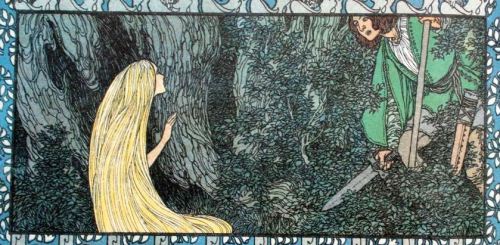
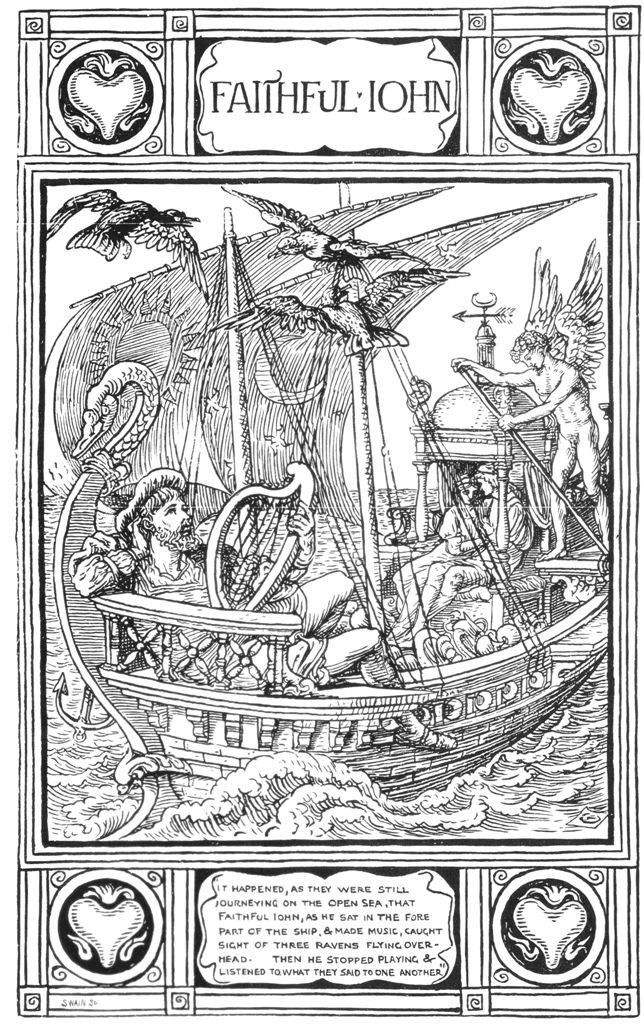
The queen’s infant daughter is giving her mother no peace until the queen exclaims she wishes the child were a raven and would fly away. I remember my beleaguered daughter, Thalia’s mother, during Thalia’s infancy, and empathize with the queen. Thalia was fortunate, but the infant in the story turns into a raven and flies from her mother’s arms.

Sometime later a man in a forest hears the raven call to him. The bird wishes him to break her spell, which he can do if he will go to a certain cottage, not eat or drink the food offered to him by the old woman who lives there, then stand on a pile of tanbark in the garden at two o’clock in the afternoon.

“What’s tanbark?” Thalia’s eyes narrow.

“It is used for making leather.”

“What’s it doing in the garden?”

“I have no idea.”

The princess, apparently now in human form, will pass by in a carriage for three consecutive days. If the man can refrain from falling asleep on any one of them, she will be rescued, but she despairs he will be able to do so. He assures her he will, but, of course, the old woman coerces him into taking a sip of wine, causing him to fall asleep. Three times the princess tries to rouse him, and on the third leaves him a loaf of bread, a piece of meat, and a bottle of wine, which are inexhaustible. As a token, she puts a ring on his finger, then leaves a letter telling him he can still rescue her if he comes to the golden castle at Mount Stromberg.

He wanders for a long time looking for the golden castle, eventually seeking the aid of a giant, whom he convinces not to eat him with the aid of the inexhaustible feast. After sating his appetite, the giant gets out his maps. When he cannot find Stromberg, he suggests they wait for his brother. The brother, after a long search, finds Stromberg on one of his maps, only to discover it is thousands of miles away. The giant offers to take the man most of the way there, but must return to nurse their child.

“What?”

“That is what it says, ‘…I must return home and nurse our child.’”

“Can guys do that?”

“No.”

“I didn’t think so.”

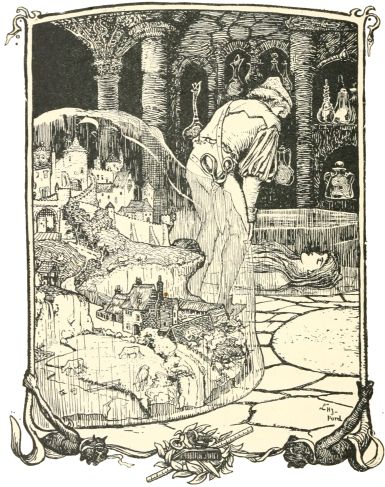
The man comes to Mount Stromberg to find it is a glass mountain, atop of which sits the golden castle. He can see the princess in her carriage drive by above him, but cannot reach her. He builds a hut at the foot of the mountain and waits.

After a year his chance comes when robbers outside his hut are arguing over who should get the magical devices they have stolen: a stick that can open any door, a cloak of invisibility, and a horse that can climb anything, even the glass mountain. He tricks the robbers, takes the stick, cloak, and horse, then drives the scoundrels off.

The man now has what he needs to enter the castle, where, wearing the cloak of invisibility, he drops the ring into the princess’s wine glass. The man does not reveal himself right away, but goes back outside and mounts his horse before taking off the cloak. The princess finds him there and promises they will wed the next day.

“There are some improbabilities in there,” I say to Thalia.

“I like it.”

I do too, but I am not sure why a story that does not quite hang together should appeal to me.

Fairy Tale of the Month: October 2013 The Raven – Part Two

raven

Fiction

My thoughts are aflutter, my questions for Augustus not flying in formation. Therefore, I am grateful when he, helping other customers and not looking at me, gestures with a finger. The gesture means, “I’ll meet you in the back room when I can. Sample my new mixture in the canister on the table. I bet you have another dilly of a question.”

All in a gesture. This gives me time to sort out my musings.

I am into my second bowl of tobacco from the canister on the table labeled “Tom Tildrum”—with a light enough hint of vanilla to be delightful—when Augustus comes in, carrying his black cat in his arms. They install themselves in the other overstuffed chair.

“I can tell by the knit of your brow you are puzzled.” Augustus reaches for his pipe.

“Yes. Thalia and I read The Raven last night. She likes it. I cannot say I dislike it, but it bothers me.”

“Why so?”

“No single thing, rather a number of little things. I am sure I am going to sound petty, but take the raven talking to the man. That is the last point in the story—and we are still in the beginning—that we see her in her raven form. From that encounter on he is supposed to rescue her from what? From the golden castle? He doesn’t. And how did she get there? Why does becoming a raven put her on the glass mountain in a golden castle?

“Then there is that giant nursing his child. What is that about? I will suppose originally there was a giant and his wife, but Wilhelm changed the story to two giant brothers and forgot to edit that part out.”

“One might suppose that,” Augustus strokes his cat, which looks at me accusingly, “but the story appeared in their first edition. I can’t imagine the error stood through the next six editions. They were German after all.”

“Then my case is stronger that the story is not coherent. And another thing, the man lives at the foot of the glass mountain for a year, seeing the princess drive by above him every day, but she never sees him. When he gets to the top of the mountain, he drops the ring in her cup and plays hide and seek. For what purpose?”

Augustus shakes his head slowly. “I am disappointed in you. Haven’t you figured out by now that fairy tales are not fiction?”

“What?”

“Mark Twain observed that fiction needs to make sense. Real life is not so encumbered. A detective story, although clues are hidden, needs to make sense in the end. Romance novels, which wallow in lavish and gritty details that culminate in a kiss, need to follow a known pattern.

“Fairy tales, like our own lives, are rich in the ‘the unlooked-for.’ Children, such as Thalia, understand fairy tales because, in their young lives, things happen to them without the benefit of experience. Children just assume events are connected. They accept the unlooked-for.

“This acceptance of the unlooked-for is schooled out of us as we grow older and are taught the value of logic. We vainly apply logic to our life experience to make sense of it, but must end up seeking our childhood acceptance of the unfathomable. That is why you read the fairy tales.”

His cat closed its eyes and released me from its judgment.

Fairy Tale of the Month: October 2013 The Raven – Part Three

toth1

Fragile Humanity

I should have gone to bed long ago, but some evenings and their accompanying thoughts render me sleepless. The pipe in my hand, filled with “Tom Tildrurm,” smolders as I stand by my bay window, watching the moon move westward over the enchanted forest.

The thought that has kept me awake is the human fascination with our animal side. In The Raven an incautious word from her mother transforms the infant into a raven. Beauty and the Beast may pose the classic dilemma between our human and animal natures. East of the Sun, West of the Moon may be the second-best-known in that motif of the human bride and animal husband.

Humans trapped inside of animal bodies are common fare. In the Flounder and the Fisherman the flounder is an enchanted prince. In both the Six Swans and Seven Ravens a sister sacrifices herself to save her enchanted brothers. The Frog King presents us with a pushy reptile with an agenda to reclaim his human form. The Golden Bird has a fox that helps the hero and asks for the reward of having his head and paws chopped off, resulting in a return to his princely form.

Another class of human/animal characters is the selkie of Celtic lore, seals that can shed their skins and appear as human. Celtic mermaids are not far behind, being able to give up their fins for legs. Outside of the fairy tale, in less friendly territory, are the werewolves.

Moving on to mythology, many Egyptian gods were represented as having animal heads: Horus with his hawk head, Thoth with his Ibis head, and the frightening crocodile-headed god Sobek.

Interestingly, in the Greek pantheon the animal natures are in the bodies, not the heads. Fauns, centaurs, harpies, all had human facial features.

Christianity is not quite devoid of human/animal connections. In the art of stained glass windows, the four apostles have their nonhuman counterparts: Matthew/angel, Mark/lion, Luke/ox, and John/eagle. I will not leave out the Lamb of God.

This list could be extended, but what does it say about real or imagined connections to the animal world? It speaks to our fear of animals. Imagine being face to face with a crocodile-headed god. Zeus might be more congenial. Certainly a werewolf in the vicinity is a cause for worry. Selkies and mermaids prompt in us unsettled feelings.

As the moon touches the tops of the trees of the forest and I relight my pipe, my thoughts center on the fairy-tale animal transitions, which are different from the mythological divine/animal awe-inspiring presence, or the selkies and mermaids parading as humans, but are akin to the werewolves losing themselves to their animal side.

Fairy tales like The Raven—and there are many of them—revolve around a prince or princess who has been cursed and lost their human form. They struggle to overcome the spell. The fairy tale acknowledges that what underlies our fear of animals is the sense that our humanity can easily slip away. A few incautious words, or mean-spirited rhetoric can cast a spell. Once cursed, the fairy tale warns us, it is hard to reclaim our fragile humanity.

Your thoughts?


Fairy Tale of the Month: September 2013 The Princess Who Became a Man – Part One

Odds and Sods

Guilty Pleasure

We all have our guilty pleasure. It is not enough that I have a library outfitted with dark oak shelves and wainscoting, a bay window that looks across a pasture to an enchanted forest, and a comfy chair in the corner near the fireplace, the mantle of which is lined with tobacco canisters.

I look up and down the hallway before closing the door, then go to my desk, pull open the lower drawer and reach for my guilty pleasure. Then I settle in to my comfy chair and flick the toggle. My Kindle comes to life.

Thalia, who hugs her book of Grimm tales, would be scandalized if she knew I had a Kindle. I rationalize that it is easy to hold, the type can be made larger for tired old eyes, and turning the page is done with a twitch of the thumb. I know it is not a real book, but I fancy I am reading the spirit of a book. Besides, this is where my copy of Odds and Sods resides, a ribald read if ever there was one.

I am rereading one of the tales from this English translation of Danish folk stories, The Princess Who Became a Man.

A king has lost his wife and cannot find another suitable until he realizes his daughter looks exactly like her. Appalled by her father’s demand that she marry him, she runs away, but is pursued by the king’s two bloodhounds. The princess cuts off her breasts and throws them to the dogs. The hounds eat the breasts and return to their master.

Staunching her wounds with moss, she finds shelter in the cottage of an old man. He takes care of her and, when she is well, he teaches her how to hunt. There comes a day when the old man suggests she leave the safety of the woods and seek the job of a gamekeeper at a royal palace not far away. If ever she is in trouble, she is to think of him.

Dressed in men’s clothing, she is soon not only the gamekeeper, but a dear friend of the princess. They wish to marry and it is granted. But on the wedding night, the Red Knight—stock villain of the Danish tales—hides himself under the bed and learns their secret. The Red Knight reveals the secret to the king, who declares a mandatory day of bathing in the river.

Everyone assembles on the river bank, but before the gamekeeper is forced to disrobe, she thinks of the old man, and a stag leaps into the river. The gamekeeper pursues the stag and, when out of sight of the bathers, the animal transforms into the old man, who changes the gamekeeper into a real man with the promise of claiming the couple’s firstborn.

When the child is born, the gamekeeper takes him to the old man, and watches in horror as he chops up the child with an ax, declaring that the pain the gamekeeper feels is like the pain he, the old man, felt at the time the gamekeeper was a princess, when her father demanded to marry her and when she cut off her breasts.

Then the old man takes the dead child away and returns with a covered dish for the gamekeeper’s wife. When the gamekeeper gets home and his wife lifts the lid, there  is the child, whole and well.

I am as perplexed by the tale as I was the first time I read it, but now there is a note to the tale I know was not there before.

“Meet me in Miss Cox’s garden at noon. Stephen.” And the Kindle turns itself off.

Fairy Tale of the Month: September 2013 The Princess Who Became a Man – Part Two

Wrought Iron Bench

More Akvavit

Sitting down on the wrought-iron bench in the garden, I see before me familiar tulip glasses filled, I am sure, with Rǿd Aalborg Akvavit. Miss Cox provided this treat the time I met Evald Tang Kristensen. The drinks are appropriate for my meeting with Stephen Badman, Kristensen’s present-day translator.

Stephen appears at the gate, leaning heavily on a cane. Before needing a cane he got around a fair bit, teaching English in Denmark and Papua New Guinea. His acting credentials came to the fore when he co-founded Gwent Theatre and directed the Gwent Young People’s Theatre in Abergavenny, Wales. Stephen looks dubiously at the two glasses of Akvavit as he stands over them.

“I lost my legs on that stuff one time, you know, and I hardly have legs to stand on now.”

Nonetheless, he sits and we knock back the two shots.

“What can you tell me about The Princess Who Became a Man?” I am anxious to know.

“Not as much as you would like. Kristensen collected it from an old woman, likely a widow, named Ane Kristine Olesdatter.

“Incest taboo aside (and I’ve yet to resolve who the `old man` is) the princess divests herself of her femininity/womanhood by removing her breasts; she is trained in a very masculine trade (gamekeeper), against all custom is allowed to marry the princess, and only then confesses her sex, by which time love has conquered all.

“The treachery of the Red Knight is a give; his betrayal is necessary for the final trial and test of faith—rather like Judas, without his intervention there would be no death and resurrection.

“The chopping of the first born as a test of one’s faith is a common motif  (shades of Abraham) and once passed, there is reward. Be true to oneself at all times and you will be rewarded—a Christian message? The more you suffer, the greater the reward? Is there a Sapphic element to the story? Is this a plea for tolerance?

“The story is a minefield of possibilities. People take from it what they will. Although not religious myself, I tend to think that there is a Christian message hidden deep within the symbolism, But there again ….”

“What of the old man?” I press him. “He is ever-present in the story. I have begun to think of him as the protagonist’s super-ego. Not that Ane Olesdatter knew anything about Freud and his theories, but might she have thought of the old man as a personification of moral thinking?”

“I always come back to the chopping of the child.” Stephen rests his chin on the top of his cane. “On the first cut,  the old man talks of his pain when her father desired to take her to wife; his desires are against the natural order. The sin is against both man and God; he takes away the girl’s innocence.

“The second cut, the removal of her breasts, which are fed to the dogs, compounds the first `sin.’ The old man was pained that she needed to mutilate herself before the hunt is called off and she is abandoned by her father. The pain the old man feels is as much about the king’s failure as about the dreadful solution she finds to her problem. She is tested to the limit and passes.

“The third cut (all good things come in threes) is all about the fulfillment of her promise to the old man; however painful her part of the bargain, she sees it through. The story is about balance; like Job the girl is rewarded. She gets to marry a princess and in the fullness of time will become the tried and tested king.

“As to who the old man is—The Righter of Wrongs, The Shield against the Storm, the protagonist’s Super-ego; I don’t know—there’s a bit of the Old and New Testament about him. He certainly gives us food for thought and discussion.”

Our eyes fall on the tulip glasses at the same time. They have refilled themselves. Stephen and I exchange glances and raised eyebrows, but pass on the delights in front of us. We do want to be able to walk out of the garden.

Fairy Tale of the Month: September 2013 The Princess Who Became a Man – Part Three

Enchanted ForestThéodore Rousseau

Changes

The enchanted forest has a reputation for being a quiet place, unnaturally quiet. I enjoy my walks there, although I never go too far into its darkness. I do not enter armed with a sword and shield, filled with courage as might a knight, but rather with my hat, cane, and pipe; my pipe filled with tobacco and my mind filled with thoughts. On my walk this evening The Princess Who Became a Man rolls around in my head.

Pieces of the story are familiar to me. As shocking as the king wanting to marry his daughter will always be, it is not new to this tale. Catskins, as an example, comes to my mind.

Magical helpers—in this case the old man—have a well-defined place in the fairy-tale cycles. The little old man or woman by the side of the road, or in the wood, who asks the young man to share some of their food, then rewards the generous with a cloak of invisibility, or a money purse that never empties, or a table cloth that presents a feast. These trinkets are usually reserved for male heroes. Often the magical helper would give female heroines shelter.

The Red Knight is familiar to Danish audiences, and here serves his usual purpose of sowing discord.

Familiar too is the giving up of the first born. Famously, Rumplestiltskin serves as an example.

Within that familiar frame are elements I have not encountered in fairy tales before until I came to The Princess Who Became a Man. I refer to, of course, the heroine becoming a hero. I know of no other variants of this motif.

Appalled by her father’s advances, she throws away her sex, feeding it to the dogs, in an effort to preserve her being.

With the help of the old man, she takes her first superficial steps toward assuming a new sex. Leaving the safety of the woods and the old man’s home, she relaunches into the world where she finds true love—for a person, who returns the love to her as a person, regardless of sex.

Their little utopia is immediately threatened by a malignant force. Before she, as the gamekeeper, must stand naked, with all her shortcomings, the magical helper intercedes, completing the last step to her becoming male, but he exacts a price.

A magical helper exacting a price is highly unusual, but is a device in this story as a setup for the last ordeal. The heroine, now a hero, must relive the horrors experienced through a ritualistic slaying of his offspring. Not until then can wholeness be achieved.

Questions of sexuality threaten to define this story, but as I wander through the enchanted forest, its odd atmosphere clarifies my thoughts, as it always does.

This is more than a story about a question of gender. The story uses that question to illustrate an overarching theme. The importance here is that the travail encompasses a painful transition. As Stephen suggested, it comes back to the dismemberment of the child. Had the story ended with the heroine completing her transition into a man, it would not have finished delivering its larger message. By reenacting the story through cutting the child in two—in graphic and immediate terms—we see clearly that a painful ordeal is nothing less than a death and rebirth.

The sun is setting and the enchanted forest grows dark. I best be out of this bower before I lose my way. I should not dwell here too long, not let the forest claim me, but allow me to return to the comforts of my home.

Your thoughts?

Fairy Tale of the Month: August 2013 Maid Maleen – Part One

Tower Irish

The Tower

“Seven years?” Thalia’s eyes fill with wonderment and concern. “She lived in a place like this for seven years?”

“Yes,” I say, “but without doors or windows. No light.”

Thalia and I stand in the Tower of London, Beauchamp Tower, precisely. It was the best I could do on the short notice given to me after we read Maid Maleen and she wanted to see a prison tower.

Princess Maleen refused to marry her father’s choice for a husband, she being in love with another suitor. Angered, the king walls up his daughter, with a serving maid, in a stone tower, declaring she will stay there for seven years to break her spirit.

Maleen and the maid lament for seven years, but at the end no one comes to release them. With a butter knife they gouge out the mortar between the stones. After three days they free themselves to find the kingdom burnt and ruined, with no one about.

Surviving on nettles, they travel to another kingdom to find work as kitchen wenches. The prince of this kingdom is none other than her former suitor. Thinking that Princess Maleen must be dead, he has consented to his father’s choice for a bride, an ugly, unreasonable woman.  Maleen becomes the ugly bride’s maid.

The ugly bride, aware of her ugliness, does not want to show herself to the court. She substitutes her maid as a stand-in for the marriage ceremony, unbeknownst to anyone else.

On the way to the church, Maleen utters three rhymes. The first is to some nettles by the road:

Oh, nettle-plant,

Little nettle-plant,

What dost thou here alone?

I have known the time

When I ate thee unboiled,

When I ate thee unroasted.


The second rhyme is spoken to a footbridge:

Foot-bridge, do not break,

I am not the true bride.


Then finally, she speaks to the church door:

Church-door, break not,

I am not the true bride.


These the prince overhears. He has become alarmed at her resemblance to his Princess Maleen. At the church door he puts a necklace about her throat before going in to be wed.

That evening the ugly bride takes up her role again, wearing a veil. The prince now asks her the meaning of the rhyme she spoke to the nettles. The ugly bride declares:

I must go out unto my maid,

Who keeps my thoughts for me.


This happens three times for all three rhymes. Then the prince wants to know why she is not wearing the necklace he gave her. Furious, the ugly brides goes off to have her maid killed. Maleen’s screams as she is being taken away bring the prince to her rescue.

Maleen now tells him the truth that he has indeed married his true bride.

The story ends with yet another rhyme, spoken by children who pass the tower in which she spent seven years:

Kling, klang, gloria.

Who sits within this tower?

A King’s daughter, she sits within,

A sight of her I cannot win,

The wall it will not break,

The stone cannot be pierced.

Little Hans, with your coat so gay,

Follow me, follow me, fast as you may.


Augustus and I have talked about rhymes in fairy tales. We suspect some of these tales came out of ballads. Broadsides—single sheets of inexpensive paper printed on one side, often with a ballad—were among the most common forms of printed material between the sixteenth and nineteenth centuries. How often did storytellers adapt these to oral stories, retaining scraps of the original song?

I realize Thalia and I have been staring at prison walls and bars for some time, a rather bleak sight.

“There are other things to explore here at the Tower. Would you like to see the Crown Jewels?”

“No. I want to see the ravens.”

“Of course you do. I think they are this way.”

Fairy Tale of the Month: August 2013 Maid Maleen – Part Two

rackhammaidmaleen1 Arthur Rackham

Of Maids and Years

The two story elements in Maid Maleen that capture my interest are the seven years of isolation from which Maleen emerges to find her father’s kingdom destroyed, and the enigmatic maid, who bears with Maleen her laments. These appear to be two separate story elements, sharing in common the same story space. Yet one senses an interweaving that creates the mood of the tale.

I am stuck first by the seven years. Seven, in the realm of numbers, has a vaunted place. Let’s start with the seven days of the week, contemplate the seven deadly sins, and remember the biblical seven years of feast and seven years of famine.

The Seven Years’ War comes to my mind as well, a candidate for the first true world war. Starting around 1756, cascading battles drew in the European countries with colonial ambitions. The Seven Years’ War was made manifest in America as the French and Indian War. Conflicts also erupted in West Africa, India, and the Philippines.

On the European continent military sieges and the arson of cities became the hallmark of that period’s conflicts. Such a scene, after her seven years in the tower, greeted Maid Maleen.

The story appeared in the Grimm edition of Children’s and Household Tales in 1850. They found it in Sagen, Marchen und Lieder der Herzogthumer Schleswig, Holstein und Lauenberg, edited by Karl Mullenhoff, published in 1845. That is less than a hundred years after the Seven Years’ War, almost within living memory.

On an entirely different level, the image of the tower and its inhabitants wrapped in darkness can be taken metaphorically as a cocoon, and Maleen’s breaking out of it as the emergence of a chrysalis. Into this transformation enters the role of the maid.

The word “maid” carries the meaning of both a young unmarried girl and a serving woman. The word in the Grimm story is “Jungfrau,” which carries the same connotation as does its English counterpart. Neither language has a comparable male version of the word.

Towers can have all sorts of meaning. In this tale, that there are no doors or windows, and yet Maleen and her maid break through, brings to mind a butterfly emerging from a cocoon.

A butterfly does not burst forth from its captivity, but rather the chrysalis is still in a fragile state, its transformation not complete. Maleen is in a fragile state, no longer a person of position. I cannot help noting, at least in the Grimm version, it is the maid who first steps out of the tower.

Maleen and the maid travel on together and enter the service of another king. At this point in the story the maid disappears and Maleen becomes the maid.

Are we loosing track of a character, or is something else happening? Has Maleen, subliminally, transformed into/merged with the maid? Is she embracing her lower status to complete her transformation—which, ironically, allows her to return to royal status and reunite with her first suitor.

The seven years in the tower and the presence of the maid are instrumental to the feel of this story. Some of its variants have a princess and her maid trapped underground for a long time. Similar, but that image does not evoke a chrysalis or a nod to the Seven Years’ War.

Fairy Tales of the Month: August 2013 Maid Maleen – Part Three

VINTAGE-TOBACCO


As You Like It

Augustus and I sit in his comfy chairs sampling a new tobacco mixture, True Bride. I’ve finished explaining my thoughts on Maid Maleen, and wait for his appraisal. Augustus, for his part, has remained silent too long.

“I am not buying the Seven Years’ War part,” he finally says.

“Oh? I thought that was clever of me.”

“You’re conjecturing, snatching things out of the air. As for the cocoon and chrysalis, that’s your romanticism showing through a thin argument.”

“Well then,” I puff. “How do you see Maid Maleen?

Augustus considers while I pack another bowl of True Bride. “Not bad by the way. I can taste the Cavendish, but what is the other flavor?”

Augustus is still considering.

“Shakespeare won’t get out of my head,” he sighs. “You know:

All the world’s a stage,

And all the men and women merely players:

They have their exits and their entrances;

And one man in his time plays many parts,

His acts being seven ages.

“Perhaps my brain is trying to suggest Maleen has spent, not seven years but all her seven ages—her life—in the tower. Her world, in the meantime, disappears.

“I am not thinking so much on the lines of this being a transformation story, but rather a reincarnation story. Maleen enters the tower as a princess. When she is reborn from the tower she is born a maid. Her karma draws her back to the prince to fulfill what she failed in her previous life.”

I stare at Augustus. “That’s wilder conjecture than mine.”

“Yes, rather,” Augustus smiles. “I think I was being too hard on you. I’m not coming up with anything coherent myself. But this is what I love about the fairy tales.”

“What’s that?” I relight my pipe.

“We get to author our own meanings because there are no story authors to tell us otherwise. With authored works, be it novels, plays, or poetry, we readers and listeners are, more often than not, voyeurs to another’s personal creation. With the folk tale, and its subgenre the fairy tale, we deal in common property, created for us by us, yet no one owns these tales. The tales live as an ongoing project, changing, evolving, becoming variants, and being transmitted into the future by us through collections, recordings and tellings.”

“Then,” I conclude, “neither of us may have the final word.”

“Quite so.” Augustus reaches for his cold pipe.

“What is the other ingredient?”

“Fairy dust.”

I wonder if he is kidding.

Your thoughts?

Fairy Tale of the Month: July 2013 The Riddle – Part One

Riddle Raven RackhamArthur Rackham

A Merry Jaunt

The river Isis flows toward us as Duckworth and I row close to the riverbank to avoid the current, making our way upstream. Our destination? A particular meadow with some ancient beech trees, for a picnic. Thalia sits in the bow, glowing, equipped with a parasol to protect her and the picnic basket from the summer sun.

“Are you familiar with The Riddle?” I ask Duckworth as we labor.

“What riddle?”

The Riddle.”

“You mean, then, the riddle of the Sphinx.”

“No, no, the Grimm story, The Riddle.”

“Oh. No, not at all.”

“Thalia and I read it last night.” I tell him the bones of the story to pass the time as we rhythmically dip our oars in the water.

A prince and his servant take shelter one night in the house of a witch. In the morning, as they saddle up to leave, the witch offers them a parting drink. Warned against her evil nature, the prince departs, but the servant is not as quick. The drink offered is so foul with poison the glass shatters, spilling onto the servant’s horse, killing it instantly.

The servant runs off to the prince to tell him what happened, and they return for the saddle and bridle. A raven has already begun to eat the horse. The servant kills the raven to serve as their evening meal.

The end of the day finds them in a den of thieves, who plan to kill and rob the travelers, but not until the would-be culprits have had their supper, which includes the purloined raven. Unbeknownst to everyone, the raven is infected with the poison that killed the horse. The twelve robbers meet their sorry end.

The prince’s next dilemma is to fall in love with the princess who will marry no man but the one who can pose a riddle she cannot guess (mandatory beheading included). The prince offers, “Who killed none and yet killed twelve.”

Knowing she has met her match, that evening she sends her maid, then her chambermaid, then goes herself, to see if she can get the prince to talk in his sleep. In each case the women escape, slipping out of their robes to do so. However, the princess escapes with the answer.

The next morning she declares she knows the answer, but the prince proves he gave her the answer by producing the three robes snatched from her and her servants in his bedchamber. The princess’ robe is taken, and embroidered with gold and silver to serve as her wedding mantle.

“A catchy ending,” said Duckworth, “if you will excuse the pun.”

Thalia groaned.

“I take it,” he continued, “the raven is the answer, the twelve being the robbers who died from eating it.”

“Quite right.” I ported my oars as we reached the meadow.

“It does remind me of another riddle.” Duckworth leapt to the bank and pulled us up onto the river pebbles. “Why is a raven like a writing desk?”

I’ll have to think about that one awhile.

Fairy Tale of the Month: July 2013 The Riddle – Part Two

Riddle HJ Ford H J Ford

More to the Story

If I ran across a fairy tale without a variant, I’d doubt its credentials. As yet, that has not happened. For The Riddle I know of two. I find these variants particularly interesting.  Neither of them ends where The Riddle ends. They go on to more adventure, or to make a point.

In The Ridere of Riddles, the Scottish form of the story, the travelers are half-brother princes fleeing the mother of the youngest, she trying to poison the eldest son. The numbers are different: two poisoned horses, twelve dead ravens, twenty-four robbers eat poison raven pie, and the riddle is consequently longer. Twelve maidens try to seduce the answer out of the brothers, but are themselves seduced by the younger.

In this tale, the eldest marries the princess, and the younger returns home. Time passes. The eldest achieves fame by defeating three giants and earns the name “Hero of the White Shield.” The younger, not knowing him by that title, challenges the “Hero of the White Shield” as a point of honor. After fighting for two days, the realization comes that they are of the same blood, and a happy reunion follows. Then as the younger leaves, he sees twelve striking lads, all half-brothers, playing at “shinny.”

When the younger joins in the game, he finds he has fathered the lads by the twelve maidens he seduced earlier in the story. He collects them all and returns home, now with multiple wives and sons. (Revisit Silver Tree and Gold Tree concerning multiple wives in Scottish tales.)

The second variant, my favorite of the two, is The Boy in White Silk, a Danish tale. The protagonist, a simple farm boy named Hans, sets out on his life journey. In his first act, he pays the unsettled debts of a deceased man, allowing the corpse a decent burial. Immediately afterward, a boy dressed in white silk joins him, leading Hans into bizarre adventures with a dead horse, dead ravens, and dead robbers to the poor farm boy’s increasing distress. Nonetheless, they agree to share their fortune equally.

Further adventures lengthen the riddle even beyond the Scottish version. By a similar process as in the other stories, Hans marries the princess and gets half the kingdom. The boy in white silk shares in the good fortune.

One day the boy decides to go away and wants his half of the fortune, which includes half of Hans’ five offspring. Five being an odd number, the boy cuts one of the children in half. Hans is in despair. The boy relents and puts the child back together, returning it to life. Hans is ecstatic.

The boy in white silk reveals himself to be an angel sent to reward Hans for paying the corpse’s debt. As despairing as Hans was, so was the corpse. As happy as Hans now is, so is the corpse for having a proper burial. The angel disappears, never to be seen again.

The Riddle was included in the Grimms’ second edition of Kinder- und Hausmärchen in 1819. John Francis Campbell published The Ridere of Riddles, collected from a fisherman near Inverary in 1859, in his Popular Tales of the West Highlands. The Boy in White Silk, collected by Evald Tang Kristensen, appeared in the volumes he issued between 1881 and 1887.

The dates suggest that the Grimm version is the earliest, and the later versions, with their accretions, were developed by later storytellers. The Ridere of Riddles added to the end of the story; The Boy in White Silk to the beginning, the middle and the end.

These expanding stories—living, growing entities—evolved. Being put into a fixed form, as the Grimms did when they published The Riddle, does not halt their evolution. Stories will continue to grow as long as storytellers (of all kinds) keep tinkering with the tales. Without their help, there would be no variants, no other versions.

Your thoughts?

P.S. An English translation of The Boy  in White Silk will soon be available in e-book format, entitled Odds and Sods Stories Taken from the Collections of Evald Tang Kristensen, by Stephen Badman. Other Danish tale collections already available from Stephen are Tales from Denmark, More Tales from Denmark, The Ghost on Horseback, Three Pieces of Good Advice, and The Soldier and Mr Scratch.

Fairy Tale of the Month: July 2013 – Part Three

Riidle Ford 2  H J Ford
Riddled

The almost suffocating aromas of rich tobacco, emitted from their canisters in Augustus’ shop, welcome me, along with the tinkle of the bell above the door.

“Let me guess,” says Augustus in his solemn way. “Elvish Gold.”

“No, Augustus, today I am thinking of Raven Black.”

Augustus raises an eyebrow. “That’s unusual for you; it is heavy on the Perique. Have you ever tried it?”

“No.” That signals our retreat to the back of the shop to sit in his comfy chairs and test a bowl of Raven Black.

“I’’ve read and been contemplating The Riddle,” I confess, by way of explanation.

“Ah,” he frowns. “Not my favorite Grimm story.”

“Your objection?”

“Not a true riddle.”

“The difference being…?” I query.

“There are two types of riddles: enigmas and conundra. To solve an enigma requires careful thinking, the putting aside of assumptions, and some ingenuity.

“For example: ‘Poor people have it. Rich people need it. If you eat it you will die.’

“Or: ‘What word becomes shorter when you add to letters to it?’

“Or: ‘What is so delicate that saying its name breaks it?’

“You see what I mean.”

“Yes,” I say cautiously.

“The conundrum is basically a pun, ‘the lowest form of humor,’ as Samuel Johnson said, ‘unless,’ as Doug Larson, the newspaper man, extended, ‘you thought of it yourself.’

“In that spirit, let’s try: ‘What is black and white and red all over?’

“Then there is: ‘What kind of tree can you hold in your hand?’ ”

I groan slightly as I remember that one.

“Or: ‘What does a pampered cow give?’ ”

I roll my eyes, partly from the pun and partly from the effect of the Perique. “I follow your meaning.”

“Well,” Augustus continues, “the riddle of The Riddle is neither of these. It is what we call a ‘neck riddle,’ one impossible to answer by anyone other than the one posing it in order to save their neck. The best known example being Bilbo Baggins’ ‘What have I got in my pocket?’ which he knew wasn’t a riddle, but it did save him from Gollum.”

I think about this as the Raven Black makes my head swirl. For a moment I spy ravens fluttering up around me.

“By the way,” I remember, “Why is a raven like a writing desk?”

My friend smiles “Lewis Carroll didn’t intend for there to be an answer, but when pressed he suggested the raven and the writing desk can both produce flat notes, but I prefer the answer, ‘Poe wrote on both.’ ”

Your thoughts?

P.S. I won’t leave you hanging. Enigmas 1: Nothing  2: Short  3: Silence. Conundra 1: A newspaper (red/read) 2: Palm tree 3: Spoiled milk (sorry).

Fairy Tale of the Month: June 2013 Six Swans – Part One

nielsen_sixswans  Kay Nielsen

Not Quite Right

Thalia, Teddy, and I sit side by side squeezed between the arms of a comfy chair. She has labeled this arrangement as snug-as-a-bug-in-a-rug (followed by a giggle). Otherwise, we fly aloft with The Six Swans this evening.

A king, lost in a forest and entrapped by a witch, must vow to marry her daughter. His other option—starvation. The king fears his witch/queen will do harm to his children by his first marriage, and hides them away in a castle found only by a magic ball of thread that rolls out in front, leading the way to the hiding place.

Secrets cannot be kept from a witch for long. She turns the king’s six sons into swans, unaware that there is a daughter. The swans fly off, leaving their sister to wander through the forest seeking them.

After some travail, she finds a cottage in which are six beds.

“Wait,” Thalia scowls, “I think we read this.”

“No, but you are probably thinking of The Seven Ravens or maybe The Twelve Brothers.”

“Oh, yeah, OK, go on.”

In fly six swans who blow the feathers off each other. Before her stand her six brothers, but only long enough to tell her this is the house of robbers; they cannot stay; to break the spell she must spend the next six years neither speaking nor laughing, and must make six shirts for them out of starworts. They turn back into swans and fly off.

“What’s a starwort?”

“A white flower, kind of like an aster.

“OK.”

Having walked so far that she is now in an unfamiliar kingdom, the sister finds her home safely up a tree, and starts her six-year ordeal. All goes well until the king of that country’s hunting party finds her. She tries to bribe them by throwing down her necklace, girdle, garters, and finally her dress, but it is to no avail. The king claims her in marriage.

The king’s mother disapproves of her son’s choice of a bride, and spirits off the girl’s three children-one by one as they are born-claiming the girl has eaten them. All the while, the girl says nothing in her defense and weaves flowers into shirts. The king’s mother prevails, and the girl is sentenced to be burnt at the stake.

I can tell Thalia is not worried; she’s heard this ending before in The Seven Ravens.

As the flames rise, the six swans appear. She throws onto their backs the shirts made of flowers and they transform back into her brothers, who save her from the flames. Unfortunately, the youngest brother, whose shirt still missed one sleeve, had a swan’s wing for the rest of his life.

“Oh!” That bit of imperfect ending surprises Thalia.

Now the sister could speak and defend herself. The children whom the mother-in-law had hidden away are brought back, and the old woman takes the sister’s place at the stake.

Evil is punished and everyone else lives happily ever after.

“But what about the little brother? He’s still got a wing.” Thalia is back to scowling.

That bothers me too.

Fairy Tale of the Month: June 2013 Six Swans – Part Two

Walter_Crane six swans  Walter Crane

Surreal

In The Six Swans two incidents occur, both of which do nothing to forward the story. In the first of these we see the sister entering a cottage in the wood in which stand six beds. Soon her swan brothers enter, transforming for a short time into their human shape. They tell her she cannot stay in the cottage because it belongs to robbers, who will kill her if they find her. Then the brothers turn back into swans, flying out of the window, never resting on the beds.

In The Seven Ravens the brothers are lords of the Glass Mountain, where they reside. InThe Twelve Brothers the cottage is simply where they live, their unfortunate transformation taking place later on in the story. These abodes are well integrated into their stories. In The Six Swans the brothers intrude into a robbers’ den for a few minutes, then leave again?

The second gaffe comes near the end of the story, where the sister does not have quite enough time to finish the sixth shirt, and the left sleeve remains undone. We are told the youngest brother retains a swan’s wing in place of his left arm. Nothing more is made of this detail.

The editor in me wants to eliminate these clumsy elements from the story, improving it for literary consumption. The listener in me cries out, “Why are they there?”

Let me argue that these two elements—the cottage with six beds, and the youngest brother with a swan’s wing—are there because of fairy tales’ propensity for dream imagery, or more to the point, the unsophisticated, unschooled storyteller’s reliance on their own dreams to pattern their stories. They show the image through the lens of the surreal.

Because of the spell upon them, the six brothers are in an unnatural state, never truly themselves, robbed of their rest. As in the idiom of dreams we are shown six beds in a robbers’ den that the brothers approach, regain their human form only to lose it again, and never find comfort, never stay home.

The surreal lens also shows us the brother left with a swan’s wing. Like dreams, the source of the image may not be apparent, not quite a metaphor. Interpretation is left to the listener.

As I look through the surreal lens at the brother with the swan’s wing, some obvious questions cycle through my thoughts.

Is the younger brother being punished? For what fault?

Is this a failing of the sister? Did she not quite fulfill the ordeal?

Is evil being allowed one little triumph?

My questions reflect moral values. The Grimms dealt with moral values, but these surreal moments—which the Grimms did not edit out for whatever reason—do not concern themselves with morals. These images are observations. I can safely throw out my questions posed above and look elsewhere.

What I see through the surreal lens is this observation—one rare in the fairy tales’ and-everyone-lived-happily-ever-after world: The six brothers had been enchanted. They regained their human form, but a vestige of enchantment remained, embodied in the younger brother. Imagine yourself  transformed into a swan, a creature alien to your true self, yet one that flew through the air, glided on the lake’s surface. Regaining your human form, does life go back to normal? These stories never end with “And then they forgot.”


Fairy Tale of the Month: June 2013 Six Swans – Part Three

rackham_ravens3Arthur Rackham

Birds of a Feather

At the lower end of Miss Cox’s garden is a pond with a resident swan, a cob I believe, who hasn’t taken a mate. A particularly solitary creature, even for a swan, he eyes me suspiciously if I wander on a garden path too near his domain. I am content to sit on the bench and view him from afar.

At the high end of the garden is a hazel tree, a favorite roost for ravens. I can make out four of them from where I sit. I am hoping for seven.

I hear the garden gate squeaking on its rusty hinges. Coming toward me is Reverend Edward Allsworthy Armstrong. I cannot be mistaken; he looks very much like the picture in his obituary: bald, bespectacled, yet with noble features, and wearing a ecclesiastical collar, denoting for him the Church of England.

We shake hands, and I point out the swan and the ravens. He take delight in them, heartfelt ornithologist that he is. Then I get to my question.

“I cannot help but notice that in fairy tales there exists a fascination for swans and ravens, one of them white and the other black, resting at either end of the color spectrum. Perhaps they represent good and evil. But I cannot imagine that the swan/raven presence is the exclusive property of fairy tales.”

“Oh, hardly!” the Reverend resets his glasses on his nose. “Swans and ravens populate legend and mythology as well. Zeus had his fondness for swans. He took the shape of a swan once for his nefarious purposes. At times, swans drew the chariot of Apollo.

“As an Ulsterman by birth, I assure you, ravens and swans figure into Celtic lore. The Irish hero Cú Chúlainin captured and killed swans, which got him into a bit of trouble. His father, Lug, was the raven god. The war-goddess Badb Catha, “Raven of Battle,” appeared to Cú Chúlainin. In Cú Chúlainin’s last and fatal battle, a raven came to rest on his shoulder.

“Swans and ravens appear elsewhere in Celtic lore, but let us not forget the wren.”

I should have guessed he’d come to this. I know the Reverend from his work Folklore of Birds, but he wrote the book on wrens, The Wren.

“Consider,” the Reverend forged ahead, “the Wren Hunt, which takes place in Celtic lands on Saint Stephen’s Day, a little before Christmas. Boys go out and beat the bushes until they capture/stun/kill a wren. Declared to be “The King,” the poor creature is then carried about ceremoniously from house to house, accompanied by youthful mummers—all boys—with an expectation for treats. In the end, the wren is buried outside of a cemetery, interred with a penny.

“But to return to swans and ravens, in Scotland they remember Cailleach, the hag who feasted on the bodies of men. She often appeared as a raven. The Welsh hero’s name, Bran, means “Raven,’ and his sister, Branwen, is the White Raven. There is more than one swan-maiden story throughout the Celtic world.”

I stop him here with my next question. “What is the significance of the swans and ravens in these stories?”

“They are simply a part of the wonder embodied in all these tales, legends, and myths.” He thinks a moment longer, then says. “Our life is impoverished if we do not cherish and cultivate the gift with which, as children, we were endowed—the gift of wonder—infinitely valuable in itself, but also to be cherished because it is the foundation of worship. The appreciation of nature leads to wonder, and wonder to worship.”

Your thoughts?

PS. The better part of the above paragraph is a quote I found in Armstrong’s obituary by W. H. Thorpe as it appeared in Ibis, Volume 121, Issue 3.

Fairy Tale of the Month: May 2013 Brother and Sister – Part One

nielsen_brother Kay Neilsen

A Viewpoint

Although I count myself a fan of the Grimms, with certain tales I am left unsatisfied. My criticism may sound odd because I am dealing with the magical world of fairy tales, where anything can happen, yet some of the stories feel nonetheless contrived. (This is not a problem exclusive to the Grimms, but for my immediate purposes let me pick on them.)

Grimms’ Brother and Sister is one of these less-than-satisfying tales. The construction of the story is partly to blame. As events flow along I sense the narrator saying, “Oh, by the way…” and filling in information pulled out of his hat.

The story starts with a lengthy declaration by the brother to his sister that their life is unbearable under the blows dealt to them by their stepmother, and they would be better off “in the wide world.” They travel into the forest, spending the night in a hollow log.

Oh, by the way, the stepmother is a witch, and when she sees the children are gone, she follows, putting a curse on all the springs in the forest. Upon waking, the brother is possessed by thirst and leads them toward the sound of a spring. The sister hears the spring say whoever drinks of it will turn into a tiger. She dissuades her brother from drinking. The next spring threatened to turn him into a wolf, and the third spring into a deer. Overcome by thirst, the brother drinks from the third spring, becoming a fawn.

The sister weaves a rope out of rushes and uses her golden garter as a collar. Why the stepmother, who hates the children, allows her to wear gold goes without explanation. They find an unoccupied cottage and move in. All is well for some time until the king and his men appear in the forest to hunt. The fawn, hearing the hunting horns, cannot be satisfied until he joins the hunt. For three days the king chases him, and by the third day they discover the cottage and the sister. Immediately the king proposes marriage

When the stepmother/witch hears of the children’s good fortune, she makes her plans to end it.

Oh, by the way, the stepmother/witch has an ugly daughter with only one eye. On the day of the sister/queen giving birth to her son, the witch and daughter, changing their appearance to be that of servants, take the queen to her bath, overheat the water and lock her in to suffocate.

The witch casts a glamour over her daughter, giving her the appearance of the queen, but there is nothing she can do about the missing eye, a defect that they need to keep hidden from the king.

However, the real queen’s ghost reappears nightly to nurse the child and pet the fawn. When the king discovers this, he breaks the spell, returning his true queen to life, consigning the ugly daughter to be torn apart by wild beasts, and the witch to be burnt. After the witch is reduced to ashes, the brother returns to his human form.

Amateur that I am, I defer to my betters on matters of perspective. I know no one better than my good friend Augustus. Armed with encyclopedic knowledge and undeniable artistic taste, Augustus is my mentor when I wander into the fairy realm. I will go see him. Besides, I need tobacco.


Fairy Tale of the Month: May 2013 Brother and Sister – Part Two

brother_rackham1 Arthur Rackham

A Pipeful

The bell above the door triggers a familiar ring as I enter Augustus’ store. He already stands behind the counter, expecting me. Oak, glass, the street noise silenced when I close the door, heavy odors that baffle my senses; this is Augustus’ Tobacco Shop.

We enter into our ritual greetings. “Good day,” he says.

“Good day to you. What do you suggest for today’s purchase?”

“That, of course, depends on what you are reading.”

“Grimms’ Brother and Sister.”

A frown clouds his demeanor for a moment. “We can do better.”

Augustus walks down the row of glass canisters. He passes by Elfish Gold, Leprechaun Gold, Old Rinkrank, Cobbler’s Delight, and Black Dwarf. He pauses at Evening Star, but settles on Pleiades’ Pleasure. He puts some in a silver bowl, sniffs it, and adds a little dark, shriveled Perique. He and I take to the overstuffed chairs at the back of the store; fill, tamp, and light our pipes.

“Are you familiar,” Augustus asks, “with DawkinsThe Little Boy and His Elder Sister, from his work Modern Greek Folktales? Pleiad, our heroine, has lost her mother, the queen. The new queen, having no love for Pleiad, convinces her husband that they should sell his daughter. She is locked in a room and fed nuts, figs, and sweets to fatten her up a little.

“The new queen’s son, Star of Dawn, who is fond of Pleiad, discovers his mother’s ill intent. Following the advice of a wise woman, when his mother brings Pleiad out to braid ribbons into her hair before selling her, he steals the ribbons and the comb, as if in playful jest. Pleiad, knowing her stepbrother’s plan, chases after him. When out of sight of their mother, they flee in earnest.”

Augustus pauses to relight his pipe.

“The mother soon understands the ruse and chases after them. As she is about to catch them, Star of Dawn throws down the ribbons, which turn into a wide plain, the mother at the far end. When she catches up to them again, he throws down the comb, which turns into a dense forest. Still she gains on the children. Star of Dawn throws down the small bag of salt given to him by the wise woman. It turns into a sea that the mother cannot cross.

“Now exhausted, Star of Dawn craves water and is about to drink some that has settled into the hoof print of a calf. Pleiad stops him, saying, if he drinks, he will turn into a calf. They come across the hoof print of a lamb. Again Star of Dawn is warned, but he gives in to thirst.

“Star of Dawn, now a lamb, and Pleiad travel all day until they come to the fountain of the king. There, after quenching their thirst, Pleiad climbs into a cypress tree growing over the fountain, while the lamb grazes.”

Tobacco smoke surrounds us, swirling, creating our story space.

“The king’s men come to water their horses, but the horses will not drink, seeing Pleiad’s reflection. The king himself comes and pleads with her to come down, but she will not. They all leave, but the king sends back his son, an old woman, and a pig. The old women sits under the tree, trying to knead her dough on an overturned trough with the pig stealing bits of it. Pleiad climbs down to rescue the old woman from her foolishness; the prince seizes Pleiad, and rides off to make her his bride. At her pleading, the lamb is brought into the castle garden.

“Pleiad is hated by her mother-in-law, who pushes her into the garden fountain and orders the lamb prepared for the evening meal. Pleiad prays to God to release her from the fountain, but she is too late to prevent the blade from being drawn across her lamb’s throat.

“After her husband and in-laws feast upon the lamb, Pleiad gathers his bones and plants them in the garden. In the morning there stands an orange tree bearing one orange. The branches move about preventing anyone from picking it except Pleiad. When she grasps the fruit the branch rises, sending her and the orange into the sky where she becomes part of the constellation Pleiades and he the Star of Dawn.”

Fairy Tale of the Month: May 2013 Brother and Sister – Part Three

brother_and_sister_by_hj_ford_2 H.J. Ford

Escape

“Have you ever considered the role of slavery in fairy tales?”

Augustus shatters my image of Pleiad being propelled into the heavens.

“Pardon? Where did that question come from?”

The smoke has cleared. Augustus smiles, recognizing he has set me off center.

“Pleiad was being sold into slavery. That brought the topic to mind.”

“I see.”

“Aesop was a slave. Many assume he authored the stories, but might he have been drawing from a tradition? Might he have been transmitting tales, creating his own variants?”

“Possibly.” I feel Augustus entering speculative territory—his favorite place.

“Countless times poor souls have been enslaved, taken from their homes with the clothing on their backs and whatever they carried in their heads. How many of those were taken to distant lands, ending up tending the children of their masters, drawing on their stories to entertain the little ones?

“Look to the Uncle Remus tales taken down by Joel Chandler Harris. In Africa the rabbit is the trickster, come to America as Brer Rabbit, inspiring the Warner Brothers’ entourage to come up with Bugs Bunny. Oh, the studio never acknowledged Brer Rabbit as Bugs Bunny’s predecessor, but I’ll bet my best meerschaum on it.

“Present day, we don’t think of England as a source of slaves, but before the Norman invasion, Irish raiders regularly plundered the British Isles capturing its inhabitants to sell into slavery; Saint Patrick as a youth being one of the unfortunates, by the way. Later it was the Vikings, and after them the Barbary Pirates. Those pirates did not just pick on England, but Ireland, France, Italy, Portugal, and Spain as well, taking their booty to North Africa and the Ottoman Empire. No wonder Scheherazade had a thousand and one stories.”

“But,” I get a word in, “slavery is not the only means of story migration.”

“Certainly not. The Jack tales came to America carried by the English and Scottish; mind you though, some of them were indentured servants. But, let me argue, willing immigrants tend to embrace their new home, leaving behind associations with their old home. Slaves will hang onto their former culture, making what adaptations and disguises they must to placate their masters.

“I suspect that The Little Boy and His Elder Sister drew from Greek mythology, but could not Pleiad’s plight appeal to, or be created by, a slave? The disguise of making Pleiad a princess, instead of a commoner, does not fit well to my mind. I imagine a slave teller using this disguise to imply the story is not about her people, but about another class. However, when does a princess get sold into slavery with the argument that the king and queen can’t afford to keep her. Later on in the story, Pleiad is afraid to come down out of the tree even after the king pleads with her and makes promises. Of what is she afraid? She is a princess being offered shelter by another member of royalty. Unless in the undisguised version she is not a princess, but a runaway slave. In the end, she is captured and carried off by the king’s son, or is she being recaptured?”

“Augustus,” I say, “you’re going a bit too far on shreds of evidence. You would have Hansel and Gretel in enslavement next.” I see him consider this. “No, no, that story is about childhood fears of abandonment.”

“That’s what Bettelheim would have you think.”

I sigh and relight my pipe. The bell above the door rings and Augustus is up to please another customer.

Your thoughts?

Fairy Tale of the Month: April 2013 The Elves – Part One

400px-ElvesShoemaker-Crane1886Walter Crane

Little Folk

On our wanderings through fairyland, Thalia and I chanced upon the Grimm story called The Elves, which is composed of three stories grouped together under one title.

Our “wandering” takes place in my study, on a comfy chair, Thalia and Teddy at rest on my lap. Thalia does squirm a bit. Teddy, unblinking, stares at whatever it is at which Teddy stares.

I recognized the first story right off. In other collections it bears the name The Elves and the Shoemaker. Two elves, inexplicably, attach themselves to the household of a shoemaker when he has reached the bottom of his fortune. At night, out of sight of the human couple, from cut-out material left for them, they sew and nail shoes together with such skill that the shoemaker soon prospers.

One evening, not long before Christmas, the couple determines to discover who has been aiding them. They stay up that night, and see the naked little elves, who come into the shop, quickly perform their task, and leave.

To reward the elves, the shoemaker and his wife make two suits of clothing—complete with shoes—and hide themselves again. The elves put on the outfits, dance about, and disappear never to be seen again. (Wilhelm couldn’t leave it there and tacked on that the shoemaker continued to prosper.)

The second tale, shorter than the first, deals with a young servant girl who receives a written invitation from the elves to stand as godmother at the christening of one of their children. Uncertain about what to do, she accepts the advice of her employers that it is best not to refuse the request of the little folk.

Three elves appear and conduct her into a hollow mountain. Inside the mountain, the mother of the child lies on an ebony bed with pearl finials. The child’s cradle is of ivory and its bath of gold. The elves, so pleased with the girl, beg her to stay and celebrate with them. They do all they can to please her. But, finally, when she returns home with pockets full of gold, she finds that not three days but seven years have passed, the family she served no longer alive.

Thalia looked at me with concern over this turn of events in the story. Still, we wandered on.

The third tale, even shorter than the previous, starts with the elves stealing an infant, leaving behind a changeling with a fat head and glaring eyes. The mother’s neighbor counsels her to boil water in an eggshell, causing the changeling to laugh, thereby losing its power. She does that and the changeling declares:

I am as old

as the westernwald

And in all my life I’ve never seen

Eggshells cooked as these have been.

As he laughs, elves rush in, carry him off, leaving behind her true child.

Thalia, completely distraught over this story, insisted I reread the first tale before she and Teddy would take to their beds. I had to agree.

But now I am alone in my study, with a pipe of Elfish Gold, and reconsidering the tales. In tale one, we find beneficial elves. In tale two, Christian elves? And with tale three, maleficent elves. What did Wilhelm want us to think about these beings when he collected three of their stories under one heading?

Fairy Tales of the Month: April 2013 The Elves – Part Two

Changling Detail of “The legend of St. Stephen” by Martino di Bartolomeo

Fairy Musings

While sitting in my study contemplating, the following thought comes into my mind. The Grimms called their collected stories Children’s and Household Tales. Our recasting the title in English as The Grimm Brothers’ Fairy Tales falls short of representing the collection’s content. The Elves, The Gifts of the Little People, The Water Nixie, and The Nixie in the Pond pretty much constitute the work’s fairy population. Would not the title The Grimm Brother’s Shoemaker and Tailor Tales be a small improvement? The thought leaves as quickly as it came.

I fill another pipe with Elfish Gold, tamp it down, and reach for my copy of The Fairy Tradition in Britain. Other works of Lewis Spence make scholars squirm, but I find this volume encyclopedic and useful. I had not gotten through Chapter One, “The Fairies of England,” before it became evident that, while the Grimms called the little beings who aided the shoemaker “elves,” they were clearly brownies.

The brownies of England and Scotland attach themselves to a household, doing domestic and farm chores religiously, if out of sight of the family. However, they are easily offended, and not above playing tricks on their hosts, taking their revenge on the unsuspecting. All that the brownies require is a bowl of milk left out nightly where they can find it, almost by accident. A taboo stands in place about giving anything directly to a brownie. In some stories that Spence relates, families, with good intent, reward their brownies for their labors with new clothing, a gift the brownie may or may not accept, but, in any case, the brownie will certainly disappear never to be seen again.

The tale in which the serving maid stands as godmother, I find suspicious, causing me to puff on my pipe harder than necessary. Fairies are of pagan origin. According to some, they are sprung from hell, being fallen angels. Why on earth—or under the earth—would elves hold a Christian baptism?

In the variants of this story, a woman is often requested for an elven birth as a midwife or a nurse, which makes more sense to me. Yet, in the Aarne-Thompson tale-type index, number 476 carries the label, “A midwife (godmother or nurse) for the elves.” With no further research, I will assume there are more than the few tales I ran across in which the elves are in want of a godmother, implying they practice Christianity.

With some stories in the Grimm collection, Wilhelm put a Christian gloss over obvious pagan elements. He followed a Christian habit of co-opting pagan notions and celebrations. Both Christmas and Easter have pagan roots, and retain such elements as trees, elves, eggs, and rabbits. It comes as no surprise that storytellers, over time, have inserted their own moral values into the tales they told, although not always with a good fit.

My pipe goes out and grows cold when I turn to the internet to sort out the changeling story. The changeling motif always struck me as a fairy-tale invention. To my discomfort I find instead that from medieval times to the nineteenth century the belief in infants, children, and even adults being supplanted by a changeling remained current. D. L. Ashliman, on his website, has written a summary of changeling history. Here I find no one less than Martin Luther weighing in on the subject. It gives me pause. He felt, because changelings were demon born, they could be destroyed without remorse. Infants and children who suffered from physical and mental abnormalities were likely to be thought of as changelings.

Remembering Thalia’s child-intuitive discomfort with this story, I, too, go back and reread the more reassuring The Elves and the Shoemaker before going to bed.

Fairy Tale of the Month: April 2013 The Elves – Part Three

46136_elves_shoe_md Illustrator not known, 1920.

Fairy Advice

The elves and brownies confusion is not Wilhelm’s fault.  The word he used to describe the little fellows was Heinzelmännchen. The English translators used the word Elves. Sorting out the fairy world is a perplexing matter.

One of the first attempts at classifying the fairies can be found in a legend from the Western Isles of Scotland, which made divisions of the fallen angels when they were cast out of heaven. Some fell to earth to become the fairies proper, others fell into the sea to become the Blue Men, and the Nimble Men remained in the sky. The latter appear as the Merry Dancers, or the Northern Lights.

When you encounter a fairy—which is likely at some time in your life given the troops of fairies lurking about, if underrepresented in Grimm—the problem of identification will surely arise. This fairy of yours, is it a portune, brownie, boggart, pixie, spriggan, knocker, lubber-fiend, leprechaun (they are shoemakers), hobthrust, pech, banshee (hopefully not). glaistig, bean-nighe, gruagach, buckie, uruisg, puca, bwca (not a typo), caointeach, loireag, brollachan, sluagh, or glashtyn? Maybe your fairy is of the Benedith y Manau, Tylwyth Teg, Cochion, Coblynau, Fenodyree, Tuatha di Danann … . I haven’t gotten off the British Isles with this list.

Many of the above mentioned are closely related, or it simply matters in what region you are standing to determine what name to give them.

The one thing about fairies we can count on to be consistent is that humans need to beware; human and fairy relations consist of interactions fraught with tension. Stories of the human-fairy relationship go beyond the simple folktale, surfacing in legend as well. I am thinking of Oisīn, the Irish warrior-poet, and his marriage to Niam of the Golden Hair, daughter of the king of the Lands of Youth.

Oisīn, his father Finn, and their company ride out to hunt. The fairest of women approaches them, dressed as a queen, upon a white horse. With words and song she cast a spell on them, taking the willing Oisīn from his company.

But three weeks in the Land of Youth, with all its fairy comforts, cannot quell Oisīn’s desire to be with his kin. Niam allows a visit, giving him her white horse, but warns him against setting his foot on earth, or he will never return to her.

His three weeks in the Land of Youth made for three centuries in Ireland. His people had passed into legend, as well as himself. While leaning down from his saddle to perform an act of kindness, the girth breaks; Oisīn falls to the ground. The fairy horse vanishes and an ancient man lies on the earth.

He is carried to Saint Patrick, whose scribe writes down Oisīn’s story before the Fianna warrior dies.

Be it folktales or legends, the fairies hold a special, if dangerous, place in our thinking. Wilhelm’s choices for the three tales bound together were wise ones. They show the benevolent side of fairies; their odd, friendly disregard for their human companion’s wellbeing; and their selfish deceit toward mankind.

To be honest, these good, bad, and questionable traits are not unique to brownies, elves, and other fairies. These are human traits as well. I wonder if the fairies do not represent all of our wishes, concerns, and fears projected onto these little folk. It would explain the fairies’ vast numbers.

Your thoughts?

Fairy Tale of the Month: March 2013 The Devil with Three Golden Hairs – Part One

John B. Gruelle crone John B. Gruelle

Nodding Off

Thalia and her teddy fell asleep on my lap as I read The Devil with Three Golden Hairs. I am nodding myself. Wilhelm sits in the corner of my study at the writing desk, composing a letter, he being more alive than the rest of us apparently.

Thalia and I only got through the first third of the story. It started with a lad born with a caul. How do you delicately explain a caul to a child? I did my best by telling her to image a baby born with a piece of skin worn on his head like a little cap. She wrinkled her nose at that. Well she should. A caul is actually a portion of the birth membrane.

The idea that the caul bears significance has a long history with references going back to Roman times. In the medieval period, in some places, being born with the caul meant good luck for those children, or that a destiny of greatness awaited them. In Eastern Europe the caul-children did not fare so well, destined as they were to become vampires. I have run across indications that the church burned caul-bearers as witches.

Mostly though, owning a caul, even by purchase, was prized by sailors as a talisman against drowning well into the twentieth century.

For our child in our story, the village fortune-teller declares that the boy, at the age of fourteen, will marry the king’s daughter. Upon hearing this, the king, in disguise, persuades the parents with promises and money to give him the child. The king throws the boy into the river, not knowing that the boy was rescued and raised by a childless miller and his wife.

Fourteen years later the king happens to take shelter in the mill during a storm and hears the story of the foundling boy. Realizing who he is, the king asks to have the lad deliver a letter to the queen.

The boy, ironically carrying instructions to the queen to have him killed, loses his way and ends up in a den of thieves, but is protected by an old woman. As the lad sleeps, they read the letter, and not being loyal subjects to the king, rewrite the letter to have the lad marry the princess, sending him on his way in the morning, showing him the right direction

Up to this point, the story is remarkably similar to the English tale The Fish and the Ring with these notable exceptions: The talisman is a ring instead of a caul; the fortune-teller is the king himself; and the protagonist is female. Both tales contain the king’s failed attempt at infanticide, the child becoming a foundling, the king’s second attempt at murder through the device of a letter proscribing the child’s death, and the bearer of the letter falling in among thieves who rectify fate.

I’d say more, but that is where Thalia, the teddy bear, and I fell asleep. I nodded awake to find Wilhelm gone, and a letter lying on the table in front of me, a letter addressed to Evald Tang Kristensen with no address or stamp.

I knew what that meant. Another visit to Miss Cox’s garden.

Fairy Tale of the Month: March 2013 The Devil with Three Golden Hairs – Part Two

Evald_Tang_Kristensen Evald Tang Kristensen

A Pleasant Encounter

Two tulip shot glasses of Rǿd Aalborg Akvavit, awaiting my and Evald’s arrival, are set upon the wrought-iron table in front of its matching iron bench. The odor of caraway fills the still air around me.

I see him entering at the gate, looking around. I note discomfort in his movements and expression. He never appeared to be at ease outside of his beloved Jutland. Even other parts of Denmark set him on edge.

I’d done my homework on him. Born of peasant stock in 1843, he suffered much from neglect by his stepfather and by his mother’s preference for her new family. Rather a classic Cinderella motif with gender reversal. The thought that Wilhelm and Jacob also lost their father at an early age floats around in the back of my mind.

Evald, being bright, rose above his peasant status to gain enough education to become a school teacher. In his early twenties, around the time of his first wife’s death (He married three times.), he began collecting local folk songs. This soon blossomed into other areas of folklore. By his death in 1929 he had made record of 3,000 songs, 2,700 fairy tales, 2,500 jokes, plus numerous legends, sayings, poems, and riddles. His field notes alone took up 24,000 pages. His 79 publications comprised a sampling of his collection.

Despite his monumental effort, he never gained much respect outside the admiration of fellow collectors. He did receive a state grant that allowed him to collect full time, and an eventual induction into the Order of Dannebrog (knighthood), but he struggled all his life against the upper-class intellectual’s downward glance at his peasant origins.

My rising to greet him caught his eye.

“Mr. Kristensen.” (I would not dare call him by the familiar “Evald,” although I’d begun to think of him by that name.) “I have a note for you from Mr. Wilhelm Carl Grimm.”

His countenance brightens. Communicating with a fellow collector puts him at ease and in his element. He sits beside me on the bench, translating aloud in his thick Danish accent. Wilhelm, after acknowledging Evald’s expertise, inquired if the motif of the purloined letter occurred in the Danish tales. Evald turns the paper over and explains his answer to me as he pens his reply.

The motif did occur in the tale of King Wyvern, but unlike The Devil with the Three Golden Hairs, it was patterned after The Maid with No Hands. In King Wyvern, the queen, having saved her husband from a curse in part one of the story, bears him two boys while the king is absent. The letter sent with the good news is carried by the Red Knight, the stock villain of the Danish tales, a Loki-like character who sow seeds of discord. The Red Knight reads and alters the letter to say the queen has given birth to puppies. He does this with no other motivation than deviltry. In The Maid with No Hands the role is played by the devil himself to exact revenge.

Evald refolds the letter and returns it to the envelope; then we toast with the shots of Akvavit, tossing them back in one gulp as is traditional. I return to my study, light-hearted for having met the notable Mr. Kristensen and light-headed from the Akvavit.

Your thoughts?

PS. My thanks to Stephen Badman for his continuing translations of Evald Kristensen’s works, and his advice on things Danish.


Fairy Tale of the Month: March 2013 The Devil with the Three Golden Hairs – Part Three

John B. Gruelle devilJohn B. Gruelle

Three Questions

“Whoever wants to have my daughter must first travel to hell and fetch three golden hairs from the devil’s head. If you bring me what I want, you may keep my daughter.”

Thalia and I are well into The Devil with Three Golden Hairs, and will finish it this time. Fortune’s Favorite, as the story calls the caul-child, takes up the challenge. At the first city to which he comes, the watchman at the gate asks him his trade and what he knows.

“I know everything.” (Typical teenager.)

The watchman wants to know why their fountain in the market place that once flowed with wine has not even water. The boy replies, “Just wait until I return and you shall hear the reason why.”

The next city has a tree that no longer bears golden apples nor even leaves. When the lad crosses a river, the ferryman wants to know why no one will relieve him from his task.

This part of the story I know as the Armenian folktale The Fool, in which a foolish man, while looking for his fortune has three questions posed to him. They lead to his fortune, but he does not recognize it, and bad fortune overtakes and actually eats him.

Our lad enters hell after crossing the river (evoking thoughts of the river Stix and its ferryman, Charon), there finding the devil’s grandmother, who becomes his protector and aide. The parallel between her and the crone in the den of thieves jumps to mind.

In the Christian tradition Satan is a fallen angel. In folk sensibilities the devil has a genealogy. The devil’s grandmother must be the oldest and ultimate crone.

She hides Fortune’s Favorite by turning him into an ant that crawls into the folds of her skirt. The devil soon returns home.

“I smell, I smell the flesh of a man.” He doesn’t have to say, “Fe, fi, fo, fum,” for us to recognize the start of this motif. The same sort of conversation happens in a lesser known Grimm tale, The Griffin, between the Griffin and his wife, while the lad hides under the bed.

The grandmother quiets him down, feeds him; then he lays his head in her lap, and she delouses his hair as he falls asleep. Knowing the lad’s needs, she plucks one of the devil’s golden hairs and when he wakes up asks him for the answer to the first question. This happens three times, giving the lad his three hairs and three answers for his return trip.

The two cities, grateful for the answers, give the boy considerable amounts of gold. The king, in his greed, asks his son-in-law where he got this wealth. The boy practices a bit of deceit, telling his father-in-law that gold is lying around on the far side of the river.

The king rushes off, coming to the river and its ferryman. Previously, the lad told the ferryman what the devil had said. All he need do is hand the pole used to propel the raft to the next passenger. Thus the king is punished for his wickedness.

Thalia smiles at this just punishment of the evil monarch. I reflect on the structure of this tale.

The story came to the Grimms from Dorothea Viehmann, a produce seller. She grew up the daughter of an innkeeper, hearing tales told by patrons. I can’t help but wonder if The Devil with Three Golden Hairs was not her invention. The tale is an accretion of other stories assembled, I like to think, by a young girl working for her family in a tavern, never thinking her version would be preserved in writing for centuries to come.

Your thoughts?

Fairy Tale of the Month: February 2013 Old Rinkrank – Part One

Marianna stokes Marianna Stokes

Glass Mountain

I stand at the foot of the glass mountain. Its sheer, hard wall sloping upward, the crest beyond my sight. Many a knight and his horse have clambered up its side, striving for the pinnacle and its prize, only to lose their footing and slide back down to their harm or death.

How many glass mountains are there? Maybe as many as there are people. For me, the most devious of glass mountains appears in the Grimm tale Old Rinkrank.

In this tale, as the princess and her suitor climb, she slips; the glass mountain opens up and swallows her. She is found by Old Rinkrank in the cave she falls into. He offers her death or servitude.

As his servant, she washes his dishes, makes his bed, and grows old. He takes to calling her Mother Mansrot. Every day Old Rinkrank takes his ladder out of his pocket, using it to climb to the top of mountain, and pulls the ladder up behind him. Every evening he returns with gold and silver to add to his hoard.

One day Mother Mansrot washes his dishes, makes his bed, then shuts all the doors and windows, except one small window. She refuses to open up when Rinkrank returns. He looks through the small window to see what she is up to, and she slams the window sash on his beard. Trapped, he must surrender the ladder.

After climbing to the top of the mountain, she releases him by pulling on a long rope. Returning to her father and betrothed, she tells them what has happened to her. The king condemns Old Rinkrank to death, taking his gold and silver. The princess finally marries, and they live in splendor and joy.

This story did not appear in the Grimms’ collection until the sixth edition of the seven they produced. They found it in Frisian Archiv von Ehrentraut, written in Frisian dialect, which I imagine appealed to the Grimms because of its rustic nature, but which is difficult to read in German and more difficult to translate into English. One verse of a rhyme in particular has been construed variously as “Here stand I, poor Rinkrank, On my seventeen long shanks, On my weary, worn-out foot,” and “Here I stand, poor Rinkrank, Seventeen feet long I stand on planks, On my tired-out feet.” Also as “On my seventeen legs long.”

There are numerous glass mountain stories. They harken back to Brunhilda’s deliverance from the Hall of Flame, protected by a wall of shields atop Mount Hindarfjall, which only the horse Grani could reach. Usually the variants involve a princess sitting on top of the glass mountain, often holding a golden apple, to which knights on horseback must ascend.

In Old Rinkrank, the accoutrements have fallen away. No golden apple, no horses. The princess is climbing with her young man when she slips and falls into the mountain, which opens up to receive her.

Not unlike The Turnip Princess, of which I have spoken before, the images and connections in Old Rinkrank are surreal, suggesting the art of literary correctness has not been applied to this tale. It is close to its rude, peasant origins.

Bruno Bettelheim in his Uses of Enchantment dissected a number of fairy tales to reveal their hidden meaning. He did not take on Old Rinkrank. I am a little surprised. If any of the fairy tales hold a hidden meaning, this is the one. It calls out to us, “Look deeper, look deeper.”

Fairy Tale of the Month: February 2013 Old Rinkrank – Part Two

Elf_-_Old_Man

Old Rinkrank vs Mother Mansrot

I am sure there is no edifice in fairy world more dangerous than the glass mountain. Mine towers over me, reflecting the sun to the point of blindness. I can’t see the shards of crystal that make up its face, jagged, razor-like, waiting for me to put my hand on them.

The princess of Old Rinkrank fell into her glass mountain. One moment she is beside the man she adores. In the next she finds herself in a dark cave, facing an old man with a long gray beard, who holds her life in his hands.

Did she slip and fall because of her own carelessness, or was the fall an inevitable result of her venture? In either case the event happens with disconcerting suddenness, with little recourse.

The story states, “When she had spent many years with him and had become very old, he called her Mother Mansrot, and she had to call him Old Rinkrank.” Therein lies the uniqueness of this tale, and nothing less than its horror.

Many a fairy tale ends in marriage, as does this one. Typically, the princess falls into a deathlike sleep from a bite of poison apple lodged in her throat, or swoons for a hundred years after pricking her finger on a spindle. I don’t know of any version where the princess grows old, except in Old Rinkrank.

In most of the princess tales, the heroine goes through a transformation, if only into other clothing. They might hide who they truly are, but none of these pretty girls lose their identity, lose themselves, and become “Mother Mansrot.” This name is put upon the entrapped princess by her captor. He has redefined her. Adding to the injury, she “had to call him Old Rinkrank.” This was not an exchange of fond nicknames. Through naming her, and dictating how he is to be called, he demands complete control.

The story cannot be a fairy tale unless our protagonist finds a way out of her dilemma. Mother Mansrot manages to turn her captivity into escape.

Here is the second unique feature of our story. Having lost control, the princess takes it back without the aid of a prince or a magical helper. She succeeds by her own devices.

The final surprise comes when, after all these years, she returns to her father and her betrothed. They are still there. What comes to mind is the use of time in the Celtic tales, where a day in the fairy world is a year in reality. I am tempted to think a year in the glass mountain is only a day in our time. But the story does not say that, and I’d be missing the point. Her former identity, her former world, remained suspended until she resolved her conflict, however long that took her.

I’ll play the part of Bruno Bettelheim, and put words in his mouth. The conflict and struggle between Mother Mansrot and Old Rinkrank reflects the internal struggle of an individual in whom the authoritarian superego (Rinkrank) has subjugated the id (the princess’s wants and desires) until the ego (in a burst of tenacity) releases the superego’s stranglehold and restores equilibrium, allowing the individual to reintegrate their personality.

I know a better explanation of this story. In my mind’s eye, I see an ancient Mother Goose, sitting close to the hearth to keep herself warm, weaving a tale for her listeners, who are young, old, some of her blood, some not. The story is taken from glass mountain tales she has heard; it is taken as well from her long struggle as a woman in a male-dominated world, reshaping both into part cautionary tale, part critique of her culture, and a plea for equality.

The cottage in which she told the tale has long disappeared, the hearth stones cold and scattered, but her story and her struggle remain.


Fairy Tale of the Month: February 2013 Old Rinkrank – Part Three

John Tenniel Alice Through the Looking-GlassJohn Tenniel

Mirroring

In a stupor, I remain gazing up from the foot of my glass mountain. Images, in free association, float around my brain, projecting themselves onto the clear, light-filled glass in front of me. I see a small, high window with a long rope hanging from it, a narrow ladder extending up and up, the White Knight urging his horse up the side of the mountain; by him is the Red Queen saying “—turn out your toes as you walk—and remember who you are!”

Unbidden, Old Rinkrank and Through the Looking Glass conflate in my thoughts. If you will forgive my undisciplined reasoning, I’ll argue for the connections between the two stories.

Through the Looking Glass is not a collected story as is Old Rinkrank, but it is a self-declared fairy tale. In Lewis Carroll’s opening verse to his story is the line:

Thy loving smile will surely hail,

The love-gift of a fairy tale.

I’ll take the Reverend’s word on this.

Most striking to me is that both stories depend on surreal images, creating their dreamlike existences. At one point, Alice is in a shop attended by a sheep who sits contentedly knitting. The shelves are filled with merchandise, but appear empty when Alice looks directly at them.

The princess lives in Old Rinkrank’s house, which is in a cave or is a cave, at the foot of a mountain, which is the glass mountain, or inside the glass mountain. Hard to tell where the house is, or if there really is anything on the shelves.

Alice goes through the mirror by climbing up onto the fireplace mantle. Once inside the mirror she becomes a pawn in a large chess game, and eventually forgets her name when wandering in a forest with a fawn as companion.

The princess enters the glass mountain while attempting to climb to its top. She loses all her royal status and becomes a servant to a gray-bearded man. Her name is forgotten when she becomes Mother Mansrot.

Alice is pushed around by most of the characters in her story, including flowers.

The princess is pushed around by her sole detractor, Old Rinkrank.

Both stories have bits of poetry in them. (Carroll’s is superior.)

Near the conclusion, Alice, now a queen, pulls the tablecloth out from under the chaotic feast.

The princess, now in control, climbs the ladder and pulls on the rope.

Likely, all these similarities are coincidental. Perhaps Lewis Carroll read Old Rinkrank. I want to think that he and my ancient Mother Goose were tapping into the same subconscious stream of thought, both recognizing that dreams deal with personal conflicts in their own illusive way. Maybe there are racial memories that people hold in common. That the same symbols come up again and again with similar meanings does point to a shared body of images.

Glass is one of those images, reflecting our features back at us, but in reverse of our reality. Magic mirrors have a way of distorting and also challenging us.

Looking at my glass mountain, I can see the ghostly outline of myself on the surface. Tentatively, I put my foot on the crystalline rock, and take my first step upward.

Your thoughts?
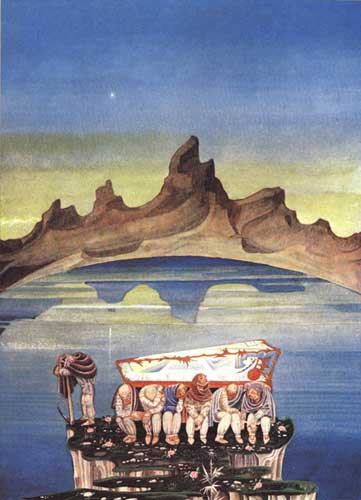
Fairy Tale of the Month: January 2013 Master Thief – Part One

Frontal Piece 4

In Disguise

Call me dishonest. I will not defend myself. I made a promise (by implication) but now I will break it.

My dishonesty snuck up on me. I like writing about some of the lesser known Grimm fairy tales that have managed to stay hidden. Deep in my volume of Brothers Grimm (tale #192) is a dandy story I decided to bring into the light of day. However, once in the light I immediately saw its disguise and knew it not to be a fairy tale at all.

I am going to write about it anyway. What story has stolen my attention and broken into the Fairy Tale of the Month? The Master Thief. The master thief in this tale never resorts to magic (the defining element of fairy tales), but plies his craft through his cleverness.

A wealthy young gentleman appears to an old couple and soon reveals himself to be their son who ran away many years ago. The old couple is at first delighted, but then depairs when they hear he had come into his wealth by thievery. The young man’s assurance that he only steals from the wealthy is of little consolation.  They are afraid if their lord, the Count, who is the young man’s godfather, finds out, he will hang their son. The young man declares he will visit the Count that very day and introduce himself as a thief.

The Count, because the youth is his godson, shows leniency and declares if the master thief can prove his abilities, then he will go free and not be hung. The first task: steal the Count’s horse from the stable while the animal is under guard by his soldiers. The master thief appears disguised as an old woman who trades her jug of drugged wine for shelter in the stable for the evening. The thief returns the next morning with the lord’s horse.

The second task is to steal the bed sheets from under the Count and his wife along with the wife’s wedding ring. The Count lies in wait, and when a ladder is set up against the bedroom window and the head of the thief is framed in the opening, the Count fires his pistol.  However, the thief is pushing a corpse in front of him up the ladder. While the Count goes off to bury the corpse, the thief enters the bedchamber pretending to be the lord. He tells the wife to give him the bed sheets the wrap the body in and her wedding ring, for which the sinner died, to be buried with him. These, too, are returned in the morning.

The third task, to steal the parson and the clerk from the church, is accomplished when the master thief, now disguised as Saint Peter, convinces them that Judgment Day has arrived. If only they will crawl into his sack, their souls will be saved.

The Count, bested by the master thief, banishes the youth, who leaves, never to be heard from again.

I hope my dishonesty in presenting this yarn as a fairy tale will not be taken with too much offense. It “feels” like a fairy tale.  The master thief appears out of nowhere and returns there. His sleight of hand is so good and so entertaining that there is something almost magical about him.

If he has stolen my attention, perhaps he will arrest yours.

Fairy Tale of the Month: January 2013 Master Thief – Part Two

Frontal Piece 2

Our Betters

One of the favorite topics of the spoken tale might be classified as “The Besting of Our Betters,” in which an underling rises to outsmart someone of higher social rank. Besting one’s betters is common to the general folk tale genre, but rather rare in the fairy tale.

I will not make too much of this point. The distinction between folk tales and fairy tales is in truth slight. The Grimms put both these tales in their book side by side, entitling their workChildren’s and Household Tales and not The Brothers Grimm Fairy Tales. By the way, we have Marie-Catherine Le Jumel de Barneville, Baroness d’Aulnoy (1650-1705), also known asCountess d’Aulnoy, to thank for the latter term when she called her works contes de fées(fairy tales).

The besting in The Master Thief is leveled at the three prominent hierarchies of the day: the military, the aristocratic government, and the church.

In the first task of stealing the Count’s horse away from the protection of the soldiers, the tone of the deception is mild compared to what follows. The thief plays on the soldiers’ simple human weakness for comfort. In social rank, soldiers were close to the listeners of the raconteurs who told this tale, and may have been among their listeners. The tellers were not about to insult them too deeply.

Making fun of members of the aristocracy was another matter. The Count stood as fair game. Of course it was not good form, and sometimes dangerous, for commoners to show disrespect to members of the upper classes, but behind their backs and out of hearing much would be said.

The wealth of the aristocracy fortified barriers between themselves and the rabble. Their palatial homes were separate from the hovels of the poor. Marriage seldom took place between the two societies. The rich put themselves on a pedestal, from which the poor took delight in knocking them down, if only in story form.

The Count set out the second task of stealing the bed sheets and wedding ring, and in meeting the dare the youth, perforce, dealt the Count a deep insult (not to mention providing the story with some macabre humor).

Concerning the third task, there is a long history of anticlericalism in Europe, directed particularly at the Roman Catholic Church, but even the Protestant clergy came in for ridicule-and for reasons similar to those that prompted stories mocking the rich. The clergy, too, many of them being educated, saw themselves as above the rabble and had a hard time not being holier-than-thou. They, too, stepped up onto that perilous pedestal. The master thief used the sacred beliefs of the parson and the clerk against them.

Poking fun at the prosperous is not peculiar to the old tales. One need only look to the Marx Brothers’ movies of the 1930s during the Depression, and view Groucho taking Margaret Dumont to task, to see a modern version of besting our betters.

Be it Groucho Marx or the master thief, underlying both is a bit of social commentary on the divide between classes, about which another Marx had a lot to say.


Fairy Tale of the Month: January 2013 Master Thief – Part Three

Frontal Piece 5

Robbers in Our Midst

“Someone took my Grimm’s.” Thalia’s look held accusation. “Teddy thinks it was you.” She held up Teddy so I could see Teddy’s look of accusation.

“Me?” I feigned innocence as I held the volume tighter behind my back. “What about the Master Thief?”

Thalia thought about that for a moment. “He wouldn’t steal from little girls.”

“Ah, you are quite right; he would not. Well then, there is the thief from The Thief and His Master; he could use magic in his thefts, and was clever enough to outsmart his master. He might have taken your book.”

Skepticism crossed her face.

“Oh,” I continued, “what about that lot of robbers in Thumbling? They were not up to any good. Or the robbers in The Bremen Town Musicians. They are still at large.”

Thalia grew thoughtful. “Maybe,” she said, “the robbers in Strong Hans. They were a bunch of drunks.”

“Or,” I suggested, “the band in The Boots of Buffalo Leather.”

“They’re all in jail.”

“Right, and the band from The Robber Bridegroom were hung.”

Thalia shuddered and I immediately regretted bringing him up. “Then,” I went on quickly, “there is that bunch in Freddy and Katy.”

She giggled at the remembrance, then said, “Oh, and a whole forest of robbers in Simeli Mountain.”

“And,” I continued the roll, “three thieving brothers in The Three Green Twigs.”

“No,” she said, “they turned Christian. They wouldn’t take my book.”

“Ah, you are right again. How about the one in The Three Army Surgeons?”

“That’s just a thief’s hand!” Thalia protested.

The Six Swans?”

“Robbers are barely mentioned.”

“Ah, then there are more robbers in The Devil With the Three Golden Hairs.”

“They were nice! They saved the little boy.”

“Yes, that they did. Well, there are three more robbers in The Raven.”

“They’re not good. They got stolen from.”

“The thief brother in The Four Skillful Brothers showed ability. Maybe he took your book.”

Thalia appeared doubtful.

I went on. “There is another set of brothers who are thieves in The Robber and His Sons.”

“I liked the daddy robber,” Thalia smiled. “He was a good storyteller.” Then she knitted her brow. “Are all storytellers thieves?”

She had noticed my hands were behind my back. She set Teddy down on the table and slipped behind me. Quickly I set her book behind the bear. When she looked up I scratched my ear with that hand.

“Let us not forget,” I said, “there are any number of dishonest inn keepers and servants. Oh, I bet it was the servants in Doctor Know-It-All who took your book. It would be just like them.”

Thalia saw her book lying behind Teddy and, uttering a gasp, she grabbed it. With their chins in the air, she, Teddy and Grimm’s marched off.

Your thoughts?
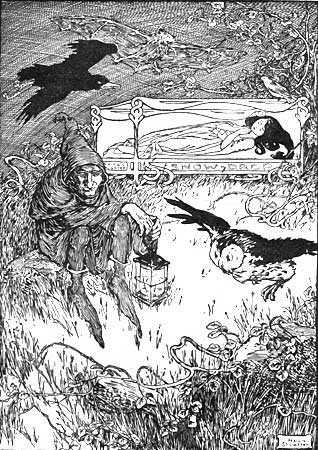
PS. I could have mentioned Thumbling’s Travels and Fools Gold, but they are variants ofThumbling and Freddy and Katy. I may have missed one or two. There are as many thieves as tailors in Grimm‘s.