Fairy Tale of the Month: May 2012 Cinderella – Part One

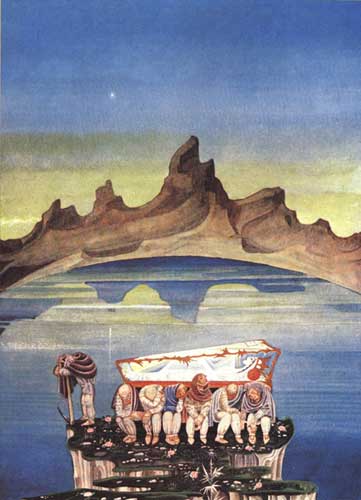
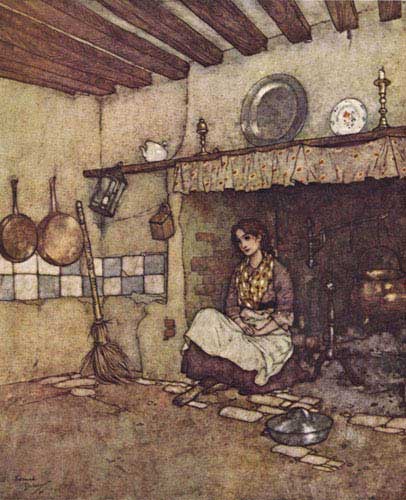
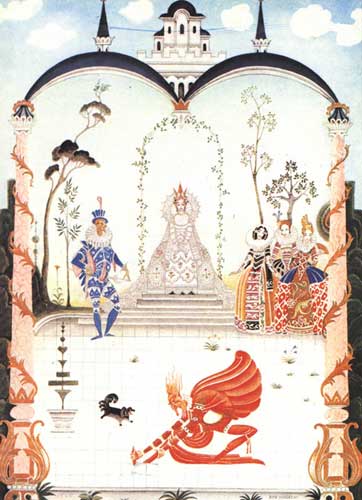
 Edmund Dulac

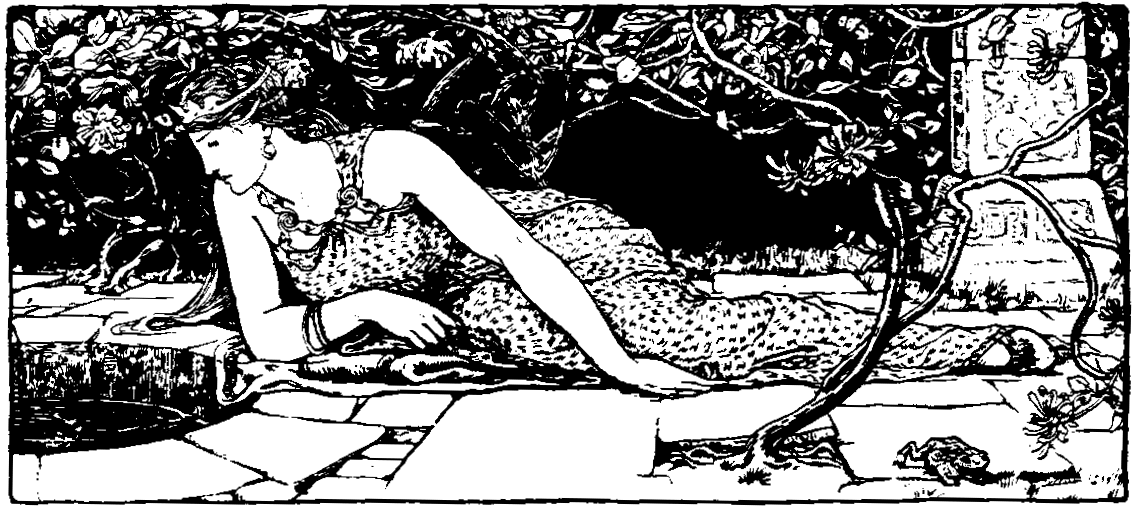
Miss Cox’s Garden

As soon as I started my research for this month’s blog, I came across Cinderella, Three Hundred and Forty-five Variants, by Marian Roalfe Cox (1893). Miss Cox, a self-educated, reclusive folklorist, pioneered studies in folklore morphology (the study of folklore and fairy tale structure), easily outclassing her fellow folklorists in this approach in both volume and content. She is really little known, although other scholars have drawn on her research, including Alan Dundes in his Cinderella, A Casebook.

The introduction to Miss Cox’s book was written by the highly respected Andrew Lang. I believe it is the oddest introduction I have ever encountered. It is seventeen pages long: for the first four pages, he all but dismisses the work at hand, then spends the next thirteen pages ranting about what Joseph Jacobs and Emmanuel Cosquin said about his theories at the latest Folklore Congress in 1891.

For us folk and fairy tale addicts who have not joined FFTA (Folk and Fairy Tales Anonymous) and who are subject to bouts of deja vu, it is people like Marian Roalfe Cox, and her fellow proponents of morphology (Vladimir Propp, Antti Aarne, and Stith Thompson et al), who have come to our rescue to say, “No, you are not crazy, you have read this before. They are called variants and here are the patterns they fall into.” (The above mentioned heroes also share in common names that are nearly impossible to remember how to spell.)

In the case of Cinderella, Miss Cox identifies three patterns. The “Ill-Treated Heroine” is the one with the shoe. In this motif the heroine, once of a higher station, has fallen to servant status. With the aid of a helper—mother’s spirit or fairy godmother—she becomes, for a short time, presentable for a ball or to attend church. She returns to her state of poverty, but not before leaving behind a token that her future husband uses to reclaim her. At the end of the story, if this is a Charles Perrault tale, the heroine’s tormentors share in her good luck, but are now beholden to her. If this is the Brothers Grimm, their eyes are plucked out.

In the second variant, the “Catskins-like” versions, the heroine has fallen from grace when she flees from the designs put upon her by her father, designs often of sexual intent. In the actual Catskins story, she disguises herself by blackening her skin and wearing a robe of animal skins. She brings with her three magnificent gowns, used to make herself presentable to royalty. She appears alternately as a mysterious noble woman and as a maid cleaning up the ashes in the kitchen, until discovered and married to the king.

The “Cap O’ Rushes” (King Lear) pattern is very similar, except that the heroine has been cast out for saying she loves her father as meat loves salt, her father not thinking that sufficient praise. After his daughter’s travail and rise, he is invited to attend the royal wedding, the identity of the bride unknown to him. The heroine arranges to have the wedding feast served unseasoned. In the middle of the meal, the father bursts out crying, confessing his error in judgment. The daughter reveals herself and all ends happily.

Keeping those story patterns in mind, we approach the tales prepared to recognize and draw comfort, rather than confusion, from their sameness. Others have done the hard work of classifying the tales. I like to think of Miss Cox tending her formal Victorian flower garden, her zinnias all in a row, as we bees flitter from bloom to bloom drawing what nectar we will.

Fairy Tale of the Month: May 2012 Cinderella – Part Two

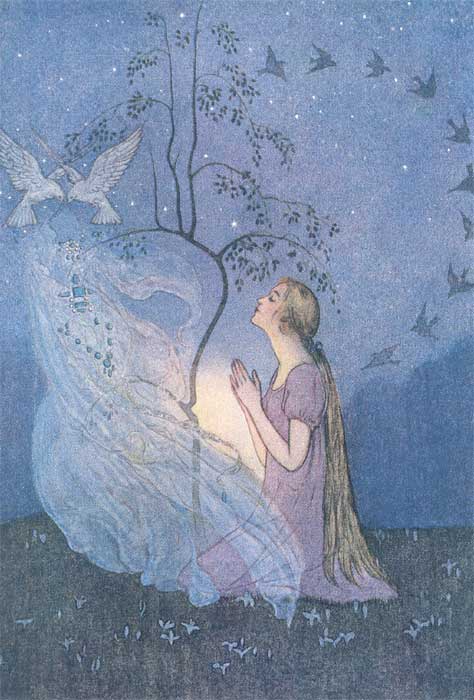
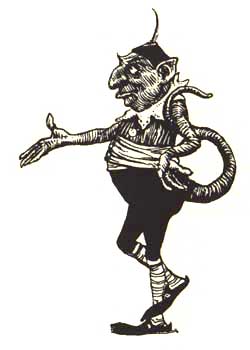
 Elenore Abbot

Three Dresses

The three hundred and forty-five Cinderella-like stories that Marian Cox identifies as being related draw some of their similarity from a pool of images: a maiden disguised, working in the kitchen, peeking into the great hall, losing a shoe in her retreat.

One of the images common to this group of stories is the wearing of three dresses. In “Cinderella,” both Perrault’s and the Grimms’ versions, the heroine, on three successive evenings, is dressed in gowns of precious materials, each dress grander than the one she wore the night before. Although her stepsisters are at the ball, they do not recognize her. Perrault makes a point of this by having Cinderella sit with these women and share oranges and citrons with them without their recognizing her.

In “Catskins” the heroine blackens her skin, which is more convincing to us as a disguise, but in “Cap O’ Rushes” she wears a dress and a headpiece made of reeds to cover her real dress and her hair, unafraid that her natural beauty will show through and give her away. Even when she is the center of attention at her wedding, her father still does not recognize her until she reveals herself.

Does this suggest that clothes have transformative properties? The special clothing of the maidens has better than usual origins.

In “A Sprig of Rosemary,” a tale I blogged about earlier, the heroine is given three articles of clothing stored inside nut shells (for the purpose of trading rather than to wear herself). She receives a mantle from the sun, a petticoat from the moon, and a gown from the stars.

Let’s take a closer look at “Catskins.” Besides her animal-skin robe that she hides behind, she had her father acquire for her three gowns: one as golden as the sun, another as silver as the moon, and the third as sparkling as the stars.

This sort of thing keeps happening in many of the variants, and the celestial connection between the clothes and their luminary counterparts is pretty clear.

We can even measure the degree of magical powers in the gowns from story to story. Catskins got her gowns from her father. Not too magical. She has to go to the elaborate length of blackening her skin, then cleaning herself before going to the ball, in order not to be recognized. Cinderella’s gowns are completely magical, and she boldly sits with her stepsisters unconcerned, apparently understanding her transformation.

I am going to avoid the temptation to say that these women are defined by their clothes (also turning a deaf ear to Mark Twain’s comment that clothing makes the man; naked people have little or no influence in society). I’ll suggest these magical gowns are transforming the maidens into beings beyond their former selves. Are they, perhaps, changing from maidens into adult women?

The change is not sudden; it comes and goes three times, each event progressively grander in some way. The maidens are rather coy, not giving themselves away too quickly. With the celestial bodies’ influences, maybe there are stars in their eyes. Notice the pattern of ups and downs, from being perfect in appearance and the center of attention to returning to the kitchen, back to drudgery and sitting among the ashes.

Sounds like dating to me.

Fairy Tale of the Month: May 2012 Cinderella – Part Three


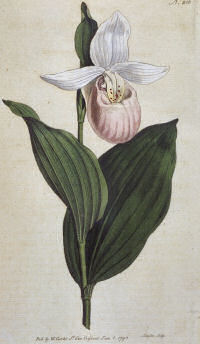
 Cypripedium reginae The Botanical Magazine, 1793
Tokens and Keys


I am strolling through Miss Cox’s flower garden and cannot help but notice her row of lady slippers just beyond the fairy ring in the lawn. Cinderella’s glass slipper comes to my mind. The glass slipper, as far as I know, was Charles Perrault’s invention, though there have been many a lost shoe before it, but nothing quite so exotic.

Footwear is well represented in folklore, fairy tales, and other stories: “The Red Shoes,” “The Elves and the Shoemaker,” and “Puss in Boots,” to list a few. But this is not what I am thinking about.

I am now looking at her roses. They come up so often in fairy tales as tokens of love. Perrault’s glass slipper is a token. So are the other shoes and slippers in the other Cinderella tales, but a glass slipper, a fanciful item, best exemplifies its token nature.

The glass slipper represents Cinderella in her transformed state, even as she slips back to her lower status. The slipper embodies all the glamour of Cinderella at the ball. I use the word “glamour” in its broadest sense: as a spectacle and as a spell. (Glamour: Enchantment; a supposed influence of a charm on the eye, causing it to see objects under an unreal semblance; hence, anything that obscures or deceives vision, physical or mental; fascination; charm; witchery…Century Dictionary and Cyclopedia.) The prince claims this token, a small remembrance of the beauty that has slipped away. There is something satisfying about the slipper remaining after all else has lost its glamour.

In “Catskins” and “Cap O’ Rushes” the token is usually a ring that is the heroine’s or has been given to her by her beloved. The ring comes back to the suitor in his food, often a bowl of soup or gruel (gruel, if he is lovesick and pining away). While the ring/food connection is vague, the heroine is invariably in the kitchen as some sort of wench, giving her the opportunity to give these little gifts.

Now I’m sitting on a stone bench under an arbor of wisteria. Before me stands a stone table. Upon the table lies a leather-bound book complete with leather strap and a lock. I reach into my pocket for the key.

All the tokens I’ve thought about are also keys, used to unlock the mysterious identity of the beauty who fled the dance before it ended. The reason for her flight may not be clear. Perrault’s Cinderella must leave by midnight before the glamour ends. The other variants usually do not have that limitation. Although we are not told, we sense it is the heroines’ timidity, or uncertainty, that drives them back into hiding.

Without the token, without the key, the prince or the king would not have the means to reveal the heroine’s identity and declare their marriage. She does not quite have the strength, or confidence, or magic to break the pattern she has fallen into. The token is the key to her happiness.

I reach out, take the leather book in hand, and turn the key in its lock. Out fly pixies, like a swarm of bees that scatter themselves though the garden, hiding in moments under the lady slippers, the zinnias, the roses, even the tiny bluebells. I needn’t count the pixies. I trust there are three hundred and forty-five of them.

Your thoughts?

Aside

Fairy Tale of the Month: April 2012 Rumpelstiltskin – Part One

Image Walter Crane

Before Sunrise

I became uncomfortable the other evening, just after Wilhelm left my study, when I realized magic works best at night. I would like to think better of magic, seeing it happen in the full light of day. And it can happen that way, but magic prefers the night or at least the darkness of a dungeon, a cave, or the bottom of a well.

With that thought rolling around in my head, I found myself thumbing through Household Tales, when my eyes fell upon that strange name, “Rumpelstiltskin.”

In the Grimms’ version of this tale, the poor miller’s daughter is put in harm’s way—again as the motif will have it—by her father. This time he brags to the king that his daughter can spin straw into gold. The next day the girl is locked up by the king to perform this task before the morrow or die. Her life is at risk, not that of her false-worded father, who, having done his damage, exits the story.

Imprisoned in a room filled with straw and a spinning wheel, the girl, naturally, sits down to cry, when through the locked door comes a “manikin.” We are left to decide if this is a dwarf, imp, or elf. It offers to do the spinning for a price. The pattern is set for three nights running, the price escalating from a necklace, to a ring, then to her firstborn. The reward also moves from not being killed to marrying the king.

When payment comes due, the manikin reappears to collect the now queen’s firstborn son. Dickering ensues and, unaccountably, the manikin offers to relent if she can guess his name during the course of three days.

Before the third day ends, the queen’s servant, burdened with the task of collecting names, returns with the odd story of a little man dancing around a fire, reciting:

“To-day I bake, to-morrow brew,
The next I’ll have the young Queen’s child.
Ha! Glad am I that no one knew
That Rumpelstiltskin I am styled.”

The game is over, the queen has won, and Rumpelstiltskin, in a rage, tears himself in two, another of the Grimms’ messy endings.

Although the story does not say so, all of Rumpelstiltskin’s visits appear to occur in the evening. The story certainly states he worked all night spinning straw into gold. This story serves as a typical example of magic happening at night. One might also recall the night shift of the shoemaker’s elves, Cinderella’s magic evening out, the prince of “Kate Crackernut” forced by fairies to dance every night to the point of exhaustion.

Why at night?

Let us step back for a moment and view all of the fairy-tale landscape. Like churches sitting close to every village, magic appears in every fairy tale. If there is no magic, there is no fairy tale; a folk tale, perhaps, but not a fairy tale.

What kind of magic? Usually black magic. White magic is the stuff of charms and wearing of garlic to ward off evil—invoking, asking magic. Black magic, for good or ill, is used to spin straw into gold—evoking, commanding magic.

Now let us ask, why, historically, have we told stories of black magic to children? My answer is that it has nothing to do with the amusement of children. It has to do with the culture (church-dominated) wanting to diminish the reputation of black magic, along with its pagan associations. If relegated to children’s stories, it is no longer a thing to be taken seriously.

The process of diminishing through storytelling happened to Fionn mac Cumhaill, the larger-than-life pre-Christian Irish hero, who became reduced through Christian tellers to a bumbling giant given to sucking his thumb.

Fairy tales are a safe place for the culture to store magic. Still, it is not reputable and needs to be put, within the stories, in its proper place—in the dark, out of sight.

Fairy Tale of the Month: April 2012 Rumpelstiltskin – Part Two

Image Kay Nielsen

The Plot Never Thickens

Fairy tales share common features with other written works of popular literature. Typically a good story has a beginning, middle, and end. There is a protagonist, hopefully a character with whom we can identify. Most popular fiction stories have a villain or something villainous. Other typical elements are the call to adventure, refusal of the call, crossing the threshold, road of trials, etc. (Go Google the hero’s journey and Joseph Campbell.)

There is one element in fairy tales that is not typically shared with other forms of popular fiction, not even fantasy. Fairy tales have holes in their plots you can fly a dragon through.

It is not uncommon for writers to take fairy tales as inspiration for novels, particularly young adult fantasy, Beauty, by Robin McKinley, being an example. One of the first tasks these writers face is the need to repair the plot so that it can sustain a work of novel length and complexity.

In “Rumpelstiltskin” let’s consider the scene between the manikin and the queen, when he comes to claim the child. I think we can safely assume he does not have a driving desire to take on responsibilities as a single parent. The closest we come to his intent is his statement: “…something living is more important to me than all the treasures in the world.” We are not told what he will do with the child, but we can guess it is nefarious.

What is his motive for inventing the guessing game? There is nothing in it to profit him. It delays by three days his acquisition of the child. Is there pity in his heart? That would be out of character. Perhaps he is playing with the queen, but, plotwise, that is weak motivation. I’d call it, in a novel, bad writing.

Let’s extrapolate a bit beyond the story’s actual plot. What happens, after the demise of Rumpelstiltskin, when the king says, “Dear, can you spin a little more gold?”

Actually, I’ve thought of a clever way around that dilemma for the queen. She would look at the king in feigned surprise and say, “My dear, only maidens can spin straw into gold. You and I have a son. He is your treasure.”

However, my self-proclaimed cleverness comes to nothing for solving this problem in our fairy tale. I am answering a question that doesn’t exist.

Here is my point. We don’t expect fairy tales to have good plots. We don’t ask them to have good plots. We may not want them to have good plots.

Fairy tales are “What if” stories, with tunnel vision, involving magic. What if you were asked—no, commanded—to spin straw into gold? That it cannot be done does not enter into consideration. All impossible tasks are accomplished in this genre. All sorts of conveniences are laid in the path of the protagonist. That servant of the queen just happened to hear the manikin singing his name as he danced around his fire.

“And they lived happily ever after.” Isn’t that a huge cliché to stick at the end of the plot? Yet it’s one that we expect to hear, and crave to hear, in our fairy tales.

We don’t want a reality check screwing up our fairy tales. Notice how the Grimms almost never put their stories in a given time or place. The only exception that comes to my mind is “The Bremen Town Musicians,” and those “musicians” never get to Bremen Town.

I believe the magic in fairy tales does not come from the turning of straw into gold, but rather being freed from the shackles of solid plot and believable motivations.


Fairy Tale of the Month: April 2012 Rumpelstiltskin – Part Three

Image

John D. Batten

Secret Names

One needs to be careful when dealing with names that may evoke dark spirits. Craving to know the meaning behind a particularly mysterious name, I drew a white chalk circle on the floor around myself. Within its protection I cast the runes until they spelled out “Rumpelstiltskin.” (Well, actually, I tapped them out on the laptop.)

As I hoped, my command was answered by that benevolent spirit, Wiki, who, in a shimmering voice like warm vapors, patiently explained to this mere mortal the following:

“The name Rumpelstilzchen in German means literally “little rattle stilt.” (A stilt is a post or pole which provides support for a structure.) A rumpelstilt or rumpelstilz was the name of a type of goblin, also called a pophart or poppart that makes noises by rattling posts and rapping on planks. …. The ending “-chen” is a German diminutive and designates something as “little” or “dear,” depending on context.”

The meaning behind a name is interesting, but its power resides in the name itself. In evocative magic, if one knows the name of a demon, one can summon it and have it do one’s bidding. This is never a safe thing to do. Demons are dangerous, tricky beings. Any sorcerer who knows his craft will do his summoning standing within the protective confines of a pentacle (a five- pointed star within a circle drawn on the ground.)

In a number of cultures, individuals have a name by which they are known, but also have a secret true name, often given to them at puberty. To know that name is to have the power to cast charms over that person.

The contest between the queen and Rumpelstiltskin fell within the circle of a power struggle. The condition of the queen gaining control had always been there; the manikin simply made a game of it, never thinking she would find out his name through his own careless act of uttering it aloud. Then, rather than be controlled by the queen, he destroyed himself.

I sat in my chalk circle contemplating the nature of secret names long after the spirit of Wiki had faded. Did I have a secret name and not know it? Could some other entity discover it and henceforth control me?

No. We live in a modern civilized society, no longer given to superstitious constructions of reality that dictate the need for secret names to protect us from evil spirits or to control those same spirits. We have no need for secret names.

Then the full horror came to me. I have many secret names! My Social Security number, my PIN number, my Visa card number, and my computer password (letters and numbers), any of which can be discovered. My chalk circle is dust; it cannot protect me. With that many secret names, is it only time until one of them is revealed? Shall I tear myself in two and join Rumpelstiltskin?

I then understood how this tale relates to the modern world. Though written so long ago, it calls forth our present. “Rumpelstilskin” is the origin story of Identity Theft.

Your thoughts?


PS. While researching I found the Grimms’ oral collected version had Rumpelstiltskin traveling about riding in a cooking ladle, an image the Grimms edited out of their printed version. I am going to have to talk to Wilhelm about that the next time I see him.

Fairy Tale of the Month: March 2012 The Turnip Princess – Part One

 Jean Baptiste Simeon Chardin “Turnip Cleaner”
Of Turnips and Princesses

            The fairy tale world is all aflutter with the news coming to us via The Guardian (UK) that five hundred fairy tales have awakened from a one hundred and fifty year slumber in their castle surrounded by a thorn thicket.

OK, they were in thirty some boxes collecting dust in a municipal archive in Regensburg, Germany. The prince who slashed his way through the thorn thicket … ahem, the researcher who slashed her way through the thorn thicket was the scholar Erika Eichenseer. That happened around 2008. In 2010 she published a book, Prinz Roßwifl, (in German) with selections from this archive, a work apparently now out of print. We (English speakers) belatedly heard about it because of the Guardian article that has a link to one of the tales, “The Turnip Princess,” translated into English.

In this raw and disjointed tale, a lost prince takes shelter in a cave, where he is entrapped by a witch. With the witch are a bear and a dog. The dog disappears entirely from the tale, but the bear is central. He tells the prince to pull a rusty nail from the cave wall to break the spell over the bear and then to place the nail under a turnip, thereby finding a bride.

Alas, a monster (whom we never hear of again either after its first appearance) frightens the prince out of the turnip field. The nail is lost and the prince falls into a deep, long slumber. Upon awakening, the prince seeks the nail, eventually finding it one morning in the shell of a turnip he had pierced with a blackthorn branch the evening before. He sees, imprinted on the inside of the turnip shell, the shape of a beautiful girl.

Returning to the cave, he reinserts the nail into the wall, evoking the witch and the bear. The witch turns out to be the beautiful girl from the turnip and the bear the prince’s father. The nail disappears in a burst of flame.

OK, then. Who collected this one? Franz Xaver von Schönwerth (this link is in German. If you are using Google Cromo it will offer to translate).  And who was he? An avid collector of Bavarian folk tales, legends, traditions, and customs. The Grimms had high regard for Von Schönwerth. Jacob reportedly told King Maximilian II of Bavaria that only Von Schönwerth could replace him and his brother given Von Schönwerth’s accuracy, thoroughness, and sensitivity. This was not a recommendation, but rather an observation. The King knew Von Schönwerth very well. Von Schönwerth had been his private secretary before the King’s accession, then his cabinet chief, and later a councilor in the Financial Ministry. Cushy jobs apparently, allowing Von Schönwerth to wander around the countryside collecting thirty boxes worth of notes on peasant life. He put some of it into three volumes called Aus der Oberpfalz — Sitten und Sagen (available as a free Kindle book on Amazon). It slipped quickly into obscurity despite the Grimms’ enthusiasm for his work.

If the fairy dust raised by all the recent fuss made about these tales has settled on you, as it has on me, you will want to know more. Maria Tatar has something to say about it in her blog on the New Yorker site and Jack Zipes has weighed in from Sussex. Both of these are informative reads.

Fairy Tale of the Month: March 2012 The Turnip Princess – Part Two


Wilhelm Grimm

In the Spirit of Wilhelm

More than once, the term “raw” has been used in describing the tales thatFranz Xaver von Schönwerth collected. “The Turnip Princess” is a good example.

This tale seems raw because it does not adhere to literary rules. The events in the story do not segue neatly, nor logically, from one to the other. Unnecessary and confusing details appear while other details go missing, creating a plotline that feels disjointed and surreal. Had Von Schönwerth’s informant been relating a dream, I would not be surprised.

Perhaps our view of this tale as “raw” comes from our expectations. There are familiar literary forms we want all stories to follow. At the very least, we want the storyline to make sense. That doesn’t seem too much to ask, but is it a requirement for nonliterary tellers and listeners? Might they be as comfortable with “dream logic,” having dreamt, but never having read a book?

Be that as it may, we literates do have our requirements. Wilhelm agrees with me. He is here in my study as I take my first stabs at making sense of “The Turnip Princess.”

Taking my pen in hand, I suggest, “Once upon a time …?” Wilhelm, pacing back and forth in front of the bay window, makes a noncommittal gesture.

“Once there was a prince,” I propose. Wilhelm raises his forefinger in the air approvingly.

“Right then,” I say. “The prince is lost, but why? The story gives no reason. Is he out hunting and became separated from his party?” Wilhelm looks thoughtfully out the bay window. I continue. “Is he on some sort of quest… Ahh, I’ve got it!”

Wilhelm looks at me quizzically, as I continue triumphantly. “At the end of the story it seems that the bear has changed, unaccountably, into the prince’s father. Why not have the prince on a quest to find his father, who has disappeared many years ago. That lends the story a traditional circular structure. The prince starts out to find his father—the king—and in the end not only finds his father but his bride as well through his persistence.” Wilhelm silently applauds.

“Good then. When he wakes up in the cave there is a witch, a bear, and a dog, but the dog has no role in the story.” Wilhelm draws his finger across his neck.

“Right,” I say. “We kill the dog. The reader will never know.” By Wilhelm, I think to myself, This is beginning to shape up!


Fairy Tale of the Month: March 2012 The Turnip Princess – Part Three


Avenue of Chestnut Trees

The Language Divide

I feel that Jack Zipes, well known among folklore scholars, has the advantage of a panoramic view of the fairy-tale forest. He leaves me disgruntled with my realization I’ve been staring at a fairy tree.

In his note on the Sussex Centre for Folklore, Fairy Tales and Fantasy site, Professor Zipes presents me with a laundry list of other early collectors, whom he prefers over Von Schönwerth, a list of names that rings not a single bell in my head. These authors are German and French, and their works written in those languages. I am one of those wimpy Americans who hasn’t bothered to learn another language. Well, a lot of us aren’t near any borders and have been told that English is a universal language. Why make the effort?

Not knowing other languages, I find myself in a deep, dark forest and a little depressed to discover I cannot comprehend its myriad paths. But I do have a candle and there is a signpost with many arrows. How many miles to Babylon?

To guide me through tales from other languages there are good translations of the Brothers Grimm, Jack Zipes’ being one of them. Charles Perrault’s versions of many fairy tales that he wrote for the French court are well covered in translation. Then there is the Decameron of Boccaccio for tales from Italy. (Actually, Chaucer’s Canterbury Tales in Old English sounds rather foreign to most of us.) Celtic and Gaelic stories are easily available via Joseph Jacobs, Jeremiah Curtain, Thomas Croker, W.B. Yeats, Lady Gregory, Lady Wilde, Sir George Douglas and others.

Andrew Lang’s colored fairy books contain a wide range of tales from all over the world. Sir Richard Burton’s (not the actor) One Thousand and One Nights is a classic of Arabian tales not to be overlooked. Far less known, but a favorite of mine, is R. M. Dawkins’ Modern Greek Folktales and More Greek Folktales. Dawkins’ works are examples of books out of print, but not in the public domain, which makes them expensive and hard to find.

Public domain books are another matter. We used to depend on Dover Publications for these titles, but no longer. Dover puts out a number of fairy tale collections in trade-paper format. However, if you make the techno-leap to electronic books there are numerous titles of all genres for free, including many cultural folklore collections. The big three for free books in the public domain are Amazon, Google Books and The Gutenberg Project. These free books come in many different formats that may or may not work on your devices. There are conversion programs out there, such as Calibre, that are free. Kindle will read PDFs, but the type is small and cannot take advantage of most of Kindle’s features. Calibre can convert PDFs to MOBIs (a Kindle-readable format), but I have had variable success. Free is not necessarily easy.

With all these translations, we must stay conscious of “fakelore,” against which Eliot Singer has warned us. A certain amount of cultural bias cannot help but creep into translations. In a conversation with Native American storyteller Dovie Thomason, I asked about nonnative Americans telling those stories that do not “belong” to them. She replied, “If I were to tell a Polish tale, it would have a Lakota spin on it.”

I am sure I have missed some authors/collectors worthy of mention, but having written the above, I think I see some light filtering through the dark canopy of the fairy-tale forest above my head.

Your thoughts?

Fairy Tale of the Month: Feb. 2012 The Maiden Without Hands – Part One

 John Constable   The Mill

A little rain must fall

            I am walking down a muddy path. I have been avoiding it for at least a year. Turn from it, though I have, the path remains and will not disappear until I have walked it. It’s the same path taken by “The Maiden Without Hands” so long ago. Who put us on this path? Wilhelm Grimm.

            The bones of “The Maiden Without Hands” are these: A miller, unwittingly, makes a pact with the devil to give him what stands behind the mill in exchange for wealth. The miller thinks it is the old apple tree, but the devil is thinking of the miller’s daughter, who at the time of their pact is cleaning the yard around the apple tree.

            To thwart the devil, the maiden cleanses herself and stands in a circle drawn on the ground. Furious, the devil demands that the miller not allow his daughter to wash. On the second day she has washed her hands with her tears. The devil demands the miller cut off her hands, which he does out of fear of the devil. Tears, again, are sufficient to clean the stumps of her arms, and the devil departs.

            The maiden leaves her father, wandering out into the greater world, where she is helped by an angel to find food—a pear from a tree in the king’s garden. There the king discovers her and they are soon married

            She bears him a son while the king is in a distant land, and the exchange of letters between the king’s mother and the king are intercepted by the devil. This ends with the king’s mother thinking her son wants the queen and the child killed. Instead she allows them to escape. The angel reappears and gives them shelter.

            Upon return, the king discovers the mistakes and goes off on a penitential search for seven years, declaring he will not eat or drink until he finds his queen. God preserves him and he comes eventually to the angel’s shelter, where the queen and his son, Sorrowful, await him. 

            Now comes a sharp turn in the muddy path I wander down. The above description is of the 1857 version of this Grimm tale. Their own 1812 version is quite different. It starts out the same, but in the 1812 version there is no angel. The maiden comes to the king’s garden, bangs her body against an apple tree to knock down fruit and eats it off the ground. Captured by the guards, she is thrown into prison, but the king’s son suggests she be employed to feed the chickens. (How she does this without hands is not explained.) The prince is, of course, in love with her and talks the king into letting him marry her.

            From here the versions are similar, with the devil intercepting letters, but the king’s mother is absent from the 1812 version, and the queen and her son are simply banished. She is now helped by an old man and her hands restored by wrapping her arms around a tree three times, rather than being re-grown in the presence of the angel. Her husband, when he realizes what has happened, goes off with a servant to find her. The old man has sheltered the queen and her son in a house no one can enter until they ask three times “for God’s sake”. This is the only Christian reference in the 1812 version. After the king, queen, and their son are reunited and they return to their kingdom, the house of the old man vanishes.

Jack Zipes, in “The Brothers Grimm, From Enchanted Forest to the Modern World,” attributes the changes to Wilhelm, and I’ll assume with Jacob’s consent. But why the changes?

Because the Grimms were bourgeois. That term carries a negative feel in modern-day parlance, but back in their day the Grimms struggled for the ascendancy of the bourgeois. And they had an agenda. They were in the forefront of rising German nationalism against the remnants of the Holy Roman Empire. The bourgeoisie composed the rising middle class, democratic in leaning. The Grimms had to flee at times to avoid being arrested for their stand against monarchy. 

The Grimms wrote and re-wrote the fairy tales to reflect the values of their radical audience and not the minds of earlier serfs and peasants. Between the 1812 and 1857 editions the revolutions of 1848 swept through Europe, carrying the Grimms in their wake. I will forgive Wilhelm for mudding the path. A lot of rain fell in his day.

Fairy Tale of the Month: Feb. 2012 The Maiden Without Hands – Part Two

 Leonardo da Vinci  Study of Hands

Musings on violence

What attracts my attention to “The Maiden Without Hands” is its title. The faint-hearted know better than to read such a story, but curiosity draws in the rest of us.

The faint-hearted prove correct in their suspicions, for we meet with wantonness brutality at the start of the story. But the actual violence ends there. Threatened violence occurs when the devil’s altered letters call for the queen and son’s destruction, but they are allowed to escape unharmed.

We, the reader, understand that the violence is not gratuitous. It has meaning. We read on, wanting to discover at least a hint of that meaning. We sense that the violence is code for something worse. In our case, the violence of amputation is a replacement for incest between father and daughter.

To prove this assertion I could safely stand on the shoulders of a number of scholars, Jack Zipes and Alan Dundes to name two. Or I could site the variants of this story that depict the incestuous elements more obviously. Instead I am going to look only at the internal evidence that the abuse heaped upon the maiden is code for incest.

When reading fairy tales, particularly Grimm, the first clue that we are dealing with code is when the story does not quite make sense. The father, after making a bad pact with the devil, is accused by his wife of betraying their daughter. The miller’s wife now disappears from the story. She is not there in a supportive role at the daughter’s time of need. Neither is the father supportive. If we see through the code, that makes sense, because the father is the problem.

After the maiden has gone through her ordeal with the devil, the father offers to provide for her material comfort. Hardly in any shape to take care of herself, she decides to leave home. On the face of the story and logically, this is a really bad idea. Looking again, deciphering the code, the maiden has to leave home to get away from her father’s abuse. Although she escapes, she leaves as a damaged person, handless, helpless, her healing still to take place.

In considering this “replacement code,” two points jump to mind. First, isincest less obnoxious than chopping off the maiden’s hands? Apparently so, at least in the Grimm’s time and in the Victorian mindset, vestiges of which still survive in American culture. This mindset holds what I consider to be an odd acceptance of blatant violence while blanching at sexual content. For example, commercial television will air scenes of death by horrific violence as long as none of the perpetrators or victims says the “F word.”

The second point, and more on topic than my first, concerns replacements and the psyche of the child who hears them used in stories. Bruno Bettelheim explains this notion with the example of the evil stepmother as a stand-in for the real mother, allowing a child to vent and defuse subliminal anger toward their own mother by directing it against the one-step-removed mother of the story.

There were far fewer stepmothers in fairy tales before the Grimms than afterwards; the Grimms all but invented character and situation replacement. They quickly saw its value in disguising harsh topics from children and making the story compatible with bourgeois sensibilities.


Fairy Tale of the Month: Feb. 2012 The Maiden Without Hands – Part Three

  Carl Larsson “Brtia as Iduna

Apple of my eye.

In “The Maiden Without Hands” there is an old apple tree growing behind the mill. If there is a fruit in a Grimm story it is an apple—OK, sometimes a pear. I don’t recall a peach anywhere (that’s French). Forget the apricot. Oranges, kumquats—nada.

Given that apples grow about everywhere and are easy to preserve, their favored status is no surprise. If not the first fruit to be cultivated by us, it is among the earliest. Genus-wise, the apple is in the rose family, which I find rather charming. Its medical properties are established in the popular culture. I grew up on “an apple a day keeps the doctor away.”

What I find the most fun about this compact, solid, shiny bit of fruit is all the symbolic baggage it has picked up during its travels through time and place.

The ancient Greeks certainly took to the apple. The goddess Eris, when not invited to the wedding of Peleus and Thetis, shows up anyway to cause trouble. (That scenario sounds familiar.) Into the midst of the wedding party she throws the apple of discord. It’s a clever design. She has written on it “for the most beautiful one.” Hera, Athena, and Aphrodite each assume that title is theirs. Hence the discord.

What better way to solve such a dispute than to bring in a mortal? They appoint Paris of Troy to be their victim—I mean judge. Well, these contacts between mortals and immortals rarely go well, and when Aphrodite bribes Paris with the most beautiful mortal woman, Helen, the specter of war between Troy and Sparta is not far behind. However, it made for a heck of a good story.

Christianity has its take on the apple, as it appears in the Garden of Eden, though technically it really doesn’t. The Bible speaks of the fruit of the Tree of Knowledge and Tree of Life. Genesis never mentions an apple and scholars differ regarding which fruit is meant. However, returning to the Greeks, Hercules had the task of getting the three apples from the garden of the Hesperides, the three daughters of Atlas. These apples grow on the Tree of Life. For the newly Christianized pagans it might have been easy to conflate the Garden of Hesperides and the Garden of Eden’s fruit.

Moving up into the cold lands, the apple comes up again in the lsunga saga.The goddess Frigg, wife of Odin, sends King Rerir an apple for his wife to eat and become pregnant. The apple is delivered to the king by a giantess in the form of a crow, who drops the apple in his lap.

That image of the crow dropping the apple in a lap is similar to a scene in the Grimms’ tale “The White Snake” when the hero is seeking an apple from the Tree of Life, which is given to him by three ravens whose lives he had saved. To say the Grimms were well versed in these mythic images would be an understatement given Jacob’s exhaustive work, Deutsche Mythologie (Teutonic Mythology). Whether the Grimms improved that particular scene or if the stolen images were already there, hardly matters. As soon as a story evokes the apple, all of its symbolic baggage is available to be plundered.

My above ramblings are a mere sampling of the near countless mythic, legendary, and story references to apples. By the way, the sound track you hear in the background (you hear it don’t you?) is the William Tell Overture. I thought it appropriate. (Well, it’s been running through my head.)

Your thoughts?

Fairy Tale of the Month: Jan. 2012 East of the Sun And West of the Moon – Part One

 Kay Nielsen

Marriage and parentheticals

A rather disproportionate number of fairy tales end in marriage. (Divorce never comes up.) On occasion “false brides” are cast aside (or worse), and mothers die to be replaced by stepmothers. (Are there ever any stepfathers in these tales?) But the marriage that dominates fairy tales is one that ends in bliss.

My wife points out that these fairy-tale marriages are usually between someone poor and someone rich. That, she claims, is why they are called fairy tales.  (She married someone poor who stayed that way.)

Why the consuming interest in marriage? Why is it the focus of such popular tales as “East of the Sun and West of the Moon”?

Our fairy tale of the month falls into the same category as “Sprig of Rosemary” and “Beauty and the Beast.”  (In the Aarne-Thompson fairy tale index this is type 425A, the search for the lost husband.) I mention two examples above, but could entirely fill this blog post with the titles of others. They all harken back to “Cupid and Psyche.”

(We think of “Cupid and Psyche” as one of the Greek myths. Actually, it is a good canidate for the first literary fairy tale, written by Lucius Apuleius in the second century AD, told in the context of another story.)

The events of “East of the Sun and West of the Moon” are typical of the pattern of the Animal Bridegrooms. In this pattern, the father gives/surrrenders/loses the youngest/only daughter. (In our story a white bear promises her father riches.) The girl goes willingly (an important character attribute). She is well treated (our heroine rings a bell to get all her wants) and is surrounded by wealth. She need only adhere to one promise (the white bear tells her not to listen to her mother’s advice), which is invariable broken. (I am not sure not listening to your mother is a good message.) The bridegroom (under some sort of enchantment) is whisked away to marry someone else (a troll with a nose three yards long in our tale). The abandoned bride must now go through an ordeal to reclaim her husband (what I called in an eariler post “the marriage test”). (The best known of these animal bridegrooms is the beast in “Beauty and the Beast”, although it does not exactly follow the usual pattern.) (Probably because it’s very literary and introspective.) (And French.)

I return to my question: why the interest in marriage? Or, am I asking the wrong question? Are these tales about marriage? I am going to suggest that these marriages are being used as a device (the McGuffin if you will) for illustrating a different dilemma. I am thinking of loss and recovery.

A much more common experience than having to find a husband who has suffered magical memory loss (the cause of distracted husbands has nothing to do with magic, as my wife will tell you), is the experience, or better yet, feeling, of something being lost: a long-ago friend, an irreplaceable book you once had, a time and place gone by. Tales like “East of the Sun and West of the Moon” hold out the hope (even if in vain) we too can recover what is lost: hold again in our hands the hand of another, feel the weight and open up the pages of that book, or grasp that feeling we once felt in that almost forgotten place.

Fairy Tale of the Month: Jan. 2012 East of the Sun And West of the Moon – Part Two

 Kay Nielsen

 So Who…?

            There exists a thoughtless habit, to which we may easily fall victim: The assumption. I call it thoughtless because if we thought about if for a moment we would see the error. 

            How many of us assume Elvis Presley wrote “You Ain’t Nothing but a Hound Dog”? How many of us have heard of Jerry Leiber and Mike Stoller, who actually wrote it, or “Big Mama” Thornton, who first recorded it? 

            How many of us thought Kay Nielsen wrote and illustrated “East of the Sun and West of the Moon”? I for one.

            Illustrate it, he did. Kay Nielsen, born in Copenhagen, Denmark, in 1886, of theatrical parents, studied art in Paris from 1904 to 1911. A good part of his career he spent designing and painting stage scenery. In 1914 he produced twenty-five color plates and twenty-one monotones for “East of the Sun and West of the Moon”, generally recognized as his most popular accomplishment and  one of the great gift books of the early twentieth century.

I quote here from Wikipedia: “Gift books, literary annuals or a keepsake, were 19th century books, often lavishly decorated, which collected essays, short fiction, and poetry. They were primarily published in the autumn, in time for the holiday season and were intended to be given away rather than read by the purchaser.” 

Classed along side of Edmund Dulac and Arthur Rackham, Nielsen’s rise to fame was cut short by the advent of World War I, during which the gift book industry devolved, never to recover. While Dulac and Rackham were the kings of the gift book illustrators, Nielsen was only the heir apparent. 

1936 found Nielsen working for Walt Disney. The mark he left behind can be seen in the sequences “Ave Maria” and “Night on Bald Mountain” in “Fantasia”, one of Disney’s early feature-length animated films. The film did not do too well when first released in 1940, partly because of the outbreak of World War II. Nielsen left Disney in 1941. 

By the end of World War II, art nouveau had run its course, and Nielsen’s style was no longer in demand. He and his wife took up chicken farming, unsuccessfully. He died in poverty in 1957. It would be another twenty years before his work would again be recognized for its worth.

For me, Nielsen’s illustrations told me the story, but, in truth, “East of the Sun and West of the Moon” was collected by Peter Christen AsbjØrnsen (1812-1885) and JØrgen Engebretsen Moe (1813-1882). Professionally, AsbjØrnsen was a zoologist, and Moe a theologian, but they both held a lifelong abiding interest in Nordic folklore.  They were, as well as boyhood friends, Norway’s “Brothers Grimm”. Unlike the Grimms, they both actually wandered out into the hinterlands and collected stories from the folk. 

The names Peter Christen AsbjØrnsen and JØrgen Engebretsen Moe do not trip off the tongue like the Three Billy Goats Gruff tripping over the bridge. How many times have we read and listen to that folktale without an acknowledgement of AsbjØrnsen and Moe? 

The companion of false attribution is no attribution. With no attribution given, we assume “it has always been there”.  These foktales have “always been there” through the efforts of the Brothers Grimm, AsbjØrnsen and Moe, Joseph Jacobs, Andrew Lang, Jeremiah Curtain, Thomas Crofton Croker, W.B. Yeats, Lady Wilde, Sir George Douglas, R. M. Dawkins… I could fill up another blog entry with names. There is a legion of writers and illustrators who have helped to keep these stories alive in words and images. They have my undying gratitude, even if I conflate, confuse and forget who they are.  

Fairy Tale of the Month: Jan. 2012 East of the Sun And West of the Moon – Part Three

 Kay Nielsen

Loose Ends

Unlike other literature, the fairy tale is allowed to be downright sloppy in matters of internal logic and in character development and motivation. And no one cares.

I’ll take the bear in “East of the Sun and West of the Moon” to task. Don’t worry; I’ll keep my distance. Is he a bear, a man or a troll? Clearly, he appears to be a bear as the story starts, but we quickly learn the white bear can throw off his bear shape at night and take on the shape of a man.

Against the bear’s warnings, the heroine lights a candle and looks upon a prince lying in their bed. The logic of the story starts to unwind with this scene. How does a sleeping prince look different than a run-of-the-mill handsome man? We are not told how she knows him to be a prince.

Further, upon waking, the prince declares she has ruined their happiness. He has been under an enchantment put on him by his stepmother, and now he must return to her and marry a long-nosed princess.

Let’s look at this from the stepmother’s point of view. One day she says to her stepson, “Look, I’m going to change you into a bear by day and a man by night. If you can get someone to sleep with you for a year and not look on your man-shape, I’ll let you go. Otherwise, you must come back here and marry Long Nose.” Why would she say that? What is her motive for this strange arrangement? Why not say, “Marry Long Nose or I’ll change you into a newt.”

Toward the end of the tale we learn that the stepmother and the long-nosed princess are trolls. If the prince’s stepmother is a troll, was his father a troll? Everyone else in the castle east of the sun and west of the moon, outside of captive Christians, are trolls. If he, too, is a troll, then the heroine’s mother’s fear has come true.

Here is the important point: It doesn’t matter. Nothing I have stated above matters to the fairy tale. And more, everything I have written these past months doesn’t matter to the fairy tale. I am holding up the wrong measure. Willingly and knowingly I have done so and will continue to do so from time to time, but to the fairy tale itself…

Although we have what are called literary fairy tales, these tales are not literature in my view. The literary writer spends 80,000—90,000—100,000 words to get the reader to see, hear and feel what the author wants the reader to sense and understand. Characters need to be developed: have names, have clear motives, and follow long, logical, exciting, interesting progressions. The reader is allowed into the heads of the characters and experiences the progressions with them.

Fairy tales are short, compact, and sketchy on details. We never get inside the hero or heroine’s head; we may not even know their names. We see them on the surface. Motivations and logic are optional.

If we are to measure the fairy tale as an artistic form—not that it cares—we would do better to use the terms we use to describe paintings. What are the images? What does it say to us? What is the atmosphere of the work? What memories does it evoke? What is the impression it leaves behind?

For me, a fairy tale is more like a still life than a novel.

Your thoughts?


Fairy Tale of the Month: Dec 2011 Sprig of Rosemary – Part One

William_Gorman_Wills-Ophelia_and_Laertes William Gorman Wills – Ophelia & Laertes

A story in Shadows 

            I walked into Wegmans one post-Halloween day to find Christmas attributes accumulated near the entrance (never mind Thanksgiving). Some of these items were little, live Christmas trees. Bonsai Christmas trees? No. Conically trimmed rosemary bushes. Talk about smelling good. I bought one, nursing it through the winter, and planting it in the spring. By summer I owned a dry, dead twig. It still smelled good.

            Although it proved an arboreal failure, I have ever since equated rosemary with Christmas.  To me, “The Sprig of Rosemary” is appropriate for my December entry.

            The tale is little known, included in Andrew Lang’s “The Pink Fairy Book”, and first appearing in “Cuentos Populars Catalans” by Dr. D. Francisco de S. Maspons y Labros. In the story, a maiden uproots a rosemary plant, evoking a handsome lord and revealing his underground palace. (Shades of Janet evoking Tam Lim in that old Scottish ballad.) It doesn’t take long for them to fall in love and get married. Upon receiving the keys to the palace, as its mistress, she is instructed to never open a particular small chest. (Shades of Pandora’s box from Greek myth.)

            Unavoidably, she opens the chest to find inside a snake’s skin. Immediately all disappears, leaving her standing in a meadow. (Shades of Lucius Apuleius’ “Cupid and Psyche.”) Breaking off a sprig of another rosemary bush, she becomes determined to find her husband.

            Before questing, she tarries at a house built of straw, becoming a servant to the mistress. The mistress gives her the advice to seek out the sun, moon, and wind, who travel far, see much, and may know where to find her husband. (Shades of the Russian epic, “The Lay of Igor’s Campaign,” in which Igor’s wife, Yaroslavna, calls upon the sun, the wind and the River Dneiper. Or Grimm’s “Seven Ravens,” although the sun and moon are pretty nasty.)

            The sun, moon, and wind cannot help her, but each gives her a nut to be opened in her greatest time of need. The wind, however, does her one better, going out to seek news of her husband and finding him, but bears the sad news that her lord, under a spell, is to be married the next day to an ugly princesses.

            Cracking open the nuts, out springs a mantle, petticoats, and a gown. (Shades of Grimm’s “All Fur”.) These she exchanges with the ugly princess for a visit with the bridegroom, her husband. Only after he smells her sprig of rosemary does he recognize her and declare her his wife, whom he loves. (Shades of the end of Grimm’s “Sweetheart Roland. Actually, the whole story bears shades of the Norwegian fairy tale, “Soria Moria Castle,” made famous by Peter Christen Asbjørnsen and Jørgen Moe, and appearing in translation in Lang’s “The Red Fairy Book.”)

            Between this story, the song refrain “parsley, sage, rosemary, and thyme”, and Ophelia’s mention of rosemary in her decent into madness in Shakespeare’s “Hamlet,” the herb has its own special place in the arts. In the art of herbology, the association of rosemary with memory goes back to the ancient Greeks

            The tale appeals to me because of its surreal nature: underground castles, the maiden seeking out celestial beings, magnificent clothes sprung from nuts. This is a dream world in which we follow the heroine through her travail. I fear I will wake up and forget the dream, forget the maiden as did her husband when their castle disappeared. Did the castle disappear or was it forgotten? May this herb preserve my memory. As Ophelia says, “There’s Rosemary, that’s for Remembrance. Pray you, love, remember.”

Fairy Tale of the Month: Dec 2011 Sprig of Rosemary – Part Two

 H. J. Ford

An amble

Take my hand and walk with me through Fairy Tale, down by the Sea of Stories. Look, a few of those stories rise up from the murky depths and wash ashore to our feet. Which ones are so chosen? Pick one up; I will tell you.

Ah, look, it’s “Cinderella.” Now, turn it over. What is there? “By Charles Perrault.” Why do we easily find this one, and not one of its hundreds of variants—really, hundreds—that remain in the depths out of sight?

In this world it’s the perfect ones that wash ashore—perfect because they are crafted. “The Sprig of Rosemary” I fished out of the murky waters. It is not perfect.

I see two blots on the story. In one of the inciting incidents, the heroine, determined to find out what lays in the box she has been warned not to open, finds that the key cannot work in the rust-stiffened lock. Undeterred, she breaks the lock. Inside she sees a snake’s skin. Immediately her world of wealth and her loving husband disappear.

I find this a striking, powerful image. The narrator then attempts to explain it all away. We are told that her husband, unknown to her, is a magician and wears the snake skin when he performs magic. All the internal evidence in the story is against this assertion. The lock is rusted, unused. When did he last perform magic? We already know that he is magical. He lives in an underground palace, for goodness sakes, but nowhere in the story does he perform magic. Rather, he falls under the magic spell of another character. Some magician!

Somewhere in the course of the telling someone felt the need to explain the inexplicable, thereby defusing the image’s power.

The second blot involves loss of consistency. When the heroine learns from the wind that her husband is to be married the next day, she pleads with the wind to delay the wedding for two or three days until she can travel to this distant kingdom. The wind agrees and rushes off to snatch the wedding dress away from the tailors and scatter its parts over the countryside. The King, furious, allows the tailors a few hours to come up with a new gown. Into this chaos arrives the heroine. What happened to the days of travel?

Perhaps the confused time lapse comes from a bad translation of the story out of Spanish, its original language. (Imagine “in the twinkling of an eye” being translated into another language as “He closed his eyes than opened them.”) Was Andrew Lang (the English collector of this tale) more of a folklorist than an author, reticent to make corrections? In any case, this tale bears few marks of skillful crafting.

May I craft this tale, make it perfect, throw it back into the surf, and see it if washes ashore somewhere else? Or has the time for crafting these tales passed? Are fairy tales the Latin of literature? Latin is the basis for the Romance languages, but is, itself, no longer spoken. Are the fairy tales a dead language, not longer allowed to evolve?


Fairy Tale of the Month: Dec 2011 Sprig of Rosemary – Part Three

 H. J. Ford

Oh Nuts!

Nuts constitute one of my reasons for covering this tale. What is with full garments springing out of nuts?

In “The Sprig of Rosemary” the maiden uses the three nuts given to her by the sun, moon, and wind in her greatest moment of need. Each contains a marvelous article of clothing: a mantle, petticoats, and a gown, which the maiden ultimately uses to regain her husband.

The sun’s gift is described as being in a nut, the moon’s gift in an almond, and the wind’s in a walnut. Why the sun’s gift is not in a specific type of nut may have to do with the lack of crafting in this story as it appears in Andrew Lang’s “Pink Fairy Book.” I will ignore that problem, and focus in largely on the walnut.

Looking at this story, all we can see is that the walnut holds the most important article—the gown. Looking at this story’s variants and other stories in which nuts appear, casts a brighter light, and longer shadow, on the role of the walnut in these tales.

In Grimm’s “The Two King’s Children,” we revisit the three garments used by the heroine to reclaim her bridegroom in the context of a far more complex story than “The Sprig of Rosemary.” In this story all three garments are in walnut shells.

In another Grimm story, “All Fur,” the princess, running away to avoid a forced marriage to her father, takes with her a number of magical items, one being three gowns associated with the sun, moon, and stars, which she packs in a nut shell.

In “Romeo and Juilet,” Mercutio describes Queen Mab—the midwife of dreams—as driving a chariot made out of an empty Hazelnut shell.

In “The Magic Egg and Other Tales from Ukraine” by Barbara J. Suwyn, I found a version of “Pea-Roll-Along” in which the antagonist’s soul is hidden in a walnut on the world tree, and he cannot be destroyed until the nut is found.

Certain images in fairy tales resonant with the listener: Cinderella’s glass slipper, Sleeping Beauty’s spinning wheel, Rapunzel’s golden hair. To a lesser degree, the walnut (and to the extent it represents nuts in general) is one of those imagines. Why this is so may be a hard nut to crack.

Immediately, two possibilities jumped to my mind. First is the secretive nature of the nut, with the edible heart hidden away inside the shell. We discover its secret by breaking into the inner sanctum. However, the content is pretty predictable. Why would the expectations of our fancy jump from finding an edible nut to some other sort of gift?

My second notion involves the brain-like shape of the nut, particularly the English walnut. It does look rather like a brain sitting inside a brainpan. Certainly the peasants, who butchered mammals and used every part of the mammal short of the sound they made, would have recognized the similarity. However, this line of thought leads to zombies, who simply are not part of the European fairy tale tradition. I will go not farther down that path. Something at the end of it might attack me.

I abandon both of my notions (after some prowling on the internet) in preference to the walnut purse. These were little drawstring bags made from covered walnut shells given as gifts in the time of Elizabeth I. By the 18th century, Limerick gloves, similar to kid gloves, being so sheer and delicate, were presented inside a walnut shell.  That the garments in our stories could also fit inside a walnut shell was a testament to the exquisite nature of these articles, and not so much a matter of magic. Well, good things come in small packages, do they not?

Your thoughts?


From the Hunt Museum collection, Limerick, Ireland.


 PS. While we old hippies think of “parsley, sage, rosemary, and thyme” as one of the lyrics in Simon and Garfunkel’s “Scarborough Fair,” the source is much older. Check out “The English and Scottish Popular Ballads, Volume 1” by Francis James Child, ballad #2 “The Elfin knight” version G. While this five volume work is highly scholastic, there is here a wealth of folkloric themes.

Fairy Tale of the Month: Nov. 2011 The Juniper Tree – Part One

 Warwick Goble

Slippery Slopes

When I first climbed the glass mountain of fairy tales my foot slipped on the revelation that Jacob and Wilhelm Grimm had not gone out to the villages and fields of Germany with pen and paper to sit at the feet of indigenous folk tellers, transcribing the words that came directly from the fount of provincial wisdom. They collected many of their fairy tales from family, friends and acquaintances, who were well educated and even members of the aristocracy. Significant exceptions were Dorothea Viehmann, a fruit seller, and Johann Friedrich Krause, an old soldier who traded stories with the Grimms for old clothes.  “Field work” was not in Jacob and Wilhelm’s vocabulary, linguists though they were.

Later, I tumbled down the glass mountain while struggling with “The Juniper Tree,” that grim Grimm story of familial decapitation, cannibalism, and murder. Echoing through the story we hear the curse of the House of Atreus, members of that family serving human flesh at banquets more than once. In the form of a goldsmith losing a shoe, we hear the echo of Jason losing his sandal before his search for the Golden Fleece. These are motifs traveling down through the course of time from ancient Greece. The story itself testifies the events might be two thousand years old.

Oh, wait… How does the narrator of this story know its two thousand years old? There is nothing in the story to date it. That’s when my foot slipped.

“The Juniper Tree,” as well as “The Flounder and the Fisherman” were given to the Grimms by Philipp Otto Runge, considered one of the great German Romantic painters. He inserted those echoes of Greek mythology. Nicely done, but this version of the story springs from a classically trained mind. Is it truly a fairy tale? If fairy tales are a sub-genre of folk tales, should they not come from the folk, from the peasants, from the unschooled, from the—stupid? There went the other foot.

Let me start the climb all over again. I recently fell into a conversation with a woman who told me of her grandmother, the neighborhood storyteller. On summer evenings her grandmother would tell the collected children stories. There was one special favorite, a rather long story, that the children insisted she tell a couple of times each summer. The granddaughter, as a grown woman, realized she had been listening to “The Hunchback of Notre Dame.”

The flow between literary work and folk work is long standing. Runge was hardly the first, or last, to take folk work and elevate it to higher standards. The Grimm brothers did the same to other stories. Then there is Charles Perrault and Hans Christian Andersen. Educated treatments constitute a large part of the fairy tale development in our culture.

Every storyteller has their vision of the tale they tell; they see the story. Every listener has their vision of the story, but will see something different than the teller. The teller was once the listener. We are hearing an educated listener’s vision of the tale when we encounter Runge and the Grimms, and, for that matter, the later collectors like Joseph Jacobs and Andrew Lang. They wrote down what they saw in their vision of the story. Although they worked in a folk form, were they any less fairy tale tellers than their unlettered fellows?

Fairy Tale of the Month: Nov. 2011 The Juniper Tree – Part Two

The Flavor of Juniper

We have Philipp Otto Runge to thank for “The Juniper Tree.” At the age of twenty-two, he started his study of painting at the Copenhagen Academy. At the age of thirty-three he died. In those few years he established himself as a major German Romantic painter. Though deeply Christian, he studied the seventeenth century mystic Jakob Boehme. He also befriended Johann Wolfgang Von Goethe. In 1808 he published “The Fisherman and His Wife” and “The Juniper Tree,” which the Grimms later included in their book. In the matter of writing style, the Grimms were influence by Runge.

Runge took “The Juniper Tree” from a local tale, that location being Hamburg, where he and his family resided. The difference between the story Runge heard and the story Runge wrote down is hard to say. Let me pour myself a glass of gin and tell you what I hear in Runge’s story.

The merchant’s pious wife stands under the juniper tree in the cold of winter, peeling an apple. Cutting her finger, she sees two drops of blood fall to the snow. Blood on the snow forms, for me, one of the more compelling motifs in folklore. It comes up in the Irish legend of Deirdre and in Grimm’s Snow White. Deirdre sees a black crow eating its prey in the snow. Snow White’s mother pricks her finger while sewing at a window for the light. She sees her own drops of blood in the snow through the black wooden frame of the window.

The significant difference between these two treatments of this motif and “The Juniper Tree” treatment is the absence of the color black in the latter. Red, white and black are the colors of the alchemist, the magical philosopher. Red and white, alone, are the colors of hell. The animals of the fairy world—the underworld—are white with red ears. This description includes the hounds of hell.

When the good woman sees the blood in the snow, she wishes for a child as red as blood and as white as snow. As she says this, her mood suddenly changes from sadness to joyfulness, and she has hope this wish will come true.

Runge follows the changes of the season, and the merchant’s wife’s emotional changes, through nine months. Over the months she moves from joy to sadness. In the seventh month she gorges herself on the ripe juniper berries and becomes ill. In the eighth month she makes her husband promise he will bury her beneath the juniper tree. In the ninth month she gives birth and dies, leaving behind her husband and a child as red as blood and as white as snow.

I feel Runge is suggesting that the child is demonically conceived. The merchant’s wife, at first joyful, comes to realize the child will be unnatural and tries to abort the fetus with the juniper berries. The pharmacological effects of juniper berries are largely beneficial, but the berries can be used to stimulate the uterus so as to bring on an abortion.

Failing in her attempt to destroy the child, she relents, accepting her own death. When the child is born, her maternal instincts return, and she looks lovingly upon the child before she dies. The stage is set for the second attempt to destroy this child and for his eventual resurrection.

I’d say more, but the gin has gone to my head, so I will end my speculations here.

Fairy Tale of the Month: Nov. 2011 The Juniper Tree – Part Three

 Louis Rhead

A Few Branches

After recovering from my imbibing with the berry, I began ruminating about that juniper tree. I’d be happy to have someone correct me, but I believe this is the only fairy tale with a juniper tree.

There are many varieties of juniper and they grow in all climates that can grow anything.  Many of these varieties are of remarkably twisted shape. Some types are used as bonsai trees. For being a common sight and yet of notable appearance, they haven’t caught the fancy of storytellers outside of Runge.

Some presentations of this tale it speak of an almond tree, due to the name’s translation from Low German. As storyteller Richard Martin explained it to me, the Low German title is “Von Dem Machandelboom.” In modern German, the almond tree is “mandelbaum”, and the juniper tree is “wacholderbaum”.

In another version of the story it is a rose-tree (The Rose-tree, England), and in yet another, a birch tree (The Magic Birch Tree, Russia). In “The Crow’s Nest” (Hungary) and “The Little Boy and the Wicked Stepmother” (Romania) the bones are put into a hollow tree.  In “The Girl and the Boy” (Austria), “The Satin Frock” (England), and “The Milk-White Doo” (Scotland) trees do not play a role at all. The above mentioned stories can be found at  D. L. Ashliman’s  most useful site. (Also check out his main page.)

If standing alone in the fairy tale forest, the juniper tree still fulfils its role as a magical tree that houses a female spirit. In the case of the juniper—not in  Runge’s version, but traditionally—her name is Frau Wachholder, and she can be invoked to recover stolen property.

The purpose of magical trees in fairy tales is not to recover stolen property, but to render aid and bestow gifts. Staying with Grimm, a good example is their “Cinderella” in which the heroine asks her father for a twig that brushes against his hat, rather than an expensive gift, as do her stepsisters. He returns with a hazel twig, which she plants on her mother’s grave and waters with her tears. The twig grows into a tree in which perches a white bird that gives the daughter whatever she wishes.

In our story, it is the hero, in the shape of a bird, who collects the gifts to bestow upon his family, not all the gifts being beneficial. The bird’s first journey it to the goldsmith, upon whom Runge overlays an image of the Greek hero Jason.

The second journey is to the shoemaker, where he gets a pair of red shoes. Runge predates Hans Christian Andersen by a number of decades, so he is not referring to Andersen’s “The Red Shoes”. I am sure Runge is citing something, but I don’t know what.

Then the bird flies off to acquire a millstone from the twenty millers. The millstone and millers appear in every version of this tale that involves gifts, but only Runge has twenty millers. What jumps to my mind is the conical of twenty bishops, who meet to decide on matters of the church.

In the versions where gifts are given—that is, the ones most similar to “The Juniper Tree”—the bird sings a morbid song that the listeners think is beautiful, and all these versions include the millstone that kills the wicked wife. However, in none of the versions, with or without gifts, is the child restored to life except in Runge’s story.

One more striking feature of Runge’s treatment: when the son is resurrected, he, his father, and sister go back inside the house to eat. The hero’s mother consumed the juniper berries; his sister wanted an apple; his father ate all the stew; and after his sister puts the bones under the juniper tree she returns to the house to eat. When the bird returns to his father’s house with the gifts, the family is sitting at the table in the parlor. I am going to assume they are at least snacking on something.

That is what I see in Runge’s “The Juniper Tree.” I haven’t decided what it all means to me, but therein lies the fun and further exploration of fairy tale.

Your thoughts?


Fairy Tale of the Month: Oct. 2011 The Horned Women – Part One

 John D.  Batten

Dark Reflections

The medieval rituals of witches, as they have been recorded and passed down to us, are imitative of their Christian counterparts. One description of a witches’ coven is twelve women and a devil, a dark reflection of Jesus and his twelve apostles.

In “The Horned Women” we clearly have a witches’ coven. One Samhain evening, twelve witches (in one variant thirteen witches) make visitation on a hapless, good woman to occupy her home, where they go about the mundane tasks of carding, spinning and weaving wool. Having invaded the mistress’s home, they make the demand that she bake them a cake, and get the water needed from the spring with a sieve. After sending her off, the witches finish the cake with blood drawn from her family, putting it on the hearth to bake.

The spirit of the spring takes pity on the woman and instructs her in how to fool the witches into quitting her house, and then in how to bar them from entry. Water used to wash her children’s feet is poured over the threshold; the cake broken and placed in the mouths of her family; the cloth that the witches are weaving is placed half in and half out of a locked chest; and a crossbeam set against the door jambs. In this way she defeats the witches who, when they soon return, cannot reenter.

I can’t argue that there are strong correlations between the events in this story and Christian church rituals, but there are allusions that suggest such links.

Foot washing has ancient origins and carries on to the present. In the Christian tradition, it is a show of humility, practiced both by Roman Catholics and some Protestant sects. Christ famously washed the feet of his twelve apostles. In our story the mistress uses the water brought from the spring to wash the feet of her children (innocents) and pours it over the threshold as a talisman against the return of the twelve women.

The Eucharist speaks of the bread and wine of communion as the body and blood of Christ.  In “The Horned Women” the cake the witches bake conflates these two elements. The cake is broken and placed in the mouths of the mistress’s family members, restoring them to life.

The cloth that the witches were weaving the mistress puts into a chest, half in and half out, locking the lid on it. Perhaps this is only me, but my mind jumps to the Shroud of Turin, probably the most famous of the Christian relics, which is said to have covered Christ when he was laid in the tomb and yet, according to Christian belief, not consigned to the tomb.  The cloth that the witches made feels like the opposite of the Shroud. The Shroud of Turin is white and served a sacred purpose. In my imagination, the witches’ cloth is black and being made for some unnamed, nefarious use, in mockery of the Shroud.

I have gone too far in my assertions to stand on solid academic ground. Like the mistress’s sieve, they don’t hold water. However, in the untrained minds of the Irish peasants who listened to this story, I cannot help but wonder if they didn’t make the same loose associations that I have allowed myself. The distinction between the symbolic gestures of Christian ceremony and the shamanistic magic of peasant superstition might not have been too clear for the first listeners who gathered around the peat fire while their shanachie told “The Horned Women.”


Fairy Tale of the Month: Oct. 2011 The Horned Women – Part Two

 John D.  Batten

Impossible tasks and spirit helpers

One of the mainstays of folk tales and fairy tales is the impossible task. Sometimes the task is the central thrust of the story, other times simply an obstacle as part of the storyline. In “The Horned Women” the impossible task is manifest in two ways: as an immediate problem and as a broader dilemma, both answered by the spirit of the spring.

Before I get started on the tasks, let me take a drink at the spring. In Celtic times numerous springs and wells throughout the British Isles and Ireland were held to have healing properties, be it for ears, eyes, nose and throat; or twisted limbs; or skin affliction. To assure a cure one needed only leave behind an offering to the resident spirit: a crutch no longer needed, a coin thrown into the water, a nail hammered into a sacred tree, or a rag tied to a bush. These springs and wells also could serve as an entry place to the fairy world.

As Celtic pagans converted to Christianity the spirits departed; springs and wells were assigned to saints, the water flowing from where the saint thrust his staff into the ground, or from the spot were a martyred saint fell. As Protestantism rose, the popularity of saints diminished in many areas and along with them the reputation of their springs and wells.  Be that as it may, a spring refreshes, even one dispirited. I take a drink and move along.

Carrying water in a sieve, as was required of the mistress in “The Horned Women,” I see as the classical impossible task. Shakespeare refers to it in “Much Ado About Nothing”, when Leonato says to Antonio, “I pray thee, cease thy counsel, which falls into mine ears as profitless as water in a sieve.”  There also is a Buddhist story of a master and a student contemplating the implications of water in a sieve. What our mistress held in her hand is a universal conundrum.

The spirit of the spring tells her to line the bottom of the sieve with yellow clay and moss, allowing the sieve to hold water. The solution is simple and uninteresting. Storywise, I find it a cheat, and, in the world of fairy tales and folklore, the usual, boring answer to the mistress’s problem. But, immediately, the spirit of the spring adds, “Return, and when thou comes to the north angle of the house, cry aloud three times and say, ‘The mountain of the Fenian women and the sky over it is all on fire.’” Here the spirit begins to address the mistress’s broader dilemma.

With these words in our thoughts, we enter into a complex world of images and inferences. Holding water in a sieve is the entry point into a world of subtle and layered strata of magic. Although arcane and inexplicable, the advice the spring gives the mistress guides her through impending missteps, coaching her to drive out beings that would use her for their own diabolical ends.

Within this dark tale of evil manipulation emerges a heroine, who throws off the usurpers, over comes the impossible task by adhering to mystical injunction, and reclaims her rightful place. Might we take some encouragement from such a cautionary tale, each finding our own spring and our own life-giving sources, as we face those who would usurp our energies for themselves?

Fairy Tale of the Month: Oct. 2011 The Horned Women – Part Three

 The Many Horns

The most striking feature of “The Horned Women” is, of course, the horns. I don’t recall encountering horned witches in folklore before this tale. Horns are usually reserved to accentuate masculine prowess, but this does not appear to be the case. As to the symbolism, meaning, purpose and origin of the witches’ horns—I haven’t a clue.

The first reference I know of to this tale appears in John O’Donovan, The Tribes and Territories of Ancient Ossory, (Dublin, 1853).The version in this work pre-dates 1851, collected by James Fogarty from the peasants of Ivewrk. This suggests the story is of folk origins and not from a literary tradition where we could expect fanciful elements to creep into the storyline.

There is a recognizable pattern. The first witch identifies herself as “the witch with one horn”. The second witch has two horns, the third has three, and so on, up to a witch with twelve or thirteen horns depending on the version.  Nothing in the story indicates that the horns create any kind of ranking among the witches; the one with the most horns is not spoken of as their leader. There seems to be no functional purpose for the horns growing on their heads.

Medusa comes to my mind, because of the similarity of the image, but those are snakes coming out of her head. There are plenty of horned gods, but no horned goddesses.

Cuckoldry can involve horns, but they are placed on the heads of the deluded husbands.  A devil, who has horns as a mark of his virility, is a member of the witches’ coven.However, I am not sensing any sexual allusions to the witches’ horns. Nor are the witches of an animal nature. They are doing the women’s work of carding, spinning and weaving wool, which comes from sheep, and the rams have horns, but I see no reason to make connections between witches and rams.

Enough. I feel I have adequately demonstrated my cluelessness. (I don’t think that is a word, but it is my condition.) Your thoughts?

Fairy Tale of the Month: Sept 2011 Twelve Dancing Princesses – Part One

 Anne Anderson

 A Comparison

The first word a baby folklorist learns is “version.” If there isn’t more than one version of a folktale then it probably isn’t a folktale. “The Twelve Dancing Princesses,” has a comfortable number of variants, dispersed from Russia, across Europe, to Scotland.

Also, like all true folktales, “The Twelve” does change color like a chameleon as it scampers from the forests of one ethnic area to another. I’m going to follow this critter as it makes it way from Germany to Ireland and France.

In the German flora the tale takes on the title, “The Worn-out Dancing Shoes,” appearing in the Grimms’ collection. The protagonist is an old soldier, who is aided by a magical helper, the iconic Old-woman-in-the-wood, who gives him good advice and a cloak of invisibility. Thus armed, he presents himself to the king in an attempt to find out how the king’s daughters dance their shoes to pieces while asleep in their beds. The reward is to marry one of the princesses. Failure at the task means death.

The old woman had advised him not to drink the drugged wine offered by the heartless princesses, a drink that led to the deaths of the other suitors. The old soldier pretended to drink the wine, and, feigning sleep, observes the princesses descending into the underworld. Donning the magic cloak, he follows them through groves of silver trees, golden trees and diamond trees to a lake where twelve princes wait to row them across to an island castle to dance away the night. For three nights the soldier follows, watches, and collects tokens to prove his story. Upon his revealing the truth to the king, the spell is broken; the princes who waylaid the princesses are punished for the same number of days they danced with their partners; and, interestingly, referring to his own age, The soldier marries the eldest daughter, even though he followed the youngest during his invisibility.

With a clap of my hands, the chameleon darts off into the Scottish foliage. Here the story is called “Katie Crackernut,” as collected by Andrew Lang. In this version, the same story motif as the Grimm version is identifiable, only turned upside down. The protagonist is a princess fleeing her parents’ home with her stepsister in tow, the latter of whom has acquired a sheep’s head in lieu of her own, through the machinations of the protagonist’s own mother. Seeking shelter in another castle, Katie finds there a dying prince, one of the two sons of the king and queen. Inexplicably, anyone who watches over the prince at night disappears.

The king offers a peck of silver to anyone who will stay with the prince. Katie volunteers and at midnight the prince rises and rides off. Katie gets on behind him, collecting nuts from trees as they pass by. At a green hill, they enter the fairy world, where Katie hides and watches the fairies dance the prince into exhaustion until dawn.

For the second night Katie demands a peck of gold to watch over the prince. That night she learns that a wand a baby fairy is carrying about can be used to cure her stepsister. She lures the baby fairy with the nuts and gets the wand.

Now Katie asks to marry the prince, if she will stay a third night. During that night’s dancing she overhears that the birdie the baby is carrying around can be used to cure the prince. The fairy kid never stood a chance. Katie plucks and cooks the birdie, which the prince greatly desires to eat. On the third bite the spell is broken. The prince and Katie are married in a double wedding, along with the prince’s spare brother and the stepsister.

Another clap of my hands and off goes the chameleon to France. I am using Andrew Lang’s translation, which is called “The Twelve Dancing Princesses.” Now the protagonist is a young gardener, who brings bouquets of flowers to the princesses, falling in love with the youngest. His magical helper appears as the lady in the golden dress, who gives him two laurel bushes that can grant him wishes.

He first wishes for invisibility, allowing him to overhear the princesses, learn their secret, and follow them to the underworld dance. He reveals to the youngest that he knows their secret. The sisters decide to enchant him with a wine philtre, as they did the fifty princes who came to solve the riddle and instead became their dance partners.

Although he knows all this, he goes to the laurels and wishes for princely clothing to attend the dance. Offered the wine potion, he is about to drink, when the youngest stops him, declaring her love for him. He tosses the potion aside and drops to his knees, proposing marriage. The other dance partners do the same, the spell now broken. Before the dance castle collapses, they have to get themselves and the extra princes back across the lake, not bothering to beg the question who were the original dance partners that started the whole thing off? It gets terrible messy and illogical, but then it’s French.

My chameleon is looking at me with his rotating eyes. I’m rolling my eyes too. These tales are all the same story, but then they are not.

In the Grimm version the old soldier is rather calculating; comes out on top, besting the cold-hearted princesses; and takes the hand of the eldest princess, the very same who offered him the drugged wine. I wish him luck.

The Scottish version brings to the fore the strong, resourceful Gaelic woman, who needs no magical helpers, and solves everyone’s dilemmas by keeping her head (unlike her stepsister) in the face of magic and fairies.

The French version—romantic through and through, if not very tidy.

Hey, what happened to my chameleon? Did he disappear or just…

Fairy Tale of the Month: Sept 2011 Twelve Dancing Princesses – Part Two

 Kay Nielsen

The Dance

In fairy tales, dancing ranges from Cinderella acquiring magnificent gowns to attend the royal ball and win the heart of the prince, to Snow White’s stepmother/witch-queen forced to dance in red-hot iron shoes until she falls down dead. Other examples of dance in fairy tales include the seven kids dancing around their mother goat after the wolf has drowned, and Rumpelstilskin dancing around his fire when he inadvertently reveals his name.

Dancing, as recreation, is a common activity, if maligned by Christian Fundamentalists. That it enters into fairy tales is unavoidable given the number of tales that end with a wedding. But when we come to “The Twelve Dancing Princesses” and its variants, such as “Katie Crackernut,” the dance takes on another level of significance.

“The Twelve” and its variants share some common features:
1. The number three plays its strong, traditional role. The protagonist follows the dancers for three nights. In most versions three groves of trees appear. In some versions there are three princesses.
2. The dance takes place at night.
3. Always, if the dancers are female, there are shoes involved. (There is a correlation between women and shoes. In one of the variants the protagonist is an apprentice cobbler. Only in “Katie Crackernut,” where the dancer is male, does the story not talk about his shoes.)
4. The most striking parallel, the element that pulls us into the story, is that the dance takes place in the underworld.

That the dance may have dire consequences is clearest in “Katie Crackernut.” The fairies are dancing the prince to exhaustion, toward his death, under the green hill. In a Portuguese version, three sisters are dancing in hell every night. In a witches’ coven they dance with the devil, and let’s keep in mind a witches’ coven is made up of twelve women (twelve witches and the devil, making thirteen, thought to be a parody of Jesus and the twelve apostles). In the most familiar story line of “The Twelve,” the princesses come to no harm; it is the suitors who pay the price by beheading, disappearing or becoming enchanted themselves. Hmmm. Perhaps the Southern Baptists are right about what dancing can lead to.

The element common to all these tales that I have not yet mentioned is the spell. In every case the dancers are under a spell. In every case the spell is broken by the hero. Who cast the spell? Why was it cast? When was it cast? The tales will not tell us. The tales do not know. In “Katie Crackernut” we are left to assume that the fairies have waylaid a hapless being, ensnared by them for their own entertainment, as they are wont to do. But with the twelve princesses, I have the sense the spell, the dance, has been going on forever. Regardless of the story’s end, for me, they are still dancing, under us, in a castle filled with light and music, not thinking, as they dance, of consequences.


Fairy Tale of the Month: Sept 2011 Twelve Dancing Princesses – Part Three

 Kay Nielsen

Tension

One of my “hats” is that of an unpublished young adult fantasy writer. My critique groups tell me my story lacks tension. They inform me that genre readers (fantasy, mystery, crime) expect tension—that ever since the rise of melodrama as a story structure, the public has valued escalating tension. I observe that, with the advent of movies, devices such as car chases and cliff-hangers generate enough tension to attract viewers like crows around shiny objects. The action/adventure genre verges on needing plot and storyline only to string together the action.

The attention now paid to escalating tension postdates the development of fairy tales. When last did you come across one with a cliff-hanger? OK, Disney inserted a few in the reworking of those classics, but those are modern adaptations (violations?).

Does that mean there is no tension in those tales? I am going to argue in the next couple of paragraphs that there is tension, but, like many elements in fairy tales, it is subliminal and coded. The tension in fairy tales is created quietly and subtly through the story’s progression.

In “The Twelve Dancing Princesses,” after entering the underground, the old soldier follows the princesses as they progress through three groves. The first is a grove of trees with silver leaves and branches. The soldier breaks off a twig as a token, causing an unnaturally loud noise, which alarms the youngest princess; but the impatient eldest sister explains away the disturbance. They proceed into a second grove, this with trees made of gold—another token, another noise, another excuse. The third grove is of diamonds, and the pattern is repeated.

On first reading, that there might be tension here never crossed by mind. I suspected that silver, gold, and diamonds held some arcane, mystical, symbolic meaning, understood in olden days by the listener. Today, if I were to say “Moe, Larry and Curly,” you would think “Three Stooges.” Back then, if I were to say “silver, gold and diamonds,” they would think—what?

I went looking for the “what.” I didn’t find it. Yes, all the precious metals have been assigned symbolic meanings and curative powers, etc. But none formed a triad of cabalistic or alchemistic significance. What I found was another story: “The Three Kingdoms—The Copper, The Silver, and The Golden.” This long Russian tale, collected by Jeremiah Curtain, throws in a diamond castle near the end for good measure. The progress of the hero starts at the Copper Castle, traveling to the next more valuable castle, all guarded by serpents, until he reaches the diamond castle, guarded by six-headed serpents, where the climax of the story occurs. That there might be tension here still did not occur to me. It is still, in my mind, all about the precious metals.

However, Jeremiah Curtain also wrote “Myths and Folktales of Ireland,” in which he collected “The Shee an Gannon and the Gruagach Gaire.” In part of that tale, the young Shee an Gannon battles three giants in turn. He throws down the stone wall surrounding the first giant’s apple trees and helps himself. The first giant comes crashing through the woods and a terrible struggle follows. Shee an Gannon is victorious, and the next day throws down the wall of the second, larger, giant brother, followed by an even more desperate fight. Shee an Gannon’s victory over the third and largest giant is a near thing, but he has now proven himself, and the story moves on to the next scene. There are no copper, silver, gold or diamond anythings in this tale, but the progression through larger and stronger is not unlike the progression toward more valuable and precious.

It’s not the underlying symbolism, but rather the increase in value, or the increase in size, or the increase in violence that is the device. These are the markers that inform the listener that the tension in the story is rising. These are not the same markers as in melodrama, where the rise in tension is blatantly described. The fairy tales use the progression of story elements to suggest tension.

As the old soldier passes through the groves, he is getting deeper and deeper into the mysteries of the underground world, drawing closer to the heart of the story, the castle of dancing and its music. His progress is a cue to the listeners to co-create the story’s tension for themselves.

Your thoughts?


Fairy Tale of the Month: August 2011 Seven Kids – Part One

 Karl Fahringer 

Wolf at the door.

            I keep getting emails from the Natural Resources Defense Council asking me to throw money to the wolves. I get these emails because of the art (almost science) of those who specialize in targeting susceptible audiences who wish to entertain the idea of parting with their money for worthy causes. These entrepreneurs are heir to the thoughts of that great promoter of performing artists, P.T. Barnum, to whom is attributed the phrase, “There’s a sucker born every minute.”

            In present-day American society we are ambivalent toward wolves. They are both a threat to livestock and on the endangered species list. City dwellers feel soft hearted toward these creatures, seeing them as distant echoes of an America passing, already lost to the urban landscape. Those living close to the wolves’ natural habitat may well feel differently about them.

             When it comes to the fairy-tale treatment of wolves, as in “The Wolf and the Seven Kids,” I am not sure we are talking about wolves at all. I think we are talking about the embodiment of evil.

            I am not talking about fairy tale’s anthropomorphizing  of animals. We dress animals up in hats and coats. We have them build and live in houses. All very enchanting and entertaining, but not what I am talking about.

            I’m talking about the nature of fairy tale wolves. Actual wolves are scary animals. If you or I were to meet a pack of wolves, while we are alone, in a forest, at night, they would not consider our donations to the NRDC. However, notice the plural. There are no packs of wolves in fairy tales.

            The fairy-tale wolf is much more synonymous with the devil than he is with his fellow creatures in the wild. As listeners, we are never allowed to feel sympathy for the wolf (setting aside some clever modern-day spoofs to the contrary). Ultimately the wolf is punished for his deeds. In the case of “The Wolf and the Seven Kids,” the mother goat cuts open the wolf’s stomach as he sleeps, releasing her children and replacing them with stones. When the wolf goes to the well to drink he topples in and drowns. The seven kids and their mother dance around the well in joy. This is the proper course of punishment in fairy tales.

            In grander tales such as “The Lord of the Rings” and “Star Wars” the embodiment of evil is represented by Sauron and Emperor Palpatine. Like the wolf, they represent all that is unwholesome. Unlike the wolf, they are supported by a host of minions, some as powerful as Saruman and Darth Vader. When the hero or heroes destroy these representations of evil the minions disperse, and wholesomeness is restored. While the fairy-tale wolf does not have his minions, I am suggesting they too would disperse if he did.

            I am left to wonder, if the fairy-tale wolf has lost his status as an individual member of a pack, to be put forth as the sole embodiment of evil, do not these tales misrepresent evil?

            When Americans’ symbols of evil, Saddam Hussein and Osama Bin Laden, were destroyed, what happened to their minions? Did a period of peace and contentment follow?

            Do fairy tales offer up a false hope? Do they mislead us in the nature of evil by putting evil into one solitary body? Or, are fairy tales responding, as best they can, to our inability to comprehend evil as complicated and diverse?

Fairy Tale of the Month: August 2011 Seven Kids – Part Two

 Adrian Ludwig Richter

About those Animals

I settled down in my study to write this blog not knowing what I wanted to write about. Our cat passed through the room wearing a vest and breeches, breeches. He produced a pocket watch, checked the time, then with a snap of its lid, hurried out, slamming the door behind him. I wish he wouldn’t do that. Slam the door I mean.

 
We love giving our pets human attributes. How necessary are those dog sweaters, really? How many times have we photographed dogs wearing glasses? How many dogs know how to shake hands?

Cats will not put up with much of these activities. We have a photo of one of our cats in a baby carriage, dressed in doll clothes. As a result, the cat shunned our daughter ever after.
The delight we take in these doubtful costumed antics gets transferred to, and expanded in, fairy tales. Looking at “The Wolf and the Seven Kids,” Old Mother Goat lives in a house furnished with table, bed, oven, cupboard, washbasin, and clock case (largely ineffectual hiding places for her kids). The wolf converses with a shopkeeper, a baker, and a miller (whom the wolf threatens). During the course of action Old Mother Goat cuts open the sleeping wolf’s stomach, then deftly sews him back up again, seemingly without benefit of opposable thumbs.

 
In another set of fairy tales we don’t dress up our animal characters and we return them to their habitats, but give them magical powers. My favorite among these is Falada, the talking horse in “The Goose Girl”. Another example is the Flounder in “The Flounder and the Fisherman.” A good half of these magical helpers turn out to be humans under enchantment.

 
Do we do this to our animal friends for sheer entertainment, or are there other, deeper reasons?

 
There is a different feel about our anthropomorphizing when we get to the half-humans—mermaids, Centaurs, pans—who populate a mythical world. Stories about them embody a haunting uneasiness. Particularly the mermaid in folklore has a seductress nature. Marriages between them and humans are usually ill fated, as are the unions between selkies and men.  Selkies are a somewhat different category, being seals in the water and humans on land, not being half-human on the upper half and animal on the lower half, but rather shedding their animal skins. In all cases, these relationships left us with a sense of the uncanny.

 
If we reverse the order of upper half human and lower half animal we are plunged back further in time to the Egyptian pantheon, that house the likes of Horus, Sobek, and Sekhmet, who bear the heads of a falcon, a crocodile, and a lioness respectively. These are gods and goddesses, idols of worship, more than the playthings of our idle imaginations. It is they who act out the Egyptian cosmology in time to the rise and fall of the Nile.  Can we draw a line between Anubis, the jackel-headed god of the underworld and the big bad wolf?

 
I sense an undercurrent of suspicion that we fear we are not as high above our animal companions in the hierarchy of existence as would please us.
Our cat came back into the study mumbling under his breath, grabbed my copy of Grimm, and left again. I wish he wouldn’t do that. Mumble I mean. I don’t know what he said.

Fairy Tale of the Month: August 2011 Seven Kids – Part Three

 Otto Ubbelohde

An upset stomach

“The way to a man’s heart is through his stomach.”
“I have butterflies in my stomach,”
“I can’t stomach that.”
The stomach comes in for its fair share of inclusions in adages and expressions. Holidays mean special foods for our stomachs, from turkey and hot dogs to cookies and candy. Entire industries are dedicated to the condition and shape of our stomachs. For as much concern as we have with our stomachs, it plays but a small, although specific, role in fairy tales.

 
Only two tummy-mofits (Am I coining a term?) come to mind and one of them isn’t strictly a stomach. I will first deal with (to get it out of the way) the gizzard.

 
With due respect, it is a magical gizzard. The two best loved gizzards belong to Drakestail of the story “Drakestail” and the little red Hungarian rooster of “The Turkish Sultan.” Both gizzards have the ability to hold objects far beyond expectations. Drakestail’s contains a fox, a ladder, a river, and a wasp nest. The Little Rooster holds a well of water, a bee’s nest, and, in the end, all of the Sultan’s treasure.

 
The stomach that interests me most is the wolf’s. (There is a Norwegian troll stomach of some merit, but that is a tale I have not explored.) In “The Wolf and the Seven Kids,” after a third attempt at deception the wolf succeeds in eating six of the seven kids, but with such haste and greed that he swallows them whole. The seventh kid leads Old Mother Goat to where the wolf is sleeping off his meal. Seeing movement in his stomach, she gets scissors, needle, and thread, cuts open the wolf’s stomach, and lets out her kids who gather stones to replace themselves, after which the wolf is sewn up again.  Upon waking, in some discomfort, the wolf goes to the well for a drink. As he leans down the stones roll forward tipping him into the well to drown.

 
I’ll compare the above tale with another tale. This tale is Greek, and I’ll suppose older, but I cannot be certain about the age of any tale and its origins. The parents of the Greek pantheon were the Titan, Cronus, and his sister/wife Rhea. It was prophesized that Cronus would be overthrown by one of his children, just as he had overthrown his father. Cronus attempted to get around the prophesy by eating his children. Rhea didn’t like that much, and when she gave birth to Zeus, she substituted a stone statue for the child, which Cronus swallowed instead.

 
In some versions of this tale Zeus is raised by the goat Amalthea. When Zeus grows up he overthrows Cronus as predicted, by cutting open Cronus’s stomach, thereby releasing his siblings. Oh, by the way, Cronus had seven children. Well, okay, Chiron was a centaur born of the nymph Philyra, and not one of the gods, but, hey, close enough for fairy tales.

 
I leave you to draw the parallels.


Your thoughts?