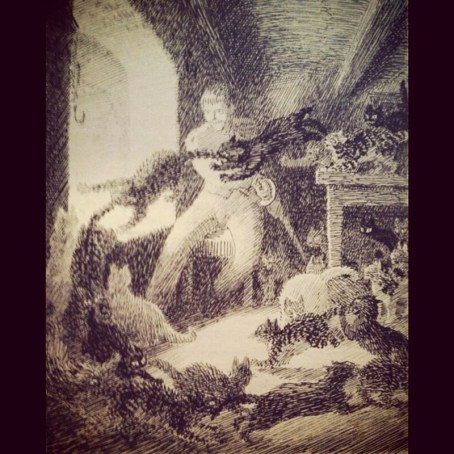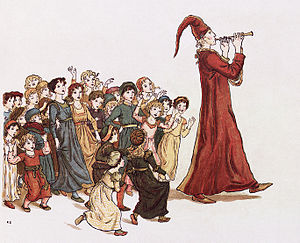
Fairy Tale of the Month: June 2016 The Singing Bone – Part One

singing bone milestone

Milestones

How many mental milestones do we pass in a lifetime? I am sure most of them go by unnoticed, like those tenth-of-a-mile markers on American turnpikes. Yet some milestones are remarkable. I am passing one of them now.

Melissa is sitting in my comfy chair with Thalia and Teddy on her lap, reading Grimm. Thalia has abandoned me before—oh the vagaries of youth—but I don’t mind in the least. I am a child at heart and love to be read to as well.

Thalia has tasked Melissa with reading The Singing Bone, not a comfortable story, really.

A wild boar has taken upon itself to devastate a kingdom, killing peasants and livestock. The king offers up in marriage his only daughter to whoever can rid his realm of this menace.

Two sons of a poor man come forward, the elder approaching the challenge out of pride, and the younger out of concern for others. They plan to enter the forest of the wild boar at either end, trapping the boar between them.

The younger comes upon a dwarf who gives him a spear, which the youth plunges into the heart of the beast.

Carrying the beast on his back, he passes through the forest to find his brother loitering at a tavern. On their way to the castle, the jealous elder brother murders his younger brother, burying him under a bridge, taking the boar carcass as proof of his valor, and to claim the bride.

Years later a shepherd finds a bleached, white bone under that bridge that he carves into a flute that only plays the sad tune of the younger brother’s fate. Amazed, the shepherd presents this miraculous instrument to the king, who immediately understands its meaning.

The rest of the bones of the youth are dug up and properly buried, while the elder brother is tied in a sack and drowned.

“I wish she had chosen Cinderella,” Melissa says after Thalia has given both of us a kiss and dragged Teddy out the study door. “What a bleak story.”

“I sense a bit of Cain and Abel in this tale.” I pour two small glasses of wine.

Melissa puts her chin in her hand. “I am going to say ‘no’ to that. I know the female version of this tale.”

I hand her a glass and let her continue.

Binnorie, a Scottish tale.” Melissa takes a sip, thinking. “Ah, English Fairy Tales, by Joseph Jacobs.” She looks at me slyly. “You’ve met him.”

“That I have.” And I remember the story she is talking about.

“But,” she continues, “I think it comes from a ballad.”

I stand and go to my bookshelves to peruse Child’s The English and Scottish Popular Ballads and come up with The Twa Sisters, in which Child dedicates over twenty pages to notes and variations on the ballad.

“The common traits,” I muse after a quick scan of Child’s notes, “is the sibling murders, improper burials, and the bones becoming musical instruments to reveal the crime.”

“The notable difference is the wild boar in The Singing Bone,” Melissa ponders and pulls out her smart phone from her purse. “Wild boars in fairy tales,” she intones to the device. I sense a delightful evening of research and conversation coming on.

Fairy Tale of the Month: June 2016 The Singing Bone – Part Two

Singing bone boar

Smarty Phones

Huddling together, peering into the glow of Melissa’s cell phone, we don’t come up with many other fairy tales with wild boars in them besides The Singing Bone. The tale Old Sultan has a boar, but it is of a comical order. There is a boar in The Mitten, but it is just one of a series of animals of increasing size that squeeze into the mitten.

Melissa taps the microphone icon and tries again.

“Wild boars and mythology.”

No shortage of good links with that inquiry.

The first image we see is of the Norse god Frey with his solar boar, Gullinborsti, pulling his chariot. His sister Freya also rides a boar. We see that pigs make a number of appearances in The Odyssey. These are fairly honorable positions for swine, but we soon run across Robert Graves’s assessment that in myth, pigs are the beasts of death.

In the Welsh Mabinogion, pigs come from the kingdom of Annwyn, the underworld. There are a number of male deities who are killed by boars, Attis and Adonis being two of them. Pigs are involved with the myth of Persephone in that they obliterate the tracks of Persephone and fall into Hades with her.

“This looks interesting.” Melissa points to the hyperlink phrase “Calydonian boar.”

In this myth, King Oeneus makes offerings to the gods for a plentiful harvest, forgetting about the goddess Diana. In revenge, she loosens a boar upon King Oeneus’s land that destroys crops and flocks, and sends the people scurrying inside the city walls.

Oeneus’s son, Meleager, gathers about him his brother, uncle, and numerous Greek heroes to hunt the boar. Meleager is virtually immortal given that one of the Fates decreed that he live only until a certain log burning in the fire is consumed, a log which his mother, Althaea, removes from the flames and hides away.

The hunt does not go well. All the heroes miss their mark, except for the Amazon Atalanta, who is able to wound the beast. Then Meleager’s second spear pierces the boar’s heart.

He gives the skin and head of the boar to Atalanta, with whom he has fallen in love, angering his brother and uncle, who take the prize away from her. Enraged, Meleager slays his brother and uncle, among others.

Althaea, grief stricken, avenges their deaths by throwing the log—ordained, if you will, by the Fates—into the fire.

“That rather sounds like our story.” I am, again, surprised by the parallels between myth and fairy tales.

Melissa ticks off the similarities. “A wild boar ravaging the countryside, a love interest—the princess and Atalanta, and both brothers die—with the Greeks having more collateral damage. No singing bone, though.”

We search a little further and come up with the Celtic Diarmait and the Boar of Benn Gulbain. Diarmait and the boar are actually foster brothers, the boar being under an enchantment, and the two are fated to kill each other.

The story culminates when Diarmait and Finn McCool, who have come to a tentative peace after Diarmait stole Finn’s bride, find themselves hunting down a boar that has killed fifty of Finn’s men. The boar is, of course, the foster brother.

“Same elements,” Melissa muses. “Two brothers killing each other with a boar involved, and some sort of love interest in there somewhere.”

“But no singing bone. Where does that come from?” I take her smart phone from her hand.

I’m going to try this.

Fairy Tale of the Month: June 2016 The Singing Bone – Part Three

Singing bone bone flute Hohle Fels Flute

Bone Flute

Our search for a source of the bone flute element proves not to be as productive as that for the wild boar.

“There, that guy will help.” Melissa reaches over and taps “D. L. Ashliman.” Of course. I have used his site often. He offers up the text of numerous variants.

There is a French Louisiana version, called The Singing Bones (plural), which pulls from The Singing Bone and The Juniper Tree, with the culprit wife feeding her husband some of their numerous children. He eventually hears their bones calling to him.

An Italian version, The Griffin—in which a king sends out his two sons to compete in attaining a griffin’s feather to cure the king’s illness—is similar to a source from Lower Hesse listed in Grimms’ notes.

Both Ashliman’s list and the Grimms’ notes cite the Swiss version The Dead Girl’s Bone.

In this tale the rivalry is between a brother and sister in search of a certain flower, the brother doing the murdering.

Also cited by both Ashliman and the Grimms is Binnorie. While there is no bone flute in this tale, there is a harp made of bones; this is, after all, a tale of Celtic origin.

“Most of these,” notes Melissa, pouring us each another glass, “have shepherds in them. I am remembering something about the god Pan.”

“The god Pan,” I say to her phone. This still feels strange to me.

The Wikipedia listing pops up first.

Back to Greek mythology again. We learn that Pan falls in love with the Nymph Syrinx, daughter of Ladon the river god. Fleeing the amorous Pan, Syrinx calls to Zeus to save her and she turns into reeds. Enraged, Pan shatters the reeds, but is then struck with remorse and kisses the broken pieces. As he does so, he discovers that his breath can create music from them, and so he ties a number of them together to make his flute, which he keeps with him always.

On a sidebar I see Pan is, among other things, the patron of shepherds.

“Those are reed flutes,” Melissa observes. “What about the bone flute?”

I give her back her phone and pick up my wine glass.

“Bone fl…” she starts.

“Bohn, here you go,” the not-so-smart phone chimes back.

Melissa sighs and tries again, speaking a little more quickly.

It turns out there is a rather scholarly controversy over as to which among several contenders is the oldest bone flute.

The first is the Divje Babe flute, discovered in Slovenia in 1995. It is a cave bear femur, perhaps 45,000 years old. It appears that the holes were man-made, though some scientists argue that  an animal gnawed on the bone creating the holes.

Another, an undisputed musical instrument, is the Hohle Fels Flute discovered in the Hohle Fels cave in Germany’s Swabian Alb in 2008, made from a vulture’s wing bone, dating from approximately 35,000 years ago. However, several years before, two flutes made of mute swan bone and one made of woolly mammoth ivory were found in the nearby Geisenklösterle cave. The claim is they are 42,000 to 43,000 years old.

“I’ll take it there were lots of bone flutes lying around,” says Melissa. “The wild boar may come out of mythology, but the flute, like the spinning wheel in these tales, probably comes out of the material culture of the time.”

I agree with Melissa.

Your thoughts?


Fairy Tale of the Month: May 2016 Prince Swan – Part One

Prince Swan one

Fe, Fi, Fo, Fum

I’ve become aware that I live for this time of the evening, these moments when I sit in my study awaiting the padding of footsteps down the hall. I know Thalia will grow up, shed Teddy, shed me, and shed the magic that surrounds the both of us. Will I be able to live again in the mundane world?

My study door creaks open. Thalia is in her favorite nightdress, the hem of which touches the floor, picking up its gray dust and grime. Teddy, dragging behind her, does his duty by cleaning a swath of the floor.

As they settle in beside me on the comfy chair, Thalia declares, “Read me  . . . ,”  she considers, “ . . . the last story,” handing me her tattered copy of Grimm. I turn to the end, noting it is story number 250, and read.

“Little Hen found a little key in the dung heap, and Little Rooster found a little chest. They opened the chest and found a small, red short fur. If the little fur had been longer, then this tale would have been longer, too.

“Well, that’s it, time for bed.”

“Nooooooo! Read me the second last.”

I of course relent.

The second last story in these latter-day full collections of the Grimm stories is the overlooked Prince Swan. A maiden is approached by an enchanted prince in the form of a swan, who declares he will marry her if she will unravel the ball of yarn to which he is attached as he flies off to his kingdom.

This she does for an entire day, but just before the last of the yarn is untangled, it catches on a thorn bush and is broken.

Looking for food and shelter, the maiden comes to a house where an old woman answers the door. The old woman helps the girl, but warns that her husband is a cannibal. The husband returns home, smells the girl, and catches herl. The old woman talks him into saving the girl for breakfast. Before dawn the old woman, who identifies herself as “Sun”, gives the maiden a golden spinning wheel and sends her on her way.

The girl encounters two other old women with cannibal husbands, from whom she gets a golden spindle from the one named “Moon,” and a golden reel from “Star.” Star also tells the maiden that the spell over the prince has been broken by the girl’s efforts despite the mishap. However, he is now a king, has married a princess, and is living atop the Glass Mountain guarded by a lion and a dragon. Star gives the maiden bread and bacon to feed and placate the beasts.

Thalia giggles about the bread and bacon.

At the castle gate, the maiden uses her golden spinning wheel, attracting the attention of the queen. The maiden trades the wheel for a night in the chamber next to the king. There she sings the song of her travail, but the queen has drugged the king to sleep.

The girl trades the other devices for more nights in the chamber, and is able to fool the queen on the third try. The king hears the song, and puts aside his queen to marry the true bride.

“That’s sorta like Sprig of Rosemary.” Thalia knits her brow.

“And a little like Jack and the Beanstalk, ‘Fe, fie, fo, fum. I smell the blood of an Englishman.’”

“Yeah,” Thalia’s eyes light up. “Weird.”

Fairy Tale of the Month: May 2016 Prince Swan – Part Two

Prince Swan Elisabeth Sonrel Elizabeth Sonrel

Some Questions

I have questions. Fairy-tale questions. Questions with deep roots in my psyche. Yet I have not the words to express them. Images imbued with distress flicker through my head, but nothing more concrete.  When I find myself popping popcorn, I then know what I intend.

Clutching a bag filled with still warm, fluffy kernels, I enter the Magic Forest at dusk, never a good idea. I know the way to the nixie’s pond despite the gloom.

“Hello, my human.” The nixie emerges from the water to sit upon her rock.

“Hello, my nixie.” I toss her a popped kernel that she catches with her webbed hands, then savors.

“Have you read the story of Prince Swan?” I ask.

“Your books do not do well under the water. Tell me the story.”

Even the immortals like to hear a good story.

When I finish she responds, “Of course I know the story. It is an old tale of human carnal love.”

“Carnal,” I say, while methodically throwing her popcorn. I think it keeps her at bay, and from dragging me beneath the water’s surface. Popcorn does not do any better under water than books.

“Carnal,” I repeat. “That is a base way of describing what we call ‘true love.’ ”

“Ah, true love, there is a mystery for us immortals. We know pleasure, but you mortals take more from knowing each other than we do.”

I toss her another kernel and she continues.

“Your maiden meets her prince, but not in his human form. Yet, her heart goes out to him at once, unconditionally. Explain that to me. Why does she travel to the sun, moon, and stars to reclaim a thing she never had? What did she think her chances were?”

“Her chances were always good,” I say. “She was connected to the prince through the symbolism of the yarn. The longer it traveled outward, the more connected they became.”

“But when the yarn broke, did not that all go away?” The nixie frowns as she nimbly catches another kernel.

“No,” I say. “It is only the inciting incident for the hero’s journey, or in this case, the heroine’s journey.”

“Yes,” her green eyes flicker. “You mortals are always searching. I don’t sense you are finding. Do the tales give you restless beings an illusion of closure? That is to say, somebody has found?”

She may have something there.

“We do like happy endings, but it is the search that is important. We take clues from the hero or heroine’s search and apply them to our own search, however imaginary that might be.”

“But why make the journey? If you want love so badly, why not love the next enchanted prince who blunders by?”

I keep the popcorn coming as I consider.

“We,” I finally answer, “like to think there is only one person we are meant to love, and when we find that person, we need to follow them down whatever path they travel.”

“And what happens when you get to the end of that path?”

“I don’t know. The path never ends, if we ever get to travel it.”

The nixie’s green eyes narrow. “How often do your people get to meet this one and only love?”

“That varies. Some of us never, others frequently.”

The nixie sighs. “You mortals are hopeless.”

“Oh no,” I say. “We are full of hope. Endless hope.”

“Perhaps that is what the fairy tale is about,” I say to myself.

Fairy Tale of the Month: May 2016 Prince Swan – Part Three

Prince Swan Frank Cadogan Cowper Frank Cadogan Cowper

Another Thought

My bag of popcorn is half empty, but I know I have not asked the question for which I have no words. The nixie’s eyes penetrate mine. She knows another question lies within me.

I almost hear a bubble burst in my thoughts and words flow from my mouth. “Where can I find the soul of a fairy tale?”

Is that the right question?

The nixie frowns. “You speak in Christian terms. Rephrase your question.”

I think I may have offended her. There is much that is Christian in the tales, but it is a gloss put upon them by Christian writers. At their heart the tales are pagan in nature.

“Where,” I start again, after a few more tosses of kernels, “is the spirit of the fairy tale to be found?”

“Ah, there is such a place. I can take you there.”

I sense the danger in that. “Tell me of it, instead.”

She smiles wickedly, but tempts me no further. “You do not need me as a guide. You have probably been there, but it is hard to remember such visits. Many a storyteller visits the spirit, if only for a fleeting moment while their bodies remain in a tavern, a workroom, by a family hearth, or near a fire in a Bronze Age hovel. Most commonly, you mortals visit from a place we immortals cannot tread—your dreams.”

“Motifs,” I blurt. “If the tales came from one place, then so do the motifs, those pieces of a tale that come up again in story after story, as in my Prince Swan: the women with cannibal husbands, those very women being the sun, moon, and stars, and the frequently-appearing spinning wheel.”

The nixie nods in confirmation. Another bubble bursts in my thoughts. “If there is but one spirit, is there but one true story, one complete fairy tale?”

“There was.” The nixie holds up her webbed hand for more popcorn. For my life, I’d forgotten to throw her some during my reverie.

“In the beginning,” she says between bits, “there was only one fairy tale. I knew it then. It took a mortal’s lifetime to tell it.

“Now it has come apart, flake by flake, falling to your plane of knowing in perfect little symmetries, leaving behind its spirit. I do not know where all the flakes have fallen, although when I see them, I recognize them.”

“Can the story be pieced back together and made whole again?”

‘Why would you want that? The weight of the whole story might crush you. Take what little wisdom it gives you when it melts on your tongue and be content.”

“No.” I hold back the popcorn on purpose. “I want to know the whole of it, hold it in my hands, as it were.”

“First try catching a snowfall in your hands. How many flakes would you miss? How many would melt in your hands?”

My popcorn bag is nearly empty. I throw her the last of the kernels.

“Well then, my nixie, take pity on a poor mortal who wants to know the ultimate story, but apparently cannot.”

“Pity is not one of my abilities. You need do that for yourself.”

I should have known and I shall.

Your thoughts?


Fairy Tale of the Month: April 2016 Puss in Boots – Part One

Puss in Boots CraneWalter Crane

Special Cats

I am undone, abandoned in a harsh world. Although a friendly fire burns on my hearth, there is no companion with whom to share its warmth, nor share a story. Thalia is on a sleepover.

Johannes curls up on the back of the sofa, his tail wrapping around his black body.

“Would you like a story?” I ask.

His yellow eyes focus on me. “The title?”

I consider for a moment. “Puss in Boots.”

“Puss?” Johannes’ whiskers twitch in annoyance.

“Or, The Master Cat.” I go for the same story’s alternate title.

“Why would I listen to such a thing?”

“Because the cat is the hero?” I offer, reaching for Andrew Lang’s Blue Fairy Book.

Johannes does not get up and leave the room. I take that as permission to continue.

The Master Cat or Puss in Boots starts with the miller’s three sons getting their inheritance, the youngest receiving a cat as his due. The youth considers eating his cat and making warmers of its fur, but the cat suggests a more novel idea, that of the master acquiring for his cat a pair of boots and a bag.

Thus arrayed, the cat bags a rabbit and resplendently dressed—illustrators have given him a cavalier hat as well, though the story says nothing about it—presents the food gift to the king saying it is from the Marquis of Carabas. The gift-giving goes on for months until one day the king and his daughter are out for a drive in their carriage. Following the cat’s instructions, the young man undresses and submerges himself in a pond. The cat cries out that his master, the Marquis of Carabas, has been set upon by thieves and is now in fear of drowning.

The king, having received so many gifts from the Marquis, is happy to rescue and clothe the poor fellow. The cat runs ahead of the king’s carriage, instructing all he meets—along with threats—to declare these are the lands of the Marquis of Carabas.

The cat goes to the ogre’s castle—the real owner of the lands—to admire the ogre’s shape-shifting abilities. The ogre, suffering as ogres do with an inverse relationship between their powers and their intelligence, allows himself to be talked into turning himself into a mouse, with predictable results.

The marquis assumes ownership of the castle, and the king, impressed with his wealth, proposes that the young man marry his daughter, the idea of which the young man and the king’s daughter are way beyond him, having fallen in love the moment they laid eyes upon each other. The marriage is made and so is the cat, now only chasing mice for sport at his leisure.

“A French cat, isn’t he? “Johannes’ eyes are half-closed in superior mode.

“Yes, the story is by Charles Perrault, written sometime in the late sixteen hundreds.”

“I can tell he wasn’t a proper English cat, not nearly condescending enough toward his provider. In fact, he is the provider.”

“Actually, the original source is Italian. Both Giovanni Straparola and Giambattista Basile had versions of it.”

“Mediterranean cats aren’t much better than the French, subservient with skinny tails, all of them.”

Why do I feel like slapping him?

Fairy Tale of the Month: April 2016 Puss in Boots – Part Two

Puss in Boots oneIllustration 1843, from édition L. Curmer

Branding

Duckworth and I pull at the oars. It is delightful to be on the river again on a glorious spring day.

“Tell me, what tale have you foisted upon poor Thalia recently?” Duckworth says that simply to make conversation, knowing my passion for the tales.

“Thalia escaped. Off to a sleepover. I told to the cat.”

“Animal abuse, dear me,” Duckworth smirks.

“No, not at all. I told an appropriate story to engage his interest—Puss in Boots.”

Duckworth missed a beat with his oar. “Really? You’ve finally landed on a story I know well.”

“Oh, are you a fan of Charles Perrault?”

“Who?”

“Perrault, the author of Puss in Boots.

“Oh, is that who wrote it? I thought these tales were authorless—traditional.”

“Well, yes and no. Some versions are definitely literary.”

“I see. Well, I use this story as an example in one of my seminars.”

“Seminar?” My turn to miss a beat.

“Yes, on branding and marketing.”

“Branding?” I stop rowing.

“That cat’s a genius marketer. Listen, to start, the cat is threatened to be eaten up by the competition. What does he do to survive? He comes up with a brand—the boots. Totally iconic. Throw in a cool hat and he is a made man.”

“He’s not a man.” Duckworth ignores my protest.

“Now, having his identifiable brand, he needs to create a demand for his product. What does he do? He catches rabbits and partridges, etc. and gives them to the king. Freebies. Giveaways. No better way to attract attention to your product than to introduce it by handing it out, usually a downsized version.”

“Product?” I echo.

“Now, having his brand and having a demand strategy in place, he takes the next step in getting the customer to buy into the product. By creating a situation, a position if you will, the cat gets the king to take the young man into his carriage, into his sphere of awareness, his marketplace.”

I know I am gaping.

“The cat runs ahead of the carriage, creating a stir among the peasants to do his bidding. Strong-arm tactics, creating a buzz. Yes, he uses threats, which could lead to a legal battle, but why not? Publicity is publicity. Everyone now knows you are a player; whether you win or lose the case, your name, your brand, is out there.”

I feel like crying.

“Immediately,” Duckworth continues, on a roll, “the cat minimizes the competition—the ogre—and assumes his prerogative.”

I wipe a tear.

“The cat doesn’t even have to make the sales pitch. The consumer, the king, suggests the purchase—the marriage. It’s brilliant!”

“Wait.” I try to recover. “Wasn’t Puss ‘n Boots a failed cat food company?”

“Yes, I know.” Duckworth waves his hands in the air. “They messed up on the logo. They had their cat in boots all right, but turned the bag into a swag, making him look like a bum. Had they put a natty hat on him, they might still be in business.”

With no warning, we lurch forward. Since neither of us have been paying attention, we’ve run aground.

Fairy Tale of the Month: April 2016 Puss in Boots – Part Three

Puss in Boots gpjHood2George Percy Jacomb-Hood

A Stroll

I skirt the edge of the Magic Forest as I amble along on my evening stroll, which I am squeezing in between a rain squall and the sunset. Notions about Puss in Boots float around  in my thoughts while my pipe smoke encircles me for a moment before drifting off into the arch of tree limbs.

Puss in Boots is a literary tale, with a known author, but even if I didn’t know his name, the story is absent the usual markers of a traditional fairy tale. The one traditional marker it does have is the trickster/animal helper, and yet I can qualify that.

The pedigree of the fairy-tale trickster goes back to the trickster gods, such as Loki of the Nordic pantheon, who could transform himself into animal shape. I doubt there is a culture that does not have a trickster figure lurking somewhere in its lore.

Just as popular are animal helpers. In the fairy tales these creatures abound, but I have noticed the majority of them fall into two categories. First, the hero or heroine is often helped by an enchanted being in animal form, who at the end of the tale regains human shape. A famous example is The Frog King, and there is also The Golden Bird.

The second category of animal helpers is from stories like The Queen Bee and The White Snake. In these tales the helpers come in sets of three and in groups. Taking The Queen Bee as example, the hero is helped by a colony of ants, a flock of ducks, and a swarm of bees in exchange for his kindness to them.

Now, there are stories like The Six Swans in which the brothers are turned into swans and their sister must restore them, but these are not animal helpers. Also, there are animals in fairy tales that are simply animals, but these tend to talk among themselves and not interact with humans to any great degree. I am thinking of The Bremen Town Musicians or The Companionship of the Cat and the Mouse (You can imagine where that latter ends without reading it.) Here the animals are the main characters in the story and not in a trickster or helper role.

None of the markers I am thinking of quite fit our puss wearing boots. The cat is not an enchanted prince. He is not part of a colony, flock, or swarm. He does not talk to any other animals—his peers.

I pause in my stroll for a bit, and sit on a stump, studying my wet wellies. My boots are plain, not like what I imagine the cat wears. I assume the cat was not wearing rubber rain boots. As Johannes pointed out, this is a French cat. How the young master afforded fancy boots, not to mention the size issue, is of no concern to the story. What strikes me is I have not encountered an animal in a fairy tale that is dressed in any fashion. Illustrators might put clothing on them, but not the story.

Not so with Puss in Boots, which one can tell by the very title. Clearly a marker for a literary tale, the invention of a bold, individual author, not the result of repetitive, conservative, passing down of a community story. As a group, we humans will anthropomorphize the animals only so far. Giving them a hat might be too much.

The sun is setting and I dare not be close to the Magic Forest at night.  I will let my thoughts on Puss in Boots slip below the horizon as well.

Your thoughts?


Fairy Tale of the Month: March 2016 Tam Lin – Part One

Tam Lin NeilsenKay Nielsen

A Ballad

Melissa and I sit, wrapped in our coats, in Miss Cox’s garden. We are not waiting for anyone. Melissa asked to come here to see the approaching spring. The crocuses have come up and faded, but both the daffodils and the tulips are pushing up from the earth. Miss Cox has set out a pot of jasmine tea, protected by a cozy.

My friend sips from a steaming cup while I say, “I am thinking of reading Tam Lin to Thalia. It’s an old Scottish ballad actually, about the heroine, Janet, rescuing her lover from the fairy queen.”

Melissa swirls around the tea in her cup. “I know it well. I wouldn’t read it to her.”

“Hmmm,” I say, “Too much sexual content?”

“Oh, no, not that.” Melissa sets down her cup. “There is lots of implied sex in the fairy tales. Every king and queen has either a beautiful daughter or three sons. The tales do not state, on a regular basis, that these children come from under cabbage leaves. I don’t think children are discomforted by fairy-tale characters themselves having children.”

“But,” I consider, “The ballad of Tam Lin deals directly with a pregnancy. That is a bit more graphic.”

I take a sip of my jasmine tea as Melissa takes up her cup again, saying, “It’s the language and the longing that will stop Thalia from understanding the story.”

“Language? It has been awhile since I read this story, but I don’t recall any bad language.”

“Not bad language,” Melissa smiles, “Difficult language.” Melissa composes herself then recites:

 Janet has kilted her green kirtle

A little aboon her knee,

And she has broded her yellow hair

A little aboon her bree,

And she’s awa to Carterhaugh

As fast as she can hie.

Of course she has memorized it. “I see what you mean,” I say. “I suppose I could find an updated version.” My own suggestion makes me uncomfortable. “But then we begin to lose the sound of it, don’t we?”

Melissa nods. “That would be like updating Chaucer’s Canterbury Tales, turning,

Whan that Aprill, with his shoures soote

The droghte of March hath perced to the roote

into:

When in April the sweet showers fall

That pierce March’s drought to the root and all.”

“What about the longing part? You are saying Thalia does not understand longing?”

“Hopefully, she hasn’t experienced it at her tender age. Certainly she loves you and loves her teddy. Certainly children have emotions, but the longing of love comes about somewhat later. If Thalia has not experienced longing’s fear of emptiness, she may well not understand why our heroine, Janet, does what she does.”

I hear caution in my voice as I say, “If Thalia cannot identify with Janet on the level of shared experience, can she not empathize with her on a romantic level? I am guessing Thalia has absorbed an uncurious sense of German Romanticism via her reading Grimm.”

Melissa sips the last, cold dregs of her jasmine tea. “I am not sure we can equate romanticism with the darkness of an old Scottish ballad. In Tam Lin there is something of the uncanny that goes beyond the naturalism of the romantics.”

My tea has grown cold as well.

Fairy Tale of the Month: March 2016 Tam Lin – Part Two

Tam Lin batten John Batten

Which One

When I think of Augustus, I see him in the context of a cloud of tobacco smoke. If I met him on the quad, in the fresh air, I’m not sure I’d recognize him. We sit together in his testing room, happily fouling the air around us.

Tam Lin you say,” puffs Augustus. “You are referring, of course, to Francis Child’s The English and Scottish Popular Ballads.”

“Of course,” I say, feeling a little snobbish that I know the reference.

“Which one of the nine versions that he presents will you pick?”

“Oh, are there that many? I think . . .  I forgot that.”

Augustus rises and returns with volume I in his hand. “Let’s see, ballad #39. Yes, usually people use version A or B—the more modest versions. I have a slight preference for version B; the fairy queen wants to turn Tam Lin’s eyes to wood, and his heart to stone. Version A only has the first threat.”

“Oh, that’s pleasant,” I say, blowing a smoke ring.

“Now, a number of the other versions are much more explicit about the rape of Janet.”

“Version A or B remain attractive to me for my purpose,” I say, but Augustus continues.

“”Version I is a little coy about the rape:

He’s taen her by the milk-white hand,

Among the leaves sae green,

And what they did I cannot say,

The green leaves were between.”

“That’s not going to help me,” I repeat.

“Version G is interesting.” He’s on a roll. “Besides being changed to Lady Margaret, after Tam Lin rapes her, she is left to wander through a sunless, moonless realm for seven days.”

“Interesting,” I agree, “but no—not for Thalia.”

“Oh, right, Thalia. Then I vote for version B. All the versions have the Wild Ride on Halloween night; Janet (or Margaret) always pulls Tam Lin from the white steed as they pass by, and, in rapid succession, the fairy queen turns Tam Lin into a snake, or black dog, even a silken thread, and usually a red-hot iron, a series of these in any case, trying to get her to let him go. In all the versions the fairy queen fails, leaving behind only her empty threats.”

“But, Augustus, should I be telling her this ballad at all?”

Smoke appears to clear between Augustus and me. “Well,” he muses, “should age make a difference?”

“Isn’t this story a bit over her head? I know it was my notion to tell it to her, but it’s begun to makes me uncomfortable the more I think about it.”

“Yes, it makes you uncomfortable and if you tell her the story in that state she will pick up on your mood and be uncomfortable too. I believe you need to come to terms with the tale.”

“But, if I bowdlerize the story until I am comfortable, I will have changed the story, perhaps gutted it.”

“No, no, you can’t do that. I am saying, ‘stiff upper lip,’ present the story for what it is, and let it stand on its own.”

Why is this so difficult?

Fairy Tale of the Month: March 2016 Tam Lin – Part Three

Wild hunt Aasgaardreien_peter_nicolai_arbo_mindre Peter Nicolai Arbo

Wild Hunt

Perhaps my troubles over this old ballad I take too closely to heart, but being a person of a retiring nature, I have nothing more with which to plague myself. I take shelter in my study in front of my fireplace, still feeling a little chilled by Melissa and my visit to the garden, and despite the warmth of Augustus’s company earlier this evening.

Upon my first reading of Tam Lin, The Wild Hunt grabbed me—the very term coined by Jacob Grimm in his study of mythology and legends, Deutsche Mythologie. He considered the Wild Hunt to be a remnant of Germanic pagan tradition and that the god Woden (and on occasion his wife) led in its forefront.

Over time and place, the cast of this furious ride in the night changed. King Arthur took his turn in the lead, along with other historical kings, and biblical figures such as Cain, Gabriel, and, not the least, the Devil had their moments. The purpose of their chase was not always clear; it could precede catastrophe, with willing and unwilling souls getting swept up into the procession.

When the Wild Ride appears in Scotland, the participants are diminished –fairies rather than a god or goddess. However, unique to Scotland is the story of one of the riders being pulled from the saddle and rescued from hell by a lover. Francis Child knew of no other example than Tam Lin.

Staring into the flames, I recall my introduction to Tam Lin. As a student—a library science major—my professor for reference studies gave me and my fellow students a list of possible library patron questions, plus a list of likely reference sources that we could use to answer the questions.  Put more simply, he assigned us a treasure hunt.

One of the possible sources on the list was Francis Child’s The English and Scottish Popular Ballads. I forget the actual question that led me to this work, but I do remember being in the university’s new library, under florescent lights, breathing sanitized air, sitting in one of the Naugahyde-covered chairs around a low table, and being plummeted down a thousand years into a world of earthy smells and course textures. I crouched beside Janet at Miles Cross waiting to hear the jingling of the bridle bells as the Wild Hunt approached. The tale thrust me into a world of magic where I have dwelt ever since.

Thalia’s fairy flitters into the study and settles close to the hearth. She would never be one of the fairies of the Wild Hunt; those would be the larger fairies. Fairies are as variable in shape and appearance as claims of honesty among politicians.  Our house fairy would fit into the company of Trooping Fairies, those that dance in fairy rings, luring mortals to dance with them for an evening, only to find on morrow that a hundred years has passed.

Nonetheless, our fairy serves as warning to me that Thalia is on her way to the study for a story. It will not be this story. Tam Lin will come to Thalia, as he came to Janet, when it is time, and not with my interference.

Your thoughts?


Fairy Tale of the Month: February 2016 Jorinda and Joringel – Part One

Jorinda & Joringel Robert Anning BellRobert Anning Bell

Bird in a Basket

I think winter wears thin on me because of my age, but it has worn thin on Duckworth as well, and he is a younger man. When the Met Office predicted a warm day, he rang me up to go rowing. I understand the American Ground Hog—Gus, I think they call him—has spoken of an early spring, and our balmy day may be a manifestation of that trend.

Duckworth and I ignore the frozen water along the edge of the riverbank and pull at the oars, freeing ourselves from winter’s doldrums.

“What frightening tales have you been telling Thalia these days?” Duckworth grins with a twinkle in his eye.

“If you are referring to my reading her Grimm, they are not frightful, if—well—a little grim sometimes. But to answer your question, Jorinde and Joringel.

“Haven’t heard of that one. Anything like Hansel and Gretel?”

“Well, some of the constructs are the same, but, really, no, not the same story.”

I summarize for him.

“The story tells us there is a witch, who transforms by night into a cat or an owl, catching and eating other creatures. People she ensnarls get a special treatment. Men, she casts a glamour upon so that they cannot move until she releases them. Girls, she turns into birds, puts them in wicker baskets, and stores them away in a special room in her castle. “

“How pleasant,” says Duckworth.

“Two young lovers, Jorinde and Joringel,  walking in the wood become unaccountably sad and confused, and find themselves near the witch’s castle.  Jorinde sings out, answering a turtledove:

Oh my bird with your ring of red,

Sitting and singing your tale of woe!

You tell us now that the poor dove is dead.

You sing your tale of woe—oh-oh, oh-oh!

“And turns into a nightingale. An owl appears and flies around her three times crying, To-whoo! To-whoo! To-whoo!

“Joringel is immobile as the witch transforms into her human shape, carries off the nightingale, then returns uttering, ‘Greetings, Zachiel. When the moon shines into the basket, let him loose, Zachiel, just at the right moment.’ ”

“Zachiel,” says Duckworth, shipping his oars for a moment, “Jorinde, Joringel. This story is full of strange names.”

“Joringel is released and sent away. He becomes a shepherd, but after a long time he has a dream about a red flower with a pearl in its center, which can break the spell. He searches for the flower for nine days. He finds a red flower with a dewdrop in its center, the size of a pearl.

“Returning to the castle, he finds the room where the wicker baskets of birds are kept. He ignores the witch spitting poison and gall at him, and looks for the basket that holds Jorinde among the seven thousand baskets that are there. When he thinks he cannot find her, he sees the witch carrying off one of the baskets. He chases after her, dispelling the witch by touching her with the flower, and turning Jorinde back into herself with another touch of the flower.

“After turning all of the birds into young ladies, he and Jorinde return home to live happily for a long time.”

“Hmmm,” says Duckworth. I see he is thinking.

Fairy Tale of the Month: February 2016 Jorinda and Joringel – Part Two

Jorinde_und_Joringel 2anonymous

The Witch

Duckworth pulls steadily at his oars. “Let me take a stab at analyzing this one.”

“Have at it.” I am pleased he is taking the tale seriously.

“Well, to start, the names ‘Jorinda’ and ‘Joringel’ are obviously similar, the female and male versions of the same root name, whatever that is.”

“Obviously,” I comment.

“I think you are right that this is not a Hansel-and-Gretel thing, where there is a brother and sister, rather these two represent one person, the animus and anima of an individual.”

“Ah,” I say, “you have read your Carl Jung.”

“Oh, yes. Back in college I considered a psychology major, before taking up business.”

I had not known that.

Duckworth continued. “Jorinda and Joringel go for a walk in the wood.” He looks at me quizzically.

“The wood—the forest—is a place of danger in these tales,” I answer.

“Right, I thought so. As I see it, they bring the sadness with them into the forest. Well, I shouldn’t say they, they are really one person. What should I call him? Oh, well, let’s just say I.

I go into the forest. I am sad.” Duckworth stops. I see the wheels turning. “No,” he says, “it’s not sadness; it’s uncertainty.”

“Okay, so,” he muses, “enters the witch. Hmmm. She is the conflict. Call her evil if you like, but I see her as the soulless boss, dictating how I should act and what I should be doing. Actually, I can cast the witch as any number of bosses—authority figures, if you will—who have left my animus standing helplessly by as they carry off my anima in a basket; my anima being my creative side.”

“A bossy witch,” I contemplate.

“I guess I can sum her up as the accumulated conventions we are expected to follow.”

“Like, ‘get a job,’ ” I suggest.

“Exactly, and our hero does just that after the witch releases him. He becomes a shepherd. Does the story say he liked his job?”

“It really says nothing more about it.”

“Okay, so, projecting myself back into the story, I am a shepherd and have a dream about a flower with a pearl in its center. My animus knows it is only half of who I am, having let my anima go in my uncertainty. I need a device to reclaim my other half.”

Here Duckworth pauses.

“And the device?” I prompt.

“I don’t know. That is where I am in the story. I ‘ve had the dream and now I am searching.”

“You only have nine days,” I prod, and notice we are farther downstream than we have ever rowed before.

Duckworth laughs. “I hope the nine days are metaphorical, but I have had these reoccurring dreams that I am an artist, and I am at some sort of party, and people I don’t know are talking to me about my art, and I don’t know what kind of artist I am.

“I have been dragging my wife and kids to more movies and even a couple of plays, lately. I hadn’t put it together before now, but I think I am looking for the flower with the dewdrop pearl in its center.”

Fairy Tale of the Month: February 2016 Jorinda and Joringel – Part Three

Jorinda Heinrich_Vogeler_-_Illustration_Jorinde_und_JoringelHeinrich Vogeler

Another Analysis

Melissa and I have agreed to meet in the park after she locks up her shop for the day. It is late enough in the winter that we have a little daylight. I sit by the fountain, a metal tree supporting three concentric bowls that get smaller toward the top of the tree. Water is meant to spill from the smaller bowl into the larger bowls, and then into the pool. At its base are four frogs, their mouths puckered skyward. This time of the year there is no water to animate them. They sit waiting, like me, for spring.

My moment of melancholy is swept away when I see Melissa approaching from beyond the fountain. I rise to greet her. She eyes me with concern. “You look—flushed.”

“I do? Oh, of course, Duckworth and I were out rowing today and got pretty far down stream and had to labor our way back. Do you know Duckworth?”

“Yes,” she smiles. “He was my last customer before I closed. I am sure you are why he bought a copy of Grimm.”

“Hah, yes, my small victory.” I tell her of the afternoon conversation.

However, the more I talk about animus and anima, and Duckworth’s analysis, the more somber she grows. “I know the tale well,” she says, “I read it rather compulsively as a young girl and then again after my first divorce.”

First divorce? I am learning so much about my friends today that I did not know before. “Ah, and what is your analysis?” We walk on, Melissa not speaking.

When we come to a bench she sits. I am beside her in a trice. “I will not analyze it,” she says. We sit, she plays with the drawstring of her coat, then laughs, and claps her hands, apparently at her own sense of humor. “Fairy tales are subatomic particles.”

I feel myself frown. “You will have to explain that one.”

“I am thinking of quantum mechanics, one of its rules being that at the subatomic level, the observation of an event alters it. I am saying, if you look too closely at a fairy tale it changes.”

She is disappointed when she sees the confusion in my face, and returns to playing with the drawstring.  A cat comes stalking across the dried grass, a wren in its sights. It moves in halting, menacing steps. Drawing close to its prey, it freezes, wiggles its butt and leaps as the bird flutters away.

“There,” says Melissa. “What did you see?”

“A rather silly cat.”

“But was there not both grace and humor in its movements? Let’s go catch the cat, cut it open, and see where the grace and humor comes from.”

“Ow, that was visceral of you.” I love Melissa, but she can make me uneasy.

She smiles. “I have a more comfortable simile. Fairy tales are to be read as poetry, read for their emotional content. What good is it to parse the sentences of a poem? That is not where its meaning lies. It is all in how it makes us feel.”

Your thoughts?


Fairy Tale of the Month: January 2016 Iron Hans – Part One

Iron John GrimmFrom a Grimms’ edition

A Wild Man

Thalia’s index finger circles in the air above the table of contents as she stares at the ceiling, then stabs down on a title. “That one!”

“We read that last night,” I say.

The finger rises again and descends. “That one!”

Iron Hans it is. Can you stay awake? This is a rather long one.”

“Of course I can,” she pouts.

“Can Teddy stay awake?” I look at her stuffed bear.

“I’m not sure about him.” Thalia’s brow wrinkles.

Iron Hans is something of a three-act play. In the first act a huntsman, sent into the forest, disappears. Three more huntsmen are sent to find him but do not return. A third party meets the same fate. The culprit is a rusty-looking, hairy man who lives at the bottom of a pond. The king has him captured and put in a cage.

One day (the start of act two) the young prince lets his golden ball roll into the hairy man’s cage, and the creature will not return it until the lad opens the cage. After some reluctance, the prince does and is carried off by the hairy man.

The hairy man, who calls himself Iron Hans, sets the lad the task of guarding a well, not allowing anything to touch the water. Unfortunately the lad’s finger, injured while opening the cage, throbs, and he dips it into the water to soothe it. The finger turns to gold. By the end of the third day the lad has a whole head of golden hair. Iron Hans sends him away to learn poverty, but with the promise to help the lad if he is in need and calls for him.

The third act begins with the young man finding employment at a castle. He hides his golden hair under a cap (How he hides his golden finger the tale does not tell us.) and gets into a bit of trouble for not taking off his cap to the king. Because he is likeable, our hero still ends up as the assistant to the king’s gardener.

The princess spots him in the garden with his golden hair uncovered, and has him bring her wildflowers. She snatches off his cap and he tries to flee, but she forces gold coins into his hands. These he gives to the gardener’s children.

War breaks out, and the lad desires to be part of it. He calls to Iron Hans, who gives him a horse, armor, and an army of iron knights to follow him into battle. It is the lad who turns the tide of battle, but he disappears after his victory.

The king declares a three-day festival, during which the princess will throw out a golden apple to the knights each day. The king rightly assumes the mysterious knight will not turn down the challenge, but each day, dressed in different armor, the lad catches the apple and escapes. On the last day, the king’s men manage to pursue and wound him.

The princess talks to the head gardener about his assistant and learns the young man has shown three golden apples to the children. The youth is brought before the king and the princess once again snatches off his cap revealing his golden hair. The hero confesses all his good deeds and when asked what he will take as a reward, asks for and is granted the princess’s hand in marriage.

At the wedding, Iron Hans reappears restored to his true form as a king.

Thalia breathes gently and rhythmically in my arms. I put her stuffed bear in her lap and lift her up to carry her down the hall. I can’t help but notice Teddy’s button eyes are still wide open.

Fairy Tale of the Month: January 2016 Iron Hans – Part Two

Iron John 15th centFrom 15th Century manuscript

A Bit of Smoke

There are only a handful of places I’d rather be than Augustus’ tobacco shop. I am flattered to be a special customer, one who shares his interest in fairy tales and who can offer a valued opinion on his tobacco blends. I lounge in one of his overstuffed chairs in his backroom while he attends to a customer. In my bowl is Wilhelm’s Delight, though I don’t think either of the Grimms smoked.

“What can you tell me about Iron Hans?” I ask when Augustus passes through the heavy curtain.

“Good story, very complete. The Grimm tales can be a little sketchy at times, you know. I’ve noticed the more popular stories are the longer ones, such as Iron Hans. Disney would do well to look at it, and the tale does have it proponents.  Robert Bly wrote his book on men by using this story as its central metaphor, although he called it Iron John. The psychotherapistJim Moyers has things to say about the tale along the same lines.

“And what do you think of the blend?” One of Augustus’ eyebrows rises.

“Too much Cavendish, but I like the light touch of Perique.”

“More Burley?”

“That might help.”

Iron Hans,” Augustus continues on my topic, “was in the Grimms’ 1815 edition, but they called it The Wild Man, which is a somewhat different story than the last edition’s version.”

“Oh?” Again I haven’t done my research.

“Well, the wild man does not live at the bottom of a pond and they catch him by getting him drunk. The lad’s ball is not golden, nor does the golden well appear, so there is no golden hair, nor a golden finger. The wild man put the young prince in dirty clothes and takes him straight to the emperor’s court to be the gardener’s helper. However, the wild man does help with the gardening.

“The princess falls in love with the handsome youth and has him bring her flowers on three occasions. On the first visit she gives him a roast chicken filled with gold. On the second visit it is a roasted duck filled with gold, and on the third a gold-filled goose, all of which the lad gives to the gardener, saying he has no need of it. The princess, thinking her lover still has the gold, marries him in secret and finds she is destitute.

“War breaks out and there are three battles into which the youth leads an army given to him by the wild man, thereby winning the war. In the third battle the youth is wounded, then returns to being the gardener’s helper, but allows himself to be identified by the wound as the battle’s hero. The emperor gives him the entire kingdom, and the wild man, released from a spell and returned to his kingship, has the young man and his wife come live with him.”

“Hmmm,” I contemplate, “I am not sure which version I like better. Of course, there will be other versions as well.”

“Many I would think—over time. Have you heard about the study published in The Royal Society about dating the fairy tales?”

“Well, yes, it is all over the press, even the Daily Mail covered it. You’re suggesting this story is very old?”

“Jim Moyer, whom I just mentioned and with whom I agree, suggests it goes back to The epic of Gilgamesh.”

Now that’s old.

Fairy Tale of the Month: January 2016 Iron Hans – Part Three

iron hans Wild man, bestiaryWild Man from a bestiary.

Two Men

The comforts of my study await as I return from Augustus’ shop. I sink into my comfy chair, gazing out my bay window overlooking the Magic Forest. There is no better place for rambling contemplation, especially if there is a fire on the hearth crackling in the background. I stuff my pipe with Wilhelm’s Delight (now with a bit more Burley in it) after reading the articles Augustus pointed out to me.

Jim Moyers suggests in his From Wild Man to King that there is a connection between The Epic of Gilgamesh and Iron Hans that spans thousands of years. He is coming from a Jungian/Collective Consciousness standpoint, as opposed to Sara Graça da Silva and Jamshid J. Tehrani’s phylogenic archeology. The signs all point in the same direction; I am intrigued me.

I see the connection in the openings of each story. In both tales the wild man is discovered by a hunter, and the hunter takes action to capture the being. In the case of The Epic of Gilgamesh the wild man, Enkidu, is drawn away from his forest home by the temptations of a temple prostitute brought to him by the hunter. After he lies with the prostitute, Enkidu’s animal companions run away from him, and he finds he cannot run after them, as if he were bound. In Grimms’ The Wild Man, the hunter seduces the wild man with drink; a bottle of beer, a bottle of wine, and a bottle of brandy. When the wild man falls into a stupor the hunter ties him up.  In both stories, when the hunter has played his role he disappears from the action. We are not even told if he gets a reward for his labors.

The later version, Iron Hans, favored by the Grimms, does not appear to be a Wilhelm rewrite—although he was not above such a thing—but is drawn from a different source, one with far more Celtic influences. In this latter telling, Iron Hans is found at the bottom of a pond. The Irish, Scots, and Welsh have many creatures emerging from and submerging into ponds, lakes, and seas, from mermaids and nixies, to silkies and cattle. The Welsh are fond of plunging whole towns and castles tragically to the bottom of lakes.

The theme of iron and gold in Iron Hans cannot so easily be given attribution or understood. Iron comes up in the very title. Hans is described at rusty-colored. Another variant describes him as having iron skin. Toward the end of the story he provides the lad with iron knights.

In counterpoint, the lad’s gold ball rolls into the hairy man’s cage. The careless youth ends up with a golden finger and golden hair. In both versions, the princess pushes gold coins on him; in The Wild Man it is roasted fowl filled with gold. Hans = iron. The lad = gold. Why? I cannot concoct an answer.

I glance up and see the ghost of Wilhelm standing by my fire, peering into the flames. This tale, both versions, must have had special significance for Wilhelm. He and his brother, Jacob, were devoted to each other, all throughout their family’s travails. Wilhelm and Jacob had a comradery not unlike Gilgamesh and Enkidu, not unlike Iron Hans and the young prince. To what degree is this their story, a men’s story?

Your thoughts?

Fairy Tale of the Month: December 2015 Einion and the Lady of the Greenwood – Part One

Greewood three

A Small Book

Thalia and I are having our weekly outing. These outings can be as elaborate as rowing on the Thames, or visiting the Tower of London. They can be as simple as a walk on the Quad, or a stroll in the streets. Today is too cold for much of a walk, and we only get as far as Melissa’s bookstore.

Melissa smiles brightly when we enter the store, but a customer, a woman of scholarly bearing, is taking her attention. Melissa knows Thaila and I can entertain ourselves.

Soon, Thalia sits on the floor in her aisle, a copy of Barrie’s Peter Pan in her lap, and her fairy sitting on her shoulder, her wild black hair floating about, reading along with absorbed interest.

I am in the next aisle reading the spines of books, waiting for one of them to catch my fancy. I take from its shelf a small, thin book, The Welsh Fairy Book, by W. Jenkyn Thomas. I open to the middle of the book and read a few tales. They are all short and many of them not afraid of an unhappy ending.

One story, one that does end happily, disturbs me. Einion and the Lady of the Greenwood.

Einion falls in love with a lady he encounters in the greenwood, her goat hooves being no stop to his affections. Before going off with her, he asks to say goodbye to his wife, who appears to him now to be an old hag. Still, they break a gold ring and each keeps half.

After living with the Lady of the Greenwood, he knows not how long, he sees again his half of the ring and resolves to hide it under his eyelid.

Immediately he sees a man dressed in white, riding a horse. The rider pulls him up behind him in the saddle from where Einion can see more clearly. Giving Einion a white staff the rider requests him to see the one Einion most desires. He wills to see the Lady of the Greenwood, who appears to him in its true, hideous state. As Einion cries out in terror the rider casts his cloak over him and Einion finds himself outside his own home.

The goblin has not been idle, appearing to Einion’s wife as a nobleman, and they are soon to be wed. When Einion enters the hall, she sees him as an old, ragged beggar. It is not until he takes up the family harp, tunes it when none of the other wedding guests could, and plays her favorite tune, does she inquire as to who he is. After giving her his half of the ring, she still does not recognize him. It is not until he hands her the white staff, does she see the horror of the goblin, and she and her husband are reconciled.

The tale ends with the enigmatic line, “There is a moral to this story, but it does not signify.”

Despite the happy ending, it gnaws at me that the goblin used appearances to deceive—he made each of them to appear old to the other.

Old? Wait a minute, I’m old. The tale tells me I am undesirable. Is old a condemnation of character?

I am quite offended.

Fairy Tale of the Month: December 2015  Einion and the Lady of the Greenwood – Part Two

Greenwood oneWilly Pogány

Appearances

“You know, I thought of you when I shelved it,” Melissa says, reading Einion and the Lady of the Greenwood, as we sit having tea at her table in a nook of her shop, the India print tablecloth reaching down to the floor. I sip my Darjeeling as I wait for her to finish reading.

Melissa raises her eyes to me. “That is a weird tale, shall I ring it up for you?” She holds up the book and nods toward the register.

“You’ve sold me another one, but what do you think about the tale?”

She sets the book down between us. “The first word to come to mind is “deception,” but I think of deception as having to do with falsely spoken words. The word “Appearances” might be more appropriate. The tale focuses on what Einion and his wife thought they saw.”

Melissa pauses. I see her sorting her thoughts before speaking again. “The goblin appears as both a lady and a gentleman, speaking to the goblin’s androgynous nature.”

“Androgynous,” I echo. “The goblin is neither male or female. That does suggest a motive other than malice. It wants to experience being the Lady of the Greenwood and the nobleman with his mistress.”

“There is a sexual undertone,” Melissa agrees, “but, this being a fairy tale, we can never be sure of motives. It is not in the genre to tell us about the subtle thoughts of its characters. By intent, we are left to speculate. That is the power and frustration of these beloved tales.”

“And what of Einion and his wife, what are their motives?” I finish my Darjeeling.

“They don’t have motives. They are victims of their desires, on which the goblin plays. Einion was not looking to leave his wife, the goblin put a glamour upon him.”

“What’s a glamour?” Thalia is beside us.

A glamour,” says Melissa, “is a spell that can made a dark, dripping cave look like an underground, enchanted palace to the beholder.”

“Cool!” Thalia’s eyes glisten.

I feel a twitch in my eyelid. “Are we so shallow that appearances can pull us away from what we know and trust?”

“Apparently,” Melissa says. “It’s happened to me.” Her pleasant countenance sours.

I have a moment of clarity. “You have an X?”

Melissa nods to the affirmative. “But I can’t help wondering if the gold ring they broke was not a wedding ring.”

“Ah, the symbolism would be right, given the broken marriage. His putting his half of the golden ring under his eyelid for safekeeping though, I find strange.”

“It is the ring and the white staff that cut though appearances and allow the humans to see the reality.”

Thalia pulls at my sleeve. We all rise from the table and move to the register for my purchase. Thalia plops Peter Pan on top of my book, giving me her expectant stare.

“Of course,” I say, then turn my attention to Melissa. “What about the ‘old’ thing?”

She glances at me quizzically for a moment, then smiles. “You are not old.”

“But I am.”

Melissa takes my hand, “Not in my eyes.”

She is so dear.

Fairy Tale of the Month: December 2015  Einion and the Lady of the Greenwood – Part Three

Greenwood twoWilly Pogány

Two Stories

Our outing is finished for today; we returned from Melissa’s soaked by a fine drizzle. I noticed Thalia’s raincoat pocket wiggling, from which escaped a wisp of opalescent black hair.

“You baited her with Peter Pan didn’t you?” I speculated.

“Yep.”

Clever girl.

I am back in my study, standing at the bay window watching the rain coursing down the panes, my pipe in hand. It slowly comes to me how curious is the structure of Einion and the Lady of the Greenwood. I sense two divergent stories coming together to make a whole.

The first half of the story, when the Lady of the Greenwood lures Einion off to her domain, brings to my mind the Irish legend of Oisin in Tír na nÓg. One day, while out hunting with his father Fionn Mac Cumhaill and the other Fianna warriors, Oisin sees the fairy woman Niam of the Golden Hair approach them. She asks Oisin to return with her to the Land of Youth. Her act of asking enamors Oisin, and he leaves his father and fellow warriors behind, never to see them again.

I leave off my musing by my bay window and open up my computer window. With a little research, I come up with a delightful, if entirely spurious, connection between the Irish legend and the first half of my Welsh tale.

Oisin’s father is Fionn Mac Cumhaill. The Irish word “Fionn” is etymologically connected with the Welsh “Gwyn.” Gwyn ap Nudd is king of the Fair Folk, and the prominent member of the Wild Hunt—the trooping of the fairies. All of these characters—Mac Cumhaill, Oisin, Niam, Gwyn—in most parts of the stories, are mounted on horses, usually white horses. Both words, Fionn and Gwyn, mean “fair,” “bright,” or “white.”

Might the man in white, mounted on a horse, who rescues Einion, be Gwyn ap Nudd? In the back of my brain, I hear my friend, Augustus, telling me, if I respect scholarship at all, I cannot make such assertions. To that I say, “Wait, you haven’t heard the half of it.”

Part one ends with Einion waking up, as it were, finding himself back home again. Many stories end here. Not this one.

Part two reflects in many ways part one, yet the situation is different. The goblin, in the guise of a gentleman, has lured Einion’s wife into marriage, the wedding in full tilt, taking place in her hall, when

Einion arrives. This is the first indication that Einion and his wife are of noble bearing.

Einion enters his hall unrecognized, appearing to be a beggar. The goblin/gentleman wishes one of the wedding guests would tune and play the hall’s harp. None can do so except Einion, leading to the reunion with his wife after the additional tests of presenting his half of the ring and having her hold the white staff.

As I re-read this second part, the returning of Odysseus to Ithaca echoes through my otherwise empty head. Odysseus, after an absence of twenty years, returns home to find his hall full of suitors to his wife, Penelope. She has declared whoever can string her husband’s bow and shoot an arrow through twelve axe heads will have her hand.

The suitors fail where only Odysseus can succeed. After he wins the contest—and slaughters the suitors—Penelope hesitates to recognize him until he reveals an intimate fact no one else but he and she knew.

Only Einion can tune the harp; only Odysseus can string the bow. Still, in the back of my brain, Augustus shakes his head in dismay. Well, I have convinced myself if nobody else.

Your thoughts?

Fairy Tale of the Month: November 2015 The Jew in the Thornbush -Part One

Jew in bush.jpgJohn B. Gruelle

A Thorny Tale

This is my favorite part of the day, when Thalia crawls into my lap with Teddy in tow and we nestle into the comfy chair. Thalia’s small finger circles in the air and lands on a line of the table of contents in her copy of Grimm.

“That one.”

I grimace. “How about this one?” I stab at another line. She jerks her head around and fixes me with a stare of suspicion.  “Well,” I defend, “it’s not a nice story.”

“How do you know?”

“I read it.”

“Read it to me.”

I sigh and give into child logic. “The Jew in the Thornbush.”

A servant, after three years of faithful service, is paid a mere three farthings by his miserly employer. The servant, content with that small amount, nonetheless gives it all to a beggar. The beggar, who is more than he seems, grants the servant  three wishes: a fowling gun that never misses; a fiddle, to the music of which all must dance; and the boon that others must do as he wishes.

The servant soon comes across a Jew admiring a bird’s song and wishing aloud that he could have that bird. In a rather sudden turn of his good nature, the servant shoots the bird and obliges the Jew to crawl into the thornbush into which the bird has fallen. The servant then plays his fiddle, causing the Jew to dance inside the brambles. In pain, the Jew pleads with the servant to stop playing and offers him all the money he has, a substantial bag of gold.

Thalia wriggles in my lap, pulling Teddy closer to her, toying with his floppy ear, the one not as well sewn on as the other.

When freed, the Jew curses the fellow and runs off to a judge with his complaint. The servant is found, arrested, and condemned to death for highway robbery.

At the hanging, the servant requests to play his fiddle one last time. Against the Jew’s warning, and because everyone must do as the fellow wishes anyway, the judge allows it. Soon the Jew, the judge, the hangman, and everyone gathered to watch the hanging are dancing to the tune of the fiddle.

At the point of exhaustion, the judge cries out and pledges to release the servant from his sentence if he will only stop fiddling. The Jew then, unaccountably, confesses that he stole the money, but that the servant came into its possession honestly, and for this confession he is hung in the servant’s stead.

Thalia looks at me accusingly. “Teddy doesn’t like that story.”

“Well, I don’t either and I did warn you,” I say.

“Humph.”  Thalia slips off my lap. Teddy, being dragged behind her, looks at me with the same accusing eyes.

Fairy Tale of the Month: November 2015 The Jew in the Thornbush – Part Two

Jew hatTraditional Jewish Hat

Not So Bad?

Duckworth and I stand under an archway at Christ Church, one which barely affords us shelter from the rain that has cut short our walk around the quad.

Duckworth stuffs his hands deeper into his overcoat pockets. “While we’re trapped here—careless, umbrellaless chums that we are—tell me how you have been entertaining Thalia of late.”

“Hmmm. Jew in the Thornbush last night.”

Duckworth looks at me askance. “You know I don’t spend time reading fairy tales, but that one sounds a bit dodgy. I’ll assume it has its redeeming qualities.”

“No, none whatsoever. It’s as bad as it sounds.”

“Then why did you choose to read it to her?”

“She asked me to.”

“My good fellow, I know she has you wrapped around her little finger, but you are the adult. You ought to be protecting her from such things.”

I am not sure how to answer. “Should I protect her, or would I be pretending anti-Semitism doesn’t exist?”

“We’re talking about a child.” Duckworth raises an eyebrow.

“Yes, we are,” I say. “Perhaps that’s the point.” I notice my shoes and pant cuffs are getting wet. “Perhaps informing them is what fairy tales do best for children.”

Duckworth’s skeptical smile begs me to wade in deeper.

“Thalia,” I muse, “told me she didn’t like the story. Actually, she said her teddy bear didn’t like the story. That is displacement, which is what I think I am talking about. I introduced her to an anti-Sematic thought—before that adjective has entered her vocabulary—in a safe, nonthreatening-to-her fashion. She does not have to take action, or make a judgment. The act of judgment she passed off to her teddy bear.  And yet, in a small but significant way I have prepared her for facing anti-Semitism when it comes around again in a more direct manner.”

“Displacement,” Duckworth considers. “Then Thalia is not dealing with the issue directly, but flitting around the edges? That appears to me rather unproductive.”

“Think of it as dipping her toe in the water instead of throwing her in over her head.”

“Sorry, I’m not buying it.” Duckworth stares at the sky as the rain comes down harder. “Your approach is terribly indirect. Besides, children will face prejudice soon enough without us foisting it upon them at an early age.”

“Well, perhaps it’s a moot point.” I press against the wall behind me, trying to stay dry. “Anti-Semitism isn’t the issue it used to be, say, a hundred years ago. Jews are much more accepted in our—let me call it—cosmopolitan times. I don’t think Thalia will observe nearly the level of prejudice that once existed.”

“That’s arguable. And what about the Muslims?” says Duckworth.

“What do they have to do with The Jew in the Thornbush?   Oh, I know in the Muslim world there is plenty of . . .”

“No, I mean here, in your cosmopolitan times, Thalia may well have her mind poisoned against them. In our context, the Muslims are simply the new Jews. And for how many decades will that go on?”


Fairy Tale of the Month: November 2015 The Jew in the Thornbush – Part Three

Jew too

Not So Good

A drizzle still falls outside my study’s bay window. It is misty enough that I can barely see the first line of trees at the edge of the Magic Forest. Johannes dozes on the window sill. I will not disturb him with my questions. I can image what less than generous things he might say.

I decide to explore how The Jew in the Thornbush reflects the time and culture from which it came: the late seventeenth century, among the uneducated peasants of the Holy Roman Empire.

To help educate myself, I have balanced the laptop on my knees. With one hand I tap “Jewish History German 17th Century” into the search box, holding my pipe filled with Elfish Gold in the other.

I find that religious differences between the Christians and the Jews weren’t enough (Martin Luther had truly terrible things to say.) there were other causes for the peasants to harbor resentment.

Starting in the Middle Ages, Jews were confined to ghettoes, and barred from many occupations and trades, allowed to fill only those positions considered socially inferior. Both money lending and tax collecting fell into that category. Money lending, in particular, Christians saw as a sin, a necessary sin at times, but a sin nonetheless. Not surprisingly, the Jews, whether they practiced those services or not, acquired the reputation for being stingy, greedy, and corrupt.

At some times and places the restrictions on the Jews were so great, they turned to crime to survive. The reputation of “thief” the peasants quickly added to their Jewish list of sins.

I close the lid of my computer as I settle back to consider how this applies to The Jew in the Thornbush.

In this tale, the Jew appears as the butt of the joke, a comic character, not to be taken seriously. Even his hanging is portrayed as entertaining. The purpose of the tale is to have an underling, with whom a peasant might well identify, get the better of those outside his class. This brings to my mind The Blue Light, in which a soldier gets the better of the king, his daughter, the judges and their assistants (Judges, too, come in for a fair amount of abuse in the Grimm tales.) The Jew in the Thornbush is not meant to be an anti-Semitic tale. It is casually anti-Semitic, using the Jew as a device for humor.

Violence in the Grimm tales is certainly not unusual, but usually has a purpose. The tales were structured so that violence becomes an obstacle for the hero or heroine to overcome during the tale, and serves as punishment for evil at the end of the tale. That the Jew is hung in the last act of the story is meant to signal to the reader that evil has been destroyed.

As my pipe goes out, I must sadly conclude that my precious fairy tales, for all the good they do when reflecting on personal concerns—such as feelings of abandonment, fear of the unknown, finding a life partner— fail when they touch on issues of social justice. They bear no more insight for us than could be provided by a medieval peasant, for whom the tales were meant to entertain.

Your thoughts?

Fairy Tale of the Month: October 2015 Childe Rowland – Part One

Childe Rowland BE Batten John Batten

An Eerie Tale

I hear Thalia padding down the hall, having returned from her trick or treating. Thalia’s mother took her around the neighborhood, plus Augustus’s tobacco shop and Melissa’s bookstore. Maternal suggestions of dressing up as a witch or a ghost went unheeded. Thalia chose to disguise herself as a phone booth, which involved a cardboard box, poster paint, and a small brass bell. In these days of cellphones, where she got that bit of antique knowledge I have no idea.

Grimm fails me on Halloween. There are stories in the collection with witches, but they don’t quite evoke the spirit of this unhallowed day. The old English fairy tales do better.

Thalia is in her jammies and crawls onto my lap with Teddy in hand; I reach for English Fairy Tales, by my friend Joseph Jacobs, and turn to Childe Rowland.

Three sons of the king play at ball, kicking it over the church roof. Their sister, Burd Ellen, chases after it and never returns. A warlock explains that she passed

‘widdershins’ around the church, has fallen into the hands of the King of Elfland, and now resides in the Dark Tower.

One by one the elder brothers go off in search of their sister until only the youngest, Childe Rowland, is left. The queen is reluctant to let him go, but finally concedes and gives him his father’s sword with an enchantment upon it. The warlock instructs him not to eat or drink while in Elfland, and to cut off the head of anyone to whom he speaks until he gets to the Dark Tower.

After some travel and a few heads, including one of a henwife, (“Aww,” says Thalia.) Childe Rowland comes to the Dark Tower, which is actually a tall, terraced, green hill. He gains entrance following the instructions of the henwife by riding widdershins around the green hill three times calling out “Open door! Open door! Let me come in.” On the third pass, a door appears in the side of the hill.

He walks down a long narrow passage, which leads to a large chamber, rather cathedral-like in appearance, lit by the curious device of a large, translucent, hollow pearl, inside of which spins a blue gem emitting a bright glow.

There he finds his sister, Burd Ellen. She grieves at his coming, declaring her husband, the Elf King, will overthrow him as he did their two brothers.

Childe Rowland, suddenly hungry, asks for food and drink. Burd Ellen, under a spell and unable to warn him, brings him bowls of bread and milk. Before he can eat anything, he recalls the warlock’s words, throws the bowls to the floor, and calls for the Elf King to face him.

Through the same door that Childe Rowland entered, a tall, armored elf appears and they do battle, Rowland eventually defeating him. The king calls for mercy and Rowland grants it if Burd Ellen is freed, their brothers restored, and all allowed to leave Elfland.

The Elf King takes a vial of red liquid and moves off to a small room adjoining the main chamber. There on stone tables lay the brothers’ bodies. The elf touches their ears, eyes, nose, mouth, and fingertips with the liquid, restoring them. He pronounces a spell over Burd Ellen and she is released.

The happy siblings return home and Burd Ellen never passes widdershins around the church again.

“Cool.” Thalia’s eyes glow. Then she frowns. “What about the henwife?”

“This is Elfland; she’ll be back in the morning.”

Fairy Tale of the Month: October 2015 Childe Rowland

Childe Rowland  BattenJohn Batten

Back Again

It is a delight to hear the bell over Augustus’s door. I haven’t been in his shop since doing in my foot, and I smoked the last bit of tobacco finings last night.

“There you are,” says Augustus. “I feared you gave up the pipe.”

“Hardly, but I need to restock; two ounces each of Elfish Gold, Old Rinkrank, and Cobbler’s Delight. Hmmm, and one of Raven Black.”

“I’ve changed the mixture of Raven Black. We ought to sit and test it out.”

“Quite so.”

His suggestion is as much an excuse to sit and talk as it is a courtesy, and I am glad to oblige.

“I saw a walking phone booth last night. I hope you called her up and told her a good Halloween story.”

We settle into our comfy chairs.

Childe Rowland.”

“Good choice. You read Jacobs’ notes on it?”

He has caught me off guard. “No, I haven’t quite got around to it.”

“Well, let me summarize. Apparently Jacobs was taken with this tale. His notes are a bit longer than the tale itself. He goes on for seven or eight pages, with illustrations. No other tale gets as much attention, a page or two, often a mere paragraph.

“His main point deals with the similarity between the Dark Tower—the terraced green hill—and the passage tombs they’d begun excavating about that time in the nineteenth century.”

“Passage tombs,” I echo.

“Yes, structures built of large stone slabs, not unlike Stonehenge although not so massive. They covered the structure with ground, forming an artificial hill. A long, narrow passageway formed the entrance leading to a chamber, off of which might be smaller chambers.”

“Ahh, I see. Childe Rowland enters the hill, goes down a long passage to the room where he finds Burd Ellen and fights with the Elf King. His brothers lie in a small chamber off of the main chamber on stone tables as if—oh my—as if dead.”

Augustus nods in assent. The smoke of Raven Black floats between us.

“But wait,” I caution. “Aren’t these things terribly old?”

“Neolithic,” replies Augustus. “Let’s say four or five thousand years old.”

“That’s a long way to whisper down the alley. Did the people telling this tale know of these things?”

“The artificial hills of the passage tombs, other similar tombs, and sacred sites were the fairy mounds to the locals. The speculation in Jacobs’ time was that the mounds were built by, or at least used by, the Picts, a smaller race of men defeated and pushed out by the Aryan race. Jacobs also notes the similarity between the word ‘Picts’ and the Scottish word for fairy, ‘Pechs.’

“The fairies supposedly lived in the mounds, but whether anyone knew what lay inside, under the ground, I cannot say.”

“Tempting us,” I suggest, “to use terms like ‘racial memory’ to explain it.”

“Tempting, yes.”

“And what about this ‘widdershins?’”

“Jacobs talks about that too, as analogous to the German ‘wider Schein,’ against the appearance of the sun, or counterclockwise. Perhaps it means in the opposite direction or against sense.

“I ran across a tale one time of a lad who danced nine times widdershins around a fairy ring of toadstools to prove it nonsense that he would fall under the power of the fairy people. As I recall, it didn’t end well.”

Fairy Tale of the Month: October 2015 Childe Rowland

Childe Rowland  T Moran 59Childe Roland to the Dark Tower Came, Thomas Moranin

Not on Top

I sit on the trunk of a fallen tree that lies across the path through the Magic Forest. This is as far as my recovering ankle will allow me to traverse uneven ground, yet it is far enough to see the sun setting behind the Glass Mountain. I won’t stay long. I can feel the temperature dropping.

I let my thoughts flutter through Childe Rowland and they settle on the hero walking through the underground passageway. I have a preference for tales that let me follow the heroes and heroines beneath the earth’s surface. As I sit on my log I mentally list some of those favorites.

  • Katie Crackernut. In this tale a fairy mound appears similar to Childe Rowland’s green hill.
  • Worn Out Dancing Shoes. A hidden staircase in the princess’s bedroom leads to an enchanted underworld.
  • Sprig of Rosemary. Our heroine pulls up a rosemary bush, unearthing a stairway to a subterranean castle.
  • Old Rinkrank. I am sitting here looking at the Glass Mountain, which swallowed up the princess who became Old Mother Masrot.
  • The Three Feathers. The simpleton brother moves aside a stone to reveal another descending staircase, this one to a colony of toads.
  • The Three Snake Leaves. We find our hero confined to a tomb with his dead wife.

I can list more examples as easily as Alice fell down the rabbit hole, but what are their meanings?

In my mind’s eye I see Freud sit down beside me on my log, with Bettelheim standing behind him. In my understanding of Freud, he might argue that the hero or heroine descends into the realm of the unconscious.

But if I follow my hero or heroine to that realm, I’d expect Rowland, Katie, and the simpleton to face their fears, uncertainties, and frustrations; reaching into the dark corners with trepidation. Instead, I see my protagonists encounter wonderment, gain knowledge, and win the prize.

Jung sits down on the other side of me. I anticipate his argument that the hero or heroine enters the realm of the collective unconscious, an entirely difference place from Freud’s unconscious. Here can be found the accumulated visions of our human race. I use the word “visions,” thinking it the right term to describe what the collective unconscious contains.

  • In Childe Rowland we see the long, dim passageway.
  • In Katie Crackernut we see the baby fairy waddling around, playing with magical devices.
  • In The Worn Out Dancing Shoes we see the forest of silver, gold, and diamond trees.
  • In The Sprig of Rosemary we see the snake skin in the forbidden box.

I need not go on.

The collective unconscious does not speak to me in words. I perceive that words make up language, but are themselves not things. They are symbols. The visions of the collective unconscious are also symbols and make up another language, one we cannot hear. I am not sure—although I call them visions—that we can really see them, but rather feel them.

I blink and my log companions are gone. Gone with them is my confidence that my line of thought has any substance. I sigh, shiver, and start for home.

Your thoughts?

Fairy Tale of the Month: September 2015 The Toad Bride – Part One

Toad Bride Wheel

Well Met

Melissa perches on Miss Cox’s bench, her hands in her lap, but her back straight, not touching the backrest. She won’t talk to or look at me, her eyes fixed on the garden gate. Her copy of The Turnip Princess lies on the wrought-iron table in front of us. I grab it as an escape from the surrounding air of doubt.

I open the book in its middle. My eyes fall upon one of its shorter stories, only a page long, The Toad Bride.

A man with three sons sets the challenge that the one who can spin the finest thread from flax will inherit his house. The elder brothers set about their task in a logical manner, but the younger, foolish brother “…takes the flax and runs with the wind…” until he gets mired in mud. A toad takes his flax, sets him free, and tells him to come back later.

When the foolish brother returns to the toad, he is given fine thread and in addition told to prepare for a marriage, with the injunction that he places a bridal gown and veil on the altar.

The youngest son wins the contest, and everyone assembles for his wedding. The groom is at the altar, the bells are ringing, but there is no bride.

A toad hops into the church, crawls into the bridal gown, and transforms into a beautiful woman. We soon find out that when the toad helped the young man by giving him the fine thread, she broke a witch’s curse. Of course they marry and live happily.

I glance at Melissa, who remains statue-still. If I were to cast us into this story, would I or Melissa be the toad?

Although I am hardly young, I can relate to the foolish part of the main character. Do I run with the wind until mired in mud? Metaphorically, I think I do. I wander alone in the Magic Forest and throw peanuts to a nixie. I do that at my peril.

That would make Melissa the magical toad. They are both feminine, but there the parallel ends. Melissa is not bewitched. Enchanted beings possess a certain amount of magic, and Melissa only now faces the existence of magic in the mode of can-this-be-true?

Rather, I must be the magical toad in this story. Magic and I are old friends. I won’t say I possess magic, but I do walk through magic. I see it all around me. Vaporous at times, but there nonetheless. I am the one bewitched—though willingly, not under a curse.

Can I cast Melissa as a foolish youth? Well, she is young, much younger than I. Foolish? She is sitting here in Miss Cox’s garden with me. “Foolish” is an applicable adjective.

Melissa takes in a breath and stirs. Entering the garden is a stately gentleman dressed in a tailored, black suit, though of a cut I do not recognize. His proud countenance is that of a man of a royal court. Melissa and I both rise.

Well, here we go.

Fairy Tale of the Month: September 2015 The Toad Bride – Part Two

Toad Bride medal2Bavarian Order of the Crown

The Meeting

There are people who radiate charm. Is it Schönwerth’s pleasant, confident smile? The ease of his stride as he approaches us? The tone of his voice?

“Guten Tag. Mit wem spreche ich, bitte?”

Oh, no. The language barrier. I haven’t thought of that since my awkward interview with Hans Christian Andersen.

“Ich bin Melissa Serious und es freut mich Sie kennenzulernen.”

I should have guessed Melissa would be good to the task. They settle onto the wrought-iron bench and immediately fall into an intense discussion. I find myself standing beside them, the bench holding only two. It is best that I take a stroll around the garden even though I am still hobbling at bit.

An interesting fellow, Schönwerth. Educated in both the arts and law, he held the position of private secretary to the crown prince Maximilian of Bavaria. Schönwerth’s duties included the management the prince’s wealth, a well-placed trust. During the upheaval of the 1848 revolt, Schönwerth, dressed as a laborer, wheeled three million thaler’s worth of cash and securities to safety in a handcart.

When the crown prince rose to kingship as Maximilian II, Schönwerth led his cabinet and guided the king’s patronage of the arts and sciences. Not surprisingly, he was knighted as well. Actually, twice: First as a knight of the Bavarian Order of St. Michael and later as a knight of the Bavarian Order of the Crown.

But Schönwerth had another dimension and passion, that of German folklore, specifically that of the Upper Palatinate. Erika Eichenseer’s recent translation of some of the fairy tales he collected has brought that piece of his collection to light, but he also collected and recorded nursery rhymes, games, songs, proverbs, customs, and made observations on the peasants’ everyday lives.

He went about this in a structured, scientific manner, leading the way toward modern folklore collecting techniques. He was Inspired by the Grimms and corresponded with them starting in 1858. Jacob Grimm wrote that Schönwerth was the obvious heir to their work.

Schönwerth showed an unusual talent for drawing out information from subjects he interviewed without appearing to pry and with little more inducement than coffee and cigars. What he collected was absolutely voluminous.

To his credit as a folklorist, Schönwerth did not refine the stories he collected to suit an audience. He recorded what he heard. The downside of that practice meant his published works never drew much popular attention during his life.

Through the efforts of Erika Eichenseer, there is a rising interest in Schönwerth’s work. At the University of Regensburg, where the collection is housed, research continues to unearth details hidden in the unsorted heaps of paper that make up his legacy.

Also, there is now a Schönwerth Fairytale Path near Regensburg, which presents eight nature tales illustrated by local artists and which I hear has been very well received by the public. Perhaps the long overdue notice has finally come to Franz Von Schönwerth.

I look across the garden to where the two of them are sitting knee to knee. I think I’ll stroll farther along.

As I amble about, an errant thought comes to me. The task proposed by the father does not conform to the typical challenge. In The Three Feathers, which this story resembles, the king sends his sons out to find the best of something, which he ends up doing three times because of the discontented elder brothers. In The Toad Bride, the brothers compete to make the finest linen thread, which is women’s work. The tale glosses over the fact that he youngest has help and doesn’t do it himself. The contest is a foil, simply to move the story forward. Fairness is not important.

Fairy Tale of the Month: September 2015 The Toad Bride – Part Three

Frog-program green H J Ford

Just Strolling

I wander down toward the pond in Miss Cox’s garden and continue to occupy my thoughts with The Toad Bride. I can easily find common elements this story shares with others of its ilk. The three brothers, with the youngest being the simpleton and victor in the contest proposed by the father; the animal helper who is really a human cursed by a witch to appear in animal form; and the concluding marriage, of course.

Although Schönwerth corresponded with the Grimms, and each had much respect for the other, he did not follow the Grimms’ habit of polishing the stories. The echo of the storyteller’s mindset comes through Schönwerth’s transcriptions more clearly than it does in those tales that went through the Grimm filter.

In the Grimms’ hands, the three brothers motif appears having the youngest being a simpleton, yet gentle, thoughtful, and kind. The two elder brothers discredit themselves by being rude, jealous, and  greedy. In some cases the simpleton is shown to be a lot smarter than first credited.

Not so with the teller of The Toad Bride. Here the elder brothers set about their task, and we hear no more of them for good or for ill. The younger runs about willy-nilly (I see him waving his share of the flax in the air) until he is trapped in a mud pit and needs to be rescued. The only thing he does that comes close to making him worthy is to follow the toad’s simple instructions. The tale has the feel of The Prodigal Son, void of Grimm-added character justifications.

I hear Melissa’s laughter ringing from the upper part of the garden. I know now she will let me back into her bookstore. I feel myself breathing easier.

Also, unlike Grimm, the magical helper is a female. Usually for Grimm, the helper is not only a male, but also a prince. In The Toad Bride the toad transforms into a beautiful woman with no mention of royal blood. That is not to say there are no female magical helpers in Grimm—a notable exception being The Three Feathers.

The youngest brother and the beautiful woman get married; a more traditional, happy ending I cannot think of. The striking image comes when the toad hops into the church and crawls into the wedding dress. I think this picture contains the tale’s meaning. She broke the curse when she helped the young man, but her transformation does not occur until the wedding. The teller that Schönwerth sat with and transcribed this tale may well have been thinking of the generative power of marriage as the tale’s message.

By the time I return to the upper garden, their goodbys have been said. I see Schönwerth disappearing through the garden gate. Melissa throws her arms around me in a hug.

“Thank you,” she says into my ear, “for showing me the garden and letting me into your world.”

I am the magical toad of this story, and happy about it.

Your thoughts?